Alice from Alice’s Adventures in Wonderland is a character that has been represented many times throughout both film and literature. Thanks to the Disney adaptation that, like most Disney adaptations, was fairly unfaithful to its source material, she is often pictured as a long haired blonde girl. That is very much to the contrary of any photographic evidence (of which there is a great deal, possibly due to the fact that Lewis Carroll was very much interested in photographing her, a fact that can be interpreted however you’d like). I have always felt a bit annoyed at Alice’s constant blondeness, especially after I found out that Alice Liddell, who the character was based on was not a blonde. The real reason that Alice is blonde in the incorrectly named Disney animated film is because her live-action character model and voice actor, the then 10-year old Kathryn Beaumont looked something like this:

The classic John Tenniel illustration probably did not do much to help and so we go from an Alice that, according to photographs taken of her, looked like a short-haired brunette girl who looked something like this:

To an Alice that was interpreted by an illustrator in the published novel that the author of the book absolute hated, as appearing to look something like this:

And further and further on until we lose our source material and Carroll’s inspiration and have unleashed upon the world an Alice that barely looks like Alice at all. The Alice that has been seen in so many film versions takes after the blonde haired Alice of Disney film fame. Even the more recent Tim Burton films have stuck to the portrayal of Alice as a blonde haired girl, played in the live-action film by Mia Wasikowska:
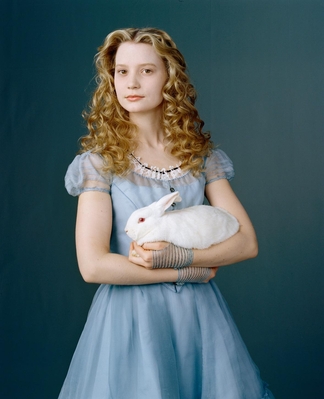
Instead of looking like this: 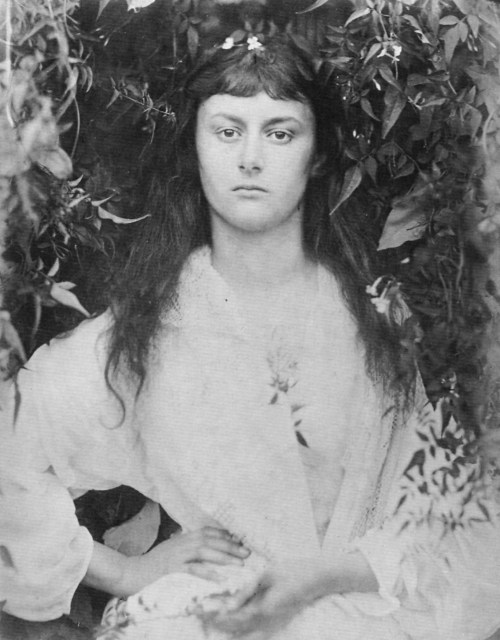
In fact, it there is very little in modern interpretations of Alice that show that she was ever a real person at all as almost all traces of the little girl who Lewis Carroll wrote the stories for have almost all but been erased as the story of Alice is told and retold over and over again.


 Victorian Visual Culture
This is a very interesting post that made me think about the accuracy of representation. The questions of whether or not Lewis Carroll had a person in mind when writing the adventures of Alice seems indisputable. The issue is whether or not the faithfulness of the representation is important or even necessary.
There is the idea is that Alice is a sort of “every-girl” that is meant to represent the idea of childhood. As a symbol of every childhood, it seems wrong for her to be a blonde because, being a recessive gene, it is less likely for children to be blonde than it is for them to be brunette. It would seem like a more “every” characteristic for Alice to be brunette,
However! The idea of Alice as an idealized version of childhood is also an important part of her representation. Being idealized, it seems like the blonde hair makes more sense. Consider imagery of angelic children and how blonde hair helps to give the look a more innocent bent. If Carroll’s idea was to represent childhood as an idealistic stage of life to be held on to for as long as possible, the blonde hair seems to fit the best.
By: rojas25m on December 21, 2015
at 8:55 pm
still-she-haunts-me-phantomwise.tumblr.com article Was Alice Liddell the inspiration? Are there references to her in the books? points out why Alice Liddell wasn’t a muse for the story.
you had left out Lewis Carroll’s illustrations of fictional Alice in Alice’s Adventures Under Ground manuscript.
in the manuscript fictional Alice has curly light colored hair that is long and messy while Liddell had short dark hair that looks tidy by the looks of the next picture in your post of the real Alice she didn’t have long hair until she grew up.
according to dad on the text of Through the Looking Glass chapter 5 fictional Alice’s hair is elbow length since it went into the water the same time as her elbows and it has tangled ends.
Lewis Carroll didn’t absolutely hated Tenniel’s version of Alice completely on page 43 of Fashioning Alice by Kiera Vaclavik with loose hair and unadorned and a go-getting pinafore is certainly in line with Carroll’s impatience with formality.
on page 24 of Fashioning Alice what Carroll like all anti-fashion advocates favours is according to this same account by Ella Monier Williams a natural child with ruffled untidy hair.
Carroll probably liked the dirty blonde hair interpretation in The Nursery Alice because the coloring looks untidy.
By: Anders Solli on February 4, 2025
at 7:01 am
I don’t think Alice Liddell was the model for fictional Alice.
The life and letters of Lewis Carroll (Rev. C. L. Dodgson by Collingwood on page 365 had pointed out that Lewis had wrote a letter to M. E. Manners stating Permit me to offer you my sincere thanks for the very sweet verses you have written about my dream-child (named after a real Alice but none the less a dream-child and her Wonder-land.
Lewis Carroll did not absolutely hated Tenniel’s vision of Alice.
Fashioning Alice by Kiera Vaclavik had pointed out that there are elements of Alice’s appearance he would have liked like the unadorned and untidy hair.
while i don’t agree with Franziska Kohlt’s statement i could be wrong there is a possibility that he had wanted fictional Alice to have blonde hair.
The Lady with the Lilacs painting by Arthur Hughes 1863 which Lewis had owned resembles fictional Alice from Alice’s Adventures Under Ground more than Alice Liddell does.
the painting shows a woman with red Venetian hair compare the painting with Lewis Carroll’s image of Alice tilting her head and his image of Alice stuck inside the White Rabbit’s house.
By: Anders on June 5, 2025
at 11:43 am