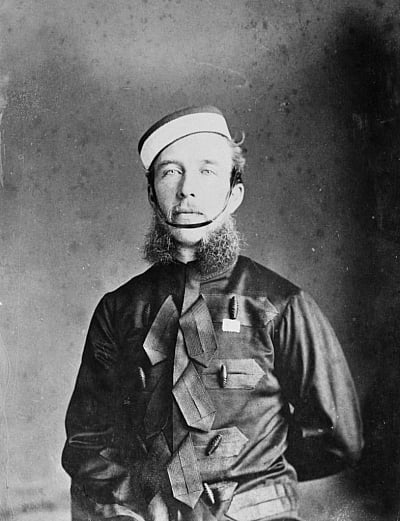
I was curious to know more about Willoughby Wallace Hooper after seeing his famine photographs from India between 1876-1878. Googling his name, one of the top results is the title of an article from an India-based website: “Who was the photographer who took these dehumanising images of the Madras famine?” That title bluntly asks a question similar to my own: Who was Hooper, and what was his motivation in taking these disturbing photographs of the dying?
The motivation question came to my mind first, due to the fact that some of his photographs appear to be carefully constructed, with the individuals facing the camera, some people sitting, some with arms wrapped around others, the kind of positioning one associates with traditional, ordinary family portraits. Hooper’s images are anything but. In this image available through the Getty Museum, the individual seated in the middle is so sick and emaciated that it’s difficult to believe he or she is still alive. What was Hooper trying to accomplish by asking individuals in such a horrific situation to essentially “pose” for him?
It was actually difficult to find information about Hooper via Google, the article mentioned above with the pointed title wound up providing the most details. Written by Sujaan Mukherjee for Scroll.in, the article coincidentally opens with a mention of Kevin Carter, the same photographer discussed in great detail in KJ Brown’s “Regarding the Pain of the Other: Photography, Famine, and the Transference of Affect.” Both writings touch on the role of the audience when viewing such images of individuals in extreme suffering, where death is presented as an immediate certainty. Her article ends with “it becomes essential to account not just for the photographer’s actions but the entire technological and state apparatus that is involved in framing and circulating images representing the most extreme of man-made human situations.”
Hooper was a member of the British military, rumored to have had an unfeeling attitude towards the people he photographed. Whether true or not, if the photographer’s intent is apathetic, or even malicious, is the viewer of the image also apathetic and/or malicious? This question is applicable to both Hooper’s photographs, and Carter’s, taken a century apart. I think the photographer’s intent and the viewer’s reaction can be separate entities, and can vary greatly. It’s possible for a person to visit that museum to see Hooper’s images, and to view them as “artworks,” as an image put on paper, and that there isn’t greater complexity. Brown takes a similar stance in her essay, where she sees the role of the audience as having potential for othering. Then there are unintentional audiences, like a photograph of a deceased Syrian child on a beach, an image which permeated news outlets and social media. The way a person chooses (or doesn’t choose) to view photographs of famine, suffering, death is a separate issue from the photographer’s intent.


 Victorian Visual Culture
Kate M, I was interested to read your article. I live in what was Willoughby Wallace Hooper’s house from c 1904 to his death in 1912. I have done a little research on him and I am struck by the contrast between the controversy aroused by his Indian phtographs and reports of his activities in my Devon village. He was said to be a much loved churchwarden and especially kind to the local children – reports of summer games in the garden. I wonder if his earlier motives were misunderstood or whether his later life reflects remorse. It is hard to reconcile accounts of the public photographer and the private man.
By: Siân on August 16, 2022
at 3:23 am
Hi, I have a couple of glass negatives of Hoopers, one from the famine and one of a house, I wonder if it’s the house you lived in? not sure how to post it on here.
By: johnkillick1 on November 2, 2025
at 9:32 am
I would love to see that – would you be able to email it to sian1plant@gmail.com please?
By: Sian Plant on November 2, 2025
at 2:00 pm
The intent of the photographer makes possible for us to enter the psyche of the system which ran government (British Indian government in the 1876 case). There’re certainly enough researches to know the psyche of Nazi men and women giving “pose” to the photographer. Equally important are the pictures which are availabe of the Holocaust so that PEOPLE DO NOT DENY it. Similarly the pictures of recurrent famines throughout British Indian period also serve the purpose of NOT FORGETTING the inhuman Colonial past. I believe the intent of the post of Miss Sujan Mukherjee is exactly to ask a rhetorical question “Who was the guy who took picture” (or in other words, it’s not the photographer who is referred to but the gravity of famine). I hope as researches and learned people we are able to understand the intended meaning of wrtings. 🙂
By: Chui Jazu on July 26, 2023
at 2:43 pm