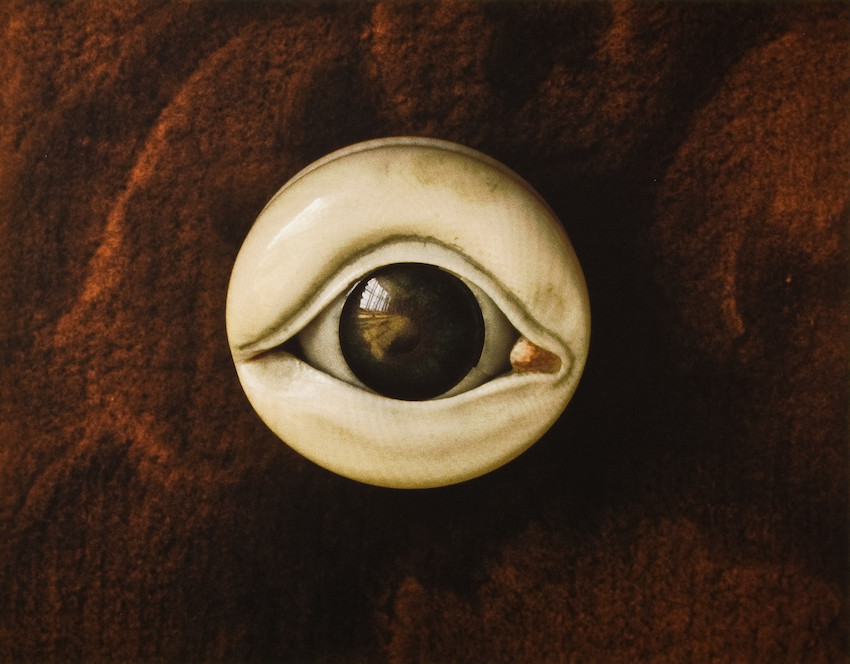
The Gothic, as a genre, thrives on ideas and images of power, ownership, wealth, body-doubles, death, life, etc., which all changed in the advent of photography’s invention. Notably, changing concepts of image-possession and power over one’s image have turned photography into a force of power, as we’ve discussed in our recent conversations about photojournalism. The power to capture the truth of something in its entirety exposes that subject to exceptional vulnerability at the production and dispersion of the image. The power to bias an image and place it out of context, and yet still portray this altered truth as explicitly truthful also disempowers a photographic subject. The power to place a subject in a new context, aestheticize it, and change how it is perceived and considered by an audience is perhaps the most insidious and frequent sort of power-exertion. The idea of a “subject” changes then, and works on many levels– a model, an individual over whom some governing body rules, a target; a thing “subject” to whatever the photographer chooses. Purcell plays with this idea here. The eye may, or it may not, necessarily, have belonged to Peter the Great, but that doesn’t matter. Purcell has power over this object in ways even a Russian Emperor did not. She has positioned it within the Gothic intentionally, using it’s disembodiment and a deep velvet background almost as a nod to the decaying opulence of Gothic settings. She has complete control over how it is portrayed, and seems to be intentionally manipulating it’s presentation to make it a frightening object. She can use it however she chooses for her artistic means. The idea of complete power over anything– life, death, pain, fear– is one, in Gothic media, which we are both encouraged to fear and are coaxed into identifying with. Complete control is, in a sick way, a giddying amount of power, and it is almost totally an imagined and fantastical sort of power in nearly every realm except for art-making. An artist and a photographer are the only individuals with that certainty over control. Honing an artistic skill is becoming more and more able to exactly execute the creation of an artist’s intention for their art. Photography, in particular, is more pervasively powerful as, unlike other forms of visual art, it captures an exact rendering of real living things, and yet the creative control and power still remain present. And for the target of this power to be, of all body parts, an eye, emphasizes the irony of how powerful a visual presentation is, and how transformative viewership can be. Much as the eye cannot see, its photographed double cannot see– and this one-way mirror is one which creates the potential for exceptional cruelty. I feel Purcell is commenting on this sort of latent power, and on the inherent Gothic nature of photography.


 Victorian Visual Culture
Citation: Wolff Purcell, Rosamond. Eye from the Collection of Peter the Great. 2004, Boston, USA
By: midts22k on November 17, 2023
at 5:16 pm
I am not familiar with this work by Rosamund Purcell, but I am so impressed by the ways that you use a powerful close reading of it to explore and to expose photography as a technology of “power-exertion” and as inherently Gothic. You do an exceptional job of revealing how being seen but not seeing — like the eye here — is a logic of cruelty and domination.
By: amartinmhc on December 23, 2023
at 5:33 pm