Over Thanksgiving break, I had the pleasure of spending an afternoon at Boston’s Isabella Stewart Gardner Museum. In spite of my being a Massachusetts resident and an art museum enthusiast, I had somehow never visited the Isabella Stewart Gardner Museum before! I can now firmly attest to the museum’s esteemed reputation; with a breathtakingly elegant garden courtyard and an extensive collection of multinational artifacts, this place feels downright magical to explore.

The cherry on top to my visit was the all-new exhibit that had just made its debut only a month prior in October. This exhibit, titled “Inventing Isabella,” was about the museum’s enigmatic namesake herself. After reading the wall panel outside the Hostetter Gallery’s entrance, I had to stifle a laugh because of just how perfectly applicable—almost to an eerie degree—this exhibit’s content was to the themes of our course.

(TL;DR: “[Isabella]’s legendary aura is not accidental. She deliberately cultivated her public persona, pioneering the type of image control that many of us navigate today in the age of social media… She used paintings, fashion, and photography to shape her own image and negotiate the boundary between private and public… she collaborated with trusted artists to craft her public identity and to create enduring portraits of herself for posterity… [she] shaped her public persona through art.”)
Yeah, I wasn’t exaggerating: this entire gallery was dedicated to the manner in which Isabella defied the social expectations forced upon aristocratic Victorian women to meticulously “invent” her own public identity! There’s something so fascinating to me about an art connoisseur extending their own philosophy towards art collection to literally curate their own self-image; I consider this a resounding testament to Isabella’s intimate understanding of the arts and their cultural evolution.
As the blurb above states, Isabella pioneered the art of self-curation many of us actively participate in today. Even before the age of social media and photo manipulation tools like Photoshop and Facetune, Isabella was hyper-aware of visual media’s power over people’s appearances and reputations. As a celebrity figure, she was constantly scrutinized and commented on by the press. To prevent the distribution and circulation of photographs of which she’d have no control over, Isabella notoriously dodged unauthorized photographers by limiting her daytime outings and concealing her face. In a 1915 letter addressed to her friend Edmund Hill on display, Isabella even wrote, “I am never photographed, unless by some Kodax fiend, who does it on the sly, & without my permission.” Her usage of the word “fiend” here reveals both her disdain for prying eyes and commitment to her own self-preservation.
According to the archival records featured in the exhibit, her efforts were so successful that newspapers resorted to publishing photographs of women with Isabella’s likeness under the pretense that they were of Isabella herself. An 1894 article even claimed to include the first ever “photographic likeness” of Isabella, but in actuality it was only a drawing of a faceless woman climbing into a carriage:
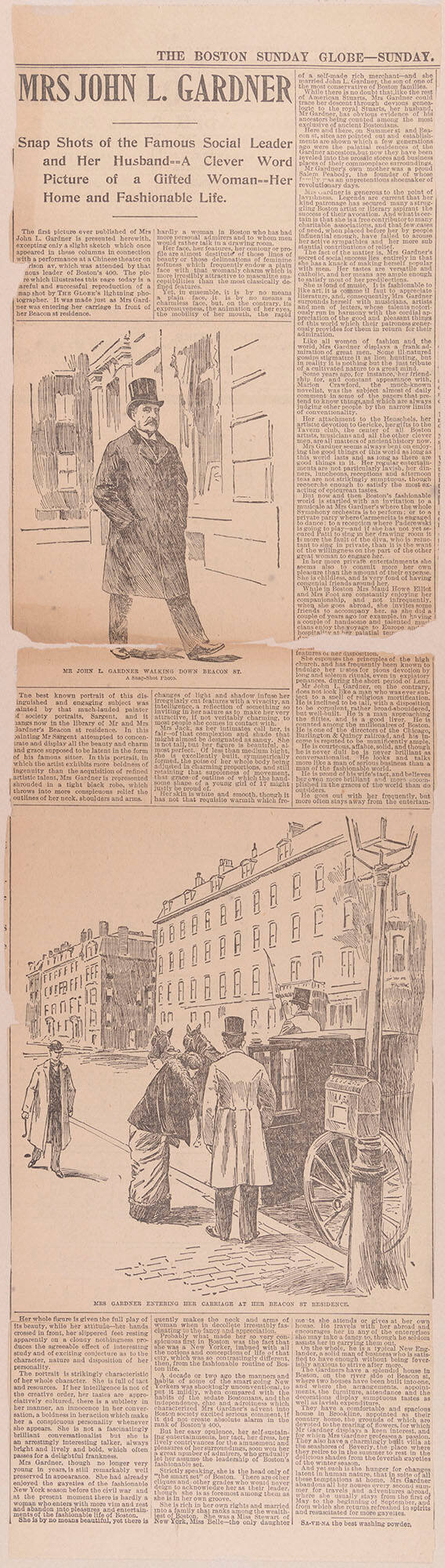
“Mrs. John L. Gardner: Snap Shots of the Famous Social Leader and Her Husband,” The Boston Globe, 1 April 1894, printed ink on newspaper.
Another newspaper account from the same year said the following about Isabella (beside an impersonator’s portrait): “She can never be induced to look fairly and squarely into the camera. It is true that she has been taken at various times in groups, but invariably the moment of exposing the camera coincides with some movement of Mrs. Gardner’s so that the face is blurred.” This exemplifies how the elusive Isabella, like many other rebellious women across history, frustrated those who couldn’t bend her to their whims.

“The Real Mrs. Jack Gardner.” Boston Post, 4 December 1904, printed ink on newspaper.
Instead of allowing the press to shape her identity, Isabella commissioned and collaborated with a wide array of trusted artists from across the globe. Within the privacy of their personal studios or her own home, she had complete agency. These were spaces where her own artistic vision could operate in dialogue with the artist’s. Together, the patron and artist could freely experiment with different poses, outfits, backgrounds, and color schemes to perfectly encapsulate the “Isabella” brand. This was done with varying degrees of success, as Isabella was known to destroy or hide works that she was dissatisfied with.
Her most notable intellectual friendships were shared with prolific artists John Singer Sargent and Anders Zorn, whose respective renditions of her garnered both great acclaim and criticism for their provocativeness. Sargent’s 1888 oil painting in particular, considered the Isabella Stewart Gardner portrait, was the centerpiece of the entire “Inventing Isabella” exhibit. The description beside the painting mentioned that Isabella herself “rejected eight renderings of the [portrait’s] face until she was satisfied,” which epitomizes her preoccupation with her own image. In real life the portrait has an almost ethereal quality to it, which can likely be attributed to its halo iconography. With its commanding, direct gaze and straightforward pose, Sargent’s portrait is extremely daring: it perfectly reflects Isabella’s unconventional character.
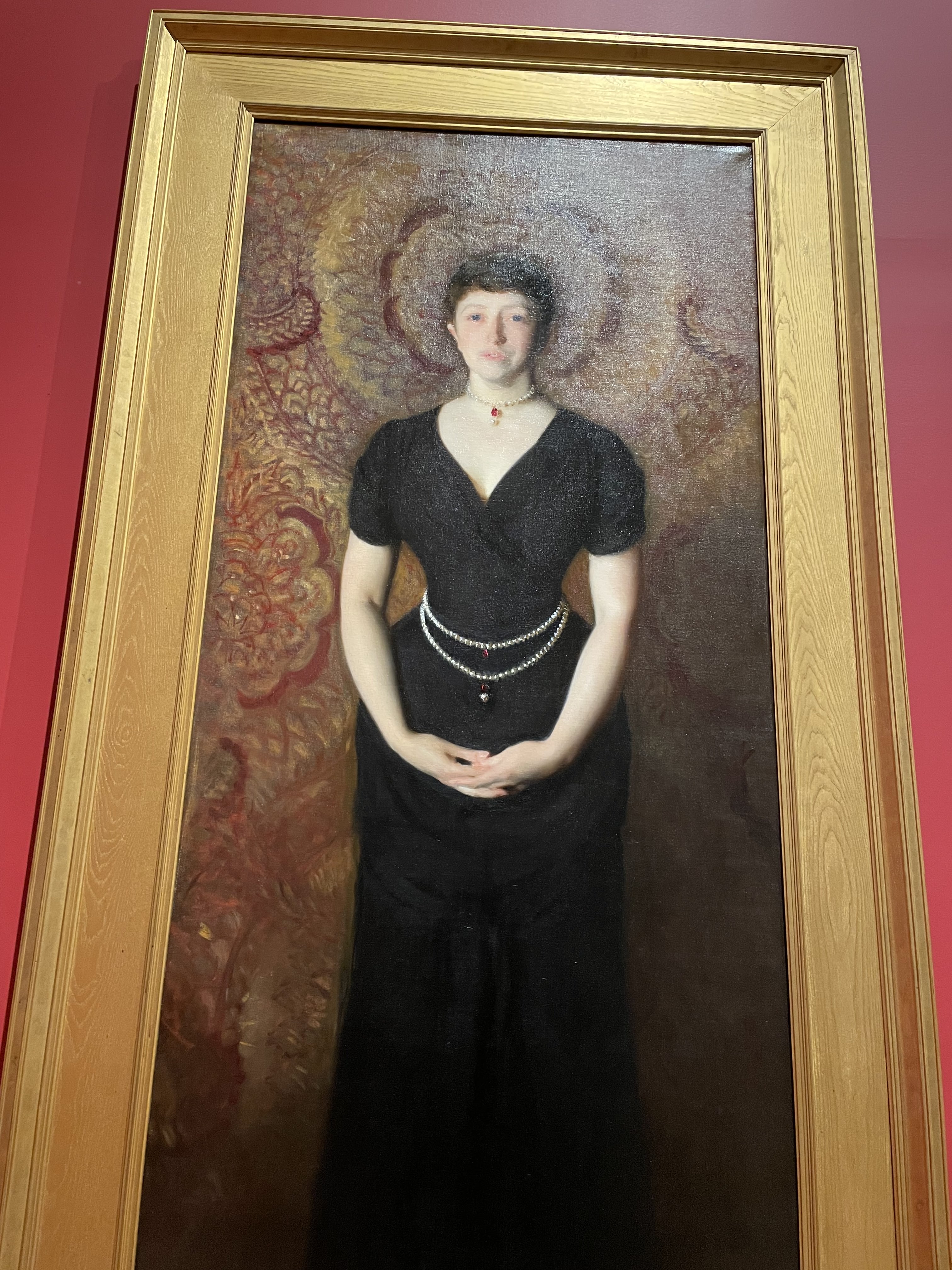
John Singer Sargent (American, 1856-1925), Isabella Stewart Gardner, 1888. Oil on canvas.
“Inventing Isabella” is an absolute gem of an exhibit that explores the many nuances of Victorian visual culture. What really resonated with me was that after a lifetime of methodical curation (of both artwork and her own image), Isabella’s home-turned-museum is her public identity; it has preserved her legacy as a legendary aesthete, visionary, and philanthropist. Art is simultaneously her life’s work and her identity, even after death.
Links/Further Reading:
Photos 1, 2 & 5: mine
Photo 3: https://www.gardnermuseum.org/experience/collection/27939000
Photo 4: https://www.gardnermuseum.org/experience/collection/27940000
“Inventing Isabella” Homepage: https://www.gardnermuseum.org/calendar/inventing-isabella


 Victorian Visual Culture
An excellent review that makes me want to be sure to visit this exhibit! The convergence with some of our course’s primary areas of inquiry is indeed uncanny, and Gardner’s proleptic self-curation is fascinating.
By: amartinmhc on December 23, 2023
at 5:49 pm