As a ballet dancer, it wasn’t long before I discovered Christopher Wheeldon’s production of Alice’s Adventures in Wonderland for the Royal Ballet. I’ve loved the choreography and the score since I watched it the first time, but it wasn’t until our discussion of Victorian women’s photocollage that I really payed attention to Bob Crowley’s set design.
Much of the backdrop of the ballet is characterized by falling letters – Alice falls into the book as she falls down the rabbit hole. These letters seem random and vary in fonts and orientation. Overlaying the projection of these letters are designs that seem hand drawn, engraved, painted, or cut from photographs. In the Caucus Race, the water is three-dimensional, forming paper cutouts that make lanes though which the dancers swim. Alice travels in a paper boat made from a page of the book itself, and animated projections travel across these material media. Wheeldon and Crowley’s Wonderland is constituted by an assemblage of visual materials.
This Wonderland, then, is constituted in much the same way as a collage. The connection between the two is perhaps most easily visible in Crowley’s set for the scene in which Alice first enters the garden. Painted flowers border the scene, lowered in front of the background of falling letters. Most notable is the face of a child nestled in the central flower, which is painted, though it gives the impression that it was cut and pasted from a different source than the flowers were. This calls to mind a photocollage from Alexandra, Princess of Wales, in which children were cut out of photographs and arranged on painted flowers.

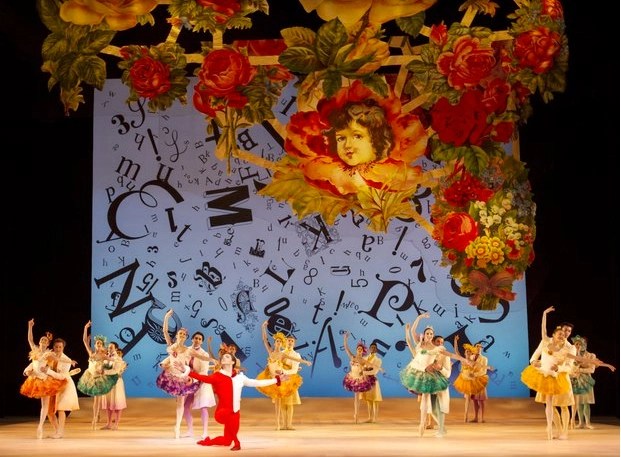
Photographs make a claim to realism. In “Society Cutups,” Elizabeth Siegel describes the Victorian understanding of the medium by saying that “photography in the mid-nineteenth century was generally understood to represent accuracy, fidelity to nature, and representational stability” (32). In the ballet, this can be seen in the first and final scenes. Before falling down the rabbit hole and after waking from her dream, Alice dances before a backdrop representing her house that is painted in a more realistic style, and the interior of the house is represented by a photograph. As Alice occupies a space closer to the real world, her surroundings move closer to the real with her.
But by taking the photograph out of its context and relocating it, collage disrupts and undermines the photograph’s realist logic (Siegel 33). The assemblage of materials used is destabilizing and disorienting. Made up of fragments, the images themselves never feel quite whole. Not only does incorporating collage elements into Alice’s Adventures in Wonderland produce a fitting feeling of whimsy, but it also lends a sense of the uncanny to Alice’s world. Wonderland is recognizable in its realistic aspects, yet unfamiliar as the real is turned on its head, manipulated into something imaginary and otherworldly.
Works Cited:
Siegel, Elizabeth. “Society Cutups.” Playing with Pictures, The Art Institute of Chicago, 2009.
Wheeldon, Christopher. Alice’s Adventures in Wonderland, Royal Opera House, London, 2017.


 Victorian Visual Culture
Kate, I am not familiar with this ballet or Crowley’s sets, although now I MUST watch this production. What an incredibly fascinating use of photocollage as the backdrop for a stage adaptation of Alice’s Adventures! I love your reading of the sets as creating and dismantling realism simultaneously.
By: amartinmhc on December 23, 2023
at 5:59 pm