From our readings and discussion in class, Victorian photocollage oftentimes took fantastical and visual choices by combining photographed portraits with painted settings, resulting in dream-like and often absurd environments. Such oddities were not limited to photocollage; they circulated widely across Victorian visual media, including children’s literature (Siegel 28). In Elizabeth Siegel’s Painting With Pictures: The Art of Victorian Photocollage, she highlights the work of author and illustrator Edward Lear, particularly his celebrated Nonsense books. Before producing his nonsense illustrations and poetry, Lear (1812–1888) had established himself as a skilled zoological illustrator. In 1832, the London Zoological Society commissioned him to paint detailed portraits of birds. He later published A Book of Nonsense (1846), dedicated to the grandchildren of Edward Smith-Stanley, the 13th Earl of Derby, a naturalist who admired Lear’s parrot illustrations (“Biography”). Lear’s nonsense pieces also extend well beyond children’s literature with his array of fantastical botanical drawings depicting fish, pigs, tigers and other animals or objects sprouting from flowers like petals, echoing this fascination with imaginative absurdity.
After reading Sigel’s text and researching the artists’ pieces, Lear’s work immediately reminded me of contemporary picture-book artist Eric Carle (1929–2021). In 2015, Carle published The Nonsense Show, a book that blends nonsense and surrealism—elements that are deeply embedded in nursery rhymes and children’s literature, such as the familiar phrase “the cow jumped over the moon.” It is also important to note that Carle is well known for his collage-based art making: he painted acrylics on tissue paper, cut the papers into shapes, and assembled them into figures (“Artistic Process”). This technique produces segmented yet cohesive compositions, vaguely reminiscent of Victorian photocollage and its union of seemingly unrelated elements that are both humorous and whimsical. One illustration, for example, depicts two characters riding in a yellow taxi with the bottom cut out, forcing them to move the vehicle forward with their feet. The accompanying text reads, “Oh dear! Look here: It says ‘NO GAS’ Alas! ‘No gas? Don’t worry. We’re not in a hurry’” (Carle). The simplicity of the rhyme scheme paired with the playful, vibrant artwork underscores Carle’s lighthearted approach to nonsense.

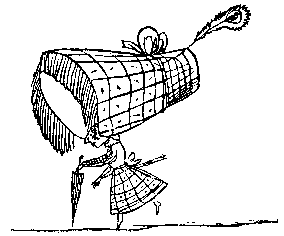
Returning to Edward Lear, A Book of Nonsense contains more than one hundred original illustrations paired with short poems. The book opens with a preface in which Lear offers a brief account of his artistic background and the inspiration behind his nonsense writing. Notably, he also includes a poem about himself, “How pleasant to know Mr. Lear!”, written in the same playful rhyming style that characterizes the rest of the volume. The book’s central poetic form is the limerick: a short, humorous five-line verse following an aabba rhyme scheme. Lear’s limericks typically focus on a single individual located in a specific geographical place, highlighting some peculiarity in the person’s appearance or behavior (“Edward Lear”). For example, one poem reads: “There was a Young Lady of Dorking, Who bought a large bonnet for walking; But its colour and size So bedazzled her eyes, That she very soon went back to Dorking” (Lear 41). The accompanying illustration depicts a woman holding a parasol and wearing an oversized bonnet nearly twice her height. While this playful exaggeration aligns with Carle’s whimsical tendencies, other pages in Nonsense contain more troubling imagery.
Some of Lear’s depictions of characters outside England and the West rely on racialized caricature and exoticization. One particularly concerning limerick states: “There was an Old Man of Jamaica, Who suddenly married a Quaker; But she cried out, ‘Alack! I have married a black!’ Which distressed the Old Man of Jamaica” (Lear 90). The illustration shows the man with a face rendered so dark and indistinct as to be unrecognizable. The accompanying text clearly derives its humor from racial difference and from the shock of a Black man marrying a white woman; a scenario that would have been loaded with social anxieties in the Victorian era. Such content raises questions about whether Lear employed nonsense not only to entertain but also to express, critique, or reproduce political beliefs about race and empire through stereotypes embedded in his verse and imagery.

As someone interested in children’s literature and its formative influence on young readers, I find it important to consider how such depictions would have shaped children’s understandings of people beyond the West. This blending of humor, visual exaggeration, and cultural stereotyping reveals how storytelling and Victorian visual culture could simultaneously amuse and reinforce imperial ideologies. Ultimately, examining Lear’s work alongside Victorian photocollage and contemporary figures like Eric Carle illuminates the complex legacy of nonsense as a genre: one that merges imagination and even cultural commentary. Rather than ignoring literature that brings discomfort to audiences including myself, I believe it is of utmost importance to continue viewing and critiquing works such as Lear’s for the purpose of knowing how these ideas developed and continue to seep into modern-day culture.
Works Cited:
“Artistic Process.” The Eric Carle Museum of Picture Book Art, https://carlemuseum.org/about/about-eric-carle/artistic-process
“Biography.” The Edward Lear Society, https://edwardlearsociety.org/biography/
Carle, Eric. The Nonsense Show. Philomel Books, 2015.
“Edward Lear (1812-1888).” Poetry Foundation, https://www.poetryfoundation.org/poets/edward-lear
“Edward Lear’s Nonsense Botany (1871-1877).” The Public Domain Review, https://publicdomainreview.org/collection/edward-lears-nonsense-botany-1871-77/
Lear, Edward. A Book of Nonsense. London, Frederick Warne & Co., ltd, 1846.


 Victorian Visual Culture
I loved this post, and the modern day connection to Eric Carle! It’s also so interesting to focus on racist caricatures and colonization narratives as they manifest in texts meant for children. There is so much potential there to discuss the construction of national identity, which starts in childhood as they learn the values and history of their country, even if this is racist, revisionist, and flawed. Or to go a different way and consider the history of children’s media in general (not Victorian studies related, but this reminded me about something I learned in a film studies class, which is that there didn’t used to be an idea of movies or TV shows made specifically for kids, and instead media was seen as having a much more general audience, like the whole family. When networks/studios did start creating media just for certain age demographics, it was about both profiting more through targeted marketing and advertising and about the construction of what “childhood” is and how media could spread social messaging under the guise of entertainment.) Overall, loved your post!
By: Sophie Frank on December 4, 2025
at 10:19 am