
Rain, Steam, and Speed — The Great Western Railway by Joseph Mallord William Turner 1840
After doing a close look at Joseph Mallord William Turner’s painting, Rockets and Blue Lights (Close at Hand) to Warn Steamboats of Shoal Water (1840), I wanted to look into another piece by him. I decided to look at Rain, Steam, and Speed – The Great Western Railway to continue to see how Turner utilized light and contrasting colors to convey industrialization and nature. Like in class, Turner utilized blue, yellow, and whites to represent the sky and a rusty brown to show the influence of humans and black smoke to showcase the change of power as time went on and technology continued to develop. When looking at this image it shows the train coming towards the viewer while in the corner is a boat with two figures on it, one with an umbrella and the other holding the oar as they move across the river in the same direction as the train. With the two figures in the boat as a point of reference, as one’s eyes move to the right, waving figures are also visible on the train itself. Their light clothing standing out from the vegetation, red, blue and white being visible in the midground while little splotches on the train may also be intercepted as waving passengers as they pass by.
How I interpret the movement of this painting is that transportation is becoming more efficient and accessible to many people and both the boat and train are moving towards us in the present. At the time of painting, the artwork would be viewed by someone who is living during the Victorian era and Industrial Revolution. While the painting depicts movement of a train on the Maidenhead Railway Bridge located in Maidenhead, England it also shows how industrialization is also having an impact on the surrounding areas. The areas closer to the train take on a more dark tinge, while this is the aging varnish or intentional, it connects the Rockets and Blue Lights (Close at Hand) to Warn Steamboats of Shoal Water painting to Rain, Steam, and Speed — The Great Western Railway through showing a reddish brown dock and people on it and people becoming covered in a darker area, respectively. I also wanted to note that the rain almost creates a water color like feeling, the view is not perfect and almost blurry. A fine mist that was absent in Rockets and Blue Lights (Close at Hand) to Warn Steamboats of Shoal Water. Showing differences in weather through brush strokes, with over the bridge having hues of blue, similar to light beams coming through clouds, reinforces the existence of nature despite the construction of bridges and trains. I enjoyed learning about Turner’s artwork and I am curious to read more into it, an example being that I did not mention the three puffs of steam coming from the train’s smokestack, being one of the only sharp components of the painting. The bridge on the left is also defined as said, both being manmade while everything else has softer edges.
Overall, Turner’s interest in contemporary art and the industrial revolution can be seen from the two aforementioned paintings as well as nautical ships. Using light and brushstrokes allowed him to convey the weather and conditions that would come to make the painting come to life and create a dreamy representation of life.
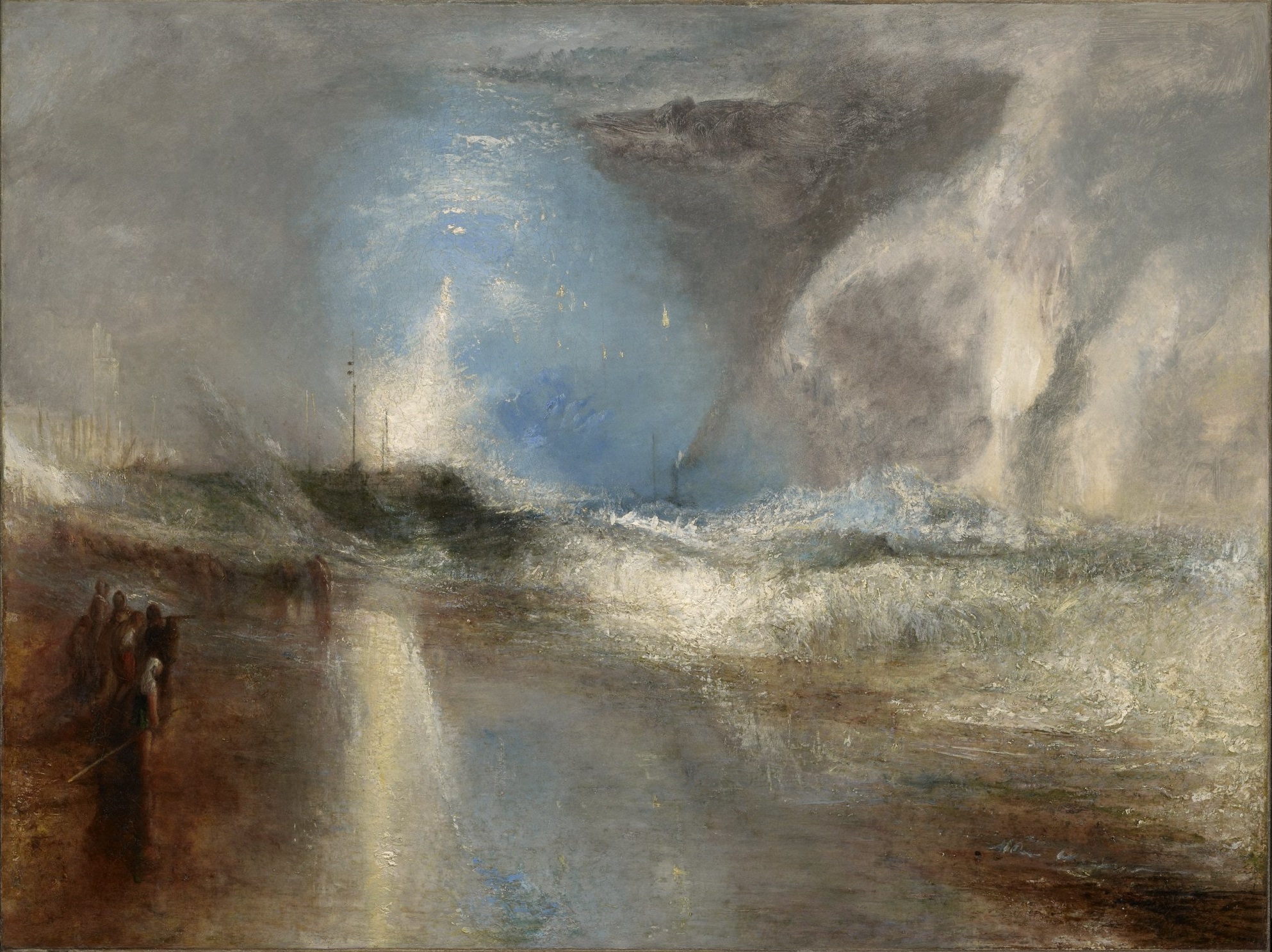
Rockets and Blue Lights (Close at hand) to Warn Steamboats of Shoal Water by Joseph Mallord William Turner (1840)
Sources
Dr. Beth Harris and Dr. Steven Zucker, “J. M. W. Turner, Rain, Steam, and Speed — The Great Western Railway,” in Smarthistory, November 25, 2015, accessed December 8, 2025, https://smarthistory.org/j-m-w-turner-rain-steam-and-speed-the-great-western-railway/.
Joseph Mallord William Turner, Rain, Steam, and Speed — The Great Western Railway, oil on canvas, 1844 (National Gallery, London)
Joseph Mallord William Turner, Rockets and Blue Lights (Close at hand) to Warn Steamboats of Shoal Water, oil on canvas. 1840. (Clark Art Institute, Williamstown, Massachusetts)


 Victorian Visual Culture
I really enjoyed reading your analysis of Rain, Steam, and Speed! Nice Work!
By: Jasmine Thomas on December 16, 2025
at 11:00 am
This painting is so wonderful. I learned a bit about J M W Turner in an art history class this semester, and he did a LOT of traveling around Europe completing sketches of landscapes. It’s so interesting to see how his works change and criticize industrialization’s impacts on the natural world. This painting is such a good one for capturing that critical impulse within his work. It feels like both the viewer and the rabbit on the tracks are doomed by this impending powerful force barreling towards us.
By: ross24m on December 16, 2025
at 11:51 am