At the beginning of this course, I clearly remembered in depth analysis of the portrait Lady Betty Delme and her Children(1777-79). It served as a strong introduction into nineteenth-century Victorian portraiture because, at first glance, the viewer is presented with a seemingly simple image of a mother posing with her two children in an exapanzive landscape. However, through close analysis, we uncovered the various power structures latent within the construction of the scene.
Lady Delme’s clothing is long and oppulent, impractical for the outdoor environment in which she is depicted. She is positioned with her son closest to her, while her daughter stands on the outside, hugging her brother. This arrangement displays the inherent power granted to the son as the male heir to the estate. While the daughter’s outfit is relatively appropriate for her age, the son is dressed in finer fabric and a design more suited to showcasing his rank within the family structure one that untlimately supasses even that of his mother, Lady Delme. Lastly, I noted the inclusion of a dog in the portrait, which not only emphasizes the family’s wealth suggested by both the pet and enormous estate in the background but is also is also positioned looking towards the son, as if recognizing the individual who holds power and will wield higher authority in the future.
In conversation with this piece, I encountered a another work recently, Bélizaire and the Frey Children (ca. 1837) which similarily contains many underlying meanings of popwer behind what initially was assumed to be a conventional domestic depiction.
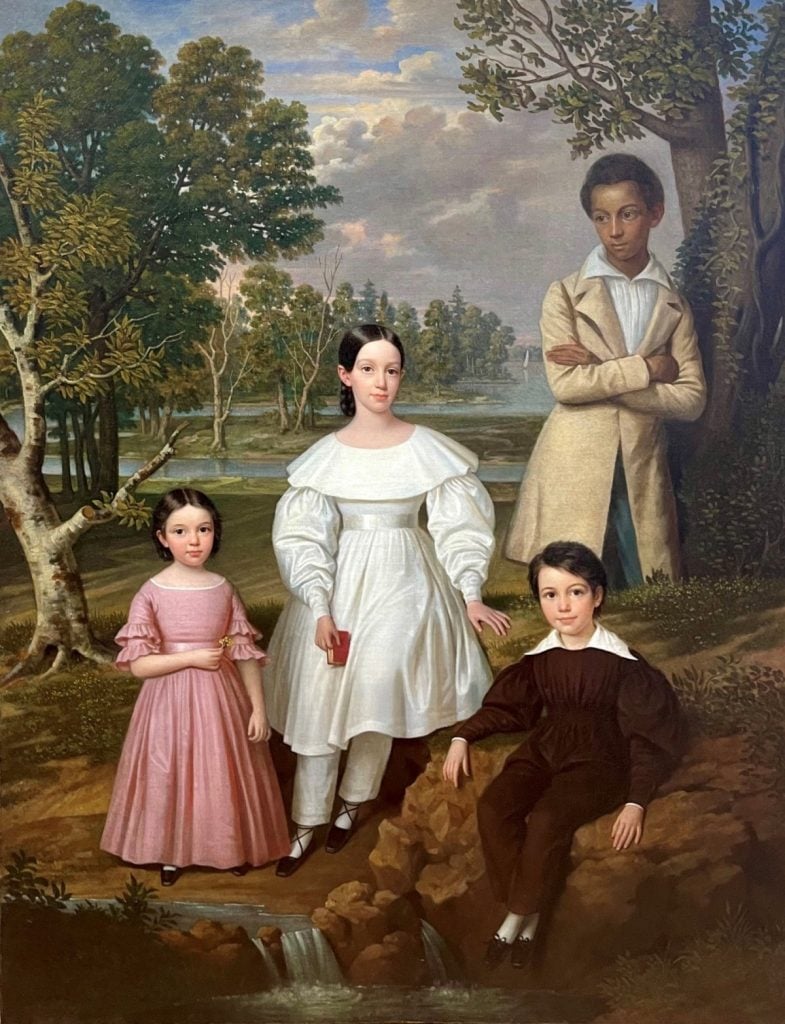
The portrait itself was comissioned by Federick Frey a banker and merchant who lived in the French Quarter around 1837 with his wife and two children. The original portrait of the wife and two kids sold for a huge amount in 2012 at $165,000. The portrait on its face depicted much like Lady Delme a domestic scene of an affulent family, however what lay uncovered was the face of Belizaire who was an enslaved teenager painted over in the righthand side of the portrait. Once uncovered historians noted his the close positioning of his subject to Coralie Frey and the other children. At the same time adorning oppulent clothes that don’t only establish him as close to the family but as an established family member and Federicks potential eledest son.
While studying this portrait ,I was immediately brought back to that first analysis at the beginning of the course, as I disected the various unseen power relations in the Bélizaire and the Frey Children and understood further how important as a whole portraiture was in conveying the inherent wealth and power, while also showcasing the relationship between family members we would nothave previously known. It only further shows how different aspects of portraiture were exhibited in the Victorian era and all over the world.
Works Cited
“Lady Elizabeth Delmé and Her Children by Sir Joshua Reynolds.” 2025. National Gallery of Art. 2025. https://www.nga.gov/artworks/102-lady-elizabeth-delme-and-her-children.
Cascone, Sarah. 2023. “An 1837 Portrait of an Enslaved Child, Obscured by Overpainting for a Century, Has Been Restored and Acquired by the Met.” Artnet News. August 15, 2023. https://news.artnet.com/art-world/met-museum-acquires-enslaved-portrait-2350056.
 Victorian Visual Culture
Leave a comment