Posted by: tessag | December 9, 2025

Salomé and the Moon

Prior to this class I was familiar with the story of John the Baptist, but I had never heard of Oscar Wilde’s retelling of the story in his play Salomé. The themes of the dangers of the gaze and obsessive desire were clear throughout, and the play was rich with symbolism. A symbol that particularly stood out to me was the moon and how it connected to Salomé.

The very beginning of the play immediately connects Salomé to the moon and to death. The play begins with an interaction between the Young Syrian and the Page of Herodias, who are standing on a balcony under the moonlight. The opening goes as follows:

THE YOUNG SYRIAN

How beautiful is the Princess Salomé to-night!

THE PAGE OF HERODIAS

Look at the moon! How strange the moon seems! She is like a woman rising from a tomb. She is like a dead woman. You would fancy she was looking for dead things.

THE YOUNG SYRIAN

She has a strange look. She is like a little princess who wears a yellow veil, and whose feet are of silver. She is like a princess who has little white doves for feet. You would fancy she was dancing.

THE PAGE OF HERODIAS

She is like a woman who is dead. She moves very slowly.

These are the first lines of dialogue and serve as our introduction to Princess Salomé, and they indicate that the moon will be an important symbol closely linked to Princess Salomé throughout the play. The way in which the Princess Salomé and the moon are introduced mirror each other in form; both are exclamations about a property of the subject, in the case of Salomé her beauty and in the case of the moon her strangeness. The moon has often been associated with femininity throughout history and in literary works, but in this play the decision to gender the moon as female further links her with Salomé. 

When the Young Syrian responds to the Page saying “She has a strange look”, the antecedent of “She” is not clearly established; is he talking about Salomé or the moon? If he is describing Salomé, who is a Princess and who has already been referred to in the play as “the Princess Salomé”, why does he say “She is like a little princess” rather than “She is a little princess”? That he uses a simile here could mean that he is referring to the moon and comparing the moon to a little princess dancing. However the Young Syrian began the play with an exclamation about the Princess Salomé, and this is his next line of dialogue, which suggests that the Princess Salomé is the subject of his description. The ambiguity of the Young Syrian’s phrasing and description serve to further associate Salomé with the moon.

The Page’s next line of dialogue begins in a similar manner, saying “She is like a woman who is dead.” The Page had previously described the moon as being like a dead woman which indicates that he is again referring to the moon here, but because he begins with “She” without giving a clear antecedent, it’s possible he is now referring to Salomé. Even if he is not referring to Salomé here, the mention of the Princess by the Young Syrian alongside the description of the ominous death-like qualities of the moon entwines Salomé closely with death, foreshadowing what is to come.

There are no stage directions given as to where the Young Syrian and the Page are looking when they say these lines, leaving it up to interpretation and further convoluting the true meaning of the characters’ words. The ambiguity of this opening dialogue feels very intentional to me, and when first reading the play the clear link between Salomé and death made me suspect she would die in the end (which she does, covered in moonlight). It also indicated to me that I should keep close track of any mention of the moon throughout the play and think about how it could relate to Salomé.

Salomé herself talks about the moon later in the play, saying “I am sure she is a virgin, she has a virgin’s beauty…She has never defiled herself. She has never abandoned herself to men, like the other goddesses.” Salomé says this shortly after revealing that the Tetrarch, who is technically her father, looks at her in a lustful way and that she had to leave the banquet to avoid his gaze. Her subsequent emphasis on the chasteness and purity of the moon, which is a symbol already associated with her, indicates that she also considers herself to be pure and that she has no intentions of engaging with the Tetrarch. 

However Salomé’s fixation on purity turns into a darker obsession when she becomes infatuated with Jokanaan, the prophet John the Baptist. Salomé compares Jokanaan to the moon, saying “I am sure he is chaste as the moon is. He is like a moonbeam, like a shaft of silver.” In ascribing to Jokanaan the perceived purity of the moon, Salomé reveals that her own purity is morphing into a sexual desire, evident by her next words: “His flesh must be cool like ivory. I would look closer at him.” She then goes on to express her desire for Jokanaan repeatedly while he continuously refuses her advances. 

Later, just before Salomé dances the dance of the seven veils and is rewarded with the head of Jokanaan the moon is described as becoming “red as blood”. The dance is a pivotal moment in the play for multiple reasons. By agreeing to dance for the Tetrarch Salomé consents to having his gaze upon her, something she expressed displeasure about and repeatedly avoided previously. The dance is also what allows Salomé to satiate her desire for Jokanaan as she is rewarded with his severed head, which she is then able to kiss. That the moon turned from a pure white to the red of blood prior to this moment indicates to me Salomé’s surrender to her obsessive desires even at the cost of her own personal morals.

The moon is a complex symbol in this play, and while it is certainly associated with Salomé and her desire it also has many associations with other characters and other meanings. This play has so many layers of symbolism that it’s impossible to understand it all in one reading, and I’d like to look at what other symbolic functions the moon has in the play in future readings.

Source:

Wilde, Oscar. “Salomé.” The Project Gutenberg eBook of Salomé, by Oscar Wilde., http://www.gutenberg.org/files/42704/42704-h/42704-h.htm. Accessed 9 Dec. 2025.
Posted by: tessag | December 9, 2025

Intentional Art: Lady Hawarden’s Photographs

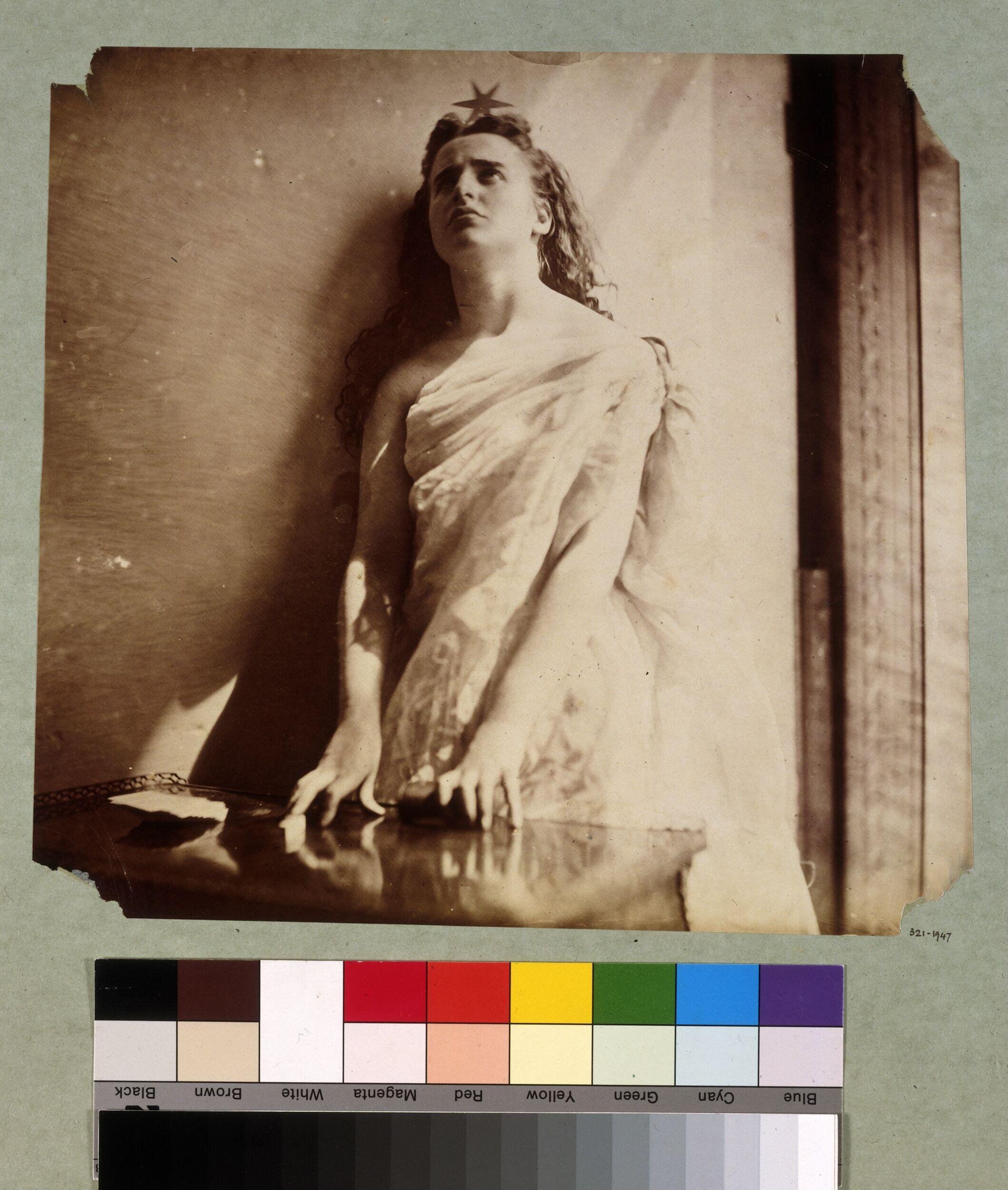
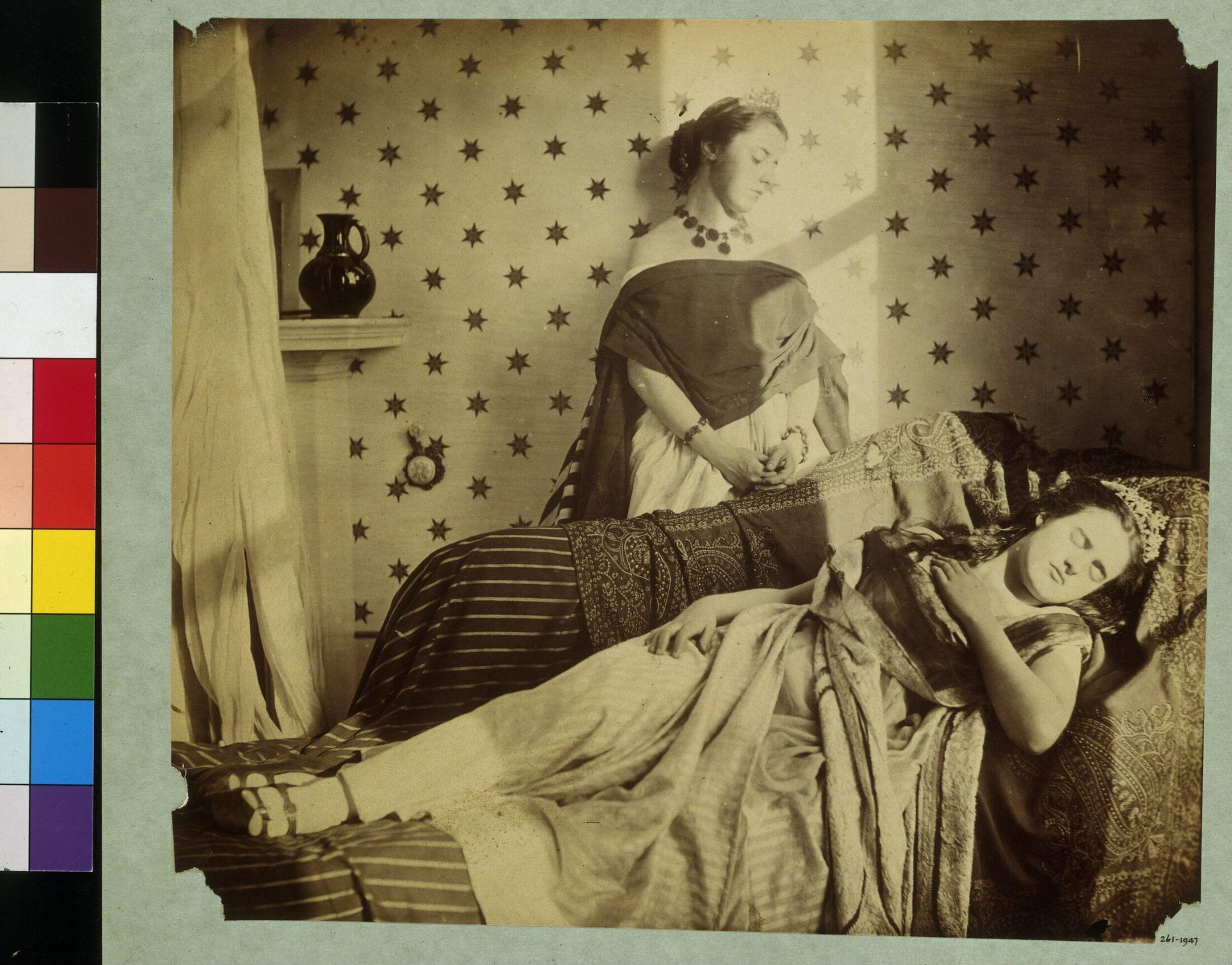
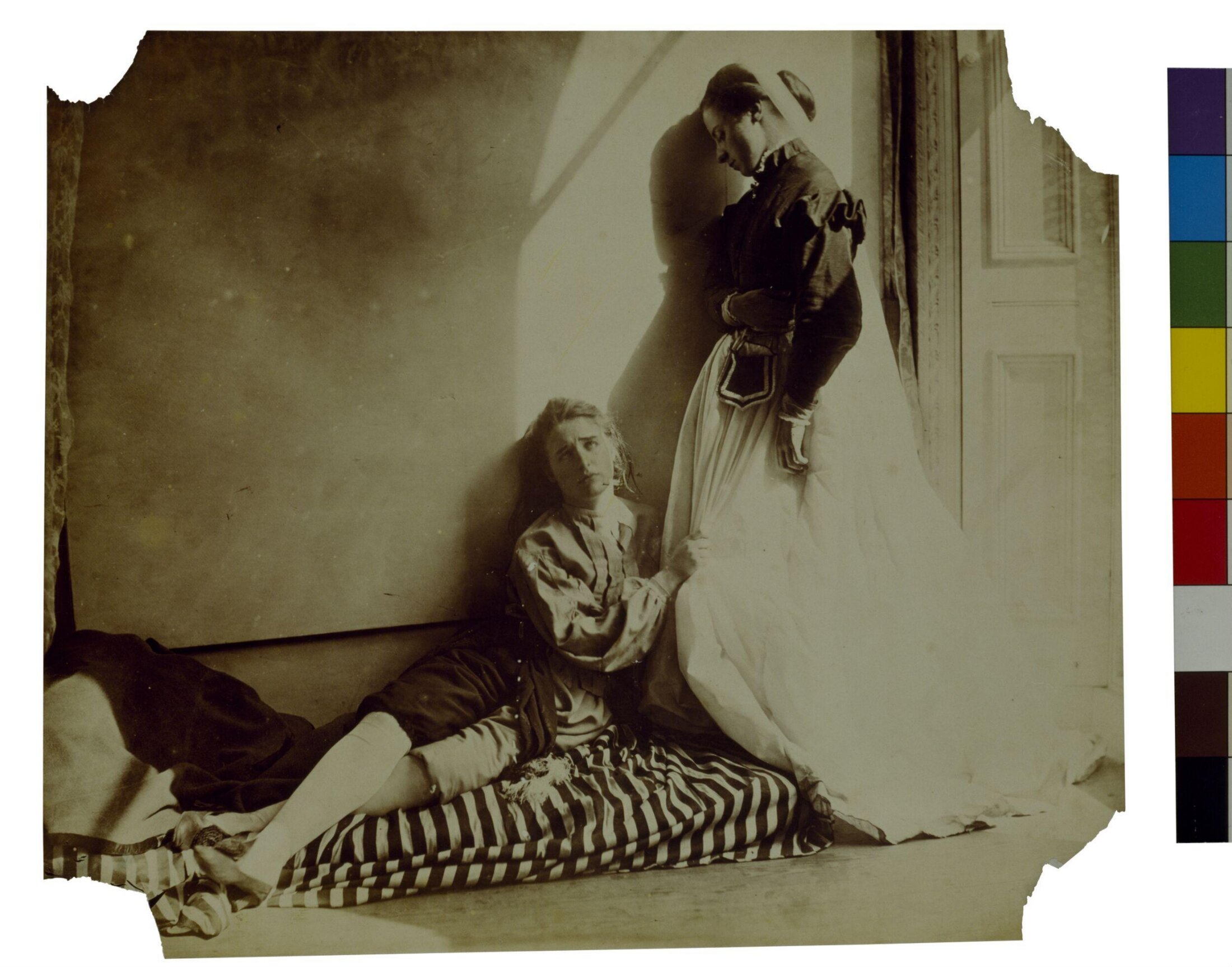
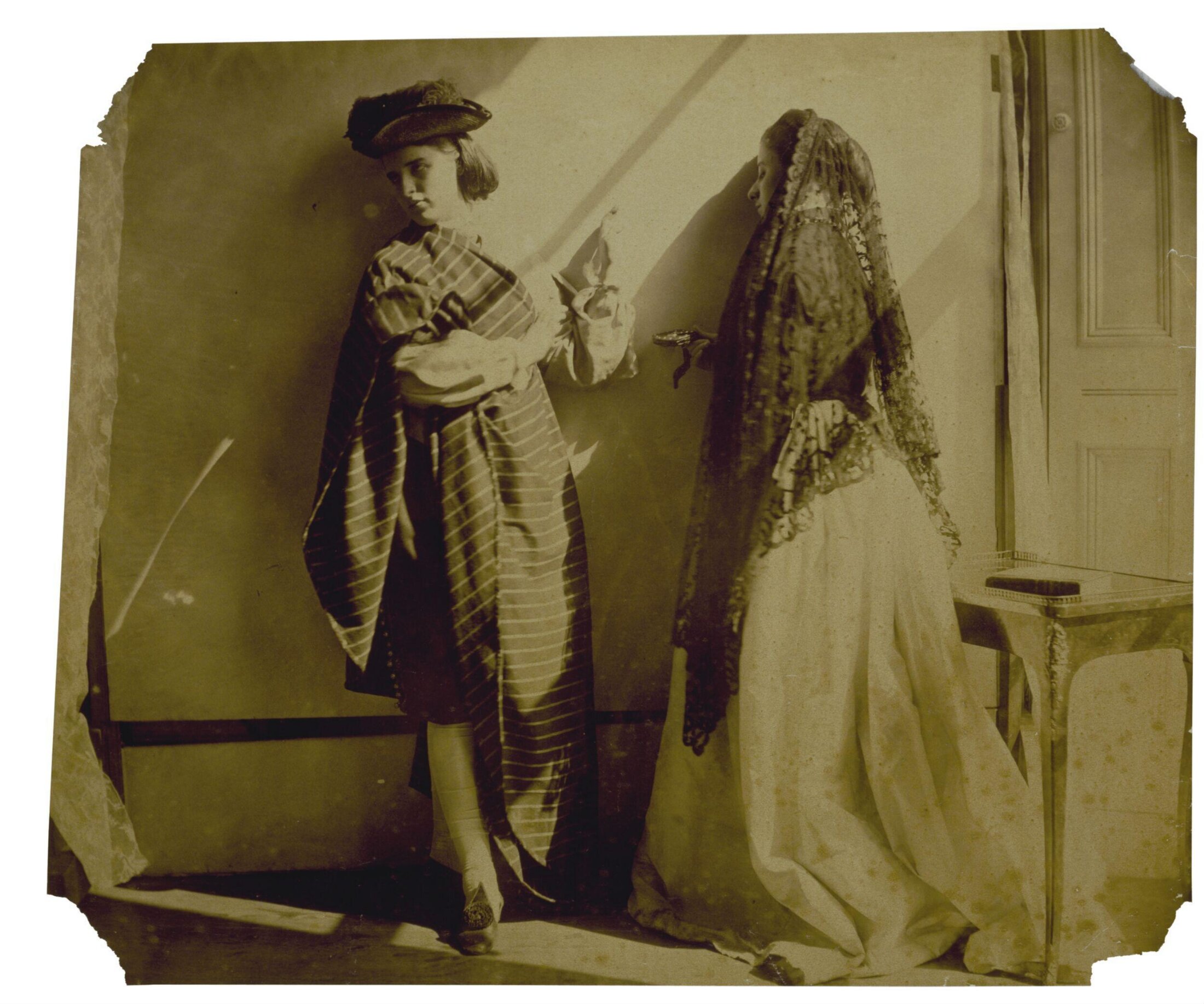
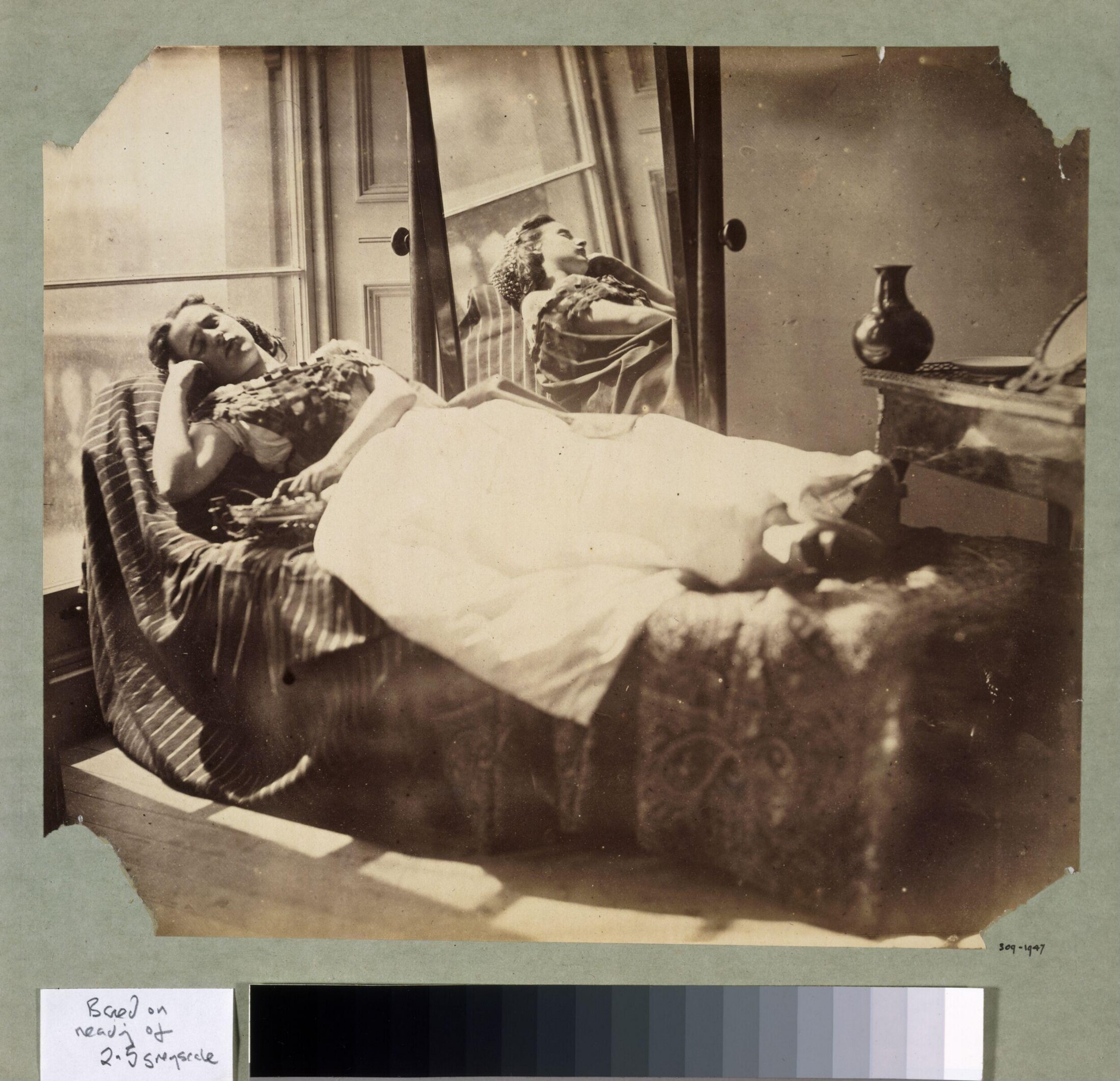
After looking at many photographs by Lady Clementina Hawarden I realized how deliberate every choice in each composition was, and I’m deeply impressed by how she utilized posture, props, and lighting to create drastically different effects in her photographs. A unifying factor in her work is the relatively simple space and background, which focuses attention on the figures and any props included. A common setting for her figures was in front of a large window, and in many of her works she used natural light from a window rather than studio lighting. This was not common practice for photographers of the time and was highly experimental. As mentioned in class, Hawarden was working at the cusp of photography being considered ‘art’ and in her photographs we can see her experimenting with light, reflections, costumes and poses. Lady Hawarden did not title her photographs, calling them only “Studies from Life” or “Photographic Studies”, and many of her works appear to be studies of light and shadow and the way they interact with fabric and the female form. She also often used mirrors to reflect images of her subjects (often her daughters Clementina Maude and Isabella Grace), and we discussed in class how these transgressive mirror-versions are visible, yet inaccessible. 

These are my favorite of her photographs, which at first may appear to be the same. The color of the photographs is different, which may be a product of their development or aging, but there are other intentional differences between the two. In the first photograph, the light casts the half of Clementina Maude’s face nearest the viewer into shadow while illuminating the half of her face that is reflected in the mirror. The light is reflected from her dress so brightly that it has a flattening effect on her body, creating a sense of unreality amplified by the shadow of her real-self and the illuminated view of her mirror-self. Squares of light from the window are cast around her body on the floor, creating a sense of illumination from below as well. She is posed with her head resting on her hand, recalling a classical Greek posture of contemplation, and the vase placed on a nearby table evokes classical ideals about female proportions. There is another blank mirror visible on the table, and Clementina Maude’s hand rests on a fruit basket, a symbol of sensuality, tucked close to her body.

The second photograph appears much the same at first glance, but careful inspection reveals that the small mirror on the table is not visible and the fruit basket has been removed. The most striking difference to me is the effect created by the changed angle of the light. In the second photograph, the natural light from the window also illuminates her dress, but in such a way that the folds and physicality of the fabric are visible. The light also highlights her full face, both facing the viewer and reflected in the mirror, and paints sharp diagonals on the wall that balance the sharp angles of Clementina Maude’s arm. The second photograph feels much more grounded in reality and creates a sense of serenity and contemplation while the first photograph feels almost immaterial and transcendental (to me, at least).

I find it amazing that Lady Hawarden was able to create such different atmospheres by merely changing the angle of the light and moving a few props, and it shows how intentional every choice in posture, prop, and lighting was for her work. I’ve included some more of my favorites that I feel show this intentionality:

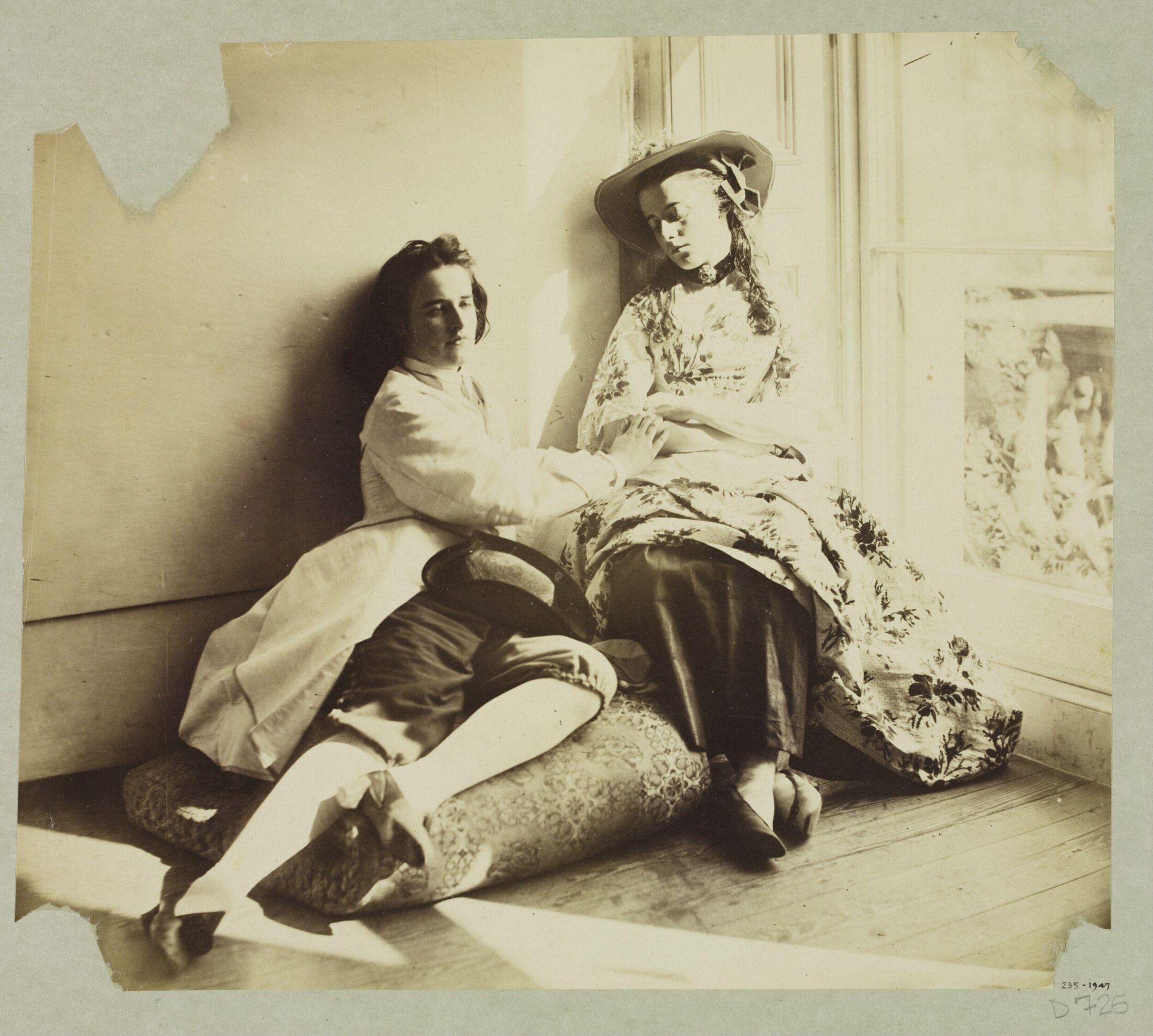
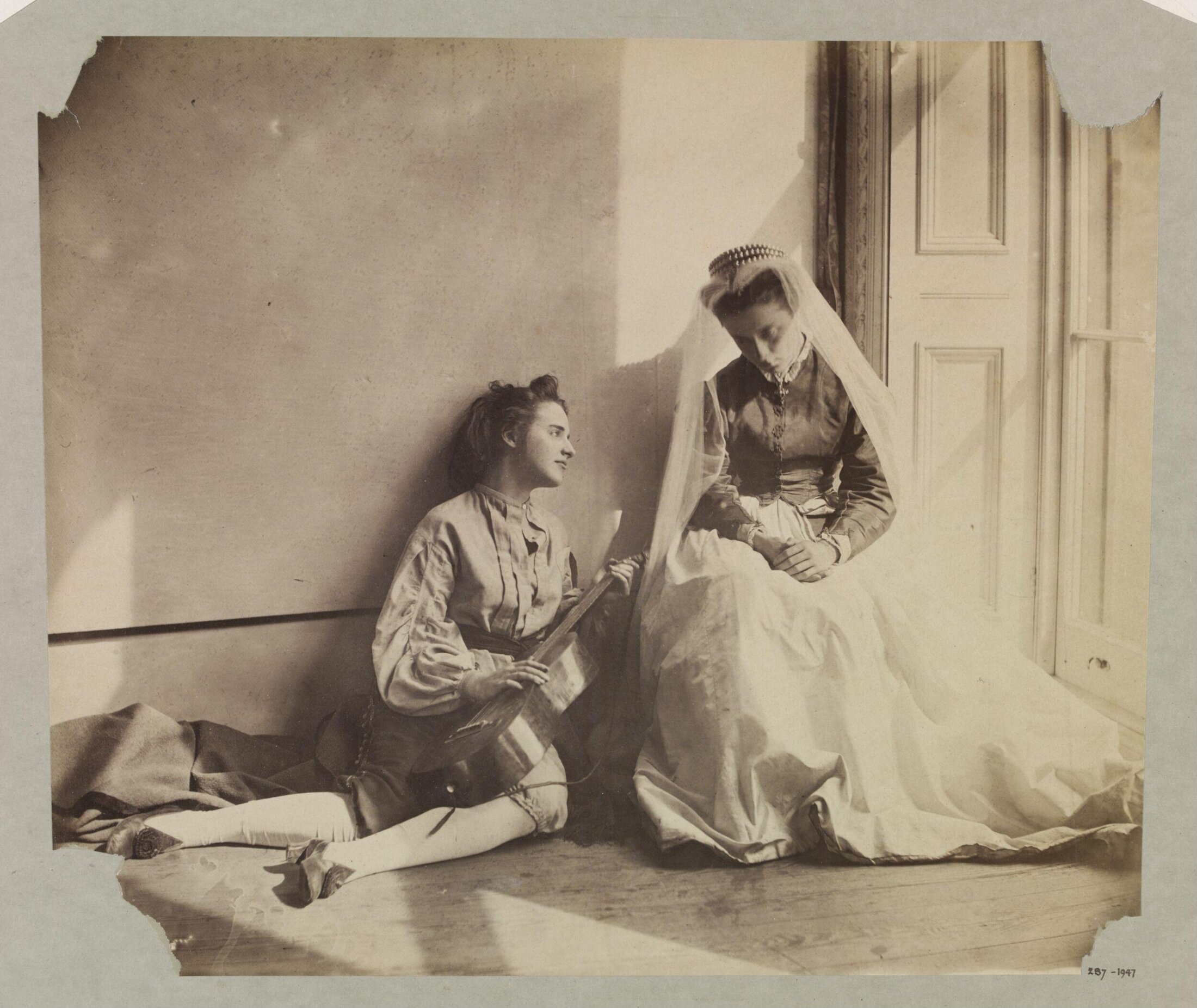
I also wanted to include some more of the ‘narrative-like’ photographs I found while looking through Lady Hawarden’s work that suggest a scene. I found it particularly intriguing that there is a whole series of photographs where Clementina Maude, dressed in men’s clothing, interacts with Isabella Grace, who wears fancy dress or clothing like that of Mary, Queen of Scots. These photographs create elaborate narrative scenes that feel quite different from the scenes where both of them are in women’s clothing. These scenes evoke the idea of courtship, and I find it interesting that Lady Hawarden created these scenes with her daughters who were around the age of becoming eligible for marriage.

Sources:

Harris, Leila Anne. “Lady Clementina Hawarden, Clementina and Florence Elizabeth Maude.” Smarthistory, smarthistory.org/lady-clementina-hawarden-clementina-and-florence-elizabeth-maude/. Accessed 9 Dec. 2025.

“Lady Clementina Hawarden – an Introduction · V&A.” Victoria and Albert Museum, http://www.vam.ac.uk/articles/lady-clementina-hawarden-an-introduction#:~:text=Lady%20Clementina%20Hawarden%20(1822%20%E2%80%93%2065,her%20life%20remains%20a%20mystery. Accessed 9 Dec. 2025.

Walker, Dave. “The First Fashion Photographer: Clementina, Lady Hawarden.” The Library Time Machine, 23 Sept. 2014, rbkclocalstudies.wordpress.com/2012/10/04/the-first-fashion-photographer-clementina-lady-hawarden/.

Images from the Victoria and Albert Museum and Walker.

Posted by: genevieve.zahner19 | December 9, 2025

Night at the Museum Event Review

This past Friday I attended the “Night at the Museum” event that was put on by the senior class board to celebrate the museum on campus before they start renovations. Something interesting I was thinking about while I was there was the photo section that had frames for students to pose like they were in paintings, as well as people taking pictures with the paintings in the exhibits. 

The photo section caught my attention because it was making me think about how now that we have the ability to take digital photos, we still choose to pretend to go back to a time where it wasn’t available. I know that my friends and I were trying to mimic the paintings we had seen where their faces are solemn and their poses stiff. It’s kind of funny to think about how something that is so casual and silly for us was serious to someone else a little over one hundred years ago. Especially because our photos will probably be put into a large shared drive with the rest of the senior class to see, whereas paintings from the Victorian era were not able to be shared so widely so easily, and were not even meant to. 

Taking pictures in the exhibits with the paintings was intriguing to me because I was wondering what the people in the paintings would have thought about us taking pictures with them. They might be upset, because as we’ve discussed in class paintings and portraits held a significant amount of meaning to the people in them. They might be upset that they were in a museum in the first place, because that means they’re being shown to many people. Or maybe it would be seen as a good thing to be hanging in a museum, because that means their portrait was worthy enough or the subject holds enough beauty to be displayed. Either way, I found it kind of funny that something that was so serious to one society is now something that’s more casual for another.

Then this event also got me thinking about how many movies take place in museums, like obviously “Night at the Museum,” “The DaVinci Code,” or “Ocean’s 8” and how the meaning  of museums has changed so much over the years, especially with movies focused around stealing from museums. The theme of the senior event was “heist” with a raffle to win a fake set of jewels like the ones stolen recently from the Louvre in France. Additionally, the Isabella Stewart Gardener museum in Boston that was the scene of a famous heist that still displays the empty frames, turning a once revered art collection into more of a tourist attraction to see the scene of the crime. The theme of the event and the connection to the ISG museum had me thinking that some people are more interested in the act of the crime than the art, and just how in general art exhibitions, museums and the meaning of portraiture has changed so much throughout the ages.

Throughout our class, Jane Eyre has come up in different ways. I personally find myself returning to the novel frequently as it is one I have encountered at different points in my life, sometimes personal and sometimes scholarly. Most recently, I analyzed Jane Eyre for my final project in a Victorian Studies class I took last semester while studying abroad. (It was an intro level course, so I was glad to be able to expand my knowledge and continue the continuity of the course through Victorian Literature and Visual Culture at MHC.) For this blog post, I would like to return to that essay and add some of the new concepts that have come up in this class. 

In this paper, I conducted a comparative analysis of Charlotte Brontë’s Jane Eyre and Mary Elizabeth Braddon’s sensation novel Lady Audley’s Secret, published in 1862. (To quickly summarize the latter, Lady Audley’s Secret centers around Lucy, a beautiful but mysterious woman who has recently married to a society man and is hiding a dark secret that slowly unravels around her.) I argued that both texts feature a key female figure with an “other” self that manifests both literally and figuratively. This “other” allows the heroine to transgress gender norms and temporarily escape patriarchal structures through taboo gender performance and violence. 

For Jane, her spiritual “other” manifests in the form of Bertha, Mr. Rochester’s first wife. Jane, after learning of her existence, understands her to be insane, but refuses to be with Mr. Rochester when he is married. The argument that Jane and Bertha are two sides of the same self was first put forth by the scholars Sandra Gilbert and Susan Gubar in their book of feminist literary criticism, “The Madwoman in the Attic: The Woman Writer and the Nineteenth-Century Literary Imagination.” Gilbert and Gubar analyze the restrictive expectation placed upon Victorian women that they be “angels in the house,” demure, presentable, all-capable women who take care of their homes and raise children while living up to ideals of feminine virtue. This expectation was impossible to truly meet and so, I argued, many female writers (and, in turn, readers) crafted stories where alternate versions of themselves could be represented. Gilbert and Gubar claim that Jane’s interactions with Bertha are “the book’s central confrontation[s], an encounter…with her own imprisoned ‘hunger, rebellion, and rage, a secret dialogue of self’” (339). When Jane feels ambivalent about getting married, Bertha manifests in her room as a “fearful and ghastly” (Jane Eyre, 242) figure who destroys her wedding veil, a physical manifestation of Jane’s new role as a wife. Symbolically, Bertha represents strength Jane does not have; while Jane secretly wishes she could Mr. Rochester’s equal, both physically and emotionally, Bertha is described as “a big woman, in stature almost equalling her husband” (360). Their looks are juxtaposed against each other as well, with Jane continually described as plain and Bertha as “like some strange wild animal” with hair as “wild as a mane.” (Jane Eyre, 250). Gilbert and Gubar conclude that Bertha is “Jane’s truest and darkest double” (360) who helps her resist domesticity she does not want and unleash the anger she has been suppressing since childhood. 

I added to their argument by applying it to Lady Audley’s Secret, where the idea of the “other” manifests differently. In this case, the “other” comes in the form of an identity transformation, where we see a monstrous transgression of gender norms through Lucy’s breakdown as she attempts to conceal her secret. In a past life, Lucy was married to another man, who abandoned her and her child. She fled her old life and began anew, meeting a new man who offered her upward mobility and security. However, when old friends and foes come back into her life and make her fear exposure, Lucy goes to extreme lengths to protect herself. She attempts to muder several people, pushing one down a well and lighting an inn on fire with people still inside. She also transgresses expectations of feminine virtue by yelling at people, and being unabashedly determined to gain wealth and status through marriage. Thus, I argued, her “other” self manifested through this identity transformation, which sees her lashing out at the people—and, therefore, the patriarchal structures—that confine her. She ends the novel tragically, placed in an asylum to die by multiple men who colluded against her, so her “other” is unable to secure true liberation for her in the end. But nevertheless, the parallels between the two novels and the use of two selves to represent opposition to patriarchal subjugation remain. Ultimately, through transgressive violence, both women found freedom from patriarchy, if only temporarily. 

This was where my original argument ended. However, given the emphasis on visual culture in this class, I would like to point to several instances where we see visuality manifest in both novels. Firstly, both novels make much of women’s physical appearances as representative of their emotional state and role in society. Jane’s unremarkable physical appearance aids her characterization as someone who is selfless, kind, and morally pure. Conversely, Bertha’s “wild” appearance matches her descent into madness. (It may also be reflective of racialized narratives at the time, as some scholars have explored Bertha’s non-white racial identity that is explored very little in the novel.) Lucy is described as unearthly beautiful, which is what originally drew both her husbands to her. As she spirals out of control, the men around her describe her as monstrous and ugly to the point of no longer looking human. The novels also devote time to describing various symbols of femininity, such as Jane’s veil, and class, such as Mr. Rochester’s and Lucy’s estates. If I was redoing this project through the lens of visuality, I would be interested in exploring the ways in which other course themes, such as portraiture, plays a role in the films.

Works Cited:

Braddon, Mary Elizabeth. Lady Audley’s Secret. Vol. 1–3. London, United Kingdom of Great Britain and Northern Ireland: The Tinsley Brothers, 1862.

Brontë, Charlotte. Jane Eyre. London, United Kingdom of Great Britain and Northern Ireland: Smith, Elder & Co., 1847. 

Gilbert, Sandra, and Susan Gubar. The Madwoman in the Attic: The Woman Writer and the Nineteenth-Century Literary Imagination. 2nd ed. New Haven, United States of America: Yale University Press, 2000.

Posted by: ross24m | December 9, 2025

Viewing Carrel Collages

While discussing Victorian photocollage in class, I was struck by the many similarities between collage making in the Victorian era and my own experiences decorating my senior carrel in the Mount Holyoke Library. Decorating a carrel has been something I have looked forward to for years, and I honestly probably put in way more effort than I needed to. What was originally going to be only a small portion of my carrel quickly turned into me burning through a lot of my printing money on pages of full-color photos of me with my friends, places I have been, pictures of pretty buildings/art/cool stuff, inside jokes I’m in on, my family, memes, etc etc. Every photo has a story, and I could point to any of the pictures and give you an explanation for where I took/found the photo, what it means to me, and why I chose that particular photo. The pictures quickly overtook the entire back wall of my carrel, and are slowly beginning to encroach on the upper wall above my bookshelf and the sides of the desk. 

Much of the intention within the Victorian photocollage was also present in my arrangement of photos on my carrel. I spent a lot of time (that I was supposed to spend studying) cutting out pictures, finding the right ways to layer them, spacing them out evenly across the space, and trying not to clutter too many of the same theme together. I found ways to leave little Easter eggs for my carrel-less friends who I know frequent the desk, and they have snuck their own contributions to my collage themselves. It has turned into a bit of a collaborative project. This feels, the way I imagine it, somewhat similar to a group of Victorian women sitting around a table and trading photos back and forth, all helping each other create something interesting and expressive.

Also, I can’t help but consider the discussion we had about the potential implications for collages that unintentionally left the sphere of their intended audience (i.e. collages that mock certain people making their way to the subject of mockery). I have unfortunately already fallen victim to such a fate. One image on my carrel is a years-old reaction image that my friend group uses. In this image, my partner’s brother has a snail filter on his face (which he posted in a photo dump on his public Instagram, to be clear). He looks ridiculous, and we circulated that photo within the friend group. I put it on my carrel, and unbeknownst to me, my partner’s PARENTS CAME TO VISIT MY CARREL OVER FAMILY AND FRIENDS WEEKEND. The horror. I’ve since learned my lesson, so I won’t be including the photo here, but just imagine it. I have a lot of empathy for anybody who dealt with some minor social consequences because a collage of theirs got into the wrong hands. 

Finally, I am obsessed with the Victorian animal collages. I made a similar image in October, well before I knew the Victorians also did this type of thing. The original two photos were of my legs emerging from a playground set, and the other was the head of a horse I rode while studying abroad. After printing, I noticed that they just happened to be a close enough fit to make me chuckle. It’s really fun to seek out these similarities between my own collage and the Victorian photocollage traditions, especially to see the silly things that persist. Like animal-head-on-human-body collage.

Posted by: juliamorrison | December 9, 2025

The Trial of Oscar Wilde

After reading The Picture of Dorian Gray, I became curious about Oscar Wilde’s life and legal troubles, particularly those connected to Dorian Gray.

Oscar Wilde met Lord Alfred Douglas at a tea party, and the two quickly formed an intense bond. By then, Wilde was already a celebrated literary figure. His affection for Douglas was unmistakable: he showered him with gifts, attention, and what many would recognize as love letters. On several occasions, these letters fell into the hands of blackmailers who extorted Wilde in exchange for their silence. Their closeness soon became a subject of public speculation in London, much to the dismay of Douglas’s father, John Douglas, the Marquess of Queensberry. Determined to separate them, the Marquess threatened to cut off his son financially unless he ended the relationship. Alfred, instead of yielding, resisted these pressures and defied the era’s strict social expectations.

Source: British Library

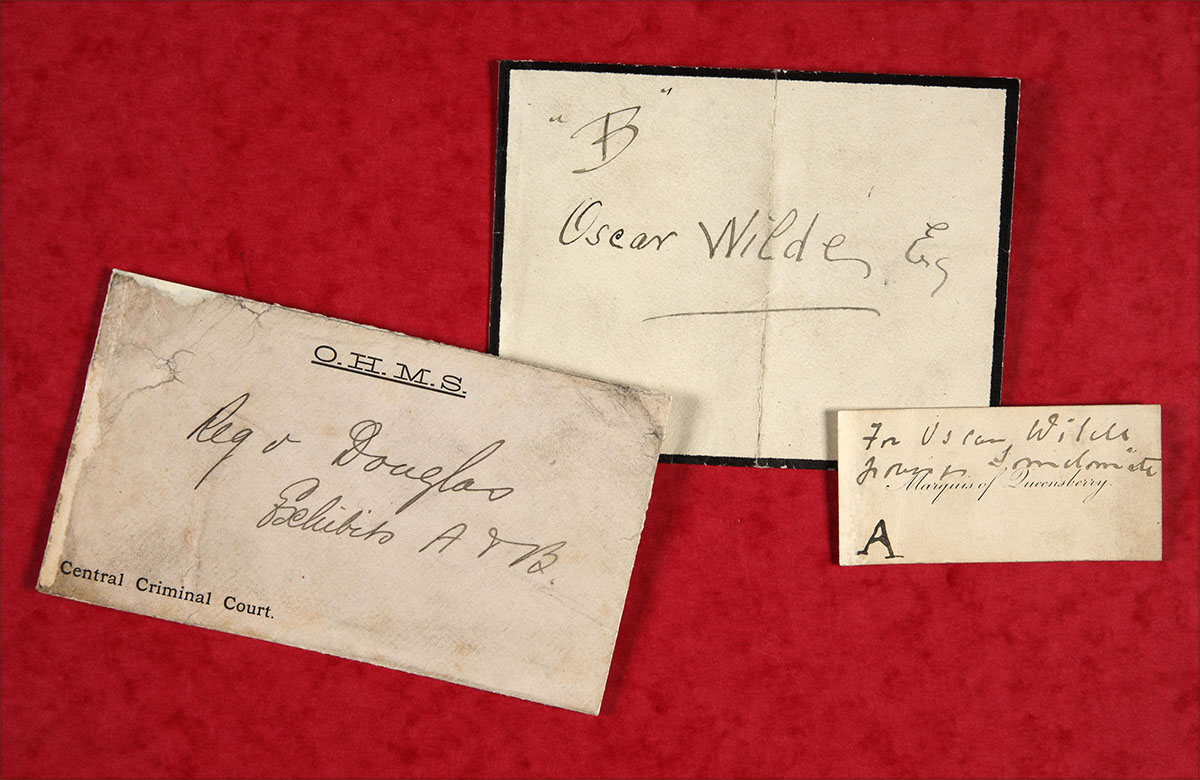
The Marquess persisted. Even after cutting off his son, he continued to demand that Alfred sever ties with Wilde. His hostility escalated when he left a card at Wilde’s club accusing him of “posing sodomite.” Outraged, Wilde responded by suing the Marquess for libel. Under English law at the time, the only way for the Marquess to defend himself was to prove that his accusation was true.

Source: National Archives

Wilde’s trials unfolded within the rigid legal framework of late-Victorian England. The Criminal Law Amendment Act of 1885, specifically the Labouchere Amendment, criminalized nearly any intimate act between men under the vague charge of “gross indecency,” requiring no proof of sodomy. Prosecutors used this law to reinterpret Wilde’s relationships, his aesthetic philosophy, and even his literary style as evidence of criminal behavior.

The libel suit disastrously backfired. Once the trial began, scrutiny shifted entirely onto Wilde. The courtroom became a stage for moral panic. Prosecutors treated The Picture of Dorian Gray as a coded autobiography, presenting its themes of beauty, corruption, and queer longing as proof of Wilde’s alleged immorality. This was striking, given that the novel’s central queer-coded character is hardly an aspirational figure; nevertheless, the mere portrayal of queer desire was taken as incriminating.

On May 25, 1895, Wilde was convicted of gross indecency and sentenced to two years of hard labor. This punishment devastated his personal life and literary career, yet his prosecution holds lasting historical significance. Wilde’s downfall reveals how Victorian society simultaneously cast homosexuality as deviant and, paradoxically, helped solidify it as a recognizable identity.

Wilde’s conviction and imprisonment were deeply destructive, but they also expose how Victorian legal and cultural institutions defined, regulated, and punished queer existence. At the same time, Wilde’s writing, and even his courtroom defenses, offered one of the era’s most enduring affirmations of queer dignity.

Sources:

1885 Labouchere Amendment. (n.d.). UK Parliament. https://www.parliament.uk/about/living-heritage/transformingsociety/private-lives/relationships/collections1/sexual-offences-act-1967/1885-labouchere-amendment/ Mace, R. (n.d.).

The Picture of Dorian Gray. University of Leeds Library. https://library.leeds.ac.uk/special-collections/view/1270

Oscar Wilde Imprisonment and Sentencing. (n.d.). American History, Steinway Diary. https://americanhistory.si.edu/steinwaydiary/annotations/?id=854

Oscar Wilde is convicted of gross indecency | Research Starters | EBSCO Research. (n.d.). EBSCO. https://www.ebsco.com/research-starters/social-sciences-and-humanities/oscar-wilde-convicted-gross-indecency

Posted by: Juliette C | December 7, 2025

Ghost Mother Photographs

Ghost mother photographs are some of the most interesting photographs from the Victorian era, and that’s saying something. There is something so disturbing and uncanny about each and every one of these photographs. These kids are not old enough to be in pictures by themselves; most of these babies aren’t old enough to sit up by themselves. This is not the biggest uncanny feeling in these photos; it is, in fact, the mother and how she is always slightly out of frame. Whether she is crouching behind furniture or her face is burned from the picture, she is looming in the background, never fully seen, but always present. This changes the photos completely; it is no longer a nice picture of some children, it has turned into a very clear example of the erasure of feminine labor in Victorian England. The erasure of female labor in the Victorian era is very fitting for that time period. Women were commodifications, not real people. They were seen as the means to the end, that end being reproduction and domestic labor. For society at the time, once a woman had reproduced, she no longer mattered; all that did was the children. They are the ones who are front and center in these photographs. 

Although these photos are distinct from the time, there are echoes of them throughout history. At the beginning of the semester, when we looked at the portrait of Lady Betty Delme and her children, we noted how the son is front and center and that Lady Delme looks as though she is fading into the scenery. Her hair is blending into the tree, and her skirts almost look like a piece of furniture. This is a less extreme version of the ghost mother photos. In the ghost mother photographs, the mothers are often shrouded in a sheet of some sort. This makes them look like they are the sofa or chair that the child is sitting on. Even the photos where the mother’s face has been taken out of the picture, her body often ends up being obscured in the same way Lady Delme’s is obscured. This goes along with the more modern tradition of having the mom take all the photos of her kids without actually being in them. There are a lot of families where the mom is barely in any of the photos. Neither  of these examples is the same as the ghost mother photographs because the harm in the ghost mother photos is incomparable to everything else. 

The harm of taking these mothers out of the photographs is unquestionable when looking at these photos. Not only the ones where the faces of these women are being scratched, burned, or cut out, but all of the photos. It is harmful to erase all of the labor that these women are doing and have done for their families. By shrouding and erasing the faces of these women, the photographer and society at large are keeping the labor hidden from the world. Society didn’t want to recognize reproductive labor as real labor, so that women would keep doing it for free. The fewer people who see, the less they care about women and their feelings on the matter. There are so many photos where the mom is hunched over a piece of furniture. The cloth covering her is also draped over the couch. It looks like she is the couch that her children are sitting on. She is nothing more than an ornament to the scene of this picture, a tool.

Posted by: dawnefawne | December 7, 2025

Photography and Visuality in Frankenstein 2025

Guillermo Del Toro’s 2025 adaptation of Mary Shelly’s Frankenstein is a very fascinating film for many reasons, particularly when examining it through the lens of Victorian visuality and visual culture. I was very excited and anxious for its release, as Frankenstein is one of my favorite novels, let alone pieces of Regency-era (late Georgian period, just before the start of Victorian) literature. I will not be delving into how faithful this adaptation is to its original text because that would require more time and space than is available. I was so happy to be in this class at the time of this film’s release because it allowed me to understand threads of the film that would have been otherwise untouched in my mind.

A fascinating aspect of this film is Del Toro’s choice to situate the contents of the film more firmly inside the Victorian era for the utilization of Victorian and Gothic aesthetics and themes. Mary Shelly’s novel was finished in 1818, and Del Toro’s film is set in 1857, years after Shelly’s death. RoggerEbert.com says, “placing the tale squarely in the Victorian era grounds it in period trappings more familiar to the contemporary viewer, one supposes; it also allows its visionary (at least at first) scientist Victor Frankenstein (Oscar Isaac) to place electricity more fully at his disposal when animating his creature,”(Kenny). This is a fact of the film but not the one of focus for this conversation, as the film’s being set more directly inside the Victorian era also allows it to play with the photography and visuality that is characteristic of Victorian culture.

One moment in the film that stood out to me was when I watched it for the first time at Amherst Cinema. The Creature is exploring Victor’s castle and comes across a photograph. This is the first time we see the Creature interact with any sort of visual media, let alone an image of himself. Drawing on my knowledge of Victorians’ changing attitudes toward photography, I believe that Victor was unaware of the consequences of his creature’s being photographed, particularly in this death-like state. Another interesting aspect of this photograph is that it was taken before the creation was animated; in that sense, it is a sort of ante vitam (pre-life)/pseudo post-mortem photograph. It is reminiscent of post-mortem photography, a Gothic stronghold of Victorian mourning practices. This moment is incredibly poignant in the film as it is the moment when the creature realizes his own strange subjectivity and the truth of his past and genesis. It is an extraordinary moment through the lens of Victorian visuality because, in reality, this situation could never have occurred. A dead person could not view their own post-mortem photograph; it is simply not possible. But here, through the scientific and natural weaving of the gothic tale of the creature and a post-mortem collaboration between Shelley’s work and Del Toro’s new film, this strange question can be brought to light. In this beautiful shot, the camera frames the photo to cover the creature’s face, and so, through the camera’s lens, we see the lifeless face atop the life-filled body of the Creature.

Works Cited 

Frankenstein. Directed by Guillermo Del Toro, Netflix, 17 Oct. 2025.

Kenny, Glenn. “Frankenstein Movie Review & Film Summary (2025) | Roger Ebert.” Roger Ebert, 16 Oct. 2025, http://www.rogerebert.com/reviews/frankenstein-film-review-2025.

Posted by: juliamorrison | December 7, 2025

Women Growing Women: Feminist Imagery in the 1979 Herland Cover

The image below is the cover of the first full-length edition of Herland by Charlotte Perkins Gilman. Gilman wrote Herland in 1915 and published it serially in her literary magazine The Forerunner. The novel was first published in book form in 1979 when the London-based feminist publisher The Women’s Press Ltd. picked it to share with a wider contemporary audience. The original 1979 edition features a striking bookcover, with the cover collage by Joan Hall and cover design by Louise Fili.

https://grabthelapels.com/2021/11/09/herland/

Herland Synopsis:

Herland is a feminist utopian novel that imagines a remote, self-sustaining society composed entirely of women. Reproducing through parthenogenesis (asexual reproduction), the women of Herland have, over generations, built a peaceful, cooperative, and egalitarian culture free from warfare and domination.

The story is narrated by sociology student Vandyck “Van” Jennings, who, along with two male companions, stumbles upon this hidden civilization. Their encounter with the women of Herland forces each of them (and by extension the reader) to reconsider deeply rooted assumptions about gender roles, power structures, reproduction, and social organization. Gilman’s imagined world becomes both a critique of patriarchal norms and a bold blueprint for alternative social possibilities.

Artists behind the collage, Joan Hill & Louise Fili:

Both Joan Hall and Louise Fili bring a distinctly feminist sensibility to this cover, though through different artistic languages. Hall’s collage practice often involves recombining historical or found images. By transforming anonymous photographs of women into an interconnected flowering structure, she reclaims their representation and turns them into symbols of agency, lineage, and growth, reshaping inherited imagery to tell women’s stories on women’s terms. Fili’s design and typographic work, celebrated for its elegance and its embrace of ornament, elevates visual forms traditionally coded as “feminine” into the realm of serious, high-impact design. Together, Hall and Fili craft a visual statement aligned with Gilman’s themes, one meant to project the power of women’s interconnectedness and the radical possibilities that emerge when female creativity, agency, and community take center stage.

Unpacking the Cover:

The 1979 cover of Herland resembles a Victorian photocollage and can be seen as a continuation of their proto-feminist narrative. The photographs of women’s faces—anonymous to us, their origins and identities unknown—emerge from a green stalk like blossoms. Of the four growing heads, three women look directly out at the viewer, their gazes steady and almost confrontational; the fourth looks downward, her face turned away.

The three direct gazes confront the viewer with an assertiveness that challenges the traditionally passive way women have been imaged in art and photography. Their upward growth suggests empowerment, emergence, and emerging visibility. The fourth head looks down, perhaps representing the women who have not yet gained the confidence to look forward. The inclusion of this woman suggests that all women, regardless of their confidence or visibility, are linked to each other and growing together.

At the base lies another woman, this time her full body, as she curls inwards on herself. It appears as if the stalk and therefore the other women are growing out of her. She can be read as the generational foundation; the unseen emotional, physical, and cultural labor from which others grow. Her collapsed posture symbolizes the toll the weight of such wisdom can take. The fact that the other figures appear to grow from her body turns her into both a literal and metaphorical source, underscoring themes of matrilineal continuity and the labor that sustains women’s communities. It mirrors Herland’s vision of disrupting traditional patriarchal structures and imagining a society built on cooperation, equality, and shared purpose.

The collage medium itself ties the cover to a longstanding feminist artistic tradition. Photocollage has often allowed women artists to reclaim and reassemble historical imagery, reshaping it into narratives of empowerment and solidarity. In this way, the cover effectively participates in the political and feminist intentions of the text.

In sum, the 1979 Herland cover by Joan Hall and Louise Fili does more than illustrate Gilman’s text—it enacts its feminist vision through visual form. By using a collage of women’s images, Hall and Fili both honor and transform the anonymous, often passive representations of women found in historical photography, echoing the Victorian photocollage tradition in which found images were rearranged to produce new narratives. Just as Victorian women artists experimented with layering, juxtaposition, and recontextualization to assert agency and authorship, this cover recombines female imagery into a living, growing structure that embodies the intergenerational strength, cooperation, and emergence central to Herland. In doing so, the design bridges past and present, showing how feminist visual practices—from early photographic experiments to late-20th-century book art—can reclaim, reshape, and celebrate women’s lives and labor, making the cover itself a continuation of Gilman’s utopian imagination.

Sources

About Louise Fili Ltd — Louise Fili Ltd. (n.d.). Louise Fili Ltd. https://www.louisefili.com/about

Gilman, C. P. (1979). Herland. The Women’s Press Ltd.

Herland. (n.d.). American Literature. https://americanliterature.com/author/charlotte-perkins-gilman/book/herland/summary

Herland by Charlotte Perkins Gilman. (n.d.). Grab the Lapels. https://grabthelapels.com/2021/11/09/herland/ Image of the cover originated from this source.

Mixed Media & Handmade Paper Sculptor | Joan Hall Studios. (2025, February 25). Joan Hall Studios. https://www.joanhallstudio.com/

Siegel, Elizabeth, et al. Playing with Pictures: The Art of Victorian Photocollage. Art Institute of Chicago, 2009.

Posted by: Bryanda Mendez-Torres | December 7, 2025

Comparing Victorian and 1950s advertisements: Give your mother a break

Earlier this year, I took a course titled History of U.S. Television with the remarkable Professor Hannah Goodwin. Here, I learned about the significance that television has played in American life, from the early development of technology to major waves of entertainment. We analyzed a plethora of advertisements, where it is placed, and why its appearance as regular furniture matters in the grand scheme of marketing. The television was a brand new phenomenon; you need to buy it to share happiness with all the family! However, I was primarily interested in looking at the role of the mothers and how they fit into selling the new product. But how does this relate to Victorian visual culture? Why does it matter? I want to compare early Victorian advertisements to 1950s television advertisements while viewing the mother, the woman, the ‘caregiver.’ How have these depictions of women changed over time? 

In this particular Motorola TV (https://guides.library.duke.edu/c.php?g=480747&p=3321107) advertisement, television is placed up against the wall much like the paintings right above it. The color of the television box matches the earthy tones of the rest of the ad, brown and gold. It also functions as storage, storing what appears to be a record player. The father and son are sitting on a chair while the small daughter sits on the floor (which is a whole other conversation). Each person is looking at the television, presumably having a good time. The mother in the image is standing up behind the husband, carrying a plate of some sort, attending to her motherly and wifely duties, yet she still gets to enjoy the program. This ad is meant to serve as a place for relaxation and entertainment, but for whom exactly? The ad paints itself as “happiness shared by all the family,” while mothers must perform their duties as caretakers of the household. As absurd as it seems, let us take a look at a Victorian ad from Victorian Consumer Culture.

[photo could not be uploaded] This image showcases an advertisement for soap, where the women are at the forefront washing clothes and taking care of the children. You can clearly tell that these women are doing some sort of labor; however, if you take a closer look, you can see a man wearing what seems to be a traditional Chinese hat, pulling up water from a well so that these women can wash the clothing. He is the only man in this ad that does not seem to serve the role of the father, meaning there is no father figure, which is a stark contrast to the Motorola ad. The angel at the very top of the advertisement adds another layer to this piece, and why it’s there still confuses me. Still, a white biblical figure is more visible than the person of color. This ad could potentially paint women in a hardworking light; sleeves are up and aprons are dirty. The real war is cleaning that nasty stain from little Johnny’s school uniform. The little boy’s face is also visible, while we hardly see the young girl, much like the ad above.

Women and girls in these advertisements are only meant to serve as units of the family. The little girl in the Victorian advertisement could be learning to wash clothes to take on this new role she will eventually uphold. In contrast, the little girl in the 1950s ad is glued to a screen, presumably watching the woman in the show. The women serve as commodities themselves, I believe. Soap is like an accessory for women to use to help with household chores. The television, perhaps, could be used as a placeholder for peace to get chores done without the children bothering her.

Domesticity was pivotal to these companies to sell their items, clearly targeting women since they were primarily doing all the shopping in the household. Happiness shared by all the family and saves time and money, labor, and fuel being sold to these women perhaps felt like relief, and seeing themselves in the ads could have also persuaded them to purchase soap or a television. This representation all those years ago perhaps meant something, but in contemporary times, it feels wrong to look at.

The early 2000s was an accumulation of things that transpired for women after the ’60s, empowering them rather than viewing them as housewives.

“Advertisers increasingly aligned their messaging with progressive values, advocating for gender equality and social justice.” – Modus Direct

Women, especially mothers, were no longer objects in the household but rather members of society that served a greater purpose. Now, with the digital age of social media, it is easy for a woman to showcase her authenticity without constraint. Women in advertisements have grown and have certainly given younger minds an idea of what a woman can be.

« Newer Posts - Older Posts »

Categories