Posted by: Isabelle Kirwin | November 7, 2018

First Impressions: Dance and Social Performativity

First Impressions: Dance and Social Performativity

We view most of the visual culture in our course out of time, in a context that the creators could never have dreamed. The art and culture that is based on time, however, cannot be recontextualized in this way and we are left with only the nonvisual descriptions in written text or the incomplete visual depictions in still images. Of these, Bleak House is the only textual representation of dance in our coursework thus far, through the character of Caddy Jellyby and her quest for respectability and status.

As many of us know from Regency novels and certainly from Bleak House, dance in the 19th century was a form of social interaction and a status symbol. It often sets up important first impressions – think of Mr. Darcy refusing to dance in Pride and Prejudice, and how this social performance impacted the villagers’ opinions of him. Fearing something similar, Caddy Jellyby bemoans her awkwardness to Esther by describing Ada as an accomplished lady who “can dance, and play music, and sing” (60). When Caddy determines “to be improved in that respect at all events” she declares that she “must be taught to dance” (220). This is the first step she takes toward becoming accomplished, something Caddy sees as necessary in order to raise herself above her current social status. Dance requires no specialized equipment like painting or piano playing – it is located entirely within the body, and is thus visual by nature. The accomplishment of dance, which includes deportment in Bleak House, is a visual presentation of status that affects physical appearances and thus first impressions, the first ‘barrier’ Caddy must overcome to break into new social circles.

Dance is a performative skill in all contexts, though we generally think of dance a little differently than in the Victorian era. Social dance has become a ‘lower’ form of dance, with concert/performance dance rising in popularity and status through the decades. Performance dances, particularly in classical ballet, are representations of individuals other than the dancer; the dancer performs a narrative while representing a particular character. For Caddy Jellyby and women like her, however, dance is a performative representation of the self. This function of dance has become less vital to socialization in the twentieth and twenty-first centuries. Nowadays, the stakes are lower in social dance scenarios now (e.g., clubbing, contradance, concerts), and the use of these situations as important first impressions has been rendered mostly obsolete. Dance as a performative accomplishment in the Victorian sense has lost popularity for the masses, and concert dance has taken hold as the dominant form of the art.

The social dances we think of from the Regency era (the Quadrille, the Scottish Reel, etc.) were already falling out of style in favor of ballroom dances in the Victorian period (“Social Dances of the Nineteenth Century”), though ballroom dance is still considered social in comparison to concert dance. The outdatedness of some of these dance forms leads us of course to Mr. Turveydrop and his obsession with the Prince Regent. He is depicted as teaching an outdated form of dance with outdated methods. Dickens may poke fun at deportment and dance, but for Caddy, upward social mobility – and thus independence from her less than ideal family situation –  hinges on the first impressions garnered by trained physicality. That she meets and falls for Prince Turveydrop in the pursuit of her dance training could be interpreted as a sign that this type of performative physicality is not necessary, that Caddy simply needed to be out from under her mother’s thumb. Conversely, it reveals that Caddy took the correct first step in ‘bettering’ herself in the model of Ada, learning to perform the social signals of gentility.


Sources

Dickens, Charles. Bleak House. Edited by Joseph Hillis Miller, Penguin, 2012. Print.

Powers, Richard. “Social Dances of the Nineteenth Century.” 19th Century Social Dance, socialdance.stanford.edu/Syllabi/19th_century.htm.


Posted by: Lily DeBenedictis | November 6, 2018

Exploring the Transformation of Consumer Culture

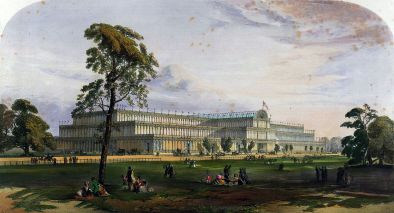
The 1850s sparked a transformation in commercialism and commodity towards the today’s modern consumer market. Starting in 1851 at the Great Exhibition in London hosted by Queen Victoria and Prince Albert, the exhibition put on displays to show off the newest technology, fashions and international cultures. Even the building itself ignited new architectural trends. The Crystal Palace capitalized on the use of modern materials to maximize natural light and floor space. These exhibits became the center for commodity. It provided a space where the people came to see, feel and touch of expensive luxury goods, technology and clothing. It was a monument dedicated to consumption. This seems to have been the primitive start of shopping and commodity as a spectacle.

Crystal_Palace_from_the_northeast_from_Dickinsons_Comprehensive_Pictures_of_the_Great_Exhibition_of_1851._1854.jpg

These ideas continued to pervade society at the Chicago Exposition in 1893. Here the desire for luxury goods became almost a trend. Many attendees went specifically to look at international and local products. The exterior design of these buildings also demonstrates the turn towards grandeur. Turning back to classical architecture, many of the buildings in the main center reflected the styles found in Italian Villas, Palazzos and the Duomo. These ornately designed exteriors reflected the products found within. By viewing fashion, furniture and luxurious goods from all over the world, people began wanting these items for themselves.

1893-worlds-fair-001.jpg

A new commercial phenomenon occurred where the masses began to “desire” and “want” these items rather than need. Before, shopping occurred more out of necessity. People would only buy clothing or shoes when they began to fall apart, food for the day of and one set of dishes until they broke. Instead of buying items for their utilitarian purposes, people began to desire items for the status and luxury of having them.

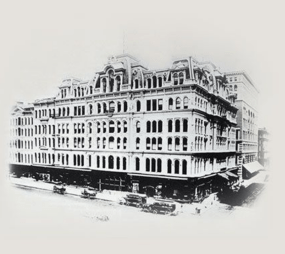
One of the first department stores to emerge was Selfridges in London. In 1906 Selfridges & Co. was born and only three years later, the Grand Opening of the store opened Selfridge’s doors to the public. Using commodity as a spectacle, Harry Selfridge placed the first plane that went over water in the windows of his store. People flocked to the store to not only see the plane, but also see what kinds of items were available for purchase. This created a female space in an era when women were not allowed out without an escort. They were allowed to indulge in fashion, furniture and products that were imported from Europe without having to travel there. It was the ultimate luxury experience.

Screen Shot 2018-11-06 at 10.41.30 PM.png

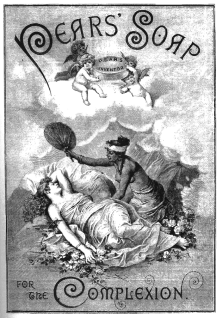
Store advertisements targeted the middle-class woman. It gives women a semblance of control over their lives to be able to shop and desire items that their husbands could buy them (Loeb). Posters, magazine and newspapers held ads for new fashions, makeup or other products that promised to enhance the body in very appealing ways. This is evident by the Pears Soap Ads which promised to enhance complexion or wash away all impurities (Loeb).

Screen Shot 2018-11-06 at 10.42.05 PM.png

Who knew that the first World’s Fair under the reign of Queen Victoria in the mid-1800s would transform the evolution of commodity? The second half of the 19th century completely changed the way that the public thought about commerce and the effect that it has on society. The public changed from one of shopping out of necessity to one that was wooed into consumerism through advertisements. This rapid transformation of the consumer and commodity would come to influence today’s markets and the consumer culture that we experience today.

Works Cited:

Leonard, Garry. Reviewed Work(s): The Commodity Culture of Victorian England: Advertising and Spectacle, 1851-1914 by Thomas Karr Richards. James Joyce Quarterly 28 no. 4 (1990): 1001-1008. https://www.jstor.org/stable/pdf/25485226.pdf?refreqid=excelsior%3A44725dbbb060c758f5d6417974372593
Rydell, Robert W. World’s Columbian Exposition. Encyclopedia of Chicago. Published 2005. Date accessed 11.4.18. http://www.encyclopedia.chicagohistory.org/pages/1386.html
Selfridges & Co. Our History. Selfridges. http://www.selfridges.com/US/en/features/info/our-heritage
Posted by: Marisca Pichette | October 28, 2018

Marginalising “Women’s Work”: Craft Versus Art

What makes something created by human hands “art”? Society has both flexible and rigid definitions around this question, and such delineations are constantly changing. At the height of Victorian of photocollage, scrapbooks were not, perhaps, considered art. Today, we might consider them on the verge–but why are they not given full privilege as artistic pieces, displaying individuality and creative skill?


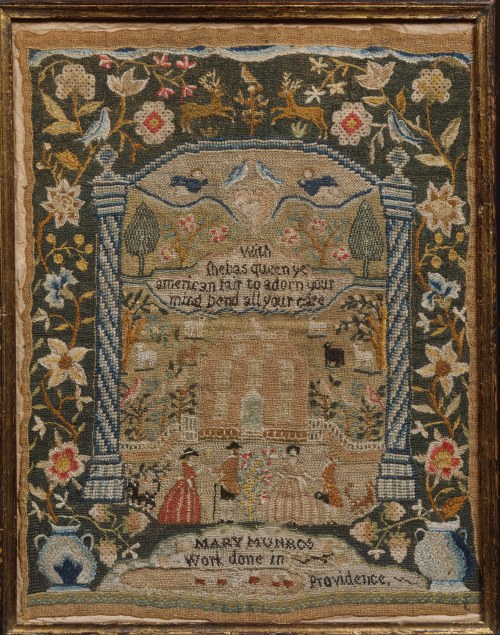
Elizabeth Siegel’s discussion of how photocollage has been excluded from art historical studies confronts our estimation of women’s work, and whether it is craft, compilation, or art. This issue reminds me of the studies surrounding Colonial American samplers. Samplers were important projects for young women in 17th-18th century New England, showcasing their talent and capability with needlework. They would start on these works at a young age, from a simple cross-stitch to more developed and complicated pictures of people and plant life. Often, samplers depicted the alphabet or other standard patterns and sayings, and were begun at around five years of age, then became more complex as the girl grew. While many of these have the names, years, and ages of their makers on them, they are not considered art in the same way as, say, a painting.

hb_1984.331.14.jpg

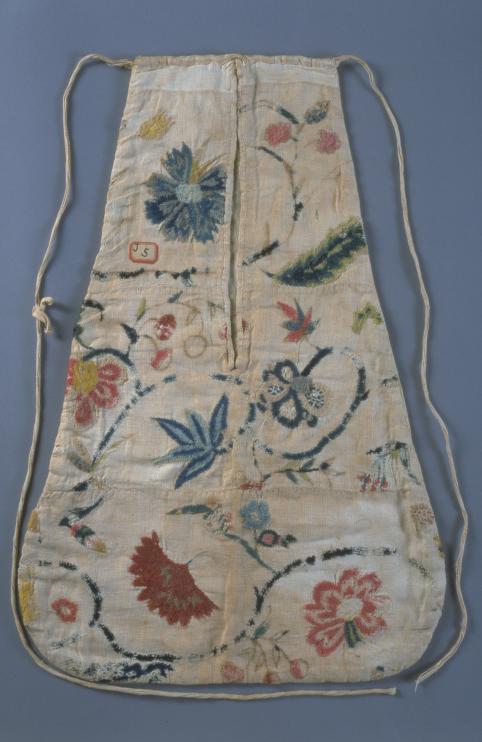
Samplers can often look similar due to the fact that they followed conventions and popular patterns, but each was made by the hands of an individual, choosing her own colours and varying in style and execution. Above all, they contributed to the development of the girl’s skill with her fingers, something necessary in the middle class, as women would do much of the sewing for their clothes and the clothes of their families. In the upper classes, samplers displayed the delicacy and domestic talent of young women. Do we consider these works of art, or do they, too, occupy the murky in-between place of Victorian photocollage?

getimage.jpeg

There is a long tradition of works by women and girls being passed off as “handiwork” or “craft”, the result of women’s work, which has little artistic value. Like photocollage, samplers were displayed in the home, hung to demonstrate the skill and intelligence of the girls who made them. Today, they are useful for determining the level of literacy and education of young women in Colonial America. Art historians can place the patterns in certain regions, and trace the popularity of different stitching patterns. Now, samplers are displayed in museums alongside works of art, so maybe it is finally time to consider works such as these as more than mere “ladies’ pastimes”.


Sources:

History of samplers: http://americanhistory.si.edu/collections/object-groups/american-samplers

More on samplers in the Pioneer Valley: https://deerfield-ma.org

Image 1: metmuseum.org

Image 2: Digital Collection -Embroidered pocket


Posted by: lederniermot7 | October 26, 2018

Copy and Paste – Conventions of Photocollage

The concept of collage is an intriguing one: the manual manipulation of photographs and scrap to produce something new; something which can be called art. That manipulation and its import is figured in Elizabeth Siegel’s “Playing with Pictures”, and begs the question, why? Why distort these images in such a way? Why pull them apart just to piece them back together out of context? What could drive the desire to alter so drastically images considered first and foremost for their veracity, for their true depiction of life as it is?

One understanding of this can be looked at through the lens of those producing the collages themselves: the women of Victorian society’s upper ranks. The ease of creation prompted by this art form and access to the means of its production allow this to be quite the pastime for those confined to domestic spaces. Those albums are, nevertheless, as Siegel puts it “excluded from traditional art histories as examples of domestic busywork, private and contextual rather than public and autonomous (Society Cutups,  13-14).” This is interesting, the thoughts of this work as “private and contextual” art without any bearing of the self or its makers, as the very base of its creation is derived from images made for public use. As Siegel continues, to participate in such work “defined one as part of Society,” lending to the impression that such a form exists on a grander scale of reproduction and reinvention, not only in terms of the art world, but of emergent photographic practices as well.

In consideration of photocollage as a collaborative endeavor, not simply in terms of the consolidation of many physical pieces in formation of the whole completed image, but in terms of collage as a societal activity, the work becomes even more curious. While we can easily say it spans a gap between old Victorian ideals and new technology, it also can be said that it works to incorporate that meld into a thing of its own which does not and cannot be defined by either party. Within these collages, we see the literal dismemberment and the decontextualization of imagery reshaped and reimagined to reflect that blurring between the domestic and public spaces the Victorian world had become.

Posted by: Lily DeBenedictis | October 24, 2018

Motherhood Over the Centuries

This past week while we were looking at the Famine Documentation in the context of the Irish Potato Famine and the Sepoy Rebellion, I was particularly struck by our conversation regarding the sympathetic view of media feature females. I was specifically interested the use of the identity of motherhood, the potential of the family unit as a vessel to garner sympathy, and the use of these methods over centuries to influence visual culture.

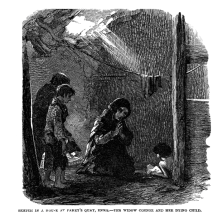
Screen Shot 2018-10-24 at 11.43.36 PMJames Mahoney, Sketch in a House at Fahey Quay, Ennis – the Widow Connor and Her Dying Child

In this sketch by James Mahoney, a mother leans over her dying child in the hovel that they inhabit. The caption labels it “The Widow Connor and Her Dying Child”. Here, the figure of the mother who is supposed to be a nurturer and caretaker has failed, according to Mahoney. She is on her knees, praying over her dying child who is bathed in the warm heavenly light of God. No illusions here. Religious overtones dominate this scene with the light, the male child and the mother with the head covering. Here, Mahoney has set up his own Potato Famine Madonna and Child. However, Madonna has failed to take care of her child. To support him. To let him live out his full potential. Despite these important things, these details reflect more deeply on the role and character of the mother. It puts her into the negative light of being a failed and unfit caretaker.

Despite these negative connotations brought on by sketches such as this one, Irish women were actually the centers of the family. During the Potato Famine, 1-1.5 million Irish died and between 1-2 million Irish emigrated (Martin, 2018). Many of these were men. Feeling like they could not support their families, men emigrated hoping to find work and send money back to their families. This left the women to raise the children, farm the potatoes and keep the family together. They became the backbone for Irish culture and economy (Martin, 2018). This is completely opposite of how females are depicted in visual media from this time.

Outreach was not as readily available as efforts are today and the effort from the British to help their colony was minimal. In order to be more effective in their methods to attract Britain’s attention, perhaps the Irish were capitalizing on their method of garnering sympathy using the female body. No matter what the intent, the sketch captures only one dimension of Irish women, as a mother. There is no visual culture addressing their success in creating economy and trade during the Famine. Instead, we consume the media portraying mothers in their times of perceived failure.

dorothea_lange'smigrant_mother.jpg
Dorothea Lange, Migrant Mother

This kind of sympathetic documentary photography was not scant in the 20th century. During the Great Depression, documentary photography also used this kind of light to garner support and sympathy that was disseminated through magazines and newspapers. This is Dorothea Lange’s Migrant Mother. A photo produced for precisely this reason. Here, the mother is sitting between her two children looking pensively off to the left. Her children lean on her shoulders, hiding their heads in the crook of her neck and her shoulder. She is central to the photograph. Her face showing the stress and worry. How is she going to take care of these two who are literally leaning on her? Whose lives depend on her. Her hands are dirty and play with the downward turned corner of her mouth. Perhaps indicating the hunger and desire for food or just playing with her face in worry.

Lange has perhaps posed her as the new-age, Great Depression Madonna and Child. Where the sketch of the Irish mother has her on her knees praying to save her child or to send her child to heaven, this photo shows the more realistic view of motherhood. She worries over how to care for her children, not that this photograph will be used to garner sympathy. That her role as a mother is to provide, not provide a momentary look of worry that will motivate others to reach out in aid. This again provides only one aspect of the mother. In this medium, this mother becomes a representative for all suffering in the Depression. This photograph is a seemingly a portrait that captures her features and her children who are wrapped up in her identity. She is not presenting herself as an individual for the sake of herself. Instead, she becomes every mother during the Depression.


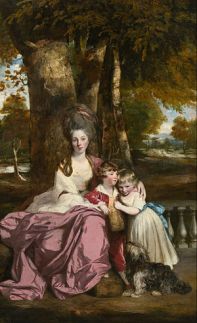
300px-Sir_Joshua_Reynolds_-_Lady_Elizabeth_Delmé_and_Her_Children_-_Google_Art_Project.jpgJoshua Reynolds, Lady Delme and Her Children

Unlike the two pieces of media above, the intention of this portrait is not sympathetic or empathetic. Rather, it speaks more to the representation of motherhood. The composition of both of these images recalls a portrait that we looked at in the beginning of the semester, Joshua Reynolds’ “Lady Delme and Her Children”. Compositionally they are extremely similar, with the female dominating as the central presence and the children gathering around. They create a triangle which allows the viewer to look at her then down to each of her children and then the dog at the bottom right (Martin, 2018). Symbolically, she also has a similar function to “Migrant Mother” and Widow Connor. Since the father is not in the portrait, she is tied to child-raising and the children themselves. Like “Migrant Mother”, Lady Delme’s identity is wrapped up with the idea of child bearing, raising and motherhood. There is a feeling of intense nurturing and care for the children as Lady Delme’s arm is wrapped around them. However, what differentiates her here is the lack of sympathy. Instead, this portrait is one to be made spectacle of. It is meant to be gazed at and admired in, I dare to say, jealousy. There is not feeling of sympathy to be elicited from this image, but the functionality in representing motherhood is remarkably similar.

Although, these pieces come from significantly different time periods but the use of the mother to garner sympathy is utilized in all of them. All these women are shown in completely different contexts but whose identities are completely intertwined with children. Their role as a mother is made into a spectacle, an object for the gaze of any media consumer. Rather than focusing on them as an individual and representing themselves, they become emblematic of all mothers and children during these times of natural catastrophe.


Works Cited:

Lange, Dorathea. “Migrant Mother”, 1936.

Martin, Amy. “Famine Sketches and Photography Lecture”. Victorian Literature and Visual Culture. Mount Holyoke College, Massachusetts. 10 Oct, 2018.

Reynolds, Joshua. “Lady Delme and Her Children”, 1777-79.

Posted by: Lily DeBenedictis | October 21, 2018

Jone Jonas: 60 years of illusion, fragmentation & (de)familiarization

At 5:30pm in Gamble Auditorium, a small figure made her way up to the podium. Her ascent was met with cheering and applause bouncing off the walls of the theater, the echo of almost 400 people waiting to hear about the journey and life’s work of the “Mother of All Performing Art”, Joan Jonas. Newly inaugurated Mount Holyoke College President Sonya Stephens began the evening by welcoming Jonas back to campus as a graduate in 1958. She congratulated Jones on her many accolades and now new title as the 2018-19 Leading Woman in The Arts. Professor of English, Amy Martin and Tricia Paik, the Florence Finch Abbott Director of the Mount Holyoke Art Museum who introduced Jonas to the audience.

Jonas looked out at the crowd through her thick round Edna Mode-esque glasses with a look of appreciation and perhaps a little apprehension. Preparing herself to speak in front of the crowd. Her red sweater made her stand out from the dull beige walls of Gamble and the lilt of her voice was soothing yet crisp in the silence that met her.

Beginning at the actual start of her life, Jonas took us through her childhood spending her time outdoors with her dog Cindy. She then went on to talk about her early exposure to Broadway, the MoMA, the Metropolitan Museum of Art and movies as her introduction to the arts, entering the art circles by way of her step-mother. Jonas seemed to be in awe of all the different kinds of resources and mediums that were available to artists.

Early on in her artistic career, Jonas recognized metaphor and the process of draw, erase, draw, erase as her main modes of creation as she figured out what art was and what it meant to her. The themes of disillusionment, defamiliarization and fragmentation are ones that she has come back to throughout her lifetime. Addressing these themes, Jonas played many of her multi-medium projects such as Beach which focused on how sound carries a distinct sound, or some of her projects that started with one object or shape such as a cone and transformed them into something completely different. Jonas also became fascinated with miniatures. She began creating these shadow boxes that a viewer would look down into and see a particular scene.

In the 1970s, Jonas purchased her first camera and began filming her live performances. In one such event she draped a wet towel over her body and began to draw her own outline on herself. Much of her work is doused in props, mirrors and other devices that act as symbolically. More recently she has focused on form and the culmination of her earlier ideas. Mirrors, fragmentation and illusion. She finished the presentation by talking about her most current pieces which emphasize the dire nature of the changing environment, believing that by understanding where we come from and the beauty in the world we can live in peace.

Jonas produced a captivating over view of her journey as an artist. Working in a field as complex and personal as performance art, Jonas could have taken hours to explain her life’s work rather than a one presentation. The shortened time period, made her speech to feel like we were running through her life, only stopping to look at the pieces that were defining moments in her career. The moments that she chose to stop at were pivotal to the audience for understanding the transformation in her artistic focus and interests. However, it was the question and answer segment where she was able to slow down and really discuss choices she had made where I felt most connected to her work and seemed to understand it more.

By the end, the audience understood the full scope of her work so far. To get even a small glimpse into their world for a one-hour presentation is getting to look at the world through a different perspective, which after all is the aim of her work. As much as the presentation covered the scope of Jonas’ work, it would have been more interesting to look more in depth at a few pieces of her choice and have her talk the audience through her intentions while making the piece, her process to create it and then how it fit into the larger scheme of her work. Although it was fascinating to hear about how her story fit into her work, the presentation of the information felt rushed and too rehearsed. When listening to an artist about their work, it would have been nice to understand why she chose to drape a wet towel over her body and draw on herself or what drew her to using mirrors and bodies as a form of disillusionment. However, this is the opinion of an art history major that is fascinated by performance art.

The presentation that was given was an appropriate overview of her work as a whole. The language was not overly methodological and appealed to a larger audience who may not have been versed in the art world at all. However, what did come across was Jonas’ passion for her work, to keep learning and to continue in this vein work in order to fully explore the themes that seem to reoccur throughout her work. I would be interested to see what Jonas’ up and coming work looks like and how she feels that it fits into the scheme of her work over these last 60 years.

— Lily DeBenedictis

Posted by: Casey L | October 21, 2018

Mulvey and Movie Marketing

A movie poster is a pitch, a promise of sorts. At best, it captures what the genre, themes and conflicts will be in the film, and thus the reasons it deserves your attention (and money). There are plenty of tropes in movie posters that are more obvious than others, but focusing on conventions can obscure the underlying principles. Mulvey’s passive/active theory, of “Woman as Image, Man as Bearer of the Look,” is the central theory that can be applied to movie posters.

I am not setting out to argue that these films or their marketing teams made misogynist miscalculations. My intention is to practice (and invite others to practice) analyzing that which is mundane and ubiquitous using the tools that Mulvey provides. To do so, I have chosen posters featuring women from some of the 2017 and 2018 Academy Awards nominees.

ARRIVAL (2016)

arrival poster

Source: Amazon

How do Mulvey’s principles apply in films with female protagonists? More specifically, for the sake of this post, how do her principles apply to the film posters when the films have female protagonists? Amy Adams is the biggest face of the actors featured on the poster. Viewers are meant to empathize most with her in the film, to feel as she feels. Is this why her face is the most free of emotion, so viewers can project their own meanings? Both Jeremy Renner and Forest Whitaker’s characters have faces caught mid-reaction, mid-look, faces wrinkled with thought. One would think they have more active roles, while Adams is passive. Although Adams’ eyes are pointed toward something, she is not grounded in a particular active moment in the film, unlike Whitaker and Renner, who are cut out of scenes. This, combined with the intensity of the airbrushing on her skin, is reminiscent of the Disney princess controversy from five years ago—is it better for the female character to be beautiful than to show emotion?

The marketing roots the film in the past. Mulvey’s argument has to be adapted to fit analysis of a frame that does not mirror the film. “The presence of woman is an indispensable element of spectacle in normal narrative film, yet her visual presence tends to work against the development of a story line, to freeze the flow of action in moments of erotic contemplation” (837). Because Adams’ character is the lead, she becomes suspended in order to maintain the flow of action: the sun rises to shine on her face, as though the very nature surrounding her is geared toward beautifying and illuminating her for the gaze. In the poster, her agency (specifically, as a viewer may glean from the trailer beforehand, her ability to communicate with aliens) is directly associated with her pure skin and a feminized openness to ideas (or influence).


THE POST (2017)

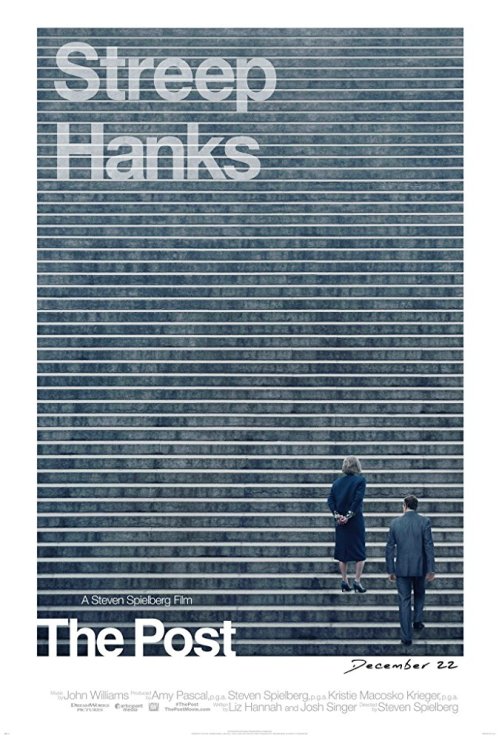
the post poster

Source: Amazon

The Post has by far the most abstract poster in this analysis. The human form is set aside, featuring two human figures, both of whom have a clear gender. Nothing is in the center of the poster to draw the eye in, until it finds Meryl Streep and Tom Hanks in the corner. Streep’s name and person are above Hanks’, and yet, she is still set off on an angle that seems fairly nonsensical, frozen. If Streep’s calves and heels were insufficient in marking her, one can use the names on the poster to interpret the female form. Streep’s character has a higher level of decision-making power, but is not the most active figure in terms of advocating for the film’s central news story. Hanks is the only moving figure suggested in the entire image. It is clear the pair have been pasted into this scene, because his gaze doesn’t quite make sense (is he looking at her feet, or a bit higher?). Still, with a suit the same color as the steps, and he is closer to the corner, suggesting his normativity and emphasizing Streep’s character as subversive.


HIDDEN FIGURES (2016)

hidden figures poster

Source: Amazon

Unlike the slightly confused layering of characters in the Arrival poster, the Hidden Figures poster makes it clear how large of a share the protagonists have in the film. Their height is exaggerated from the camera angled up at them, giving a higher degree of power than an angle that appears to point down or straight. Confidence and dominance in the frame makes clear the film as a historical and patriotic project. The representation of three Black women on a (mainstream—compare with Daughters of the Dust) film poster is groundbreaking, let alone that they take center stage.

Taraji P. Henson shares a column with Kevin Costner, who matches her front-facing gaze. as though there was some anxiety in the marketing team that her gaze had to be offset, or supplemented. Color editing is a slight sidebar here—by reducing the saturation, their faces have a pallid note, though not to the level of instances of whitewashing in magazines. The color of their lipstick, on the other hand, have likely been enhanced to reinforce their femininity. The airbrushing tradition has persisted, as well as, in Janelle Monae and Octavia Spencer’s case, the ability of the viewer to gaze the posing female face as she is unaware.


PHANTOM THREAD (2017)

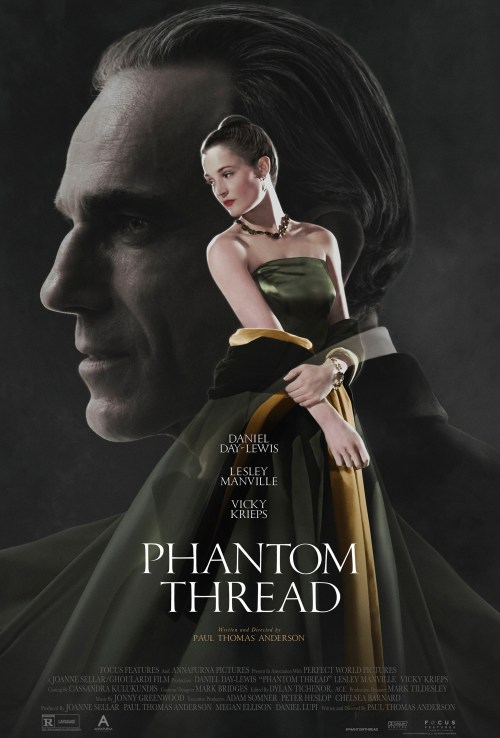
phantom thread poster

Source: Amazon

In this poster for Phantom Thread, the female protagonist and love interest could be posing for the viewer, or the viewer could be looking without her knowledge. At the same time that the viewer can freely look at the protagonist (Vicky Krieps), they don’t have to directly compete with the male protagonist (Daniel Day-Lewis). The lighting has put the curves of her body in greater relief; other than the title in a white font, her skin is the brightest part of the image. “To-be-looked-at-ness” is center stage of this poster, and the viewer can project into the huge blown-up gaze of Day-Lewis. Using Mulvey’s argument, the male viewer can find his place as an erotic actor and possess the woman in the frame.

Only after seeing the film may some of these assumptions complicate the poster, and conclude that this framing is a comment on the dynamic between the two characters. Because Alma in Phantom Thread is supposed to wield power over Woodcock (his name proof of an exaggerated male erotic gaze), understand him like others have not, it is significant that her passive gaze is reframed to imitate looking at him. Still, viewers of the poster (and, arguably, the film) are allowed to indulge in the female form as passive and pristine. In order to draw people into theaters, Krieps’ figure is used as a marketing tool.


Although it is easy to dismiss some film posters as objectifying women, it is more difficult to parse through the meaning of posters that are less overtly so. The phenomena of the poster raises important questions about the commodification of the female form, the effectiveness in films aiming to shed themselves of sexism and how one can imagine an un-objectifying poster. For now, the common thread is a promise to the imagined viewer that they (he?) will be able to watch beautiful women at their leisure.

As I wrote this post a week before posting, I was more informed by Mulvey than our readings on Victorian advertising, so I would be interested to hear how others may apply the latter to modern marketing, or in general. Also, I would be interested to read feedback both on my analysis and if others want to offer their own of different posters or their application of Mulvey.

Resources:

Mulvey, Laura. “Visual Pleasure and Narrative Cinema.” Film Theory and Criticism: Introductory Readings. Eds. Leo Braudy and Marshall Cohen. New York: Oxford UP, 1999: 833-44.

          This past Thursday, I attended Joan Jonas’ lecture, Mirror Mirror, as part of Mount Holyoke’s 2018-2019 Leading Women in the Arts series. Each year, the Mount Holyoke Weissman Center for Leadership brings an acclaimed artist to our community to give lectures, workshop, and discussion events related to their professional work. As a student who is pursuing a self-designed major in Intermedia Performance Art, Joan Jonas especially intrigued me because of her pioneering multimedial work.

          Before the lecture, the Weissman Center for Leadership host gave us a overview of Jonas’ recognized background. To give some context, Joan Jonas is Mount Holyoke alumna (‘58) whose work has been exhibited and performed in museums at the international standard. Exhibitions have included the 2008 Sydney Biennial, Yokohama Triennial (2008), United States Pavillion for the 56th Edition of the Venice Biennial (2015), Akureyri National Gallery of Iceland, the London’s Tate Modern (2018) and more. Her work will travel to Munich’s Haus der Kunst this November and to the Porto’s Serralves Museum in May 2019. You can further about all her exhibitions here: https://art21.org/artist/joan-jonas/

          Jonas opened her lecture by situating us with her early enthusiasm of theatrical play and experimentation of  materials as a child. She then described her numerous exhibitions throughout career, using images to supplement her discussion. For every point, she had a correlating image and at times re-displayed a previous image so that there was always a visual representation to her words. The extent of her oral delivery continuously aligning with some image was unique to me, and made me consider her choice to have a conscious multimedia presentation. At times she would even pause her lecture to allow us to listen and watch the video displayed before us. I observed her value in giving an audience the privilege to watch, to be a viewer of an experience, in addition to a listener.

          Her explanation of her Mirror Piece (1969) particularly  inspired me to consider audience/medium encounter, within my own creative work. In this piece, Jonas had choreographed full length mirrors to face the audience so that they saw their own reflection. She mentioned how use of multiple mirrors created a fragmented reflection. I admire her atypical use of materials, and in this instance, she choreographs static objects into mobility. She considers the potential of an object’s medium and how it can be used to distort common applications of them, exemplifying her motivation to experiment, play, and forge her own methodology of investigation.

          In a recent study abroad application portfolio, I submitted a proposal for a hypothetical performance art installation using mirrors and photographs to interrogate the ideas of subjective viewpoint, representations of reality, and aesthetic preference. Confronting reflection through different angles (literally through different mirror positions and symbolically through the notion of our personal viewpoints/aesthetic preferences) is an aspect I have always desired to explore, and intend on doing so if I pursue this proposed installation next semester. As Jonas shared how she gave the mirrors a mobile quality through choreography, thus changing our encounter with them, I see possibility in my own creative pursuit to explore how experimenting with a mirror’s physical position can alter and distort our confrontations of viewpoint and subjective reflection.

          I find the act of holding up a mirror to an audience an appealing artistice choice. Seeing one’s own reflection in a mirror can be uncomfortable for some, especially when the audience, committed to sitting in their seats, has no choice about having this confrontation. The mirror can bring up themes of accuracy/self-subjectivity, vanity/repulsion, and even the sense of compacting/expanding space. In my hypothetical installation proposal, I had laid out a choreographed plan for the audience to encounter their reflections at various angles and mirror types (concave/convex/plain mirrors; mirrors laying flat on a surface/mirrors mounted on a wall/mirrors laying at the base of a water tub; full length mirrors/profile sized mirrors). Through my experience in site specific design, I always consider the audience and intentionally incorporate their interaction into my pieces.

          In contrast, Jonas mentioned how she is “not so much interested including the audience in [her] work,” but knows her work will have a dialogue and a presence of an audience in the room. She knows her exhibits includes “images that need to be seen.” I think her claim that installations “include audiences – the audience moves through the work at their own time and space,” is useful for understanding our differences in intention. It seems her exhibitions depend less the specities of what the audience is doing and rather invites them into the space as a active viewers and reactors. It seems my work, more based in site specific performance and design, choreographs specific interactions for the audience to take part, utilizing them as a necessary component to the piece. Neither is better than the other in my view, and I do not intend to make these official and restricted distinctions. In fact, I am so fascinated to continue considering both the fine and slippery lines between a curated installation or a curated site specific performance.

          As Jonas has shown, the two can become conflated, which I realize is an essential definition of performance art. By nature, performance art must be a hybridized form of visual, installation, and performance. It inherently demands the collaboration of visual, dramatic, and digital arts. Her lecture and artistic work has inspired me to expand my thinking of the technical possibilities for using the mirrors and mediums in general within my own creative work. I began asking various questions: How does manipulation of a medium influence our investigation  and understanding of a concept (e.g. masking, reflection, delayed sound)? What are the ways installation can choreograph, or hyper-utilize an audience versus allowing them their own navigation of a space? What discoveries and manifestations are possible because of a multi-medial approach to creative investigation? Her method of using mediums, such as a stick to hold a drawing instrument rather than a hand, is another example of her commitment to find new methodologies of artmaking. Among the various performance artists I have come to respect in the last few years, Jonas is unique for intention to make art that “includes the world,” rather than only relying on technology.  Her work exemplifies the art of probing art’s capabilities while breaking though artistic conventions in the process, rightly recognizing her as the pioneer of the field.

          Below I have included various images of Joan Jonas’ exhibitions as a demonstrating abstract use of mediums, including the mentioned Mirror Piece (1968). I have also included photos of my own recent installation proposal to show how her work can inspire my own creative thinking. 
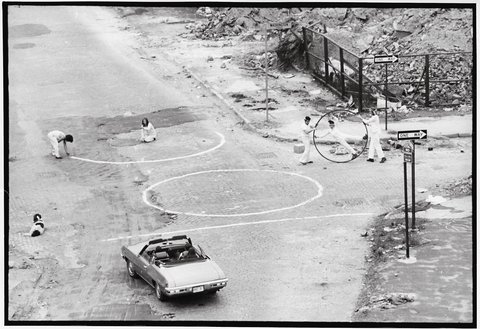
16_joan_jonas_delay_delay_1972_performance_lower_west_side_new_york_ny_1972._photo_by_gianfranco_gorgoni_c_20

Delay Delay (1972) on Lower West Side, New York, NY. Spectators stood on the roof of a building overlooking a large area of empty lots in downtown New York. That performance incorporated ideas of seeing from a distance and seeing from overhead. For more information: https://www.apollo-magazine.com/its-a-record-of-my-life-translated-into-art/
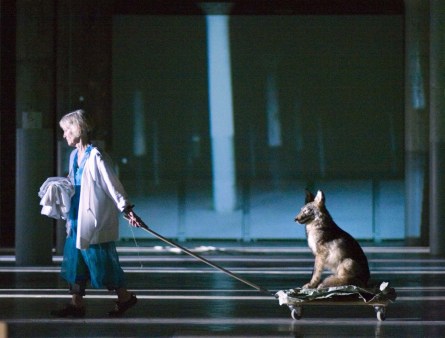
481.1017.jpg

The Shape, The Scent, The Feel of Things (2005), the newest iteration of Joan Jonas’s The Shape, The Scent, The Feel of Things, performed at Dia:Beacon is a sophisticated, layered, and at times exhaustingly complex reflection on diverse cultural source material. The text of this performance is a collage of fragments made up from art historian Aby Warburg’s lecture notes delivered in 1923 to doctors at a Sanatorium in Kreuzlingen, Switzerland, thirty years after his travels in 1896 to the American Southwest, where he visited the Hopi Indians. The lecture was given to demonstrate that he had recovered from a nervous breakdown. It describes the ideas generated by his journey, which had altered his views of cultural history. Jonas interprets and responds to Warburg’s text. For more information: https://www.brooklynmuseum.org/eascfa/feminist_art_base/joan-jonas
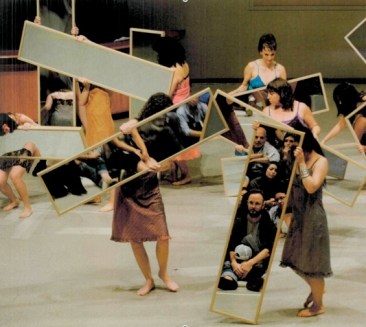
display_37879c241b7c5d3672a3b32359eb6d85.jpg

Mirror Piece (1969) reconfigured at the Guggenheim (2010).  Inspired by the writings of Jorge Luis Borges, featured performers holding large mirrors on stage, slowly rotating them so as to alter conceptions of space and offer shifting reflections of the audience. For more information:

https://www.apollo-magazine.com/its-a-record-of-my-life-translated-into-art/ . Mirror Piece will be reconfigured again January 2019 at Mount Holyoke College

Here are a few models in my portfolio submission for my recent application to show how Jonas’ work has possibility to inform my creative thinking. Note: I am not showing the whole proposal, only relevant parts to this discussion, so it is okay if these presentations seem somewhat decontextualized:
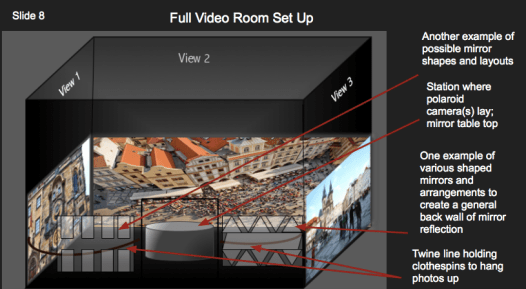
Screen Shot 2018-10-20 at 2.42.30 PM.png

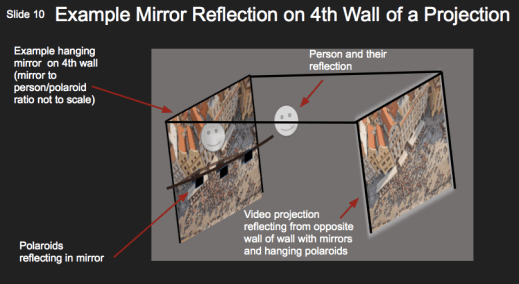
          In one the rooms of my proposed installation, there is a room with video projections. Alongside the back wall, I have envisioned having mirrors along the back wall, in array of shapes, dimensions, and positions as shown above. In front of these mirrors is a twine line acting as clothesline holding photos up. The audience encounters subjective representation multiple ways: Firstly by encountering a photographic image. Secondly by encountering the mirrors along the back wall behind this clothesline. Thirdly by seeing the reflection in these mirrors of the projections on the opposite walls of them where. These projects are intended to be moving images of pre-shot street scene footage. The act of shooting video is a manipulated and subjective art in itself. Jonas’ multi-positionality of  mirrors inspires me to consider how different mounted angles in my piece might expose/conceal the reflections we see from the medium in the first place.
Screen Shot 2018-10-20 at 2.42.24 PM.png

          Above is an upclose example of how I intend to investigate reflection in three different instances and layers. Reflection is embodied through the literal layer of using photographic and mirror mediums. It is also embodied on the conceptual layer of understanding film is a manipulated reflection of reality.  
Screen Shot 2018-10-20 at 2.42.17 PM

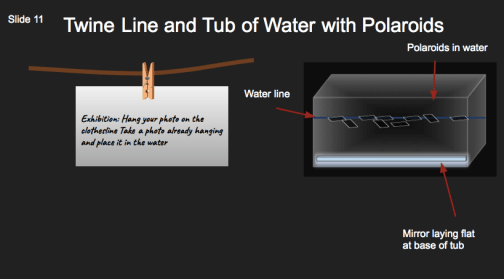
          At one area of my proposed installation, there is a 2 x 3 ft tub of water with polaroids and a mirror lying flat inside its base, as shown. In short, viewers are instructed to take their own photos using a polaroid camera provided in the installation space and hang it up on the close line (show in previous 2 images). They are then instructed to replace their photo with a photo already hanging on this clothesline. This photo that they take off the clothesline is instructed to be placed  this tub of water. Throughout this proposed installation, there is a continual change of the images displayed. The exhibition of photos hanging becomes an organic, changing piece of art as the audience actively manipulates display of photos hanging. Jonas inspires me to probe how the same concept can be examined through multiple mediums. If I were to pursue this installation, I would ponder how the audience might encounter reflection through different mediums in a single space (e.g. through the mechanical reproduction of the photo, through the medium of water, and through the mirror lying in the  water tub perhaps)

-Madeleine Olson
Posted by: Casey L | October 14, 2018

“The Famine Year”: Culpability and Decomposition

Depictions of the famine-stricken Irish in photography often relieve the Victorian viewer of blame. They may indulge in sympathy for the suffering without feeling any responsibility or outrage. At best, the feelings evoked are of charity, an abstract desire to help, particularly since the Irish are generalized as other, a helpless mass. Jane Wilde (née Elgee) uses this convention of pathos in “The Famine Year” to produce a different effect, one that is grounded in evoking guilt.

A few important shifts in the poem mark the loss of the Irish’s humanity. The “gaunt crowd” (15) that is composed of the Irish forced from their homes becomes at the end of the poem a “spectral army” (47). Parallelism is important because it reinforces the cause and effect relationship between the abandonment of the Irish people, their loss of life, and the uniting effect of their shared suffering. Expounding on culpability, the full line is “A ghastly, spectral army, before the great God we’ll stand,” a line that personifies the dead. Losing life ironically empowers the Irish to take on a new, united form—ironic because the dead will not rise, and because famine is disempowering. In both lines, and throughout the poem, the individual is erased in favor of the masses.

The language and imagery used in the poem are overwhelmingly negative. There are only three lines with positive words, and each can be thought of as the deprivation of presupposed comforts: “God meant you but to smile within your mother’s soft embraces” (10), “Better, infant, thou wert smothered in thy mother’s first caresses” (24), and “Now is your hour of pleasurebask ye in the world’s caress” (43, emphases added). Lack is felt better when juxtaposed with what the Irish deserve. Unlike the physical, racialized markers of difference depicted in cartoons, the markers of difference in the poem are between the healthy potential (or healthy English) and unhealthy reality (or unhealthy Irish). Line 10 sets up the idea of a God-given right to pure bodily comfort. Line 24 seems even more unnatural as a result, since the mother directly unwillingly opposes God’s intent. The ultimate sympathetic figures to strike down are the child and its mother. With the simplest pleasures squashed by the speaker—smiling, embracing, experiencing a mother’s love—the reader is forced to acknowledge what they have taken for granted. This culminates in line 43, in which the speaker unites these arguments to argue the supposed English readers (or at least the upper classes among them) have enjoyed relative safety and comfort of their privileged stance in the physical realm, not where God wields the most power.

Compared to a single photograph or an ad requesting aid for those in need, the poem is more akin to a lengthy documentary; Wilde strives to show the process of starvation and mass suffering over time. Through famine, the Irish become animal and skeletal. “Some of us grow cold and white” (14) becomes “our whitening bones” (44), a depiction of the body decomposing. Although the poem is not grounded in political context, the perpetrators are bookended in the first and last stanzas, so the deterioration is not inevitable. While those who deprived the Irish of food were aware of the “Fainting forms, hunger-stricken,” (3) from the beginning, they allowed the fainting to become deadly: “One by one they’re falling round us, their pale faces to the sky” (33). The causality of the tragedy is created by parallel imagery, an escalation that may be partly obscured by the repetition within stanzas. Among the shifting perspectives and smaller-scale comparisons, this parallel imagery penetrates deeper into the psyche. Ultimately, the inhumanity and dehumanization in the poem create a want of humanization that could have only been granted from the English state, but that, in Wilde’s view, can now only come from God.

Resources:

Wilde, Jane. “The Famine Year.” 1847.

Posted by: Isabelle Kirwin | October 13, 2018

Review: “Promise of the Infinite: Joan Jonas and the Mirror”

Review: “Promise of the Infinite: Joan Jonas and the Mirror”

In Dance 390, the capstone course for senior dance majors, I visited the Joan Jonas exhibit in the MHC Art Museum. We experienced each of the four installations, then discussed as a group with museum director Tricia Y. Paik. She focused our discussion mainly on Mirror Pieces Installation II, which is positioned directly across from the doors to the museum proper. Three full-length mirrors, frameless, lean against the wall beneath two hanging garments. The left garment is a black dress with small rectangular mirrors affixed to the chest, elbows, and skirt hem. On the right is a men’s double breasted wool jacket, also black, with mirrors on the lapels, front panels, and hem. Somehow the last noticeable piece of this installation, a black cubic monitor – outdated in style, facing toward the mirrors – is playing a recording created by Jonas in 1969. On Super8 film transferred to HD video, the monitor plays Jonas’s Nudes with Mirrors so that it reflects in the leftmost mirror of the three in the gallery.

The viewer is watching a reflection of the film, which consists of a line of nude people, all women but one, holding full-length mirrors in order to reflect perfect vertical symmetry of their bodies. Another man, also nude, walks through the line of people to retrieve a mirrored jacket, a replica of which is hanging above the mirrors in the gallery. He dons the jacket, then removes it, in a cyclical pattern, walking sideways along the line of mirrored people. They do not acknowledge each other, but the mirrors on the man’s jacket force each person to confront a collection of fragmented images of bodies reflected onto the jacketed man’s body. This experience of the people in the recording is relegated to only one corner of the installation, leaving the remaining mirrors open for reflection of us as viewers. As the nude people see fragments of themselves reflected in the jacket, we too see ourselves, both wholly in the full-length mirrors, and in fragments in the jacket and dress hanging above. This implicates the viewer in the work, including ‘outsiders’ in the work’s performative nature. The mirrors become confrontational, and I found myself moving in order to avoid my full-body reflection. Though I could never see myself reflected in the mirrored garments, I could see other people’s fragmented reflections in the small mirrors and assumed they could see mine as well. Like the people in the recording, I knew my reflection was being transmitted to others, but I did not know what fragmented part of myself comprised these images.

I turned away from the mirrors, and spotted two quotes printed on the wall across the room. One was from Jonas herself, quoted in 2001: “In addition to creating space, a mirror disturbs space, suggesting another reality through the looking glass – to see the reflection of Narcissus, to be a voyeur, to see one’s self as the other…to see one’s self also among, as one with, the others.” Of course this references Alice Through the Looking Glass, and Jonas often receives inspiration from literature, but I feel that Mirror Pieces Installation II relates more to the final part of the quote, seeing one’s self (not oneself, but the self one has) as conflated with the selves of others. The second quote, printed above the first, creates a strange opposition to Jonas’s idea. Quoted from The Library of Babel, Jorge Luis Borges says “In the hallway there is a mirror which faithfully duplicates all appearances.” Despite Jonas’s literary inspiration sources, I find that this decontextualized Borges quote undermines Jonas’s work. Jonas’s mirrors are never faithful; they distort reality in a way that forces the viewer to confront themselves and their perspectives, creating reflection both internally and externally.

The introduction to Jonas’s work in the museum describes her use of mirrors as indicating “that images are not facts, but reflections of our individual imaginations and assumptions,” again incorporating the viewer into the work. This was of course a groundbreaking element of Jonas’s work, and much of her impact in the art field, and Jonas demonstrates the value of reflection by revisiting her own past work. The video of Nudes with Mirrors was filmed by Jonas in 1969, but she created it purely for experimental purposes, with no intention of using the recording as performance based art. She created Mirror Pieces Installation II, incorporating the 1969 film, in 2014. Both dates are listed on the installation’s label as 1969/2014. Dr. Paik describes Jonas’s revisiting of earlier work as part of the “active life of time based performance work,” similar to dance and other performing arts because of its temporality. Though the museum has rented archival recordings, the performances Jonas creates exist only as they are being created, and are not easily reproduced for galleries or collectors. In fact, Jonas resisted the commerciality of visual art, the containment of her work in “the White Cube” of the gallery space.

This resistance forms a conundrum. How is Jonas to be represented in the art world if she rejects the most accessible public exhibition of her work? Obviously she has figured out a way, or else she would not be the most prolific visual art alumna from this college. But the question of how to represent the unrepresentable is a big issue in time based art, and I know as a dancer and choreographer that video never captures the experience of live performance. With Mirror Pieces Installation II, Jonas cleverly created a unique experience that circumvents these challenges. The mirrors create a live performance with the viewers as performers, an experience that is not reproducible even as the installed materials remain the same, and the recorded video continues its cycle.


Works Cited

Jonas, Joan. Mirror Pieces Installation II. 1969/2014. Mount Holyoke College Art Museum, South Hadley, MA.

Paik, Tricia Y. “Joan Jonas Discussion.” 12 Oct. 2018. Mount Holyoke College Art Museum, South Hadley, MA.

« Newer Posts - Older Posts »

Categories