Posted by: Aislin McKaelen | December 7, 2025

Photography in Frankenstein (2025)

Mary Shelley originally wrote her hit novel Frankenstein during the Regency period and set it in the recently passed 18th century. The novel is obsessed with death, a theme that would be popularized in the soon-to-come Victorian era. For this reason, many adaptations of Shelley’s fabulous novel are set during the Victorian period in Europe. One such adaptation is the most recent adaptation, Guillermo del Toro’s Frankenstein.

Del Toro’s adaptation of the classic story adds something that Shelley could not have imagined for her story, a technology that did not exist as she was writing it: photography. The art of photography is prominent throughout the film, a prominent feature in the stories of Frankenstein’s creature and a newly invented character for the film, Heir Harlander.

Harlander introduces photography to the audience. His first scene with the camera shows him creating a “memento mori” image, a popular aesthetic of the Victorian period. The image Harlander is creating, although we never see the final product, is meant to symbolize life and death, showing photography as a budding new art form. Harlander also takes pictures of Frankenstein working on the Creature, documenting the scientist’s progress with his creation. It also speaks to postmortem photography, another Victorian art obsession. While Harlander is not taking photos of someone who has recently passed, he is still photographing a lifeless form, or multiple, depending on the work Frankenstein was currently doing. Harlander’s photography work in this stage of the film is almost twisting postmortem photography on its head. The photographs themselves are documenting something lifeless but Harlander intends to document the process of reanimation, the bringing of life rather than the aftermath of death.

Harlander’s photos still capture death and his and Frankenstein’s obsession with it. It is only through these photos that the Creature, upon discovering them, figures out what he is: a jumbled group of once lifeless body parts sewn together and magically brought back from the dead.


Guillermo Del Toro, dir., Frankenstein, Netflix, 2025.

While reading Bleak House, I was struck by the novel’s fixation on specific aspects of Esther’s illness (coded as smallpox). There are moments in the text where characters seem to fixate on how the illness has changed Esther’s appearance, and Jo later reveals how desperately guilty he feels for having gotten Esther sick. I also got a strong resounding sense from the text that the class differences between Esther and Jo seem to amplify the feelings of guilt and/or shame on Jo’s part (ex: the confrontation scene in Tom-All-Alone’s between Jo and Jenny in “Stop Him!”). Needless to say, there’s a weird interaction happening between class and illness within the novel. 

I realized I didn’t know a ton about smallpox in general, and particularly little about smallpox in Victorian England, so I set out to do a little bit of reading on the subject. The method of vaccination then was much more invasive than current vaccines. Doctors would lance patients’ arms and literally put material from the sores of those infected with cowpox in the wounds. Then, a few days later, the newly infected patient would come back and have the cowpox pustules drained, creating the immunization material for the next patient. This was VERY off-putting for some people, and led to discourse about the safety of vaccines. There were fears that mass vaccination could lead to the spread of other illnesses between those vaccinated, both physical and mental. People also had a lot of gripes with the actual contents of the vaccine, thinking that it was “Unchristian” that the smallpox vaccine originated from the contraction of a disease originating in a non-human species. 

Interestingly, in 1853 (right around the time the second half of Bleak House was being written), there was a fairly strong anti-vaccination movement amongst (predominantly) the British working class. Compulsory vaccination for infants was first introduced in England in the 1850s, but there had been legal and social projects in previous years focused on increasing vaccination rates within working class communities, so vaccination became a heavily classed and stigmatized phenomenon. Since the vaccination process involved actually being infected with cowpox, some vaccinated patients would feel very ill or even die from the exposure to the vaccine. 

Obviously, we are not free from these problems and the resistance towards beneficial medical practices (like vaccines) today. There are a lot of similarities between present day anti-vaccination movements and the movements in Victorian England. Considering the class elements surrounding smallpox in Bleak House, and the overlap between the novel’s serialization with the rise of working-class anti-vaccination movements, I can’t help but wonder whether or not Dickens tried to slip a voice for pro-vaccination with his depiction of smallpox’s impact on the story. 

Bibliography

Dickens, Charles, et al. Bleak House. Penguin Books, 2011. 

Durbach, Nadja. “They Might as Well Brand Us”: Working-Class Resistance to Compulsory Vaccination in Victorian England.” Social History of Medicine, vol. 13, no. 1, Apr. 2000, pp. 45–62. EBSCOhost, https://doi.org/10.1093/shm/13.1.45.

Fitzpatrick, Michael. “The Anti-Vaccination Movement in England, 1853-1907.” Journal of the Royal Society of Medicine, The Royal Society of Medicine, Aug. 2005, pmc.ncbi.nlm.nih.gov/articles/PMC1181850/. 

Watson, Greig. “The Anti-Vaccination Movement That Gripped Victorian England.” BBC News, BBC, 28 Dec. 2019, http://www.bbc.com/news/uk-england-leicestershire-50713991. 

From our readings and discussion in class, Victorian photocollage oftentimes took fantastical and visual choices by combining photographed portraits with painted settings, resulting in dream-like and often absurd environments. Such oddities were not limited to photocollage; they circulated widely across Victorian visual media, including children’s literature (Siegel 28). In Elizabeth Siegel’s Painting With Pictures: The Art of Victorian Photocollage, she highlights the work of author and illustrator Edward Lear, particularly his celebrated Nonsense books. Before producing his nonsense illustrations and poetry, Lear (1812–1888) had established himself as a skilled zoological illustrator. In 1832, the London Zoological Society commissioned him to paint detailed portraits of birds. He later published A Book of Nonsense (1846), dedicated to the grandchildren of Edward Smith-Stanley, the 13th Earl of Derby, a naturalist who admired Lear’s parrot illustrations (“Biography”). Lear’s nonsense pieces also extend well beyond children’s literature with his array of fantastical botanical drawings depicting fish, pigs, tigers and other animals or objects sprouting from flowers like petals, echoing this fascination with imaginative absurdity.

After reading Sigel’s text and researching the artists’ pieces, Lear’s work immediately reminded me of contemporary picture-book artist Eric Carle (1929–2021). In 2015, Carle published The Nonsense Show, a book that blends nonsense and surrealism—elements that are deeply embedded in nursery rhymes and children’s literature, such as the familiar phrase “the cow jumped over the moon.” It is also important to note that Carle is well known for his collage-based art making: he painted acrylics on tissue paper, cut the papers into shapes, and assembled them into figures (“Artistic Process”). This technique produces segmented yet cohesive compositions, vaguely reminiscent of Victorian photocollage and its union of seemingly unrelated elements that are both humorous and whimsical. One illustration, for example, depicts two characters riding in a yellow taxi with the bottom cut out, forcing them to move the vehicle forward with their feet. The accompanying text reads, “Oh dear! Look here: It says ‘NO GAS’ Alas! ‘No gas? Don’t worry. We’re not in a hurry’” (Carle). The simplicity of the rhyme scheme paired with the playful, vibrant artwork underscores Carle’s lighthearted approach to nonsense.

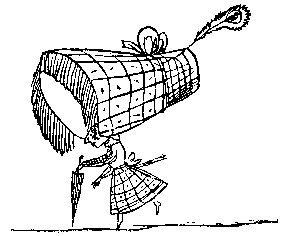
Returning to Edward Lear, A Book of Nonsense contains more than one hundred original illustrations paired with short poems. The book opens with a preface in which Lear offers a brief account of his artistic background and the inspiration behind his nonsense writing. Notably, he also includes a poem about himself, “How pleasant to know Mr. Lear!”, written in the same playful rhyming style that characterizes the rest of the volume. The book’s central poetic form is the limerick: a short, humorous five-line verse following an aabba rhyme scheme. Lear’s limericks typically focus on a single individual located in a specific geographical place, highlighting some peculiarity in the person’s appearance or behavior (“Edward Lear”). For example, one poem reads: “There was a Young Lady of Dorking, Who bought a large bonnet for walking; But its colour and size So bedazzled her eyes, That she very soon went back to Dorking” (Lear 41). The accompanying illustration depicts a woman holding a parasol and wearing an oversized bonnet nearly twice her height. While this playful exaggeration aligns with Carle’s whimsical tendencies, other pages in Nonsense contain more troubling imagery.

Some of Lear’s depictions of characters outside England and the West rely on racialized caricature and exoticization. One particularly concerning limerick states: “There was an Old Man of Jamaica, Who suddenly married a Quaker; But she cried out, ‘Alack! I have married a black!’ Which distressed the Old Man of Jamaica” (Lear 90). The illustration shows the man with a face rendered so dark and indistinct as to be unrecognizable. The accompanying text clearly derives its humor from racial difference and from the shock of a Black man marrying a white woman; a scenario that would have been loaded with social anxieties in the Victorian era. Such content raises questions about whether Lear employed nonsense not only to entertain but also to express, critique, or reproduce political beliefs about race and empire through stereotypes embedded in his verse and imagery.

As someone interested in children’s literature and its formative influence on young readers, I find it important to consider how such depictions would have shaped children’s understandings of people beyond the West. This blending of humor, visual exaggeration, and cultural stereotyping reveals how storytelling and Victorian visual culture could simultaneously amuse and reinforce imperial ideologies. Ultimately, examining Lear’s work alongside Victorian photocollage and contemporary figures like Eric Carle illuminates the complex legacy of nonsense as a genre: one that merges imagination and even cultural commentary. Rather than ignoring literature that brings discomfort to audiences including myself, I believe it is of utmost importance to continue viewing and critiquing works such as Lear’s for the purpose of knowing how these ideas developed and continue to seep into modern-day culture.

Works Cited:

“Artistic Process.” The Eric Carle Museum of Picture Book Art, https://carlemuseum.org/about/about-eric-carle/artistic-process

“Biography.” The Edward Lear Society, https://edwardlearsociety.org/biography/

Carle, Eric. The Nonsense Show. Philomel Books, 2015. 

“Edward Lear (1812-1888).” Poetry Foundation, https://www.poetryfoundation.org/poets/edward-lear

“Edward Lear’s Nonsense Botany (1871-1877).” The Public Domain Review, https://publicdomainreview.org/collection/edward-lears-nonsense-botany-1871-77/

Lear, Edward. A Book of Nonsense. London, Frederick Warne & Co., ltd, 1846.

Posted by: Angel Crow | November 23, 2025

Visuality and Spectacle in Del Toro’s Frankenstein

Adaptations often receive backlash from fans of literary works but on the whole Guillermo del Toro’s Frankenstein appears to be well received by the general public. The movie has received 85% on Rotten Tomatoes, 4/4 by Roger Ebert, and 7.6/10 on IMDB, demonstrating a positive reception by the majority of viewers and critics. Much of this is likely due to the visuality and respectful adaptation to the 1818 novel by Mary Shelley in combination with the 1931 film. The use of realistic movie techniques instead of CGI, rich palettes and details in the sets, decor, and costumes makes this gothic fantasy come to life. Many of the sets were built on site or in miniature and the costumes were breathtaking, inspired by science such as the blood cells in Elizabeth’s dress and Gothic fashion. The boat was built on a gimbal, the torches used real fire, and the shots were cinematic and wide, similar to Lawrence of Arabias far away shots showcasing the landscape and then moving into a close up creating movement, depth, and dynamic imagery. 

While I was watching the film I couldn’t help but view the movie through critical eyes, both as I conduct independent research on the 1818 novel Frankenstein, by Mary Shelley, but also as influenced by our course. The book predates the Victorian era, coming out in Georgian times with the 1831 version coming out 6 years before the start of the Victorian era. However, when interviewed by Harper’s Bazaar, Costume designer Kate Hawley kept mentioning the Victorian era. He stated, “When I think of Victorian, it’s very hard not to think of Oliver Twist or Little Dorrit. But this is Frankenstein. It has that Germanic kind of backdrop.” While it is a minor detail, I found this a bit irksome, I would hope that consideration for the film’s creation would have acknowledged the novel’s time period more accurately. 

Guillermo del Toro claims the 1818 version is “his bible,” and he was largely influenced by it and the 1931 film, which I have not seen. That being said, as an undergraduate who chose their senior independent study project to be singularly focused on the novel, I have some big feelings about the film. When I started watching the film I had a visceral reaction as so much was out of order, out of touch with the characters I read and loved, and just seemed so over the top. I still don’t agree with a lot of choices del Toro made, especially with Victor, but by the end of the film I did enjoy it. The visual choices were very hard to ignore and it is a very beautiful film, despite the gore. 

Del Toro wanted to make the 1818 novel his own, “to sing it back in a different key with a different emotion.” His choice in colors in the introduction is obvious, the blue, white, and grey emblematic of isolation of the arctic convey the isolation and despair of the captain Walton and his men, Victor, and the creature. Cinematographer Dan Laustsen calls the coloring of the film an “amber-and-steel-blue” palette. Amber reflects a similar color to sun and candle light and steel blue the sky in addition to the cold of ice. This fastisiousness to the truth of reality really helped to sell the visual impression that this fantasy world was real. Introducing Victor and the creature in the cold blue of the arctic is also emblematic of the coldness Victor has towards his creature and the isolation of the creature’s birth. The warmth of Captain Walton’s cabin fire is also an allegorical reference to the hearthspace allowing the kind of vulnerability shown in the characters in the end. 

Del Toro’s choice to introduce the creature in darkness to men huddled around torches illustrates the way in which individuals and society behave towards the creature while simultaneously illustrating their fear of his otherness. His introductory cry in the darkness could be interpreted as a roar of pain, injustice, despair, at his existence, one of loss of his prey, or the fear the creature imparts upon others. By the end of the film the story has evolved to show the creature as a victim of his arrogant “father’s” ambitions. The film truly shines in its portrayal of the creature in its third act with the redemption arc and nod to the 1931 film’s bride of Frankenstein. 

The women’s costumes match and foreshadow the blood and gore of Victor’s macabre research. His mother appears in a splendid red gown with a red veil that flows in the wind many feet above her while she waits for Victor’s father to return. The flowing veil may represent her soon to be departure from life and matches the inlay of her coffin. She leaves a red handprint on Victor’s white costume and he then wears red gloves and has red bed sheets as an adult. The spinal accents of the creature’s coat matches the spinal details of Elizabeth’s dress. And Elizabeth’s bridal gown becomes red as she dies exposing a ribcage bodice. These details create a common theme throughout the film tying the story and characters together in a morbid web. 

Overall the visuality of the film is cohesive, creates strong emotions in the audience and takes viewers on a journey of spectacle in a fictional world. The colors, themes, and details create both shocking gore and beauty in the way they are presented. While the film may not hold true to the 1818 novel, it keeps the essence of the creature’s vulnerability and victimhood. It is a story of redemption, hope and healing, and love.   

Romero, A. (2025) Guillermo del Toro Frankenstein: Director Explains Adaptation for Mary Shelley Day, Netflix Tudum. Available at: https://www.netflix.com/tudum/articles/frankenstein-book-adaptation-guillermo-del-toro.  Accessed 16 Nov. 2025

“Frankenstein (2025).” Rotten Tomatoes, 17 Oct. 2025, www.rottentomatoes.com/m/frankenstein_2025.  Accessed 16 Nov. 2025

Webster, Stephanie. “Mary Shelley | How Old Was Mary Shelley When She Wrote Frankenstein?” History Associates Incorporated, 30 Aug. 2023, www.historyassociates.com/the-last-woman-standing-mary-shelley-and-the-enduring-power-of-frankenstein/.  Accessed 16 Nov. 2025

Roxborough, Scott. “Cinematographer Dan Laustsen on Guillermo Del Toro’s ‘Frankenstein.’” The Hollywood Reporter, 17 Nov. 2025, www.hollywoodreporter.com/movies/movie-news/cinematographer-dan-laustsen-frankenstein-del-toro-elordi-1236428714/.  Accessed 18 Nov. 2025

Sanchez, Chelsey. “Inside the Making of Guillermo Del Toro’s Frankenstein Costumes.” Harper’s BAZAAR, 29 Oct. 2025, http://www.harpersbazaar.com/culture/film-tv/a69180730/frankenstein-kate-hawley-costume-designer-interview-2025/. Accessed 19 Nov. 2025.

Posted by: Sasha Shishov | November 18, 2025

Lady Dedlock and her Obsession with Windows

I’d describe one of my closest friends as having an obsession with sitting in windows. Anytime we are within the vicinity of a window with a ledge, she always finds a way to perch within its frame. I also love a good window seat, but her insistence on enjoying a window scene stands out to me. Some people and characters are just drawn to windows more than others, and within Bleak House, there is no better encapsulation of this characteristic than Lady Dedlock. What is so important about Lady Dedlock, a character contained within her visuality, constantly looking out of a window? More importantly, what does this say about Dickens’s interest in the window as a literary space? 

One search on LITS for windows and Victorian culture yields an astonishing amount of sources. In this article by Katherine Williams, I learned about the window tax, first introduced in 1696. To summarize briefly, households were taxed proportionally based on the number of windows their homes had. This acted as an early form of income tax, as houses with more windows were naturally bigger in size, therefore belonging to more affluent families. However, Williams writes that this encouraged builders to plan houses with fewer windows and also prompted individuals who could not afford the tax to board up existing windows. It wasn’t until 1825 that “light-deprived householders got a break” and the tax was amended to exclude “dwellings with fewer than eight windows” (Williams 56). Yet, landlords were still incentivized to lease homes with less than eight windows. This period during which houses were constructed without windows, meant that many lived without access to light for quite some time. Without windows, the lower class was shut off from the world and human connection, which naturally brought about hopelessness and psychological upset. 

The article further explains that Dickens viewed the window as representing health and safety, and was thus staunchly anti the window tax. So, when he writes about the window space, it is inherently political, moving beyond being just a place for psychological reflection. Furthermore, there is something inherently strange in seeing the window as a method for accessing total truth, as even glass itself is a product of industry. The production of glass is a representation of industrial mystery, produced by “faceless men in a factory system” who “forge a gleaming, modern substance out of natural elements…all on a massive commercial scale” (62). Glass, previously handmade, is now mechanized, and yet when we look out a window, we do not see that labor. 

Given that Lady Dedlock has married into the estate, the building old and part of a generational inheritance, the window pane she looks from was likely made before large-scale glass production. This would make the window imperfect, handmade. So while I may think of glass as able to grant me a true picture of what lies outside, old windows are slightly opaque, tinging truth. Glass also reflects back an image of yourself, placing your likeness against the landscape. In this might lie part of Lady Dedlock’s attraction to the window, wishing to see herself as outside and not trapped within. Bleak House is a novel largely concerned with obscured truth and partial truth, down to employing both an omniscient narrator and Esther, a biased narrator. Therefore, it makes sense that the window is working out this anxiety, not as inherently truthful as what may first be assumed. 

Lady Dedlock epitomizes Dickens’s fears about photography and its uncontrollable proliferation. Her image is distributed outside of her knowledge, which causes her greatest secret, her motherhood, to be exhumed. But even further, she is shrouded in partial knowledge. The narrative is quick to call her bored and fanciful, these words obscuring the true nature of her dissociation based on the trauma of losing a child (or the belief that she had). We are repeatedly told to misread her. One of the only indications that something might be bubbling under the surface is found in her insistence to be near windows. We are not allowed to know what she might be transposing onto the surface of the glass, what inner narratives might be playing out. But we are given a description of what her window looks like: “The view from my Lady Dedlock’s windows is alternately a lead-coloured view, and a view in Indian ink” (Dickens 21). These windows are largely opaque as if spilled on by ink, making the window stained glass. Stained glass is often a method of storytelling, and so it can be inferred that Lady Dedlock is using the window to read her own story, one reflecting her feelings of captivity in the austere house. 

Williams’s article describes the camera lens and the window as synonymous. The camera works by “doubling the eye” magnifying “behind glass plate windows” to make “marketable goods seem intense and dramatic” (67). Lady Dedlock is often described as a physical fixture of the home, interested in the material. So, she can be read in this context as a marketable good and an active participant in commodity culture, made dramatic by her physical appearance. The camera, or the perception of the reader, doubles reality; Dedlock is both a bored wife and a grieving mother. One reality does not see the other. 

If the camera and the window are “a frame for what is inside and what is outside” then Dedlock is left to imagine an outside world through the window (59). Sitting on this threshold, she is both what is seen and also what sees. This connection between surveillance and the inside/outside is something I’ve been thinking about a lot in regards to our own increasingly surveyed society. We are becoming used to being seen, acting as cameras to our own peers. We are primed to document our movements and the movements of others, normalized by the increasing presence of technology in all facets of life. Reading Dedlock’s descent into madness as partially due to her surveillance is a reminder to me that the human psyche is not naturally comfortable in a state in which it might be constantly watched.

Works Cited

Dickens, Charles. Bleak House. Edited by Nicola Bradbury, Penguin Publishing Group, 2003.

Williams, Katherine. “Glass Windows: The View from ‘Bleak House.’” Dickens Studies Annual, vol. 33, 2003, pp. 55–85. JSTOR, http://www.jstor.org/stable/44372073. Accessed 22 Oct. 2025.

Posted by: Abigail McKeon | November 16, 2025

Is “Goblin Market” Queer?

Christina Rossetti’s poem “Goblin Market” has been lauded as “the gay poem” over the course of my semester in Victorian Literature. Whenever I mention that Rossetti’s work is on my syllabus to another person familiar with queer literature, I am met with sparkling eyes and an eager smile. “Oh, that poem!” they say. “Just wait until you read it.”

I was excited by the poem’s glowing reviews, but skeptical about the actual amount of queer content in “Goblin Market.” I have repeatedly been forewarned about my Victoria-era readings’ excessive queer content, but am disappointed again and again to find that this content usually amounts to an especially close relationship between two characters, an ambiguous line or two of dialogue, or some unconfirmed allegations about the author’s sexuality that are hardly reflected in their work. I assumed that “Goblin Market” would be similarly vague, leading to a few minutes of class discussion about Victorian societal norms and female friendships before the closure of the topic. Still, I began reading Rossetti’s work with a watery sense of hope.

“Goblin Market” centers two female characters, who are apparently sisters: Lizzie and Laura. When the girls see the fantastical fruit market run by goblins that habitually appears in their town at dusk, Laura is tempted by their wares, despite Lizzie’s warnings that buying from the goblins will cause her to waste away and die. Laura ignores Lizzie’s warnings, eventually paying the goblins with a lock of her golden hair and gorging herself on the fresh fruit that they sell. Then, as Lizzie had said, Laura slowly wastes away, longing for more fruit but unable to find the magical marketplace for a second time — it appears that vulnerable shoppers can only eat at the market once. After Laura seems on the point of death, Lizzie becomes desperate and seeks out the market herself, trying to pay for fruit — with a coin, rather than her hair — that she can bring back to Laura. The goblins are angry that Lizzie herself refuses their fruit, and try to force her to eat it, smearing it all over her in the process. Lizzie resists, and the goblins finally allow her to escape home. Lizzie gives Laura the dregs of fruit that are mashed over her body, and Laura faints away, disgusted by the goblin fruit’s true foul taste, overwhelmed by her experiences, and finally set free from the demonic spell. When she wakes up, she is healthy again, and she and Lizzie later part ways to happily marry and have children, saved from the wasting disease of the goblins.

After hearing this summary, many would argue that “Goblin Market” has no queer connotations at all. Firstly, and most obviously, Lizzie and Laura are written as sisters. I initially wondered if this was a term of endearment rather than a marker of actual blood relation; but, I soon found that Christina Rossetti had dedicated “Goblin Market” to her own sister, Maria Rossetti (Rossetti 884). The poem also ends with these words of wisdom: “For there is no friend like a sister / In calm or stormy weather; / To cheer one on the tedious way, / To fetch one if one goes astray, / To lift one if one totters down, / To strengthen whilst one stands” (20). This cheerful passage, combined with the poem’s dedication, seems that it can only signpost a platonic, sisterly relationship between Lizzie and Laura. Though the poem never explicitly states that Lizzie and Laura are really related, it seems likely that Rossetti intended for them to be. The somewhat abrupt happily-ever-after ending, in which Lizzie and Laura marry unidentified men and become mothers, also works in conjunction with these elements to firmly root Rossetti’s female leads in the world of heterosexuality. Despite a harrowing magical adventure in their youth, the girls clearly grow up to be functioning members of Victorian society, with their escapades reduced to “Those pleasant days long gone / Of not-returning time” and their purity restored in the form of golden hair and a desire to complete household chores (Rossetti 19).

Even if queer relationships were not at the forefront of Rossetti’s mind as she created “Goblin Market,” it seems certain that there is some intended double meaning behind Lizzie and Laura’s perils. It is possible that Laura’s burning need for the goblins’ fruit is meant to represent struggles with addiction; Rossetti writes that Laura “gnashed her teeth for baulked desire … She no more swept the house … But sat down listless in the chimney-nook / And would not eat” as her hair grayed, her health dwindled, and her body wasted away (12-13). It also is possible that Rossetti intended to analogize sex work, or extramarital sex. Rossetti herself worked at a penitentiary for “fallen women” around the time she wrote “Goblin Market,” and may have wanted to represent the issues that the women she met there faced (Black 517). Lizzie makes a reference to a former victim of the goblins, who “should have been a bride; / But who for joys brides hope to have / Fell sick and died” (Rossetti 13). This seems to refer to a woman who threw away her respectable marriage prospects in order to eat the “forbidden fruit” that the goblins offered up, a clear allusion to extramarital sex. Additionally, the goblins’ behavior toward Lizzie and Laura is overtly sexualized: Laura literally sells a part of her body — her hair — in order to gain access to the “fruits which that unknown orchard bore,” which she “sucked and sucked and sucked … she sucked until her lips were sore” (Rossetti 8). When Lizzie visits the goblins, they “hugged her and kissed her, / Squeezed and caressed her” to compel her to “suck” their fruit (Rossetti 14). When she refused, they “tore her gown and soiled her stocking … Held her hands and squeezed their fruits / Against her mouth to make her eat” (Rossetti 15). Here, the fresh fruit — a rarity for most Victorians — seems to represent both an incentive that the women are willing to commodify themselves for, as well as a phallic tool of subversion that the goblins use to control the desperate young women who seek them out.

Though there are several interpretations of the meaning behind “Goblin Market,” reading the text as a queer narrative is another valid route of analysis. Despite being labeled as sisters, Lizzie and Laura act in ways that are undeniably romantic. Most prominently, Lizzie’s delivery method of choice for the fruit she retrieves from the goblin market for Laura is explicitly queer. After seeing that the fruit is crushed over her body, she asks Laura, “Did you miss me? / Come and kiss me. / Never mind my bruises, / Hug me, kiss me, suck my juices … Eat me, drink me, love me; Laura, make much of me” (Rossetti 17). Laura, accordingly, “kissed and kissed and kissed her: / Tears once again / Refreshed her shrunken eyes, / Dropping like rain / After long sultry drouth; / Shaking with aguish fear, and pain, / She kissed and kissed her with a hungry mouth” (Rossetti 18). Undoubtedly, Laura’s enthusiastic ravishment of her savior seems more than sisterly; it is certainly a more direct portrayal of love than most other queer Victorian texts I have come across. The girls are also described as kissing each other on two other occasions in this short poem, and are said to sleep “​​cheek to cheek and breast to breast / Locked together in one nest” (Rossetti 10). “Goblin Market” even opens with the two lying hidden in the tall grass by the brook, “close together … With clasping arms and cautioning lips, / With tingling cheeks and finger tips,” as Lizzie “veiled her blushes” (Rossetti 6). Though of course plenty of non-romantic relationships allow for physical affection, Lizzie and Laura’s prolonged entanglements have an overwhelmingly sapphic association. Lizzie’s solo journey to the goblin market also speaks to her deep love for Laura. Despite knowing that she risked her own life, Lizzie chose to value Laura’s salvation over her own needs and fears, and did not acquiesce to the goblins until she had accomplished her mission of collecting fruit for her beloved. The use of fruit as a symbol also connotes Eve’s biblical temptation for the original “forbidden fruit,” representing her disobedience to God. In this context, the fruit that Laura lusts after may represent another disobedient, sinful desire: her love for Lizzie.

Christina Rossetti may not have intended for “Goblin Market” to be an allegory for queer joy that was oppressed by Victorian societal expectations. Yet, this is how I — and many others — choose to interpret her work. I don’t know what Rossetti was doing with her sister; but, to me, it seems as though Lizzie and Laura bear a romantic love for each other rather than a familial closeness. Queer readings of other Victorian works often rely on foggier pieces of evidence, from conversational subtexts to mysteriously broken engagements. When a poem like “Goblin Market” is discussed, and blatant acts of romantic love are described in detail, it seems fair to point unfamiliar readers toward it with eager smiles and sparkling eyes. “Oh, that poem!” I’ll say. “Just wait until you read it.”

Works Cited

Black, Joseph, editor. The Broadview Anthology of British Literature: The Victorian Era. 2nd ed., vol. 5, Broadview Press, 2011.

Rossetti, Christina Georgina. The Complete Poems. Penguin Classics, 2001.

Posted by: cateh2 | November 16, 2025

Entertainment, Spectacle, and the Distortion of Photography

On September 27, 2025, I went to the Big E with my parents, sister, and two of my younger cousins. The Big E is a massive event held for 17 days every year in West Springfield by the Eastern States Exposition (ESE), first held in 1917. It has the traditional fairground elements, such as fried food, rollercoasters, and small games where you can win prizes. However, it also has unique elements such as “The Avenue of States”, a line of buildings with each one representing a New England state, selling signature foods and trinkets within. One event that has struck the attention of my siblings and I ever since we started going is the pig race. Twice a day, three or four miniature pigs at a time are set loose on a small track and challenged to see who can run the fastest to the end. Stands are constructed around the track, and they quickly become overflowing when the race is about to start. There’s music, an announcer, screams from rollercoasters in the distance, which all get drowned out by the roar of the crowd when the pigs set off and one wins only seconds later.

With Victorian Visual Culture in mind, I am lead down two paths of thought. For one, the Big E is a humane, ethical venture that aims to promote local businesses, artists, and farms, and the ESE is a non-profit. On its own, the event caters to every one of the senses, with bright, flashy colors, rich foods, and more. However, I can’t help but think of other, more disturbing media that depict a chase after sensationalism, new technologies, and shock value–particularly regarding animals–and disregarding ethics. For example, the film “Poor Things” (dir. Lanthimos, 2023), which proposes a Frankenstein-like scientist that combines different animals and human beings together. The film examines the detrimental effects of a man playing at God, the development of biology and technology, and what conformity (and nonconformity) looks like in Victorian England. It additionally questions how to make sense of your own identity while being forcibly defined by other peoples’ perceptions of you manifold, a question that is very relevant to interrogating the popularization and spread of photographs.

The second path of thought that struck me was how technology both expands and interrupts “real life”. When I went to see the miniature pig race at the Big E, my family arrived late so we had to stand at the back of the crowd. We couldn’t actually see the pigs from our position, but several people were filming with phones or cameras, so even though I was only a few feet away from the track I ended up watching through someone’s phone they were using to record. His phone provided a workaround and made the event accessible to me, albeit in a strange way, but it felt truly bizarre. I was right there – and yet it was like I wasn’t watching the race in person. It both brought me closer to and abstracted reality.

Posted by: hanso23e | November 16, 2025

Race in “The Romance of a Shop”

When reading The Romance of a Shop by Amy Levy, I was struck by the suddenness and the ease in which racial slurs were used by the Lorimer women and by the author herself in her narration of the story. It reminded me that we need to pay attention to how active women were in participating in and upholding the system of racism and enslavement. 

The Lorimer sisters are encased within a world that is described in feminine terminology, as the bonds between the sisters are, at the beginning of the novel, the most important relationships the sisters have. The novel is a detailed account of middle-class life for white British women, and is primarily situated within the bounds of the photography studio that becomes both the domestic and work-related realm of the Lorimer sisters. Though the novel doesn’t offer a sophisticated account of race relations at the time, we can still pull out important fragments that offer readers glimpses of the absent presence of racial tensions in the minds of white British women. 

The first instance of a racial slur being used is by Lucy, who says that the girls must “work like *******, and not have very much to eat” in order to get their photography studio ready for the public (Levy 35). Linking unpaid, domestic work to the system of enslavement reveals what might be an understanding grounded in solidarity between two oppressed groups, but that possibility is shut off through the usage of incredibly violent descriptive language. Enslaved people’s labor is degraded, and the Lorimer sisters use this particular racial slur as a way to center their own struggles with unpaid domestic labor. The Lorimer’s unpaid work is also a temporary arrangement, as once they are finished setting up their studio, they will be able to receive monetary compensation for their work. This is not the case for enslaved people, making this comparison another example of the way that the labor of enslaved people is deliberately invisibilized. 

The second instance of the slur being used is by the omniscient narrator, who describes that “Gertrude worked like a ****** that day, which fortunately for the state of mind, turned out an unusually busy one” (Levy 78). As a reader, the way that this racial slur is used in the exact same context both times is significant. Both the narrator and the Lorimer sisters act as uncanny, robotic arbiters of the way that racialized labor appears in this text. Clearly, there is something troubling about the system of enslavement to them, but these ideas don’t fully surface in their minds to form a coherent critique of it. Racism appears in the text as anxious, repetitive fragments.

The language of empire is also central to this story’s progressive push toward a resolution. When Frank Jermyn is tasked with going to Africa to make engravings of the war happening there for The Woodcut, neither the sisters nor the men around them acknowledge any specific details of the war. In fact, when Frank Jermyn’s engravings are published, Phyllis is described as “yawning over a copy of The Woodcut; which was opened at a page of engravings headed: ‘The War in Africa; from sketches by our special artist’” (Levy 117). The sisters are not emotionally moved by the circumstances, nor are they acknowledging the British empire’s role in the violence of war. “The War in Africa” becomes something for Phyllis to yawn over within the confines of her domestic space, as the entire concept of “Africa” is verbally and visually abstracted in this novel. Frank’s illustrations are not described in any detail, shutting down any possibility of a visual representation of the violence in Africa for the reader. 

Examining the way that race shows up in Victorian texts sometimes means reading into the perceived absence of race, as characters like the Lorimer sisters seem uninterested in acknowledging the system of enslavement but still find significant ways to commit verbal violence. The presence of slurs needs to be expanded upon by scholars instead of being casually looked over as “products of the Victorian era,” as the context around their usage is significant. In this particular context, racial slurs are linked to labor, revealing a piece of Victorian women’s attitudes toward the racialization of work. It’s useful to ask ourselves: What slur is being used and why? What does this reveal about the representation of race in Victorian texts? This work is part of filling in the scholarly silences around race in the Victorian era, and a way to take white women’s complicity into account. 

Works Cited

Levy, Amy. The Romance of a Shop. Mint Editions, 1888.

Shortly after finishing Bleak House, I decided to start the 2005 BBC limited series adaptation of the book. I was curious to know how faithful an adaptation it might be given the book’s sprawling narrative, and how the visual aspect of a book to TV adaptation might change my perspective. I was also interested in reading reviews written at the time, keenly aware that adaptations bring up many social, political, and fandom issues (Aislin’s post from earlier this semester examines some contemporary discourse around adaptation, I hope to add to that discussion). 

The class disparities that Dickens critiques in the novel are thrown into harsh relief in the show. As with many Victorian period dramas, we see fabulous gowns and stately homes, but given Bleak House’s focus on class, we also see people on the streets in dirty clothes and shadowy, overfilled apartments. During scenes with Mrs. Jellyby—a particular interest of mine—her house is so dark it is hard to get a sense of the space, and in the claustrophobic rooms, the chaos of the screaming children takes over the screen, drawing viewers in. Mrs. Jellyby’s character comes across even worse in the show, with her blithe tone of voice and dramatic movements rendering her both foolish and callous. Her scenes are even played for a bit of humor, since the juxtaposition between her attitude and her material reality is so stark. While this is true to her characterization in the book too, the show brings it to life in a visceral way. The other particular strength of the show, in my opinion, is that it hammers home the youth of Esther and Ada, and the burdens placed upon them from a young age. Just seeing their young faces (Ada is played by a very young Carey Mulligan; this show was released the same year as her first feature film) made everything we read feel more emotional. 

The show feels like a fairly comprehensive adaptation, but I turned to critics to lend insights. Perhaps unsurprisingly, a key topic of discussion was the very concept of watching an adaptation at all; many argued that a TV show could not in any way add to the story of “the greatest novel in the English language” (words from Philip Hensher’s negative review in The Guardian. Hensher’s language is disparaging, framing reading the novel as inherently superior to watching the show. Last year, I took a class on adaptation, and we learned about the concept of the fidelity model, where film and TV is seen as most legitimate when it imitates literature as closely as possible. Film and TV are often seen as inferior to literature, and adaptations are often viewed only through how closely they resemble their source text, ignoring the unique political factors, production systems, and artistic choices that make the adaptation an entirely new text, joining a broader conversation. 

The Bleak House miniseries is fairly uncomplicated to analyze through the lens of adaptation struggles. It does try to closely adapt the text, and any changes or omissions seem to have been made out of narrative necessity. I enjoyed it as a show that successfully brings the book we have done so much work on to life, and found moments in it that genuinely tugged at my heartstrings. But it also made me think about adaptations more generally, in an era when so many acclaimed directors are choosing to adapt famous works of Victorian literature. To me, it will always be worth asking what is lost and what is gained when we watch or read adaptations. Victorian literature has always been a site to examine class, gender, race, and politics, and every bit of scholarship or creative adaptation builds upon that. Our discussions about hating Victorian Studies properly prove that even calling for a deconstructionist approach to an entire field moves the needle forward in important ways. 

Overall, I enjoyed the experience of viewing the show through the lens of multiple concepts I’ve learned throughout college, and recommend to anyone who feels like returning to Bleak House

Works Cited: 

Hensher, Philip. “You’ll Never  Catch Me Watching It.” The Guardian, The Guardian, 7 Nov. 2005, http://www.theguardian.com/media/2005/nov/07/broadcasting.arts. Accessed 11 Nov. 2025.

Posted by: Maire K | November 15, 2025

The West and the Rest: Levy and the Tourist Gaze

After class discussion on ‘geographic imaginaries’ in Amy Levy’s novella The Romance of a Shop, I am interested in how characters’ mapping of geographies beyond the West influences readers’ understanding of place. Within the novel, London is rendered as a concrete, locatable environment with a specificity of addresses such as the photography studio on Baker Street or lengthy descriptors of the London area. This precision clearly stands in contrast to the way other countries are presented: broad, indistinct territories rather than coherent, lived spaces. As a result, these “othered” locations appear as alien, exotic, and saturated with stereotypes.

These ideas are further illustrated in the scene where Phyllis reads aloud from the Waterloo Place Gazette: “‘More fighting in Africa.’ Ah, here’s something interesting at last—‘We understand that the exhibition of Mr. Sidney Darrell, A.R.A. ‘s pictures, to be held in Berkeley Galleries, New Bond Street…” (Levy 79).  Phyllis’ rapid shift from violence in Africa to a Darrell’s art exhibition, reveals not only a lack of sympathy for individuals positioned outside of the English identity but also a sense of detachment from the space. At this moment, Africa is a distant site of conflict that feels disconnected cognitively and emotionally from the sisters’ world. The war in Africa only then becomes relevant later in the story when there is a rumor that Frank might be among the casualties. 

What is most striking is how these concepts reflected in Levy’s The Romance of a Shop continue to shape perceptions of places beyond the West today. Contemporary discourse still tends to categorize regions outside Europe into homogenized, indistinct spaces, and even narratives of tourism often reproduce this sense of otherness. Expressions of surprise such as “I can’t believe they have [literally any large franchise] here” perhaps reveal an underlying assumption that modernity and cultural “normalcy” are primarily Western attributes. This dynamic is intensified when travelers choose to visit countries experiencing war, economic distress, or social upheaval, often exacerbating local challenges and contributing to financial burdens for residents. In Levy’s novella, a similar pattern emerges in Frank’s travels to Africa to produce art amidst conflict. He approaches the region primarily as a site for aesthetics rather than engaging with the lived realities of those who inhabit it. In both cases, these non-Western spaces are consumed as resources whether for artistic inspiration, leisure, or spectacle.

Work Cited: Levy, Amy. The Romance of a Shop. Mint Editions, 2021.

« Newer Posts - Older Posts »

Categories