In the time since COVID-19 shutdowns and isolation, I feel I’ve forgotten to reflect on lost time and tend to conceptualize that period as a big blank space, void of color and meaning. Mount Holyoke College Art Museum’s exhibit “Long Distance Relationship,” details the defiance of color and artistic connection in isolation. The virtual exhibition was offered by students involved in “Senior Studio,” Class of 2020 and 2021. These students describe how though isolation stifled artistic discourse, which is the backbone of most considerable works in visual culture, “new territories” emerged to maintain artistic connection, such as “Zoom, Google, Discord, Instagram, Facetime, Moodle,” and, “Spotify.” The exhibition’s categories include “Fragmented Bodies, Stitching Past into Present, Constructing Memory, and Chromatic Abstraction.” What drew me to this exhibit was the idea of persevering connection through digital and impressionistic means, like photography (Zoom), writing (Discord), and music (Spotify). The exhibit itself represents visual culture, but what’s most striking is the way visual culture benefits human connection and the endeavor to create, first. I’m reminded of a popular tweet about the value of visual culture–movies, books, photos, art–and that being the life raft that kept humans afloat during COVID-19, but the tweet itself was what I find significant. The desire to communicate about visual culture speaks to the encouraging value of connection through art. Much of the art I intend on discussing remarks on the intended value of art. Whether a piece represents a human, looking at nature as a reflection, making oneself from nature, and the cyclical experience of becoming and unbecoming a self through art. Discussions create this art, and from this art, discussions spark – connection, connection, connection. The humanity embedded in art is significant in all of these pieces, and the artists explore the dimensions of representation as impressionistic or limiting.
To begin, I’m interested in Anaïs Quiles-Lewis’s pieces.

This artist opens with a question “What extent is [art] in response to the world around us?” This question primarily refers to the construction of identity in art, the degree to which a person can be themself, and how this manifests in self-portraits (self-representation). This paired with their photography implies the question of “truth.” The artist titles their piece, “I finally know,” playing into this idea of coming to know oneself due to objective photography, whilst being unable to break free from the constraints of photography and form. Quiles-Lewis writes, “ As I press my face onto the glass, my form becomes crushed by my physical weight[…]As I move around in an attempt to free myself, I become more distorted and more trapped.” The artist concentrates on the concept of a “copy of oneself,” which reminds me of Oscar Wilde’s portraits, hating the impression of himself. He struggles, as this artist demonstrates, to understand which dimension of himself is the copy, his photograph, or his idea of how he looks.
This idea is somewhat abstracted in Levi Brooker’s thesis project, Flesh and Mud: Bodily Construction Through Handmade Paper. Brooker radicalizes truth in their art by making casts of their body with handmade paper and exposing it to the world.

The sense of ownership defies Wilde and Quiles-Lewis’s idea of representation as limited by highlighting the act of “hyperawareness” and therefore stripping it of its power. The artist conceives of the creations as “monstrous or mythical hybrids to reflect the experience of being “othered,” which I conceive as a relieving measure of expectation, and allowing the body to be a body, and not a truth. By being able to see all dimensions of the body–a head, an arm, etc–unlike photography, the human form becomes regular and not representative of value. By utilizing nature in papermaking, the artist heals this sense of being “unseen,” by virtually invisibilizing nature in art while specifically crediting nature as the makings of their art. Nature is supposedly “unseen,” and yet allows for creation–nature is (in) everything.
This sentiment is further explored and yet inverted in Micha Haftl’s exhibited art. The pieces “All or Nothing,” and, “Looking Up/I Hope You Feel Awe,” are pastoral examinations of nature and the human impression of it.
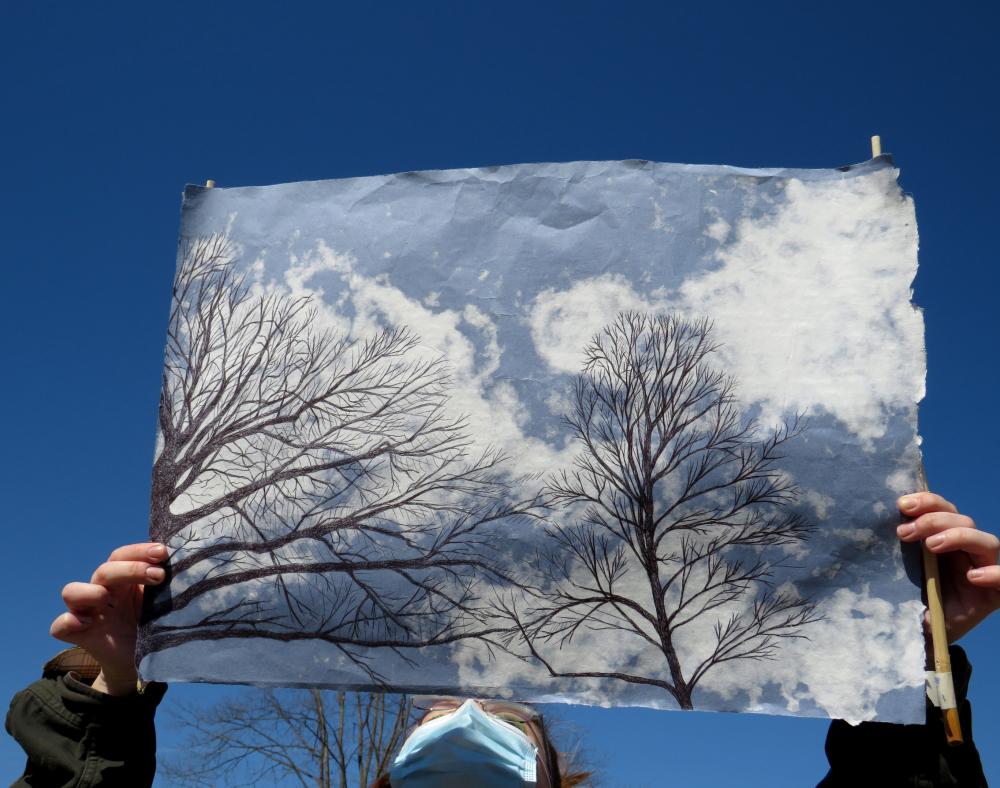
As with Levi Brooker, Haftl reexamines the human form through nature–as a function of nature. Brooker writes, “Kids all draw trees the same way—tall, skinny trunks and winding branches, much like how they draw people similarly with a head and arms and legs.” Human forms, like trees, are approximated without care for individuality. That said, Haftl “hopes to mimic” the “feelings,” evoked by witnessing “the sun peek through stripes of trees or the laugh of two trees rubbing against each other.” Nature becomes a reflection of the human psyche, seeing oneself everywhere by personifying the sun and trees, and humans in turn become a reflection of nature. This is especially true given that they don’t “intentionally bring the human body and its recognizable features into [their] work.” This is a common artistic experience that reminds me of communal interactions with nature, which was once deified through organized religion and is now deified through artistic expression. No matter how human perceptions of Gods and power change, there is a desire to be surrounded by sentience, and held by nature’s community.
The exhibit, “Long Distance Relationship,” contributes to visual culture beyond the evident art, identifying the significance of human connection in making art and becoming a part of visual culture. The question of who one is fuels the pieces and continues to inspire newness from established artistic self-expression.
Credited: Mount Holyoke Art Museum’s exhibit “Long Distance Relationship,” (2021). https://artmuseum.mtholyoke.edu/virtual-engagement/long-distance-relationship?bc=node/2207


 Victorian Visual Culture
That first picture really stood out to me while reading this. The contrast between the lips being smushed, while the rest of the face isn’t, is very interesting visually. To me, I interpret it as the subject attempting to make a connection, but then is being restrained, not fully able to get to the other side. Overall, very good post!
By: evaallii on December 11, 2023
at 3:50 pm
Brilliant review, Maya! You use this virtual exhibit, created under the conditions of lockdown and remote learning, as an opportunity to explore how visual culture, visual art in particular, can become a vehicle for community and for self-expression. In the process, you show how successful this exhibit is and offer some powerful and sophisticated close readings of the work displayed.
By: amartinmhc on December 23, 2023
at 6:07 pm