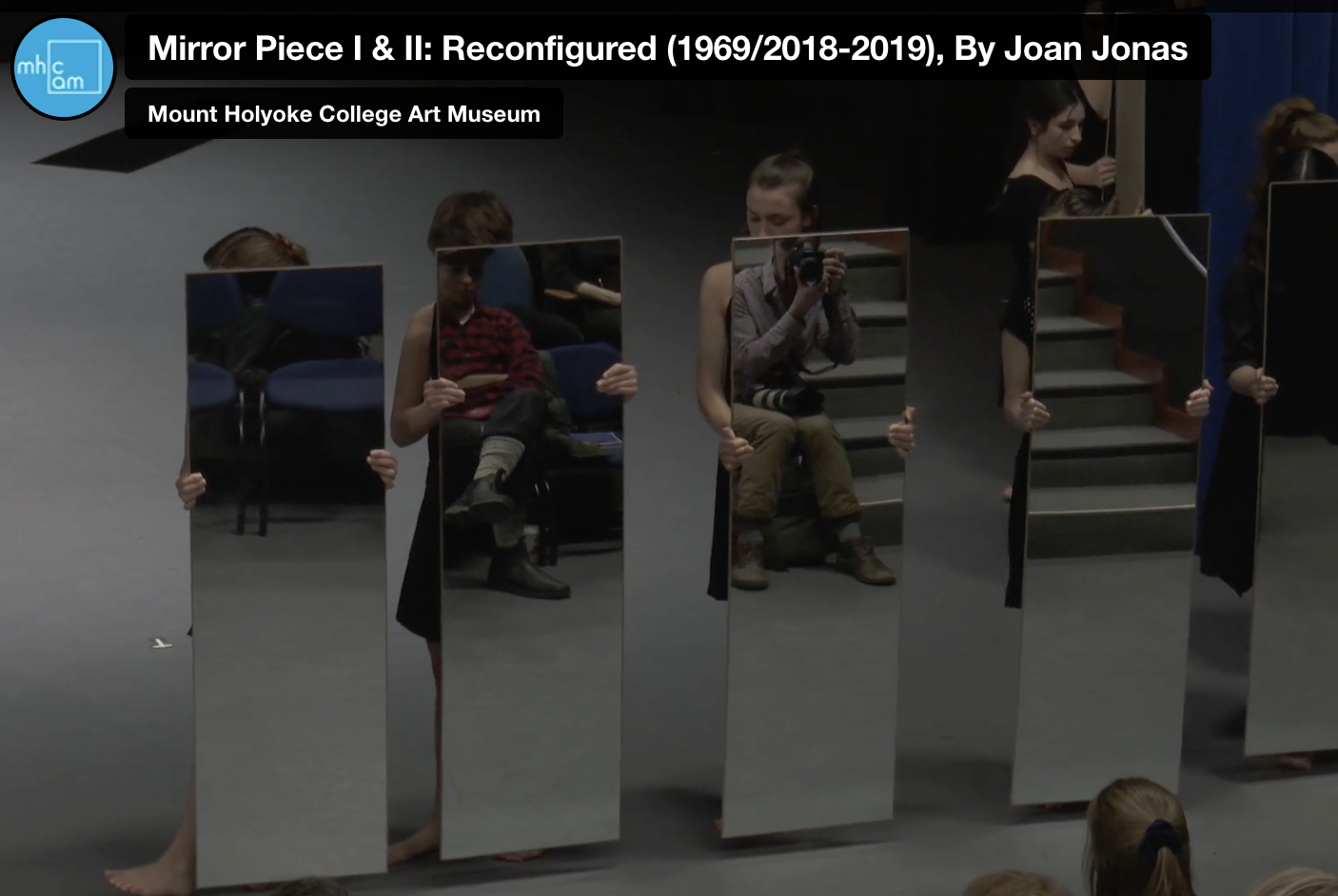
I chose to review the Mirror Piece I & II: Reconfigured (1969/2018-2019), which can be found on the Virtual Tours through the MHC Art Museum website. It was performed on January 31st, 2019.
When browsing through the exhibits on the MHCAM website, this particular dance piece stole my attention. I’m incredibly impacted by visual art produced through dance. As someone who grew up with dance, I was always so aware of the power that physical movement can create. Movement through dance can tell stories that words sometimes can’t reach. Much like photography, dance can invoke emotions and feelings in the people viewing. Dance is traditionally a spectacle, with the audience projecting its gaze onto the people performing. As a performer myself, the relationship of gaze between the performer and the audience is very one sided. The gaze is normally never projected back onto the audience. However, one of my favorite parts of this exhibit is when the dancers walk out with full length mirrors obscuring their bodies. They walk slowly in a single file line with the mirrors directly facing the audience. When they stop, it forces the audience to look at themselves in the mirrors. Above I caught a screencap of a photographer being captured by the mirror while simultaneously capturing photographs. After seeing this, I knew I wanted to watch the rest of it and write my review on it.
The choreography and staging was created by Mount Holyoke Alum Joan Jonas (‘58), who originally put on these performances in 1969 and 1970. Mirror Piece I was originally held at New York University’s Loeb Student Center and Mirror Piece II at New York’s Emanuel-El YMHA. The pieces were performed by a group of women holding large mirrors, and occasionally two men appeared to carry and place the women in different positions throughout. Mirror Piece I and II were inspired by Jonas’ interests in “gender hierarchies, the power of the gaze, and notions of perception and representation,” ultimately opening up her career in performance art. In 2019, the Mount Holyoke Dance Department and Joan Jonas reconfigured the staging performance.
I can only describe watching this performance for the first time as mesmerizing. The slow movements of the dancers direct your attention to each step they take, giving you ample time to watch and understand the movements. The use of the large mirrors obscuring the performers is captivating to watch. Sometimes all you could see were the performers’ heads, or their feet. Sometimes they would lay on the ground and only show their limbs. Each choice and each step was carefully chosen and carefully thought about. It made me think about what it really means to perform, and what it really means to perform for a larger audience.
There is something quite meta about watching an audience watch their own reflections through a performance they are watching. I looked into one of the mirrors through my computer laptop and instead of seeing myself I saw the reflection of a woman, a man, maybe somebody’s grandmother, maybe somebody’s lover. It was cool to think about how this experience differs virtually and seeing it live.
Another aspect that stood out to me was the physical tilting of the mirrors. Many times throughout, the performers would tilt the mirrors upwards and the overhead lighting in the auditorium would refract off of the mirrors. This simple movement would create lights that flashed directly towards the gaze of the audience. It reminded me distinctly of turning on a flashlight. As for the sound, the majority of the piece is done entirely in silence. This choice not only enhances the haunting nature of this piece but it makes you focus on the movement itself.
Finally, it is worth noting that there was one performer chosen to hold a large pane of glass instead of a mirror. Unlike a mirror, the glass is clear and completely see through so it is unable to reflect on the audience. Instead the sheerness allows the audience to see through and observe the performer’s movements. Opposite to the gaze of the mirror, the audience could project onto the glass to decipher the movements that they are denied. This artistic choice is incredibly interesting to me, because it creates a crack in the wall that the performance creates. It made me question what is being obscured and where I should be looking, at myself or the performer?
Overall, this virtual performance was completely worth looking into. It creates an aura that is calming yet thought provoking. Visually it stands out as a living work of art. It tells a story that the eyes of the gaze are a part of. The audience performs as well, making this video one I will definitely rewatch in the future. It left me with a lot of questions, but questions that are worth ruminating and finding answers for.


 Victorian Visual Culture
I remember when this performance piece happened at Mount Holyoke! Joan Jonas was here for a brief residency, and it was part of an exhibit of her work. Your analysis of the dance and the use of mirrors is just fantastic, especially your careful reading of how the mirrors deflect and interrogate the audience and their gaze which is so integral to dance and to performance more broadly. I will go back and watch this again thanks to your review.
By: amartinmhc on December 24, 2023
at 9:32 am