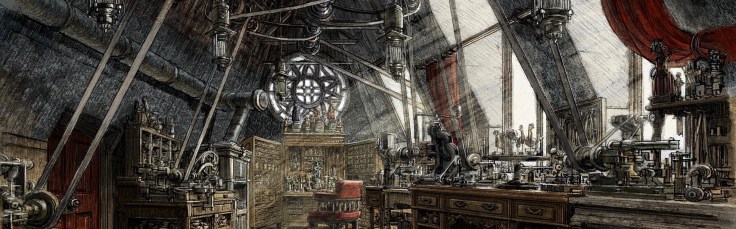
I’ve spent a while going on about the costuming of Guillermo del Toro’s 2015 film Crimson Peak here, but would like to elaborate further on some of the film’s content that intrigues me, beyond the visuals. I’ve long been fascinated with the ways Victorian literature can break down the family structure or turn that site of safety to one of danger and insecurity. Our discussions of the domestic and motherhood this semester have certainly been in the back of my mind while thinking abut the film, as it is so concerned with domestic horror and tragedy. We’ve encountered many examples depicting the consequences of that domestic breakdown, and Crimson Peak is an interesting one as we see the same ideas addressed by modern creatives, then filtered through a Victorian lens. In the film, the family home is the center of the danger and horror; it is where the violence that begets infinitely more violence begins, in a Wuthering Heights sort of fashion. Even before arriving at the (appropriately!) ominously named Crimson Peak, the protagonist Edith’s first tragedy — and encounter with the supernatural — takes place after the death of her mother, an event that remains ever-significant to her navigation of the distorted domestic sphere of the Sharpe family home, Allerdale Hall.
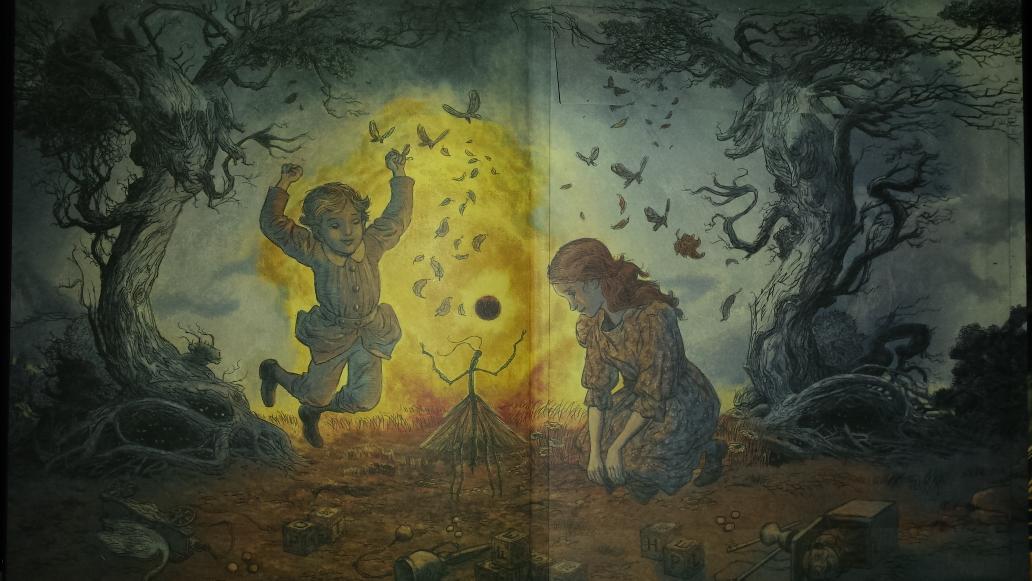
The attic nursery mural in Allerdale Hall. Artwork by Guy Davis, via https://twitter.com/deltorofilms/status/660837212666396673. Lucille Sharpe, portrayed by Jessica Chastain, pictured below.

The breakdown of family structure is so severe there that it transforms Thomas and Lucille Sharpe from mistreated children to the perpetrators of violence. The family structure is continuously distorted through the film, seen in the Sharpes’ repeated acquisition of wives for Thomas (always murdered shortly thereafter), or the incestuous relationship between the siblings brought about as a byproduct of severe abuse and neglect in their childhood.
The fate that eventually befalls the rest of their family is a grotesque sort of reckoning for the traumas the children suffered at their hands. After that initial breakdown in their developmental years, they (and especially Lucille) adapt to life poorly and exist almost as specters, driven by their pasts and unable to escape the site of their tragedy. It’s fascinating to examine a character like Lucille in this modern gothic tale; she recalls Bertha Mason (of Jane Eyre) — a madwoman, initially confined, though she escapes confinement to an attic or institution and returns to the family home which becomes her domain, though it entraps her in a different sense. So there is something of Heathcliff (of Wuthering Heights) in the way that she threateningly moves through and controls the collapsed domestic sphere, bound to endless cycles of violence, unwilling or unequipped to escape them. The film is a lovely and disturbing collage of these Victorian recollections, remade into a newly distorted domesticity.

Thanks for reading!
Works Cited
Crimson Peak. Directed by Guillermo del Toro, Universal Pictures, 2015.
Guy Davis [@GuyDavisArt]. Concept art for Crimson Peak. Twitter, 26 June 2020, 8:10 a.m., https://twitter.com/GuyDavisART/status/1276487899802931200.


 Victorian Visual Culture
An excellent reading of gothic domesticity in this film! I was particularly intrigued by your comparison with Wuthering Heights, a novel that, like Crimson Peak, explores the family as an institution that serves as the vehicle for the intergenerational repetition of domestic trauma. I’m curious about why you think Del Toro returns to the end of the Victorian era to explore this violence and trauma! Especially given the fact about Bleak House that you shared in your other post, I’m now fascinated by this question.
By: amartinmhc on December 24, 2023
at 9:49 am