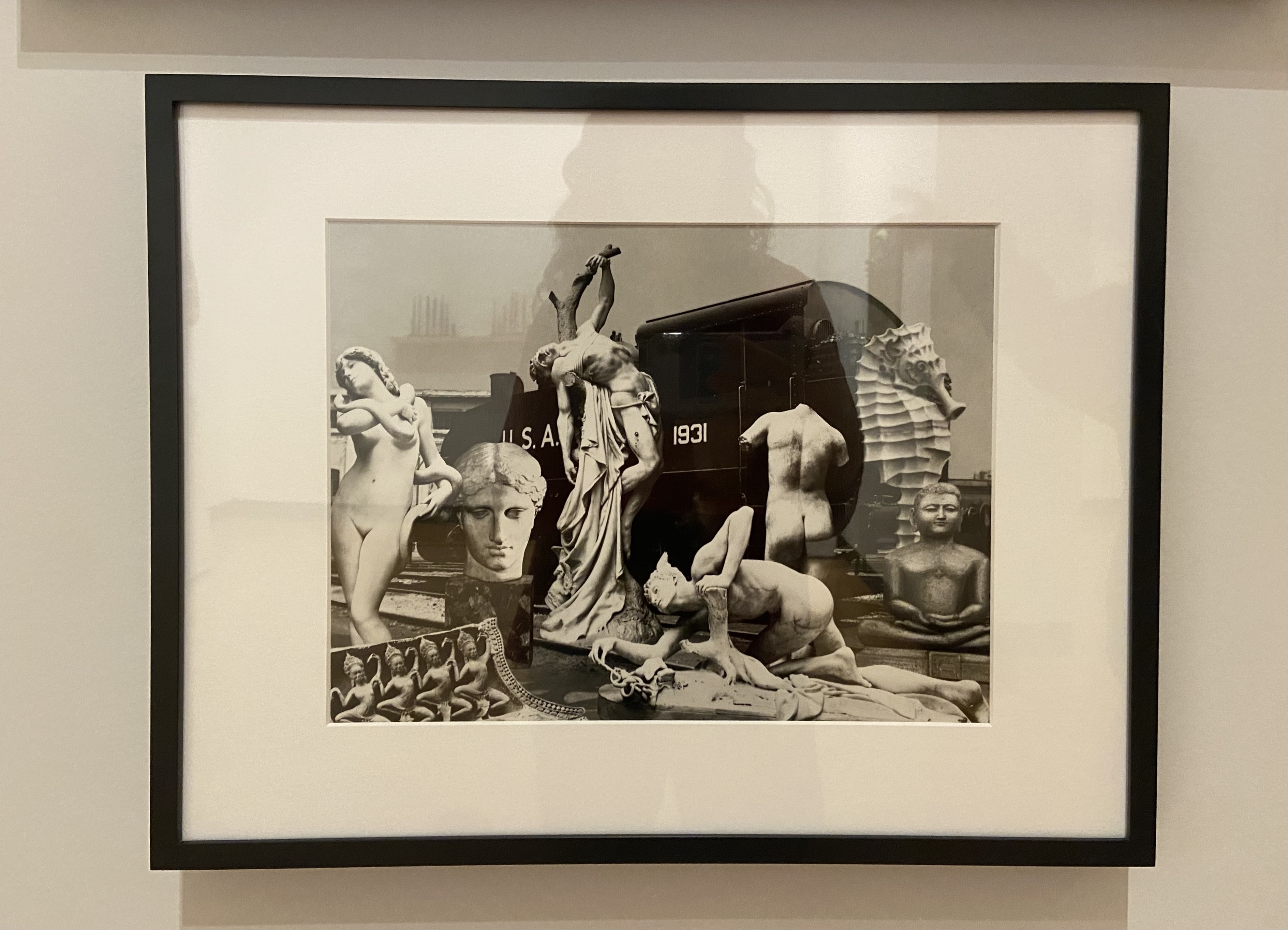
Making my way around the exhibition “Art of the 20th and 21st Centuries Reimagined” in the MHC art museum, one piece in particular stood out to me: City of New Orleans by Jane Hammond, class of 1972. This piece is a collage done completely in black and white, depicting a variety of ancient sculpture in the form of “human divine, and aquatic bodies” (City of New Orleans). Behind the “overlapping” bodies appears to be an old freight train car, hardly the scenery where one would expect to see this combination of greek statues, statues of the Buddha, and one large seahorse statue, if there is a scenery in which to expect it at all (City of New Orleans).

The absurdity and surrealism of this work took me back to one of my favorite portions of the class, where we looked at the Victorian photocollage. Peaking in the 1860s and 1870s, photocollage was a common pastime for aristocratic Victorian women, involving the marriage of photography and painting. While Hammond’s work contains no element of drawing or painting, her work is reminiscent of the photocollage in its use of found materials, wacky scale, and desire to represent an understanding of femininity.
In her book Playing with Pictures: The Art of Victorian Photocollage, Elizabeth Siegel writes that photocollage makers “combined the facts of photography with the fictions of painting” to create “a new kind of representation” (32). This format “allowed–even encouraged–” Victorian women “to expand the limitations of photography to incorporate fantasy, dreamscapes, whimsy, and humor” (Siegel 32).
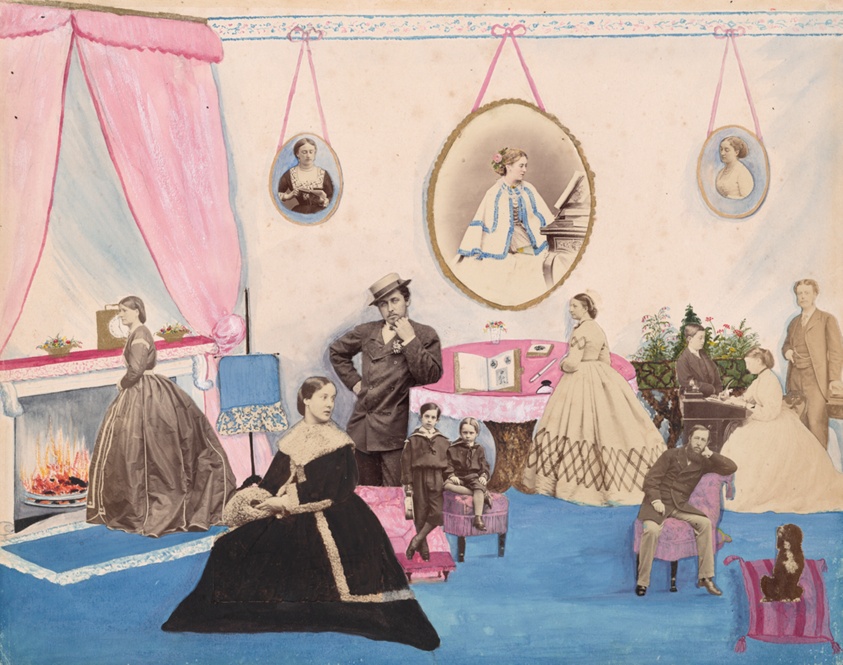
In the photocollage above, we find twelve separate portraits that have been rearranged into a parlor room scene. Their inconsistent size lends itself to a sense of playfulness. Seven of the twelve images depict women, so while they dominate the scene in terms of numbers, not a single one looks straight ahead; her face is always turned towards some unseen interest (aside from the two women who peer down at desks). Six male figures are included in the scene, though they are generally much smaller than the women. Their gazes, however (with one exception), are all directed towards the viewer. Perhaps Lady Filmer wishes to communicate that although aristocratic women were largely responsible for the Victorian social scene, the way she “staged her family’s social position, marked her gentility and taste, and displayed her connections” was not seen as work, and she was therefore not supposed to desire recognition for the labor she performed.
Hammond sees the meaning of her work as “fluid and multiple,” an attitude that can be gauged from the androgyny/genderlessness of all the figures she chose to include in her work (City of New Orleans). Here, we experience a range of subjects’ sizes, but the effect is more unsettling than playful. These figures appear vulnerable and/or to be in states of distress between their general nakedness and dramatic arches and bends of their bodies to convey emotion (rather than their faces, which are oddly blank). The only figure that is obviously a woman draws the eye’s attention for this reason. Her body is almost completely visible, not wrapped in cloth or shadowed by severe movement. Only a snake slithers around her shoulders, rendering her as the biblical Eve. Thus, this statue still communicates a tragedy in its implication that Eve is in the process of being tempted to eat the forbidden fruit. Posed against an object of modern industry, we are forced to confront how this image, and the associated story, as well as all the other icons in the work, stand the test of time. Perhaps Hammond also uses this piece as a space to mourn the loss of sculpture as a popular art form.
I am left thinking of the following explanation from art historian Geoffrey Batchen: “As with all collage practices, attention is drawn to the edges of each page’s constituent images, disrupting the realism of the photographs and locating them in the here and now of the page itself” (32). I find so much pleasure in studying collages because there are so many images to be picked apart, and what they mean individually is not indication of what they mean all together.
Works Cited
Filmer, Mary Georgina. Lady Filmer in Her Drawing Room, The Filmer Album, mid 1860s, The Art Institute of Chicago.
Hammond, Jane. City of New Orleans, 2007/2009, The Mount Holyoke College Art Museum.
Siegel, Elizabeth. Playing with Pictures: The Art of Victorian Photocollage. The Art Institute of Chicago, 2009.


 Victorian Visual Culture
I am so glad that you connect Victorian photocollage with Hammond’s work because it leads you to a powerful comparative reading. Indeed while separated by well over a hundred years, both of these pieces use the medium of collage to explore related questions and themes. In fact, once in the past when I taught this class, we visited to MHC Art Museum to see some of Hammond’s work including another photocollage work!
By: amartinmhc on December 24, 2023
at 10:19 am