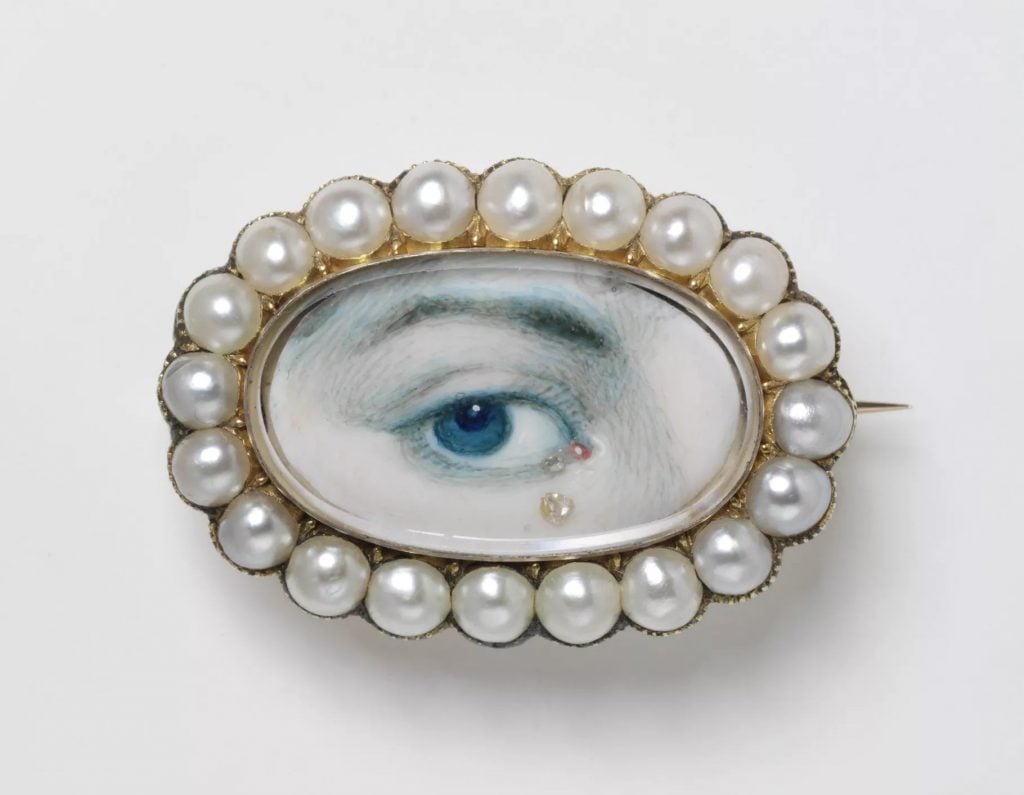
Eye Miniature, early 19th century. © Victoria and Albert Museum, London.
As a jewelry maker myself, I was fascinated when I heard about Victorian lover’s eye jewelry. I found a helpful article that discusses the origins of this trend written by Alexxa Gotthardt, which contains many photos of lover’s eye jewelry from various museums. This style of jewelry was popularized in Britain around the late 1700s and started with a marriage proposal from Prince George of Wales to a woman named Maria Anne Fitzherbert. George had proposed before, but the courtship was forbidden because of laws around a Catholic widow from becoming a monarch. Fitzherbert opened a letter written by the prince in November of 1785 to reveal a marriage proposal in the form of a letter and a small painting of his eye. The two eventually married, and a locket was crafted for the prince with a small painting of Fitzherbert’s eye within.
Gotthardt analyzes Victorian eye jewelry as an expression of Victorian culture’s focus on visuality, as she points out that “even the subtlest glance could convey lust, love, surveillance, or a heady mix of all three.” Lover’s eye jewelry relied upon a complex depiction of a small part of the body, one that could convey an immense amount of emotion in a single glance. The experience of both looking and being looked on makes these jewelry pieces even more compelling, as they embody a kind of meta-narrative of visuality.
There is also the potential for these accessories to be indicative of surveillance around marital fidelity. One might find themselves less inclined to cheat on their spouse if they knew they had a constant reminder of their lover’s gaze hung around their neck. Wearing a piece of lover’s eye jewelry would also indicate to other people that an individual is romantically involved, and could deter potential suitors.
The gendered dynamics of these pieces are also interesting to consider. It might appear to be an egalitarian exchange of love between a heterosexual couple, as both the man and the woman are essentially giving the other a representation of an intimate part of their bodies. Additionally, in locket form, a person could control who looked upon the eye of their lover. This would prevent uncomfortable incidents of boundary-crossing, such as the scene in the novel Bleak House when Mr. Guppy looks at the portrait of Lady Dedlock, despite Sir Leicester’s wishes that the portrait remain private and Lady Dedlock’s loud silence about whether or not she wants her portrait to be viewed by others. However, it does reduce the body to a commodity, an act that has historically been used to violate the female body. Not only is the body reduced to a commodity, but there is a kind of violence in stripping away the context of the rest of a person’s body to focus on one disembodied part. Women also might not have any say on whether or not their eye is used in this way, as they likely did not have control over their finances to pay an artist to make one.
According to Gotthardt, lover’s eye jewelry faded out from popularity around the early 1800s. Because of the novelty of photography, people seemed to lose interest in miniature portraits once they could have access to a photo of their exact likeness quickly and cheaply. However, Victorian era lover’s eye jewelry experienced a revival on TikTok, with amateur artists painting small portraits of their lover’s eye and attaching them to pieces of jewelry. Making video-form content of an intimate artistic exchange between two romantic partners presents a new kind of ideological struggle being played out visually. Visual indicators provide little context about the rest of the relationship, and the quality of a relationship is often judged by its visual appeal on social media platforms. This resurgence makes sense with our current era’s emphasis on visuality and spectacle which is similar to Victorian-era visual drama.
Source: Gotthardt, Alexxa. “The Mysterious Lover’s Eye Jewelry of 18th-Century England | Artsy.” Artsy, 4 Jan. 2019, http://www.artsy.net/article/artsy-editorial-mysterious-history-lovers-eye-jewelry.


 Victorian Visual Culture
Interesting! I had never heard of lover’s eye jewelry before, but it is beautiful and aligns well with the values of visual culture I know of. “Owning” the body of a lover is a concept with so many weird connotations — but, I suppose we do the same thing with photos these days. Great post!
By: Abigail McKeon on October 14, 2025
at 1:29 pm
I also had never heard about this kind of jewelry, and am really fascinated by it. In particular I’m struck by the way the piece of jewelry signified a kind of surveillance, representing and reinforcing a sense of the presence of the lover at all times. I’m headed to TikTok now to look at the revivals of this lost art form!
By: amartinmhc on October 14, 2025
at 9:44 pm
This is so interesting, I had never heard of this kind of jewelry before! While reading your post, I was wondering if there was going to be some kind of modern reinvention of the style, perhaps due to social media, because so many of our class conversations have been about the ways Victorian ideals live on today through new technologies, so I was really intrigued by your analysis. It makes sense to me that this style might have a comeback thanks to TikTok, which is, of course, a visual medium, and one that perpetuates both surveillance culture and overconsumption, or artistic resistance to overconsumption.
By: Sophie Frank on October 27, 2025
at 12:22 pm
This is so interesting to learn about this type of jewelry! I knew that there was mourning lockets for a lock of hair, as hair has great symbolism and meaning to people, and later on small photographs to help people have some memento to hold onto. But this is interesting because while lasting for 100 years, it still continued to be in existence through portraits taking its place and becoming easier to access by anyone who wanted a similar reminder of their partner, family, friends, etc. or display of ownership. In addition to the revival of these lockets being that of surveillance culture, as Sophie said, it arguably has the same meaning and symbolism as someone keeping a charm with the initials of their partners on a bracelet or, most commonly, a necklace. I don’t know the history of these charms so it is interesting to see the similarities and constant need of people to have control and ownership. Great post!
By: Maggie Doig on December 4, 2025
at 10:04 am
I have always found victorian jewelry so fascinating, but I have a special place in my heart for the victorian lover’s eye. Something about the intimacy of taking time to pose for a portrait of your eye, the window to your soul, to give to a lover as a memento, a token of your affection. And then to be the receiver, having such an innocuous and yet intimate moment–eye contact–memorialized.
My girlfriend actually got me a drawing of her eye a few years ago as my own lover’s eye jewelry and I absolutely love it. People sometimes think its creepy, but I think they’re boring.
By: juliamorrison on December 16, 2025
at 6:38 pm