After reading The Picture of Dorian Gray, I became curious about Oscar Wilde’s life and legal troubles, particularly those connected to Dorian Gray.
Oscar Wilde met Lord Alfred Douglas at a tea party, and the two quickly formed an intense bond. By then, Wilde was already a celebrated literary figure. His affection for Douglas was unmistakable: he showered him with gifts, attention, and what many would recognize as love letters. On several occasions, these letters fell into the hands of blackmailers who extorted Wilde in exchange for their silence. Their closeness soon became a subject of public speculation in London, much to the dismay of Douglas’s father, John Douglas, the Marquess of Queensberry. Determined to separate them, the Marquess threatened to cut off his son financially unless he ended the relationship. Alfred, instead of yielding, resisted these pressures and defied the era’s strict social expectations.

The Marquess persisted. Even after cutting off his son, he continued to demand that Alfred sever ties with Wilde. His hostility escalated when he left a card at Wilde’s club accusing him of “posing sodomite.” Outraged, Wilde responded by suing the Marquess for libel. Under English law at the time, the only way for the Marquess to defend himself was to prove that his accusation was true.
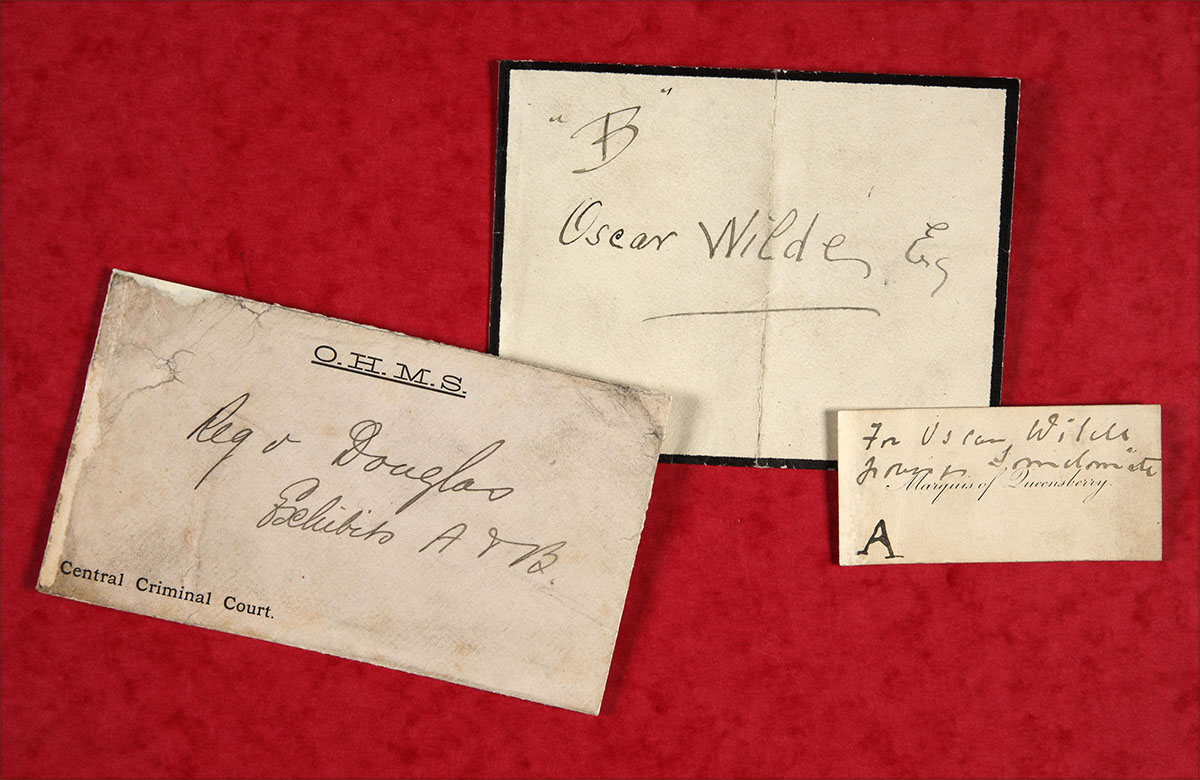
Wilde’s trials unfolded within the rigid legal framework of late-Victorian England. The Criminal Law Amendment Act of 1885, specifically the Labouchere Amendment, criminalized nearly any intimate act between men under the vague charge of “gross indecency,” requiring no proof of sodomy. Prosecutors used this law to reinterpret Wilde’s relationships, his aesthetic philosophy, and even his literary style as evidence of criminal behavior.
The libel suit disastrously backfired. Once the trial began, scrutiny shifted entirely onto Wilde. The courtroom became a stage for moral panic. Prosecutors treated The Picture of Dorian Gray as a coded autobiography, presenting its themes of beauty, corruption, and queer longing as proof of Wilde’s alleged immorality. This was striking, given that the novel’s central queer-coded character is hardly an aspirational figure; nevertheless, the mere portrayal of queer desire was taken as incriminating.
On May 25, 1895, Wilde was convicted of gross indecency and sentenced to two years of hard labor. This punishment devastated his personal life and literary career, yet his prosecution holds lasting historical significance. Wilde’s downfall reveals how Victorian society simultaneously cast homosexuality as deviant and, paradoxically, helped solidify it as a recognizable identity.
Wilde’s conviction and imprisonment were deeply destructive, but they also expose how Victorian legal and cultural institutions defined, regulated, and punished queer existence. At the same time, Wilde’s writing, and even his courtroom defenses, offered one of the era’s most enduring affirmations of queer dignity.
Sources:
1885 Labouchere Amendment. (n.d.). UK Parliament. https://www.parliament.uk/about/living-heritage/transformingsociety/private-lives/relationships/collections1/sexual-offences-act-1967/1885-labouchere-amendment/ Mace, R. (n.d.).
The Picture of Dorian Gray. University of Leeds Library. https://library.leeds.ac.uk/special-collections/view/1270
Oscar Wilde Imprisonment and Sentencing. (n.d.). American History, Steinway Diary. https://americanhistory.si.edu/steinwaydiary/annotations/?id=854
Oscar Wilde is convicted of gross indecency | Research Starters | EBSCO Research. (n.d.). EBSCO. https://www.ebsco.com/research-starters/social-sciences-and-humanities/oscar-wilde-convicted-gross-indecency


 Victorian Visual Culture
Wilde’s end was so tragic, and following the case is (while interesting) deeply, deeply harrowing. Really well written, Julia!!
By: ladysundayalice on December 11, 2025
at 9:41 pm
I will admit that before this class, I avoided work by Oscar Wilde. Too many of my friends were pressuring me to read his work, so I obstained out of spite since they wouldn’t read Game of Thrones. After taking Victorian Lit, though I found that I didnt just enjoy and value Wilde’s work, but I also valued the bravery he had in expressing himself in such a vulnerable way in his writing. It is so sad to know that his own work was twisted to fit a harmful agenda to convict him.
By: Jasmine Thomas on December 12, 2025
at 1:39 pm
Hi Julia! Thank you so much for posting about this! I was really curious to learn more about what had happened during his trial. I like that you pointed out that the public nature of Wilde’s trial indirectly ended up giving more attention to the existence of queer people when it was intended to solely cast them as deviant criminals. Sexual identity becomes much easier to punish after being explicitly named in legal settings. Before the Victorian era, in the class “The Queer Early Modern,” taught by Dr. Mahaffy, we talked about how the early modern period actually opened up possibilities for lesbian desire between women to manifest, as sex between women was seen by male society as being “impossible,” and therefore went unacknowledged for many years.
In the case of Oscar Wilde’s public trial, there is the possibility that some closeting or questioning Victorians were able to name the kinds of desire they were experiencing after reading newspaper coverage of it, even if it was stigmatizing. The battle between public vs. private domains is really interesting to study in the context of queerness, as both can offer different outlets for expressing or experiencing queer desire.
By: hanso23e on December 13, 2025
at 7:30 pm