Posted by: Alice Strangman | October 5, 2023

Sympathy and Power in Bleak House’s Illustrations

“Mr Guppy’s desolation” (Dickens 185)

At a glance, there is nothing especially absurd about this illustration of H.K. Brown’s in Bleak House. A sorrowful, unkempt man stands in shadow during a theater performance, staring up at one of the boxes above. Most of the other figures face the light with pleasant expressions, and few to none of them stand out. There is a genuine sentimentality here, enough that I can’t help but feel…sympathy, perhaps, for the man.

Then again, that man apparently now frequents the theater with the sole purpose of expressing wordless despair to Esther, who turned down his abrupt marriage proposal some time before. It is comically manipulative. Esther “really cannot express how uneasy this made me,” to see him “with his hair straight and flat, hs [sic] shirt-collar turned down, and a general feebleness about him.” Mr. Guppy gazes so persistently, and looks so unkempt, that Esther doesn’t know what to do. She “did not like to laugh at the play, or to cry at it, or to move, or to speak. I seemed to do nothing naturally … thinking of the dreadful expense to which this young man was putting himself.” Yet she also cannot make herself tell anyone, for fear that “I might ruin him” one way or another. In short, Mr. Guppy has used Esther’s sympathy to force a near-deadlock, where Esther can either change her mind about him, or remain uncomfortable, as she does. (Dickens 184)

Brown’s adaptation communicates something else. It takes a moment to locate Esther even knowing where the narration says she sits, and she has few defining features. Instead, Brown draws much of the viewer’s attention to Mr. Guppy himself, a man alone and out of place, his disarray on full display. I would suggest that Brown disguises Mr. Guppy’s manipulation. We see his sad state without his knowledge; he is made a spectacle. Paradoxically, I think this way the viewer is more likely to view him as Esther does, as it masks the discomfort of being seen by him and hides the inadequate reason for his behavior.

The illustration shares its forthright emotion and framing as spectacle with “The visit at the Brickmaker’s.” The image shows the entire room, and all the figures in the house look uncomfortable, many of them hunching in worn clothes, all frowning, none facing the viewer. They must be othered before they can receive sympathy, and indeed they do, as Ada and Esther are greatly moved by “[t]he suffering, quiet, pretty little” baby of one of the women (123). Since the later illustration, “Mr Guppy’s desolation,” shares this quality, it is easy to assume they function the same, but Brown makes this a bait-and-switch by disguising Mr. Guppy’s discomforting gaze. Readers may now wonder: what figures of sympathy are deserved, whatever that means, and what are coercive? What are these sympathetic images hiding about the figures they intend to solicit sympathy for? The suggestion seems to be that if sympathy can be manufactured and forced, especially in images, then what we need to rely on when interacting with potentially sympathetic subjects is some quality besides, or beyond, sympathy.

What quality might that be? I’d need more time to consider that. Perhaps it is something to look out for in the rest of the novel.

“The visit at the Brickmaker’s” (119)

Works Cited

Dickens, Charles. Bleak House. Oxford University Press, 2008.

Posted by: mayaduganbloom | October 2, 2023

Photography is not taboo, I am.

I don’t want my photograph taken. Who says that? I have been and the pushback is astonishing. 

Post-daguerreotype innovations, Tagg asserts in The Burden of Representation, “the development of faster dry plates and flexible film,” along with the “mass production of simple and convenient photographic equipment,” meant any member of the growing middle class could own a “Kodak” camera (Tagg 60, 66). Tagg describes the newfound “power” of the camera and the subsequent separation of photography from being a means of art to casual documentation: “Photography functioned as a means of record and evidence” (Tagg 66). Nowadays, as Frederick Douglass predicted in his “Lecture on Pictures,” “Daguerre…has converted the planet into a picture gallery” (Douglass 127). No corner of life is allowed to live in the dark; to turn Douglass’s phrase, the power of the “simple but all-abounding sunlight” illuminates all secrets and banishes privacy. Cameras have only grown more accessible, being embedded into every Smartphone; there are more steps required to call somebody–the intended purpose–than to take a photograph: photos are captured every day; nobody may remain anonymous. 

In this sense, I wonder how the commonality of photography has altered self-consciousness. I can’t help but wonder if humans were meant to regularly–or at all–witness their bodies; different modes of reflection, such as a mirror, glass, or even a body of water offered an incomplete and alterable image; one would see what they looked at, a nose or legs or an outfit; ridiculing separate parts of oneself is a far cry from the assertive objectivity of “proof,” the perspective of a person which everyone around holds and which said person was blind to. There is a sense of illumination, of the “modest distrust of our good looks” (Douglass 128). Especially in this age of Smartphones, there is a dissonance of the self from birth: there is a constant self-consciousness produced by the permanence of the camera–who is the person in photographs versus the person one perceives oneself to be?  Personally, it is always a surprise to see myself in photographs, I wonder “Who is that person?” Never the twain shall meet. Furthermore, an inward camera develops, requiring a constant imagined impression of the permanent self, and how to step away from the unalterable body. Tagg remarks that the camera, like State surveillance, “bears directly and physically upon the body” (Tagg 70). Has this just intensified self-consciousness or redefined it completely? 

I’ve requested that my friends refrain from taking pictures of me. I would never ask my mother, who would have a serious talk with me about self-image; it merits more backlash to not want to be photographed than it is to photograph without consent. Even writing it makes me cringe. It is so taboo to not want to be photographed that even when I voice this, friends continue to take photographs and just don’t show me as a way to soothe my discomfort; not taking photographs of your loved ones and having documentation is unfathomable. The language regarding photographs is reminiscent of Arthur Conan Doyle’s “A Scandal in Bohemia”: a photo is “captured,” or “taken,” just like Doyle’s main character goes about “stealing” a condemning photograph, which might be used against him (Holmes 6). There is implied violence or nonconsent in photography. Who owns the picture is also up for debate, and sparked the Nussenzweig v. DiCorcia case: Phillip Gefter of the New York Times wrote an article about the case which established the precedent for the legality of photographing people in public. The case determined that because the photo, a simple headshot of an Orthodox Jewish man, was taken in public, the “photographer’s right to artistic expression trumped the subject’s privacy rights” (Gefter). The photograph is sacred, in the name of art and not. It is protected by the government, too, for the sake of “instilling docility and practices of social obedience,” (Tagg 62). Photography emerged as an “apparatus of the new and more puncturing form of the state” which is a “regime of truth” (Tagg 61). This truth takes on two relevant modes: self-reflection and evidentiary truth, which feed into each other; when humans witness themself, they witness their wrongs. 

Work Cited

Douglass, Frederick. “Lecture on Pictures.” Picturing Frederick Douglass. 1861. 

Doyle, Arthur Conan. “A Scandal in Bohemia.” Stanford University, 2006. 

Gefter, Philip. “Street Photography: A Right or Invasion?” The New York Times, The New York Times, 17 Mar. 2006, http://www.nytimes.com/2006/03/17/arts/street-photography-a-right-or-invasion.html. 

Tagg, John. The Burden of Representation: Essays on Photographies and Histories. The University of Massachusetts Press, Amherst, 1988. 

Posted by: kuffl22a | September 27, 2023

Working Mothers in “Bleak House”

So far, in the first 19 chapters of Charles Dickens’ Bleak House, we see two examples of mothers who work, Mrs. Jellyby and Mrs. Pardiggle. The way Dickens chooses to portray them is particularly interesting. I do not believe that it is a coincidence that both women are portrayed as ‘bad’ mothers. Mrs. Jellyby is neglectful of her children’s needs in favor of her passion project to ‘help’ Africa, and Mrs. Pardiggle forces her children to contribute to her work. While their interactions with their respective children are different, they are both shown as ‘bad’ mothers, because they are focused on something other than their domestic duties. In contrast, Joshua Reynolds’ “Lady Delme and Her Children,” portrays Lady Delme as nothing more than her identity as a Lady and mother. She is pictured with her arms wrapped protectively around her children, but not entirely forcing them to pose a certain way for the portrait. She is depicted as more attentive to her children than Mrs. Jellyby, but not overbearing as Mrs. Pardiggle. The portrayal of these two characters in the novel, whether intentional or not (though I believe it was), makes the statement that women should stick to their domestic duties, or else they have failed as mothers.

Works Cited

Dickens, Charles. Bleak House. Oxford University Press, 2008.
Reynolds, Joshua. “Lady Delme and Her Children”, 1777-79.

The Museum of High Art In Atlanta seems an artistic wonder from the outside itself. At 1280 Peach Tree in Atlanta, Georgia, a building grows out of the green as a stately wonder of different geometric shapes brought together by a common white color scheme. Drawn to the building that stands out uniquely in the heart of Atlanta, I find myself walking into the building to purchase a ticket, curious to explore what the inside might look like.

Outside the High Museum of Art, picture courtesy of Wikimedia Commons

The inside is as fascinating, fashioning art from across the years and from different histories and styles: traditional African art on the first floor is followed by American art, European art, photography as well as the wing that intrigued me the most — the modern art wing — a new installation added post the museum’s expansion in 2005. Given our study of visual material in our course this semester, I found myself paying particular attention to portraits as well as how people and human figures were staged in general in different artworks.

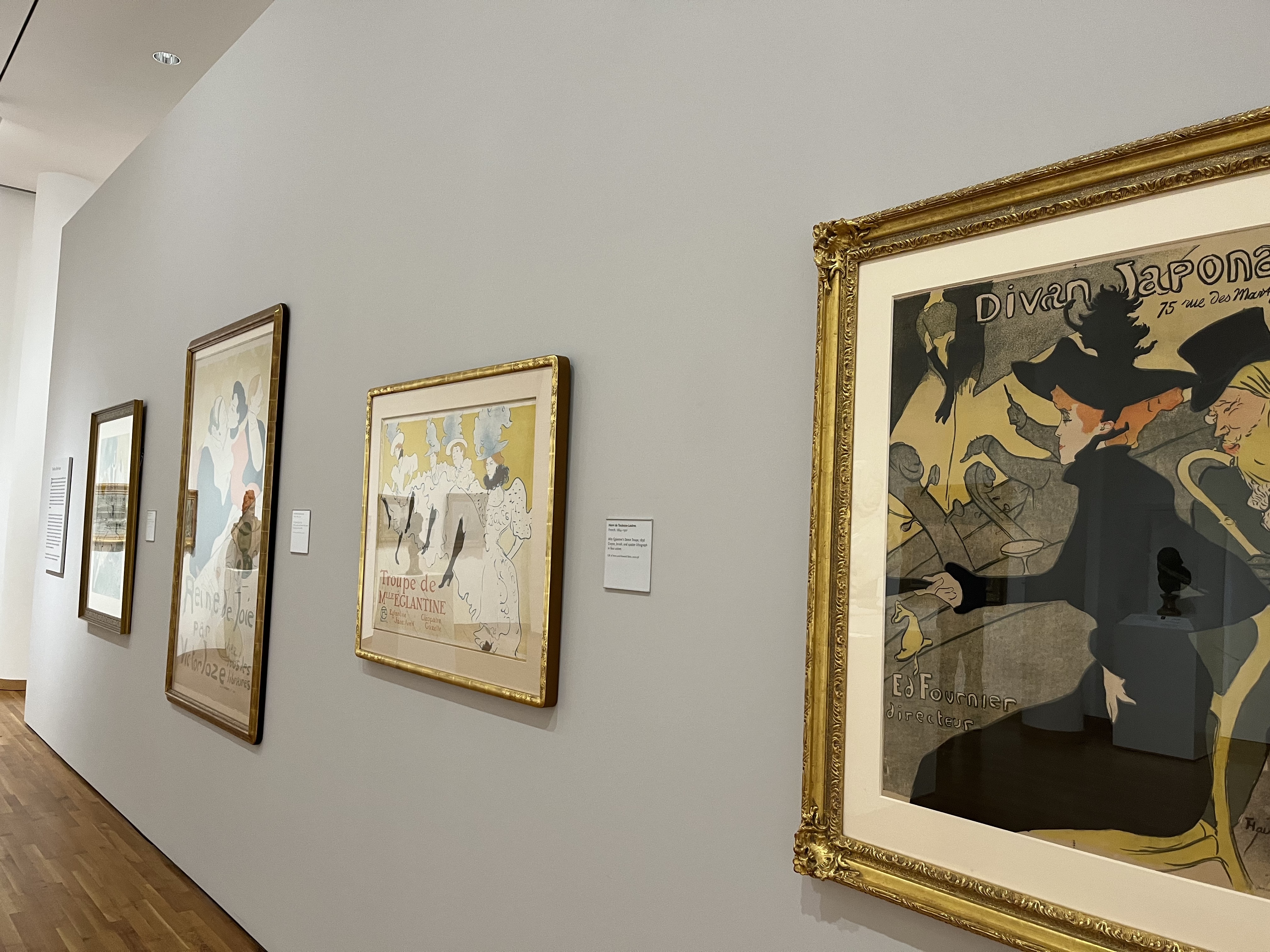
The museum is fashioned to walk audiences through more traditional art pieces from previous centuries first. We see Thomas Cole, Benjamin West, Henri de Toulouse-Lautrec, and Claude Monet, amongst a host of others. Having briefly studied Toulouse-Lautrec before, I am intrigued to check his posters a bit more. The posters fashion entertainers in cabarets, theaters, and dance halls. It is interesting to learn about the subjects that Toulouse-Lautrec picks and how he depicts them through his use of lithographs. A closer look reveals how Toulouse-Lautrec attempts to humanize and provide center-stage to his female subjects. In each image, they are the main focus: either in their placement, color, or the ways that different subjects interact with each other. Used commercially when they were created, Toulouse-Lautrec’s posters speak to mid-1800’s Paris and the place of entertainers in artistic circles, particularly female entertainers.

Toulouse-Lautrec’s Posters, picture taken during museum visit

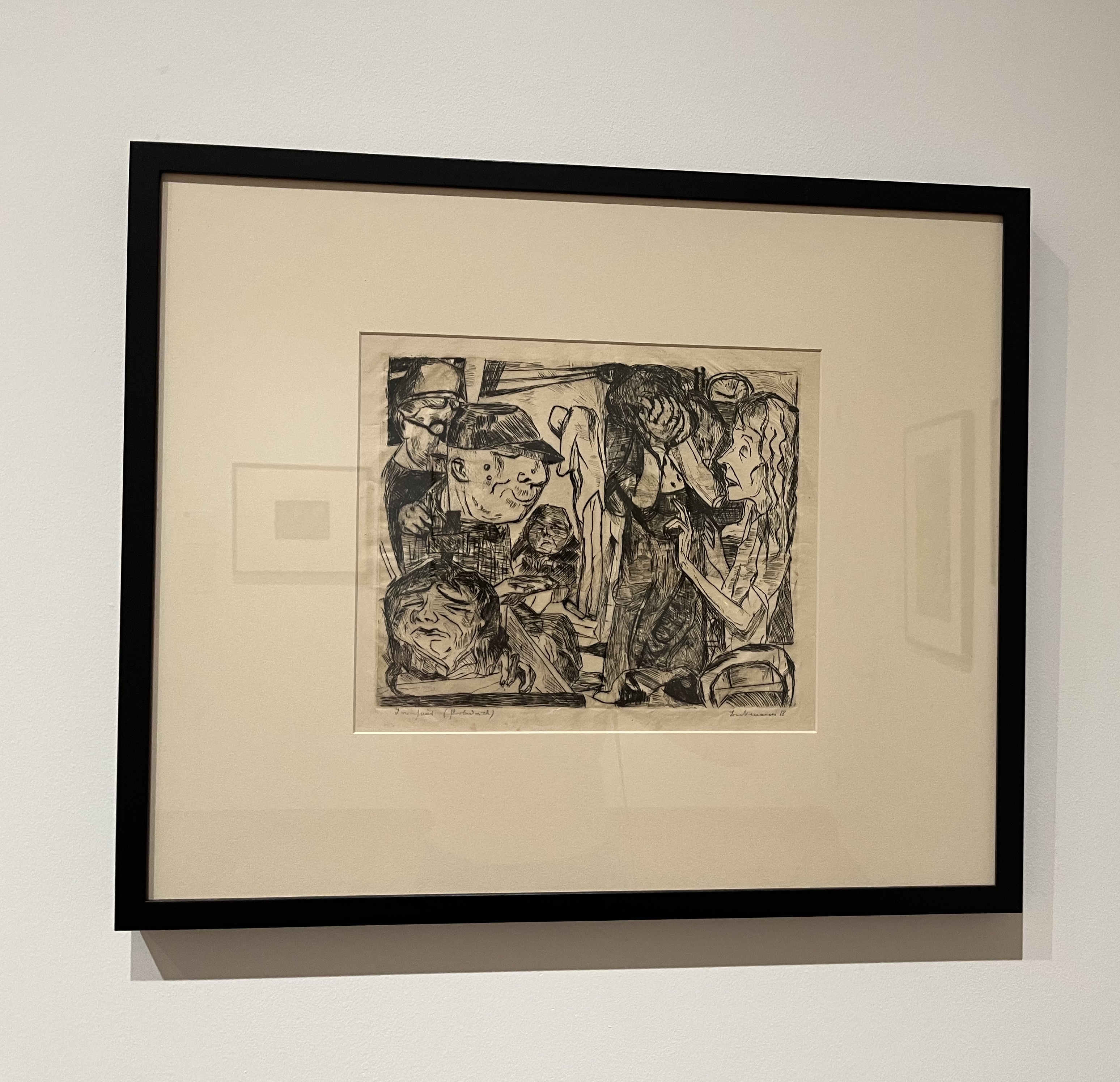
As I continue touring the European art section, I notice a different style that captures the human figure quite varied to the style of Toulouse-Lautrec. German artist Max Beckman’s work titled ‘Madhouse’ uses etching to capture different human faces and half-body figures overlapping on the canvas. The etching wears a dull yet chaotic look of black and white, with all figures wearing somber and worn-out expressions. Done during the time of war, the use of his color, medium, and cramped style echo the pain and suffocation of the first world war that was taking place at the time.

Max Beckmann’s ‘Madhouse,’ picture taken during museum visit

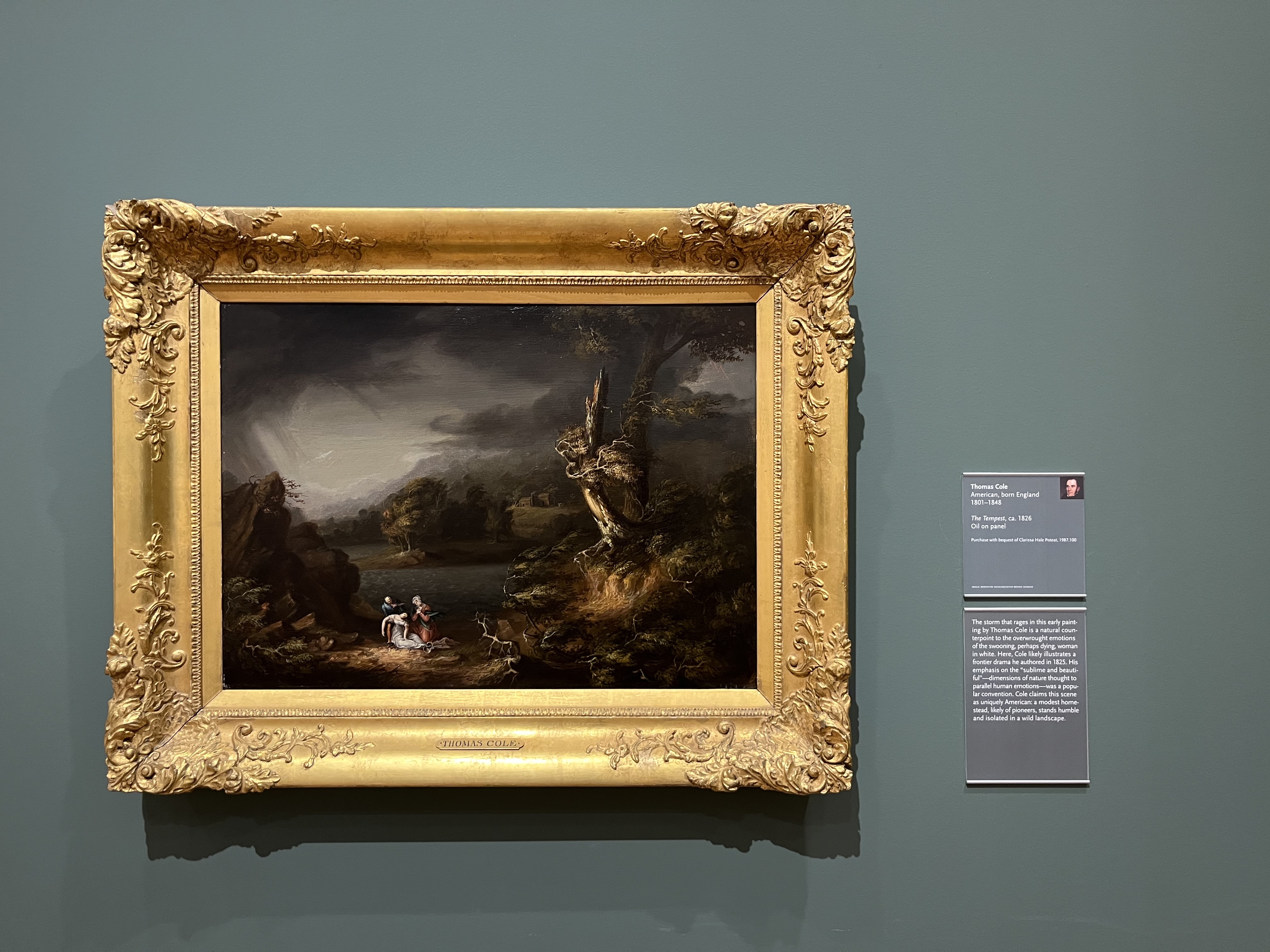
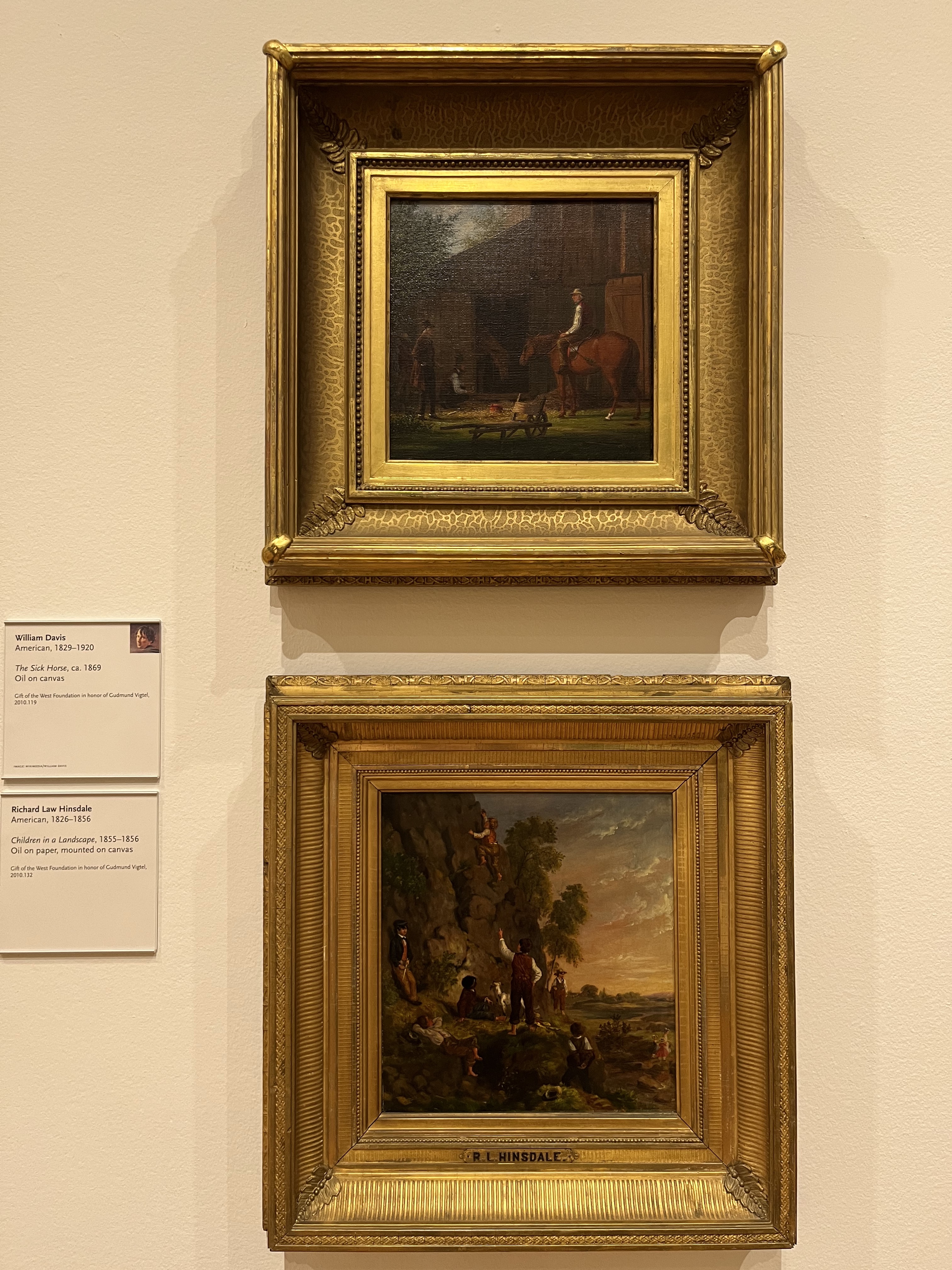
When I came across some of the paintings that the museum houses for the 1800s American art, I saw a very different placement of the human figure compared to the closeup focused attention to it that either Toulouse-Lautrec or Beckmann gave their subjects. The human figure is minuscule, lost amidst the landscapes they are framed against. Thomas Cole’s ‘The Tempest’ is a prime example. Cole’s painting captures the sublime and beauty of American history and portrays a storm of the American frontier. Amidst this setting are three figures, one of them a dying woman clad in white. While at the heart of the painting, the figures themselves are tiny. This reflects the relationship between land and people that someone like Cole attempts to voice, showing the potential and opportunity of the American frontier as what was important to highlight at this time. Cole is not alone. William Davis’ ‘The Sick Horse’ and Richard Law Hisndale’s ‘Children in a Landscape’ capture tinier human figures against American landscapes. The surroundings and setting are what is essential to subjects and the American history of the time.

Thomas Cole’ The Tempest,’ picture taken during museum visit
William Davis’ ‘The Sick Horse’ and Richard Law Hisndale’s ‘Children in a Landscape,’ picture taken during museum visit

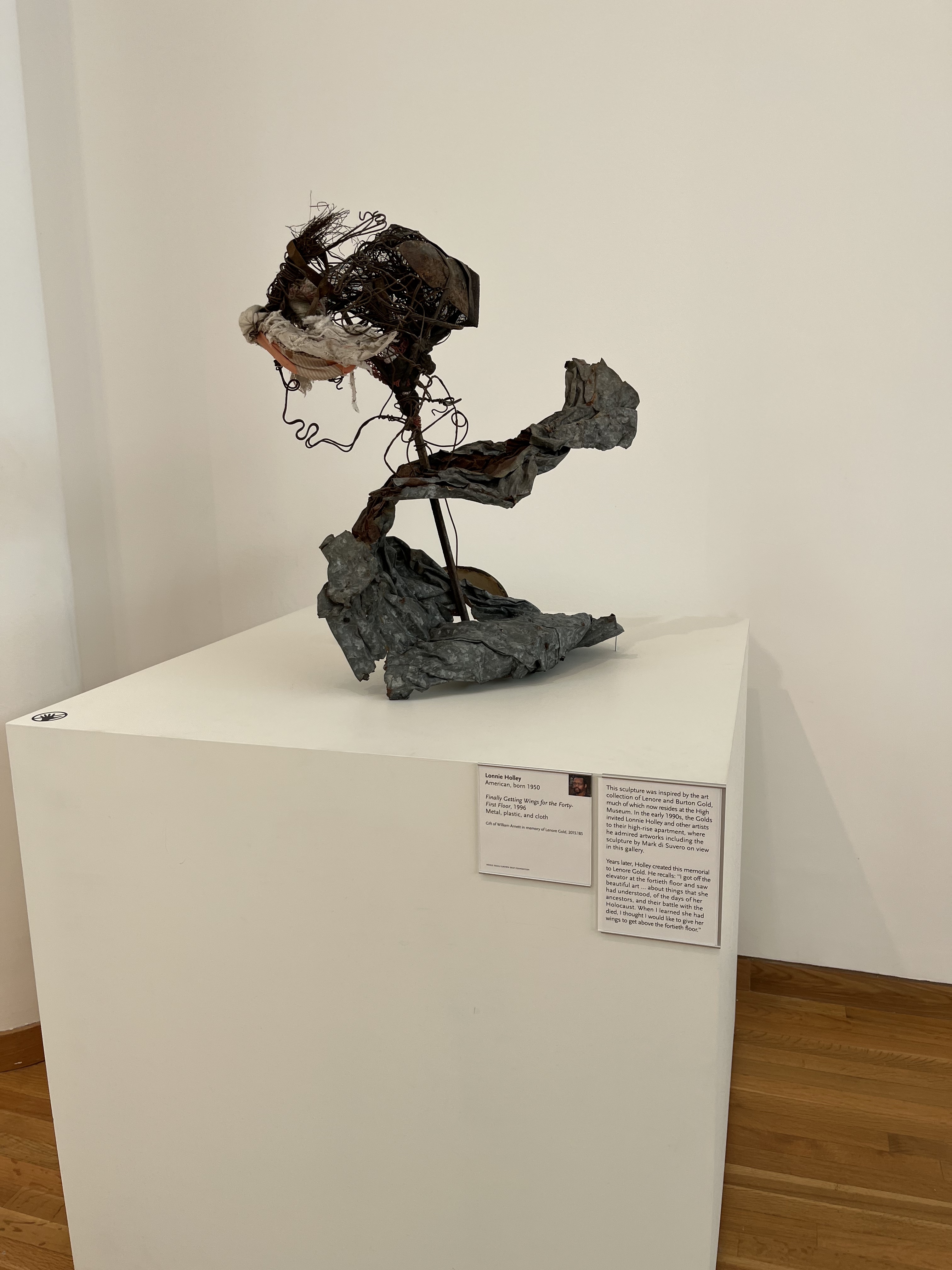
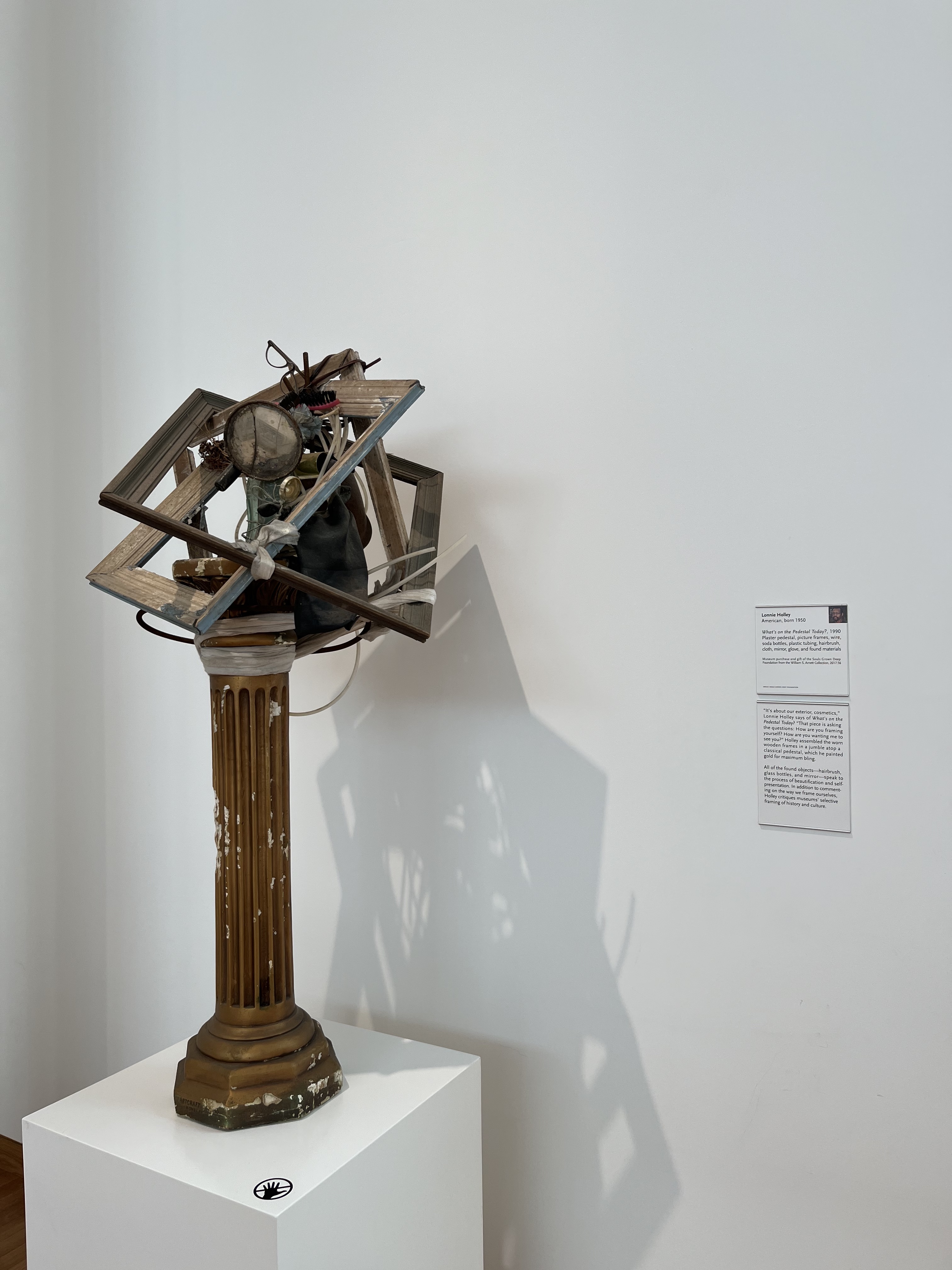
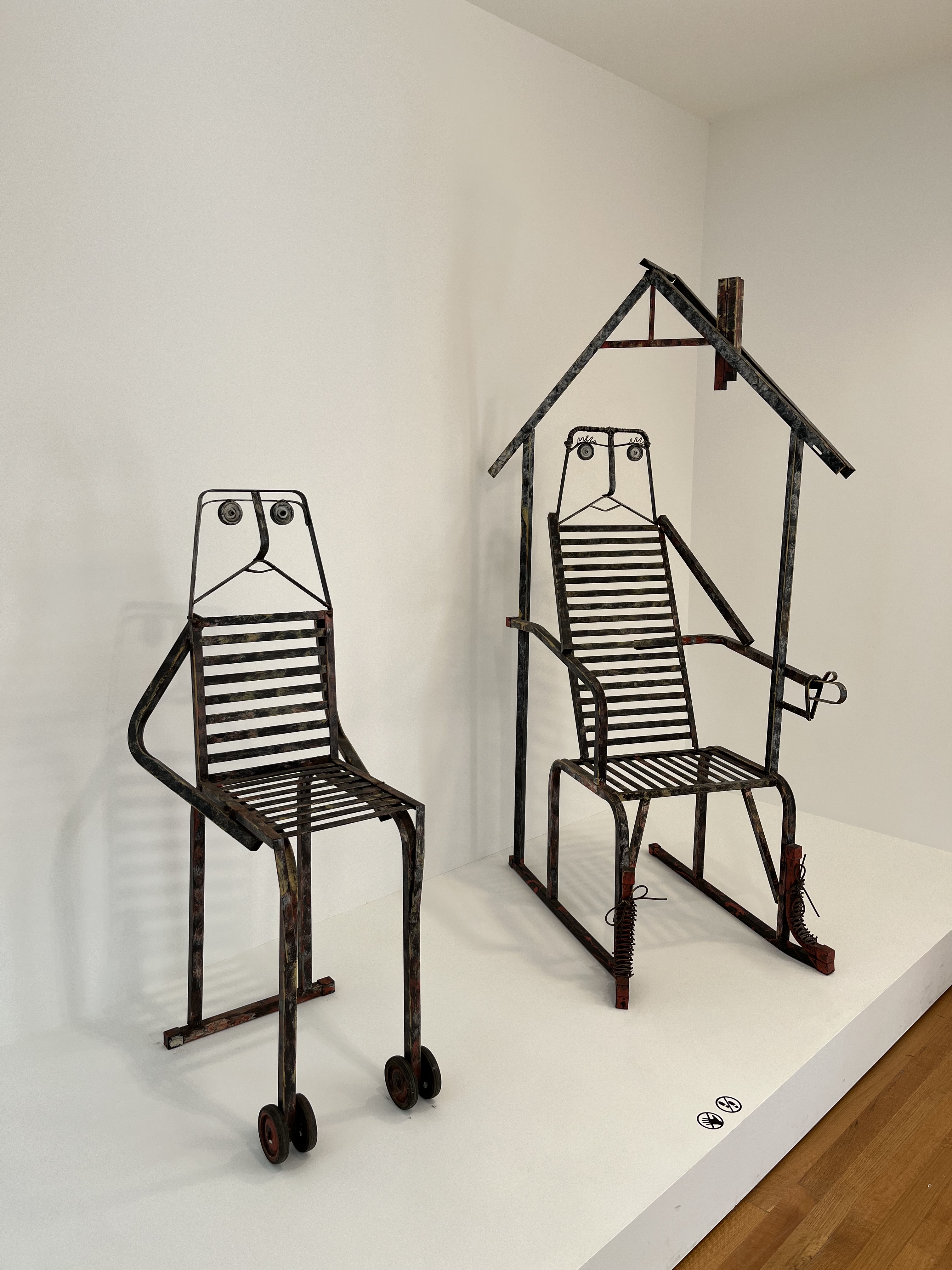
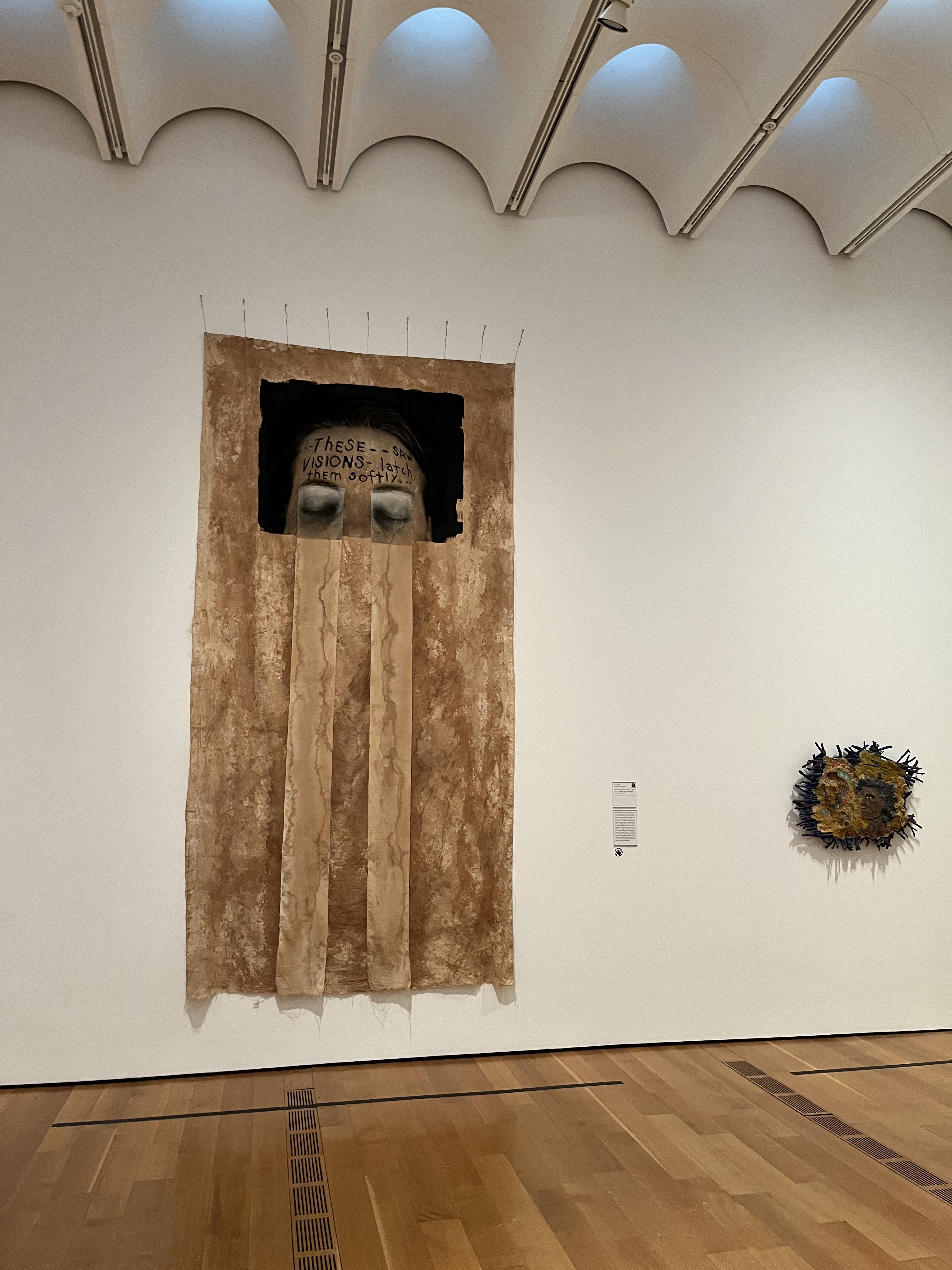
The most fascinating encounter was the modern wing, that fashions art that is quite different from previously mentioned techniques. Here, the human figure is seen in distorted ways and played with to convey different ideas. Modern art became a time of expression and the idea of ‘art for art’s sake.’ in this climate, it is interesting what the human figure meant for different artists. The following images are some of the examples that stood out to me. For example, Lonnie Holley’s ‘Finally Getting Wings for the Forty-First Floor’ takes everyday material to create what resembles the side profile of a human figure out of wire and other material. Similar is Holley’s ‘What’s on the Pedestal Today?’, a tall pillar-like piece embellished with objects such as hairbrushes, glass bottles, and mirrors. Holley argues that these are critical for the modern consumer to build how they wish to be perceived. I think it is particularly fascinating to look at how the art piece can almost be read as a standing human figure. Instead of bodily features, there are these objects, marking Holley’s commentary on what actually makes up how we view or project ourselves.

Lonnie Holley’s ‘Finally Getting Wings for the Forty-First Floor,’ picture taken during museum visit
Holley’s ‘What’s on the Pedestal Today?, picture taken during museum visit
Picture taken during museum visit

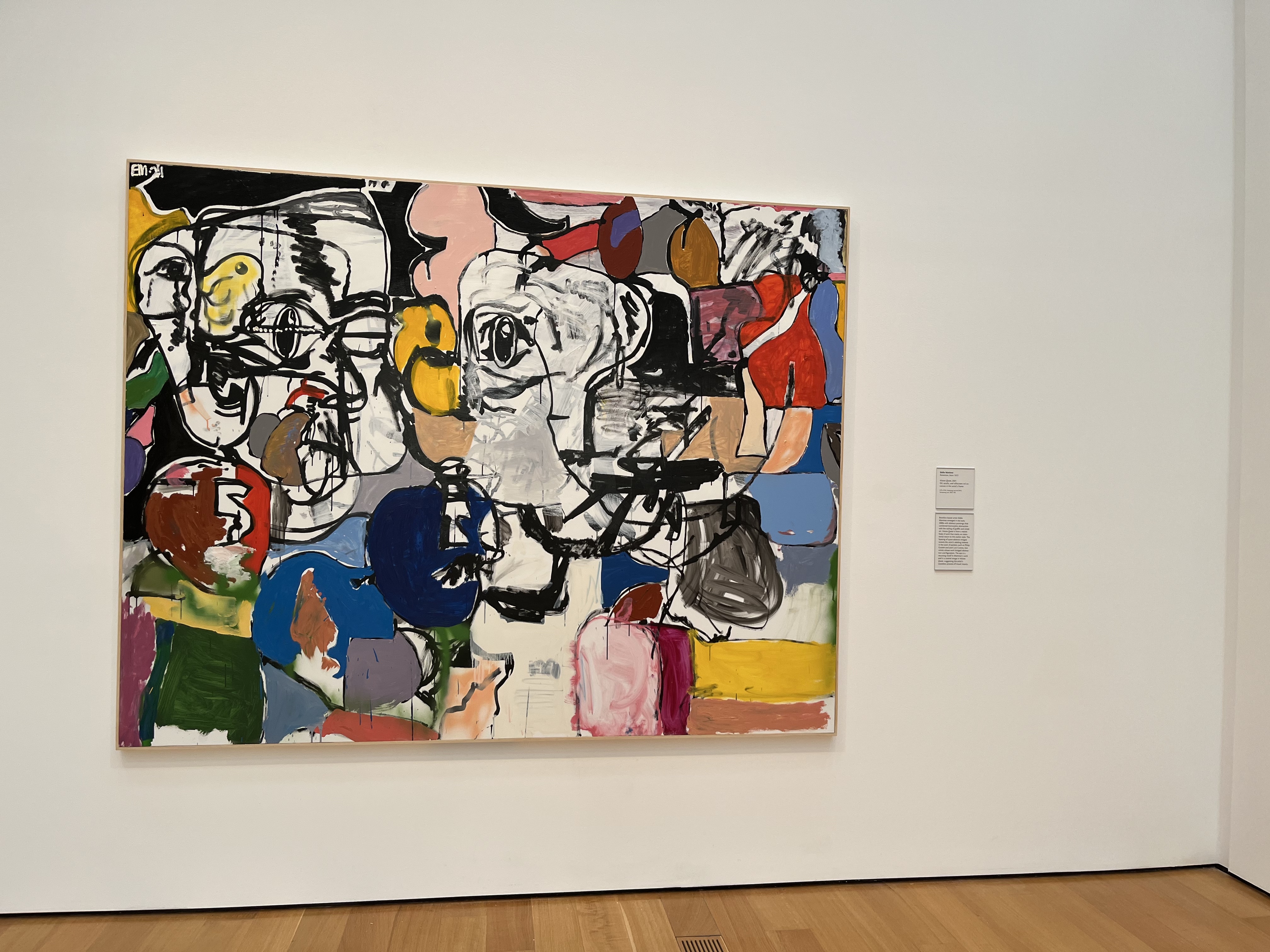
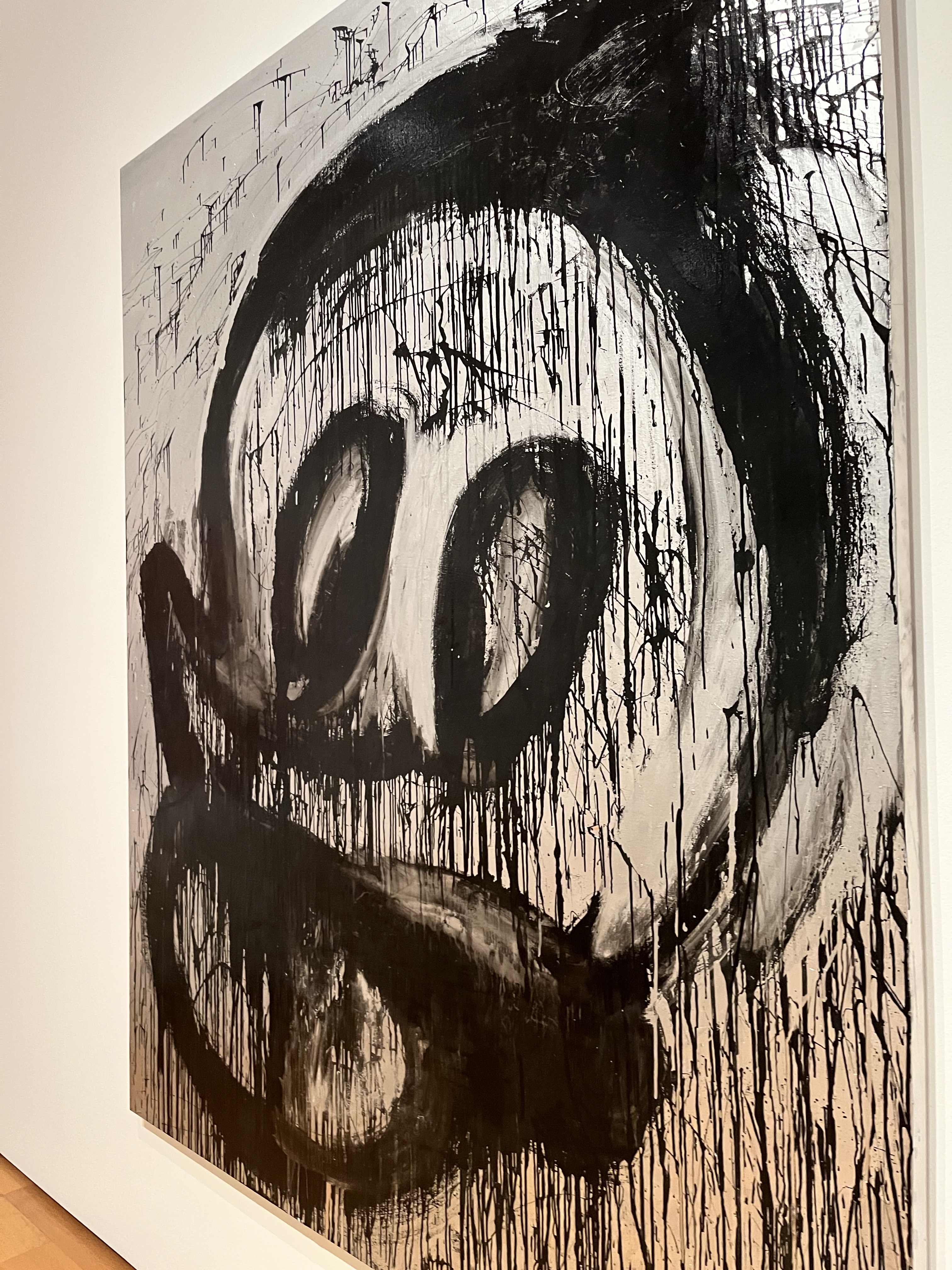
Here are some more interesting distortions of the human figure. The use of different colors, materials, and styles stood out to me in marking how artists used art in their own ways and to express their own ideas and create certain ideas on identities. While I was unable to source the background of some of the following pictures, i included them as they are in line wit this artistic expression of the modern era.

Picture taken during museum visit

In my pursuit of human figures across the museum, I was particularly fascinated by the different ways artists considered human figures, be it in terms of importance and what the subject meant to them as well as what they wished to say about them and how. I hope you find them as fascinating as I did! 

Works Cited: High Museum of Art, https://high.org. 

Posted by: vincentgaberlavage | December 13, 2021

On Art Deco, and Victoriana, in Robinson And Harris’s Star Man

Robinson and Harris’s 94-01 run on Starman for DC is notable, not only for it’s high quality in an era where most other mainstream books were trying to tack as many spikes as they could get away with onto their protagonists, but also for it’s striking Art Nouveau inspired visuals. While these might initially seem out of place in a comic who’s main character looks like an off brand Guy Fieri with bad tattoos, they serve a definitive purpose in the narrative in visually separating him from his father.

The plot of this particular run on Starman is fairly common in Superhero comics. The original Starman, Ted Knight, is forced into retirement due to his old age and must pass his mantle onto his son. However what elevates this particular comic is the relationship between the father and son involved. Jack is in his late twenties when the comic begins. He has a job as an antiques dealer, a messy relationship with his ex, a few tattoos he regrets, and most importantly a strained relationship with the father who was absent through out most of his childhood and teenage years. His father on the other hand is a straight laced intellectual of the Greatest Generation (this was back in the days of Gen X rebellion) who has a strained relationship with his rebellious son. The difference between these two characters is represented visually through differing associations with artistic and architectural movements.

Ted, the elder Knight, is visually associated with Art Deco. The use of the style ties him back to the era referred to as the Golden Age of comics (1938-56) during which he first emerged. However the style’s sleek futuristic lines and association with the high society of the 20’s and thirties speaks to his retro futuristic optimism, and wealthy playboy secret identity (shared by a few other maybe more notable characters. It’s mechanical and aerodynamics influenced design also calls back to his creation of his own gadgets and his ridiculous but also aerodynamics inspired costume. It also places him firmly within the framework of societal power, Art Deco architecture specifically is still to some extent associated with the power of industry and finance.

His son Jack, the principle character of the comic is associated with the visual aesthetics of Art Nouveau. I might seem to be putting the cart before the horse to have the son associated with an older school of design than the father however this is actually used to tie him visually back to the counter culture of the 80’s and 90’s. The fashion of the goth subculture specifically takes a great deal of influence from Victorian aesthetics. The more natural shapes of Art Nouveau also puts him in direct contrast to his father’s geometric industrial style.

The use of Victorian and Modern aesthetics here are not just used for the purposes of aesthetics but also as a means of displaying aspects of a complex relationship between the two principle characters.

Posted by: lizl3wis | December 13, 2021

REVIEW — A.P.E. Ltd. Gallery Art Show, December 10

On December 10, the current art showcase at the A.P.E. Ltd. Gallery in Northampton, MA held an evening reception in celebration of the gallery’s Flat File Exhibition’s featured artists, one of whom was my beloved roommate. She had a print of hers accepted to the show, so I came to the reception to support her and see the artwork on display. As a pleasant bonus, this meant I also got to enjoy a night of milling around, looking at visual art, and speaking to local artists — an event that was entirely lovely in its own right.

The reception was held in the evening, and offered drinks, but no formal speeches or otherwise structured time. Instead, people were encouraged to walk around and look. The showcased work was sourced from members of the Western Mass community, ranging from Smith College art students to local Northampton retirees. Mediums included acrylic and oil paint, pastel, pen and pencil on paper, screen printings, photography, cyanotype on handmade paper, textile weavings, digital art, and even a multimedia project consisting of an old skirt smeared with a globular, textured paint that may have been constructed out of food matter. There was much more than that, as well, in just about every flat medium you could think of. Many of the showcased artists and photographers were present. I got to speak to several of them about their work, often by accident, which was the case for the piece below.

I couldn’t stop staring at this photograph in particular. After a few minutes of doing so, a man came up behind me and told me it was his photo. When I asked how he got a shot like this, he explained that it was the upside down reflection in a puddle on a bike path he was walking on. To me, it didn’t even read as a reflection when I first tried to make sense of it — there’s an otherworldly quality to it, as though the reflected trees are really there, behind the puddle. The mirrored effect also makes for some interesting visual elements, such as the white flecks in the upper half, which almost read as stars or snow in this imaginary scene. I love everything about this photo, but I was most intrigued by the beige leaf, which, to me, looks like a tear in an oil painting, or some similar artistic break in the scene. In actuality, it’s just naturally part of it. This photo played so many fascinating tricks on my eyes and mind, just by virtue of its staging within a reflection. (Zoom in for the photographer’s name — I didn’t want to make his name searchable on the internet without his consent.)

While this photographer toyed with the eye through reflection, several other artists played with distorted visuality in intriguing ways. My favorite, not that I’m biased, was the work of my roommate, Olivia Brandwein ’22. Below is her print, “Shadow.”

I love the way that this artwork forces the viewer to examine the relationship between the hands and the shadow they produce. It reminds me of the optical illusions I used to love as a kid, because they, like this piece, make me think about image and perspective as intertwined. I love what this piece does to my eyes without even trying — whenever I look at it, I see the bunny first, and then I move to the hands to puzzle out how exactly a rabbit came from those shapes. The shadow rabbit takes on a life of its own, no wrist shadows attached, emphasizing that the shadow is a creation in itself, and is, in a way, its own work of art. This piece also reminds me, in a heartwarming way, that so much visual art — whether it’s the bunny or the print itself — begins with your hands.

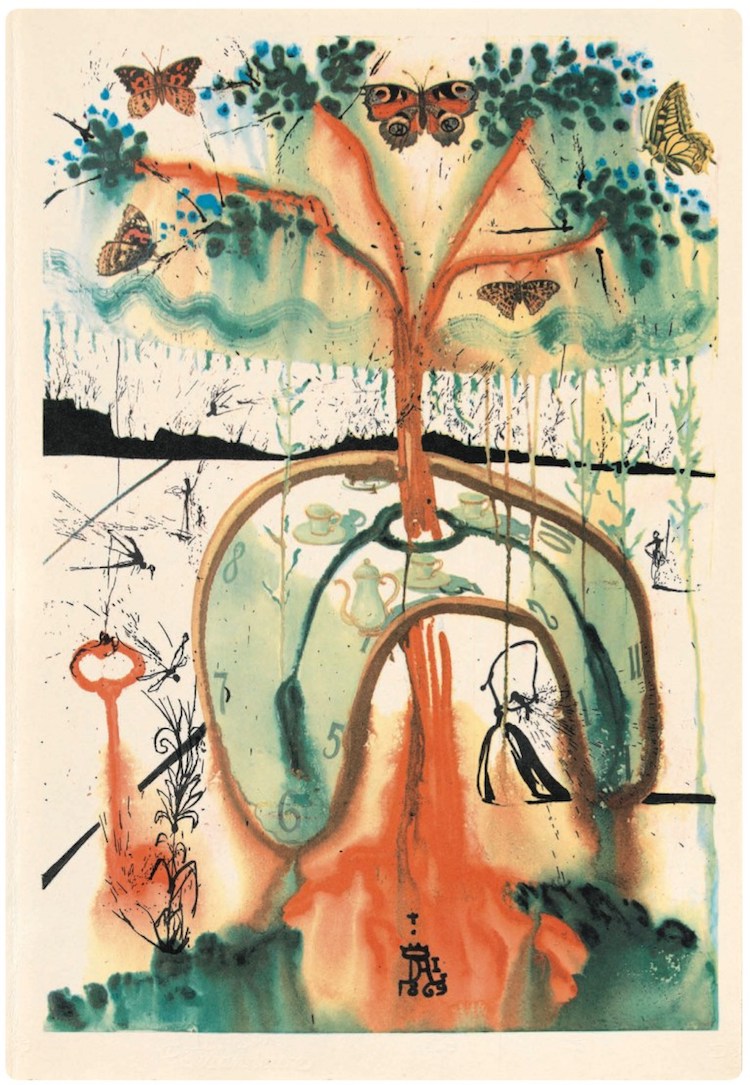
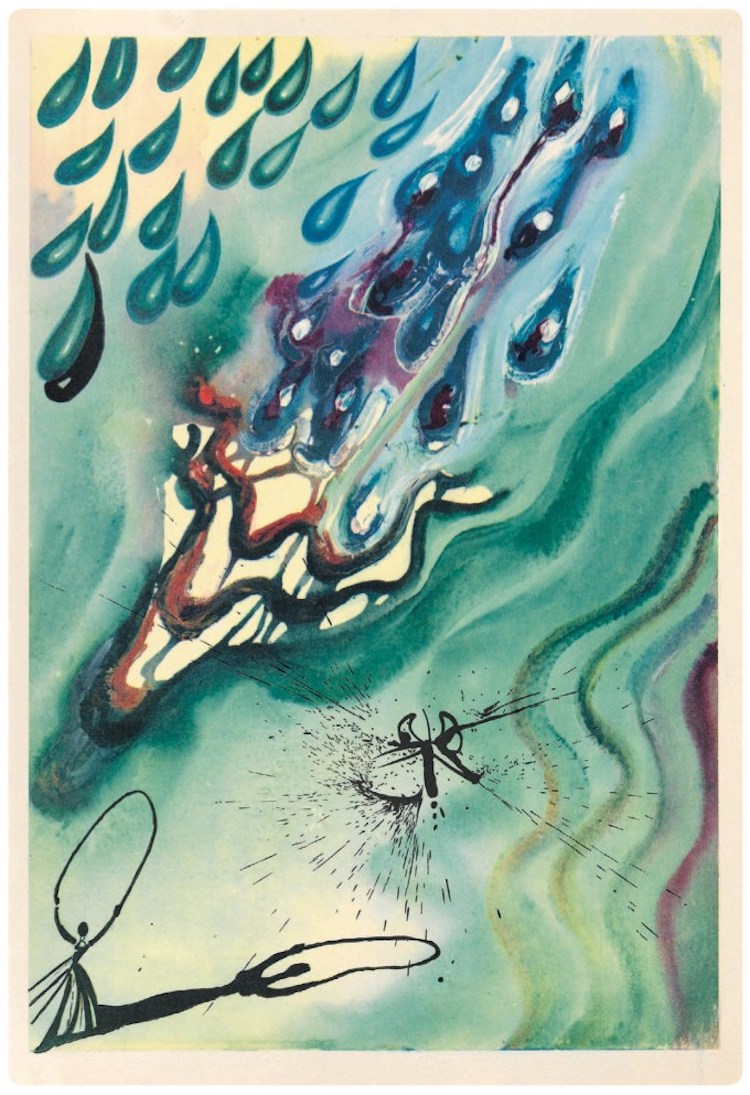
In 1969, Random House commissioned surrealist icon Salvador Dalí to illustrate Lewis Carroll’s Alice in Wonderland. The result was a four-color etching as a frontispiece and twelve heliogravures, one representing each chapter of Carroll’s work. Heliogravure is a printmaking technique originally developed by Nicéphore Niépce in the 1820s, contemporaneous with his work in developing photography. Heliogravure is considered one of the earliest ways of reproducing photographic images. Dali’s use of the medium is fitting — an abstracted representation of Carroll’s already whimsical story, expressed through one of the mediums that shaped the visual culture of Alice’s historical moment. 

The illustrations are often abstracted to the point where they could be described as psychedelic, but one feature remains staunchly and recognizably present throughout all twelve editions: Dali’s representation of Alice. The artist chooses to portray Alice as a silhouette of a woman jumping rope, always accompanied by her shadow. Dalí initially used this figure in some earlier paintings during his career, often titling the figure, “Girl Skipping Rope.” Here, this girl is repurposed as his Alice. Her jump rope is suspended in an arc above her head in every appearance. 

For all of the real Alice’s morphing, shrinking, growing, and other disruptions to her form, Dali’s representation of her is surprisingly static. The shadow, however, is granted that freedom of form. In some images, it stretches far taller than the figure, as though the sun is setting. In other illustrations, the shadow is identical to the figure, creating an uncanny doubled effect that carries echoes of Lady Clementina Hawarden’s photography, and all other features of Victorian visual culture that positions adolescent girls in front of mirrors. 

Though this Alice is only a silhouette, she still carries with her two seemingly contradictory ideas of age and Victorian girlhood. First, she seems to have been aged up considerably — a young woman, rather than a child. In several of the twelve representations of her, she is clearly drawn to have the figure of someone who’s already gone through puberty, and perhaps even reached young adulthood. This is an interesting choice, considering that Carroll’s Alice is firmly a child, several years removed from entering the nebulous Victorian space of young womanhood. This idea is complicated, however, by the jump rope.

The jump rope makes for a compelling and recognizable silhouette, but holds symbolic function as well. First, it communicates a sense of suspension in time for her character that carries interesting implications. Though Wonderland as a space already complicates the passage and function of time, we never get the sense in the original work that Alice, herself, is frozen in time in some way. This Alice, though, seems suspended in a paradoxical moment of frozen motion, the rope at the height of its trajectory, suspended in the space between upward movement and downward movement.

Second, the jump rope carries with it the undeniable connection to childhood. It indirectly suggests a reading of Alice that exists in a suspended state of play, hoisting that moment above her head; girlhood, frozen at its apex, right before it falls. 

Posted by: gaurikaushik | December 13, 2021

Table for 500 Review

Table for 500, 2021, by Rua McGarry was an exhibition that was displayed in the Blanchard Dining Commons as part of a broader collection of exhibits by Mount Holyoke students called Art Unexpected ‘21. The exhibit displayed five place settings with dinnerware that had “been rendered unsuitable for food and drink and now functions solely as an art object” (McGarry). It featured dinnerware such as plates and utensils that had been altered through the mediums of newspaper, acrylic paint, mod pod, and glitter. According to the artist, the concept aims to refer back to students taking decorative plates from Blanch in the spring of 2019 as a response to increased tuition. This project, McGarry writes in the description, allows students to take another piece of dinnerware from Blanch.

Although I was unable to view all of the installations of Art Unexpected ‘21, of the few I did see, this one caught my eye for a couple of reasons. For one, Table for 500 was placed in a very central location, one that all students are compelled to visit in order to eat. It was also an interactive work of art.

What I found most interesting about this exhibit was the interactive portion of it. Viewers of the exhibit were encouraged to take an art object from the table, while leaving something of their own behind. I thought this was an interesting concept, as it resulted in the viewing of everyday objects as pieces or components of a larger art piece. McGarry stated rhat the purpose of the interactive portion of the piece was to explore “how exchange can function outside of assigning monetary value to art” (McGarry). I thought this was interesting because the significance of art is often measured by its monetary value, and McGarry was allowing their art to be taken in exchange for common, everyday objects like a granola bar.

The result of the interactive portion of this piece was that it was difficult to tell which pieces were originally part of the installation, and which were additions by students. Trying to guess adds a different, entertaining element to viewing this installation, but taking in the whole exhibit as art without picking apart which components could be everyday objects left behind by students is also interesting. For example, I thought the plate and the cup were surely part of the original exhibit, while the paper swan and flower and balloon animal in the picture above could have also possibly been part of the art installation, although they could have also been random objects left by students. On the other hand, I thought of how the granola bar in the cup symbolized the meals of a college student: always on the go and just a little bit chaotic

As someone who knows next to nothing about critiquing art, I do believe that even after much of the original artwork has been taken, the exhibit still has the appeal of a contemporary art installation. If anything, it’s interesting to see what students choose to leave behind and how they interact with the piece.

It was also interesting to see the progression of the installation over time. Although I didn’t have the chance to take pictures of it throughout the course of the exhibition, I saw items appearing and disappearing as I walked by the exhibit every day. This photo, which was taken once a day or two before the exhibit was taken down, shows the last objects left on the table. I thought this was interesting because the description specifically stated to exchange a personal item for one of the place setting objects on the table. It’s compelling to think about how things that were left by other students could have been perceived as art and taken in exchange for something else. 

An intriguing thought I had while walking past this exhibit multiple times a day for the length of its installation was that even though there were random objects lik Tums and toothpaste on the table, I was hesitant to interact with the installation myself. For some reason, I felt that the intrigue of the art would be altered if I myself participated in it. Upon further introspection, I came to the conclusion that while I could dream up the significance of the objects left by other viewers and draw connections between the components of the installation, if I added something of myself, I would know exactly what I was thinking and why I added the random thing I did. To me, this would have decreased the value of this art piece.

Overall, I enjoyed the concept of this exhibit. For me, though, it was more reflective of the idea of collaborative art. I found a deeper connection to the way people interacted with this art piece and the objects they left behind, instead of reflecting on the idea of taking dinnerware from Blanch.

Posted by: gillianpet | December 13, 2021

Cheap Victorian Homes Allow Millennials to Become Homeowners

I recently read an article titled “Cheap old homes draw U.S. millennials escaping pandemic cages” which I think is interesting in terms of how Victorian architecture and homes are being treated in modern times.

The article’s main subjects are Kate Reinhart and her husband Cameron who bought a house near Norwich, Connecticut built-in 1885. The couple bought the home for $85,000, however, the selling of the home was contingent upon them renovating it. So the couple also took out a $100,000 renovation loan. Kate has been documenting the renovation on her Tik Tok account @the1880soctagon. The couple has chosen to renovate the home in the gothic style. While going through each room Kate provides historical details on what the original owners of the home would have used each room for.

During the pandemic, Damian Mordecai (far left) and Nick Weith bought an 1870s home they found via the Cheap Old Houses Instagram feed.

Buying and renovating a Victorian Home was always a goal for Kate and Cameron, however, according to the article cheap Victorian homes are allowing Millennials to become homeowners. The Instagram account @cheapoldhomes founded by Elizabeth Finkelstein has over 1 million followers and has helped many couples find a cheap historic home to renovate and move into. Finkelstein said that she started the account in order to help Millennials, who are statistically less likely to own a home, connect with historic homes and become homeowners.

Although the homes may be cheap, the renovations are not. Some of the people who have bought homes through the site have renovation budgets of $125,000. Some of the couples have chosen to renovate the homes true to gothic style, while others have chosen a more modern approach. Personally, I feel this is the most interesting part of this. Millennials are buying these homes and stripping them of their culture and beauty. However, I am looking forward to now following Kate and Cameron’s home renovation journey.

Works Cited

Hoffower, Hillary. “Millennials Are Finally Buying Homes – and It’s through Instagram, of Course.” Business Insider, Business Insider, 8 Aug. 2020, https://www.businessinsider.com/millennials-buying-cheap-historic-homes-through-instagram-2020-8.

Today. “Cheap Old Homes Draw U.S. Millennials Escaping Pandemic Cages.” TODAY, https://www.todayonline.com/world/cheap-old-homes-draw-millennials-escaping-pandemic-cages.

Posted by: gaurikaushik | December 13, 2021

Alice in Wonderland and Oxford

One thing that I always think about whenever Alice’s Adventure in Wonderland is brought up is the effect that the scenery of Oxford had on Charles Dodgson. When I was studying at Oxford over a summer in high school, I took it upon myself to take myself on a tour of all the famous writers that found inspiration in their surroundings in Oxford, such as the door that inspired C.S. Lewis’ Narnia, J.R.R. Tolkien’s grave, and the river where Lewis Carroll took his boat trips with Alice Liddell and his children, as well as Christ Church (Alice Liddell’s father was a Dean). 

Andy Haslam for The New York Times

The downside of visiting these places was the erasure of the magic of total imagination that I believed these authors had. Of course, their work and creativity still amazed me ⏤ Wonderland is, after all, thought to be something that was inspired by psychedelics. But things like the illustrations of Alice’s abnormally long neck looked a little too similar to the brass andirons with women’s heads perched on top of them in the Great Hall of Christ Church.

The discovery of these possible inspirations for Carroll’s story invariably begged other questions, though. For example, as the sub-librarian of Christ Church, Dodgson’s office could look directly into the deanery garden in which Alice Liddell often played. The wooden door set into a stone wall in the garden may have served as further inspiration in the creation of Alice in Wonderland, but what was Dodgson doing watching a little girl playing in the garden?
Of course, Dodgson could have had completely innocent intentions in his writing. Perhaps it really was, as he put it, just “nonsense.” His stories are still, after all, presented as pure, innocent, and still wildly popular children’s literature. But there are still questions of his attraction to Alice Liddell as his photographic and creative muse. Alice’s Adventures in Wonderland could also be rife with sexual imagery in some interpretations (Kaigh, Georgetown University). There are many ways to interpret Dodgson’s relationship with Alice Liddell, and even Liddell’s influence on Dodgson’s stories. I think it’s interesting to point out that Liddell was not the only subject that inspired Alice’s Adventures in Wonderland, though. The city of Oxford and little things like doors or fireplaces also played a role in creating the fascinating world that is Wonderland, which I often think is completely removed from reality.

« Newer Posts - Older Posts »

Categories