Posted by: willconley1025 | December 12, 2021

Ana Mendieta and Visual Culture

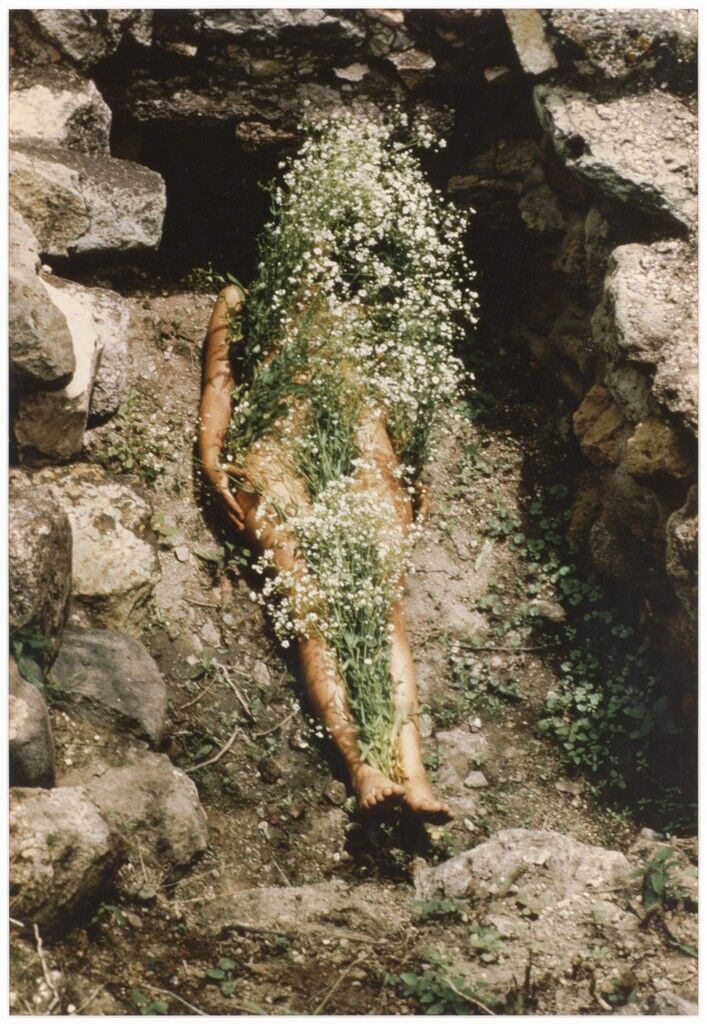
There have been multiple times this semester when something I’ve learned in one of my other classes has made me think of topics we’ve covered in this class (or vice versa). One of these times was in my Spanish class (which focuses on violence, gender, and queer identity in Latin America), when we had class in the art museum and watched a short film called Silueta Sangrienta (bloody silhouette) by Ana Mendieta. It’s a two-minute video that shows a human-shaped hole in the ground, filled with what appears to be blood, then shows the artist lying in the hole. (Unfortunately I could not find a link to the video, but I have included a screenshot of it below.) It’s part of Mendieta’s Siluetas series, a long-term project that consists of over 200 images and videos of human silhouettes in various natural settings.

A lot of the connections that I’ve made between this class and others have been fairly loose, and this is definitely one of them. Mendieta’s work isn’t directly related to any kind of Victorian art or culture, but Silueta Sangrienta (and the Siluetas series in general) made me think about some of the ideas about visual culture that we’ve discussed in this course. Mendieta’s silhouette images are often deliberately unsettling; I wasn’t quite sure how to respond or what to think about them, and I’m sure that effect was intentional. The disquieting effect of the images made me think of different disturbing images, such as the famine photographs we viewed. The basic emotions of discomfort that I felt were similar with both sets of images, but the context for those emotions was very different. There are obviously a lot of ethical issues with visual representations of tragedy and suffering, and part of the discomfort (at least for me, and I’m sure for many other people as well) comes not only from the disturbing images themselves but also from the knowledge that, in many cases, the people in question didn’t consent to their suffering being exploited in this way. Mendieta’s images, on the other hand, are created entirely by her; she is in control of what is being portrayed and how. Her photographs that depict blood, fire, and other things that may imply violence are certainly disturbing, but in a way that emphasizes the artist’s agency and her relationship with her body and the land.

Another thing about Silueta Sangrienta that I found interesting was the video format. Most of the entries in the Siluetas are solely photographed, while this one is a video but is silent and largely portraying one consistent image. The overall effect is uniquely unnerving, and made me uncomfortably aware of my role as an observer. In a way the film walks the line between video and photograph, and I felt strange and almost voyeuristic looking at it. It was an interesting experience that made me think about the evolution from painting to photography to video recording, and the different ways that things can be portrayed in these formats.
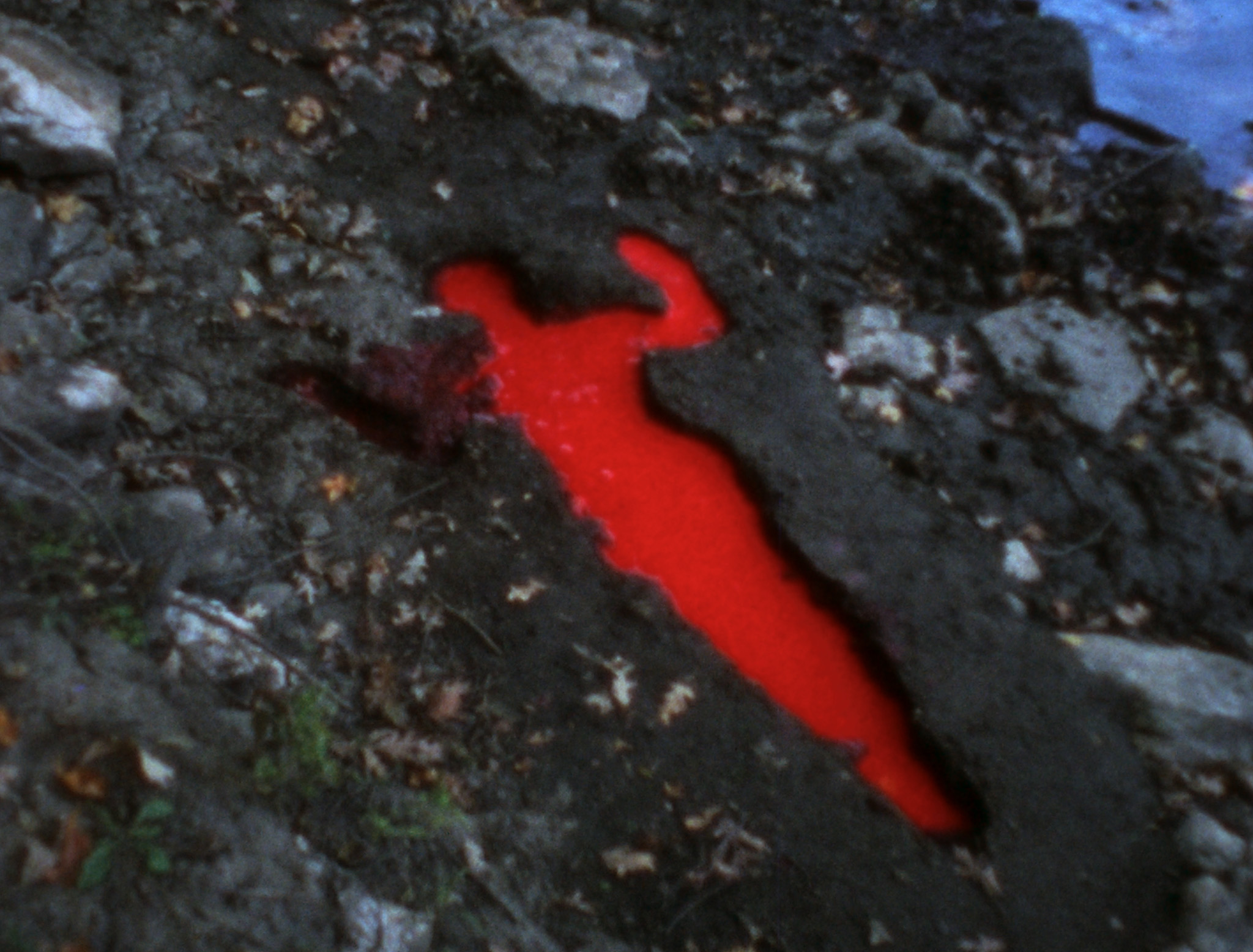
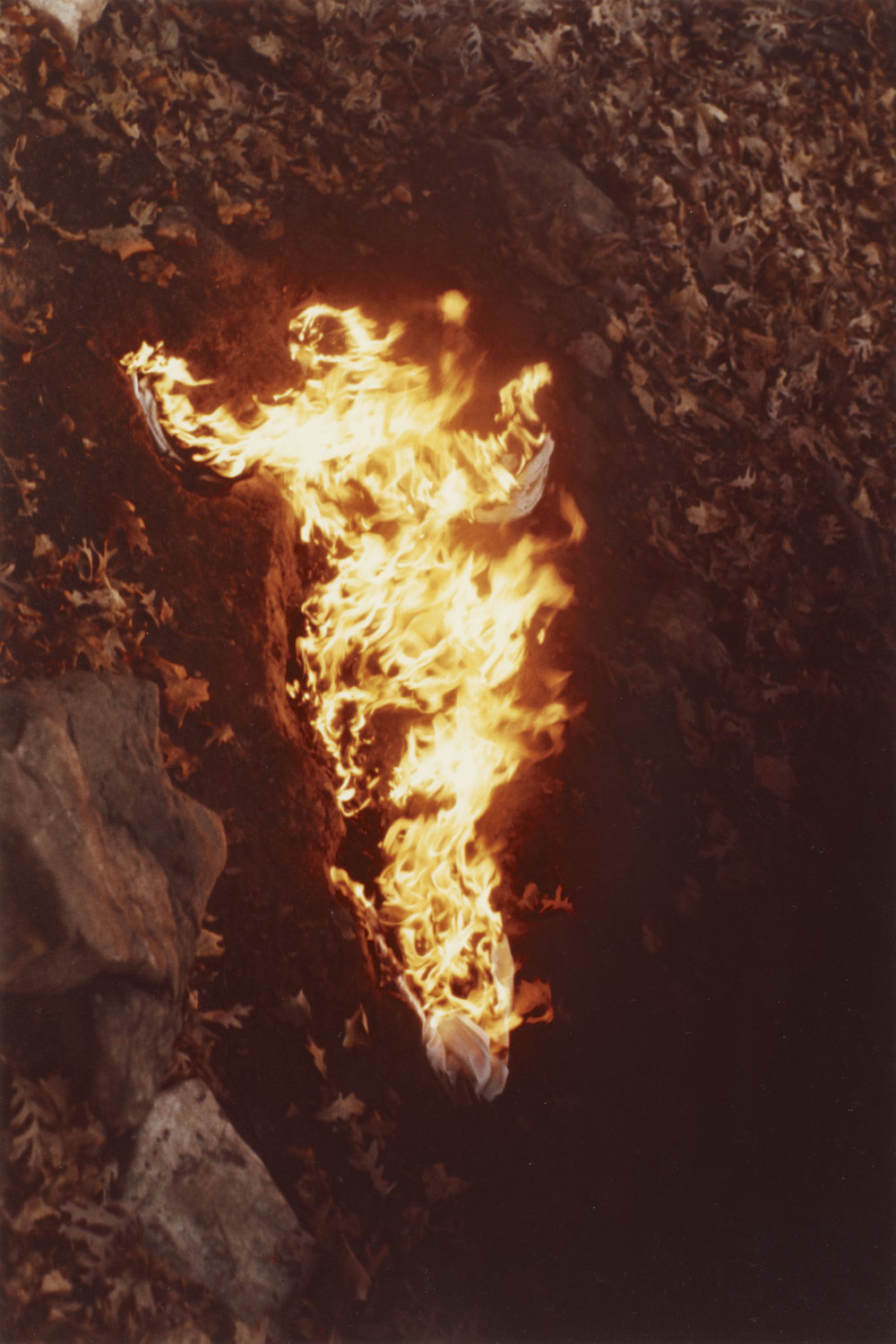
A screenshot from Silueta Sangrienta

Artnet. “Ana Mendieta.” http://www.artnet.com/artists/ana-mendieta/

Posted by: Lynn Moynahan | December 12, 2021

Photographing Victorian Crime Scenes

TW/CW: Crime scene photos containing blood, a deceased person and detailed descriptions of deceased persons

Alphonse Bertillon (1853-1914), French scholar, developed the criminal anthropometry. Self-portrait ID following his own methods made on August 7 1912, at the age of 59. (adoc-photos/Corbis via Getty Images)
Alphonse Bertillon took his own mugshot as an example of the standards he wanted to set. https://www.salon.com/2021/05/15/alphonse-bertillon-and-the-troubling-pursuit-of-human-metrics_partner/

Alphonse Bertillon (1853-1914) was a French photographer credited with standardizing the mugshot in the 1880s but became well known for being one of the first to photograph crime scenes, revolutionizing the documentation used in law enforcement. His father was a physician, likely lending a hand to Bertillon’s stomach for gruesome crime scenes, like one where a victim is decomposed and bloated, eyes bulging while it hangs off the edge of a bed. Bertillon was frustrated with the way law enforcement documented and organized information and photos of criminals, so he developed the first mugshot styles and an anthropometric identification system for criminals. Of course, this method proved to be ineffective in future years and embroiled him in the Dreyfus affair in which his handwriting analysis of a suspect led to the conviction of an innocent man. The conviction was overturned, and eventually, Bertillon moved on to be one of the first crime scene photographers. 

The following are two of Bertillon’s crime scene photos from The Metropolitan Museum of Art.

There are elaborate furnishings, including window hangings and an ornate bed frame with a mini canopy hanging over the head of the bed, looming over a pillow with a lacy cover. A nicely upholstered chair is on the left, catty-cornered between two windows. A short sitting bench and a washbasin are away from the foot of the bed. This is the bedroom of someone with a moderate amount of wealth and could be a point of interest to law enforcement. There is some disarray of the sheets and blankets on the bed, indicating someone having recently woken up. A chair is knocked over, mostly concealed by the bed, and a pillow is on the floor. The eye is quickly drawn to the framed Birth of Venus print on the back wall, unusually tilted, and the large bloodstain on the pillows at the head of the bed.

The second picture reveals Madame Debeinche, the victim. She is lying between the bed and the back wall. A second chair is knocked over. The body of Madame Debeinche is posed eerily similar to the Venus in the painting above her. Her fingers and toes are dark from livor mortis, suggesting she had been dead for six to 12 hours before the photo was taken. She is still wearing her nightclothes, now stained with her blood spatters. Coming from the bottom left corner of the photo is the bottom half of the first tipped chair, pointing directly at the deceased. Despite the coincidence, there is an irony in the painting being the birth of Venus while the death of a woman happened right below it. The positioning of the chairs and tilted picture suggests a struggle between Madame Debeinche and her killer, though the delicate, tall table in the corner holding a vase of flowers remains untouched. 

While generally used for legal purposes, photographs of victims of crimes were treated differently than some others. Notorious outlaw Jesse James and Jack the Ripper victim Mary Kelly were seen as “others” in relation to other victims. In her book Photography and Death: Framing Death Throughout History, Racheal Harris says, “publication and dissemination of the slain criminal body was a tool through which law enforcement might indicate the consequences for criminal behavior” (Harris 36). Jesse James was a bank and train robber and the leader of a gang, highly sought after by law enforcement. When he was caught and killed by the police, his post-mortem was very different from what we see in others. There are no flowers or other adornments in his coffin, he’s not wearing what would be considered his best clothes, and there are officials surrounding him, to indicate he was in fact a criminal. The release of these photos were probably trying to deter anyone else from doing something similar meeting the same fate. Other killed criminals were pictured at the scene of their death, wearing the same clothing they died in, showing a lack of compassion from those involved (Harris 36-37). 

Mary Kelly wasn’t the same kind of criminal that James was. Though sex work was and still mostly remains illegal, Kelly could still be considered the same level of criminal as James. Mary Kelly was the only Ripper victim whose whole body was photographed. She is mutilated beyond recognition from head to toe and some of her organs are set on her side table. Her head is turned toward the camera. Megha Anwer, author of “Murder in Black and White: Victorian Crime Scenes and the Ripper Photographs” details the journalistic aftermath when it was discovered that one of Kelly’s organs, her heart, was missing. The journalists took this information and ran, disregarding the way in which Kelly had been murdered. “To focus on the absent body part becomes a self-deluding detour that allows us to turn a blind eye to the remnants of the savaged body left behind by the murderer,” Anwer says (438). Officials and journalists treated Kelly’s brutal murder as less important and sensationalized it more simply because she was a sex worker. Many consider sex work immoral and degrading to one’s reputation and in society, they are not seen as worthy of the compassion and respect as others. The photograph of Kelly is haunting and gruesome and a stark reminder of why Jack got his Ripper moniker. 

Works Cited

Anwer, Megha. “Murder in Black and White: Victorian Crime Scenes and the Ripper Photographs.” Victorian Studies, vol. 56, no. 3, 2014, pp. 433–441., https://doi.org/10.2979/victorianstudies.56.3.433.

Bertillon, Alphonse. “Album of Paris Crime Scenes.” Metmuseum.org, Metropolitain Museum of Art, https://www.metmuseum.org/art/collection/search/284718.

Harris, Racheal. “Romance: Post-Mortem Photography.” Photography and Death: Framing Death throughout History, 2020, pp. 19–39., https://doi.org/10.1108/978-1-83909-045-520201002.

Jones, Richard. “The Mary Kelly Photo Gallery.” The Mary Kelly Photo Gallery., https://www.jack-the-ripper.org/mary-kelly-gallery.htm.

Posted by: kate m. | December 12, 2021

Exhibition Review | Pamela Tulizo: “Face to Face”

The first thought I had while thinking about photography exhibitions was the Maison Européenne de la Photographie (MEP) in Paris. I’ve been very lucky to have visited Paris twice, and both times I’ve gone to this amazing photography museum; it might be my favorite museum, and I highly recommend it should you be in Paris.

I was completely enchanted by the photographs I saw in a forthcoming exhibit by a photographer I had never heard of: Pamela Tulizo. The MEP’s exhibit, “Face to Face,” doesn’t open till 2022, so I crossed my fingers that another exhibit of her work would be available elsewhere online. 

Tulizo won the 2020 Dior Photography & Visual Arts Award for Young Talents, where the theme of the competition was “Face to Face,” the exhibit had originally been presented on Instagram due to the pandemic, and is now available in certain art and fashion magazines, like V

“Face to Face” completely “flips the script” on the Victorian photographs and illustrations of citizens of countries suffering from war and famine that we’ve studied in class, which often showed the intense suffering of women and children. Tulizo, born in the Democratic Republic of Congo, started her career in journalism prior to becoming a photographer. Her experience as a journalist was a factor in the inspiration to show women who are resilient while in difficult circumstances, who still maintain an interest in fashion, make-up, jewelry, and creating a personal aesthetic. 

Tulizo’s journalistic background reminds me of KJ Brown’s essay on Kevin Carter. Tulizo’s work is basically the opposite of Carter’s ethically controversial photographs of impending death. Her photographs, with women in bold and colorful outfits, are full of life. 

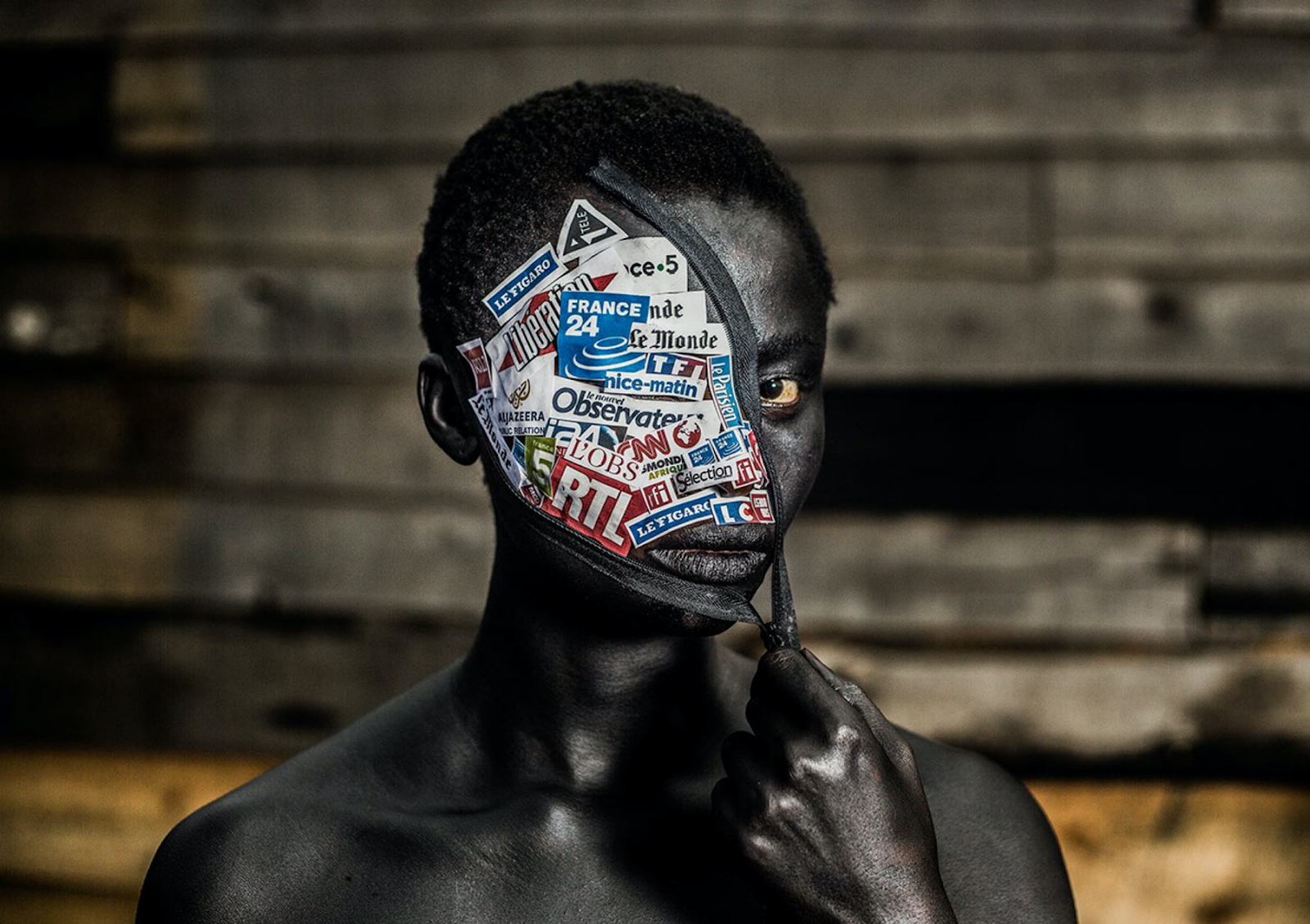
Other photographs in her collection address the issue of journalistic representation of African women. In the series, “Double identity (Women from Kivu),” a woman is “unzipping” half of her face as it reveals the logos for dozens of media outlets. This photo presents numerous questions to the viewer, asking them iif the media’s images of African women are artificial. If it’s false for a woman’s “unzipped” face to reveal media enterprises thousands of miles away, then what does that mean for people who consider those outlets to be sources of factual news?   

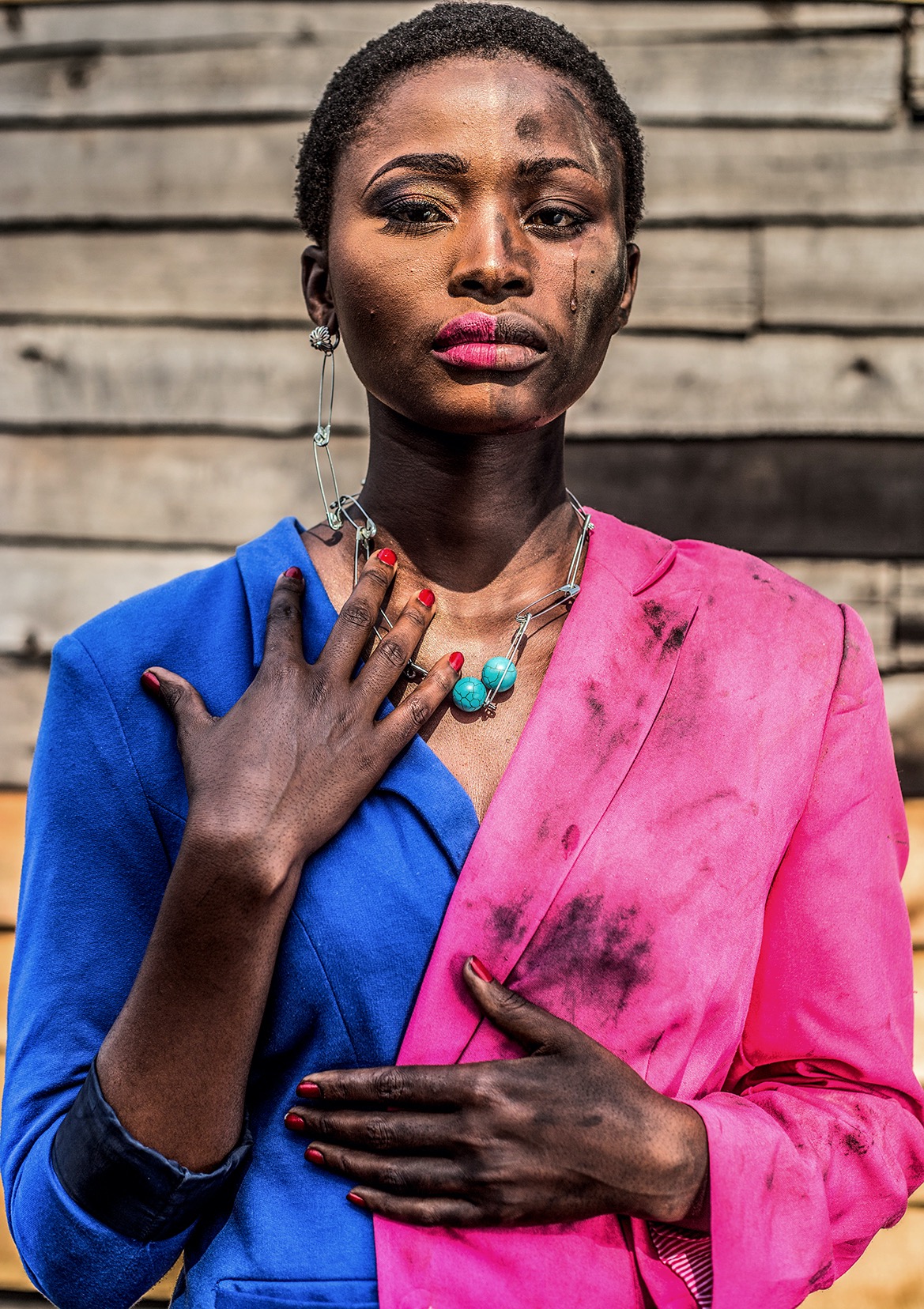
Another portrait from the “Double-Identité” series that shows the complexity of womanhood in Africa is one in which a woman is shown with half of her face and outfit dirty, covered in what appears to be soot, whereas in the other half, the outfit is clean, and that half of the woman’s lips are colored with pink lipstick. The left ear is an interesting detail, where it appears that there’s an expensive-looking earring, which is then attached to a chain of safety pins that go around the woman’s collar, and then upwards around the right side of her neck, the side of the portrait where the woman looks like she’s just been thrown into dirt. The safety pins going around the neck on this side is a visual reminder of bondage, yet the portrait also shows the safety pin chain as a fashion accessory. Her manicured fingernails and the position of her hands in the portrait is also contrasting, where the left hand has a kind of “vogue” gesture, while the right is over her abdomen, like she is protecting herself from the jacket being opened.

Tulizo’s award-winning exhibition also includes photographs where mirrors are used in a very empowering way. I was very excited about seeing the use of mirrors in her photographs, as I think mirrors are one of the most interesting items in an artist’s “back of tricks,” whether it be the end of Shakespeare’s Richard II, Jack Nicholson in Batman, or the last episode of Twin Peaks. In one of her “Double Identité” photos, we see a woman who is in a forceful pose over a mirror, a mirror with a bright orange trim, when the woman’s surroundings are very gray. She’s located on a street, the sky is gray, even the trees seem to be more gray than green. The image in the mirror shows the woman in bright pink scrubs, glasses, and a stethoscope around her neck. When I first saw this photo, I thought the image in the mirror was the woman in a complete hospital uniform, but when I looked at it more closely, she’s wearing a hospital scrub shirt but with ripped black jeans that are very punk rock. Is this a photograph that is “triple identity” rather than double? Is the woman seeking a future where she can have a multi-faceted identity where she works in a medical setting, and during her free time has a personal fashion style that involves ripped jeans?  I have absolutely no idea, which is one of the reasons why taking in these photos is a fun experience.

In the biography of Tulizo included in the introduction to her forthcoming exhibition, it’s mentioned her father was unhappy about her career choice, and that photography is a profession for men. To that end, her photographs of women who see themselves in the mirror as health professionals and construction workers is an act of personal rebellion. The MEP’s exhibition of her work will certainly inspire viewers to re-examine the visual representation of women in unfamiliar, faraway parts of the world, and who they really are.

Posted by: gabybarber23 | December 11, 2021

Victorian Adolescence and Sculpture

In my search to decide what to write my final blog post about, I pulled up the Mount Holyoke College Art Museum Website and typed “Victorian” into the search bar. By some stroke of luck, the search returned a variety of results, one of which was a sculpture created by British artist Sir Alfred Gilbert, titled An Offering to Hymen which is from c. 1886 (Fahey). According to the webpage which features Fahey’s description, the item is not currently on display at the museum, but you can view it on the website

Beneath the image of the sculpture there is a description attributed to Eva Fahey, a member of the University of Massachusetts Amherst’s class of 2017, and an exhibit entitled: “A Very Long Engagement: Nineteenth Century Sculpture and Its Afterlives” which ran from July 29th, 2017 to May 27th, 2018. Fahey’s description explicitly associates the sculpture with adolescence. I have cited Fahey as the author of the webpage as their name is listed underneath all of the information.

Gilbert’s sculpture depicts a naked girl with her hair arranged off her shoulders, her eyes closed, her legs pressed together, and her hands holding what Fahey notes to be a hawthorn branch and a statue of Anteros in front of her chest. She stands on a pedestal decorated with arches (Gilbert). Fahey writes: “This sculpture asks you to share the uncertainty of a young girl venturing into adulthood and to consider the uneasiness that accompanies her transition. What conflicts or outside forces might she face in the future?”

In asking this question, and sharing that Anteros is the god of reciprocal love, Fahey leads us to examine the anxieties a Victorian girl would feel as she approaches the prospect of marriage. Fahey writes: “Gilbert’s piece is contextualized by the expectations of the Victorian era, a time when early marriage was common if not expected.” It seems from this piece and Fahey’s description that adolescence for Victorian girls is just the stage of life when they begin to think about the future and their marriage prospects. I would say that adolescence in the modern day United States is largely concerned with the “what next?” step – or, in other words, what do you do once you turn 18? Work? Study more? Travel? At least for me, figuring out what I wanted to do for college was a large marker of my teen years. I think in some senses, adolescence may just be a phase where someone puts down their toys for a bit in favor of contemplating adult life in a genuine way. 

Unfortunately, I left my copy of Alice in Wonderland by Lewis Carroll at school, but Fahey’s discussion of this sculpture in relation to adolescence reminds me of our discussions in class about the novel and adolescence. I think it is interesting and important that this idea was being explored not only through a literary medium, but through an artistic one, as well. 

I think what is most significant about Gilbert’s sculpture is the way in which it puts the girl’s body on display. The nudity of the girl asks the viewer to consider her adolescence not only socially, but physically, too. This again reminds me of in-class discussion, where we talked about artistic traditions in which drawings of girls where given adult-like features but retained their child’s body. I think Gilbert’s sculpture, based on Fahey’s association of it with adolescence, rejects the idea that girls turn into women – rather, girls turn into teens and then become women. However, it is also important to acknowledge that this sculpture is a Victorian man’s rendering of an adolescent girl, much like Alice in Wonderland is a Victorian man’s exploration of girlhood. It would be interesting to see how a Victorian woman would have represented and interpreted the same subject. 

Works Cited

Gilbert, Alfred. An Offering to Hymen. c. 1866. Mount Holyoke College Art Museum. Mount 

Holyoke College Art Museum. Web. Photograph by Laura Shea. Accessed 11 Dec. 2021. 

Fahey, Eva. “An Offering to Hymen.” Mount Holyoke College Art Museum, 

https://artmuseum.mtholyoke.edu/object/offering-hymenAccessed 11 Dec. 2021. 

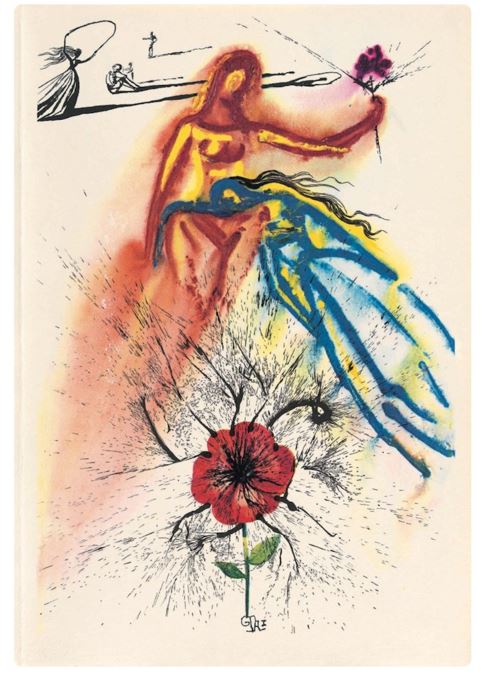
“Alice’s Evidence” by Salvador Dali, image source: https://mymodernmet.com/salvador-dali-alice-in-wonderland/

A few patrons at my local library might have overheard a bit of an unusual discussion when I picked up The Annotated Alice: My partner was with me and asked, “I don’t think I read that when I was younger; it’s about drugs, right?” My response was, “I definitely read it when I was younger, but don’t remember much. It doesn’t have anyone doing drugs, but I think it made people want to get high. Might have pedophilia in it, though.” 

On the drive home, I flipped through the book, and with each illustration I was immediately reminded of my first experience reading Alice as a child. Tenniel’s images brought back those memories in a way the text did not. (As an English major, I feel legally obligated to note that without Carroll’s visually exhilarative writing, the images wouldn’t exist.)

I came across the novel’s last paragraph, which begins, “Lastly, she pictured to herself how this same little sister of hers would, in the after-time, be herself a grown woman; and how she would keep, through all her riper years, the simple and loving heart of her childhood…” I let out an “eugh!” at her riper years. Did Lewis Carroll know that 156 years later, using the word “ripe” in this context screams “R. Kelly” and you don’t want to be compared to R. Kelly? No, he did not. Nevertheless, there’s both academic research, investigative journalism, and opinionated bloggers who debate whether or not Carroll was a pedophile. Despite all this material, there seems to be a lack of concrete evidence to adequately support either side. 

As far as drugs go, Alice’s association with drug use is so ingrained in our society that the subject has its own article on the National Institute of Health’s website. Appearing in 2010 on the federal government’s website, the author reminds readers that LSD didn’t exist during Carroll’s time and, of course,  “Lewis Carroll’s writing is much too imaginative and clever to be done by someone on drugs.”

The fact that the US government felt obliged to weigh in on the topic of Alice and drugs as recently as 2010  is a reminder that debating Alice’s meaning is almost as much of a cultural phenomenon as the story itself. 

In 1969, Salvador Dali illustrated an edition of Alice in Wonderland. His surrealist interpretations are gorgeous (in my opinion) and have a loopy, dream-like quality that strikes me as appropriate for 1969, and that Alice fits seamlessly into. There is a bit of interesting overlap, as many believe Dali must have been a drug user, which he denied, and his sexuality, like Carroll’s, was enigmatic. 

In 1996, there was a bit of an “Alice-ish” uproar when director Baz Lurhmann applied his extroverted style to an interpretation of Romeo and Juliet. Romeo and Mercutio both take ecstasy; Juliet initiates sex with Romeo (in the play she’s 13-years-old); and the soundtrack is dark, moody, and loud mid-90s alternative rock. The combination of “sex, drugs, and rock music” resulting in criticism sounds satiricial, not something that actually happened. 

Because Alice’s primary audience is often children, that factors into the vehement denials of its potential relationship to sex and drugs. But reading the text, and looking at  the artwork it inspired, is a worthwhile adventure in itself.

Posted by: willconley1025 | December 11, 2021

Aubrey Beardsley and Edward Gorey

When viewing Aubrey Beardsley’s illustrations for Salomé, I was struck by a strange sense of familiarity, but was initially unable to figure out why. As I scrolled through them, however, I realized that they reminded me somewhat of the illustrations of American artist and writer Edward Gorey. When I was a child, my family had a copy of Gorey’s short story collection Amphigorey that I read over and over again, morbidly fascinated by the dark content and somewhat unsettling ink drawings. Beardsley’s illustrations inspired me to revisit some of Gorey’s work, and I was intrigued by its similarity to some of what we’ve covered in this class, including Salomé itself.

While Edward Gorey was not alive during the Victorian era (he was born in 1925 and died in 2000), his work often portrays Victorian settings and characters, and in fact he did cover illustrations for various books including Bleak House. He also wrote many books, often formatted like children’s picture books, that depict individuals in Victorian dress meeting dark, gruesome fates. For instance, his 1963 picture book The Gashlycrumb Tinies, or, After the Outing is a rhyming alphabet book telling of the grisly deaths of 26 young children, many of whom look as though they could be characters in a story like Bleak House or Alice in Wonderland. The book begins, “A is for Amy who fell down the stairs; B is for Basil assaulted by bears. C is for Clara who wasted away; D is for Desmond thrown out of a sleigh.” The book continues through the whole alphabet, with each section accompanied by an ink drawing of the death in question. The violent content and dark, sketchy illustrations contrast with the expectations one would typically have of an alphabet book, creating a chilling overall effect.

There are multiple different reasons that reading Salomé and viewing Beardsley’s illustrations made me think of Gorey’s work. For one thing, while Beardsley’s drawings are more detailed and finished-looking than Gorey’s, they have a similarly unnerving quality to them. The dark ink, hunched figures, and vaguely surreal imagery of Beardsley’s work reminded me fairly strongly of Gorey’s work that I had seen in the past. Additionally, the content of the play itself reminded me in some ways of the stories that Gorey tells. His stories and illustrations are designed to disturb and unsettle the viewer, and the deliberately unpleasant content of Salomé reminded me of this. Much of the dialogue of Salomé is also written in blunt, straightforward sentences, which are somewhat reminiscent of the simple, gruesome statements found in Gorey’s work. Reading the play and viewing Beardsley’s illustrations felt almost like an evolution of reading Amphigorey as a child, and in fact I wouldn’t be surprised if Beardsley’s work was an inspiration for Gorey.

One of Gorey’s illustrations
Gorey’s cover for Bleak House

One of Beardsley’s illustrations for Salomé

Gorey, Edward. The Gashlycrumb Tinies. 1963. Bloomsbury, 2019.

Wilde, Oscar.  Salome: a tragedy in one act / translated from the French of Oscar Wilde, with sixteen drawings by Aubrey Beardsley. John Lane London; New York, 1920.

Posted by: Jasmyn Barkley | December 9, 2021

Review: James Veitch, “The Bit with the Ducks,” 1/23/21

            This event was a short appearance by James Veitch on the TBS network. “The Bit with the Ducks,” uploaded to YouTube on Jan. 23, 2021, can be found here: https://www.youtube.com/watch?v=uYOmtEcZ1lk

I thought it relevant to our course because Veitch’s brand of humor relies heavily on imagery: he presents with a slideshow of pictures and videos, which he uses to punctuate his stories.

            This particular presentation is mostly focused on the incident with the ducks (I’ll get to that in a bit), but begins with another, shorter story, which exemplifies Veitch’s style of humor and provides a lead in to the main story. Veitch describes a time when his roommate mentioned that her mother was coming to visit, so Veitch bought some flour and used it to make what looked like a drug setup. It is the way he tells this story that makes it so hilarious, though: he has a short video playing behind him that shows the setup, piece by piece, each more explicit and dramatic than the previous. It ends with an image of a small notebook labeled “PEOPLE WHO OWE ME MONEY (FOR DRUGS) (THAT I SOLD THEM).” Starting with something that could be worryingly convincing, it quickly escalates to the ridiculous; and this is mostly communicated through the carefully-structured video. In essence, it is a careful application of visuality combined with timing to craft humor.

            Veitch then goes on in the same style to tell a story of an escalating “conflict” surrounding rubber ducks in his and his roommates’ shared bathroom. He uses a series of photographs, screenshots of text conversations, and videos, lightly narrated, to show the audience the unfolding saga of the rubber ducks. What starts off with a basket full of them (in place of toiletries) turns into increasingly dramatic scenes that the ducks “act out.” Then the little ducks disappear, and are replaced with sink-sized rubber ducks, filling every basin-like spot in the bathroom. Finally, Veitch shares a text conversation with one of his roommates, telling him he has to get rid of the ducks. He bargains, and is allowed to keep one. Naturally, the next image is of a gigantic, inflatable duck completely filling the bathroom. My description can’t do the humor justice, but it’s absolutely hilarious.

            I think that I like this presentation because of how well-structured it is, and because Veitch often shows the punchline before he tells it. He is describing pranks that are visual in nature, and he shares them with us in that format. As the saying goes, “a picture is worth a thousand words;” I think, in this case, that is because words do not have the surprise value of a picture. They also simply aren’t as precise… it’s just difficult to try to communicate something visual through a non-visual medium. In other words, Veitch is using his tools cleverly to be as effective and impactful as possible.

            Veitch appeared on TBS because he took off on the Internet a few years ago, making videos in a similar style. He did not physically appear, but narrated over a presentation of sorts that showed what he was talking about. Most of these videos were about scam emails that he had replied to in order to waste the scammers’ time in the most ridiculous ways possible. At one point, Veitch gave a TED talk on one of these scam incidents, presenting the same way as with the TBS appearance, and ultimately leaving a message of how humor and creativity are the best ways to deal with certain issues.

            “The Bit with the Ducks” is not as meaning-focused, as Veitch’s appearance was more for comedy here than to make a point. But this kind of humor is Veitch’s public face, and this bit is one of his most masterful and hilarious. It’s clever, it’s silly, the timing is perfect; it’s an exemplar of humor through visual media. I like it because it uses this medium so well, and I think it is relevant to the class for the same reason. We have talked a lot about the morality of visuality, and how photography can be problematic, but Veitch uses it to bring delight into the world. There are at least two sides to everything, and this is one example of the good side of visual media.

Posted by: vincentgaberlavage | December 8, 2021

Art Imitates Life At The Mount Holyoke Art Museum

On November 19th I attended the Art Imitates Life event hosted by the senior class board. This was a seniors only event (alcohol was provided) dedicated to giving the seniors a break towards the end of the semester as well as a chance to wander around the museum. I went with a friend of mine who works at the museum. Some people had dressed up for the event while others, like myself, simply came in what they had went to class in. Food was provided for free, I personally was a fan of the bruschetta. Students were free to move between the entrance where food and drinks were served and the museum. For the most part I deferred to my friend in terms of direction.

One of the first pieces we looked at was Twilight Over The Oxbow: The View from Mount Holyoke painted by Stephen Hannock. At first glance the painting is a simple landscape depicting sunset over the oxbow. However as the viewer gets closer to the painting they begin to notice notes scratched into the layers of paint, noting places where the painter spent time with others or giving directions to the various colleges in the area or sharing short anecdotes. The viewer will also notice photographs of friends of the artist painted into the scene. As in the photographs were painted over with a thin wash to better blend into the surrounding environment. The piece suggests a very interesting view of this landscape not as an untamed wilderness to be conquered as many landscape paintings depict, but as a place the painter has concrete connections and attachments to.

After this, while we were looking at a vanitas still life in the renaissance section, I heard strains of music coming from the entrance. I motioned to my friend, and we walked back up to the front to see what was going on. The class board had invited one of the acapella groups to perform, so we waited quietly until they finished before returning to the art.

At this point we started looking at some of the modern/contemporary artworks in the museum. One of my personal favorites being, Sculpture for Keyboards (Rocks and Minerals II) created by Lenka Clayton. The piece is a vintage typewriter with a semiprecious stone corresponding to each letter of the alphabet glued to the corresponding key. The typewriter is a medium of expression, it can be used to create works of art as a literary tool or to create ASCII art if you’re dedicated enough. However here the medium itself is rendered a piece of art. However by rendering the medium itself a piece of art it renders it incapable of producing art. Not only are the keys rendered non-functional by the rocks glued to it, but it is also kept out of the reach of theoretical artist that would use it by the barrier of glass. It reminds me of what happens when an artist becomes commodified. Can the artist truly produce art when they are locked into a brand? Can they ever make art again that is not in someway recursive and still satisfy their audience? Can they create authentic art when they are the one being sold?

My friend also directed me towards one of her favorite pieces in that specific room called, Petrified Glove, Brave Glove The piece consists of a reconstruction of a Victorian lady’s glove and a calcified Victorian lady’s glove from the Skinner museum’s collection. The Petrified glove is believed to have been sourced from Mother Shipton’s Cave in England, a popular Victorian tourist destination. The piece of course plays on the double meaning of “petrified” being afraid and being rendered stone, with the calcified glove being placed in contrast to the “brave” reconstruction.

At this point we turned to a piece my friend hadn’t considered very much in her time at the museum, Radio 05 painted by Supote Sivalax. It is a modern piece painted in 1967 but it looks forward to graphic design trends of the 90’s, especially those of the internet. We approached the painting from a formalist perspective looking at the techniques use to create it. We could see the way the painter layered patterns using tape and acrylic and created gradients using a tempura wash over the layers of acrylic (you could see the way the watery painted beaded up on top of the plastic based medium). You could still see faint pencil marks on the canvas marking where the artist planned to put tape and layers of patterns. The aesthetics of Adobe Illustrator brought forward in the sixties by an artist using mediums we use to train elementary schoolers in art. It struck me as a fascinating piece, and my friend and I had a really rich discussion about it.

In terms of the event itself, I enjoyed it however I feel like I could’ve had the same experience going to the art museum with the same friend. The snacks were nice, but I felt like the acapella performance disrupted our experience of the exhibits. Overall I’d recommend it but I’d also recommend just going to the art museum with a friend and wandering around.

We started our ENG-325 course with Robert Browning’s ‘My Last Duchess,’ discussing the poem’s commentary on portraiture and what this visual tool says about society. While sifting back through the course material, I noticed how ‘My Last Duchess’ has a lot to say regarding gaze, be it of the viewer or the subject, especially when the latter is female. For Browning, it successfully reveals the social economy of gender and control in English society. He brings to light the dark underbelly of Victorian society and the place of gaze in particularly determining the patriarchal culture of inherence and marriage.

‘My Last Duchess,’ in brief, is a poem following a Duke as he introduces an unnamed visitor to a portrait of his late wife. The power of the male viewer’s gaze begins here. The Duke has total control over the portrait of the Duchess, which he hides behind a curtain and decides who gets to gaze upon. The portrait becomes instrumental in exposing the patriarchal structure that controls the Duchess’ life, both when she was alive and now. The Duchess, who has no agency of her own in the poem, is the property of the Duke, who governs her life and words. It is left to him how he wants to describe her and what he wants to discuss about her. This gaze is very different from how the Duke describes the female gaze of the Duchess. This latter gaze is seen as dangerous and not deserving of agency. The Duke describes how the glances and looks of the Duchess led to her infidelity and relationship with the painter, Fra Pandolf. He states how the Duchess “liked whate’er she looked on, and her looks went everywhere.” The female gaze lacks control and leads to damage.

Browning’s poem says a lot about the privilege of looking in Renaissance and Victorian society along the lines of gender. Men have the rationality and power to decide the functions of gaze. On the other hand, women become mere objects of the male gaze. They cannot even tell their own stories or determine how they are portrayed.

While not directly linked to Browning’s poem and his discussion, I wonder how this idea of gaze and its relationship with gender has changed over the years. Where can we see some examples of women breaking through to gain power over their visual representation? One thing that got me thinking about an evolved history is the place of self-portraiture by female artists over the years. This art form allows subjects to change how they are seen and give them agency and control over their stories, unlike the Duchess in Browning’s poem.

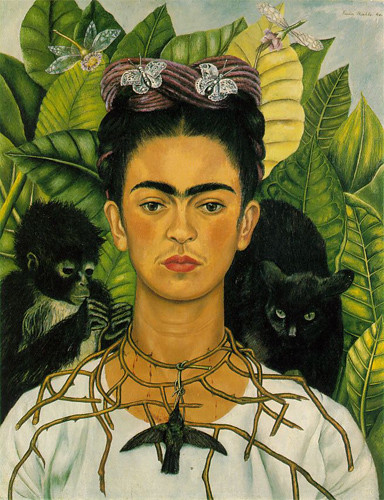
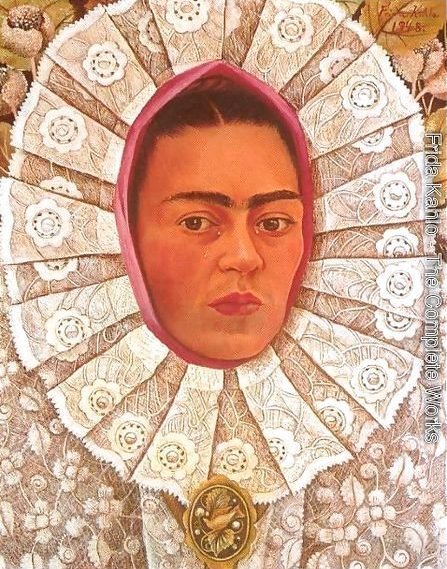
For example, Freida Kahlo discusses how “I paint self-portraits because I am often so alone, because I am the person I know best.” Kahlo drew several self-portraits over her lifetime, using vivid colors, brushstrokes and usually gazing straight through the portrait to the viewer. Kahlo uses subtle artistic choices in her paintings that reveal her deeper psychological narrative and portray her experiences from the inside. As a result, she can use the medium to express her sexuality and suffering as she has experienced it. Kahlo establishes control over the gaze of the subject and the viewer. She paints herself to look at the camera directly, confronting her viewer to look into her life and see her story. In this process, she also has directed the viewer’s gaze in seeing what she wants them to see.

Self-Portrait with Monkeys 1940, image courtesy of Flickr
Self Portrait with Loose Hair, image courtesy of Flickr
Self Portrait in Medallion, image courtesy of The Frida Kahlo Foundation

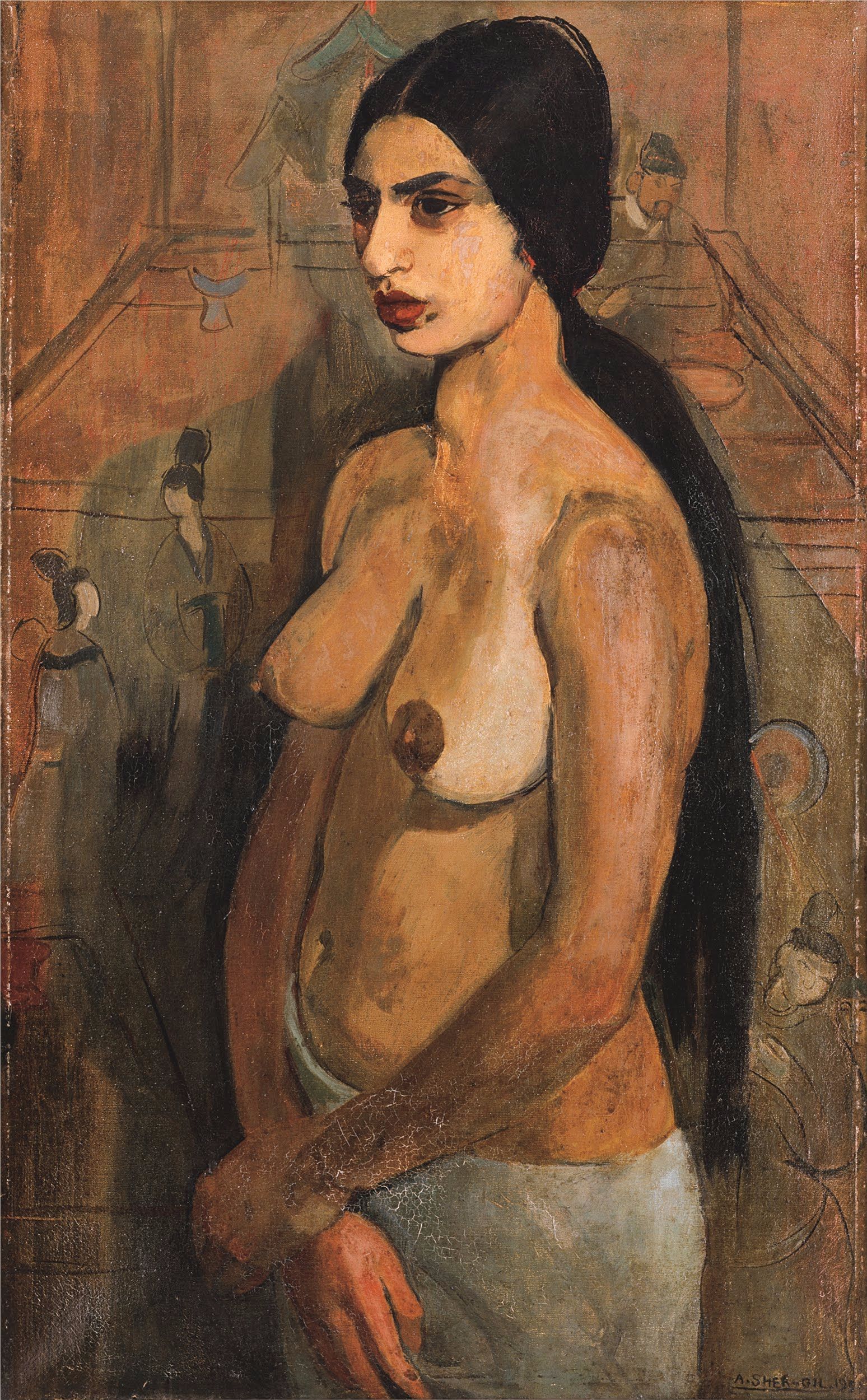
Kahlo is not alone. Women across cultures and the world have broken free from the gaze and power of men to establish their own narratives. Amrita-Sher-Gil, dubbed the Indian Freida Kahlo, is one of them. Sher-Gil is known for revolutionizing the artistic depiction of Indian women, giving voice to their inner experiences, and her self-portraits become the entry point into this. Her portraits capture her cultural identity Indian and Hungarian, and her accompanying range of personal emotions and experiences, such as her quest for belonging and troubles with loneliness and hopelessness. For example, Sher-Gil’s Self-Portrait as a Tahitian’ captures a nude Sher-Gil wearing a somber expression and staring into the distance. Her portrayal of her body here liberates the female body and sexuality from previous gender conventions and towards how she sees herself. 

Amrita Sher-Gil Self-Portrait 1930, image courtesy of Wikimedia Commons
Amrita Sher-Gil Self-Portrait 1931, image courtesy of Wikimedia Commons

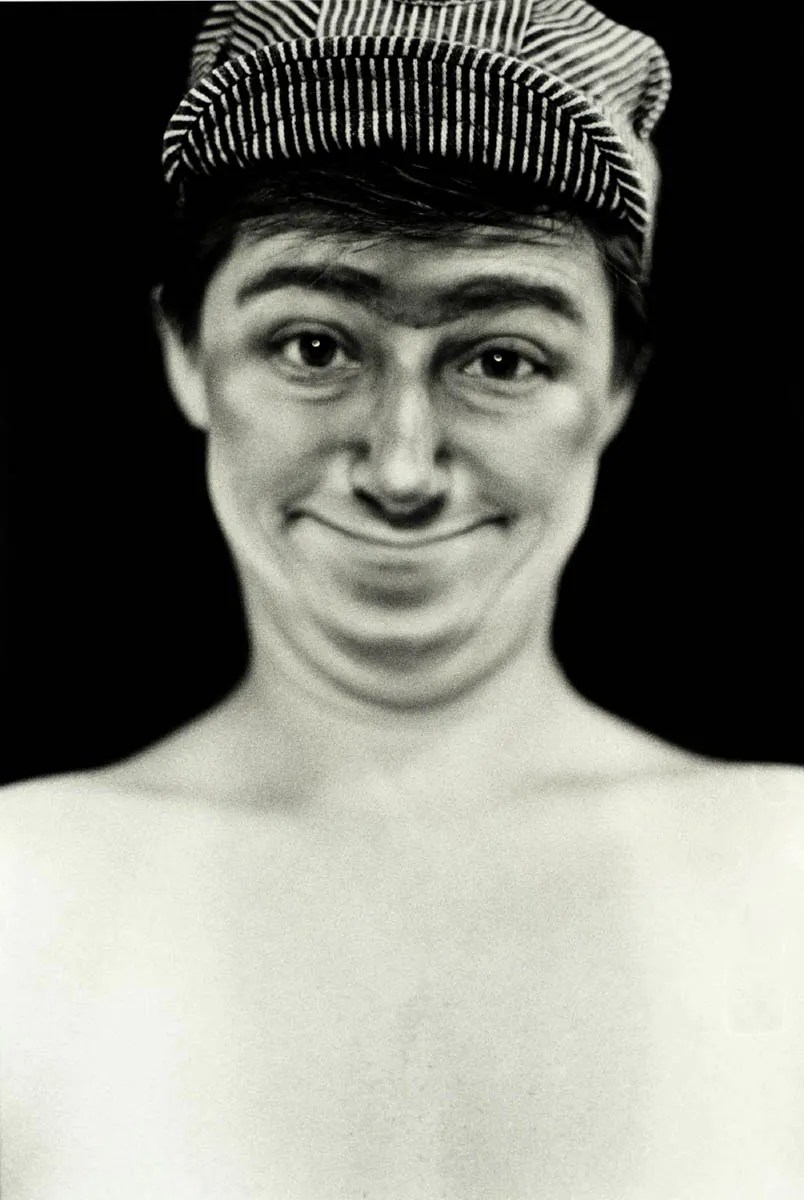
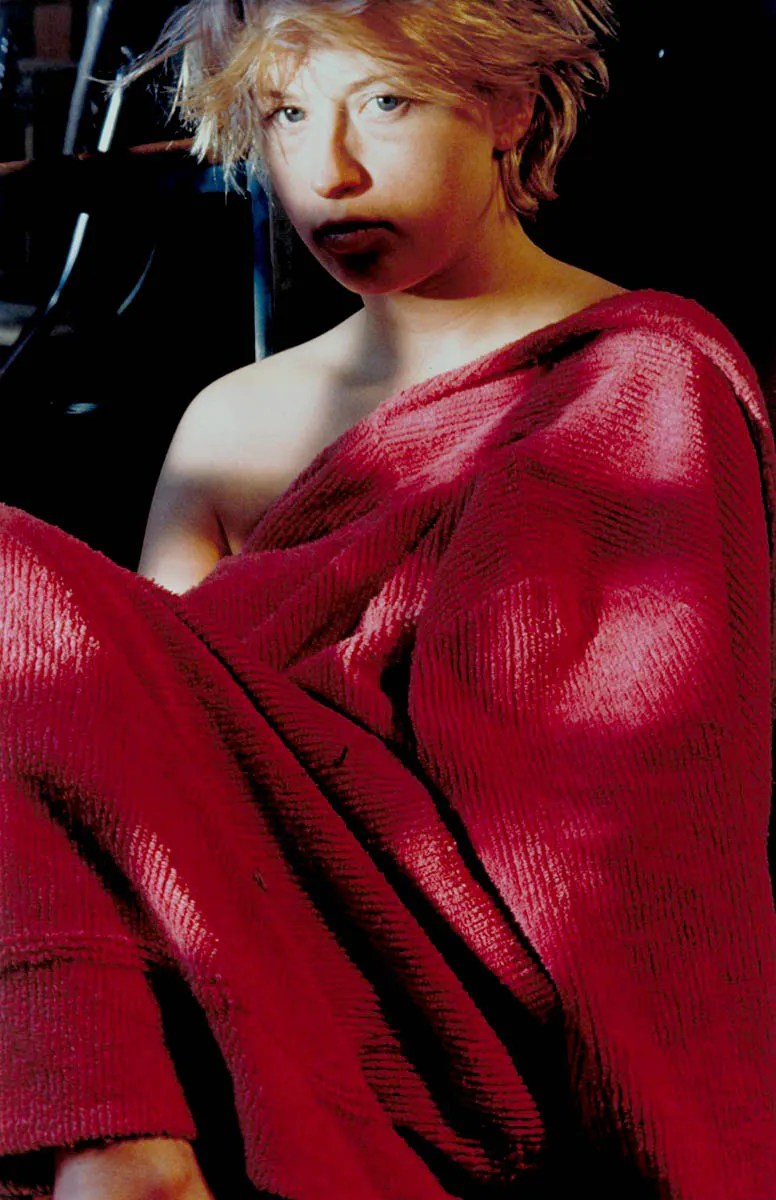
Cindy Sherman is a more modern example of an artist who has used photographic self-portraits to reorient viewers’ gazes. Sherman is particularly fascinating to consider as she uses cinematic tools to transform herself into different possible representations. She constructs her portraits around certain female stereotypes but adds a twist. For example, prosthetics, wigs, and makeup are all worn incorrectly, challenging the conventions often set for how women were meant to be seen and perceived. Sherman does a lot more in challenging the portrayal of women in visual culture, paying attention to the ugly and ungroomed. Below are a few examples of her artwork that have depicted her boldness and confrontation of gendered conventions.

Cindy Sherman Self-Portrait: Untitled B, image courtesy of The Collector
Cindy Sherman Self-Portrait: Untitled 98, image courtesy of The Collector

While these are among the few female artists who challenged gender convention and redirected the viewer’s gaze, the list is far from exhaustive. In addition, these examples are solely reliant on art and portraiture. With the danger of sounding tangential, I also wonder how technology today in 2021 has further changed self-representation. With our phones and easy access to camera (taking selfies, for example), I think it’s interesting to look at how this might have changed ideas on how we market ourselves and further redirect gaze as well.

Works Cited 

  1. Browning, Robert. “My Last Duchess.” Poetry Foundation, Poetry Foundation, https://www.poetryfoundation.org/poems/43768/my-last-duchess. 
  2. “10 Self-Portraits by Women Artists – Google Arts & Culture.” Google, Google, https://artsandculture.google.com/story/10-self-portraits-by-women-artists/nAJyCun4qsH7Jg.
  3. “Frida Kahlo.” Frida Kahlo – The Complete Works, https://www.frida-kahlo-foundation.org/. 
  4. “Amrita Sher-Gil – Google Arts & Culture.” Google, Google, https://artsandculture.google.com/entity/amrita-sher-gil/m09sphm?hl=en. 
  5. “Overlooked No More: Amrita Sher-Gil, a Pioneer of Indian Art.” The New York Times, The New York Times, 21 June 2018, https://www.nytimes.com/2018/06/20/obituaries/amrita-shergil-dead.html. 
  6. “Amrita Sher-Gil.” Obelisk Art History, https://arthistoryproject.com/artists/amrita-sher-gil/.
  7. “Cindy Sherman: Moma.” The Museum of Modern Art, https://www.moma.org/artists/5392. 
  8. “How Cindy Sherman Redefined Self-Portraiture (7 Artworks).” TheCollector, 29 Oct. 2021, https://www.thecollector.com/cindy-sherman-self-portraits/. 
Posted by: mollyjoyce | December 6, 2021

Repurposing Remains: Victorian Hairwork

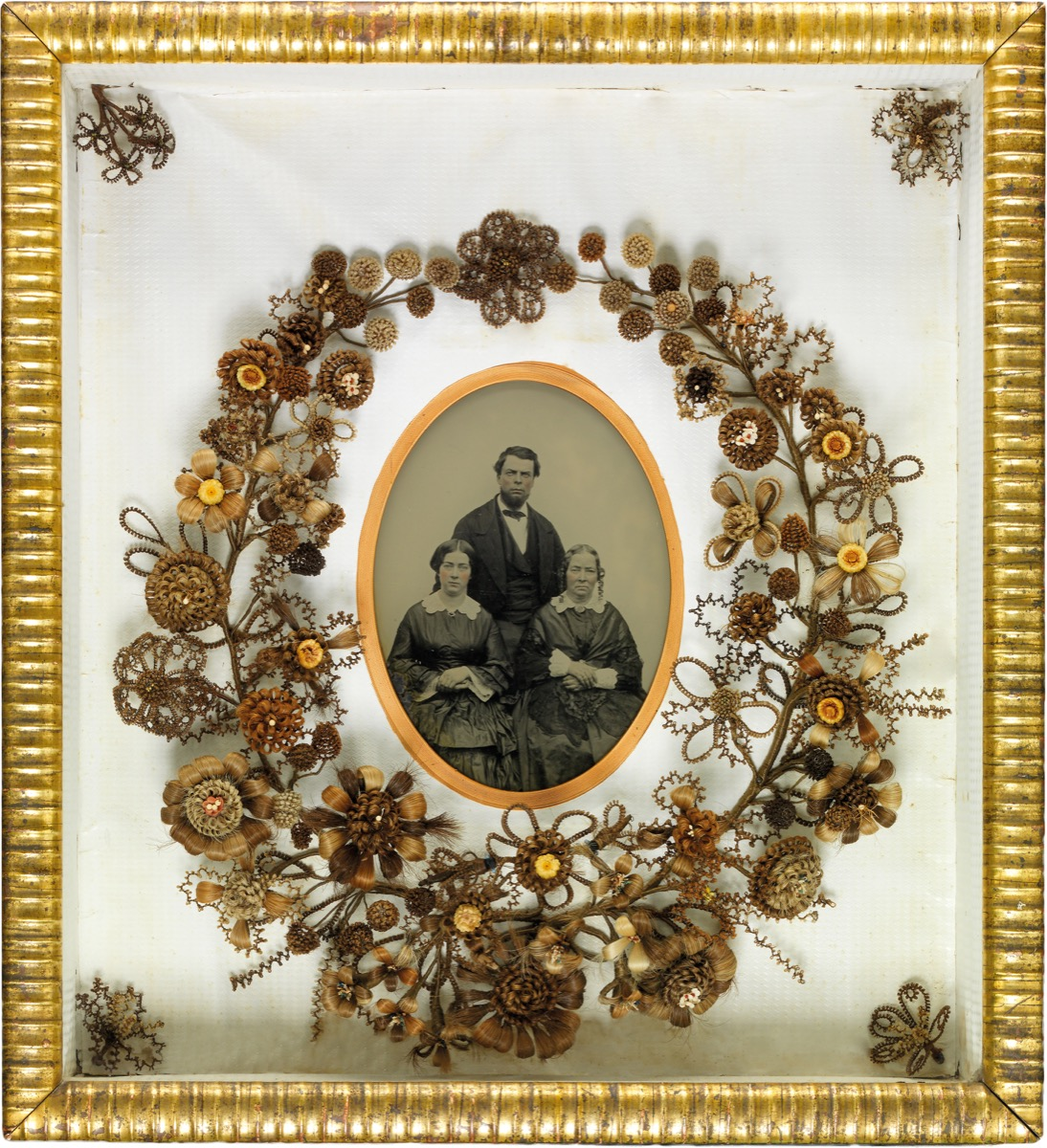
Unknown, Framed Hair Wreath with Ambrotype, 1860’s. The College of Physicians of Philadelphia and Mütter Museum.

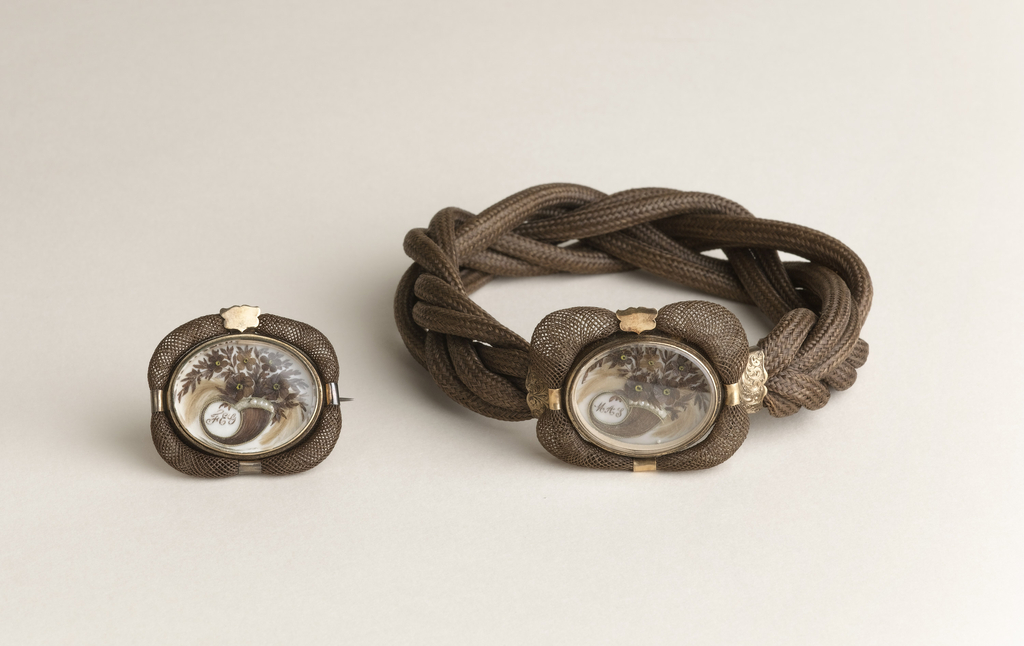
In this class, we’ve explored aspects of the Victorian cult of death, particularly post-mortem photography, which afforded loved ones a last opportunity to immortalize the body of the deceased. Victorians were highly sentimental and preoccupied with death, and photography was not their only method of preservation. Some Victorians kept their loved ones’ teeth, but one of the most striking examples of post-mortem preservation are hairworks – artwork or jewelry made from a lock of the deceased’s hair. Hairworks allowed loved ones to carry their remains around with them – as bracelets, necklaces, and hairclips. When people die, they leave objects and memories behind, but hairworks far surpass earthly possessions or abstract memories as commemorative instruments. They are tangible pieces of their bodies.

Unknown, Bracelet and brooch, British ca. 1837. Hair, gold, ivory, seed pearls, paillettes, Cooper Hewitt, Smithsonian Design Museum.

Hair was an ideal medium, as it can last for centuries without losing its pigmentation. Most fascinating is how the Victorians saw hair as a suitable stand-in for the person’s essence. It goes farther than a photograph or artistic representation of their likeness: it contains actual organic material from their bodies, therein keeping them alive in-part (no matter that hair is technically dead to begin with). Some pieces combine post-mortem photography with hairworks, framing the photographs with floral wreaths made from hair to create a more holistic representation of the departed.

Another intriguing aspect of hairworks was their usage as talismans that could connect the living to the dead. In The Dead Still Among Us: Victorian Secular Relics, Hair Jewelry, and Death Culture, Deborah Lutz explores the usage of Hairworks in Wuthering Heights. Upon Catherine’s death, Heathcliff steals into her room and replaces the lock of Edward’s hair in her locket with his own. He desires a part of his presence to go with her to whenever it is that she goes, and believes that connecting a piece of his body to hers would make it easier to find her on the other side. Lutz says that Heathcliff believes that “Catherine’s death doesn’t mean she has disappeared, but rather that she has become temporarily unlocatable.” Hairworks, then, are more than mere memorials; they are evidence of a soul still in existence, a mortal tether to a person who hasn’t ceased to exist, but has simply gone somewhere inaccessible to the living.

Unknown, Portrait Brooch contaning a lock of brown hair, 1800-1830. New York Historical Society.

Sources:

Lutz, Deborah. “The Dead Still Among Us: Victorian Secular Relics, Hair Jewelry, and Death Culture.” Victorian Literature and Culture, vol. 39, no. 1, Cambridge University Press, 2011, pp. 127–42, http://www.jstor.org/stable/41307854.

« Newer Posts - Older Posts »

Categories