Posted by: Jahnavi | December 5, 2021

Victorian Architecture in Colonial India 

Bangalore, the city I grew up in, is an odd concoction: tucked away amidst its metropolitan sky-scraping apartments, trafficked streets, and metro lines is a quaint sanctuary of sprawling colonial-style bungalows. Tiled terracotta roofs, dome-arched doorways, decorative parapets, and stained glass windows set the houses apart as visually striking unique structures of a hybrid architecture. The buildings display styles of east and west coming together, blending the medieval Hindu and Islamic styles of India with Victorian England’s Neoclassical styles.

The bungalows in Bangalore are few amongst a vast set of structures across India that capture in their pillars and roofs the history of the nation and its trysts with colonialism. Amongst the family is a classic example of the hybrid architecture — the famed Chhatrapati Shivaji Train Station of Bombay, formerly known as The Victoria Terminus Station. Designed by the architectural engineer Frederick William Stevens in 1878, the sprawling station wears a contemporary Victorian Gothic style, closely resembling the London St Pancras Railway Station. The building fashions an iron framework, church-like countered arching roofs, multiple stories, and round turrets, all characteristic of a Victorian architectural style that was emerging at the second half of the nineteenth century. In addition, amongst other things, gargoyles, such as dogs, crocodiles, and lizards, distinctive Victorian Gothic ornaments, are used as drain spouts on the building. Amidst all this is a figure of Queen Victoria herself, after whom the building was initially named. However, Chhatrapati Shivaji station blends this Victorian Gothic architecture with a traditional Indian model. While the main structure of the building is modeled after Victorian architecture and built to suit the functions familiar more to the British (over Indians), aesthetics reach towards incorporating Indian styles as well. A stone dome and deep verandahs, for example, make the building look more like one of the Indian palaces or forts. This is supplemented with detailed engravings on the structure that closely resemble the stone sculpting done at traditional Indian temples.

St Pancras Station, image courtesy of Wikimedia Commons
Chhatrapati Shivaji Station, image courtesy of Wikimedia Commons

This structure reveals the historical and colonial relationship of the British with India: They successfully remodeled India to suit their own needs while retaining some aspects of the culture for aesthetic pleasure. This architectural blending dates back to the nineteenth century when Indian architecture was veered toward western styles by the British to civilize South Asia and bring a sense of law, order, and beauty to its construction. Stations, courtrooms, bungalows, churches, and forts were built in Victorian models, with architects and engineers coming in from England. Chhatrapati Shivaji is one such example. However, as with this station and other buildings, Indian styles remained for a degree of a new visual appeal. These Hindu and Islamic styles were adapted to suit the western building requirements and more as wall hangings and visual aesthetics pushed to the back as mere accents for the looming Victorian architecture. Bombay itself is one such locus of this architecture: the Rajabai Clock Tower, the BMC building, the Bombay High Court, along with Chhatrapati Shivaji Terminal, fashion Victorian buildings with Indian accents.

These historic buildings are not alone. Bangalore bungalows are a clear example of the domestic being influenced by this design: the houses are Victorian in style with South Indian elements here and there. The large houses are marked by square architecture, detailed pillars, and high, sloping roofs adapted from Victorian architecture. Verandahs and Indian floorings accent these to adapt to the climate of India. These houses still prevail in the city and are a part f Bangalore’s identity. while apartments and modern houses slowly permeate their way into the city, these bungalows are reminiscent of a previous history and visual world of the city. Following are some images of both Indian and Victorian buildings that capture the visual similarity and differences between the structures.

Bangalore Palace, image courtesy of Wikimedia Commons
Indian Bungalow in Allahabad, image courtesy of Wikimedia Commons
Rajabai Clock Tower, Image courtesy of Wikimedia Commons
Municipal Corporation of Greater Bombay, image courtesy of Wkimedia Commons

Following are Victorian style building from England

St Mary’s Church, image courtesy of English Heritage
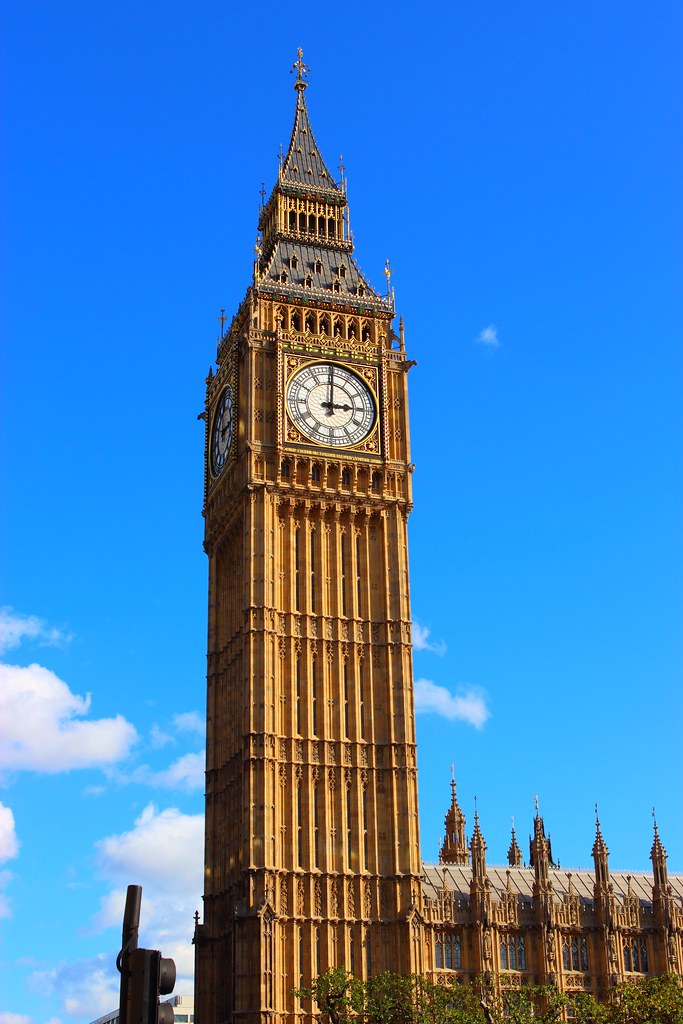
Big Ben Clock Tower, image courtesy of Flickr

Works Cited 

  1. A city icon – Chhatrapati Shivaji Maharaj Terminus – Google Arts & Culture. Google. Retrieved December 6, 2021, from https://artsandculture.google.com/exhibit/a-city-icon-chhatrapati-shivaji-maharaj-terminus/yAICfPyC2jrBIQ?hl=en. 
  2. St. Pancras Station, London. (n.d.). Retrieved December 6, 2021, from https://victorianweb.org/art/architecture/pancras/1.html. 
  3. An illustrated guide to the victorian gothic architecture of Mumbai. https://www.outlookindia.com/outlooktraveller/. (n.d.). Retrieved December 6, 2021, from https://www.outlookindia.com/outlooktraveller/explore/story/70002/an-illustrated-guide-to-the-victorian-gothic-architecture-of-mumbai. 
  4. Imperial India. A Tradition Created: Indo-Saracenic Architecture under the Raj. (n.d.). Retrieved December 6, 2021, from https://www.britishempire.co.uk/maproom/india/indosaracenic.htm.
  5. Houses of history: Bangalore’s Art Deco and Colonial Heritage. RoofandFloor Blog. Retrieved December 6, 2021, from https://roofandfloor.thehindu.com/real-estate-blog/bangalore-art-deco-colonial-heritage/. 
Posted by: gabybarber23 | December 2, 2021

Review: Citing Memory: Reimagining Archives Through Art

On December 2nd, I decided to walk around the Williston Library and take a look at an art exhibition that is currently on display: Citing Memory: Reimagining Archives Through Art. This exhibition was created by the 5-College Advanced Art Seminar students and visiting artist Becci Davis. I am not sure when the exhibit began, though I know it was before November break, and I do not know how long it will be on display. Before the break, when the show was making its debut, I was given a program and a map in the library. I have found both of these handouts to be useful, as the art installations are spread out throughout the library – I found myself viewing them in places such as the atrium, the stairwells, and even the stacks. The program is particularly useful as it compiles the statements of each artist. 

The pedestrian nature of the exhibit reminded me of Thompson’s Street Life in London. Rather than walking through a traditional museum-style display, where everything is in a shared space dedicated to a certain purpose, I had to move around the library and into spaces with different traditional uses. Like Thompson and Smith, I could find art around any corner and in any kind of location. I think that the pair traveling through London collecting their own artistic references is similar to the way this exhibit is viewed – traveling through different nooks and crannies of the library to take in different works of art. 

According to the program for the exhibition: 

“Through the examination of letters and scrapbooks, photographs and drawings, legal documents, toys, and everything in between, this group of artists from Mount Holyoke College, Amherst College, Hampshire College, and Smith College have put together a show that looks to explore and question archives and collections on both personal and institutional levels. The artists have each created a project that asks the viewer to think about what we save, what we value, and what we try to remember through the objects we keep.” (5-College Advanced Art Seminar and Becci Davis 3)(Please forgive the formatting of this quote – it is intended to be a block quote, but I couldn’t figure out the formatting in WordPress, so I have added quotation marks)

This archival evaluation seems very relevant to our class – it reminds me of the discussion Professor Martin had with us about how and why she teaches Alice in Wonderland the way she does. By sharing her reasons for her methodology surrounding Carroll’s book, Professor Martin engaged in the work of thinking about the aforementioned themes in the context of the class syllabus as an archive. These questions that the artists explore in their work seem very similar to the question of “why do we still read XYZ author?” Of course, though our values often differed from those of the authors we read, the recognition of what we value compared to the Victorians came from reading those authors. 

The exhibit is composed of 11 different artworks by 11 different artists, though I’d like to focus on Emma Spencer’s Russell School, Hadley, Massachusetts. Spencer’s work is a 40 x 50 inch photographic piece, and according to the exhibit map, is “[l]ocated in the fourth-floor stairwell on the wall (left side)” (Williston Library, Level 4). The work is not one large photograph, but rather a collection of smaller ones, with subjects ranging from building exteriors and trees to leaves creeping through what looks like a chain link fence. In their artist statement, Spencer writes: “I want to capture this once formidable building left to be reclaimed by the Earth” (6) – I think they succeed, given the photographs where nature and building seem to collide.

Moreover, Spencer notes in their artist statement: “I hope to illuminate both the similarities and differences between living today and living in the past, and how the past built and influences our lives today” (6). Spencer seeks to do in their art what we have sought to do in our class – draw connections between past and present. 

I also think the placement of Spencer’s project is interesting. I had to stop on the staircase to view it, which felt a little destabilizing. I don’t usually like to stop on stairs because – for whatever reason – I’m afraid of losing my balance and falling over. Yet, I also think there is something poignant about the placement. The artwork stops its viewer in the transition from downstairs to upstairs, much like it seems to question the idea of an absolute transition from past to present by drawing connections between the two, by showing how they mingle. I do not know if Spencer made this choice, but if so, it is an excellent one. 

Overall, I enjoyed walking around the library to experience this exhibit. I think it touches on important themes in relation to archive, much like we have done throughout the semester. If you haven’t gotten a chance to check it out, I highly recommend doing so! There are more artworks than I have mentioned here that are also worth thinking about and viewing. 

Works Cited

Program for 5-College Advanced Art Seminar and Becci Davis’ Citing Memory: Reimagining 

Archives Through Art at the Williston Library, South Hadley, 2021. 

Spencer, Emma. “Emma Spencer.” Program for 5-College Advanced Art Seminar and Becci 

Davis’ Citing Memory: Reimagining Archives Through Art at the Williston Library, South Hadley, 2021, p. 6. 

Thomson, John and Smith, Adolphe. Street Life in London, London, Sampson Low, Marston, 

Searle & Rivington, 1877.

Williston Library, Level 4. Program for 5-College Advanced Art Seminar and Becci Davis. 2021.

Posted by: emmacwatkins1 | December 2, 2021

Julia Margaret Cameron, Virginia Woolf, and Vanessa Bell

In a course I took last spring called “Virginia Woolf and the Bloomsbury Group,” I learned for the first time how artistically connected — both in terms of professional networking and also in terms of similar artistic subject matter — Virginia Woolf and her family were. Julia Margaret Cameron, the notable Victorian era photographer, was Virginia Woolf’s great aunt. Woolf’s family also had many other writers, though many of them wrote nonfiction — like her father, who was the first editor of the Dictionary of National Biography.  

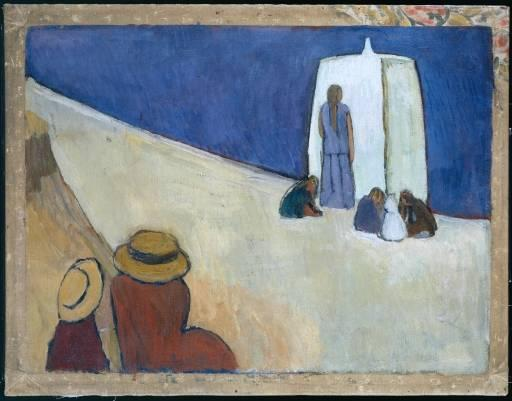
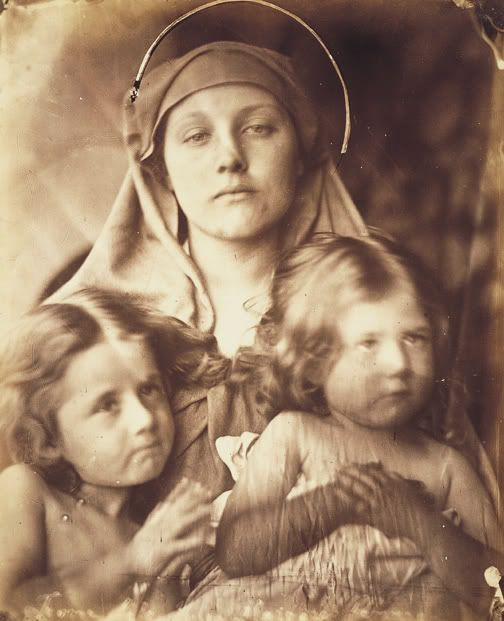
Focusing on Cameron, it is worth noting that Cameron and Woolf both became known for depicting domestic, mostly feminine scenes — Cameron in her photography, Woolf in her writing. Pictures like “Blessing and Blessed,” “La Madonna Esattata/Fervent in Prayer,” and “Holy Family,” emphasize Cameron’s fascination with posing mothers and children, or “Altered Madonnas,” in the words of Carol Mavor. But Woolf and Cameron were not the only artists in their family interested in depicting mothers and children: Vanessa Bell, a modernist painter and Virginia Woolf’s sister, was also interested in these relationships and included them in one of her most notable paintings. 

Photo courtesy of WikiArt 

​​

Studland Beach has been compared to Cameron’s works by art historian Lisa Tickner in her article “Studland Beach, Domesticity, and ‘Significant Form.’” Tickner writes, “For Bell the essential quality in a true work of art is ‘significant form,’ … that common property that combination of lines and colors, of forms and relations of forms that produces aesthetic emotion.” Essentially, she defines significant form as the emotional response to a work of art. In portraits of mothers and children, no matter the medium, this emotional response may come from how the viewer interprets the relationship between the figures in the artwork. Studland Beach is much more abstract than Cameron’s photographs and provides both more and less room for interpretation based on how little viewers can see of the actual features of the painting’s figures. On the other hand, where we get vivid colors from Bell, Cameron’s photographs are shades of sepia, black, and white — allowing for more flexibility when interpreting the mood of the photographs.

Both of these examples depict mothers and children, but in very different ways. The powerful gaze of Cameron’s depiction of the mother contrasts strikingly with the faceless figures of Bell’s painting. The contrast in how the two artists depict emotions — one through photographic staging and facial expression, and one through color and more abstract painting staging — shows the changing perceptions of interiority and feeling from the Victorian era to the Modern period, and also show the similar artistic inclinations of Julia Margaret Cameron and her great-niece Vanessa Bell.

Posted by: Jasmyn Barkley | November 30, 2021

“Among Us” and Pre-Photography Crime Investigation

This may be the most absurd connection I’ve ever made, but I think there are fascinating parallels between the multiplayer video game “Among Us” and pre-photography investigation. For those who don’t know, Among Us is a game in which each player is a uniquely-colored alien (each color of the rainbow is available, plus black, white, and brown, but no two players can be the same color) aboard a spaceship. At the beginning of each game, one or two players out of the group are randomly assigned the role of “impostor,” which only they are notified of. The impostor’s role is to kill all the other players. The other players’ roles are to figure out who the impostor is and eject them from the spaceship before they are all dead.

As I think is generally expected, this results in an atmosphere of paranoia, suspicion, and defensiveness, as crewmates and impostors alike try to convince each other of their innocence. What I think connects this to the Victorian era is that there are no cameras in this game; the only evidence that anyone can present is either eyewitness testimony or a very convincing alibi. The result: if you don’t have a ready explanation of where you were and why when the body was discovered, if no one can corroborate your absence from the scene, or if someone saw you in the area shortly before discovering a body, there is little you can do to defend yourself. This is a game in which innocent players are considered suspicious enough that they get ejected, and impostors are completely capable of diverting attention for long enough to win.

I’m fascinated by this game as a potential representation of how people act under such circumstances. Of course, real life is much more complicated, but when you boil it down to its fundamentals, I’d guess that crime and investigation looks very similar–especially without the benefit of cameras. It’s difficult to prove anything when surveillance is nonexistent. Not impossible, but difficult; and I wonder how many times a situation like this played out in criminal investigations before photography became widely used to surveil and document people.

Essentially, limited visuality can have interesting consequences. On the one hand, we have witnesses (“I saw Orange in the hallway walking away from the body!”), but on the other hand, there is rarely any actual visual proof. It’s complicated, because what people say they saw in this case becomes the most important thing, in which case we are still relying on visual evidence to reach a conclusion; however, it is distinctly unreliable, and there is a painfully conspicuous lack of objective data. It’s a complicated situation, and while it can’t exactly reflect any real-life event, I think this dual nature of visuality–both important and unreliable–is exemplified by Among Us, but applicable to reality as well. It calls into question what we trust, and what we choose to believe, especially when technology has failed or is absent from the scenario.

Of course, it also calls into question whether any of this matters, since lots of people are going to die either way.

Posted by: willconley1025 | November 30, 2021

Review: Transpire (11/13)

On November 13th, I attended Transpire, a collaborative dance concert choreographed by Mount Holyoke and Amherst faculty. It was the first live dance performance that I had attended since the beginning of the pandemic, and I was acutely aware of the experience of being an observer, which is interesting to think about in the context of visual culture. I am a theatre major and took dance lessons for a long time as a child, so I am very familiar with the experience of being in or watching a performance. Being watched and watching others in the context of dance and theatre has been a part of my life for a long time, and has never felt particularly unnatural to me. After a year and a half, however, the experience of watching people onstage felt foreign and unusually intimate, and I felt, in some ways, as though I was intruding on something private, even though the performance was explicitly meant to be viewed by an audience.

There were five pieces in the show, all distinct from each other and utilizing different styles of dance. The first piece was high-energy and exuberant, and involved direct interaction with the audience, with the dancers coming to the front of the stage and encouraging the audience to clap along to the music. While the other pieces were different from the first, this set the tone for the evening by establishing a link between the dancers and the audience. Despite the strange feeling of intrusion that came with seeing a live performance for the first time in a while, this routine made it clear that the audience members were not being viewed merely as outside observers.

Another routine that I found interesting was one that depicted the process of a caterpillar hatching into a butterfly. There were several different ways in which the meaning of the piece was made clear: first, several of the dancers were wearing strange restrictive garments that represented cocoons, which they “hatched” out of partway through the piece. Additionally, throughout most of the piece, someone was standing onstage speaking into a microphone about rebirth and renewal. Finally, at the end of the piece, a screen behind the dancers showed a video of a butterfly hatching out of a cocoon. At first, I thought the piece was a bit too heavy-handed, but as I thought more about it, I found that I appreciated the heavy emphasis on visuality and the way it was combined with verbal storytelling. Repeatedly emphasizing the theme of rebirth was a deliberate choice, and perhaps not one that I would have made, but I thought it worked nonetheless.

One of my favorite pieces in the show was the last, which was called “Batty Moves” and was choreographed by dancer and choreographer Jawole Willa Jo Zollar. Before the piece was performed, a video was played that showed Zollar talking about the background behind it. “Batty,” she explained, is a word meaning “backside,” and she created the piece as a celebration of all body types, particularly those that are often mocked, ignored, or either desexualized or oversexualized. I enjoyed learning about the context, and I also greatly enjoyed the routine itself. Because it focused on the backside, the dancers largely faced away from the audience, but I still felt connected to them despite rarely being able to see their faces. There was a certain level of discomfort at first—this piece, even more than the rest, made me feel as though I was intruding on something very intimate. However, it didn’t take me long to be swept up in the joyful energy of the piece, and I began to feel as though I was celebrating with the dancers rather than observing them from the outside.

Even though seeing a performance was somewhat of a strange experience after such a long time, I really enjoyed Transpire and thought it was an excellent reintroduction to watching live dance. The choreographers and dancers were all immensely skilled, and the pieces made me think a lot about the concept of visuality in the context of performance.

Posted by: gillianpet | November 29, 2021

Review – VariAsians 11/12

VariAsians took place on Friday, Nov. 12 from 6-9 in Chapin Auditorium. The event was organized by the Asian Student Association and is the largest Pan-Asian performing arts showcase on campus. ASA was founded in 1974 to serve as a community of support for Pan-Asian students at Mount Holyoke. Their goal is to celebrate and spread awareness of Pan- Asian culture and to promote Pan-Asian voices, experiences, and political engagement through various events and programs. VariAsians began as a potluck, however, it evolved into a show in the year 2000. It has since become an annual tradition and has even garnered support from the Five Colleges.

 The event featured catered dining, a fashion show, and performances by student groups from across the Five College Consortium. The theme for this year’s event was “Hope.” Sarah Nam ASA co-chair said that the return to an in-person event was a big priority for the organization, as well as for them personally. “The Board chose this year’s theme to be ‘hope’ to serve as a gentle reminder that there are better things to come, especially for the members of our Pan-Asian community,” said Nam ASA co-chair. “We wanted to mark a celebration after returning from a very arduous year. For decorations we wanted to choose things that were full of light,” said Hiba Nawaid design coordinator.  According to Ayesha Binte Khalid, the outreach coordinator for ASA, it was not always clear that Mount Holyoke would host the event in this capacity this year, due to COVID-19 concerns. The largest question revolved around inviting guests from the five college area since they do not participate in the College’s testing program. Despite these concerns, the event was able to happen and involve members from the Five College area. 

The event began with a catered dinner. Food items included spicy rice cakes, lo mein, spring rolls, and chana masala. There were many options for vegetarians and vegans, as well as gluten-free. I am vegetarian and I had noodles, tofu, and a spring roll. My favorite food item was the spring roll, it had real avocado, which was a nice change from Blanch spring rolls, which contain guacamole.  I think this portion of the event was my favorite, Blanch food has not been good this semester, so it was nice to have good food for a change. For dessert, there was rice pudding as well as thai tea. Everyone at my table rated the rice pudding a 10/10. It was so sweet  – almost everyone at my table went for seconds. 

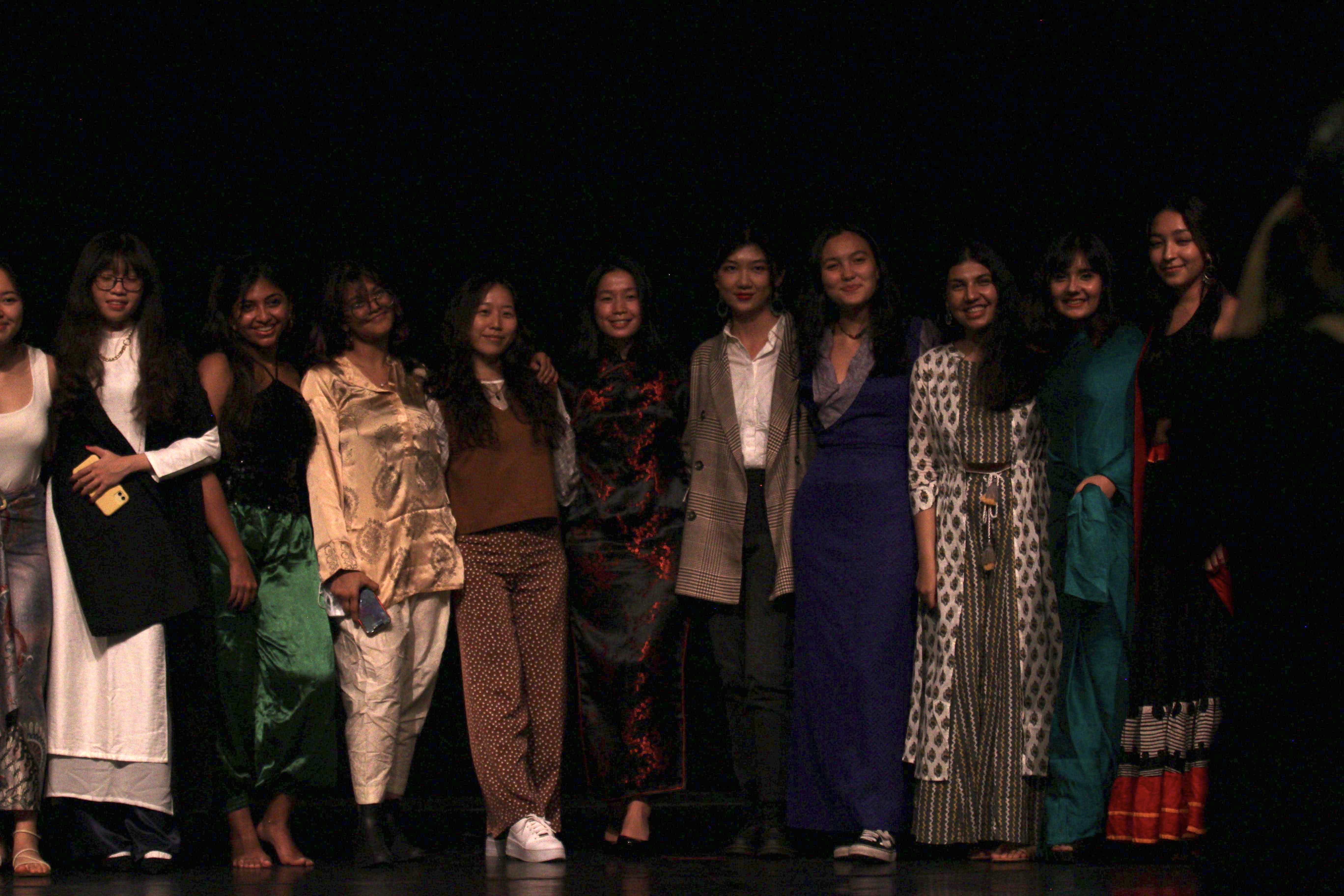
During dinner there was a fashion show walked by members of the ASA. Students came down the isles wearing traditional clothes. It was so cute to watch everyone walk past the isles and wave to their friends. After students made their way down the isles there was a show and tell about their item of clothing. Some of the traditional dress included the Indian Saree and the Ao Dai from Vietnam. I thought everyone looked really great and it was nice to have dinner and a show. 

Following the fashion show, there were dance performances from members of the Mount Holyoke Community, as well as groups from the Five College Area. Some of the groups performing included Mount Holyoke College Vietnamese Student Association, Kpop Dance Club at UMass Amherst, Jhumka, and Rainbow Jelly. My favorite performance was Rainbow Jelly. I think their energy was the highest. What made this performance, however, was the song choice. They danced to a mashup of  “Alcohol-Free” by Twice “Backdoor” by Stray Kids. The crowd was screaming the lyrics of the entire song. 

While I was attending this event, I was reminded of the Q&A portion from the Hortense Parker Celebration. Keynote speaker Zakiya Collier was asked how she would imagine what life would be like without digital collections documenting the history of people of color. She replied that she would imagine that history being shown through food or dance. I think that representation of history was seen through this event. Through the food that was served and through the various dance groups that performed through the night. It truly was an immersive event. 

Overall, I really enjoyed this event. I thought the food was very good. I left the event very full and energized by the dance performances.

ASA Board
VariAsians was held in Chapin Auditorium
Posted by: kate m. | November 28, 2021

Ethics in the Photos of Willoughby Wallace Hooper 

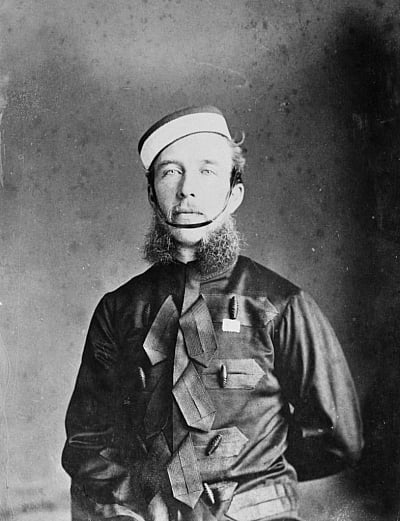
I was curious to know more about Willoughby Wallace Hooper after seeing his famine photographs from India between 1876-1878. Googling his name, one of the top results is the title of an article from an India-based website: “Who was the photographer who took these dehumanising images of the Madras famine?” That title bluntly asks a question similar to my own: Who was Hooper, and what was his motivation in taking these disturbing photographs of the dying?   

The motivation question came to my mind first, due to the fact that some of his photographs appear to be carefully constructed, with the individuals facing the camera, some people sitting, some with arms wrapped around others, the kind of positioning one associates with traditional, ordinary family portraits. Hooper’s images are anything but. In this image available through the Getty Museum, the individual seated in the middle is so sick and emaciated that it’s difficult to believe he or she is still alive. What was Hooper trying to accomplish by asking individuals in such a horrific situation to essentially “pose” for him?

It was actually difficult to find information about Hooper via Google, the article mentioned above with the pointed title wound up providing the most details. Written by Sujaan Mukherjee for Scroll.in, the article coincidentally opens with a mention of Kevin Carter, the same photographer discussed in great detail in KJ Brown’s “Regarding the Pain of the Other: Photography, Famine, and the Transference of Affect.” Both writings touch on the role of the audience when viewing such images of individuals in extreme suffering, where death is presented as an immediate certainty. Her article ends with “it becomes essential to account not just for the photographer’s actions but the entire technological and state apparatus that is involved in framing and circulating images representing the most extreme of man-made human situations.” 

Hooper was a member of the British military, rumored to have had an unfeeling attitude towards the people he photographed. Whether true or not, if the photographer’s intent is apathetic, or even malicious, is the viewer of the image also apathetic and/or malicious? This question is applicable to both Hooper’s photographs, and Carter’s, taken a century apart. I think the photographer’s intent and the viewer’s reaction can be separate entities, and can vary greatly. It’s possible for a person to visit that museum to see Hooper’s images, and to view them as “artworks,” as an image put on paper, and that there isn’t greater complexity. Brown takes a similar stance in her essay, where she sees the role of the audience as having potential for othering. Then there are unintentional audiences, like a photograph of a deceased Syrian child on a beach, an image which permeated news outlets and social media. The way a person chooses (or doesn’t choose) to view photographs of famine, suffering, death is a separate issue from the photographer’s intent.     

Posted by: Liv Pitcher | November 27, 2021

Musings on “The Nutcracker Ballet”

In July of 2020, in order to brighten spirits during the height of the pandemic, the Russian State Ballet and Opera House released a recorded version of The Nutcracker on YouTube. I have always been incredibly impressed and fascinated by ballet and wanted to take this opportunity to write about my thoughts not only of this performance, but how it reflects Victorian society. The first performance of the piece was in 1892 in Russia, composer Pyotr Ilyich Tchaikovsky’s homeland. Despite life in 19th century Russia and Victorian England being quite different, the story, staging, set, and costumes are all incredibly British. This ballet offers an interesting case study of not just art from the era, but how other nations viewed the United Kingdom. 

Firstly, I would like to start by discussing casting in this production compared to others I have seen. I tend to prefer the newer interpretations of the story that certain companies tell. The New York City Ballet, who follows the Balanchine choreography, fulfills the roles of Clara/Marie, Fitz, and the Prince/Nutcracker from the students in their junior company, the School of American Ballet. This 2020 production used the original 1892 choreography by Lev Ivanov, which slightly disappointingly used an all-adult cast. It is understandable why this choice was made in the 19th century as ballet performances were almost entirely adults, but in documentaries I have watched, age appropriate casting gives the entire production a greater sense of magic, and, in real life, is an exciting opportunity for younger dancers to meet those who are signed to a company. The Clara in this production was likely in at least her late 20’s from what I can tell, making her obsession with the Nutcracker doll appear a smidge odd and her journey through the wondrous land feel a tad more like a drug-induced nightmare than other versions. Furthermore, due to the young age of the protagonists, there should be no romantic tension between Clara and the Nutcracker. When she is crowned as queen of his land at the end of the first act, it is because she saved him, not because he has a romantic attraction towards her. This is further highlighted when the two sit up-stage for the entirety of Act II while the professionals perform for them in a show of gratitude to Clara for saving them. 

Another part of what irked me about this production were the costumes. When watching a ballet, it is always my main focus. In the opening scene of the party, all the women playing the parents are covered in their jewels, and all their gowns are made from a variety of golden thread. In what I believe was an attempt to distinguish the dancers playing parents versus the children, the adults all have donned Marie Antoinette style white wigs, making them look more like members of British parliament than party goers. All the younger girls are wearing knee-length dresses made of fluffy tulle and lace, each with a different ribbon. In American and British productions, the clothing is often far more historically accurate to the time. Clara is usually the only one permitted to wear a brightly colored dress, with those around her in far more muted mustards and maroons. In the Russian production, her dress looked so similar to everyone’s that I could not hope to distinguish her. I feel the grandeur of the dresses in the Russian version reflects how the world might imagine a Victorian Christmas. They were by no doubt lavish, but upper-middle class people were certainly not wearing gold dresses. 

Image from NYC Ballet production of The Nutcracker
Promotion material from the Russian State Ballet’s Nutcracker

On a final note about the costuming, I have no grand point to make here, but I just really disliked the Snowflake tutus. It is my favorite scene in any ballet from the choreography, to the costuming, the sets, and of course the music. The Russian version looked promising until the first dancer sashayed onto the stage with half a snowflake on her head.

Photo from Russian State Ballet’s production of The Nutcracker
NYC Ballet’s The Nutcracker

To return to my original point of an outsider’s interpretation of Victorian culture, similarly to the extravagance of the gowns, there appear to be further comments on the consumerist nature of the British people in the 19th century. The entire plot of the ballet revolves around toys and delightful sweets coming to life, both objects that were very expensive at the time this ballet premiered. This theme is highlighted through smaller aspects of the ballet, for example, all the girls have dolls at the beginning of the show with whom they dance. The toys look eerily like their new owners. Furthermore, the sets within the house are stunning and appear incredibly expensive. I believe the claim could be made that the English obsession with the home transmitted across the world, with the country promoting an image of all having rather extreme wealth, when in reality, many people were suffering at this time. 

I would sum up my observations of the Russian production as enjoying the parts that remained more akin to the Russian culture. The performers on stage looked thrilled to be showcasing numbers which are inspired by elements of Russian dance that are not usually included in ballet. Furthermore, due to Clara being played by a prima, she had many costume changes, which meant that she was a far more dynamic and active character in the story. I now plan on trying to find other ballets by this company, perhaps Firebird, which do not have as much of the cultural baggage as The Nutcracker. However, this production was not The Nutcracker was not The Nutcracker of my childhood. It was a story about two young adults falling passionately in love and ruling a kingdom. Yet, the dancing was lovely, and the performers were incredibly talented, so it was an enjoyable production to watch. 

Works Cited

The Nutcracker. Russian State Ballet and Opera. 2020. https://www.youtube.com/watch?v=tR_Z1LUDQuQ 

Macaulay, Alastair. “10 Ways to Tell if Your ‘Nutcracker’ Is Traditional.” New York Times. 2017. https://www.nytimes.com/2017/11/21/arts/dance/what-makes-a-traditional-nutcracker-ballet.html

Posted by: mollymuellner | November 17, 2021

Commedia and Caricature

Reading about English caricature drew fascinating parallels to Commedia dell’arte, a form of theater that evolved in the 1530s and 1540s out of Italian street performance and flourished across Europe, predating but influencing the Punch shows and cartoons in Victorian England. 

Commedia featured an ensemble of recurring, masked, stock characters who were subject to the recognizable trials of daily life. The nomadic nature of outdoor street or festival performance limited possibilities for complex costume or scene design, and amplified the importance of the charisma and captivating skills of the actor to local audience. Heightened physicality and improvisational dialogue were characteristic to the performances, which typically lacked a formal director and relied on tailoring the comedy to its specific spectators. Disguised in flexibility and farce, parodies of power were played out allowing for political commentary that would have been censored in a more set form. 

Actors played the same characters in every show, surrendering themselves to a physicality distinct to the archetype they played, crystallized through their mask. The mask cemented the anatomic and emotional facial characteristics of each stock character and created the clear fourth wall between played, and player. 

Drama revolved around Gil Innamorati, or the Lovers, the only unmasked characters on the stage who continually faced stock dilemmas and were rarely crowd favorites. Adultery, or thwarted love would incite the unsolicited intervention of the vecchi, elder characters who generally complicated situations further, and were accompanied by the zanni, younger servant characters who brought the wit and the solution. 

A typical vecchi character was Il Dottore, The Doctor, who delivered nonsensical advice, wore all black robes, and drank too much wine but took himself quite seriously. 

Il Dottore mask [PC: The Venetian Masks]

Shifting between vecchi and zanni was Il Capitano, modeled after a swaggering braggart soldier with a physicality led by his phallus. 

[PC: Second Face] 

Il Capitano mask

Exemplifying military machismo, his mask is characterized by a ridiculously exaggerated phallic nose and intimidating expression that amplified his arrogant entries. With enormous boots and a stiff march, he always has a sword which stays in the scabbard. Only when he is challenged to a fight, Capitano’s secretly timid and cowardly nature revealed. A classic gesture he performs is to jump suddenly into the arms of the maid who he has just been courting, at a fright so small as the squeak of a mouse.  

Arlecchino or, the Harlequin, was the most popular of the zanni, styled after a pig, monkey, or cat with a red bump on his mask that indicated his being part devil. He had the ravenous appetite and manners of an untamable animal, or oversexed man, making heinous remarks and innapropriate gestures. A classic lazzi, or small skit, of Arlecchino, was to salt and eat the fly that bothered him. 

Pantalone was the greedy merchant who stood between characters and their happiness, Tartaglia, the announcer of important news suffering from a stutter. Another zanni was Pulcinella, a servant from Naples who was loveable and pitiable with a physicality drawing on the qualities of a chicken.

A reversal of appearance was a classic element of Commedia, which inverted the usual roles of social hierarchy, with the credentially and materially rich elders spouting nonsense and engaging in ridiculous physical trifles with one another, while their servants and fools continually outwitted them and averted disaster. 

Directed by the government, political caricature in the Punch cartoons communicated a nationalistic message that was made to ultimately incite fear a dividing force, below humor a uniting one. The two forms compared reflect the thin line between laughter and shrieks of fear, a response to surprise and pain that falls into close, but different realms. 

 The Irishmen in Punch were defined by their physical distance from the ideal Englishman, and as political tensions grew they were represented as increasingly apelike and simian, stereotypes like volatility, violence, and drunkenness reaching monstrous forms. Commedia also revolved around distortion of the body, but within a nation or region rather than exhibiting the definition of boundaries of that nation or region. Rather than recognizing an demonized “other”, the audience of Commedia were intended to recognize the features of themselves and those they knew upon the stage. Through exaggerated physicality and the masks worn by actors, the fourth wall of drama formed and protected the audience from suffering the discomfort of direct mockery or self-scrutiny, which was of course the humor. 

Both forms rely on the physiognomical idea that “the character of a man may be read in his face” (Curtis, 26). But the masks of Commedia make a purposeful separation between the characters and the actors playing them, unlike the English caricature which unified character and man, eliding the role of the actor. Moral exemplars are not funny, and this draws the distinction between the humor driven Commedia and first funny, but ultimately fear-based cartoons.

[PC: Apes and Angels, LP Curtis]

Painting of Commedia [PC: Thought.Co]

The similarities between the English cartoons and representations of Commedia are apparent, the people are positioned in gestural extremes in striking tableaus like actors on a shallow stage. The above painting is imagined; as commedia expanded across Europe and was embraced by other countries and cultures, the form became set and lost the improvisational and local immediacy that had defined its spirit.

The characters who had always shifted to reflect the movement of real life became frozen into moral exemplars recognizable to mass audiences, rather than local ones. Thus Pulcinella evolved into Punchinello, shortened to Punch in the English puppet shows and cartoons. I think it’s a little sad that a true form of entertainment laughing at everyone with proclaimed power became weaponized by those in power, but then it’s an evolution of art form in its own way and the changing hands of representation. 

https://www.britannica.com/art/commedia-dellarte

“Il Dottore Masks.” THE VENETIAN MASKS, 28 Sept. 2021, https://www.thevenetianmasks.com/il-dottore-masks/. 

“Commedia Dell’arte Capitano.” Second Face, https://www.maskmuseum.org/mask/commedia-capitano-1/. 

“Il Capitano.” Mayhem, Madness, Masks and Mimes – Commedia Dell’Arte, https://mayhemmadnessmasksandmimes-commediadellarte.weebly.com/il-capitano.html. 

Costigan, Giovanni, and L. Perry Curtis. “Apes and Angels: The Irishman in Victorian Caricature.” The American Historical Review, vol. 77, no. 2, 1972, p. 519., https://doi.org/10.2307/1868756. 

Hale, Cher. “How Did Italy’s Commedia Dell’arte Shape the Art of Comedy?” ThoughtCo, ThoughtCo, 4 July 2019, https://www.thoughtco.com/what-you-need-to-know-about-commedia-dellarte-4040385. 

Graphic from Museum of Literature Ireland https://www.crowdcast.io/e/daughtersofdracula

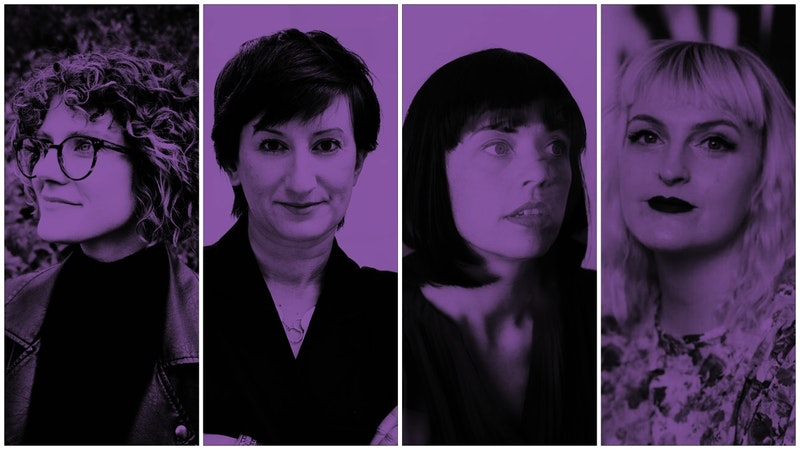
Daughters of Dracula” took place at the Museum of Literature Ireland, in Dublin, on Thursday, October 28th. It began as a hybrid event with a live stream, but due to technical difficulties was alternatively released as part of the museum’s The Dublin Gothic Podcast. This podcast is described on MoLI’s website as “a series looking at the intersection between art, psychology, folklore, architecture, natural history, and Ireland’s urban gothic writing.” The panel was moderated by Irish Research Council Enterprise Partnership Postdoctoral Fellow Dr. Katie Mishler and made up of writers Sarah Davis-Goff, Doireann Ní Ghríofa, and Sophie White. The in-person aspect of the event was held in the Old Physics Theater of the MoLI. This room has three floor-to-ceiling gothic-style windows, which added to the atmosphere and related to the content of the event, as noted by some of my fellow virtual attendees who made many remarks about the gothic atmosphere in the live stream chat before the technical difficulties. “Daughters of Dracula” did an amazing job of braiding discussions of the legacy of Victorian horror writing and Irish folklore with contemporary Irish women’s writing, particularly focusing on horror writing. 

Photo from Open House Dublin https://openhousedublin.com/locations/moli-museum-of-literature-ireland/

Sadly, due to technical difficulties, the live stream was cut short, but since the event was so discussion-heavy, I feel that I didn’t lose out on too much by listening to it in podcast form instead. That being said, it was occasionally difficult to attribute quotations to specific people if they didn’t also reference their work or bits of their biography listed on the website, so occasionally I will refer to someone simply as “the panelist.”

According to the event description, the main concept of the discussion was set to revolve around the long-lasting cultural legacies of “Vampires, ghosts, and the undead … [And how those] uncanny figures inform, or perhaps infect, depictions of the body, maternity, and sexuality in contemporary Irish women’s writing.” The first question came directly from the title of the event and asked panelists how they felt Bram Stoker, and more specifically Dracula informed their own gothic or horror writing. Sarah Davis-Goff, co-founder of Tramp Press and author of the 2019 novel Last Ones Left Alive, answered first, saying, “I’m not sure we can ever really untangle ourselves from [Stoker],” remarking on how that text is so integral to modern notions of gothic horror writing. All the panelists seemed to be in agreement, though, that Stoker was very “anti-the-power-of-women,” and they shared a laugh about how he would react to the four of them on the panel that night discussing Irish women’s literary triumphs. 

Panelist Doireann Ní Ghríofa, whose genre-blending debut prose book A Ghost in the Throat was published in 2020, explained how interacting with the gothic and horror genres allows her to feel “very close, culturally, to the people who came before us by engaging with our folklore.” She explained that one example that helps further her understanding of historical relationship with superstition and folklore is imagining people “before the advent of electric light … when the dark is coming, all [they’ve] got against it is a candle.” It was vivid imagery like this that really made the event special and allowed it to function just as well in an audio-only format as it would have live and in person.

I gained a new perspective from the way Doireann tied discussion of the true crime genre today to folklore when she explained, “We hear these stories and retell them to each other … it’s almost like an amulet … protecting ourselves by rehearsing these stories … there’s an element of the superstitious about it.” In a similar way, when addressing the frequency with which the horror genre appears in women’s writing, other panelists referenced how people who menstruate and give birth are well-accustomed to gore and other body-horror-type features of horror tales. This part of the conversation discussed how elements of the gothic and horror can be found throughout the varying genres the panelists write in. Their writing spans a wide range of genres including memoir, historical fiction, speculative fiction, poetry, biography, non-fiction academic writing, and even a cookbook (Sophie White’s 2016 book Recipes for a Nervous Breakdown), proving that horror is not exclusive to more recognized poetry or novel forms.  

Overall, I loved how the discussion branched out from what could have been just a simple conversation on Stoker and his contemporaries. In bringing in current phenomena such as true crime and contemporary memoirs, the conversation was exciting, progressive, and relevant, but still succeeded in being rooted in the common elements of horror and the gothic. I look forward to seeing what comes of the “Mapping Gothic Dublin: 1820-1900,” project, which is described on the website as “research[ing] the relationship between Dublin’s urban history and the development of Ireland’s literary gothic tradition.”

« Newer Posts - Older Posts »

Categories