Book Talk Blog Post

On the evening of December 4, I somewhat nervously entered the Stimson Room of the Library to hear Professor Suparna Roychoudhury discuss her recently published book, Phantasmatic Shakespeare: Imagination in the Age of Early Modern Science. The Stimson Room was warm and bright, with countless volumes of poetry lining the bookcases against the walls. Cozy sofas occupied the middle of the space, and large windows offered a view into the cloudless, starry night. The English department had arranged folding chairs in several neat rows, and copies of the book were available for purchase. People mingled, drinking cider and munching on cheese and crackers before the talk officially began.

I was nervous because being in a room full of intelligent, articulate academics is always a daunting task for me. I was worried that I would not understand the talk, and would have to nod and utter “ah”s of appreciation to feign a comprehension that I lacked. However, I admired Professor Roychoudhury, and as a student in her Renaissance literature seminar, I believed attending this event would give me valuable insights. The atmosphere of the room was so inviting, and the attendees so amiable, that I quickly forgot my trepidation, and chatted with friends, classmates, and professors before the talk began. When we all finally took our seats, I found myself absorbed in Professor Roychoudhury’s words.

Professor Roychoudhury opened her talk by discussing what led her to write the book in the first place. She found that scholarship concerning the impact of 16th century psychology on Shakespeare’s conception of the imagination in his plays did not exist. Surprised, she was so interested in this research problem that she decided she should be the one to investigate it. She prefaced her research by providing an overview of ancient and medieval ideas about cognitive psychology, or how the brain produces “phantasms,” mental images. Professor Roychoudhury also explained how the discipline of science, in the modern sense, arose in the 16th century, and how new notions about the mind influenced Shakespeare, even as classical philosophy remained entrenched in Renaissance thought.

Before she read the excerpts she prepared for us, Professor Roychoudhury outlined the chapters in her book and what they generally entailed. Chapter 1, Between Heart and Eye: Anatomies of Imagination in the Sonnets, examines questions about the head, heart, and eye and their relation to “fancy” in The Merchant of Venice. Chapter 2, Children of Fancy: Academic Idleness and Love’s Labor’s Lost, explores imagining as a leisure activity in Love’s Labor’s Lost. Chapter 3, Of Atoms, Air, and Insects: Mercutio’s Vain Fantasy, focuses on the immateriality of fantasy in Romeo and Juliet. Chapter 4, Seeming to See: King Lear‘s Mental Optics, studies vision as imaginative mental representation in King Lear. Chapter 5, Melancholy, Ecstasy, Phantasma: The Pathologies of Macbeth, analyzes mental illness as expressed in dreams and hallucinations. Chapter 6, Chimeras: Natural History and the Shapes of The Tempest, investigates nature’s relationship to the imagination, particularly in conceiving of the “unnatural.”

Professor Roychoudhury chose to delve into Chapter 4 in her talk. She explained Plato’s ideas about vision; he presumed that the eye sees by shooting a beam of light out onto the perceived object. Plato’s student, Aristotle, held the opposite view, asserting that light enters the eye, not exits it. Euclid, in his Optica, conceived of vision as geometrical problems, providing diagrams explaining perspective and other phenomena. This mathematical rendering of optics endured through the 15th century into the 16th century, with Johannes Kepler illustrating how the eye acts as a camera obscura (using a lens) in 1604. This discovery proved that vision produces pictures. However, Kepler’s theories also proved that vision is inverted because of how rays of light hit the eye’s lens.

Professor Roychoudhury provided us with a handout of significant passages in King Lear:

Gloucester. Dost thou know me?

Lear. I remember thine eyes well enough. Doest thou squiny at me? No, do thy worst, blind Cupid. I’ll not love. Read thou this challenge; mark but the penning of it.

Gloucester. Were all the letters suns, I could not see.

. . . . . . . . . . . . . . . . . . . . . . . . . . . . . . . . . . . . . . . . . . .

Lear. Read.

Gloucester. What, with the case of eyes?

Lear. . . . Your eyes are in a heavy case, your purse in a light, yet you see how this world goes.

Gloucester. I see it feelingly.

Lear. What, art mad? A man may see how this world goes with no eyes. Look with thine ears.

(4.6.133-37, 140-47)

Lear. Get the glass eyes, / And, like a scurvy politician, / Seem to see the things thou dost not.

(4.6.164-66)

The significance of Renaissance optics appears in King Lear, where Shakespeare plays with the trope of the blind sage. The tradition that losing one’s vision results in an increase in one’s insight was firmly established by Shakespeare’s time. Yet, it was now understood that the eye errs in seeing, leaving the mind to correct what the eye perceives, and the mind is not always able to do that. This revelation thus admits that both the eye and the mind can err, so wisdom and insight no longer entirely belong to either. Shakespeare uses Gloucester’s blinding to explore this problem.

The passages above detail the meeting of Gloucester, who is physically unable to see, and Lear, who is now mad and mentally unable to “see,” or reason. Gloucester, obsessed with the physicality of seeing, does not stop talking about his eyes or lack thereof. Meanwhile, Lear is absorbed with metaphorical eyes, invoking imagination to discuss how the mind works. Finally, Lear implies that one can see with “glass eyes,” remarking on the relative uselessness of physical vision. The appearance of seeing, achieved by wearing “glass eyes,” is, to Lear, equal to actually seeing. Thus, Shakespeare implicates the mistrust of vision and imagination in this scene.

I found Professor Roychoudhury’s arguments convincing. Her assertions were grounded in thorough close-readings of her texts, and she incorporated a number of Ancient, Medieval, and Early Modern texts to bolster her conclusions. I appreciate how she identified a hole in the scholarship and filled it, establishing a relationship between Shakespeare and science that I have not encountered before and doubt will encounter often. I regard Shakespeare’s plays, and Early Modern literature generally, in a new light because of this book talk, and I know that the knowledge I gained from it will be invaluable as I continue my education.


Posted by: lederniermot7 | December 4, 2018

Review : Crimes of Grindelwald

Outside of the noise surrounding the newest addition to the Potter family, Crimes of Grindelwald, regarding harried plot, frazzled character development, disjunction from the wizarding world as we know it amongst other criticisms, I would like to take a moment to consider the intrigue a film like Crimes holds – not only to die-hard Harry Potter fans but to all those muggle movie-goers alike.

(I would also like to refrain from any spoilers, so please, rest easy. I’ll resist the urge to talk about that thing that happened with Newt and — kidding.)

So what is the appeal here? We’ve got some magic and we’ve got some wonderful and sure as Merlin fantastic beasties running around 1927 Paris while bad things happen in the rest of the wizarding community and the goodies try their darnedest to stop it. Pretty cut and dry as far as plotting goes. Pretty predictable even. Save the details, we can probably guess how it’s going to turn out and who’ll do what. That all being said, not much seems to be rooting for Crimes’ success – and we are left with the world itself. Because the world of Harry Potter is a big one; it started with a castle and a cupboard under a staircase, some pointy hats and flying broomsticks. Then it grew, and it grew some more. Now it has left us outside the gates of Hogwarts we know and love to fend for ourselves with our wide array of magic knowledge and trivia and learn a new story that predates anything we’ve seen thus far.

That’s where I think the real magic lies: not in the big adventure plots aimed at drawing in the masses, but in the realization that something came before the world we already know. There is more for us to see and more ways to see it than the nearsighted gaze of a teenaged Harry Potter, and a companion series as the Fantastic Beasts franchise has become is a skillful way of expanding that view.

It also matters to us, however, not just when but where we can see these things happen, and even when we were at banquet in Hogwarts’ great hall, we were also in the Scottish highlands; boarding the Express, in the very real King’s Cross; and visiting the Ministry’s pedestrian entrance on the corner by Scotland Yard. The films’ (and the original texts’) positioning of the magical in the real, in the visitable is an aspect which intrigues us all the more. We are thrilled when the new and different appears in the mundane, making the transformation of a simple brick wall out back of a dingy pub still more wondrous.

It’s funny, then, to talk about illusions in Harry Potter, and most specifically, in Crimes. It is, of course, a world totally reliant on illusion and secrecy, on having two sides and keeping entire existences out of sight from others. The films in turn are forced to make do with this, to show and not tell, to reinvent ways of seeing so as to really convey that element of hidden acknowledgement the stories demand. And so we have enchanted statues which reveal passages only to those who know they’re there; government establishments hidden amidst old office buildings; briefcases to house hordes of wild beasts and whose appearance can be altered based on its audience.

This fixation on multiplicity and alteration of image is something we are inevitably drawn to, especially when those changes are made so easily, are maintained decisively, and act as the means to some end in their deception. It is something we find meaning in and seek to understand ourselves. We want to see all the sides of every picture painted, and only when we realize there is always more to know can we acknowledge truly how many sides there are.

Posted by: simmo22hmtholyokeedu | December 2, 2018

Yayoi Kusama’s Alice

In 2012, world-renowned contemporary artist Yayoi Kusama released an edition of Alice in Wonderland featuring her illustrations. You may have heard of Yayoi Kusama because of her Tate Modern exhibition from the same year, or because of the popularity of her Mirror Rooms on Instagram. Kusama’s illustrations for Alice are completely in keeping with the rest of her body of work. Some hallmarks include a repeated dot motif, plant life, and the use of bold, saturated color. She’s known for her whimsical approach to contemporary artistic practice, and that whimsy makes her a perfect match for this text.


Image result for yayoi kusama alice in wonderland

Image via Amazon


The above illustration is perhaps the most in line with Kusama’s previous works. The yellow and black color palette is reminiscent of her Pumpkins series, and mushrooms are a subject matter she has used in some of her previous pieces (example below). This particular page shows how artists can apply their own styles to Alice and make her story contemporary.

Image result for yayoi kusama mushrooms

Mushrooms (1995), Yayoi Kusama, via Artnet

Kusama’s illustrations are also just delightful in general. This one, that accompanies the poem about the crocodile tears, really displays how well suited this artist is to adapt the world of Alice. The colors are bright and almost psychedelic, reflecting the vibrancy of the characters of Wonderland. I can imagine that both kids and contemporary art connoisseurs would love these wacky pictures equally.

Image via Amazon

What I most love about Kusama’s illustrations is how well they show just one exciting iteration of the different adaptations of Alice in Wonderland that artists have done since it was published. In class, we talked about the extent to which this weird little book has stayed in the popular consciousness, and has been dissected, updated, and altered for different eras. This artist’s understanding of Alice may be widely different from Dodgson’s or Tenniel’s, but it manages to still be true to the fantastical nature of the adventures, albeit with a more abstract, contemporary aesthetic.


Posted by: simmo22hmtholyokeedu | December 2, 2018

Joan Jonas and the Mirror: A Review

The exhibition of Joan Jonas’s works concerning the mirror currently on view in the Mount Holyoke College Art Museum is dizzying. Jonas’s works, in general, are dizzying. With their bizarre combinations of performance, dance, video, and mirrors, there’s almost too much to unpack. That seems to be the point of her pieces, and the museum has done a beautiful job of highlighting that disorder.

On the left wall of the gallery is Wind, a video projection that lasts around six minutes. In it, Jonas, a few dancers and some of her friends perform a strange, ritualistic dance while buffeted by wind. According to what Jonas said about this piece during her talk at Mount Holyoke in October, this piece was initially staged inside but moved outside for shooting. The wind was an unplanned aspect that ended up changing the entire nature of the work. The wind acts almost as another dancer in the piece. Just as the pairs of performers push and balance on each other, the wind supports or topples the dancers in a similar way. As this is an exhibit on Jonas’s relationship to the mirror, reflection also plays a key role in this piece. The dancers wearing mirrored clothing, one of whom is Jonas herself, operate very differently within the work than do the other people. There seems to be, therefore, some kind of power attached to the mirrors, as though the reflection and distortion they cause imbue the wearers with an ability to defy the forces of nature.

Aside from the natural forces at work, the moment in the video which most stuck with me was the one in which one of the performers advances towards the camera with a kind of menacing grin. I thought this encapsulated the mood of the piece perfectly. The smile seems meant to communicate something to the viewer, yet the meaning of that communication seems out of reach. Likewise, the dance seems to be a part of some deliberate ritual, yet the purpose is also unclear. Like many of Jonas’s works, the movement itself seems to take precedence over some kind of coherent message.

The curators of this show have positioned this piece in a really interesting way. First of all, the piece is on the opposite wall as the explanatory text. The reflective panel that frames the text also reflects Wind from certain angles, albeit a slightly hazy and warped version. This is a really effective way of highlighting the distortion of space and that mirrors seem to cause in the piece. Also, though this may be a stretch, I think the choice to seat a metal bench in front of the piece really enhanced my experience. The cold temperature of the metal allowed me to imagine myself within the scene and made me feel almost like I was on the freezing beach with Jonas and the other performers.

The other piece that stood out to me in this show is Mirror Pieces Installation II, which takes up the entirety of the wall opposite the door. This work consists of a conglomeration of mementos from Jonas’s past works involving mirrors, including similar clothing to what was featured in Wind, a triptych of mirrors, and a video of a performance from 1968. In the video, mirrors are placed in the center of the performer’s nude bodies, which duplicates one side so that they are perfectly symmetrical. In front of the group of people doing this action, there is a man who repeatedly dons and removes a mirrored jacket like the one hanging over the mirrors. The layers upon layers of action here are parallel to the multiple mirrors which mediate our experience of the performers. It takes a while to realize that one is not actually watching a video of the performance, only the reflection. Jonas usually claims to use mirrors to distort space, yet here they also work to distort time. We are watching a taped, and therefore mediated, representation of a performance piece which is in turn mediated by the mirror. This distorts the memory of the performance and forces the viewer to watch a strange, false version of the original piece. Also, as the viewer examines the bodies of the performers, the reflection of their own body is shown in the mirror, therefore including them in a performance from fifty years ago.

That this work is what one sees when first walks in is particularly arresting. Almost immediately upon entering the gallery space, one is confronted with a reflection of themselves in the mirror. Viewers are at once involved in the world of Jonas’s works, however disorienting that world might be. From there, one can either enter the icy, turbulent world of Wind, the mediated world of Mirror Pieces Installation II, or the miniature world of My New Theater. The curators at the museum have made Joan Jonas’s works so much more accessible because of the tangible relationship between artwork and viewer that they have facilitated through the placement of the pieces.


Works Cited:

Simon, Joan. In the Shadow a Shadow: The Work of Joan Jonas. Gregory R. Miller & Co., 2015.

Posted by: penne22m | December 2, 2018

Joan Jonas: “60 Years Later” lecture

Mount Holyoke’s 2018-2019 Leading Woman in the Arts and very own alumna gave a public lecture titled “60 Years Later” in Mount Holyoke’s Gamble Auditorium. Jonas is a visual artist, who works with video and performance art in experimental and pioneering ways. She is also the first Mount Holyoke alumna to be included in the Leading Woman in the Arts program! Jonas graduated in 1958 from Mount Holyoke with a degree in Art History. The Leading Women in the Arts series has been active for 12 years, and is organized by the InterArts Council and the Weissman Center for Leadership. The program supports artists (in multiple mediums) who’s careers serve to inspire new generations of students. She was welcomed by President Sonya Stephens and warmly introduced by Amy Martin and Tricia Paik.

I found many aspects of Jonas’ lecture to be fascinating, and was excited to learn more about the work of the important female artist. What I found to be most compelling about Jonas’ work, was the emphasis she placed on life and art. Beginning with the lecture title, “60 years later” one can sense that Jonas views her work in the arts as a lifelong journey. Within her lecture, she took the audience with her through progressing periods in her life and how those periods influenced the work she went on to produce. She placed emphasis on the influence she took from experiences such as her childhood – where she learned the importance of play, spent much of her time in nature and found a connection to animals, especially to her beloved dogs. She talked about her early influences on her exposures in New York, Broadway and performance. As well as her own training in dance.

I found it most fascinating that Jonas drew and continues to draw much of her inspiration for her art from her life experiences. A creative medium that I am interested in is writing, specifically writing creative non-fiction and personal narratives. In my own work I write about life, and my childhood often appears, influencing my discoveries in different ways. In my work too I have been thinking a lot about craft recently, a question that was brought up for me when viewing Jonas’ work. The lecture that Jonas gave helped me in understanding the idea of craft in her work, which is so experimental in nature. As I learned about the life experiences that influenced Jonas’ creative decisions, I was able to connect with her work in a new way. It was in this frame that I was able to think about her work Mirror Improvisations that is currently featured in the Mount Holyoke Art Museum. My impressions and appreciation of this piece shifted after attending Jonas’ “60 Years Later” lecture. Previously, I had been unsure of how to interpret the work. But with this new idea of Jonas’ childhood influences I began to appreciate the work as an expression guided by her early life.

I interpreted this piece to be playing with the idea of a lingering childhood. The dress in the piece is striking because the two older women are dressed as children. The attire is definitely whimsical, reminiscent of a childlike interest in a fairy or a princess. The tulle skirts and paper crowns are surprising in this context of adulthood, and took me as viewer into an alternate moment in time and space. The setting also seemed to correspond with Jonas’ own childhood playing in the woods and spending summertime in nature. One could imagine this time spent in nature was made all the more important for young Jonas as it contrasted starkly with her time spent in New York. Through experimental filming, Jonas and the other members of the scene record what looks like a sequence of discovery and play. There are two people as well as a dog in the scenes. The presence of the dog further reinforced my idea that this piece could be a form of expression akin to a piece of personal narrative writing. During her lecture, Jonas stressed the significance of the continued presence of her pets in her life, especially her different dogs. Initially, I didn’t know what to make of the idea of reflection– and the filming and viewing though mirrors in this work. Now I can muse that this may be Jonas commenting on the role her childhood played in creating her sense of self, or that a part of her adult identity holds on to this inner experimental child. There is a definite sense of storytelling in Jonas’ work, which feels deeply personal. There are many ways to interpret the art of Jonas, but I was grateful for her lecture “60 Years Later” for providing me with a new way to consider her work.


Sources:

Jonas, Joan. Mirror Improvisation. 2005.


Posted by: helenabeliveau | December 1, 2018

Nostalgia Marketing in Commodity Culture


In conjunction with the rise of accessibility in creating the perfect image, most exemplified through the high quality of an iPhone camera, there has also been a resurgence in the popularity of the disposable camera.  The rise of popularity in products reminding people of their own youth has even transformed into a marketing strategy. This marketing strategy, more specifically, is targeted towards millennials, and is fittingly branded as ‘nostalgia marketing’.  It seems as if the nostalgia of growing up in the 90’s has permeated to almost all facets of consumer culture, as millennials have wholeheartedly embraced the ‘90’s aesthetic’ that has permeated in clothing, music, and the consumption of pop culture.  

This resurgence has also translated to the way in which we take photos.  Rather than with the click of an iPhone, many people are embracing the wind up shutter of a disposable camera as their preferred method to capture moments in time.  An article written in 2017 has cited that FujiFilm sales of disposable cameras have nearly doubled since 2014-15 (Hannah). In a society bogged down by the filtered perfection of social media, the disposable camera allows people to truly capture a memory, uninterrupted by the sitter’s pleas for a picture retake.  In a society that seems to have become so transient, more specifically in the realm of visual culture, this resurgence has allowed people to capture the ‘real’ of real life, in contrast to the edited and filtered version of one’s life, most often seen on social media.

However, this yearning to capture a spontaneous moment seems to have been slightly corrupted by the use of disposable cameras as aesthetic inspiration for various camera filters and apps.  This can be most represented through the development, and subsequent popularity of the ‘Huji’ camera app. The ‘Huji’ camera app, in turn, transforms pictures taken by phone cameras into what appears to be the product of a disposable camera.  The final product is then equipped with blurred edges, uneven lighting, and a time stamp. The commodifying of this product to fit the efficiency of contemporary modes of photo taking poses a conundrum. Are people simply interested in the aestheticized and filtered version of nostalgia or the feeling of nostalgia itself?  In a time where a majority of gadgets are measurable through their convenience, the resurgence of the disposable camera still requires one to wait several days for photos to develop. These camera apps conversely, do not require the time and labor associated with the type of image they produce. So then, can the malleability of these products to fit the efficiency of current times have the same emotional effect as the products they take inspiration from?

Works Cited

Friedman, Lauren. “Why Nostalgia Marketing Works So Well With Millennials, And How Your Brand Can Benefit.” Forbes, Forbes Magazine, 3 Aug. 2016, http://www.forbes.com/sites/laurenfriedman/2016/08/02/why-nostalgia-marketing-works-so-well-with-millennials-and-how-your-brand-can-benefit/#5cba1a823636.

Hannah, Jaye. “Disposable Camera Sales Are up – Instagram Backlash, or Passing Trend?” Six-Two by Contiki, 29 June 2018, http://www.contiki.com/six-two/disposable-camera-sales-instagram/.

Posted by: penne22m | December 1, 2018

Queen Victoria as Instagram Influencer, kind of.

During a discussion of advertising in the Victorian era in class, the subject of a strange new phenomenon came up: the influencer. An influencer is essentially a person, who acts as marketing. How this works is by identifying those people who have influence over potential consumers and orienting marketing actives around them. In modern day, this is typically happening through social media. Ah yes, the Instagram influencer. A person with a large enough following on Instagram who’s whole online life is a curated marketing presence. Brands will send them clothes, for example, and they will wear and tag them in a post. The same applies for bags and shoes and food and what workouts they stream and what shampoo their cat uses. Truly. While this may seem absurd, the notion that a person is a marketing tool that can change the way thousands of people (or followers) operate – I have come to consider that this may not be an entirely new phenomenon.

Instagram, and social media in general, is allowed to work in this way through photography. This idea lead me to our discussions in class, surrounding the advent of photography in the Victorian era. Specifically, it led me to think about the top influencers of Victorian society, the royals. Upon further reflection, I realized that Queen Victoria was perhaps the first Queen to use photography. In fact, countless portraits of the queen circulated into the public sphere. Was Queen Victoria among the first influencers as we know them today?

She is certainly known for her influence on fashion, having championed the popularity of the white wedding dress. We know that Queen Victoria was so fond of her husband and her gown, that she even wore her gown years after the wedding in order to pose for photographs. The widely seen images of her white wedding dress, could very well be an example of how she was one of the earliest social media influencers.


Posted by: penne22m | December 1, 2018

The Cocoa Childhood

When reading Lori Anne Loeb’s Consuming Women: Advertising and Victorian Women chapters 1 and 2 the images that struck me as most fascinating were the cocoa ads. Specifically, I was curious as to why these advertisements for cocoa seemed to be targeting and focused on children. Loeb speaks to the generational power structure and the female gendering of these advertisements but I still had the burning question: why did these advertisements paint chocolate as a “health” food of “purity” and why the focus on kids? How did these early advertisements to children effect future marketing strategies?

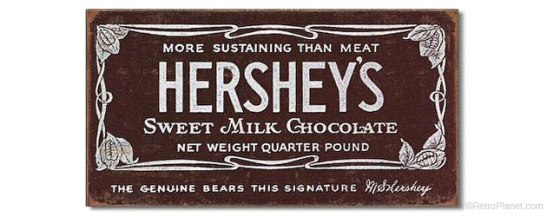
The first order of business I set out to explore was the “healthy chocolate” issue. These Victorian advertisements do many smart things: first as Loeb points out they feature little girls. This commercialized image of the pure and well-behaved child plays to the Victorian ideal. They even push “purity” further by claiming the cocoa is the purest thing you could give your children. Turns out, while these images were being circulated in Europe, Hershey’s was doing similar things around the same time in the US. In fact from 1912- 1926 the Hershey’s chocolate bar wrapper had the claim “more sustaining than meat” printed right on the label!

Bar wrapper for Hershey's Milk Chocolate bar. ca. 1912-1926

So why this effort to convince families that cocoa was healthy and nourishing for children? One theory is that it was a strategy of hooking the consumer, in this case children. Hooking them while they’re young (as they say), pushing the idea of consuming this product as being an integral and nourishing part of their day. This way not only does it become commonplace, like drinking a glass of milk, but also addictive. The sweetness of the chocolate in combination with the habit of consumption has just created a lifelong consumer. Now this is when we begin to see an experimental shift in marketing directly to children, instead of solely adults.


Flash forward to modern day: marketing to children is everywhere. And the chocolate industry is still at the forefront of this strategy. Take for example, the M&M. Have you seen an M&M commercial? They are literally giant talking cartoon chocolates. I did a science experiment in elementary school about the dangers of children mistaking medicine for candy. I rounded up all the neighborhood kids (with parental permission) and gave them two options, asking them to identify which was candy and which was medicine. Every single participant (in this revolutionary and well-conducted by an 11 year old me experiment) confused the chocolate laxatives for regular chocolate. When I revealed to them that the chocolate imposter was medicine, one boy said something that I thought was strange at the time, but that came rushing back to me upon viewing these Victorian advertisements. He told me, “my mom says chocolate is healthy, she eats a square every night after dinner and lets me have my own… so it if it’s healthy isn’t it medicine?” Needless to say, I didn’t know how to answer him at 11. And I am aware of the health benefits of certain chocolate. But I am also aware now of the complicated history of cocoa advertisements and children, going all the way back to the Victorian era. And, now I am craving some chocolate.


Loeb, Lori Anne, Consuming Women: Advertising and Victorian Women.

Posted by: simmo22hmtholyokeedu | November 29, 2018

Elizabeth Siddal: Muse and Martyr of the Pre-Raphaelite Brotherhood

If you have ever seen a Pre-Raphaelite painting, there’s a good chance you have encountered the face of Elizabeth Siddal. She is the model for John Everett Millais’s Ophelia and Dante Gabriel Rossetti’s Beata Beatrix. She was married to Rossetti, served as his “”””muse””””,  and was a central figure in the Pre-Raphaelite Brotherhood. Though she is best remembered for her striking features which adorn the aforementioned paintings, she was also a prolific poet herself. Sadly, the poetry she is most associated with was that of her husband, which was buried with her when she died.

Beata Beatrix (1864-70), Dante Gabriel Rossetti, Tate Gallery

Elizabeth Siddal was born to an upper middle class family in 1829 in London. Though she had no formal education, she nonetheless became a pivotal figure in the intellectual circle of Millais, Rossetti, and John William Waterhouse.

Ophelia (1851), John Everett Millais, Tate Gallery

I first encountered Siddal as the sitter for Millais’s Ophelia. In this painting, Siddal as Ophelia drifts along a river, captured right at the moment when her clothes are still helping her stay afloat before they become waterlogged and drag her below the surface. I was always disturbed by the depiction of Ophelia, in Shakespeare and later by Millais, as a pretty girl, even as she is about to die. In fact, Siddal was in danger of actually dying during the painting of this image. To pose as Ophelia, she lay floating in a bathtub as Millais painstakingly copied her likeness. The candles underneath the tub, which kept the water marginally warm, eventually blew out, leaving Siddal laying in rapidly cooling water in the middle of a London winter. She later caught pneumonia as a result of the ordeal. Both the painting and this anecdote lead me to the conception of this woman as a fragile, tragic figure.

While she was often painted, mostly by Rossetti, as varying folkloric and religious figures (Joan of Arc, Lady of Shalott, etc.), she ended up becoming a mythic figure in her own right. After her tragic death by suicide, her husband Rossetti was so distraught that he ordered all his poems be buried with her. Later, he realized this wasn’t such a great idea, and exhumed her coffin to retrieve his poetry. The legend goes that upon opening the coffin, her hair appeared to have grown after her death, filling the box with her distinctive red hair. Therefore, in death she takes on the kind of magical qualities associated with the women for whom she had served as a model.

What neither of these stories mention, however, is Elizabeth Siddal’s own artistic practice. By mythologizing her, and making her the victim of these two great artists, history has erased her personhood and agency. I highly recommend reading some of her poetry. They’re really lovely and brief, and help us to understand this woman as she was outside of the context of Millais and Rossetti: Alive, on dry land, and a woman who created her own works of art.


Sources:

Bradley, Laurel. “Elizabeth Siddal: Drawn into the Pre-Raphaelite Circle.” Art Institute of Chicago Museum Studies, vol. 18, no. 2, 1992, pp. 137–187. JSTOR, JSTOR, http://www.jstor.org/stable/4101558.

Hassett, Constance W. “Elizabeth Siddal’s Poetry: A Problem and Some Suggestions.” Victorian Poetry, vol. 35, no. 4, 1997, pp. 443–470. JSTOR, JSTOR, http://www.jstor.org/stable/40002261.

“Siddal, Elizabeth Eleanor (1829–1862), Painter | Oxford Dictionary of National Biography.” (1892–1973), Writer and Philologist | Oxford Dictionary of National Biography, Oxford Dictionary of National Biography, 9 Nov. 2017, http://www.oxforddnb.com/view/10.1093/ref:odnb/9780198614128.001.0001/odnb-9780198614128-e-37957?docPos=1.


Through the heavy doors and into the dark gallery. Banners bearing portraits of eight women hang from the wall. Images of the eight empresses of the Qing dynasty, which lasted from 1644 to 1912. As wife of the emperor or mother of the emperor, the empress assumed a currency of influence, both with the emperor, and in her role as head of the imperial harem. These empresses, whose stories have been overlooked, occupied an elite, rarefied position in Chinese history.

I had the pleasure of visiting the Peabody Essex Museum’s formidable exhibit “Empresses of China’s Forbidden City.” The exhibit is the product of a collaboration between the PEM in Salem Massachusetts, the Smithsonian’s Freer|Sackler galleries in Washington, and the Palace Museum in Beijing. The lives of the Qing dynasty empresses have been a neglected history, as the text introducing one of the exhibit’s galleries illustrates: “The imperial court closely regulated the life of each empress to ensure she stood as an exemplar for all women, yet the male officials who wrote Qing court history recorded very little of her activities. They perceived family matters and women’s roles as less important than the state affairs the emperor managed.” Through an astounding collection of objects, exhibition curators endeavour to “tell the little-known stories of how these women influenced art, religion, court politics and international diplomacy” (Cardin).

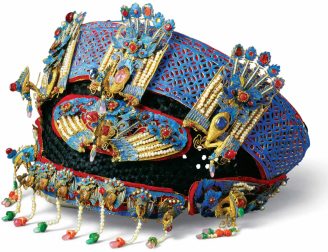
Organized thematically, each gallery in the exhibit spoke to a different theme relating to aspects of the empresses’ lives and areas in which they held influence such as “Becoming an Empress,” “Ascending the Throne,” “Fulfilling Family Roles,” “Celebrating Motherhood,”  “Worshipping as an Empress,” and “A Rich and Active Life.” Each gallery housed objects associated with each theme as well as a specific profile on one of the empresses. The sheer number of objects, nearly 200 in total, were awe-striking in their variety, from orate headdresses meant to be “demure yet tantalizing,” to intricate hairdressing sets, dressers, robes, and paintings.

blogemphddressFPO_003

(“Festive headdress with phoenixes and peonies, Tongzhi or Guangxu period, probably 1872 or 1888–89, probably Imperial Workshop, Beijing, silver with gilding, kingfisher feather, pearls, coral, jadeite, ruby, sapphire, tourmaline, turquoise, lapis lazuli, and glass; frame: metal, wires with silk satin, velvet, and cardboard, Palace Museum, Gu59708. The Palace Museum. On view in Empresses of China’s Forbidden City.”)

Every gallery of the exhibit, nearly every object, was surrounded by visitors. The crowd was very engaged in the exhibit; discussing and raising questions with their partners, children, and grandchildren. This atmosphere of inquiry and engagement not only mirrored, but heightened my experience of the exhibit.

Representations of the empresses in the material objects straddled the line of maintaining and contesting gendered expectations. Some depictions of the empresses in the exhibit revealed empresses as icons of ideal womanhood. A series of paintings represented empresses exemplifying the traits of “filial devotion to elderly, good care of sons and grandsons, diligence, and frugality” all of which Qing imperial women were expected to embody. Other galleries and objects reflected the empresses exhibiting more individuality. Empresses, with their cosmopolitan preferences, became tastemakers in culture and keen art collectors. Empresses were also exempt from footbinding and enjoyed greater freedom and mobility, from horseback riding and archery to travel. One area of influence I found interesting was the empresses’ influence over religion. Empresses’ religious practices led the court to construct “magnificent religious buildings, scriptures, and sculptures,” which in turn “shaped the pluralistic religious traditions of the court including Buddhism and shamanism.”

Despite the plethora of objects and areas of influence, I was always aware of the empresses’ confinement. Curators provided viewers a sense of scope of the empresses’ worlds by including a large map of the Forbidden City. The map denoted the living quarters and spaces the empresses would have been able to access. The space the imperial harem and empresses occupied was a relatively small cluster in such an expensive development.

The empress’ foremost job was to produce a male heir. Objects surrounding an empress made sure she never forgot that most essential job. Personal objects such as a screen, vases, a jar, and a snuff box bore images of  “boys at play” and “mother and child” or “mother and son.”

An element the exhibit made very clear was that an empresses’ influence could extend beyond producing a male heir; the relationship between emperor and his mother provided continuing influence over the court. A close relationship between emperor and mother empress dowager was “emblematic of a harmonious society that Qing rulers credited to their rule.” The objects associated with empress Chongqing (1692-1777), mother of Qianlong Emperor, revealed the closeness of her relationship with her son. Chongqing experienced good health and traveled 10 months of the year with her son into old age. On display was the travel tableware she took with her on these journeys. When Chongqing and her son were not together, she walked with a staff that symbolized his personage. Also on display was a fan Qianlong painted for Chongqing bearing the image of a daylily, a symbol of one’s love for their mother.

While the palace observed a strict patriarchal hierarchy, there was a possibility for consorts in the harem to gain some upward mobility; a mother’s birth rank was not taken into consideration when selecting which son would be chosen as the next emperor. An empress could manipulate a way to maintain power, as in the case of Empress Dowager Cixi (1835-1908) who maneuvered a way to consolidate power and maintain her influence for nearly fifty years.

Empress Dowager Cixi’s story remains, for me, one of the most intriguing of the exhibit, as it exemplifies ways empresses mobilized their influence to beget more influence. Upon the Emperor’s death Cixi and the other empress dowager Ci’an “instigated a coup to place power directly in their hands as co-regents of the child emperor” which led to her 47 year run (1861-1908)  as “de facto ruler of at the Qing court.” During her tenure Cixi “challenged the tradition that women shall not rule, and brought radical changes to the role of women in court politics, diplomacy, and art patronage.”

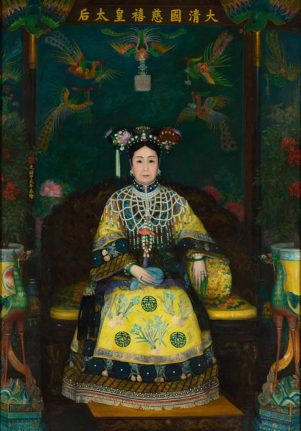
The exhibit ended with an object dissimilar to previous objects — an imposing portrait of Empress Dowager Cixi. The empress received a negative public reputation for supporting a the Boxer Rebellion a “violent anti-foreign uprising which besieged the American diplomatic quarter in Beijing in 1900.” In an effort recuperate her image for Western powers (‘the soul of a tiger in the body of a woman’ as one Western newspaper described her), the empress hired American painter Katherine A Carl to paint her portrait, which she would gift to Theodore Roosevelt for display in the 1904 World Fair. In the time of photographic portraits, the empress chose the more traditional, painted portrait, perhaps speaking to the comparative power of the two mediums. By hiring an American artist, Cixi’s political acumen is as much on display as her visage. I also found it intriguing that the empress chose a female artist to present this more ‘softened’ image of herself to the public.

EMP288lowresFPO

(“Katharine Carl, The Empress Dowager Tze Hsi, of China, oil on canvas with camphor wood frame, 1903. Freer Gallery of Art and Arthur M. Sackler Gallery, Smithsonian Institution, Washington, D.C.: Transfer from the Smithsonian American Art Museum, S2011.16.1-2a-ap.”)

I found this to be a hearty exhibit, both in terms of the materials on display and the concepts it presented. One element I found particularly interesting was how the organizers chose to end the exhibit. At the exit, a roll of unfurled butcher paper with pens and pencils sat below two questions printed on the wall reading “What do you feel are the expectations for women in power today?” and “How do you think women in power are portrayed today?” I appreciated that the curators chose to end the exhibit with these provocative, challenging questions, bringing the empresses’ experiences to a modern context. The Qing dynasty empresses dealt in complicated and precarious power. The questions reiterated for myself the sense that this exhibit is about a representation of power, as there is no written record from the empresses’ perspectives about their roles and experiences of power. The voices of the women felt at times close and distant from the material culture in the exhibit. Private objects were often not fully their own, but were imperial property. Upon the death of an empress, the objects returned to the palace, to be passed on, or melted down and made anew.

One of the excellent effects of this exhibit is that, while it illuminated aspects of the Qing dynasty consorts and empresses’ lives, it also embraced the persistence of mystery surrounding their experiences.

Curators designed the exhibit to offer visitors a view into the empresses’ world, not just a view of a world. Before entering the exhibit text printed on the wall invites viewers to imagine themselves  empresses. The theme of imagining continued throughout the galleries. At the beginning of each gallery space curators included a brief creative vignette to bring visitors closer to the empresses. The vignettes included a future consort, as young as thirteen, being transported from her family home to the palace for marriage, and an empress anxiously waiting to hear which son of the emperor would inherit the throne following the emperor’s death. These vignettes engaged the visitors imagination, something I found suited my style of exploring.

Upon leaving the exhibit I was ready to venture out and do my own research. I think this a strength of the exhibit, that it raises more questions than it answers, inspires more inquiry, invites visitors to delve deeper.


Work Cited and Credits for Images (along with their captions)

Cardin, Dinah. “Stories of Opulence and Influence.” Peabody Essex Museum, 8 Aug. 2018, https://www.pem.org/blog/stories-of-opulence-and-influence.

Gordon, Lydia. “2018 Exhibitions Examine Women and Power.” Peabody Essex Museum, 14 Feb. 2018, https://www.pem.org/blog/2018-exhibitions-examine-women-and-power.

*All other quoted material from plaques in the exhibit

« Newer Posts - Older Posts »

Categories