Posted by: phane20c | September 15, 2010

Bleak House Women

In class we had touched on the subject of gender portrayal and stereotyping -particularly of women- in the portrait of Lady Delme and in the poem My Last Duchess. As I began reading Bleak House I kept an eye out for Dickens’s representation of women, which is (unfortunately) notoriously sexist. There are numerous examples of sexism and stereotyping of women in the novel, ranging from the women characters (especially Ada) being depicted as weak, emotional, easily overwhelmed, etc., to Richard Carstone needing to “protect” and “help” Esther and Ada, to the the women characters (again, especially Ada) being represented as something to the effect of angelic little creatures. Indeed, the women are often described as “little.” It seems Ada’s main contribution to the novel is her physical appearance. Then look at Esther: she is the poster child of modesty. Whenever a man is talking she seems to keep her mouth shut and be constantly full of self doubt. The men characters, on the other hand, are often described as exquisite speakers who “love to hear themselves speak.”

Esther and Ada are represented as being completely moral and selfless and being very fond of children. These are classic examples of the ‘ideal’ woman. There is one part where Mr. Jarndyce inquires what is to become of Richard Carstone. It is expected that as a man, he ought to make a living for himself and see the world. The only thing expected of the women, however, is to be married. In the part where Esther is proposed to, she is told she will “gain” his “fortunes” if she will consent to marriage.

I typed ‘Dickens and sexism’ into my browser and loads of articles popped up. There is a book by Michael Slater entitled Dickens and Women:

http://books.google.com/books?id=GyuH6-eZZaQC&printsec=frontcover&dq=michael+slater+dickens+and+women&source=bl&ots=xJHJ0f9QRO&sig=CQRp1cz756JwkW_nnasfhKvRa3U&hl=en&ei=j0-QTN-3FMT38AaEotiOAg&sa=X&oi=book_result&ct=result&resnum=1&ved=0CBIQ6AEwAA#v=onepage&q&f=false

Critic John C. Ward summarized the negative criticism of Dickens’s female figures when he wrote: “it is commonplace to observe that Dickens’s view of women is sentimental, sexist, patriarchal and derogatory.”

Posted by: labbott12 | September 15, 2010

Setting the Scene of Dickens’ “Bleak House”

As a student who identifies as a very visual learner, I am finding Dickens’ Bleak House a rich and enticingly visual read. I’m a lover of Masterpiece Theatre and often find my way into a novel as thick as Bleak House with a little help from the Netflix gods. However, after plunging into the novel’s pages, I found that I remembered the adaptation from when it was originally aired on PBS a few years back. The film was stunningly beautiful in its cinematography and art design; from the opening scene of Lady Dedlock looking out the window on the eternally gray skies to the musty office of Kenge and Carboy, the film’s atmosphere was thick and tangible. From Dickens’ first page, the visual and atmospheric nature of the novel is introduced with the fantastic passage that reads,

“Fog everywhere. Fog up the river, where it flows among green aits anf meadows; fog down the river, where it rolls defiled among the tiers of shipping and the waterside  pollutions of a great (and dirty) city…Fog in the eyes and throats of ancient Greenwich pensioners, wheezing by the firesides of their wards; fog in the stem and bowl of the afternoon pipe of the wrathful skipper, down in his close cabin; fog cruelly pinching the toes and fingers of his shivering little ‘prentice boy on deck. Chance people on the bridges peeping over the parapets into a nether sky of a fog, with fog all round them, as if they were up in a balloon and hanging in the misty clouds.”(17)

As a sixth-grader about to open up her first Dickens’ novel Oliver Twist, I was terrified of the length, density of the small type, and overall hype about the novel being categorized as a “classic”. What I quickly discovered was that Dickens was the kind of writer who could create an entire world of image and atmosphere in your mind’s eye, and reading his novels was like stepping onto the set of a Masterpiece Theatre film…I fell in love. While reading Bleak House, I remember why it is I love Dickens’ words and how he masterfully groups them on the page. With this passage about the fog, the reader sees the fog creeping over the city and into the lungs of its inhabitants. As the fog covers the city in Dickens’ first page, a sort of cloak beckons the reader into this world of characters she is about to encounter and sets the stage as if a fog machine were switched on, for an eerie and bizarre world of characters and happenings to be uncovered.

Dickens takes the care to introduce each character and set each scene with the most visual of descriptions that the Netflix gods seem obsolete at times…yet, who can really resist a cozy night of Masterpiece Theatre and tea 🙂

Posted by: annarose12 | September 15, 2010

Early Detectives & Inspector Bucket

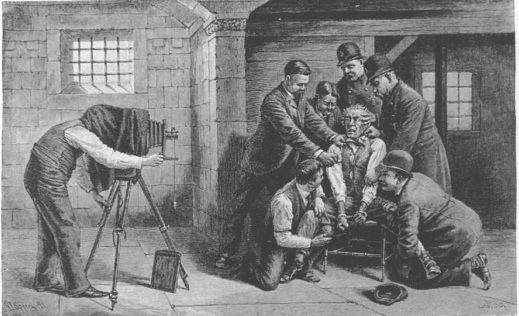
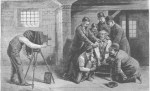
While looking at the syllabus and reading Bleak House I was really interested Inspector Bucket and the advent of Detective Fiction.  With the advent of photography inspection and conviction must have completely changed.  Photography revolutionized criminal investigation, and by 1843, less that four years after the invention of the daguerrotype, photography was already being used by the police.  As Walter Benjamin said, “Photography made it possible for the first time to preserve permanent and unmistakable traces of a human being.  The detective story came into being when this most decisive of all conquest of a person’s incognito had been accomplished.”

An Unwilling Subject – Photographing a Prisoner for the Rogues Gallery at Police Headquarters.
Source: Byrnes, Thomas. ” Famous Detectives Thirty Years Experiences and Observations.” Hartford ©1891.

Edgar Allen Poe, Charles Dickens and Sir Arthur Conan Doyle, all famous for their mystery novels, wrote on the amazing potential of photography.  In an article published in 1850 Dickens’ wrote, ” Photography is everywhere now.  Our trustiest friends, our most intimate enemies, stare us in the face from collodionised surfaces.  Sharp detectives have photographs of criminals of whom they are in search.”   The Detective was a relatively new law enforcer at this time.  England’s first Detective division was founded in 1842.  When Bleak House was published in 1852 Inspector Bucket became one of the first detectives in English Literature.

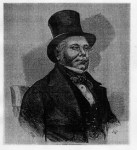
Sharp-Eyed Inspector Bucket was based on a real detective, and a friend of Dickens’, Charles Frederick Field.  One of the first detectives recruited, Field took over management of the division in 1846.  During his fourteen year stint as Chief of the Detective Branch, Field would often operate as one of Dickens’ “night-guides”, accompanying the author on his late night walks around London.  Dickens’ would in turn write a number of stories featuring Fields, the most famous of which is Bleak House.  Fields eventually retired in 1852 and following his retirement Fields worked as a private investigator until 1865.  And much like a detective we’ll read about next week Fields was involved in a number of sensational cases and was often at odds with the police force.

Charles Frederick Fields – date unknown.

Posted by: jmacd32 | September 15, 2010

Dickens and Portraiture

In class we discussed portraiture and its power to manipulate an audience. In the case of the portrait of “Lady Delme and Children” we discussed how Lady Delme is staged to be a representation of the ideal “mother” and “woman.” Here, portraiture is a limited mode of representation. Lady Delme becomes a representation of a woman rather than an individual. In Dickens’ Bleak House he represents the people of his story in writing rather than in painting or another form of visual reproduction. Reading the beginning of Bleak House and being introduced to all its many characters I thought of their descriptions as Dickens own form of portraiture. In relation to our discussion of Lady Delme, Dickens’ “portraitures” of the many characters of his novel lend the reader to question whether writing can provide more of an insight into the individual than actual portraiture. In Chapter VI when Mr. Skimpole is speaking to the debt collector who has cornered him in his room he notes,

We can separate you from your office; we can separate the individual from the pursuit. We are not so prejudiced as to suppose that in private life you are otherwise than a very estimable man, with a great deal of poetry in your nature, of which you may not be conscious. (90)

As Mr. Skimpole reasoned with the debt collector he also was in the process of making “a little drawing of his head on the fly-leaf of a book” (90). Whereas Mr. Skimpole’s drawing of the debt collector may have represented him in his “office” Mr. Skimpole’s comments suggest that the debt collector is also an “individual” outside of his “office.” Mr. Skimpole’s remarks remind me of Lady Delme’s portrait. We see Lady Delme in her “office;” she is  a mother and a wealthy women. However, we do not see Lady Delme as an individual. We can guess at her background, but her portrait is basically a representation of her role and place in life rather than an insight into her life. Through the written word does Dickens’ portray his characters in a way that can separate them from their “office” or “separate the individual from the pursuit” (90)?

Posted by: marycib | September 15, 2010

Portraits in Bleak House

When Mr. Guppy is being led throughout Chesney Wold, he is described as being “so low that he droops on the threshold and has hardly strength of mind to enter” until he sees a portrait of a woman, which “acts upon him like a charm” (Dickens 102). The description of Mr. Guppy before he notices the picture makes his reaction more pronounced and the change in his expression more drastic. Mr. Guppy is so transfixed by the picture that he feels as if he has seen her once before and inquires about whether or not the picture has ever been engraved. In connection with our class last week, the concept of a portrait being owned by a man is represented in this passage when Rosa states, “The picture has never been engraved. Sir Leicester has always refused permission” (Dickens 103). In this sense it is not the painter, nor Lady Dedlock that can claim possession of this painting, but Sir Leicester Dedlock. Even with both characters absent, the reader gets a sense that Sir Dedlock has a commanding presence in the household and assumes control over his wife. Even after Rosa points out portraits other than that of Lady Dedlock, Mr. Guppy cannot tear his eyes away from the picture. When Mr. Guppy states, “if I don’t think I must have had a dream of that picture”, it is as if he cannot imagine a world where he has seen the picture because the painting is so captivating (Dickens 103). This passage demonstrates how much power a picture can have as Mr. Guppy “follows into the succeeding rooms with a confused stare, as if he were looking everywhere for Lady Dedlock again” (Dickens 103). Mr. Guppy wishes to connect all subsequent events with Lady Dedlock, and inquires whether or not the story of Ghost’s Walk has anything to do with the picture.

Many times, a painting of a person can be embellished and not contain some of the flaws of that individual. Rosa does state, however, that for this painting, “It is considered a perfect likeness and the best work of the master” (Dickens 103). Although this could be interpreted in various lights, it makes Mr. Guppy’s fascination with the portrait all the more intriguing as the reader wishes they could see this painting of Lady Dedlock. The fact that the painting is said to look like Lady Dedlock makes it more understandable that Sir Dedlock would not wish for the painting to be copied because he wishes to be the only person to have authority over every aspect of his wife.

Posted by: lbrooksd | September 15, 2010

Bleak House Illustrations

As a precocious young thing at the beginning of my reading career, on visits to the library I was usually to be found ogling all the old books – you know, the leather bound volumes on the top shelf with titles you can barely read and authors who died centuries ago.  Predictably, Dickens was one of those nigh indecipherable names that I couldn’t keep away from.  Despite it being above my reading level, I struggled through The Old Curiosity Shop as a preteen, a labor of love for all things old and important looking.  Although the details of the story are lost to me now, what I do remember about that book is the illustrations: beautiful, ink illustrations that I quite possibly spent more time looking at than I did actually reading the text.  Remembering my first run in with Charles Dickens, as I began to read Bleak House I just had to ask a question – and that is, where are the illustrations?

They are here:

http://charlesdickenspage.com/illustrations-bleak_house.html

To me, one of the most striking things about Dickens’ world is the darkness.  The dim, sooty air that seems to permeate the heart of all his stories – that is what I think of when I think of Dickens, and this illustrator has captured that beautifully.  The cascade of characters and the wealth of detail in a Dickens novel can often be overwhelming – indeed, it is difficult to keep track of everyone and everything – but I find the illustrations to have a grounding effect.  The visual representation confirms what I have been reading, it reinforces my imagination, and it feels like part of the experience of reading the story.

On another note, I’m glad the BBC Bleak House miniseries was mentioned, and I want to add that I really loved it – definitely worth watching.  And it’s on Netflix Watch Instantly.  Booyah.

Posted by: Laurel | September 14, 2010

Ownership of Art

While reading Bleak House, I have been thinking a lot about the process of reproducing art and creating new art based off of, or heavily influenced by, other works of art. Last semester, I took a course in which we were asked to write original fiction based off of a Greek myth as it was depicted in a well-known painting (I know, we were very far removed from the original work). On page 218 of the Illuminations text, Walter begins to talk about artistic reproductions—”Mechanical reproduction of a work of art… represents something new.”

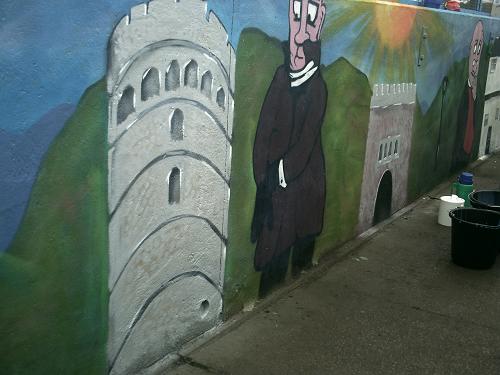
Though I am not thinking of reproduction “terra cottas” or “coins,” I found that statement interesting. I liked the idea that a reproduction can become an individual work on its own. In class, we discussed the difficulty of reproducing paintings and how creating reproductions can throw into question the ownership of a particular work. I am specifically intrigued by the art and interpretations created after Bleak House, and how each new artist can take the original idea and make it her own. One of the most well-known interpretations of the novel comes in the form of a BBC mini-series of the same name. But beyond a number of screen adaptations, there are, to be found online, numerous photographs modeled after Bleak House, cartoons, and modern murals painted along public path ways. This mural is just one of the many interpretations of Bleak House which can be found through a little bit of investigation.

Crampton Tower and Bleak House. Taken from http://www.streetartstudio.com/paragraph8.html

I was very intrigued by the idea that a work of art, after inspiring new works, may take on new ownership. The question of possession of a work of art is an interesting one, and one that I do not necessarily have an answer for. But, I suppose that with the advent of artistic reproduction (and the internet), Dickens belongs, in some small way, to all of us.

Posted by: melissayang | September 14, 2010

Portraits of Dickens

After all the discussions of portraiture during our first class, and after getting distracted in midst of bookmarking all the portraiture references in Bleak House (it’s been a while since I’ve tackled a Victorian novel and my short attention span has made it more of a challenge than I expected, but I will get back to it after I finish this post), I decided I wanted to do a visual exploration of Charles Dickens (1812-1870). Even if we may not all be familiar with his life story, I am sure all of us have seen portraits of the author at some point or another, whether or not we have given the image any conscious attention. In fact, Wilkie Glyde Wilkins, Dickens scholar, is quoted on the Victorian Web page of “Charles Dickens in Art and Photography” saying:

Probably no author ever lived of whom more portraits have been made, both during his lifetime and since his death, than Charles Dickens. There has perhaps never been an author whose features, from early youth to the time of his death, are so familiar to the reading public as those of this great author of the Victorian era. The writer has in his collection over four hundred portraits of Dickens, including steel engravings, etchings, lithographs, wood engravings and photographs. Of the latter there are one hundred and twenty in a variety of poses, — half lengths, three-quarter lengths and full length; some in sitting position and some standing; in some he is reading, some writing, some putting on his gIoves, some with hat in hand, with cane, and others with both hat and cane.

There are a number of galleries linked from the website which demonstrate Dickens’ ubiquitous image. For the purposes of this post, I will embed a number of the images from the galleries with brief biographical/historical notes to give these images some context.

Dickens was born on February 7, 1812. The following is a painted portrait of Dickens by  Irish painter Daniel Maclise in 1839 (of interest – the year photography was officially invented).
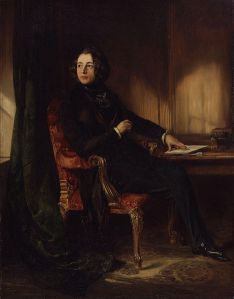
The following daguerreotype of Charles Dickens was taken by John Mayall, c. 1853

I am particularly intrigued by the patterns in the poses Dickens performs in each of these images – while, as Wilkins says, there are a number of images of Dickens doing different things, this does not change the fact that many of the portraits are, at least, rather similar, whether painted or photographed (though I wonder if some of the paintings were based on photographs?). In each of these, the viewer is confronted by a man gazing away, as if in thought, with a hand posed daintily on an elaborate, undoubtedly expensive chair. He is dressed in a suit, leaning into a comfortable though dignified pose. He is in control of his environment – it seems fairly typical of how a Victorian man might want to portray himself in a formal portrait – or perhaps how the public might want to see a popular author?

Here is yet another painted portrait similar in style. This one is by W. P. Frith in 1859.

Moving away from portraits of Dickens himself, one of my favorite images in the galleries is this one, which features Dickens with two of his daughters (he had ten children in all), in the rose garden. I suggest clicking on the image and reading the brief history that goes with the photograph.

From looking at the photograph, it appears that this exterior portrait is posed, and I find there is a feeling of closeness and familial support within the image, despite the artificiality of the composition and the rather formal, calm expressions on the faces of Dickens and his daughters. The pyramidal structure the subjects form adds another level of support to this photograph – the concentration of each of the subjects in the image is on the book, and it causes the viewer’s eyes to move directly to that central point. There is some display of wealth and leisure, as well as intellectual ability in this photograph, from my casual analysis to it, and there are probably a number of other layers I could tackle in its deconstruction. For some reason, I can’t seem to find many more Dickens’ family portraits, and the quiet (and probably faux) concentration of the characters/family here make this photograph particularly intriguing to me.

Moving back to images of Dickens alone, caricatures and cartoons of the popular author were also a huge part of how he appeared to the public. The idea of reproducibility of images and the cult of celebrity, as discussed in class, might be touched upon here – unlike daguerrotypes, which create a single, impossible-to-duplicate positive image, and paintings, which were also available to a limited audience, sketches, engravings, and such casual, printable, and reproducible images were ones many could find of Dickens.

Dickens himself found this particular sketch entertaining, and wrote in response to it: “It seems to me extraordinarily ludicrous, and much more like me than the grave portrait done in earnest.”

On that note, I think I will end a post that could probably go on for an infinite length, given how many pictorial depictions of Dickens exist, and just from his lifetime. By bringing it back to this final question and focus on portraiture and presentation – I am wondering how we can bring our discussions deconstructing portraiture to apply to these various depictions of the author. If you did not know these were images of the author, what would you think of the images? Are they typical of Victorian images? Is there anything you think makes them particularly different from the everyman Victorian’s portrait? These are just a few general questions I was thinking as I was putting together this post, and I would be interested in any feedback. Also, feel free to link your favorite images of Dickens in the comments, if you feel I’ve missed anything important!
Posted by: meghanhealy | September 13, 2010

Bleak House and Portraits

I have been particularly interested in Dickens’ continual referencing to portraits and the ways in which, as he presents them in different manners, he develops a complex theorization of the value and importance of portraits.

Bleak House is described as having dispersed portraits: “Half-length portraits, in crayons, abounded all through the house; but were so dispersed that I found the brother of a youthful officer of mine in the china-closet, and the grey old age of my pretty young bride, with a flower in her bodice, in the breakfast room.” (87, Ch. 6). In this passage, it is striking that, rather than having a dauntingly-impressive portrait gallery presenting ancestors in order, Bleak House’s portraits present a visual history that is neither coherent nor unified. The fact that some portraits are relegated to a china closet underlines the fact that the servants not only have access to these portraits, but also that they may seem some of them more than the inhabitants of the house. Depending on what rooms inhabitants frequent, they are exposed to different strands of the family line, rather than seeing a unified collection, and each person would therefore interpret the family differently, depending on which representations they see. It seems as though Dickens here presents portraits almost as clues to a larger whole, and Esther—or other viewers—must search to uncover the whole family’s history.

In other scenes, Dickens shows that portraits symbolize aristocracy and inheritance—“It has come down, through the illustrious line, like the plate, or the pictures, or the place in Lincolnshire” (255, Ch. 16). They link generations—in ways that may or may not be desired. They serve as a reminder of the past and as a substitute for the deceased person. They are a means to convey class, as well as attributes and characteristics that that person can no longer communicate: “‘I feel when I look at it,’ said Mr Badger,‘that’s a man I should like to have seen’ It strikingly bespeaks the first-class man that Captain Swosser pre-eminently was” (206, Ch. 13).

One passage I found particularly interesting was the following: “But what Mr Weevle prizes most, of all his few possessions…is a choice collection of copper-plate impressions from that truly national work, The Divinities of Albion, or Galaxy Gallery of British Beauty, representing ladies of title and fashion in every variety of smirk that art, combined with capital, is capable of producing. With these magnificent portraits, unworthily confined in a band-box during his seclusion among the market-gardens, he decorates his apartment; and as the Galaxy Gallery of British Beauty wears every variety of fancy dress, plays every variety of musical instrument, fondles every variety of dog, ogles every variety of prospect, and is backed up by every variety of flower-pot and balustrade, the result is very imposing” (330, Ch. 20). Mr. Weevle’s collection is striking in that it by no means seeks to fulfill what, in other houses, was a major function of portraits: to represent a family’s heritage. It is, nevertheless, imposing, though this characteristic appears more as a result of the overwhelming variety and number than from the sense of prestige linked to, for example, the “nine-hundred-years-old name” in “My Last Duchess.” This passage seemed relevant to Ellen’s comment on the Treasurer’s House and its portraits, though in this case, Mr. Weevle’s “magnificent portraits” are copper-plate impressions—which suggests the reproducibility of artwork that we discussed in class. Dickens’s language is telling, for he describes the gallery as a “truly national work”—inscribing the portraits in the national realm rather than merely the familial. Moreover, in describing the portraits as “art, combined with capital” and the ladies as being “produc[ed],” Dickens suggests that this art is linked to capitalism and to industrial production.

Another element of portraiture that particularly struck me was the way it serves as a representation not only of the past but also the present—as a means of identification, as a clue to a mystery. Guppy declares, “Your ladyship, I do assure you that having Miss Summerson’s image imprinted on my art–which I mention in confidence–I found, when I had the honour of going over your ladyship’s mansion of Chesney Wold while on a short out in the county of Lincolnshire with a friend, such a resemblance between Miss Esther Summerson and your ladyship’s own portrait that it completely knocked me over, so much so that I didn’t at the moment even know what it was that knocked me over. And now I have the honour of beholding your ladyship near … it’s really more surprising than I thought it…. “Your ladyship, there is a mystery about Miss Esther Summerson’s birth and bringing up…Now, as I have already mentioned to your ladyship, Miss Summerson’s image is imprinted on my ‘eart. If I could clear this mystery for her, or prove her to be well related, or find that having the honour to be a remote branch of your ladyship’s family she had a right to be made a party in Jarndyce and Jarndyce, why, I might make a sort of a claim upon Miss Summerson to look with an eye of more dedicated favour on my proposals than she has exactly done as yet. In fact, as yet she hasn’t favoured them at all. A kind of angry smile just dawns upon my Lady’s face.” (464-5, Ch. 29) Although Guppy seeks knowledge for an entirely selfish reason, his desire to know is apparently troubling, and it is suggested that the availability of the gaze, the opportunity for family portraits to be exposed to—almost paraded before—the public, has perhaps an undesired, even dangerous side-effects.

*All page numbers are from the Penguin Edition of Bleak House.

Posted by: akhtikian | September 13, 2010

Culture and Symbols

I have been appreciating my interdisciplinary, complimentary classes this week and found these words a helpful way to begin defining visual culture for myself as I start to deconstruct Bleak House.

First, a fabulous definition of culture from Clifford Geertz, one of America’s most respected and influential anthropologists (from my Cultural Anthropology reading):

The concept of culture I espouse is essentially a semiotic one. Believing, with Max Weber, that man is an animal suspended in webs of significance he himself has spun, I take culture to be those webs, and the analysis of it to be therefore not an experimental science in search of law but an interpretive one in search of meaning. (cited in Carol Delaney’s “Investigating Culture.” pg. 15)

And, also from Delaney’s work, David Schneider’s idea about culture as a system of symbols and meanings:

By symbols and meanings i mean the basic premises which a culture posits for life; what its units consist in; how those units are defined and differentiated; how they form an integrated classification; how the world is structured; in what parts it consists and on what premises it is conceived to exist, the categories and classifications of various domains of the world of man and how they relate one with another, and the world that man sees himself living in….Culture concerns the stage, the stage setting, and the cast of characters; the normative system consists in the stage directions for the actors and how the actors should play their parts on the stage that is so set. (pg. 14)

« Newer Posts - Older Posts »

Categories