Posted by: sabinabw | September 13, 2010

Bleak House-Charles Dickens

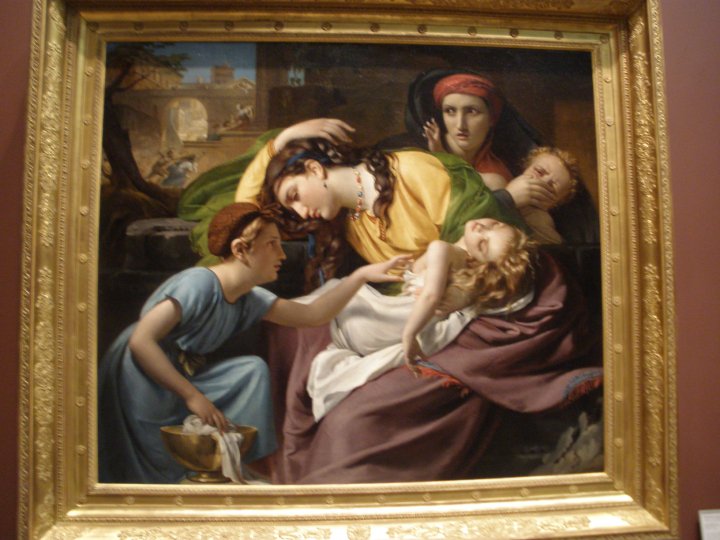
Early on in the novel, Ada and Ester meet a woman whose child has passed away and continues to hold the child in her arms.  As I read the description of the two women, one comforting the other, the image below popped into my mind.  Earlier this year I visited some museums in NYC, and this painting captured my attention and I had to snap a photo of it. The way Dickens writes about the pain felt by the women in the novel, is clearly expressed in this painting; particularly by the woman holding the deceased child.

Esther says, “I thought it very touching to see these two women, coarse and shabby and beaten, so united; to see what they could be to one another; to see how they felt for one another, how the heart of each to each was softened by the hard trials of their lives.  I think the best side of such people is almost hidden from us. What the poor are to the poor is little known, excepting to themselves and God” (p 124). Even though the women in this painting are not of the lower class as in Bleak House, death affects all the classes just the same, as seen in the faces of the women, and the written words of Dickens.
Posted by: ellenlarson | September 12, 2010

The Portraits at the Treasurer’s House

Our in-class discussion about the importance of family portraits to the aristocracy, in regards to the ownership of images, reminded me of the Treasurer’s House in York, England. This building was a private residence for the city’s treasurers for many years until sold to outside families. The last family to own the house did so during the end of Victorian era, but they were a family recently made rich from the Industrial Revolution. In 1930 the house and all its contents were donated to the National Trust.

Available to the public  for viewing is a large collection of portraits. I asked on my tour if all of the portraits depicted family members, as I had no idea who anyone was or what was the point of them all. I was told that the portraits did not show anyone of any relation to the former inhabitants and had, in fact, been purchased for the very reason that this family had no portraits of their own to show off. They had essentially fabricated the sort of genealogical history the portraits were meant to form for their original families.

These portraits, spanning hundreds of years, had apparently been sold when the descendants were hard up for money. The idealized images of their ancestors were sold off to provide a different strand idealized images for people who had none of their own. The intention here is clearly to provide for the audience an idea that this family had a far grander origin than being “new money.” The audience for this purchased heritage was by no means a small one. Royalty were known to visit the house and would have seen them. Now they are easily accessible to the general public and serve well their intended purpose of fooling the viewer into believing a more exceptional family history. After all, I wouldn’t have known that they were not actually members of the family had I not asked.

National Trust: http://www.nationaltrust.org.uk/main/w-treasurershouseyork

BBC: http://www.bbc.co.uk/dna/h2g2/A28278138

Posted by: kellyannem | September 12, 2010

Victorian Photocollage

If anyone is interested in photocollage, here is a link to a show that was at the Metropolitan Museum of Art this past spring. There are some nice images of the show with detailed paragraphs about each. If you are interested, check it out!

http://www.metmuseum.org/special/se_event.asp?OccurrenceId=07E0F589-3CF2-4929-9F71-469BC40A403E

Posted by: amartinmhc | September 9, 2010

Posting on this blog

Here are some basic instructions for creating a new post on the blog. Once you are logged into WordPress, you will see a drop down menu titled “My Blogs” in the upper left corner. Using this, go to the dashboard for “Victorian Visual Culture.” On the right side of the dashboard, you will see a box called QuickPress as well as a dropdown menu above it titled “New Post.” You can use either of these to write and publish a new post. You are able to insert links, images, and videos into your post if you wish. I have registered all of you as users who are “Authors” which means that you can post, edit and delete your own contributions and comments on the blog.

On the upper left corner, there is also a dropdown menu titled “My Account,” and one choice is “Get Support.” That link will take you to all kinds of helpful information about using WordPress.

Have fun!

Posted by: amartinmhc | August 8, 2010

Welcome to Victorian Visual Culture, English 325

Please refer to the handout provided in class that outlines the guidelines for using this blog. Have fun!

« Newer Posts

Categories