Posted by: romola68 | December 21, 2015

Review of the Isabella Stewart Gardner Museum

My recent visit to the Isabella Stewart Gardner Museum in Boston was by no means my first; however, it does represent the first time that I viewed this space with an eye towards understanding Mrs. Gardner’s place as an important nineteenth century collector of (mostly European) art. In particular, I was interested in exploring her relationship to the Pre-Raphaelite artistic movement, founded in London in 1848, which rejected classicism in favor of the romantic and spiritual views that these artists felt were especially characteristic of medieval art.

I have been visiting this museum for many years, though not long enough to have seen the items stolen in the notorious art theft of 1990. Because this is a house-museum whose display was stipulated by Mrs. Gardner to remain unchanged from her original design, the now-missing items – most notably Boston’s only Vermeer (The Concert) and a rare Rembrandt seascape (The Storm on the Sea of Galilee) are still remembered through their empty frames. These vacancies cast a somewhat forlorn atmosphere to the Dutch room, but they are also an invitation to connect this collection to a bygone era, which for my purposes here is that of the Pre-Raphaelites.

The museum has changed since I first encountered it – now the visitor enters through a new modern wing designed by the famous Italian architect Renzo Piano. This new building, which contains a visitor’s center, a café, a museum store and a temporary exhibit space, is an airy light-filled glassed in area, full of vibrant orange and red colors. While pleasant to visit, I find it somewhat of a jarring contrast to the original part of the Gardner Museum, which is entered via a glass-enclosed walkway.

1blog

The new entrance to the Isabella Stewart Gardner Museum

Making this quick journey, I am immediately confronted with the magical scene of Fenway Court, a courtyard of what looks like an Italian palace, marked by gothic arches and ornate balconied windows. The entire three-story museum is built around this courtyard, which was completed in 1901, and is filled with flowers, Roman mosaics, Italian stone sculptures and a fountain.

6blog

One view of the courtyard in the Isabella Stewart Gardner Museum

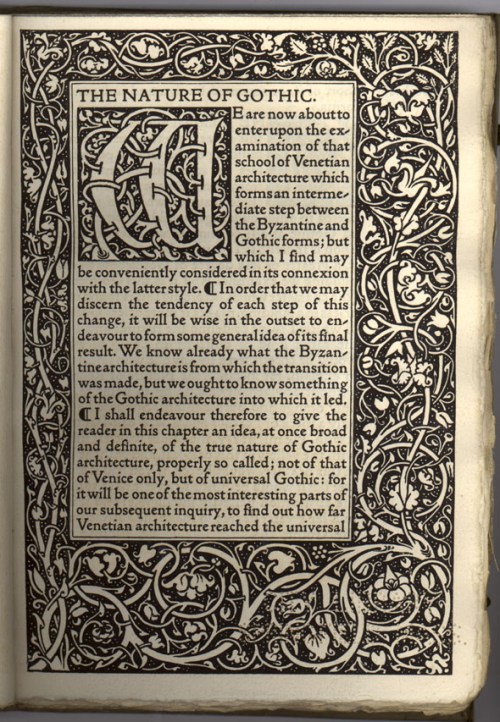
Seeing this beautiful site reminds me of the Pre-Raphaelite art critic and artist John Ruskin, who in 1853 wrote the important architectural volume, The Stones of Venice. Much of the architecture in Venice is medieval in its structural details, a style favored by Ruskin and other Pre-Raphaelites whose paintings reflected this period.
2blog

The first page of “The Nature of the Gothic”, a chapter in the second volume of Stones of Venice.

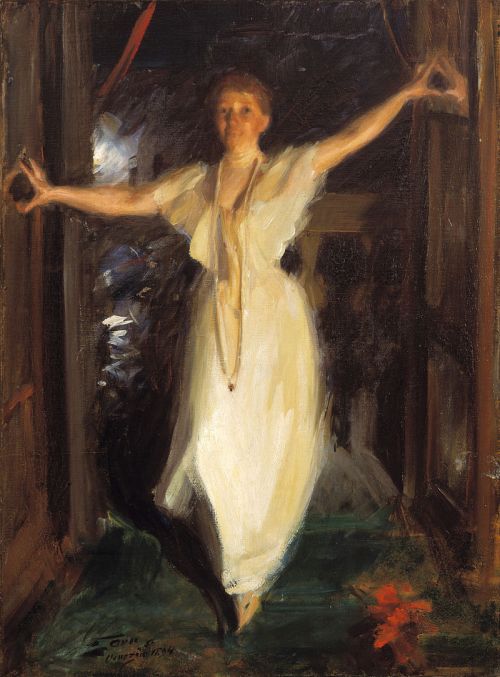
I have read that Mrs. Gardner often rented a Venetian Palace on the Grand Canal, the Palazzo Barbaro, and was inspired by that setting to create this Boston building. In the 1890’s, Mrs. Gardner brought the Swedish artist Anders Zorn to the Palazzo Barbaro, where he was stimulated to paint her excitement at seeing fireworks through an open window. This picture now hangs in the short gallery on the second floor.
3blog

Anders Zorn, Mrs. Gardner in Venice

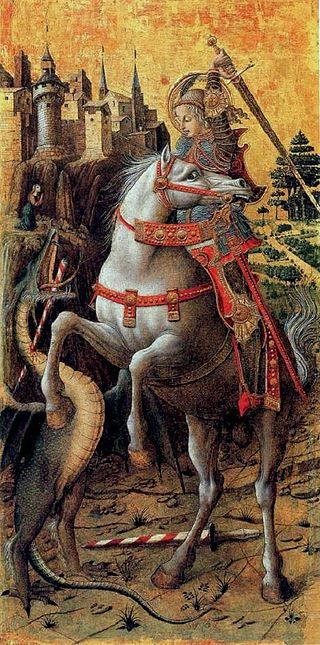
So Mrs. Gardner’s choice of setting, as well as her extensive collection of early European art, suggests a Pre-Raphaelite sensibility, though she reportedly never expressed such a philosophy. And her interest in medieval subjects is apparent in the Raphael Room, also on the second floor. Apart from a few Raphaels, this room also contains two painters who were favorites of this group. The first of these is Carlo Crivelli, whose emotionally-charged work of 1470 shows St. George slaying a dragon who had demanded a virgin sacrifice.
4blog

Carlo Crivelli, Saint George and the Dragon

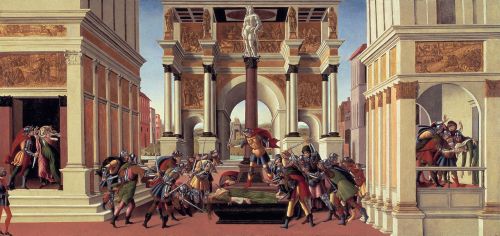
Another important source of inspiration for the Pre-Raphaelites was Sandro Botticelli. His 1504 painting at the Gardner depicts Lucretia killing herself to defend her honor after being raped by a Roman official. This tragic and emotionally sensitive work was reportedly Mrs. Gardner’s first purchase of a significant Italian painting.
5blog

Sandro Botticelli, Tragedy of Lucretia

Given this resonance with Pre-Raphaelite themes, I decided to look for Pre-Raphaelite paintings in Mrs. Gardner’s collection. I found a painting by the important Pre-Raphaelite artist, Dante Gabriel Rosetti in the small Yellow Room off the courtyard. This work was created in 1861 and reportedly stemmed from an illustration in Rosetti’s own translation of early Italian poets. The emotional tone and the medieval influences on this work are striking – it could almost be placed next to paintings created four hundred years earlier. I was surprised to discover that this painting by Rossetti appeared to be the only work by a Pre-Raphaelite artist in Mrs. Gardner’s extensive collection. Nonetheless, in her selection of paintings and in her choice of setting in which to display them, she demonstrates a certain extent of affinity with this artistic group.


References:

Goldfarb, Hilliard T. The Isabella Stewart Gardner Museum: A Companion Guide and History. New Haven: Yale University Press, 1995. Print.

Zorzi, Rosella Mamoli, Ed. Henry James’s Letters to Isabella Stewart Gardner. London: Pushkin Press, 2009. Print.


Images:

“2012 GardnerMuseum Boston USA 1” by M2545 – Own work. Licensed under CC BY-SA 3.0 via Commons – https://commons.wikimedia.org/wiki/File:2012_GardnerMuseum_Boston_USA_1.jpg#/media/File:2012_GardnerMuseum_Boston_USA_1.jpg

“Kelmscott Press – The Nature of Gothic by John Ruskin (first page)” by Kelmscott Press, William Morris, John Ruskin – Springfield, Massachusetts, library system – en:Image:Kelmscott Press – The Nature of Gothic by John Ruskin (first page).jpg. Licensed under Public Domain via Commons – https://commons.wikimedia.org/wiki/File:Kelmscott_Press_-_The_Nature_of_Gothic_by_John_Ruskin_(first_page).jpg#/media/File:Kelmscott_Press_-_The_Nature_of_Gothic_by_John_Ruskin_(first_page).jpg

“Zorn, Anders – Isabella Stewart Gardner in Venice – 1894” by Anders Zorn – http://www.gardnermuseum.org/collection/artwork/2nd_floor/short_gallery/isabella_stewart_gardner_in_venice?filter=artist:3153. Licensed under Public Domain via Commons – https://commons.wikimedia.org/wiki/File:Zorn,_Anders_-_Isabella_Stewart_Gardner_in_Venice_-_1894.jpg#/media/File:Zorn,_Anders_-_Isabella_Stewart_Gardner_in_Venice_-_1894.jpg

“Carlo Crivelli – Saint George Slaying the Dragon, 1470” by Carlo Crivelli (circa 1435–circa 1495) – [1]. Licensed under Public Domain via Commons – https://commons.wikimedia.org/wiki/File:Carlo_Crivelli_-_Saint_George_Slaying_the_Dragon,_1470.jpg#/media/File:Carlo_Crivelli_-_Saint_George_Slaying_the_Dragon,_1470.jpg

“Suicide lucretia” by Sandro Botticelli – http://www.gardnermuseum.org/collection/artwork/2nd_floor/raphael_room/the_tragedy_of_lucretia?filter=artist:3161. Licensed under Public Domain via Commons – https://commons.wikimedia.org/wiki/File:Suicide_lucretia.jpg#/media/File:Suicide_lucretia.jpg


Posted by: Joyce Linnet | December 20, 2015

Picturing Alice

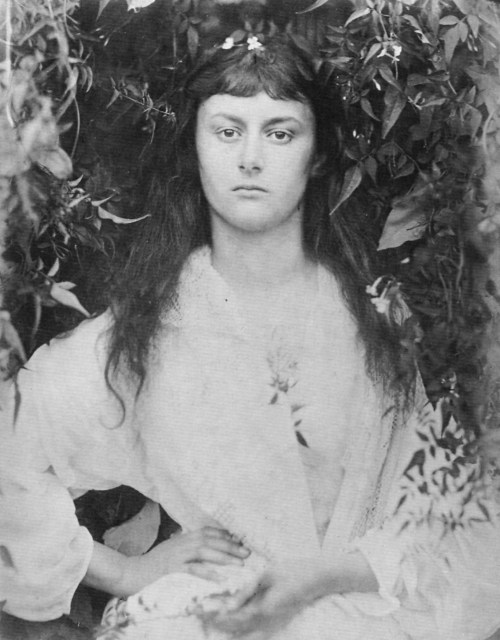
Alice from Alice’s Adventures in Wonderland is a character that has been represented many times throughout both film and literature. Thanks to the Disney adaptation that, like most Disney adaptations, was fairly unfaithful to its source material, she is often pictured as a long haired blonde girl. That is very much to the contrary of any photographic evidence (of which there is a great deal, possibly due to the fact that Lewis Carroll was very much interested in photographing her, a fact that can be interpreted however you’d like). I have always felt a bit annoyed at Alice’s constant blondeness, especially after I found out that Alice Liddell, who the character was based on was not a blonde. The real reason that Alice is blonde in the incorrectly named Disney animated film is because her live-action character model and voice actor, the then 10-year old Kathryn Beaumont looked something like this:

Kathryn_Alice

The classic John Tenniel illustration probably did not do much to help and so we go from an Alice that, according to photographs taken of her, looked like a short-haired brunette girl who looked something like this:

DP209284.jpg

To an Alice that was interpreted by an illustrator in the published novel that the author of the book absolute hated, as appearing to look something like this:

tenniel alice

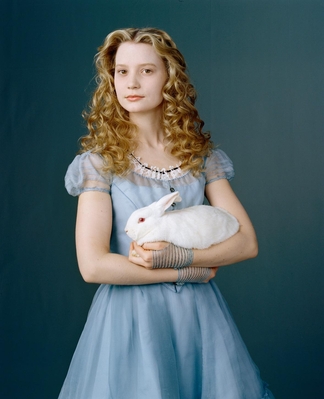
And further and further on until we lose our source material and Carroll’s inspiration and have unleashed upon the world an Alice that barely looks like Alice at all. The Alice that has been seen in so many film versions takes after the blonde haired Alice of Disney film fame. Even the more recent Tim Burton films have stuck to the portrayal of Alice as a blonde haired girl, played in the live-action film by Mia Wasikowska:

mia alice

Instead of looking like this: alice_cameron

In fact, it there is very little in modern interpretations of Alice that show that she was ever a real person at all as almost all traces of the little girl who Lewis Carroll wrote the stories for have almost all but been erased as the story of Alice is told and retold over and over again.

Posted by: rojas25m | December 20, 2015

The Stillness of Transitions in Art

Aliceroom3

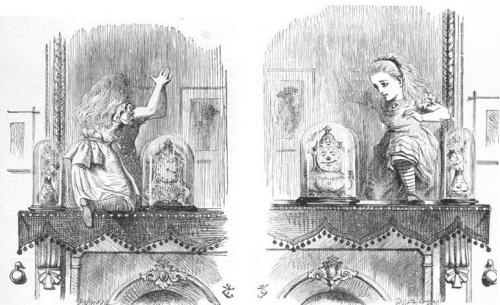
I was really enchanted by these images by John Tenniel of Alice literally going through the looking-glass .  I thought it was a charming representation of the symbolic journey a child undertakes when he or she transitions from the frolicking days of early childhood to the more chaotic  teenage years.  Using two panels to demonstrate the movement from one plane to the next was very important to the effectiveness of this illustration.  the fact that we see Alice’s back in the image that shows her in the logical world outside the looking-glass acknowledges that she is living this world behind to move forward in her journey.  In the second image, we see Alice’s face and her front foot braced and ready to move the rest of her body through this portal into this new world.  The hand that she is still bracing against the solid part of the looking-glass seems to be the last tether she has with that other world.

I so enjoyed the Tenniel illustrations that I decided to look for other representations of transitions.  I was hoping to find some other mediums that would do as good a job at representing this complex scene.  I came across this horror-show:

My excuses to anyone from England specifically Guildford Castle in Surry where this is located, but… yeah.

The first thought I had was (and maybe this was influenced by the opening of Star Wars episode 7 this weekend) that she looked like Han Solo when he was frozen in carbonite.  The distinct foot is there, just like in the Tenniel, but the medium is, perhaps, too static to represent the transition.  There is, also, the issue with the expression on the face.  Here is a child that is going on a fantastical journey and yet her face is devoid of any emotion.  I also wondered why one arm was raised so high, as if she was reaching for something inside the glass.  Although it miss the mark, I have to commend the artist for trying to depict this transition in a medium that is so much about stillness.

blog

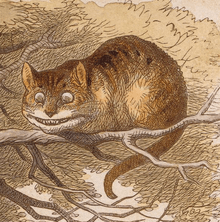
In 1967, about one hundred and two years after Charles Dodgson published Alice in Wonderland under the pen name Lewis Carroll, Charles Schulz, the author of the popular comic strip Peanuts, paid homage to Carroll’s character of the Cheshire Cat, through his own character Snoopy, Charlie Brown’s pet beagle.

Although Charles Schulz does draw some other characters from Wonderland (including The Queen of Hearts, White Rabbit, and Humpty Dumpty) his main focus is on the “Cheshire Beagle Trick” (Schulz) that Snoopy adds to his arsenal of improbable talents, including typing, cooking, World War I fighter-piloting, and playing tennis. Notably, he also made his owner Charlie Brown disappear, and, eventually, reappear in the 1981 television special “It’s Magic, Charlie Brown!”

This might serve both as a way to add to Snoopy’s aura as a supernaturally gifted dog, and as a way through which Schulz could experiment with drawing less and less of Snoopy as he kept disappearing. In this way, it allows for a reimagining of drawing and comics, letting readers explore what a beloved character might look like, and how he might keep his essence, when stripped of all recognizable traits.

Snoopy can also be cagey with the kids in Peanuts, in a similar way to the Cheshire Cat’s behavior with Alice. He may seem to be all-knowing, but at times is unhelpful in pointing other characters in the right direction, physically or metaphorically.

Just last year the Schulz Museum in Santa Monica, California, had an exhibit, titled Peanuts in Wonderland, focusing on these comic strips and Schulz’s admiration of Alice in Wonderland. Some of these strips were also adapted in “Peppermint Patty’s School Days”, a 1985 television episode of The Charlie Brown and Snoopy Show.


Links to Peanuts Comic Strips featuring the “Cheshire Beagle”, all by Charles Schulz and copyrighted by United Features Syndicate Inc.:

http://www.gocomics.com/peanuts/1967/04/18

http://www.gocomics.com/peanuts/1967/04/19

http://www.gocomics.com/peanuts/1967/04/20

http://www.gocomics.com/peanuts/1967/04/21

http://www.gocomics.com/peanuts/1967/04/22

http://www.gocomics.com/peanuts/1977/01/09

http://www.gocomics.com/peanuts/1977/01/16

http://www.gocomics.com/peanuts/1977/01/23

http://www.gocomics.com/peanuts/1982/06/20

http://www.gocomics.com/peanuts/1992/01/08

http://www.gocomics.com/peanuts/1992/01/29

http://www.gocomics.com/peanuts/1992/02/03

http://www.gocomics.com/peanuts/1993/07/11


Works Cited:

  1. Schulz, Charles. United Features Syndicate Inc.: Peanuts comic strip from January 9, 1977. http://www.gocomics.com/peanuts/1977/01/09


Images:

“Tennel Cheshire proof” by John Tenniel – http://www.themorgan.org/collections/collections.asp?id=570. Licensed under Public Domain via Commons – https://commons.wikimedia.org/wiki/File:Tennel_Cheshire_proof.png#/media/File:Tennel_Cheshire_proof.png


Mirrors in art and literature often have very diverse meanings and interpretations. In class we discussed the way in which the portrait of Dorian Gray might be interpreted to function as a mirror, reflecting the unrestrained truth of Dorian’s soul. However, we also talked about how mirrors themselves don’t show the truth but instead show only reflections. What we see when we look into a mirror is not what others see when they look at us, but a flipped version of reality. Mirrors do not show truth, but merely an echo of what is.

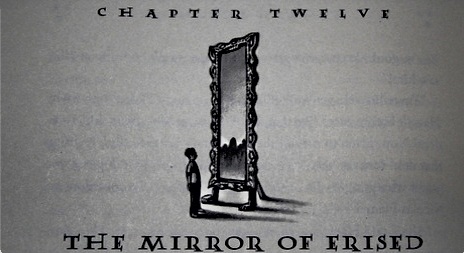
The Mirror of Erised, from Harry Potter, is said to show the true desire of the person who gazes into it and takes the question of mirrors as revealing truth even farther. The engraving on the frame of the mirror, when read backwards (with adjusted spacing), states “I show not your face but your hearts desire.” When Harry Potter looked in the Mirror, he saw himself surrounded by family, his parents and other relatives, none of whom he had ever seen before but who he saw and identified as family. Ron Weasley saw himself as Quidditch Captain, having won the Cup, and as Head Boy. Neither of these things were truth, Harry’s family was dead, and each individual sees something different, a person is unable to see anyone else’s reflected desires. The Mirror essentially fails as a mirror, not reflecting what is but instead what is desired. Like with Dorian Gray’s portrait showing the truth of his soul, the Mirror claims to show the truth of the heart.

The Mirror of Erised

Harry Potter and the Sorcerer’s Stone

However, according to Dumbledore, the Mirror shows neither truth nor knowledge and is in fact very dangerous. The Mirror is only able to show what the viewer most wishes and even then can only give the illusion of the desired.

“It shows us nothing more or less than the deepest, most desperate desire of our hearts. You, who have never known your family, see them standing around you. Ronald Weasley, who has always been overshadowed by his brothers, sees himself standing alone, the best of all of them. However, this mirror will give us neither knowledge or truth. Men have wasted away before it, entranced by what they have seen, or been driven mad, not knowing if what it shows is real or even possible.” – Albus Dumbledore (Harry Potter and the Sorcerer’s Stone, 157)

The Mirror is dangerous in the same way the Resurrection Stone, one of the Hallows from the 7th book, is dangerous. Both can only create shadows of desire and life. The Stone can conjure a shade of the dead but it cannot return them to life. The Mirror can reflect desire but there is no truth to the reflection. The story of the Hallows tells the danger of the Stone, the second brother going mad with grief, able to see a shadow of the woman he loved but knowing they were separated still, killing himself so that he could be with his dead love who the Stone could not truly bring back. Dumbledore tells Harry of the similar danger of the Mirror, that people have gone mad sitting in front of it, enticed by the reflection of a desire that is nothing more than a shadow and which, for those like Harry, can never be more than that.

Dorian Gray believes that his portrait brings understanding, that each time he views the portrait he learns something of who he truly is. Ultimately this drives him mad. The Mirror of Erised offers no such understanding, but a similar madness. The Mirror shows an echo, not of what is but of what is desired, offering nothing more than lure it can never satisfy.


The Picture of Dorian Gray – Oscar Wilde

Harry Potter and the Sorcerer’s Stone – J.K. Rowling

Harry Potter and the Deathly Hallows – J.K. Rowling

Posted by: vouto22v | December 20, 2015

Appearance yet again…

So, it has been a while since we covered Bleak House by Charles Dickens, but while looking through the blog and seeing all these things about portraitures, reading The Picture of Dorian Gray by Oscar Wilde, and thinking about mirrors, it just made me exceptionally aware of the role of appearance in Bleak House.  At first, I considered the female characters because they are the ones who vocalize the aspects of appearance when speaking to each other, such as Esther towards Ada Clare.  Although, the narrator is guilty of this as well.

-Lady Dedlock: beautiful, haughty, MAJOR secret

-Ester: pretty, kind, loses her looks to illness

-Ada Clare: prettiest girl and Esther’s best friend (and Esther always makes some comment about her looks)

-Caddy: skinny, ink-covered, not the prettiest

…and the list goes on and on.  So many of the female characters in this novel are defined by their physical descriptions, and the level of their beauty seems to correlate to the level of positive or negative emotion that they display.  For example, Lady Dedlock is always considered beautiful and guarded, but she consistently hides her darker emotions and thought/memories.  Caddy is not considered beautiful, and she lets her sadder and angrier emotions be seen much more than some of the other women.

The connection between appearance and mood/energy/outcome is so prevalent in this book, however, contrary to what I initially focused on, I realized I was excluding many other instances of this connection.  The city even has this connection because it is so fog-filled, as well as secret-filled.  This type of connection is in so many other works as well (i.e. the three witches in Shakespeare’s Macbeth, the gaze of A Flower Girl” in Doré’s London, etc.)  Is it a method of foreshadowing?

Dickens, Charles, and Terry Eagleton. Bleak House. Ed. Nicola Bradbury. London: Penguin, 2003. Print.

Posted by: vouto22v | December 19, 2015

A Lesson in Moderation _ Alice in Wonderland

Alice, from Lewis Carroll’s Alice in Wonderland, has issues with obediently following strange directions.  Whether it is in regards to follow odd directions from a crazy queen or if it is consuming an unknown substance, Alice tends to end up in unhappy situations…until she learns the concept of moderation.  As seen by Alice’s little rant to herself as she falls down the rabbit hole, she is actually a relatively smart child.  Yes,she is trying to sound incredibly intelligent, but she is a little over her head; however, it would not be unreasonable for the reader to assume that she is too smart to eat and drink things that she has no reason to trust.

After she is still alive and well despite her questionable actions regarding stranger danger and unidentified food, Alice learns to alter the amount of things she does.  She learns when to talk and when to be quiet, how much to eat and drink, and most importantly when she has had enough of Wonderland.

This moderation is so applicable to the amount of childhood girls were allowed to have in the Victorian period, as well as to the amount of everything else that women were allowed.  For instance, when discussing the domestic sphere, girls, such as Ellen Terry, were eligible for marriage and motherhood at an extremely young age.  They were allowed approximately ten-fifteen years of childhood and then that’s it.  They are only allowed a minimal amount of sexual encounters, as long as it is within the parameters of an appropriate marriage.  They are allowed a few children, as long as there is an heir.  These issues of too much regulation could be seen as a reason why Wonderland is a world of madness.  This issue of moderation, however, has now become self imposed.

Children today have gone to the other extreme.  Dating and acting in a rather scandalous way at younger and younger ages, drinking and using illicit substances at those same ages, and not taking the time to enjoy the innocence of childhood.  Social media aggravates this new trend.

So it seems that the little and confined Alice has become large and uncontrollable.  Where is the middle ground between the socially approved, strictly refined homemakers of the Victorian era and the wild, but popular, party animals of the 21st century? There needs to be a lesson in moderation.

Carroll, Lewis, and Martin Gardner. The Annotated Alice: Alice’s Adventures in Wonderland & Through the Looking Glass. New York: Norton, 1999. Print.

Posted by: vouto22v | December 19, 2015

The Fairy tale of Dorian Gray

QueenSnowWhiteWikipedia

beautyandthebeastwegotthiscovered.com

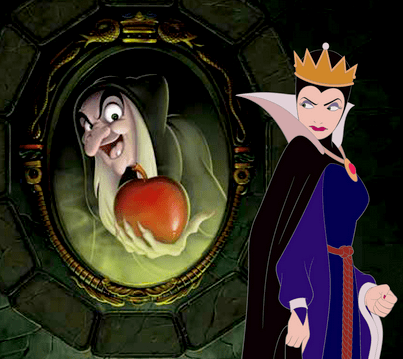
The lesson in The Picture of Dorian Gray by Oscar Wilde is a timeless message that is seen in many children’s stories, such as the classic fairy tales.  It is a message of “Beauty is Only Skin Deep.”  Notice how the apparently beautiful Queen from Snow White is really a ragged old witch, which is shown by her reflection (her inner picture as it were), but the hideous Beast from Beauty and the Beast is smiling in adoration at the woman he loves when he is supposedly not capable of loving someone other than himself.  Wilde’s Dorian Gray begins as a handsome man, as many villains do, but his image is transformed by his inner wickedness.  His obsession with beauty leads to his loss of it.

Is this message about beauty and appearance really about vanity? Much like how Dorian indirectly destroys his image through his evil deeds, the Beast rips through the canvas of a painting depicting his once handsome face.  He does this possibly in response to his hopelessness that “[no one] could learn to love a beast.”  Subsequently, the idea that inner beauty is what counts can be a message of hope and, alternately, that of a warning…Worthy people will accept you for your inner beauty (so don’t be afraid), and that inner beauty will always reflect your true self (so be cautious).  This concept of who is able to see, not your image, but your real identity and value, is central to the plot of Wilde’s book.

The Victorian period is grounded in the concept of purity and morality.  Ironically enough, Oscar Wilde was not included among the ranks of the moral.  Like Dorian Gray’s picture reflects his true inner demons, is this book Wilde’s way of expressing his own malcontent with his reputation?  This cautionary fairy tale is one that has been taught to children and adults throughout many decades, if not centuries.  Clearly, the idea that you will always see yourself as you truly are at some point in your life was and still is a troubling thought.

Wilde, Oscar. The Picture of Dorian Gray. Charlottesville, Va.: U of Virginia Library, 1993. Print.


The art of poetry often elicits a mental visual more complex and seductive than any concrete image, however, one of the few exceptions may be Indian paintings.  “Aesthetic Worlds of the Romantic Heroine in Indian Painting & Poetry”was a talk given by Columbia University Professor Allison Busch and The City College of New York Professor Molly Emma Aitken at Mount Holyoke.  Because this discussion focused on “India’s preoccupation with the musicality between text and image,” language was a central idea in terms of art.  In fact, Professor Aitken declared that “Words are full of visuality.”  This visuality translates the concept that the discussion revolved around: Indian love is special with its own flavor.

After walking into Gamble Auditorium, it became clear that the audience was somehow all connected in someway.  There was a camaraderie between the people seated there, waiting to hear the presenters.  This was reflected in the friendship of the two professors.  Aitken and Busch shared the role of the presenter in a flawless and charming way.  When one was speaking, the other contributed with colorful bursts of humor and helpful side notes.  Unlike other art-based events, this was more of an interaction with the audience.  The presenters engaged the crowd in a thoughtful way, and they not only encouraged the audience to participate in their lecture, but they taught the crowd important words in multiple languages that became relevant to the art that was being displayed and discussed.

This lecture focused heavily upon the features of the female body.  It discussed, not only physical aspects, but also abstract demeanor like sly glances exchanged between an interested suitor and a coy woman, as well as the lyrical beauty that these motions and airs inspired.  The words that were taught to the audience mirrored this.  These words, such as  “śṛṅgāra,” which means “erotic sentiment” in Sanskrit emphasize the inherent desires and forbidden romance found within Indian poetry and painting.  Furthermore, not only does this type of art accentuate the female body, it portrays what the culture believed to be the “iconic woman.”  This woman, unlike the women we have read about in Victorian Literature and Visual Culture, in order to be considered iconic, must be innocent, but also skillful, coquettish, and completely stunning.  Instead of being ideal as a maiden, this woman is ideal as a possible lover and seductress.  The appeal does not lie in what is present, but in what is subtle, aromatic, and an enigma.

The main artist that was discussed during this lecture was Abd al-Rahim.  He was a poet that brought to life many of the features that are present in depictions of subjectively beautiful women.  He created “the Bather,” who is consistently seen stretching her arms above her head, playing a musical instrument, serving food, or as a mother.  These different roles are repeated throughout different art and seen in works by other artists.

Other than as a mother, however, this woman, who is defined as a heroine, is primarily a sex symbol, a server, and an entertainer.  Although she is romanticized in a number of different ways, the viewer cannot escape the fact that she is relatively subordinate to her make counterpart.  She is there for their well-being, comfort, and pleasure.

“Aesthetic Worlds of the Romantic Heroine in Indian Painting & Poetry” was a fascinating discussion regarding the role of the perfect woman’s image, as well as how her muted sexuality is conveyed to the viewer.  The poetry that is frequently incorporated within the artwork attempts to layer the image with this fantastical sense of viewing an otherworldly, unattainable, yet desirable woman.  Professors Busch and Aitken stress, however, that the depiction of this woman does not represent one person, but represents an idea.  The musical quality and movement of Indian art underlines this abstract concept.

Victorian literature and visual culture compares and contrasts with Indian poetry and painting.  It is both similar and different.  The ideal woman in Victorian literature is not only innocent, but she is continuously chaste.  Even after marriage, she attempts to retain her purity by controlling and suppressing her sexuality.  In contrast with Indian art, her sexuality is not waiting to be awoken at the right time, but forever manageable and hidden.  In both cultures, however, it is interesting to note that women as mothers is a reoccurring interpretation of what is considered attractive.

This lecture integrated multiple ideals, concepts, and mediums of art, but focused on women.  The art of women, the art of their bodies, and the natural versus posed beauty they present is in and of itself another medium.  Due to the dancing and upraised motions of the painted women, they embody this musical quality.  Because of the poetry surrounding their figures, they embody the language.  Indian poetry and painting becomes this physical aesthetic that is illuminated by women.

Posted by: corri23j | December 18, 2015

The First Graphic Novel?

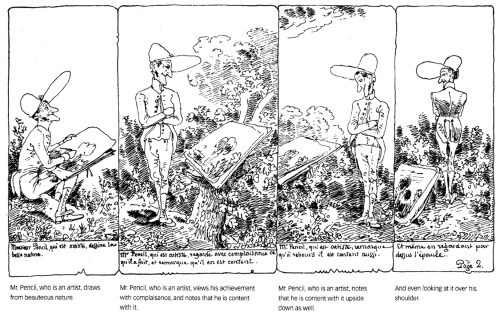
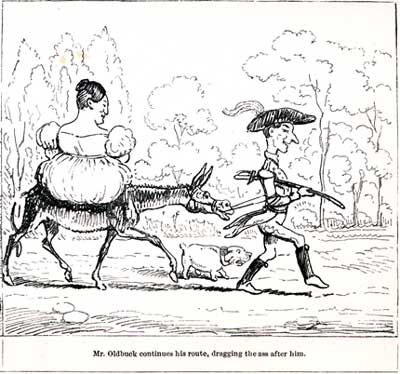
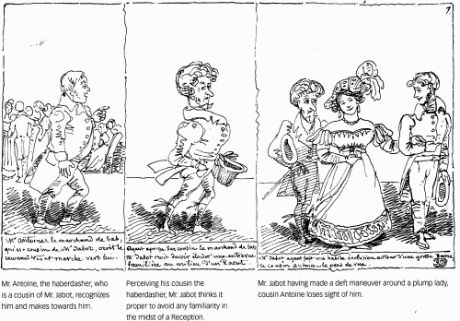
topffer_essaisautographesLast semester, I took Prof. Young’s Graphic Narratives class, and in it we read Scott McCloud’s Understanding Comics. McCloud credits Swiss teacher/author/artist Rodolphe Töpffer with inventing the genre of comics and graphic narrative, with the publication of the first of his eight illustrated books in 1837. At first, he resisted publishing his doodles, but once he did they became instantly popular among all ages and classes, both in Europe and America.
img-3

All of his works satirize 19th century society in one form or another, pairing spontaneous, scratchy doodles with humorous and absurd situations that mock some form of sociopolitical issues topical to the Victorian era. Their intended audience was originally the educated elite, and many of the scenes and protagonists reflect this.

toppfer_obediaholdbuck

I think it’s interesting to compare the political cartoons we’ve looked at in class with Töpffer’s work. Because of the sequential nature of these comics, narratives and characters are allowed to develop and proceed through a continuous story, creating a more nuanced satirical structure that is lost in single-paneled cartoons or caricatures.

2.topffer.small_

Sources:

https://www.lambiek.net/artists/t/topffer.htm

Kunzle, David. Father of the Comic Strip: Rodolphe Töpffer. Jackson: U of Mississippi, 2007. Print.

« Newer Posts - Older Posts »

Categories