Posted by: corri23j | December 6, 2015

19th-Century Dictionary Illustrations: Alphabetizing Art

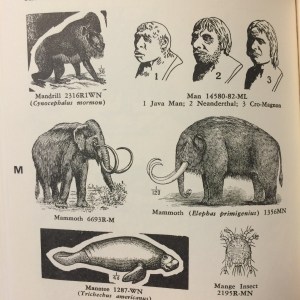
man:mammoth

man/mammoth/manatee

We’ve got this massive, old dictionary at my house, and as a kid I remember paging through it. I was hunting not for words, but the pictures that appeared at random throughout the pages – illustrations of aardvarks, barges, calipers and whatever else. A few years ago, I got a book that kid me would have loved (and present me loves now) – basically an illustrated dictionary without those pesky definitions, just more than 1,500 engravings that originally graced the pages of 19th-century Webster’s dictionaries, collected and restored.

Though the very first English dictionary featuring images was produced in the 1720s, it took the technological advancements of the Victorian Era, combined with the proliferation of terms from the sciences, exploration and technology that needed depiction, to allow fully-illustrated dictionaries to come into their own. The first printed in the US debuted in 1859, with a greatly expanded version in 1864 and an International edition in 1890 – all Webster’s dictionaries.

teeth:telephone reciever

teeth/teak/telephone receiver

What I’m most fascinated by in the context of Visual Culture is what these engravings are supposed to accomplish, and what they actually end up being. Dictionaries certainly seem to carry a lot of the weight of Tagg’s “Burden of Representation” – they have to represent, with as little disfigurement as possible, literally every concept encapsulated by words. So these illustrations must serve the same purpose: capturing, identifying and reproducing the strange and unfamiliar. But isn’t the Benjaminian “aura” lost when these images are entirely de-contextualized, an island in a sea of words, connected not by theme but by alphabet? Maybe the aura is supposed to be lost – these images are for identification and classification, meant not to represent an individual, but all of its kind.

american race:american bison

taxonomy: representing race/representing species

The line between the ostensibly hard, scientific “truths” of the dictionary and the artistry of these engravings also seems rather blurred to me – John Andrew, the head engraver of the 1859 and 1864 editions, is praised in the dictionary preface as a “skillful artist,” but can “art” still faithfully serve as a “direct transcript of the real”?

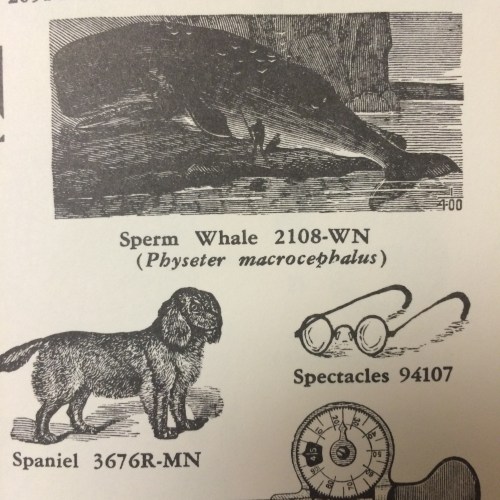
sperm whales:spectacles

the sperm whale cornered by a harpoon-wielder – an image, or a story?

Some dictionaries evolved to using photographs, but Webster’s went the other way – further de-contextualizing the engravings, taking animals out of habitats, musicians away from instruments, and workers from machinery. Does that make the depictions more accurate for their clarity, or less so for their isolation?

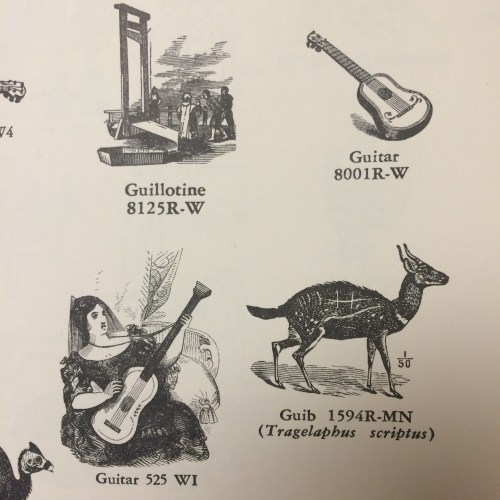
guitar:guillotine

do objects need context? the guitarist looks pleased, perhaps the guillotine-victim less so

Now, nobody who has heard of the internet would look in a dictionary as a substitute for Google Images. There are some modern online illustrated dictionaries (http://www.visualdictionaryonline.com/), and very interestingly they still use illustrations instead of photographs. Decontextualization prevails – the paradox that necessitates ideal depictions of reality, because reality is never ideal. It’s hard to take a beautiful picture of a cross-section of an earthworm or the entire solar system with all the planets like ducks in a row, I’ll give them that. Though I do miss flipping through a dictionary on a hunt for random pictures to appear amidst the rows of words.

Source for information and engravings:

Carrera, John M. Pictorial Webster’s: A Visual Dictionary of Curiosities. San Francisco: Chronicle, 2009. Print.

CONTENT WARNING: Sexual and emotional abuse, strong sexual content, themes of physical and psychological violence against women.

In class, we’ve spoken a lot, both directly and indirectly, about the male gaze, and how a variety of the women we have studied have made efforts to push back against it in order to take the power of perception away from men and restore it to the subjects of the photographs themselves. This struggle for women’s agency and control over the perception of their own bodies is, of course, nothing new. The Victorian era in particular is one in which these questions of women’s agency and sexuality were at the heart of the works of many novelists and visual artists alike. Today, however, I would like to examine a more recent novelist, whose approach marks an interesting shift in how this problem is addressed.

The person to whom I am referring is Kathy Acker. No stranger to controversy during her tragically short life, Acker is, in my opinion, one of the most fascinating literary figures of the past fifty years. For those unfamiliar with her or her work, Kathy Acker was a notable member of the punk scene in the 1970s, and pioneered a particularly visceral and iconoclastic brand of feminism. She also described her novels as “collages”, which were made up of poetry, prose, excerpts from other literary works, and her own sketches, which accompany the text as illustration.

The novel I want to focus on is probably her most famous work, Blood and Guts in High School, mostly because of the way the aforementioned sketches interact with the text. I won’t post any of them in this post, as most of them may be too distressing for some people, and I don’t want to catch anyone at unawares with an image that may make them uncomfortable. To be quite frank, though I am interested in Acker’s work and am a great admirer of her fictive and theoretical writings, I can never quite bring myself to enjoy her work.

In my opinion, this is entirely by design. Blood and Guts in High School is a novel that seems to want to make its reader uncomfortable, regardless of who they are. It’s excessive, it’s disgusting, and frankly, it’s almost unreadable (as with all of Acker’s novels, I had to put it down several times just because I was overwhelmed by it). But this mixture of revulsion and terror that the novel generates is exactly what makes it so effective at combating the same violent misogyny that it depicts. The story centers around Janey Smith, a young girl who has a sexual relationship with her father at a young age until later in the novel, where she moves to New York, is abducted, sold into sex slavery, escapes, enters into an increasingly abusive relationship with a notable French writer, is arrested, and subsequently dies without any sort of happy ending. Accompanying the text are rough sketches of the things being described by the narrative, which almost always take the form of nude bodies, specifically close-ups of male and female genitals. One could say that the human body is being objectified in this way, but Acker twists it into something grotesque, using a lack of detail to create nude images that serve to make most readers (at least those I have spoken to) more uncomfortable than anything. The implication is that the way we look at the body, particularly the female body, is in some way akin to the violence that Janey undergoes throughout her tragically short life.

One sketch, for instance, is called “Ode to a Grecian Urn”, and depicts a nude woman, legs together and hands up, with both her ankles and her wrists bound together. Taking this classical/romantic reference and distorting it (or, rather, unveiling it) into this image of a bound, physically and psychologically abused woman has a particularly disturbing effect on the viewer. The way Acker depicts the female body is the same way she depicts her protagonist: violently oppressed, subjected to the male gaze almost to the point of breaking. There is no attempt at liberation in the traditional sense: we see the pain induced by misogyny, but not its abolition, which makes this text all the more difficult to read (or indeed, even to look at).

The photos that stand out to me, however, are those of men’s bodies, which almost always depict the viewpoint of Janey herself as she looks at them. One that I found particularly unsettling is one called “You Are the Black Announcers of My Death” depicts a man’s penis from the point of view of a person (presumably Janey) staring it headlong, with her hands holding it (it is obvious from the image that she is about to engage in oral sex).

This image, and others like it, forces upon us a “female gaze” of sorts, wherein the male body is seen through the eyes of the women who are forcibly oppressed by and subjected to it. Unlike the traditional male gaze, wherein the subject is exploited and subjected to a kind of visual violence, here the reader is subjected to this same thing. Acker forces us to see the world through Janey’s eyes, and the results are painful to say the least. The novel forces empathy upon its reader. Not the traditional empathy that we so often use interchangeably with pity. This is a vengeful empathy that makes the reader (especially, I would assume, the male reader) undergo the same cruel visual torture that women undergo socially and physically. These images of men and women are not a disruption or resistance to the male-gaze, but an active attempt at a counterattack? Of course, nothing could ever truly replicate the psychosexual horrors that Janey undergoes, but through the images that accompany her story, Kathy Acker creates the illusion that it can.

This leads me to wonder: how is this accomplished? Why do we become so tied to Janey’s experiences against our will, but other feminist texts do not prompt this same reaction? I would say that this is a result of the novel’s status as a sort of collage-like texts, weaving together different fragments of texts and images to form something altogether new. The reader is constantly being bombarded by images and text, which, when combined, create a sensory overload that emotionally and intellectually dominates the viewer. We are never quite comfortable reading this text, as we never know what kind of literature, what kind of image, or even whose work (Kathy Acker openly admitted to occasionally plagiarizing the work of others in her text in order to best serve her own writing) we are going to encounter. The power of visual consumption is taken away from us, and we are placed at the mercy of the author.

Though I cannot show you the images contained within the text (those that aren’t obscene are actually quite difficult to find online), I would like to take a look at the most recent edition of the cover, which, while not designed by Acker, fits perfectly with her style. It is a photograph of Acker, taken by Michel Delsol, seemingly torn in half.


Kathy Acker


The simultaneous suggestion of nudity and fracturing of her face and body has a similar (albeit slightly less shocking) effect on the viewer. We are forced to ask: is Acker being torn in two, or patched together? Perhaps both. The effectiveness this image is in how it both destroys and rebuilds Acker’s image. In viewing this fragmented portrait, we somehow have less access to her. Note how the tear in the image runs right through the eye. Acker is not only tearing the image in half, but also interrupting the viewing experience. The destruction of Acker’s own image and body serves as a sort of reclamation of feminine identity and perception. Much like in her novel itself, Acker perpetuates the cycle of violent oppression and objectification of women, but takes control of this process herself, making the viewer (including any potential male readers) more of a bystander who is forced to watch this self-destruction in shame, without the ability to enforce it himself. The image above is one of many that contribute to the sensory overload that seeks to destroy the visual history of femininity that has been constructed by a male-driven literary culture, and in doing so allow women to reclaim control over how their bodies are perceived (or, failing to do that, level the playing field a bit), albeit in an incredibly visually violent manner

Acker is, however, not without her critics, both in and out of the feminist community. Many of these critics argue that women are never quite empowered in her novels, and that she is simply repeating an oppressive history of women without ever truly liberating her heroines. Still others say that Acker is more interested in playing out revenge fantasies than in actually engaging in conventional resistance to patriarchal culture (as we see in the works of Julia Margaret Cameron and some of her contemporaries). I certainly see some merit in these criticisms, as it is at times hard to claim that her novels quite empower women in the black and white terms that we have become used to discussing these themes in. However, there is also a reason for which Acker has become the rebellious feminist icon that she is considered to be today, with many contemporary writers having drawn inspiration from both her novels and her essays. Blood and Guts in High School is an experiment in visualization as a form of gender-based combat, one whose effectiveness may be called into question but that I think nevertheless needed to be conducted.

Frankly, however, I’m a bit out of my depth in regards to this discussion, so I’ll end it here. What do you think? Is there something to be said about images actively offending the viewer’s sensibilities rather than passively guarding themselves? Does this approach ultimately do more harm than good?
 

DP295205

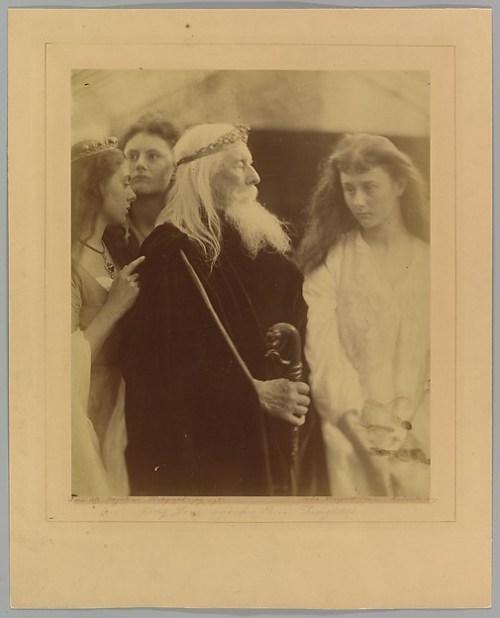
King Lear Alotting His Kingdom to His Three Daughters, 1872


In our last class we had a full-length discussion on the work of Julia Margaret Cameron. I was particularly intrigued by how Cameron staged her photographic subjects; she determined what was to be worn, how the subjects were to pose and the level of intensity of their facial expressions.In each photograph, especially ones that depict scenes from myth and literature, Cameron takes on the role of the director of a static theatrical production. We briefly touched upon Cameron’s depictions of famous Shakespearean scenes. So I’d like to examine one that we did not look at.

I recently finished reading Shakespeare’s “Tragedy of King Lear,” for my Amherst Shakespeare course. The plot is based on the relationship between a man and his daughters. King Lear, an elderly and innocent King is deceived by two of his daughters, and blind to those who are truly loyal to him. Female characters in this play actually have a lot more substance than many other Shakespeare plays. Instead of a central female figure, we are given three. One, Cordelia, a symbol of purity and innocence, and Goneril and Regan, evil and conspiring figures. The play is set in a pre-Christian era, which paints a world surrounded by the the fantastical and natural world.

When it was mentioned in class that Julia Margaret Cameron photographed a scene from King Lear, I knew I had to do a close reading. The King Lear photograph is entitled, “King Lear Alotting His Kingdom to His Three Daughters.”

The scene depicted in the photograph takes place at the beginning of the play. King Lear is aware of his advanced years and deteriorating sanity, and has thus decided to distribute his power and land equally amongst his three daughters (and their husbands). While Lear seeks to give up the work necessary for a King, he still wants to maintain his power over emotion and the loyalty of others.

In order to determine who gets what part of the Kingdom, he asks his  daughters to explain how much they love him.

Goneril and Regan, the two eldest daughters, will say anything to attain power. So each give over-the-top, wordy proclamations of false devotion and love.

Cordelia, on the other hand, sees a problem in this request. She is the only daughter who truly loves her father, but she knows that she cannot participate. In her opinion, to admit that her father is the only one that she could ever love would be a lie. What about her future husband? What about her sisters’ husbands? The truthful Cordelia thus refuses to adorn her father with false proclamations of love. Feeling betrayed, King Lear banishes his once favorite daughter. All the while, his two eldest daughters plan to usurp all of his power and ultimately plot against his life.

Cameron captures this intense moment incredibly well. The King Lear figure in the middle, who is actually her husband, has long and snow white hair. His hair gives him both a regal quality and elderly appearance. His age and decrepitness is further emphasized in the presentation of his hands. The camera has a clear image of the long veins protruding from his skin. His long and gangly fingers grasp the detailed cain, further suggesting that he is not able to support himself.

This regal but visually weak King look as if he is also leaning on the two women to the left. These women are Goneril and Regan. As Lear leans against them, you can see the daughter in the foreground placing one finger against his shoulder. Her eyes are facing downwards with her mouth slightly open. It looks as if she is whispering into his ear, filling him with false proclamations of love and devotion. The other daughter is almost completely covered by the first. We can only see her face which looks off into the distance. Her eyes give off a maniacal feeling. While the first daughter speaks of love, the second reveals to the audience their true intent and vision of the future. It should also be noted that the the eldest daughter in the foreground is the only sister wearing fine clothes and jewelry. We can imagine that the sister behind her is dressed in the same way. By adorning these two evil sisters in royal luxury, Cameron hints at their selfish and sadistic nature. While they appear beautiful on the outside, their adorned bodies are merely a distraction from the evil truth within.

The King’s cane itself serves as a hint that the sisters are up to no good. If you look carefully, the cane is carved with a serpent rising from the wood. In the play, there are comparisons drawn between the sisters and snakes. Serpants are often seen as symbols of evil. It’s as if the serpent from the cane is wrapping itself around Lear’s hand just as one of the eldest daughters is placing her finger on his shoulder.

These sisters come in sharp contrast with the woman on the right who is playing Cordelia.Unlike her sisters, she is dressed plainly. She is only wearing white, a symbol of the divine or pure. Her facial expression gives off a childish innocence. While here sisters’ expressions give off an almost sensual gaze, she looks down in thought. She is almost ashamed that she cannot do what her father asks.

It is possible that Lear has just banished Cordelia. While all three sisters have their hair down, Cordelia is the only one who does not have a crown on her head. Could Lear have stripped it from her? Her body is also not as intimately connected to her father has the other two sisters are. The black triangular space between Lear and Cordelia gives the viewer a sense of physical and emotional separation.

We discussed in class that Cameron, when working with plates, would allow them to be exposed to scratching and smudging. If you look at the bottom right-hand corner of the photograph you can see what looks to be three streaks of dirt. This in fact appears to be Cameron’s smudged finger prints. This adds an eery element to the photograph. The dark finger marks placed over Cordelia’s body look as if death’s fingers are reaching out for her. In fact, if we personify death through Cameron’s smudges, it could be said that death is reaching out for Lear and all three of his daughters. Spoiler alert, all of them die at the end of the play.

Sources:

http://www.metmuseum.org/collection/the-collection-online/search/306204

Posted by: avila22a | December 2, 2015

May Day

861px-May_Day,_by_Julia_Margaret_Cameron

Having already written about Julia Margaret Cameron’s Sadness in my midterm essay, I took the time to explore her other photographs and was struck by one called May Day. In it, Sylvia Wolf describes:

…A tangle of leaves, twigs, and berries in the foreground and wilting flowers strung around the models’ necks, or tucked behind their ears, add an element of disorder and decay that is reminiscent of the vanities theme of a Dutch still-life painting—everything a bit ripe and overdone, as a reminder of mortality. (Julia Margaret Cameron’s Women)

Upon first glance, it’s hard not to be drawn to the central figure: a woman with long flowing hair wearing a flower crown and gazing directly at the viewer. When looking at the photograph and taking into consideration its title, I make an American connection and recall Nathaniel Hawthorne’s “The May-Pole of Merry Mount” in which the people of Merry Mount gather to celebrate the wedding of the young Edith and Edgar until John Endicott and his Puritan followers come to whip everyone. Edith and Edgar are spared on the condition that they dress more conservatively and Edgar cuts his hair in the classic Puritan fashion. The story goes from joy to gloom quickly because of the power struggle between pleasure and religion. It is also notable that May Day was, for a time, banned by Puritans in the 17th century.

May Day is a holiday for celebrating the coming of spring and fertility. The most notable aspect of this holiday is the dancing around the maypole and Moho’s do in the spring and as Edith and Edgar did. Typically, a May Queen is also chosen. The May Queen is someone who personifies the tradition and wear a white gown garnered with flowers to symbolize purity and fertility and a crown.

Upon further research, Julia Margaret Cameron’s photograph has an alternative name: “For I’m to be Queen of the May Mother, I’m the Queen of May” and the central figure is her niece. In the photo, on a day expected to be filled with joy and celebration, there is a touch of sadness to. Each figure has a stillness while spring is supposed to be filled with life and movement. Flowers are supposed to be in bloom, but the ones in the photograph seem wilted and dark. The May Day theme doesn’t end with the flowers and crown, the very composition of the subjects are reminiscent of the maypole. The figures surrounding the May Queen seem to encircle her instead of just merely gathering with her. Though she is not lively, she acts as the maypole in a way.

Though “The May-Pole of Merry Mount” made for an exciting comparison, Cameron actually based the photograph off of Lord Tennyson’s poem, “The May Queen.” Written in two parts, the latter describes Alice’s expectation of life in the spring:

The honeysuckle round the porch has woven its wavy bowers,

And by the meadow-trenches blow the faint sweet cuckoo-flowers;

And the wild marsh-marigold shoes like fire in swamps in hollows gray;

And I’m to be Queen o’ the May, mother, I’m to be Queen o’ the May.

To her subsequent death in the winter:

If you’re waking, call me early, call me early, mother dear;

For I would see the sun rise upon the glad new-year.

It is the last new-year that I shall ever see,—

Then you may lay me low i’ the mold, and think no more of me.

The poem is oddly reminiscent of the myth that the May Queen was to be sacrifice after May Day. However, Alice does live to see another spring. Though May Day is about supposed to be about new life, both the poem and photograph bring up themes of death and decay.

blog1

Proserpine by Dante Gabriel Rossetti

Several Pre-Raphaelite painters, the painter John William Waterhouse, and the novelist George Eliot all showed an interest in classical mythology. Their visions of the classical world, however, were shaped by an equally strong interest in Renaissance art and literature and it is this combined interest that differentiated their masterpieces from those of the Neoclassical movement.

George Eliot’s 1863 novel, Romola, takes place in Florence in 1492, the year that the Alexander VI became pope and Lorenzo the Magnificent, who ruled over Florence, died, leaving Girolamo Savonarola, a Dominican friar and enemy of the pope, free to gain power and promote religious extremism. But most of the Florentine characters we meet seem more interested in looking back to Ancient Greece and Rome than they are in discussing how they themselves are being ruled by one harsh dictator after another.

The first section of the novel introduces Tito Melema, a young man who has come to Florence from Greece under dubious circumstances, and Romola, the titular character, who lives with her blind father Bardo. Both Romola and Bardo are drawn to Tito, partly because they associate him with Classical Greece. Romola’s brother, on the other hand, is firmly dedicated to the church. Before he dies, he gives Romola a vague warning about her wedding day, as well as a small cross. This makes her uneasy about her relationship with Tito, and Tito quickly decides that it is the cross, a physical representation of her brother, and of the church, that is causing her distress.

His solution is to lock the cross in a wooden box, which he asks to have painted with the likenesses of himself and Romola, turned into Bacchus (the Roman name for Dionysus) and Ariadne. Tito explains to the painter that “It is a favourite subject with you Florentines—the triumph of Bacchus and Ariadne; but I want it treated in a new way. A story in Ovid will give you the necessary hints.” (Eliot, 185) The painter also uses the likenesses of Romola and her father to paint Oedipus and Antigone, two other characters from Greek mythology, and Tito is able at least temporarily to cover Christian obligation with classical tradition.

The Pre-Raphaelite artist William Holman Hunt’s 1868 painting, Isabella and the Pot of Basil, was inspired by a tale from Giovanni Boccaccio’s Decameron, a book of stories narrated by friends fleeing from the Black Plague, and by a subsequent John Keats poem about Isabella. The original stories come from a variety of different cultures and time periods. In the story, Isabella’s brothers kill her lover and she grieves by keeping his head in a pot of basil.

blog2

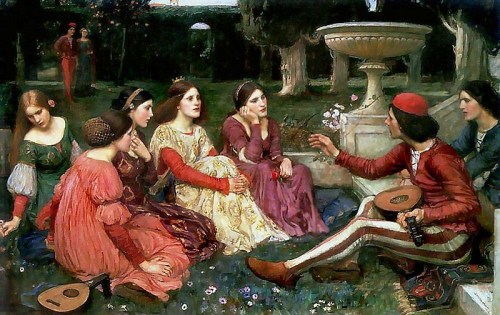
In 1916, John William Waterhouse, a late Victorian and early twentieth century artist heavily influenced by the Pre-Raphaelites, painted A Tale from the Decameron, possibly meant to portray the group of storytellers who introduce each tale.

blog3

Waterhouse also painted Dante and Beatrice (later retitled Dante and Matilda), showing characters in Dante’s Divine Comedy, which recreated elements of the classical world, despite its stern enforcement of contemporary Catholic morality.

blog4

These three Victorian artists, two painters and a novelist, each in his or her own way, looks back to ancient Greece and Rome through the words and images of writers and artists of the Italian Renaissance.

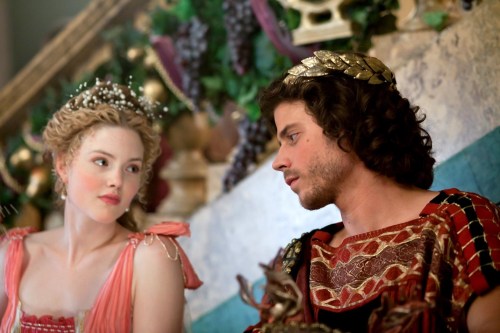
Interestingly, this tactic of examining one historical period through the artwork of another continues in modern day historical fiction. An episode of the recent television series The Borgias, shows its Renaissance protagonists, Lucrezia and Cesare, in clothing reminiscent of Echo and Narcissus, Waterhouse’s 1903 painting.

blog5In this scene, Cesare says to Lucrezia, “I may not be Narcissus, but may I dance with Echo?”, alluding to Lucrezia’s lover, who she has nicknamed Narcissus.
blog6

Holliday Granger as Lucrezia and François Arnaud as Cesare in The Borgias.


Works Cited:

Eliot, George. Romola. New York: Modern Library, 2003. Print.

“The Borgia Bull.” The Borgias. Showtime. 8 Apr. 2012. Television.


Pictures:

Dante Gabriel Rossetti, “Proserpine”, Google Art Project. https://commons.wikimedia.org/wiki/File:Dante_Gabriel_Rossetti_-_Proserpine_-_Google_Art_Project.jpg#/media/File:Dante_Gabriel_Rossetti_-_Proserpine_-_Google_Art_Project.jpgD

William Holman Hunt, “Basilpot.” Licensed under Public Domain via Wikipedia.

John William Waterhouse, “Decameron”. https://commons.wikimedia.org/wiki/File:Waterhouse_decameron.jpg#/media/File:Waterhouse_decameron.jpg

John William Waterhouse, “Dante and Matilda” [originally entitled “Dante and Beatrice”]. https://commons.wikimedia.org/wiki/File:John_William_Waterhouse_-_Dante_and_Matilda.jpg#/media/File:John_William_Waterhouse_-_Dante_and_Matilda.jpg

John William Waterhouse, “Echo and Narcissus”, Google Art Project.” https://commons.wikimedia.org/wiki/File:John_William_Waterhouse_-_Echo_and_Narcissus_-_Google_Art_Project.jpg#/media/File:John_William_Waterhouse_-_Echo_and_Narcissus_-_Google_Art_Project.jpg

Photo from The Borgias by Showtime © Copyright: Showtime 2012


Posted by: shannonp11 | December 1, 2015

Photocollage: Taking Ownership of Vintage Images

loli-5

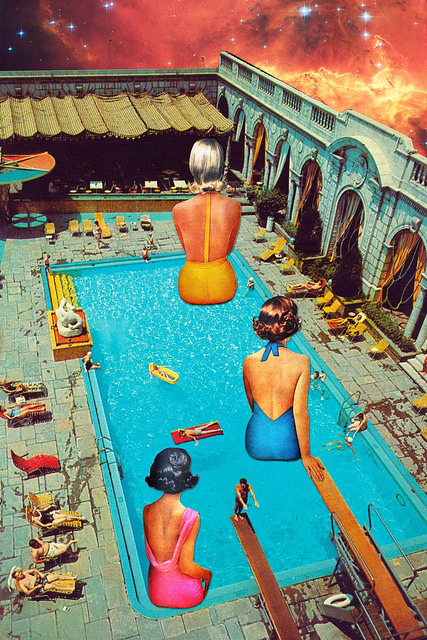
As a kid, I have memories of cutting out images from magazines and gluing them haphazardly onto sheets of paper for no reason other than simply liking the images. It seems strange, but I never considered photo collage a means of visual manipulation until reading about the women photo collage artists of the Victorian period. The fact that these women took images familiar to the everyday viewer and worked them into unfamiliar and often strange contexts – and the power this act brought them – continues to fascinate me. Allowing this fascination to guide me, I decided to take to the internet.

I had often seen modern interpretations of photo collage across the web and always thought they were “pretty cool”. I loved the implication of tactility – layering seemingly unrelated images onto one visual plane – as well as the general sense of displacement that they garnered. However, I never thought to think of these images as anything but aesthetically pleasing. The ways in which Victorian women photo collage artists used the art to convey their stance on a variety of subjects caused me to become aware of the power of this art form.

During my search, I came to realize that many modern day collage artists use vintage images in their work, rather than the relatively contemporary images used in the work of the Victorian photo collage artists. The implication of taking artistic ownership over past images is compelling; in a sense, many modern day photo collage artists seem to be attempting to take a past narrative into their own hands.

One artist in particular that intrigued me is Eugenia Loli. Here are a few examples of her work:

21484299758_7970414933_z

21690825500_04061505b4_z


19086879820_68581073ed_z

Aaaaannnnddd a few more:

eugenialoli2

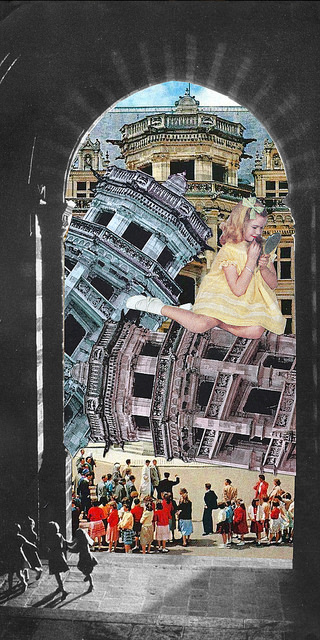
I am fascinated by Loli’s tendency to create larger than life images; her work is often teeming with impossibility, manipulating the way we think of space and scale.

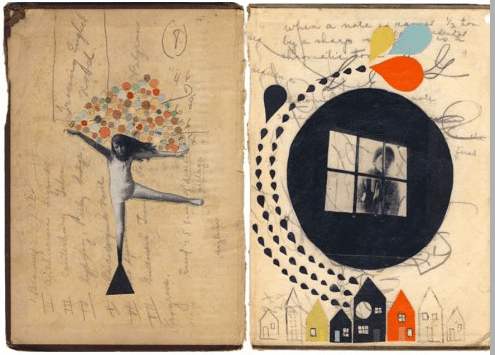
Another artist that caught my attention was Hollie Chastain. The collage work that she’s done using vintage photographs and old book covers is interesting; this layering offers a different kind of tactility than other photo collage work that I came across. Here are a few of her images:
Chastain 1

Chastain 4

I found the ways in which Chastain chose to utilize the texture of the existing book covers interesting, allowing the photograph to interact with aged designs and messy scrawl.

All images taken from the following websites:
http://collabcubed.com/2013/07/23/hollie-chastain-book-cover-collage/
http://www.thisiscolossal.com/2014/10/surreal-collages-by-eugenia-loli/
https://www.flickr.com/photos/eugenia_loli/
http://www.thejealouscurator.com/blog/2014/10/01/eugenia-loli/
Posted by: mpura | December 1, 2015

Piercing Eyes: Adele and Julia Margaret Cameron


1035x1407-R1248_cover

One of my favorite parts about our Visual Culture class is when we compare Victorian imagery with contemporary imagery. Our generation has most certainly been exposed, at a very early age, to various visual mediums such as movies, tv shows, photography, cartoons, magazines, etc. We live in a culture overwhelmed by visuality. Visuality often determines how we are perceived. We judge one another with every profile picture and every Instagram filter choice.

What has not changed since the Victorian period is the exploitation of women’s bodies in painting and photography.  It is hard not to come across a line of junky magazines at the drugstore counter with women’s breasts and pouty lips calling forth the gaze of the viewer. A magazine could be doing a bio on a pulitzer prize-winning author and still focus our attention on the sexy body represented on the cover. Women writers, actresses, musicians and tv personalities at one time or another have had their bodies put on display. Sex unfortunately does sell.

Rolling Stone Magazine recently came out with an issue that sets itself a part from the endless images of scantily clad artists. Rolling Stone is not off the hook for their stark differences in portrayal of male and female artists. But we must give them credit where credit is due. In light of Adele’s recent breakout hit “Hello” followed by her full-length album, “25,” Rolling Stone came out with an in depth bio on the British singer.

On the front cover, we see the 27-year old talent for the first time in four years. There is is something strikingly different about this photograph. It’s intriguing. But not sexually intriguing. In fact it is an incredibly raw and personal depiction of Adele.

I recently read a fantastic article from Vice’s online music journal, Noisey. The article argued that this photograph of Adele “destroys the male gaze.” Writer Kat George notes:

“Adele’s expression wears none of the self-consciousnesses that comes with being watched. She’s defiant, if a little perturbed. It’s as though we’re door-to-door-marketers who’ve caught her just as she was about to recline with her morning coffee and paper, her one moment of solitude before she starts her busy, important day. There’s nothing lustful in the way she stares out of the image at us. She’s not asking for anything, either. With one look, she’s telling us more about herself, and her expectations of us, than a woman on the cover of a magazine usually does.”

This observation completely blew my mind when I read it. Adele chooses how her body is to be perceived. We get a zoomed in snapshot of her expression which is not happy nor somber. With her intense gaze towards the lends she shatters the sexualizing gaze of the viewer. It’s as if she has caught you looking at her in this private moment of contemplation. She is not there to sell her body. She is not there to impress anyone. She is there simply as the artist.

Her body alone is natural in presentation. Although it appears she has just gotten out of the shower, the wetness of her hair is still not inherently erotic. It reveals imperfection. We also see a lack of makeup, where we are free to observe the freckles and creases in her skin. We are meant to look at her as we would look at the body of a male artist on the cover. Adele looks at us, revealing her bodily imperfections, as if saying, “look at me as the artist and not as your visual pleasure.”

Laura Mulvey would most certainly approve of this. Julia Margaret Cameron would have also approved of this approach to photography. When we first started observing Cameron’s work I was reminded of the photograph of Adele. The staging and depiction of the female body is incredibly similar.

Perfect in Peace, 1865                         Goodness, c. 1864

The above Madonna portraits are tied to the close-reading of Adele’s photograph. In both portraits the woman looks straight into the lense. Her expression is also indifferent if not somewhat annoyed. In “Goodness,” both mother and child look at us as if we have intruded on a private moment. We are looking at them and they are looking at us. The mother’s body is neither a symbol of purity nor sexuality. Although she is depicted as the virgin mother, we know as the viewer, that she is an everyday woman, whose purity remains ambiguous. The purity is set against the humanness of the portrait. Adele’s portrait works in the same way. She hints at her sexuality with her showered body but rejects this with her intense gaze. She is to be looked at as merely the artist.

1035x1407-R1248_cover

Lastly, I was thinking of how Julia Margaret Cameron would photograph Adele. I copped and filtered the Rolling Stone image to give off the essence of Cameron’s style. In fact, the way Adele is posed is reminiscent of the famous Cameron portrait of Henry Taylor with his face leaning on his hand.

How do you think Cameron would have staged Adele? What techniques would she implement on her image?


Work Cited:

http://www.metmuseum.org/toah/works-of-art/1996.99.2

http://noisey.vice.com/blog/Adeles-rolling-stone-cover-destroys-the-male-gaze


Posted by: shannonp11 | December 1, 2015

The Virgin Suicides: Perspectives on Narration

Virgin Suicides Movie Poster

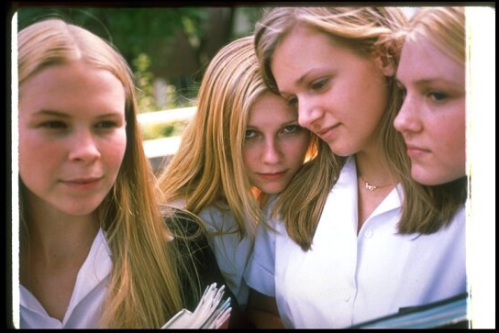
Based on the novel by Jeffrey Eugenides, The Virgin Suicides (directed by Sofia Coppola) centers on the short lives of the five Lisbon sisters — Cecilia, Lux, Bonnie, Mary, and Therese, aged 13 to 17, respectively. Set in an affluent suburban neighborhood in Michigan in the 1970s, the sisters live with their overprotective religious parents, a protection that grows increasingly overbearing when the youngest sister, Cecelia, first attempts and then eventually succeeds in taking her own life.

Throughout the film, a group of neighborhood boys display an undying fascination with the girls. It is through their eyes that we view the sisters and their story. The narrator — reflecting on the events that led up to the death of Cecelia and eventually the rest of her sisters — retells the events as he remembers them, relying on the memories of the girls he had collected when he was an adolescent. The narrator claims that he and the other neighborhood boys have never been able to figure out why the girls took their own lives, that the sisters were and forever will be shrouded in mystery.

From the outset of the film, the choice of narrator struck me as significant in understanding the story not as that of the Lisbon sisters, but of the boys’ view of them, causing me to question the validity of the narrator’s account. Recalling class discussions of the unreliability of the human eye as a means of surveillance — the beholder always imparts their individual biased opinion on the subject whether they consciously intend to or not — I feel as though the very nature of memory layered with the constant emotional separation from the sisters causes the boys to almost mythologize the girls, almost as one would when looking at a photograph of someone they don’t know.

The Virgin Suicides Still 2

As the film goes on, the sisters grow more isolated from the outside world (their mother eventually withdraws them from school); as a result the fascination that neighborhood boys hold for the sisters (or rather the idea of the sisters) continues to grow. Eventually, the sisters have consumed their thoughts, to the point where the boys order the same travel brochures and catalogues that the girls order as a means of connecting with the outside world, becoming consumed by thoughts of imaginary trips with the sisters, coinciding their day dreams with those of the girls. The boys even begin collecting items of the girls’, objects the narrator refers to as “souvenirs”.

One scene that particularly struck me was the scene in which the boys gather to read through one of the aforementioned “souvenirs”, the recently deceased Cecelia’s journal. Flipping through excerpts concerning frozen pizza and chipped front teeth, one of the boys comes across a whole section devoted to Cecelia’s favorite tree, exclaiming, “Elm trees. How many pages can you write about dying trees?”. Throughout the film, a focus is placed on one tree in particular, a tree outside of the Lisbon sisters’ home that is being prepared to be chopped down. While we see that Cecelia has a particular fascination with it (and the sisters attempt to protect it once Cecelia has passed) we never hear any discussion of it between the sisters; we never get a sense of its actual significance in the sisters’ lives. The fact that the boys choose to skip over this portion of Cecelia’s diary seems significant; this seemingly minor detail held the potential of linking the sisters’ reality to the perceived reality the boys have subjected them to.

The reason why the “pieces” that led to the eventual fate of the girls never quite add up is because the boys are tirelessly attempting to match their internal reality to the true reality of the sisters. I couldn’t help but compare this to the way Irene Adler confounds the great sleuth Sherlock Holmes in Arthur Conan Doyle’s “A Scandal in Bohemia”. Because he fails to consider Adler as an intelligent individual rather than imparting sexist stereotypes onto her, Holmes overlooks details that allow Adler to beat Holmes at his own game.

It is worth noting that the diary scene mentioned above is interplayed with scenes of the sisters in lush, overgrown fields, the sky taking nearly indescribable glowing bronze hue just before the sun meets the horizon. The sisters are shown lounging in the grass, one staring dreamily off into the distance, another absentmindedly blowing the buds of a dandelion into the wind. A unicorn even makes a brief appearance in the boys’ collective daydream. To the viewer, this image of the girls is clearly not a realistic one. However, it displays the skewed perception of the boys, how they imagine the sisters must behave when left unobserved.

The Virgin Suicides Still 1

The judgements the boys pass on the girls are almost strictly visual. Even when they find themselves in the presence of the sisters, they never seek to understand them on a human level; instead they consistently hold the idea of them at arms length. By the end of the film, the sisters are so isolated that they cease to contribute any dialogue whatsoever — as their physical autonomy fades, so does their verbal presence. They communicate with the boys through phone conversations consisting of solely holding the receiver to a record player and morse code using flashlights. And once they have taken their lives, all that is left are their possessions, photographs, and the memories carried by those who knew them. Memories that were not completely true to reality to begin with fade as time goes on, and the sisters are never able to tell their own stories.  In life and death, the sisters were viewed by the neighborhood boys as one would experience a photograph. While an image shares a likeness with an actual event in time, it can never actually be that event. The image that the boys held in their minds will never actually convey a true depiction of the sisters and, consequently, we as the viewer never get to truly know the Lisbon sisters.

Works Cited:

The Virgin Suicides. Dir. Sofia Coppola. Paramount Pictures, 2000. Film.

Doyle, Arthur Conan. “A Scandal in Bohemia”; The Strand Magazine, Stanford University, 2006. Print.

Images taken from the Internet Movie Database:

http://www.imdb.com/media/rm1082436608/tt0159097?ref_=ttmd_md_nxt

http://www.imdb.com/media/rm3424425984/tt0159097?ref_=ttmd_md_pv

http://www.imdb.com/media/rm3357317120/tt0159097?ref_=ttmd_md_nxt


Posted by: msamblas1 | November 29, 2015

Film Editing and Photography

gAs technology has advanced, we as a society have constantly found new ways to visually capture the world around us. In class, we have been looking at photography as a medium that revolutionized visual culture. More recently, the advent of film and film culture at the end of the 19th century has instigated a similar revolution, changing the way we think of the world around us visually and narratively. It is this medium and its impact that I hope to explore with this blog post. What began as a technological gimmick in the 19th century has evolved into a multi-billion dollar industry that has a massive effect on how we interpret the things we perceive in our everyday life. We have developed something of a cultural obsession with film, allowing it to seep into our consciousness in such a way that, at some level, we all seem to be under the impression that our lives in some way resemble the events of a film. This raises a number of questions. What separates film from other visual mediums of artistic expression? Perhaps more importantly, why do we see as a society view film as more accessible or stimulating in some way?


Before I take a stab at answering these questions, a brief disclaimer: I am not a film student, and have only a rudimentary understanding of the medium (thus, please take everything I write here with a grain of salt). I do, however, love going to the movies, and do so about once a week. Big studio or independent, domestic or foreign, old or new, regardless of subject or genre, I will watch just about anything as long as it can hold my interest.  One thing that fascinates me about this medium is how it takes pieces of something very familiar (visual art), and places it in a sequence, forming something altogether new that is somehow more than the sum of its parts.


The secret to this lies in the editing process. In the 1920s, Soviet filmmaker and theorist Sergei Eisenstein developed his famous theory of film as “montage”. Eisenstein argues, in his essay Film Form, that the effect film has on its audience is the result of two or more images being placed in opposition to one another. Each time a film cuts from one shot to another, the second shot is defined by its contrast to the shot immediately preceding it. Each shot that follows continues this trend, so that the audience’s opinion of the film and its accompanying narrative continues to change as each cut occurs.

When we look at a photograph, we are looking at one image representing one moment in time. Each shot in a film similarly shows us one thing over a particular period of time (the length of which depends on the length of the shot and the speed at which the events are being filmed). When the camera cuts, we see something else, and the first thing that stands out to us is the difference between the thing we are watching now and the thing we saw last. We also use both images to make assumptions about everything that occurs in between, both temporally and spatially. A photograph, on the other hand, is only one “shot” of a film. Thus, there is no “in between”. The main similarity between the two mediums is that in both cases, the viewer’s imagination supplies the majority of the narrative. Film, however, is unique in that it uses opposing images to place a limit on how far the imagination is allowed to go. No matter what we assume about an image, in film we are always expected to “arrive” at the next shot, all the way until the end.

Let’s look at two examples of film editing at work. The first one that comes to mind to me is the following scene from Lawrence of Arabia:


A brief recap of the scene: Lawrence is being assigned his mission (to contact a group of Bedouins to see how they fare in their war against the Turks), by Mr. Dryden, which will take him to the desert. Prior to this, most of the scenes are shot either in interior locations, or fairly close up, as if to emphasize the constricting, claustrophobic nature of life in the British military, a lifestyle that promotes the oppression and subjugation of foreign cultures (like that of the Arabs, as shown later in the film), and the suppression of the individualism of its members, such as Lawrence, whose homosexuality, desire for adventure, and admiration for the Bedouins is not allowed to surface until he ventures into the desert (in the case of his queerness, it is never fully able to surface at all). All of this is pre-empted in the conversation that Lawrence has with Dryden, with Lawrence insisting that “It’s going to be fun”, while Dryden remarks that “only two kinds of creatures have fun in the desert: Bedouins, and Gods, and you’re neither”, also saying that “It is well known that you have a funny sense of fun” (again highlighting Lawrence’s status as an outsider). Lawrence’s response is to hold up a match and blow it out. Immediately as he does this, the film cuts to a wide shot of a desert landscape, transporting us to the middle of Lawrence’s journey across its sands.


This simple transition tells us nearly everything we need to know about Lawrence as a character without showing us anything that happens in between the two scenes. Nearly everything about the shot of the desert, which up to this point has only ever been talked about, is strikingly different from the profile shot of Lawrence blowing out the match. Whereas before, a light is being extinguished, now a greater one (the sun) is showing itself. Before, the shot is close up and cramped. Now, Lawrence is a speck on the horizon, a small fish in a big pond. We see all of Lawrence’s hopes and aspirations expressed wordlessly, and are shown how insignificant he and all other “heroes” of this war are compared to the ancient deity that the desert becomes in this film. We also finally know why he romanticizes the desert so much, as it allows him to lose himself in it and rebuild himself with the obscurity that it provides him. Finally, we are shown some of the more problematic elements of the narrative (namely how the film’s sympathy for the victims of colonialism is expressed through a member of a colonial power’s relationship with the land). Here the desert becomes a character whose interactions with Lawrence will eventually define and consume him as an individual (as it is later shown that he does not belong in Arabia any more than he belongs in the British army). All of this is accomplished entirely with visuals. We are never told any of this, but are allowed to make these assumptions based off of the opposition between the two shots. The chaining together of these two images produces a much larger and complex narrative than either of them do individually.


The scene is remarkable for its simplicity, but what happens when two entire scenes are woven together in this way? This brings me to my second example, from The Godfather:


In the scene, Michael Corleone is attending the baptism of his new nephew and godson. He is repeatedly asked questions like “Do you renounce Satan?”, “And all his works?”, “And All His Promises?”, and “Will you be baptized?”. He replies in the affirmative to all of these questions, which are asked and answered while we look at either a close-up of Michael’s face or a shot of the child being baptized. After each question is answered, we cut to various scenes of Michael’s subordinates, acting on his orders, killing his enemies by means that are as gruesome as they are underhanded (none of the victims see the assassinations coming, and they die in increasingly visceral ways).


Once again, this scene is defined by contrast. We do not need much context, nor do we need to know exactly who Michael is killing and why (though anyone watching the film knows that they are the killers of his older brother, Sonny). If we saw the baptism on its own, we might believe that Michael is rejecting his family’s violent history, based on his solemn expression and the innocence of the image of the child. However, when we see the disturbing images of death that accompany the scene, we see it in a whole new light. Michael is not rejecting Satan, he is becoming him. The child is not being baptized; he is, and the contrast between the baptismal water and the blood of Michael’s enemies only serves to emphasize this. As before, we do not need to see every detail of the murders or of the baptism, nor do we need to be told that Michael has become corrupted. We are shown a series of images, with little dialogue in between, and forced to connect the disparate words and images, plug in the gaps, and arrive at this conclusion on our own.

There are plenty of other examples, but these two in particular have always stuck with me. What works about them both is how minimalistic they are. They use the technology of film to tell stories within the larger story that is the film’s narrative. We also see some of the limitations of photography revealed here. When viewing a photograph, the viewer must make assumptions about everything that is not explicitly shown in one image that depicts a fragment of a single event. Film, on the other hand, shows us several larger fragments of moments and allows the artist to manipulate the order in which these moving images are delivered to us. Everything that is shown to us we accept as factual (at least according to the world of the film), while everything in between the shots is what the viewer’s imagination controls. By bookending these portions “between the shots” (in other words, by showing us the before and after of what we imagine to take place), the filmmaker can guide the viewer throughout the film, manipulating our thoughts as we go. Every shot of the film thus functions as a “waypoint”, each of which yanks us back into the reality of the film and forces us to accept it as truth. This does not imply that either medium is “better” than the other, but that they have different ways of exercising control over their viewers.

These ideas ultimately only raise more questions. Is there a way in which photography performs the same function? What is it about this restriction of narrative control that makes film so appealing to us? I’m not sure I can answer these, but I would welcome any ideas that anyone else might have on the subject.

Posted by: mpura | November 29, 2015

Emily Dickinson: “Domestic Angel”?

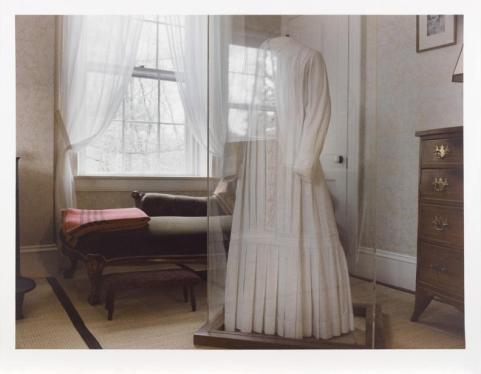
mh_2002_1_3_v1-cdm_1

As many of you probably remember, one of the final pieces of art that we discussed at the Mount Holyoke College Art Museum was the photograph entitled, “Emily Dickinson’s White Dress, The Homestead,” by Jerome Liebling. President Pasquerella recently published a brief commentary on the work. She notes that as a philosopher she saw the painting as a discussion of “presence and absence.” She also comments on the current debate on “whether there are minds or souls, in addition to bodies, that can exist independently from our bodies upon death.” Emily Dickinson was most certainly a figure whose mind and soul existed beyond the earthly imprisonment of the mortal body. As can be observed in the Liebling photograph, Emily’s dress, a signifier of her bodily existence, softly disappears into the background. She existed but also existed beyond the visible.

I would like to take President Pasquerella’s commentary a step further. In keeping with our readings that meditate on Victorian domesticity and consumerism, it is interesting to look at this painting and see a potential platform for discussion on Dickinson’s participation and rebellion in the domestic space. In relation to the idea of “presence and absence,” Dickinson was a woman who lived both within and without the Victorian household.

If you ask anyone what comes to mind when they think of Emily Dickinson, they will most likely say the following few words: “recluse,””hermit,””disturbed” and/or “ghost.”Dickinson remains forever, even over one hundred years after her death, confined to her home. It is almost impossible to talk about Dickinson without bringing up her connection to that little yellow house in Amherst, Massachusetts. The photograph emulates this fascination. The white dress, a signifier of Dickinson’s existence, remains, not trapped, but static within the home.The outside reflects itself onto the glass casing,  holding it in place. While Emily’s body remained within the home, her mind expanded far beyond the gates of the homestead. It is almost as if the outside is sucking away the material, suggesting that one is not fully part of the other.

If we think of this photograph within the context of our readings, you might be reminded of Lori Anne Loeb’s chapter “Victorian Consumer Culture,” in her book Consuming Angels. Loeb describes the assigned space for the ideal Victorian woman within domestic life:

“The ‘temple of the hearth, ‘the vestibule of heaven’ depended on the redemptive presence of a ‘household God,’ an ‘angel in the house’-immortalized by Coventry Patmore’s famous poem. The woman was expected to act as a moral regenerator. Closeted within the sanctuary, this angel could nurture purity and dependence; she could retain her asexuality and child-like simplicity. Her cheery prettiness and lady-like accomplishments would make her a dutiful companion” (Loeb, Consuming Angels, p. 19).

Based on Emily’s reputation and actions, she fits the majority of these categories. She spent the majority of her life working in the kitchen, cleaning the house (although her least favorite thing to do), and tending to the gardens. The house always had its ‘angel’ wandering the halls, filling the rooms with the fragrance of ginger bread and freshly cut dandelions. How many days did she spend wearing that white dress; a possible declaration of her purity? She does take on this child-like persona, wearing a signifier of purity, living in that bedroom for almost her entire life. When she was alive and far after she had died, Emily was seen as a ‘angel’ or ‘ghost.’ Amherst society called her the “Myth of Amherst,” peaking out through the windows, “closeted within the sanctuary,” of the household.

emily-dickinsonjpg-0105210fcf5832a0_large

But while Amherst society saw her reclusive habits as peculiar she also adhered to what Victorian society expected of women, based on the above description. But with one exception. She was no man’s “dutiful companion.” She of course served as a constant companion to her sister Lavinia and parents. Though, she never gave herself completely. Would she have become the poet that we know today, if at all, if she had married? 

While Dickinson fit within several of the categories befitting a Victorian woman, she found liberation within the confines of her “sanctuary.” Going back to Emily’s mortal body, performing the tasks within the house, her mind on the other hand, extended far beyond its walls. In that room in that dress Emily wrote her poetry. Writing almost 1,800 poems, her subject matter was far from the realm of purity. She is often seen as is described in Loeb’s article, as an “asexual” angel. Her poetry would suggest otherwise. For example:

Wild nights – Wild nights! 
Were I with thee 
Wild nights should be 
Our luxury! 
Futile – the winds – 
To a Heart in port – 
Done with the Compass – 
Done with the Chart!
Rowing in Eden – 
Ah – the Sea! 
Might I but moor – tonight – 
In thee!
You don’t need to do a close reading to understand the possible subject of this poem. Emily was most certainly a sexual being. We will never really know if she ever performed sexual acts but she was most certainly curious about her sexuality. Whether it was the passionate letters to her sister-in-law Susan Gilbert Dickinson or her only recorded suitor, Judge Otis Phillip Lorde, she did not classify herself as a symbol of purity. 
Along with Emily’s sexual curiosity, her overall intellect surpassed the traditional role of the “domestic angel.” It could be argued that she was so ahead of her time in both political and academic sense, that she felt that surrounding Amherst society was not worth her time. A rebel from the beginning, Emily rejected the harsh practices of the church that dictated Victorian middle class life. Living in an ever growing industrial and power hungry world, she sought solace within a microcosm of simplicity; away from all of the distractions and corruption that dominated 19th century America. She saw things better than most. Poetry was the only way to communicate that. 
So when you look at Liebling’s photograph, do you think of the “domestic angel” Loeb describes, or the essence of a woman who escaped the chaotic world of the 19th century? While her dress remains forever a symbol of her bodily connection to the domestic duties of the house, its receding presence suggests that she did not give herself up entirely. 

Work Cited:

https://www.mtholyoke.edu/artmuseum/blog/emily-dickinsons-white-dress-homestead-1989?bc=node/415

Loeb, Lori Anne, Consuming Angels.


« Newer Posts - Older Posts »

Categories