Posted by: rojas25m | November 29, 2015

A Madonna by Any Other Name. . .

We have seen many symbolic representations of the Madonna and Child in class. I was very intrigued by this repeating image and what it represents. I decided to do some digging in order to compare the images that we have seen in class to some of the many paintings of the Madonna and Child in order to assimilate the symbolism in these images.


Let us first take a look at these two images:

The first is the picture of A Flower Girl we saw in class.  The second is Leonardo Da Vinci’s Madonna and Child with Flowers.  Both of these images figure a humbly dressed mother (although one seems to be by choice and the other by circumstance) with child-like features and a chubby-cheeked child.  Flowers are a central theme in both pictures.  The Da Vinci piece seems to sing with innocence and purity while Dore’s version uses the same tactics in order to show how innocence fares in the harshness of the London life.  While the flowers in one symbolize the soft purity of youth, the other turns that concept on its head by making the same flowers a form of hard labor.


Let’s compare these two images:

There are striking similarities between the picture of John Thompson’s The “Crawlers” and Bernardino da Asola’s Madonna and Child. Both children lie on the ladies’ lap with total trust.  The women are looking down, engulfed in light and humbly dressed.  It is important to note, however, that while da Asola’s Madonna is looking at her child, the Crawler woman is looking at the floor in seeming despair.  With these two images, it is again obvious that the same elements are used with different goals.  One is to represent unconditional love, the other hopelessness.


Here is the last set of images to compare:

I chose to compare these two images because of less obvious reasons.  The first images is the one we saw on our visit to the art museum,  Ur-Mutter #2 by Adrian Piper.  The other is one of the earliest known representations of the Madonna and Child from an 6th century Icon in Saint Catherine’s  Monastery in Sinai.  My reading of the Piper is that “We made you” is meant to represent an origin and a debt.  If a mother is the beginning of all life, then care for them.  The Mary and Child Icon seems to be saying the same thing.  Here’s the origin of a mother and child depiction that is meant to evoke a religious experience.  The pose of both pictures is very similar, with the mother enveloping the child with both arms.  It is the mother caring for the child above all else that is pictured here, and yet there is a call to action in the eyes as both mothers as they look directly at the viewer.  One saying “care for my plight”, the other “follow the right path.”


There are many conclusions that can be reached by comparing these images.  I will, in fact, welcome your conclusions in the comments.  I thought it interesting that the children in all these images are quite interchangeable.  It made me think of how Jesus can be a symbol for humanity as a whole.  He did, after all, die for all our sin according to the christian faith.  The child is Jesus, but he is also every one of us.  If this is true then Mary is our mother.  She is the one who loves us and works for us, the one that cares for us and despairs for us, the one that teaches us and teaches others about us.

Posted by: ahmed22k | November 28, 2015

Masters of Disguise?

Do you ever feel your mother’s invisible grasp? Does she always seem to have your back? Does your mother’s love feel comfortable or insufferable?

Why have all these questions? Take a look at the images in this posting.

In our last class, we discussed how mothers were experts when it came to shopping and cleaning, basically, they were the boss in the domestic sphere.

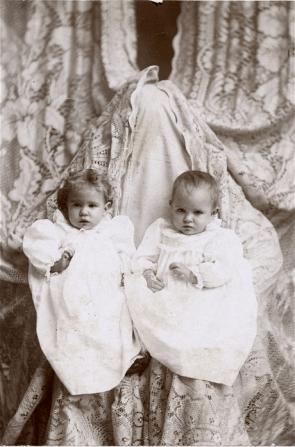
Apparently, they were also experts when it came to disguising themselves as armchairs, swathing in curtains, hiding behind pillars or simply looking away. Yes- mothers were masters of concealment. Or so they thought. So they tried. Have a look at some Victorian Period Instagram-worthy images!

mom 1

You might be thinking What’s that weird figure in the background covered in “flowery chintz” (Nagler 5)? Why is the child not scared? Wait is that the mother in the background. 

YES.

These images from Linda Fregni Nagler’s “The Hidden Mother.” She has now turned her collection of “hidden mother” photographs into a book. Every page reveals the lengths mothers went to in order to “extend their repertoire of disguises.” Nagler explains how she uncanny images when she came across a photograph for sale on eBay with the caption: “Funny baby with hidden mother”. “I thought how peculiar it was for a picture to be described by what isn’t there” (2).


Here is a mother, hiding behind a curtain, with only their hands in view, displaying the child like a puppet:

mom 2

Some mothers unpin their hair, letting it fall over their face like a curtain, or turn their heads away from the camera. Here’s a mother with her back to the photographer:

mom 3

One woman just decides to play along with this absurd approach, or maybe she genuinely thought her camouflage would work. Regardless, her ghost ensemble is easily distinguishable amidst the white-themed setting:

mom 4

Now you might ask why would mothers have to be present in the photographs? Now, remember, in the late 1800s, anyone sitting for a portrait would have to sit for at least a minute due to the exposure. Mothers had to most likely hold their children and force them to sit still.

Observe the child in the photograph below; if you look close enough you can see the mother’s hands on both sides of the baby’s head:

mom 5

Personally, this image reminds me of a burqa-clad woman holding her baby. If the Victorians were aware of Islamic fundamentalists and the depictions of such females, they might have taken offense and considered another approach to capturing an image of an infant.

I guess the Victorian people just weren’t very good at improvising- or maybe they took the improvising too far. Maybe I am taking all the photo manipulation present in today’s world for granted. But I can’t seem to get over this photo below; this is what you call very bad editing; why remove the face but leave the body? What a ghastly comical and haunting image. Albeit, the dual nature was probably unintentional.

mom 6

I can’t be too hard on the developer. After all, there was no Photoshop. Nagler emphasizes this in her book, “the only option was to obliterate the faces with a sharp object” (45).

***

According to my friend Kira, maybe the photos don’t show a mother but a maid, she just said, “If I was a rich mother from the 1800s, I wouldn’t want to have the maid in the photography- what if she got fired tomorrow?”

No No Kira. In the late 1800s all mothers, from all households, were having their children’s photographs taken. It was an affordable practice, available to mothers from all social classes.

Well, what do the rest of you think? Why did the mothers decide to take such a bizarre approach? Perhaps, mothers felt they weren’t worthy enough to be seen in pictures, even though an impression of their bodies was acceptable.

I think that they just wanted to have pictures of their children alone, and this was clearly the best way.

Nagler believes that because photography was a new phenomenon it came with a new set of rules. These were pictures that would be sent around the world to introduce family and friends to the latest member of the clan. “The mothers seem to have been aiming to create an intimate bond between the child and the viewer, rather than between themselves and the child.”

I’m not so sure about the effectiveness of the aim to create an intimate bond between the viewer and the new family member; I mean, the mothers are distracting. The compositions are simple yet confusing. I think in trying too hard to become invisible, most of the time the mothers ended up looking more conspicuous in the photos than they intended.

According to the MACK bookstore website, “The Hidden Mother is comprised of 1,002 photographs, all examples of a now redundant practice: to cloak or hide a parent within the background of a child’s portrait, a common procedure from the advent of photography up until the 1920s.”

I personally think these photographs are more than just antique representations of children in a cultural context. Is Nagler somehow responsible for creating a sub-genre in photography? These repeated positions, hand gestures, and modeling may have given rise to a momentary cultural phenomenon, contributing to the progress of photography.


All images are from:

http://www.theguardian.com/artanddesign/gallery/2013/dec/02/hidden-mothers-victorian-photography-in-pictures
http://ridiculouslyinteresting.com/2012/01/05/hidden-mothers-in-victorian-portraits/
https://www.flickr.com/groups/1264520@N21/pool/
Works Cited:
Nagler, Linda Fregni, Massimiliano Gioni, Geoffrey Batchen, and Francesco Zanot. The Hidden Mother, 2013. Print.
*”Chintz” (plural for chint) originally referred to textiles imported from India, printed with designs featuring flowers and other patterns in different colors, typically on a light plain background. Now they can be copied representations, made in China or the USA.
Sun, Dec 6, 2015, 11:28 PM
Dear Khadija,

As I confessed in class, I am somewhat obsessed with the hidden mother photographs and their strangeness, why the mother is such a distracting presence in trying to establish her absence. So I was glad to read your post as you considered what to make of this subgenre of Victorian family photographs. I was really intrigued by your opening thoughts about the ways that children (and adults) experience their mothers in ways that might parallel these photographs — every present yet ghostly. I had never thought about that before! Even though you have now completed your posts and review, I hope that you will keep contributing and commenting. You are an important presence on the blog!
Best, AM


Amy E. Martin

Chair of the English Department
Associate Professor of English and Faculty Member in Critical Social Thought
Faculty Director of the Speaking, Arguing, and Writing Program
Mount Holyoke College
413-538-2062
Posted by: ahmed22k | November 25, 2015

We SEE things not as they are, but as who we are

For my Amherst Class,  American Extravaganzas, we read “Moby Dick.” I wrote a paper on the artistic qualities of the narrator who projects his own thoughts and feelings upon everything he encounters, whether it be a person, the sea or an inanimate object- such as an artwork.

Now I strongly believe that “we see things not as they are, but as who we are” (Anthony de Mello). Thus, it appears that a person’s self-perception, beliefs, and values can affect the way they perceive a visual element. With the postings on the “male gaze,” “selfie culture,” and photography, in general, I wanted to explore the way I see the world; not as a female (this will not be a posting on the “female gaze”), but as a budding artist. How do I translate who I am; my thought process, my perspective, my understanding through my own artwork?

It is easy to project our own interpretations and our own understanding when viewing, let’s say, a portrait. Now I love portraiture, and I love photographing and drawing children. But I started to realize that I am not just duplicating the image of a child, I am capturing the person, persona & personality of the child. I am always conscious of why I am choosing to depict the subject in a particular way.

In the “Burden of Representation,” John Tagg states, “the ideological conception of the photograph as a direct and “natural” cast of reality was present from the very beginning and, almost immediately, its appeal was exploited in portraiture” (41). I agree that portraiture is a translation of a person in a given moment in time; it captures the reality of a person in a specific instance. But I don’t think that portraiture is a ““natural” cast of reality,” because it may not even look like the person, i.e. it may lack in terms of likeness.

What about painting or drawing portraits? How accurate are such depictions? Such portraiture is captured over a period of time…they capture the reality of a person over a period of time as the model for the artist. But what if the subject doesn’t model- what if the artist chooses to draw their subject from a photograph? Then it becomes a double translation. Is the reality of the image, or rather the “”natural” cast of reality” reduced in the final piece of artwork? Or does this double translation allow for a new kind of natural reality to be cast upon the subject?

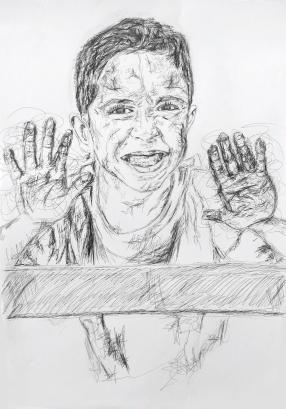
Take this photo of my brother, Abdullah; I chose to depict him in a playful light. He looks energetic; I emphasize this through the erratic mark-making that goes hand-in-hand with his energy and expression. In order to emphasize his bold nature, his exuberance and confidence, I drew him on an A1 size paper, so he was drawn relatively bigger than his real-life scale. By not sticking to an accurate scale, I wanted to emphasize his larger than life persona. My brother was only 7 years old at this time.

5

“Peek-A-Boo”

http://www.khadijaahmed.com/project-1/4588716800

This isn’t a perfect translation; it’s a biased representation of my brother for several reasons:

  • I was a less experienced artist in 2010
  • I injected my own perception of my brother as I was drawing
  • I drew him from a photograph because he wasn’t going to pose for such a long period of time.

I personally don’t think he looks 7- years-old here. Or this is the result because he looks older in the original photograph I was using for reference. Of course, at the time I thought I had done a pretty accurate representation. But I probably drew my brother as I saw him, rather than what he really looked like. This drawing was influenced by my perception of his character- he embodies many great qualities; he is very friendly, energetic, and mature for his age. Maybe I didn’t always see my  brother as 10 ½ years younger than myself. Now I do. Now he is 11. He’s my “Lil bro.” 

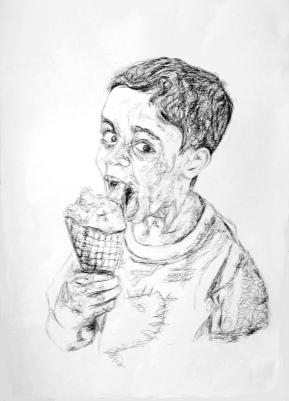
Here is another drawing of him which was drawn around the same period of time (I actually drew the one below before I drew the image above). He looks quite similar, and yet, quite different. This is another side to his character, literally and figuratively. This is a more playful image of Abdullah, or at least I think he looks younger and more playful:

4

“WHAT ARE YOU LOOKING AT?”

This one took considerably less time. I was done in one class sitting- so around 40 minutes. But the first image shown took about 4 hours or more. Maybe I became considerably attached to that image, or I was more hell-bent on creating a likeness between the subject and drawing but the photo served as an interruption. I just remember, “WHAT ARE YOU LOOKING AT?” was easier, more fun and less stressful to create than the image with my brother’s face and hands pressed against a transparent glass door. Yet, I prefer “Peek-A-Boo”- he covers most of the page, he is smiling and maybe I just love it because I spent so much time on it!

Both drawings are of the same size. Both of them are confrontational, but they could be showing different children. The medium (pen), the style, the monochrome depiction is what makes them go together as a pair. Not necessarily the likeness between the images.

While photographic portraits may be more iconic representations of people, other kinds of portraiture may be more effective when it comes to capturing the essence of the subject. These drawings serve the traditional purpose of photography; to capture loved ones- Photography was “primarily a means of obtaining pictures of faces” (Tagg 35) we know. But as a budding artist, drawing my brother allowed me to be in control and obtain more than just his face,  it allowed me to project my opinions as an artist onto him. I treat him as more than a family member- but also a subject. Or rather he is a family member and that affects the way I treat him as a subject. 

Unlike painting a portrait reserved specifically for the bourgeoisie, anyone can commission a work of art (though it is still an expensive practice compared to photographing). But doesn’t painting and drawing a face have more sentimental value compared to a photographic portrait? Especially if completed by a loved one, considering the preparation and practice time taken into account? I would say it’s like writing a personalized letter on paper; like using a pen compared to writing an e-mail dealing with the same content. Writing a letter takes more time, more effort and leaves less room for error.

Similarly drawing these portraits of my brother took more time than photographing him on two separate occasions. I took multiple pictures of him and chose the “best ones,” or rather the ones I thought were best.  The photography was more spontaneous- the drawings were not (they were more planned and thought out). There are many photographs of my brother, but fewer drawings of him. I try to reclaim the value of traditional artwork and portraiture with a contemporary spin using such poses of my brother (instead of making him sit still). I captured his smile and mischievousness in one of them. His annoyance and attitude in another. He is engaged with me (the photographer) in one, not so much on the other. The compositions are supposed to emphasize the “Complexity of Children”- the title of the series these images were part of. Children are a lot smarter than we think; there’s more to Abdullah than his childishness and innocence. 

These drawings have more sentimental value compared to the photographs of Abdullah I took. Or maybe I am just a biased sister and artist.


Posted by: ahmed22k | November 25, 2015

Of Dubious and Questionable IDENTITY…

Sherlock Holmes definitely DID NOT understand women:

In The Adventure of the Illustrious Client, Holmes contends: “Woman’s heart and mind are insoluble puzzles to the male.” In The Adventure of the Lion’s Mane, he confesses: “Women have seldom been an attraction to me for my brain has always governed my heart” (The Victorian Web).

Holmes does not appear to have any romantic interests, because the feeling of love or “grit in a sensitive instrument, or a crack in one of his own high-power lenses, would not be more disturbing than a strong emotion in a nature such as his” (Doyle 1). Nonetheless, a number of attractive young women appear in the Sherlock Holmes series, including Violet Hunter (“The Adventure of the Copper Beeches”) and Mary Morstan (first introduced in The Sign of Four), who eventually marries Dr. Watson.

But only Irene Adler from “A Scandal in Bohemia,” makes a lasting impression on Holmes.

WHO is this character that “eclipses and predominates the whole of her sex” (Doyle 1)?

This retired operatic diva is seen only from the eyes of men:

  • Adler is “the daintiest thing under a bonnet- men of at Serpentine Mews
  • Adler possesses “the face of the most beautiful of women, and the mind of the most resolute of men”- King of Bohemia,
  •  “A lovely woman,” with a “face a man might die for” –Holmes,
  • For Sherlock Holmes, “she is always the woman; I have seldom heard him mention her under any other name” – Watson

THE three primary male characters in SCANDAL:
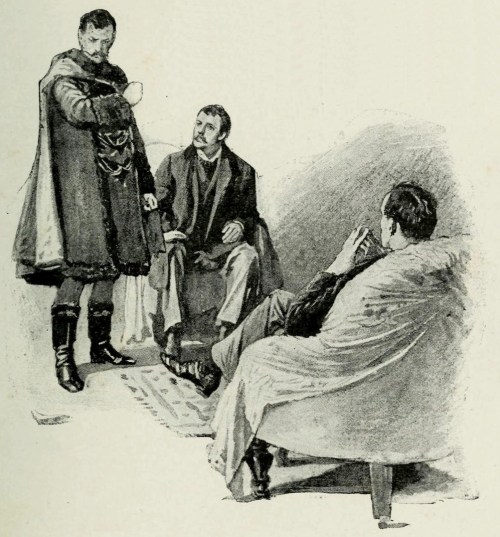
A_Scandal_in_Bohemia

 https://upload.wikimedia.org/wikipedia/commons/b/b6/A_Scandal_in_Bohemia-04.jpg

 The Scandal story mentions Adler was:

  • born in New Jersey in the 1850s.
  • followed a career in opera as a contralto, performing at La Scala in Milan, Italy,
  • ” a well-known adventuress” (the term had an ambiguous association with the word courtesan)
  • served a term as a prima donna in the Imperial Opera of Warsaw, Poland Apparently, it was there that she became the lover of King of Bohemia (who was staying in Warsaw for a period).

https://monpinillos.files.wordpress.com/2008/06/irene-norton-born-adler-by-allen-st-john.jp

Irene Adler only appears in one story. But her name is briefly mentioned in “A Case of Identity”, “The Adventure of the Blue Carbuncle” and “His Last Bow”. Additionally, in “The Five Orange Pips”, Holmes says that he has been outwitted four times, “thrice by a man and once by a woman” (The Victorian Web).

Rumour has it that the “late Irene Adler, of dubious and questionable memory” is based on an actual female persona.

But if Irene Adler was based on a true personality an actual female persona- then we must also consider the King of Bohemia’s true identity.

Now Watson was known to change names and locations to protect prominent persons who might be embarrassed by their reason for calling upon Holmes. For this reason, he also held back certain cases, to be only published at an appropriate time. This allowed a distance between the client and the case to be established, eliminating any threats and providing protection to the clients. This was especially important in preventing any aristocratic identity from being compromised. Thus, Watson was careful in his descriptions.

HISTORY SUGGESTS…

Did you know the last king of Bohemia, Mathias died in 1611. So the King of Bohemia is either pure fiction or based on another royal subject.

In a chapter, A Scandal in Identity, from “Profile by Gaslight,” critic Edgar W. Smith postulates that Wilhelm Gottsreich Sigismond von Ormstein, Grand Duke of Cassel-Felstein, and hereditary King of Bohemia, was none other than:

“HRH Albert Edward- Prince of Wales (the future King Edward VII of Great Britain)” (Smith).

In A Scandal in Identity: Reconsidered, from the online Journal “Neo-Victorian Studies,” Michael J. Quigley insists Watson’s description of the king of Bohemia suggests “a man alien to the ways of proper English gentlemen, let alone a British royal. His large physical appearance, arrogant demeanor and a penchant for an extravagant dressing style is described by the doctor as having “a richness which would, in England, be looked upon as akin to bad taste” (Quigley).

So is Ormstein not based on the Prince of Wales, or is Watson trying to protect his true identity?

EVIDENCE FROM THE KING OF BOHEMIA, himself: 

  • the affair with an Opera singer five years ago
  • the confession that he allowed himself to be photographed
  • his preparation to marry the Scandinavian princess

Further revelation:

The king states, “I was only Crown Prince then. I was young. I am but thirty now” (Doyle 4). But at the time the story was written, the Prince of Wales was 47 years old in 1888 (Quigley). This would have been an obvious fact to Sherlock Holmes. Moreover, there was no title for Crown Prince in the British system, and the very term underscores a European dynastic line. The heir to the throne of the UK is simply known as “the Prince of Wales.”

Once again, these apparent discrepancies (in the age, and Ormstein’s title), which appear invented rather than real, serve as contradictions when attempting to base his identity on the Prince of Wales. Either this undermines the true identity or suggests that the Prince of Wales was not the mysterious royal figure who had an affair with Irene Adler.

ALTERNATIVE BELIEF:

King of Bohemia was none other than the “Archduke Rudolf Karl Josef, Crown Prince of Austria, Hungary and Bohemia” writes Piya Pal-Lapinski, Associate Professor at BGSU.

“Born in 1858, making him 30 years of age at the time he commissioned Sherlock Holmes.

Rudolf was apparently already married, to Princess Stephanie” (Smith), but Holmes does not press the dishonest royal on this subject. That means the situation as already scandalous.

According to Smith, Rudolf’s mother, “Empress Elizabeth of Bavaria, did not like Princess Stephanie, describing her as a clumsy “oaf” so it makes sense that Rudolf found solace in other female companionship” (Quigley).


Speaking of inspiration, here are a couple of CHARACTER INSPIRATIONS for Irene Adler:

Lillie Langtry, one possible model for Irene Adler

https://maggiemcneiLillie Langtry, one possible model for Irene Adlerll.files.wordpress.com/2014/04/lillie-langtry-sketch-by-frank-miles-1877.jp

As a theatrical performer who becomes the lover of a powerful aristocrat, Adler had several precedents. Here are the suggestions for Doyle’s inspiration for Adler in his lifetime:

  1. Lola Montez- “a dancer who became the lover of Ludwig I of Bulgari and influenced national politics.
  2. In fact, Montez is identified as a model for Adler by several writers” (Pal-Lapinski).
  3. Lillie Langtry, singer, and the lover of Edward, Prince of Wales.   Julian Wolff points out in the Adventures of Conan Doyle, Adler was born in New Jersey and “Langtry was called the “Jersey Lily.”” Apparently, Langtry later had several other aristocratic lovers, and her relationships had been “speculated upon in the public press in the years before Doyle’s story was published”(Smith).
  4. Ludmilla Stubel, singer and the alleged lover and later wife of Archduke Johann Salvator of Austria ( Pal-Lapinski).

I personally think that the relationship between the Archduke Rudolf Karl Josef (Crown Prince of Austria + Hungary + Bohemia) and the anonymous Irene Adler is the best theory.

Perhaps, Rudolf had an affair with Adler, but did not reciprocate any feelings of love, and turned to the younger “Marie Vetsera”- the demure, attractive 17-year-old daughter of a diplomat belonging to the Austrian court (Quigley).

Was being discarded for a younger and far less accomplished woman, the very reason Irene Adler wrote in her letter to Sherlock Holmes she was “cruelly wronged”?

In January 1889, Rudolf and Marie were found dead in their secret abode on Cleveland Street. Now whether their deaths were the result of a suicide pact or murder- nobody knows. But the Cleveland Street scandal became public knowledge and might have been the prominent figures that the story is based on. But was the protection of identity necessary? After all, these characters were no longer alive.

WORDS CITED:

Doyle, Conan: A Scandal in Bohemia; The Strand Magazine, Stanford Press, 2006, Print.

Pal-Lapinski, Piya, The exotic woman in nineteenth-century British Fiction and Culture: A reconsideration, 69-71; UPNE, 2005.

Miller, Russel, Adventures of Arthur Conan Doyle, Random House, 2010. Print

Smith, Edgar.W,“A Scandal in Identity,” Profile by Gaslight, New York: Simon and Schuster, 250-262, 944.

Quigley, Michael J, A Scandal Identity: Reconsidered,<http://www.neovictorianstudies.com/&gt;

http://victorianweb.org/victorian/authors/doyle/women.html

http://literature.proquest.com/pageImage.do?ftnum=3638067371&fmt=page&area=criticism&journalid=00054070&articleid=R05165571&pubdate=2014&queryid=2890976582887


Posted by: ahmed22k | November 23, 2015

WHAT’S IN A FACE? Whom should we fear- whom should we trust?

payne

https://www.google.com/search?q=lewis+payne&espv=2&biw=911&bih=399&source=lnms&tbm=isch&sa=X&ved=0ahUKEwifv76Cz6XJAhVCdz4KHd_qAcoQ_AUIBigB#imgrc=xwA1JzzyL4HgVM%3A

This is a photograph of Lewis Thornton Powell or Lewis Payne.

He was also known as Lewis Paine.

Now on first glance I don’t think anyone is paying too much attention to specific detail because the viewer’s eye is drawn to stylistic elements of the photograph; the composition, the lighting, the contrast, the background, and of course, the subject’s gaze. His expression is not intimidating but confrontational. It is not super serious but full of concentration.

The shackles are not obvious. They are depicted on the bottom left of the photograph. When I asked a friend from outside class what she thought of it she said “a video game console?” and then she got confused. She did not think he was shackled. She did not perceive him to be a criminal.

Paine was as an American citizen who was unsuccessful in assassinating the United States Secretary of State William H. Seward on on April 14, 1865.

You might remember his name.

He was a co-conspirator of John Wilkes Booth.

On the same night, Booth assassinated President Abraham Lincoln.

Titled,“Powell in wrist irons aboard the monitor USS Saugus,” and photographed by Alexander Gardner, in 1865, Paine was on his way to be executed. So there is definitely a story behind this image- just not an obvious one- because Gardner didn’t depict him as a criminal. The storytelling, the purpose- the intent is ambiguous.

This image was not taken for prison records, it was not taken by a prison guard- but by a famous photographer.  Thus, this image does not serve as a police photograph. Neither does it serve the “honorific function of bourgeois portraiture” (Sekula 10). But it does “inherit” and “democratize” the traditional purpose of photography and takes it beyond the domestic sphere by emphasizing the social audience. This is a “private moment of sentimental individuation” but it is overshadowed by “public looks”(14). We all insert our own narrative.

I have been thinking about the image ever since Professor Martin mentioned that student once said he looked like a “Banana Republic Model.” I know I’m not the only one who thinks he is a very good-looking man. He does not resemble a terrorist.

This got me thinking about how society dictates the way we look and think about different people. There are many labels and markers surrounding how we think about class, race and status. This process of normalizing, profiling, categorizing, and stereotyping can be very detrimental to both the viewer and the subject being scrutinized.

What happens when we start judging people based on appearance and mistaking their character, instead of realizing their true identity?

“This paradigm [photography] had two tightly entwined branches, physiognomy, and phrenology. Both shared the belief that the surface of the body, and especially the face and head, bore the outwards signs of inner character” (11).

***Phrenology: The detailed study of the shape and size of the cranium as a supposed indication of character and mental abilities (OED); the supposed art of judging a character from facial characteristics.

Physiognomy: A person’s facial features or expression, especially when regarded as indicative of character or ethnic origin.***

And this photograph of Payne is perfect proof of the “broad appeal and influence of these practices on literary and artistic realism.” All the students in class began to focus on his face- in addition to other aspects of the photograph like lighting. But there was something arresting about his expression-or was it his features? Initially,  the setting, what he was feeling (etc,) was all speculation. We inserted our own comments to fill in the blanks, or rather clarify the ambiguity. The moment we discovered some context, everything changed.

I think we sympathized with him to an extent. At least, I did; he didn’t look like a bad guy. The culture and impact of photography is not fully understood without recognizing the “enormous prestige and popularity of physiognomic paradigm in the 1840s and 1850s” (12). Thus, Sekula was apt in saying “the proliferation of photography and that of physiognomy were quite coincidental” (14).

Interestingly, not only do we project our own expectations onto someone, we can idealize a face, or subject it to negative criticism based on certain facial characteristics. These societal prescriptions have been studied and proven based on how we read faces.

In light of the recent incidents in Paris, Beirut and Syria, I realize the extent to which our perception of terrorists, criminals, the innocent and the victims is obscured by the media. That is no doubt; our bias is painted by the images we see.

But it’s more than propaganda that affects our perception. Humans naturally trust or fear another human based on their facial features.

What’s in a face? According to scientists at Princeton University, plenty!

A pair of Princeton psychology researchers developed a computer program that allows scientists to analyze what it is about certain human faces that makes them look either trustworthy or fearsome. “In doing so, they have also found that the program allows them to construct computer-generated faces that display the most trustworthy or dominant faces possible” (Princeton.edu).

I will simply be exploring the study that tested trustworthiness in human faces, and the implications on how we view criminals.

Image result for intelligence and face structure

These examples show computer-generated faces displaying the common features the Princeton researchers’ test subjects rated as trustworthy: from most trustworthy at left; to neutral in the middle; to least trustworthy at right. Credit: Oosterhof & Todorov

A trustworthy face (at its most extreme) has a U-shaped mouth and eyes that form an almost surprised look. An untrustworthy face (at its most extreme) is an angry one, with the edges of the mouth curled down and eyebrows pointing down at the center.

Watch the transitional video: https://www.princeton.edu/news/2008/08/05/whom-do-we-fear-or-trust-faces-instantly-guide-us-scientists-say

After asking participants to make faces, making others rate those faces, scientists were able to make caricature representations of different expressions. Once those models were established, the scientists could  show different faces to other test subjects to confirm that they were “eliciting the predicted emotional response,” and find out what facial features are critical for different “social judgments.”

Taking what they have learned over time — people make instant judgments about faces that guide them in how they feel about that person (whether right or wrong). “The scientists decided to search for a way to quantify and define exactly what it is about each person’s face that conveys a sense they can be trusted or feared” (Princeton.edu). Scientists discovered that people make split second decisions regarding whether or not they should approach or avoid a person they see for the first time.

Could we say Lewis Payne’s face is inviting? I don’t think so, but it definitely isn’t threatening either. After discovering his true identity- could we say the face looks dominant, maybe even menacing? His character looks strong not weak. Or is it his face that gives such an impression?

Scientists chose those precise traits “fear and trust” because they found they corresponded with a whole host of other vital characteristics, such as happiness and maturity. “Humans seem to be wired to look to faces to understand the person’s intentions,” said Todorov, who has spent years studying the subtleties of the simple plane containing the eyes, nose and mouth. “People are always asking themselves, ‘Does this person have good or bad intentions?'” (Princeton.edu)

But if someone “looks” like a criminal, but they aren’t- that’s a problem. If someone is a criminal but we sympathize with them, because they don’t fit the profile- that’s also a problem.Maybe Payne had good intentions- but his actions say otherwise. Maybe he was actually a decent human being but his assassination attempt labelled him a criminal- a terrorist, regardless of what he looks like. It’s too bad he didn’t fit the profile.

I guess it’s true when they say don’t judge a book by its cover.

WORKS CITED:


Sun, Dec 6, 2015, 11:21 PM
Dear Khadija,

I am catching up on the blog and commenting on people’s posts. I just finished reading your stellar post on the Gardner photograph of Lewis Payne. I am so impressed by the way that your consideration of the photograph — interstitial as it is between honorific and disciplinary photography, a fantastic point — moves into an all too relevant set of ideas about the assumption that we can read danger onto the body. The connections that you make to the contemporary panic about terrorism are urgent! The idea that we can “tell” through seeing who is a terrorist, who is dangerous, leads to many forms of racism and Islamophobia. I also really enjoyed your fun post on Irene Adler and Scandal in Bohemia which laid out a number of interesting theories about the story. You are doing a fantastic job contributing to the blog.
Best, AM


Amy E. Martin

Chair of the English Department
Associate Professor of English and Faculty Member in Critical Social Thought
Faculty Director of the Speaking, Arguing, and Writing Program
Mount Holyoke College
413-538-2062
Posted by: rojas25m | November 17, 2015

Selfie is the New Portrait

What is lost, is never lost.  It is just replaced by something else. Remember when we talked about the importance of the portrait and portrait photography in the 18th century?  According to John Tagg, “[t]he portrait is . . . a sign whose purpose is both the description of an individual and the inscription of social identity” (37). The idea of the portrait as a type of identity is key to its enduring impact. Although the painted portrait is no longer a part of this generation’s social identity something else has taken its place.

Lady Elizabeth Delme and Her Children (Sir Joshua Reynolds) (1779)

On the first day of class, we looked at the portrait of Lady Elizabeth Delme and Her Children. As a reminder, we spoke about all the signifiers present in the painting. The wooded setting and the pointed lightning are deliberate choices that highlight the wealth and status of the subject. We also talked about the specific poses, how the boy is center stage and the woman is holding her children with regal poise. All of these signifiers were essential to providing the viewer with the desired impression of the subject.

The painted portrait became the way in which families with money and power established an identity for themselves and for posterity. The idea of being able to look as noble, as pale, as composed as you chose is, of course, appealing. With the decline in the aristocracy, however, came the decline of the portrait as the medium of choice to convey a sense of self. The oils and canvases gave way to albumen and glass. The vacuum that was created by the decline of painted portraiture was filled, in a more pragmatic way, by photographs. Although the medium changed, the purpose of the portrait remained.


Charles_Darwin_photograph_by_Julia_Margaret_Cameron,_1968

An 1869 portrait of Charles Darwin, By Julia Margaret Cameron

Remember when we talked about the photographic portrait of Charles Darwin? It may seem that with a photograph the idea of making things exactly as desired in order to display a specific set of values is gone due to the time and effort it took to take a single photo. Yet, many of the same tools used in the Lady Delme portrait to signify status and identity are used in portrait photography. A deliberate pose and creative lighting seemed to emphasize what is most important about this distinguished figure: his intellect.


Although cumbersome at first, with the passing years the technology for photographic portraiture became more and more efficient and accessible to the general public.

How did the ever-evolving technology of the photograph evolve the need for self-identification?

Today, photos have become commonplace in our society. The camera is now always in the palm of our hand and at the ready to take the perfect “pic” that will define the moment, and ourselves. The fact that we can take an innumerable amount of pictures in an instant means that we are able to choose the exact picture that defines the moment as we want others to see it. Our generation is one that is defined by the photograph. This is the era of the selfie.

The selfie is that self-taken photograph that is all about our face and, to a lesser degree, about the specific backgrounds and identifiers that we include. This type of self-portrait is ubiquitous in our culture. Our phones are the camera, we are the photographer and social media is the distributor that tells the world who we are and what we’ve done.


We post that picture that tells everyone, “I go to the gym. Be ashamed if you don’t.” We choose the perfect angle that says, “Don’t I look gorgeous in Rome. Be jealous.” We take the picture that will explain just how awesome our relationship is. It is wild and free and adventurous and if yours is not, too bad so sad.”

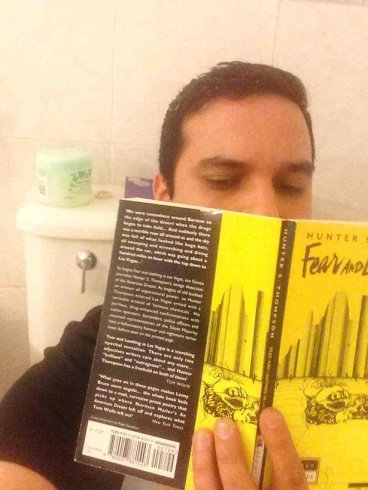
The viewer is allowed access only to that which has been carefully selected. Now you may say that is not true because you know of someone who posts every single moment of their lives without prejudice. I will argue that even those that post pictures as they sit on the toilet or looking like they just fell down a flight of stairs have made a very deliberate choice in what they have shown. With these pictures, they are saying, “I am confident enough to show you all of this. Are you this confident?”

Toilet Selfie

Nothing has changed since the time of the painted portrait. We use these pictures to show the world exactly what we want them to see. We want to look at a picture and remember who we are and what we have done. We ask the world to look at an orchestrated picture of ourselves and we want them to see as our very essence. Where we stand in society and how we see ourselves is all in a picture.

Posted by: kishi22s | November 17, 2015

Kara Walker’s Art

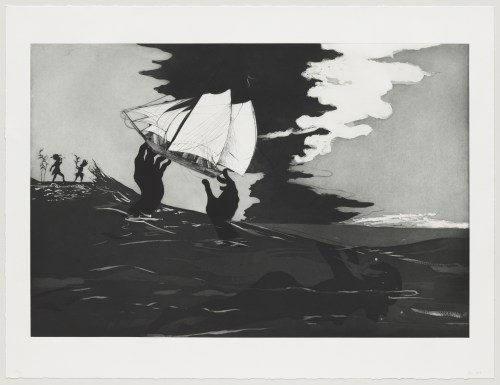
After our class visit to the MHC Art Museum, I wanted an excuse to share more of Kara Walker’s amazing prints and silhouettes!  Here is the one we saw last night:

no world

(Kara Walker, no world, 2010. [plate: 23 7/8 x 35 5/8″ (60.6 x 90.5 cm); sheet: 30 1/4 x 40 3/4″ (76.8 x 103.5 cm)]


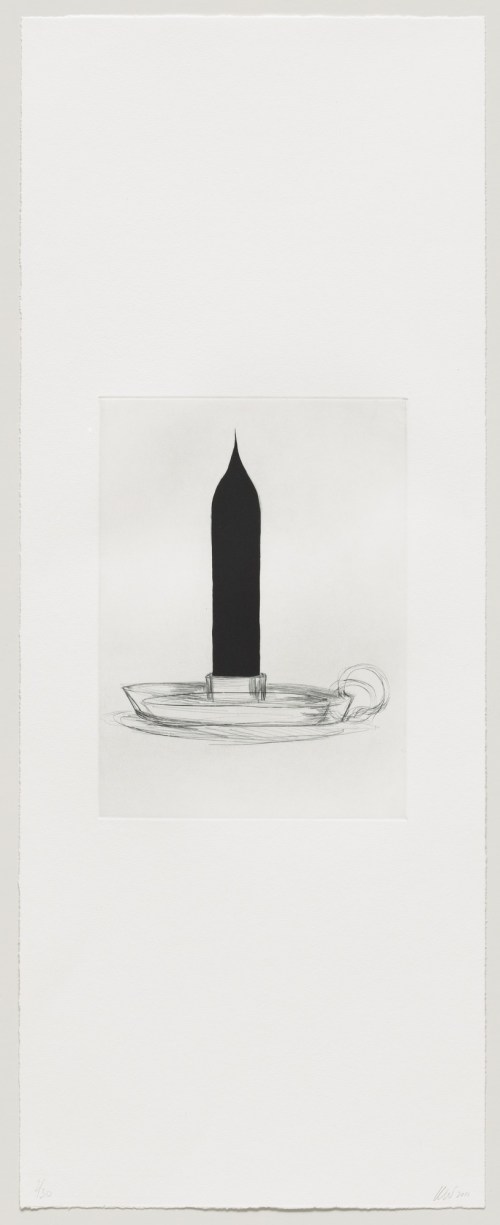
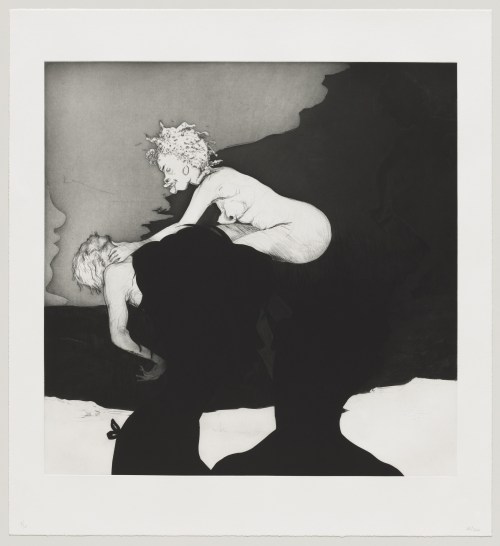
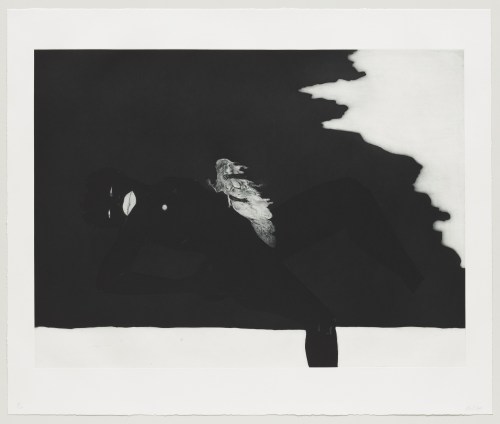
It’s actually the first of a series of six prints called An Unpeopled Land in Uncharted Waters.  I’ve included them in order here:

beacon

Kara Walker, beacon (after R.G.), 2010. [plate: 10 5/8 x 7-7/8″ (27 x 20 cm); sheet: 30 1/4 x 11 7/8″ (76.8 x 30.2 cm)]
 

savant

Kara Walker, savant, 2o10. [plate: 24 x 13 7/8″ (61 x 35.2 cm); sheet: 30 1/4 x 17 7/8″ (76.8 x 45.4 cm)]


the secret sharerer

Kara Walker, the secret sharerer, 2010. [plate: 23 3/4 x 23 3/4″ (60.3 x 60.3 cm); sheet: 30 1/4 x 27 3/4″ (76.8 x 70.5 cm)]


buoy

Kara Walker, buoy, 2010. [plate: 23 3/4 x 32 1/8″ (60.3 x 81.6 cm); sheet: 30 1/4 x 36 1/4″ (76.8 x 92.1 cm)]


dread

Kara Walker, dread, 2010. [plate: 23 7/8 x 11 7/8″ (60.6 x 30.2 cm); sheet: 30 3/8 x 15 7/8″ (77.2 x 40.3 cm)]

As with a lot of Kara Walker’s work, I have a hard time unpacking the layers of symbolic and stereotypical imagery contained in this series.  I’m especially confused by savant; I think it is a black woman, with her face covered by a white mask or bonnet, and some sort of flying insect (a fly or bee) to the left of her face.  The word “AGAIN” is written above the bow at the top of the mask (in quotes), and background is split in half–gray on the top, and white on the bottom.  I think this piece asks if color determines intelligence, then crushes the idea with an absurd mask on a person.  They cannot see, speak, or even breathe, suffocating the woman as she tries to meet the societal standards of 19th century America.  I still don’t know what to do with the fly or the words, and would love some input on what all of you think!

If you’re interested, I also found an amazing video on Kara Walker from PBS, which shows how she works and creates, as well as why she uses specific forms of imagery together.  It’s about 50 minutes, but the first 15 minutes show her setting up and cutting the images for an installation.

http://www.art21.org/videos/episode-stories

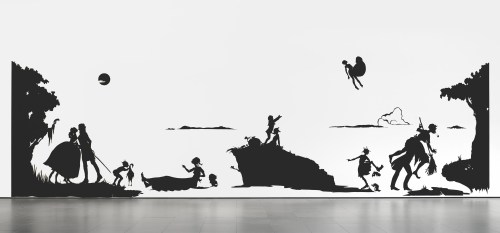
And, because I am so fascinated by her art (and wanted to show the scale and gorgeous craft in her paper silhouettes), here is one of her first installations, based on the novel, Gone with the Wind.

Gone

Kara Walker, Gone: An Historical Romance of a Civil War as It Occurred b’tween the Dusky Thighs of One Young Negress and Her Heart, 1994. [Overall 13 x 50′ (396.2 x 1524 cm) ]

(For more information, here is the link to the MoMA entry for the installation: http://www.moma.org/collection/works/110565?locale=en)

Posted by: mpura | November 16, 2015

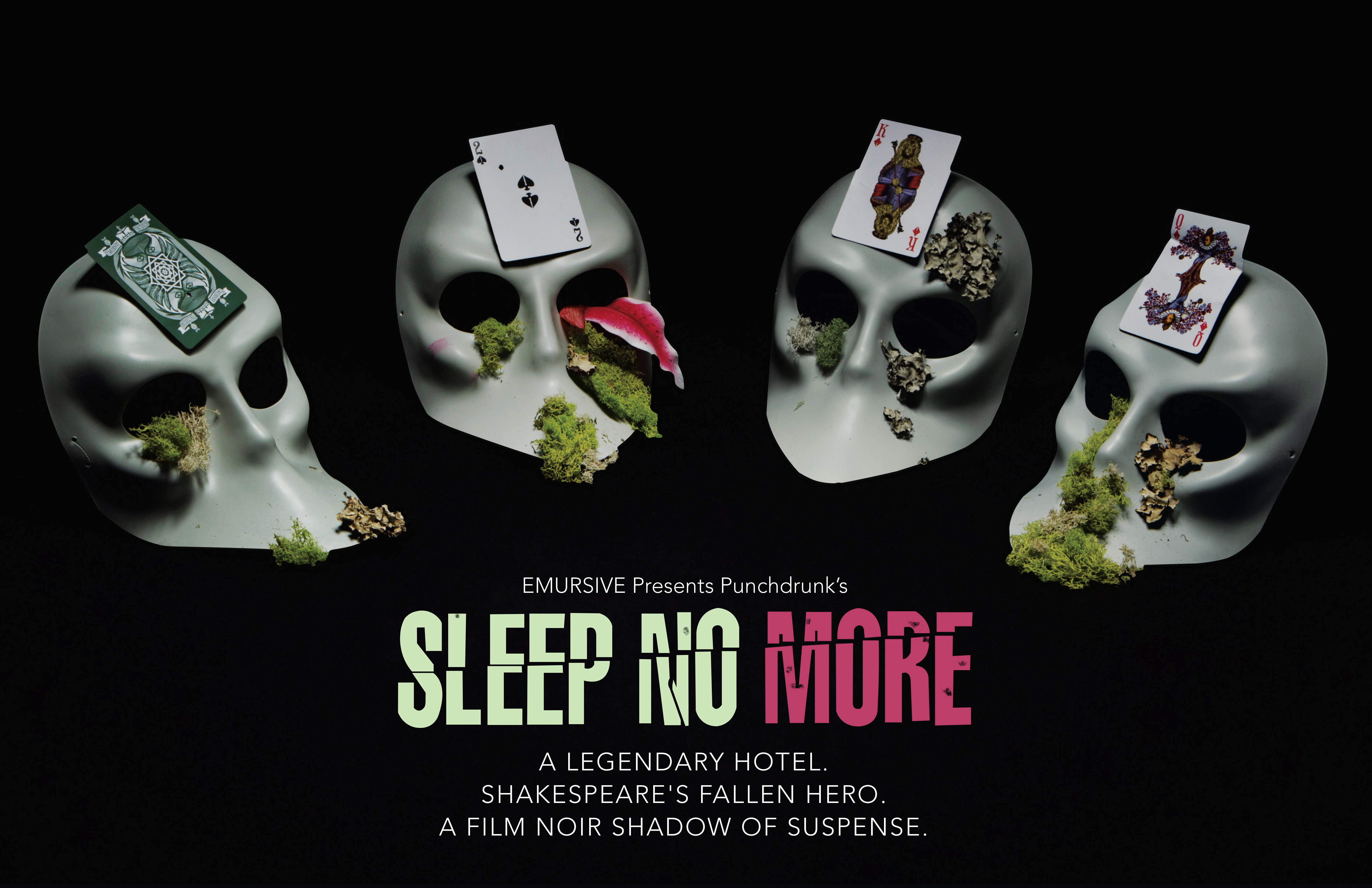
“Sleep No More”: My Night of Visual Chaos

sleepnomore

I am currently taking a Shakespeare course at Amherst College. We have read several plays ranging from, “Richard III,” “Romeo and Juliet,” “Henry IV,” “Much Ado About Nothing” and most recently, “Macbeth.” This is not just a text based class. My professor encourages us to visualize the process of staging in each of the plays that we read. What should the actors be doing? What space are they working with? How visually stimulating should the set be? Different companies answer these questions in different ways.

“Macbeth” is a play that is particularly hard to stage. If anyone is familiar with this play, there are scenes of witchcraft, bloody battles, murders, banquets, etc. With all of these challenging scenes to stage, the director must create a visually stimulating experience without confusing the audience.

A couple weeks ago my professor took my class on a day trip to New York City to see a play entitled “Sleep No More.” This play was an interpretation of “Macbeth.” But it wasn’t on a stage. In fact there wasn’t even a theater. This was going to be an immersive theater experience. The entire play was going to be using every inch and level of a five-story building in the middle of Manhattan.

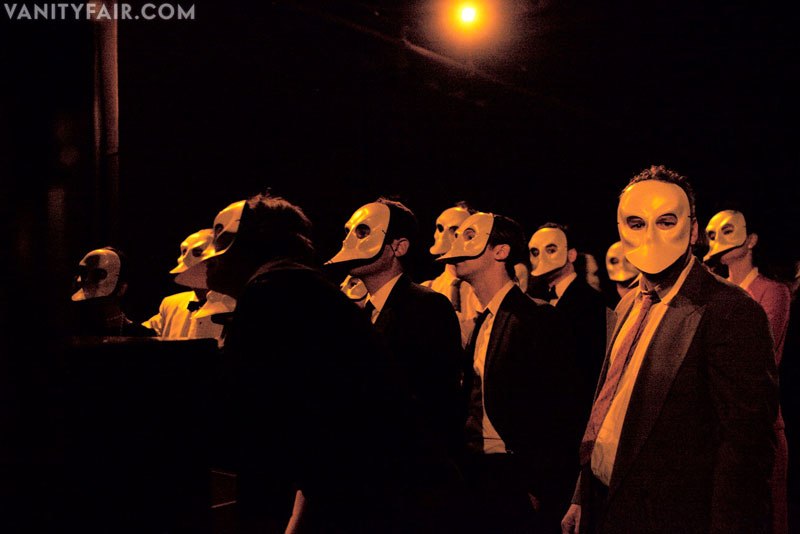
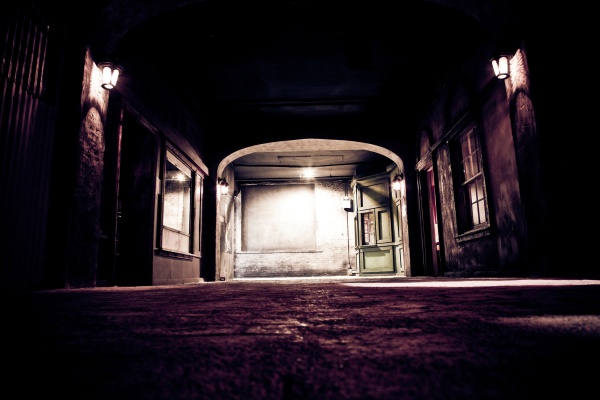
When we walked into the building, we were overwhelmed by a dimly lit hallway, surrounded by a deep musical ambience. When we reached the end of the hall, we walked into what looked like a 1930’s cocktail/jazz lounge. The room was decorated in rich and velvety couches enveloped in a smoky haze. When our group was called, a man dressed in a well-tailored suit and bow-tie greeted us. “We’re gonna get started in a hot second baby dolls. We ask you to lower your voices as we enter the hotel.” This then confirmed my initial suspicion that the play was going to be set in the 1930s. But in a hotel? My group proceeded to crowd into an elevator where the man in the suit began to pass out what looked like plague masks. “For the next few hours you are going to be wearing these masks. It will give you anonymity.” My muscles began to tighten with anxiety and anticipation. Putting on the mask made me feel as if I was stepping into the role as a voyeur. That would be my identity for the next three hours. “Now it’s best if you do this alone.” Was this a play or a haunted house? As the elevator ascended, I could feel the tension building. When the door opened I followed the crowd out into another dark hallway. I didn’t know if I should stay with the group or go off on my own. I didn’t want to get lost, so I stayed with the group.

item2.size_.0.0.sleep-no-more-ss03

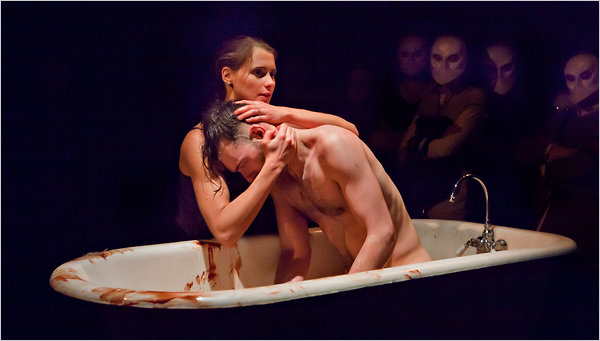
Going down the hall I started to see a sequence of rooms on either side of the hallway, intricately decorated to portray a home-like setting. But we continued on down the hall. Suddenly an eery melody echoed in the air and a light burst through the end of the hall. When I reached the source of the light I found myself in a large space with cobble-stoned floors and a space within the space surrounded by glass. Through the glass I could see two figures. One of them was completely naked. When I reached the inside of the glass enclosure I saw the two figures standing atop a pedestal with a bathtub in the middle. The man and woman were silent. But you didn’t need words to understand and feel the pain they were experiencing. The man stripped down naked, covered in blood, and dropped into the bath. The woman frantically scrubbed him down with her bear hands. Then suddenly the man let out an unnerving scream. She held his wet body against her chest. This moment, this iconic moment I could not mistake. This was Lady Macbeth washing King Duncan’s blood from Macbeth’s body.

SLEEP-articleLarge

This scene, so intense and intimate, made me feel like I was intruding on a private moment. Was I going to feel like this for the next three hours?  I knew that I was about to experience a play focused purely on visual stimulation. Once Macbeth was bathed, he leapt out of the bathtub, dressed himself and ran out of the room. This was the moment where I had to make a decision. I could follow Macbeth or I could stay and watch Lady Macbeth. Overwhelmed with the decision, I decided to follow Macbeth, thinking that I would be able to find most of the main plot through him.

There group of us following Macbeth were led down a long and wide hallway that looked like a small street. The floors were lined with stones and from left to right, there were doors leading to shops and bedrooms. I did not realize until later that I could actually go into each of these spaces to explore.

sleepnomore2

In the mean time, I raced after the troubled Macbeth. He swayed back and forth, bouncing off of the walls, struggling with his guilt. Suddenly he took a sharp turn into a narrow alley. It was dark and cold. Suddenly I realized that most of the group had left and it was just me, walking down this seemingly endless labyrinth. I was completely alone in this world. Then I began to hear what sounded like music you would hear at a rave. It was screechy and techno. Then I could see a doorway at the end of the alley. There was an intense flickering of light, a strobe light, that pierced my eyes. Walking into the strobe, I found a crowd of audience members in there masks watching something my eyes were not prepared to see. The strobe light was hard enough on the eyes. But through the intense light I could see two women half naked and a completely naked man wearing a devil-like mask. In the strobe and haunting techno music, the three disturbing figures danced convulsively. Macbeth swayed with their movements. It was as if they were performing a ritual. With that in mind I realized that I was watching an interpretation of the witches scene in the play. If the actors were trying to depict the horror and madness of the scene in the play, they most certainly succeeded.

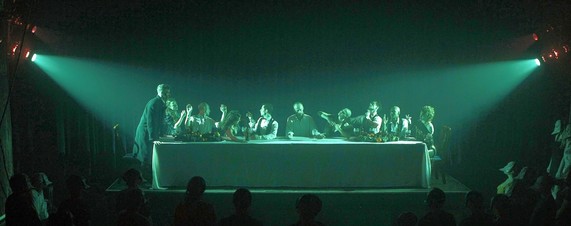
I have to admit, that was the one scene I was happy to leave. My eyes were burning from the intense visuality. So I returned to the alleyway. I soon reached a set of stairs. Walking up to the next floor I found myself in a large ball-room space. There, all of the actors gathered around a long table. They were performing the famous banquet scene. Macbeth sat on the far left, while Lady Macbeth sat on the right. As you can see in the image below, there was this vibrant light shining over the table. I will remind you that there was no dialogue. It was all about body movement. So each of the characters would move in this almost slow-motion like way, whispering in each others ears, stealing a kiss, caressing a cheek. Bear in mind at this point, Macbeth has just killed his comrade Banquo. In fact I had just witnessed the murder in a makeshift-bar made completely out of cardboard. There I watched Macbeth fight Banquo to the death in an incredibly well choreographed fight/dance scene. It ended with Macbeth bludgeoning Banquo with a brick. Not something you see too often in theater.

To get back to the banquet, you could see Macbeth eyeing Lady Macbeth. They have succeeded in their mission to attain power. But now their disintegration into madness has begun. Suddenly, Banquo’s ghost enters the scene with blood dripping down his face. He joins the banquet as if nothing has happened. As Macbeth rises to make a toast, so does Banquo. Macbeth stares in horror. With that, the scene disperses and the characters return to their assigned locations throughout the building.

NY-BK034_CURTAI_F_20120103232200

Now that I had become more comfortable with this experience, I started to drift away from Macbeth’s plot to wander on my own. I went up floor after floor where I would find more incredibly detailed rooms and spaces. I found an entire floor covered in darkness. The floors were festooned with dirt and rock, mimicking a graveyard.

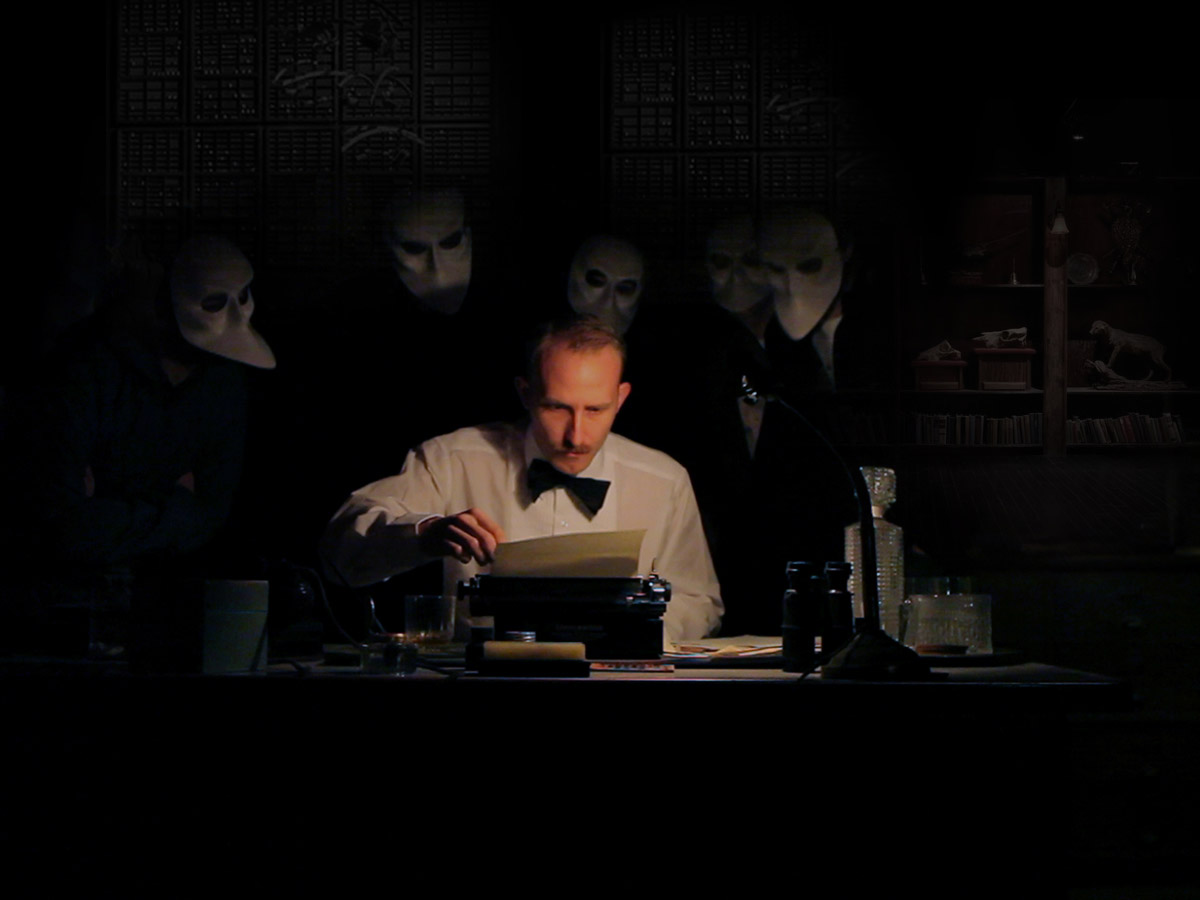
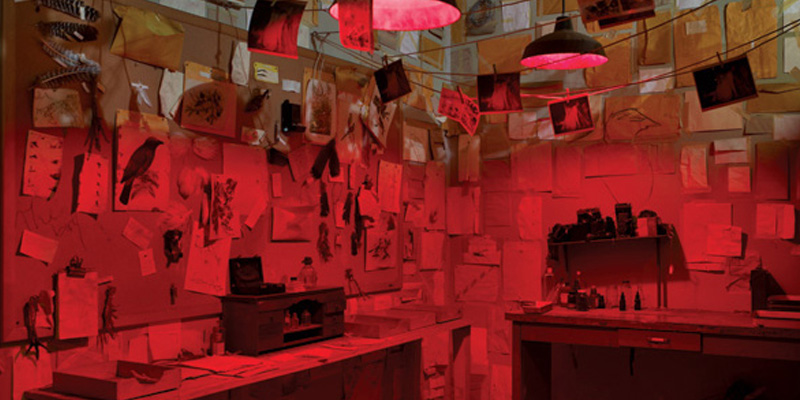
I then decided to return to the street set-up. Going into one door, I found a shop completely covered in bird carcasses. In another room I found what looked like a detective’s-office. In the front were desks covered in letters and papers pasted on the walls. Looking around, other audience members were picking up the objects to closer examine them. This was not only immersive but interactive. So I could sift through books and papers laid out on tabled, looking for clues. I could go several minutes in these rooms without a single actor performing. But suddenly, one would appear. In the detectives office, one of the actors would go about his business sifting through drawers and hanging up papers. Then he would sit down at his desk and start typing something out on his type-writer. As you can see in the photo below, the audience is looking closely at what the actor is doing. That’s what I did. I placed my head right over his shoulder and closely read what he was typing. It was a line from the play. In fact, the room was covered with lines from the play or news updates on the actions of the play. Even though this production was completely devoid of dialogue, you could not only follow the narrative through action but through all of these written clues.

1sleep3EDITED Malcolm back room Sleep No More Katie Fleming_9051znc4gi

An audience member could get away with walking aimlessly throughout the set without following a single actor. Eventually one of the actors would walk in on you. You could also choose to follow a minor character without once seeing Macbeth or Lady Macbeth. But what if you wanted to have both experiences? Well, you could. The sequence of the play repeated three times. So you could follow Macbeth in one cycle, Lady Macbeth in the next, or wander aimlessly in the final sequence. The play gave you countless narratives within the plot to follow. Each one provided you with different visual experiences.

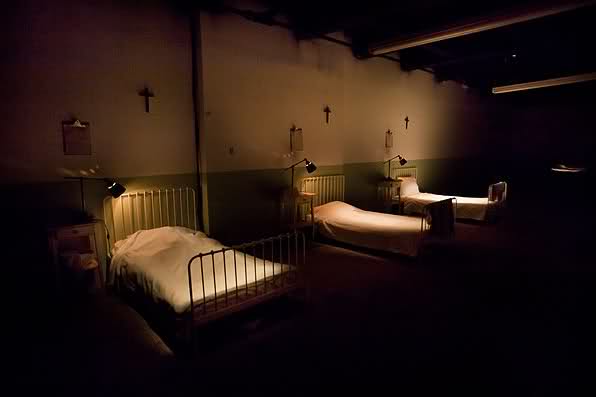
At one point I decided to follow Lady Macbeth, who really made you run up the stairs to catch her. As we ran after her I could hear her sobbing. Again, I had this feeling of intrusiveness. When we got to the top of the floor, we entered a cold room decorated to serve as an infirmary or insane asylum. Lady Macbeth moaned and curled up into one of the beds. When one of the nurses came to assist her, she started to strip down naked to bath herself. Here we witnessed the famous washing of the hands scene. One moment she would be scrubbing nothing and then blood would suddenly appear. We watched the vulnerable Lady Macbeth, naked and filled with fear. I soon left, feeling as if I had to give her privacy, which of course was not true. But the experience made you feel uncomfortable in your role as the viewer.

In each cycle, I was able to witness moments of vulnerable nakedness, overwhelming light shows, expressive dance-like movement and room-upon-room filled with disturbing and elaborate themes. Each moment, every character, was a single snap shot. Each snap shot told the story of Macbeth in different ways. In fact, I found that I had a better understanding of the play through this visual stimulation as opposed to rapid dialogue.

Citation/Link to Sleep No More site:

http://www.sleepnomorenyc.com/#share 

A noted sculptor, Jane South’s path to the present, her inspirations, and her advice, all provide the context and struggle behind her artwork.  Currently the Interim Head of the Sculpture Department at RISD, South’s lecture showed her teaching experience, relating various struggles in her life with humor and self-confidence to her audience.  She chose to show not only how her art changed through time, but also what made a difference and why looking back matters.  It didn’t feel like an introduction to her art or a story of her life, nor did she simply present the “highlights” of her art and flip through unending slides of pictures; to me, it felt cyclical and understandable, as though she was reading selections from a journal or going through various memories.  She gave me the “epiphany” moments, explaining each and always returning to the whole of her artistic work.

Growing up in England, South’s earliest point and interaction with art occurred from visits to her Grandfather in the North.  A draftsman, he had many books of his trade, detailed line drawings and etchings of architectural and other build-able plans of objects.  Another inspiration is an unfinished Renaissance painting, showing an angel coming out from a building.  I would simply pass by it, but the seemingly random painting fascinated her.  The lines showing the perspective of the room behind the painted wall, the contrast of finished and unfinished space, leading her to a major theme in her work: “constructed reality.”  She doesn’t mean completely fabricated paintings or sculptures of random objects and spaces, instead, she looks at the illusion of space; the “fakery,” what is “wrong” or “false,” and somehow without functional use.

However, Jane South made her thoughts very clear—this understanding of the attraction and connection between her art and these early memories came after decades of hard work and creation (and usually pointed out to her by others, such as her mother).  Her choice to step back and look at the whole of her life, sharing the moments when you feel like slapping yourself for not seeing the painfully obvious, made this event less like a lecture, and more like a fun conversation between friends.

Without visual art at her high school, South began to work in her school theatre program, building the sets and backgrounds framing the stage space.  Unsurprisingly, she ended up majoring in Theater Set and Costume Design at St. Martin’s in London (college), and worked in an experimental theatre production company for a while.  Yet, she still didn’t feel content and fulfilled with the work, though she enjoyed the challenge of presenting a representative, temporary space to an audience, much like the earlier painting functions.  So, moving to New York, she began to re-examine what parts of art gave her the most joy.  After a very unsuccessful sculpture, she saw the best part of creating came from drawing: the skeletal, simple lines, and the moment when ink seeps into the paper (a squishy, “magical transformation,” according to South).

Extracting line from everything, her art began to dematerialize architecture, wanting to add or subtract from the dimensionality of space.  Frequently, her sculptures feature optical illusions made up of crosshatching lines in circular forms, appearing to move in space without physically moving.  They resemble air conditioning vents and hamster wheels, random and manufactured cylindrical objects, strangely delicate despite their metallic, machine appearance.  As the viewer approaches, the pieces become even more apart from reality, their almost obsessively perfect construction combined with the simple materials of paper and ink.  South relies on her craft, or how carefully and cleanly she makes her art, to bring the viewer into the exhibition space, willing them to examine the odd, clustered objects of various sizes that form the child-like dream clouds of sculpture.

Most recently, she finally saw theatre connected the machines and the architectural three-dimensional series of sculptures.  The result was a sculpture miming the backstage of a theatre, an unseen, hidden space of potential where something should happen or should form before an audience.  Hanging above the viewer, it resembles all of the speakers, wires, lights, and other electrical parts of a production, objects obvious and necessary for a modern performance, but still hidden and ignored.  The “reality” of the theatre is the stage, a space with unlimited possibilities, but most successful when it appears to be everyday and natural, not manufactured.  Jane South’s sculpture shows exactly what a space should not, the framework and foundation making up a space.  It calls the viewer to explore the forbidden, self-generating reality and complete fiction, as each part of the experience is made from paper, mimicking the shape but not the physical use of the assumed objects.

In this way, Jan South creates environments and conditions around a viewer, without performance, an equal relationship between the people and her art.  The viewer does not need to perform anything in the space, yet the space seems to demand it from their presence.  Finally, her last few works deal with the after-effects of a production, taking down the reality from the space of a stage.  Instead of neatly held above the viewer, the collection of objects seem to be splayed out on a stage without order or method, showing another obvious, yet unconscious, part of the theatre to a member of the audience.  The space ceases to exist when the audience leaves, the before and after completely invisible to the average viewer.

From this amazing introduction to Jane South’s work, I felt more like a freshman, to whom a senior tries to explain how she created a piece of work, and why it is important.  She did not treat me (the audience) with any presumption of her work’s fame, or how influential it might be, she simply gave me insight into a fellow artist’s creative process.  Most humanizing was her comment on her latest piece, saying, “So that’s where I am,” proving her future shares the same uncertainty as my own.  Though I have not seen any of her work personally, the photographs and explanation of her work gave me context, taking me beyond the physical experience of the piece.

Jane South’s idea of presenting the unseen connects with many of the ideas in Victorian literature, trying to give a voice or attention to the ignored people, places, and events in the world (like the poor, or the starving people in the Irish Potato Famine). While this might seem extreme, South’s art is extreme—she intentionally makes individual pieces of art without meaning, and placing them collectively to create feeling in the viewer.  Charles Dickens’ Bleak House functions in the same way: a collection of random events when discussed alone, yet representing a greater mystery in modern Victorian life to the reader.

Posted by: kishi22s | November 6, 2015

Inspector Bucket: A Ghost of “Bleak House”

I know it’s been a while since we read Bleak House, but after my paper on Lady Dedlock and Esther’s dependent, mother-daughter relationship, I keep returning to the ghost-like abilities of certain characters in the novel.  Specifically, Inspector Bucket functions as a free-form, adaptable figure.  He does not seem to be held down by class distinction and strangely provides order wherever he travels.

Inspector Bucket’s experience allows him to relate to the middle and lower classes, while his authority from the police allows him to see and speak with the upper classes.  He ascends class because of his duty to uphold the law, while both following the law himself as a member of the London population.  As we discussed in class, Dickens constantly uses photographic, visual language to describe his attitude and manner (not his sight).  For example, the reader’s first introduction to Inspector Bucket (introduced initially as Mr. Bucket…again, a doubleness of the normal and the officer) occurs in Mr. Tulkinghorn’s office as he is talking with the slimy Mr. Snagsby:

Mr. Snagsby is dismayed to see, standing with an attentive face between himself and the lawyer at a little distance from the table, a person with a hat and stick in his hand who was not there when he himself came in and has not since entered by the door or by either of the windows.  There is a press in the room, but its hinges have not creaked, nor has a step been audible upon the floor.  Yet this third person stands there with his attentive face, and his hat and stick in his hands, and his hands behind him, a composed and quiet listener.  He is a stoutly built, steady-looking, sharp-eyed man in black, of about the middle-age.  Except that he looks at Mr. Snagsby as if he were going to take his portrait, there is nothing remarkable about him at first sight but his ghostly manner of appearing. (Chapter 22)

Dickens emphasizes the “attentive face” of Inspector Bucket, repeating it twice within the short passage.  In general, the novel constantly returns to the way Inspector Bucket observes the chaotic city and individuals.  Of course, the police system is a fairly new organizing force at the time, but Dickens’ fascination with Inspector Bucket’s sight almost reduces him to an all-seeing eye.  With his “sharp-eyed” appearance, this unearthly man “looks at Mr. Snagsby as if he were going to take his portrait.”  Inspector Bucket seems to capture Mr. Snagsby’s image and likeness as a kind of knowledge; he does not need a camera because he is the camera, making his sight a source of truth, accuracy, and power.  The fear and unknown of the camera’s possibilities, as well as the lack of control with an image’s reproduction, makes Inspector Bucket’s camera-like identity a dangerous tool.  He is omniscient and almost “God-like,” yet his normal, “middle-age[d]” appearance allows him to blend into the background, an invisible figure asking for order through sight.  This man with “nothing remarkable about him at first sight but his ghostly manner of appearing,” causes fear in Mr. Snagsby, who usually operates by using people and knowledge at the edge of the law.  If Inspector Bucket cannot be watched for, his power cannot be protected against; I mean that because he looks so normal, you don’t know when he will suddenly appear.  This potential for trouble also gives him another tool of control, extending beyond his physical person.  Together, Inspector Bucket becomes a man with the invisible force of power, the ability to appear at will, and instilling order and fear without his own presence–essentially a ghost in the disguise of an average man.

Work Cited

Dickens, Charles. Bleak House. 1853. London: Penguin, 2003. Print.

« Newer Posts - Older Posts »

Categories