Posted by: mpura | November 4, 2015

The Male Gaze in Mediums of Visual Culture

male-gaze

I dare you to go up to any woman and ask them if they have ever been cat called on the street or looked at strangely by a stranger. I guarantee that every woman you talk to will say YES. I can recall multiple occasions where I have felt the uncomfortable presence of a pair of lurking eyes behind me. It leaves you with a sense of powerlessness. You feel dirty and objectified. But you really can’t do anything about it. In feminist language, this action imposed upon women is known as the male gaze. This is certainly not a modern trend. In fact it is not only present in real life, but in all other forms of visual culture and literature.

In my last post I talked about the visual pleasure gained and exploitation of the lower classes on the part of the upper classes. The act of looking becomes a performative ritual.

I wanted to continue this discussion surrounding the act of looking. But instead I would like to turn your attention to the visual exploitation of the female body in literature and photography (or photography/imagery within literature). In the majority of the texts that we have read, such as Bleak House, “Scandal in Bohemia,” “The Burden of Representation,” there are central themes surrounding the way a women’s body is betrayed and how it is looked at. What is gained by looking at a woman’s image? Is the audience a primarily male one?

image

I was inspired by a recent reading entitled, “Visual Pleasure and Narrative Cinema,” by Laura Mulvey. Although Mulvey talks about the exploitation of women’s bodies in film, her points can be applied to every medium of visuality. Here she defines what the male gaze means and what it does. Mulvey writes, “Woman then stands in patriarchal culture as a signifier for the male other, bound by a symbolic order in which man can live out his fantasies and obsessions through linguistic command by imposing them on the silent image of woman still tied to her place as bearer, not maker, of meaning” (Mulvey, 15). The very act of looking gives power to the viewer, while the subject is made a vulnerable. The image can do nothing but maintain its static pose, while the male viewer gains pleasure from the sight.

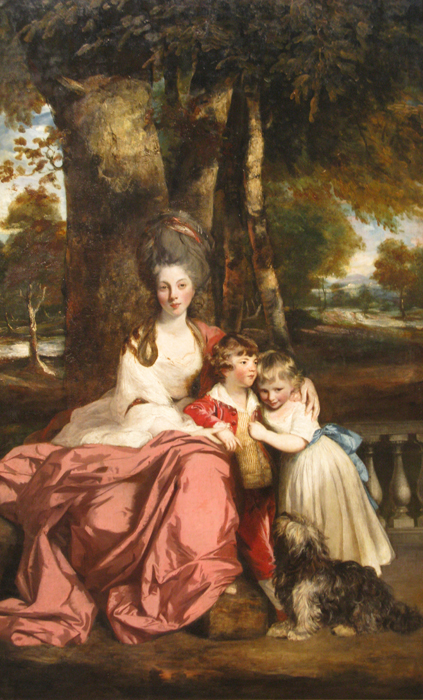
Lady Elizabeth Delme and Her Children (Sir Joshua Reynolds) (1779)

During the first class of the semester we looked at the portrait of Lady Elizabeth Delme and Her Children by Sir Joshua Reynolds (1779).  Lady Delme is adorned in signifiers of wealth and beauty. She is a symbol of domesticity and aristocratic performance. But why would this be painted? Yes, photography didn’t exist at this moment in time, so capturing one’s image through painting would have had an element of importance. But would Lady Delme primarily be looking at this image of herself. No, this image was commissioned by her husband. Lord Delme hired a painter to capture the image of his wife. Like the portrait in the poem “My Last Duchess,”by Robert Browning, Lady Delme is confined to the portrait and has no control over who can look at her body. This painting is made specifically for the eyes of Lord Delme. You could say that he may have gained pleasure from the sight of this image of aristocratic beauty. Here is an example of what Mulvey discusses in the above quote. Lady Delme is the silent image that poses while an instilled patriarchal system of looking maintains control over how she is looked at and who can look at her.

The same idea is present in Bleak House, by Charles Dickens. Lady Dedlock’s portrait becomes a major symbol in the discussion of visual objectification. Her portrait is one of many portraits of past Lady Dedlocks lining the halls of Chesney Wold. Her image becomes a part of a wide collection of women who take on the vision of aristocratic beauty and values. Each Lady Dedlock is owned and seen by each Lord Dedlock. But the audience changes when Mr. Guppy visits Chesney Wold. He is overwhelmed by her beauty and familiarity. We eventually find out that he recognizes her because she is Esther Summerson’s mother. The gaze of Mr. Guppy is a disturbing one.“The portrait over the chimney-piece, painted by the fashionable artist of the day, acts upon him like a charm” (Dickens, 110). His long, drawn out preoccupation over her image creates a subject and voyeur relationship. He’s now looking at something/one that he shouldn’t be looking at. Lady Dedlock’s portrait thus becomes a possible titliating visual not only for Lord Dedlock, but for Mr. Guppy.

To continue Mulvey writes, “In their traditional exhibitionist role women are simultaneously looked at and displayed, with their appearance coded for strong visual and erotic impact so that they can be said to connote to-be-looked-at-ness” (Mulvey, 19).

Irene_Adler

The visual and erotic go hand in hand in these examples. In the Sherlock Holmes story, “A Scandal in Bohemia,” Irene Adler’s photograph becomes a tool of control and display of the erotic. Irene Adler is most certainly a strong and intelligent character within the Sherlock Holmes series. Through photography she is able to maintain control over men. However, in the end, even though she is able to outsmart Sherlock Holmes, he maintains a grasp on her image. For payment, Sherlock asks the King of Bohemia for Irene Adler’s photograph. “What a woman-oh what a woman!” the King of Bohemia proclaims. “Did I not tell you how quick and resolute she was? Would she not have made an admirable queen” (Doyle, 14). Adler is described as this desirable woman who cannot be possessed or outsmarted. She appears to change Holmes’s opinion of women. But she does not change patriarchal domination over her body. The act of handing over the photograph of Irene is an act of objectification. She is passed from hand to hand, an object of transaction. We don’t know what Holmes will do with this photograph, perhaps add it to his file. But he now has ownership over her image. The photograph used by the King for his own personal gaze, is now for Holmes’s gaze. This image therefore has a the purpose of “to-be-looked-at-ness.” This is the one way that male characters can maintain control in a situation where they have become the weakest links,

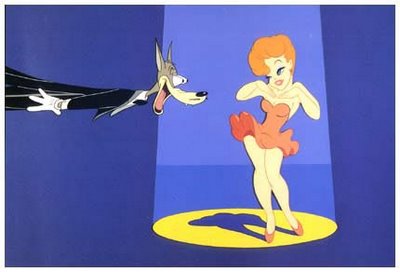
tumblr_n0uxoi75Ta1tsgdl0o1_500

These literary figures and painting subjects give us different ways of understanding the male gaze. Visual culture in 18th and 19th century literature and painting have most certainly evolved to a hyper-sexualized world of visuality geared towards a specifically male audience. Advertisements, commercials and music videos monopolize on the female body. Sex sells, as they say. Women’s bodies are perpetually put on display to entice a male audience. As an example of a modern image that caters to the male gaze is a Dolce & Gabbana ad from 2007. At first you might think this add is geared towards a “female”audience with the majority of the people being shiny, shirtless men. But in fact this controvercial is all about the male gaze. Four men, watch or gaze upon the body of a seemingly submissive model. As she looks away, a male model pins her down in an erotic position as he looks at her emotionless face. Dolce & Gabbana came under fire for this ad because it appears to promote gang rape. The female model is made into a sexual object while the other models use her. The male customer can look at the image as the models look down at the woman. It creates a doubleness to the male gaze.

Posted by: Joyce Linnet | October 26, 2015

The (Supposed) Link Between the Body and Personality

One of the aspects that especially interested me in the Sekula piece, The Body and the Archive, that we read for last class was the idea coming forward in the Victorian era and beyond that with a few pieces of information we can put together what a criminal looks like. Based on shape of a person’s head or their skull (the taking and examining of which is an ethical gray area that I will not even begin to get in to for the sake of time), we can tell that this person is a criminal or just a bad person who isn’t fit to live in a society that believes in wholesome activities like not murdering and stealing (and collecting body parts for scientific inquiry without any consent from the deceased. Sorry, last time, I swear). In today’s society, calling someone a criminal based on appearance is usually a form of stereotyping and would generally be frowned upon. Not to mention the fact that presenting a picture of a suspect’s ear to witnesses in court would sooner get you laughed at in modern society than it would win your case. Most every one knows that, for the most part (barring an prejudices that everyone holds within themselves), there is no real link between appearance and likelihood to commit a crime. Still, like most “science” from the past, we like to have a good laugh about how silly everyone was in the past and move on with our lives in the much more advanced present.

Still, using the body as a way to determine a person’s personality is not merely an antiquated Victorian ideal done away with by new science. Because the personality has always been so difficult to pinpoint and to define a person and predict their tendencies would be useful, it has always been particularly interesting to try to sort people into “types” because apparently accepting the fact that every human being is a special snowflake is completely unacceptable and human beings are only happy if there are “types” of people that exist. For example, phrenology (which is definitely considered a pseudoscience, not just on account of it being super incorrect and more than a little bit racist) was accepted as a way to determine a person’s personality based on the idea that the brain was made of 27 smaller organs and using certain measurements but mostly by having a doctor run his hands over a patient’s skull, they could tell what type of person you were. By the 1840s, phrenology mostly fell out of fashion but up until then it was used to determine things like whether a child would need to be held back in school or saying women were inferior to men or that whites were more beautiful and far superior to literally every other race, no questions asked because this is science, you guys.

goodhealthV2-paperrelics

Still, that wouldn’t be the first or the last time that a faulty link between the body was made with one’s personality. For example, humorism was a popular practice that found its way into the very serious field of medicine by which a person suffering from a certain temperament (and there were four of them: sanguine, choleric, melancholic and phlegmatic) was thought to have too much or too little of a certain body fluid resulting in an imbalance that threw off the whole body’s ability to function. Sanguine corresponded with blood, choleric corresponded with yellow bile, melancholic was black bile and phlegmatic was, you guessed it, phlegm. These humors were given personality characteristics and so a person described as sanguine was generally considered to be “courageous, hopeful, playful and carefree”, for example. One thing I will bring up that is tangentially related to the humors is the idea that blood type determines a person’s personality. This was apparently very popular in Japan for awhile with the theory being that you can determine one’s personality based which of the four blood types that they have: A, O, B or AB, taking our Type A and Type B personalities to a whole different level. Science has found that there is no link between personality and blood type but like everything from the Myers-Briggs test (which is super not accurate in predicting personality, even according to one of the people who created it) and astrology, it is pretty fun to think about and then use to tell people about yourself even though it doesn’t really mean anything at all in a scientific sense.

The last personality by body typing idea that I want to bring up is called somatotype psychology developed by a psychiatrist William Herbert Sheldon and like phrenology ended up being used to further things like racism and eugenics and is not considered to be based on any actual science at all. Somatotype psychology presents us three body types: ectomorph, endomorph and mesomorph. Each one is associated with a certain set of personality traits. For example, an endomorph was considered to be round, short and essentially, overweight, which led to them also being considered slow and lazy and an ectomorph was too skinny and too tall and was considered fragile and quiet. Mesomorphs were essentially built like Superman being muscular and considered active, assertive and vigorous. Of course, most of this research was done mostly for men so what would be considered best for women is mostly unknown. Apparently, this was also created to pinpoint what a criminal looked like (both surprisingly and not so much, it was the competitive but muscularly built mesomorph who fell into this category). While this version fell out of popularity, it is not uncommon to see forms of a type of somatotyping under a different name using a different set of adjectives.

Still, in a world where Facebook posts and newspaper reports can tell me what the size difference between my middle and pointer finger show about my personality, this kind of pop psychology personality by body type link can and probably will not disappear any time soon even just in a way to amuse us.


Works Cited

Blood Type and Personality

Humorism – Wikipedia

Phrenology – Wikipedia

Sekula, Allan. “The Body and the Archive.” October 1986: 3. JSTOR Journals. Web. 26 Oct. 2015.

Sheldon’s Personality Theory

Somatotyping – Wikipedia

Charles Dickens’s Bleak House has an interesting narrative style, using first and third person perspectives to tell the story. The character of Ester, who is kind, maternal, and traditionally feminine, provides a first person perspective while the third person narrator is critical, sardonic, and superior.

The contrasting style of narration is sometimes incredibly jarring in the book. While it’s a fascinating use of perspective, the switch could at times be hard to swallow. The juxtaposition of the third person narrator and Ester made me think of a pair with similar characteristics but a very different narrative and relationship. In the past few years there has been a rise in story telling through the relatively new medium of the webseries. There have been a number of new stories as well as quite a few modernized adaptions of classics which have utilized vlogging to tell the story.

The characters that the third person narrator and Ester reminded me of came from a webseries called “Nothing Much To Do” created by a New Zealand group called The Candle Wasters, which began in March of 2014 and concluded in October of the same year (though they are currently releasing a sequel series of sorts with many of the same characters). The series is a modernized adaption of Shakespeare’s Much Ado About Nothing told through a series of vlogs from multiple perspectives (in this case multiple YouTube channels). Two of the main characters, Beatrice and Hero Duke, share a channel on which they post videos, individually and together, and as characters they contrast similarly to the way in which Ester and the third person narrator do. Hero is the epitome of feminine and sweet while Beatrice is brash and derisive. The two are very different but, unlike the third person narrators feelings toward Ester, Beatrice and Hero hold each other in the highest regard.

The above video is the second in the “Nothing Much To Do” story line and the first in which Beatrice and Hero appear together. This is the first illustration of their relationship and dissimilar personalities and interests, including Hero expressing her desire to post videos such as make-up tutorials and shopping hauls while Beatrice makes a face at the camera. It also serves to give an example of their perspectives on other characters and how their personalities serve to warp those perspectives.

In Bleak House, Ester is Dickens’s (gendered) ideal. She is maternal (without being sexual) and kind, and annoyingly faultless at times. Much of Ester’s narration focuses on her feelings. While she is never unkind to others it is clear that Dickens is contrasting her to the characters in the book, particularly the other women, who Dickens characterizes as problematic, holding up Ester as the ideal standard.

The third person narrator has a more masculine tone and often mocks Ester. The narrator speaks in an incredibly superior and judgmental way, often looking down on characters as idiotic and pitiable.

Hero is similar to Ester in that she represents the more traditionally feminine skills and values. She exemplifies the feminine; she enjoys baking and sewing, talks about fashion and make-up, and believes wholeheartedly in the value of kindness and love. She is kind, never speaking a bad word about anyone, and believes in giving others the benefit of the doubt.

Beatrice, on the other hand, is more of a rejection of the traditionally feminine, which is not frowned upon but is a clear contrast to Hero’s obvious exemplification of it. Even the way they each dress typifies this, where Hero wears skirts and dresses and very feminine outfits and Beatrice wears t-shirts and pants. Beatrice’s interests are those typically presented as more masculine, such as science and football (though they are less touched upon than Hero’s interests) and she (initially) has no interest in love, calling it “disgusting.”

The third video in the series (above) further elaborates on the differences in attitude and personality between the two characters, including them impersonating one another.

Beatrice has plenty of critical things to say about others and is highly argumentative. Unlike the third person narrator and Ester, her unkind words are never directed at Hero because, though she sometimes teases her, she completely respects all of Hero’s choices and interests. Much like the third person narrator, Beatrice is superior and judgmental and, at times, cruel. And while this is alleviated a bit throughout the story her core character does not change, nor does Hero’s. Ultimately neither Hero nor Beatrice is presented as being superior to the other, rather they are simply two sides of the same coin and, unlike in Bleak House, neither girl needs to be fixed or held above the other (or any of the other girls in the story) to have value.

Bleak House’s contrasting narration style is that of two fundamentally different characters being pitted against one another in a way, for though Ester does not comprehend the third person narrator it is clear the two voices are meant to provide starkly contrasting views of the story. “Nothing Much To Do” provides many different perspectives but that same contrast in attitude and demeanor is found in Hero and Beatrice.  Ester and Hero serve to represent the angelic, hopeful narrator while the third person narrator and Beatrice provide the more critical, “realist” perspectives.


Works Cited

Dickens, Charles. Bleak House. London: Penguin, 2003. Print.

“Nothing Much To Do” – created by The Candle Wasters

Posted by: romola68 | October 18, 2015

Mr. Holmes, Observed

In Arthur Conan Doyle’s A Scandal in Bohemia, the detective Sherlock Holmes is portrayed as a cold, logical master of both observation and disguise. He is thus an observer who also evades observation. In this short story, he aims to make the actress Irene Adler reveal where she has hidden a damaging photograph. But in the act of revealing this, she realizes who he is, and she counters with an escape engineered partly by her own disguise. Holmes thus uncharacteristically fails to reach his goal, and his admiration for her skill is shown by the fact that the normally unsentimental Holmes keeps a photograph of her. Interestingly, however, the illustrations in the Strand Magazine never show us the face of this reported beauty–the only picture of Irene Adler veils the face, suggesting that even in a story emphasizing the visual, the illustrator apparently decided to let the reader’s imagination supply her image.

adler irene (2)

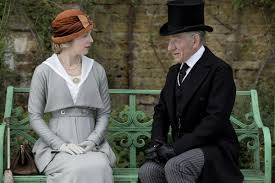
The recently released film Mr. Holmes shows an aging Holmes in 1947, reflecting on a past failure–in this case he had unsentimentally suggested that a depressed young woman who had lost two children return to her husband, rather than offer her comfort. She surprised him by committing suicide shortly afterwards.

images (2)

He then thinks about his last case, when he went to Japan to visit a man who informed Holmes that his father abandoned the family at Holmes’s request. Holmes insisted that he had never met this father, and the family was devastated. As the film progresses, and the son of his housekeeper (who had been helping him keep his bees) is badly stung by wasps, Holmes realizes that sometimes empathy must trump cold facts, and he confronts his earlier failures.

images (4)

The film, of course, modernizes Holmes by giving him a heart, but in a sense, it does more than that. The Victorian Holmes acts as an observer of others, who often avoids being observed. But in Mr. Holmes, the great detective finally turns his observational skills upon himself. This is troubling for him at first, but despite his faulty memory, he finds a way to make reparations and find peace. He writes to the man he visited, and alters the facts–he says he now remembers the father, and indeed this man had performed important work which should be commemorated.

This portrayal raises the question of whether compassion and introspection can co-exist with Holmes’ methods of deduction and observation, or if one is as fatal to the other as the wasps are to the bees. In the original stories, and many other adaptations, his aloofness is made a vital part of his talent. Even in this film, his talent in actually solving cases was at its best when he was less sentimental. It is a talent for resolving problems that seems to have been lacking earlier in his career.

Works Cited

Doyle, Arthur Conan. “A Scandal in Bohemia.” The Strand Magazine. January 27, 2006. http://sherlockholmes.stanford.edu/pdf/holmes_01.pdf

Mr. Holmes. Dir. Bill Condon. BBC Films, 2015. Film.

Posted by: kishi22s | October 5, 2015

Names in Charles Dickens’ Bleak House

After reading such a complex and chaotic book as Bleak House, I needed to find something to connect the various storylines and characters to one another, leading me back to one of my favorite subjects: etymology.  Etymology is the study of the origins of words and their meanings, especially a word’s development through history.  For me, researching the names of the characters in books adds another layer to the character’s purpose and personality, as well as references to literature, history, religion, etc.  Though I could go through every person in Bleak House, I have chosen to discuss Esther Summerson, since her name seems to me both heavy with religious meaning, and unexpected in the time and because she is a Christian.

Of the many characters, Esther’s name has the most significance and background attached to it.  In the bible, Esther has an entire book in her name, telling the story behind the Jewish holiday of Purim.  I’ll provide a brief description of the story to help with the possible connections between the biblical figure and any allusions in Esther Summerson’s story and character in Bleak House.

The Persian king, after banishing his wife for not obeying him (she refuses to come when he summons her after a lot of partying), decides to have all of the eligible virgin women brought to him, in order to choose a new wife.  Esther, a young Jewish woman, enters into this competition at the urging of her cousin and guardian, Mordecai.  Eventually, the king chooses Esther as his new queen, not knowing her religious identity (as a Jew).  Another plot line parallels this one, starting with two seemingly unrelated figures:  Mordecai, who saves the king from assassins (he overheard them planning); and a man named Haman, promoted to the second-in-command to the king.  When Mordecai refuses to bow down to Haman, Haman decides to take revenge on him by punishing all of the Jews, sending out a law (with the vague approval of the king) telling of a certain day when everyone loyal to the king should murder the Jews.  Mordecai warns Esther of Haman’s plan, and pleads with her to get help from the king to protect her people, suggesting her appointment as Queen is an act of God for this very purpose.  She agrees (though not immediately) to go before the king, inviting him and Haman to dinner in her rooms.

You might be asking, why is this such a big deal, especially since she is the queen?  Shouldn’t she be able to ask him anything she wants at anytime?  In this King’s court, however, anyone who comes before the king without his approval or invitation is killed, making this unannounced and self-initiated meeting by Esther extremely risky.  The king doesn’t seem to mind, and both Haman and the King come to dinner (which Esther repeats twice more).  After the first dinner, the King, unable to fall asleep, has his history books read to him, and finds that he never thanked Mordecai for saving his life.  He asks Haman to honor Mordecai the next day, increasing Haman’s jealousy.  During the third dinner, Esther dramatically reveals her cultural identity and the plan of her (likewise) enemy, Haman.  The King hangs Haman, appoints Mordecai to Haman’s previous position, and tells him to fix the problem.  Mordecai sends out another decree, telling the Jews that they can defend themselves and kill everyone who is their enemy.  They kill a lot of people over two days, which become the two days of Purim, celebrated for God’s plan to save them from extinction and their victory.

Although from such an important and sacred story to many major religions, the name Esther does not have a clear meaning.  Most of my research agrees on three possibilities: “myrtle,” “star,” or “a Hebrew form of the name of the Persian goddess Ishtar” (Hanks).  The first meaning of “myrtle” comes from Hadassah, Esther’s Hebrew name, possibly changed to Esther when translated into the Persian language.  The second, comes from the Persian language itself, possibly deriving from “stara,” meaning “star.”  Finally, the Persian goddess Ishtar (if you say it out loud it sounds fairly close to Esther) “was the Babylonian and Assyrian mother goddess who presided over love, war and fertility” (Campbell).

Applying all of this information to Esther’s story, I think it fits Esther Summerson’s character very well.  As one of the two narrators, the connection between nearly every character in the book, and the center of a mystery (and later, a murder), Esther is like a “star,” shining on the entire book and leading the reader through the fog of modernity to the happy ending of the book.  The myrtle tree, in Jewish literature and scholarship, represents “the righteous,” because “‘man is like a tree of the field.’  Therefore the righteous are called myrtles, likened to a good tree with a pleasant smell” (Zaklikowski).  Esther Summerson is extremely righteous throughout the book, constantly questioning her actions and humbling herself from any praise.  Because she was thought to be a still born child, and dead at her own birth, she was never given a name by her mother.  Therefore, her name comes from her Aunt (her Godmother, and her Mother’s sister), who raises her to make up for her illegitimate birth.  Perhaps this was a wish for her rising above any sin tainting Esther in her aunt’s eyes, while reaffirming her aunt’s choice to hide Esther from Esther’s mother, Lady Dedlock.  Additionally, nearly everyone comes to Esther for comfort, support, strength, etc., only a few of the many symbolic and physical characteristics given to trees.

When compared to the story, Esther has incalculable moments where she stands up to people on behalf of people she cares for.  Her self-less actions are similarly rewarded in the ending, with the murder of an evil man threatening the lives of her family–in Bleak House, this figure is Mr. Tulkinghorn, a lawyer holding Lady Dedlock’s secret (Esther’s birth).

To me, the extreme weight of Esther’s name further illuminates her in the book, drawing attention to each of her actions and foreshadowing her central role in the novel.

Works Cited

Campbell, Mike. “Ishtar.” Behind the Name. Behind the Name, n.d. Web. 4 Oct. 2015. <http://www.behindthename.com/name/ishtar&gt;.

Hanks, Patrick, Kate Hardcastle, and Flavia Hodges. “Esther.” A Dictionary of First Names. 2nd ed. Oxford: Oxford UP, 2006. Oxford Reference, 2006. Web. 4 Oct. 2015. <http://www.oxfordreference.com/view/10.1093/acref/9780198610601.001.0001/acref-9780198610601-e-1099&gt;.

Zaklikowski, Chana Raizel. “What Does the Name Hadassah Mean?” Chabad.org. Chabad.org, n.d. Web. 5 Oct. 2015. <http:// http://www.chabad.org/library/article_cdo/aid/1769366/jewish/What-Does-the-Name-Hadassah-Mean.htm>.

Posted by: mpura | October 3, 2015

The Spectacle of Charity

The world in Charles Dickens’ Bleak House is one of perpetual visuality. There are several themes of visuality that Dickens explores in this novel but I would like to pay close attention to one in particular. Let us step away for a moment from the visuality of portraiture, the physical essence of another thing or person. Do we paint a portrait in our mind when we look at others? Does that moving image become a part of our memory? The eyes of the viewer can form an invisible frame around the action that unfolds before them. You are not just looking at a static pose or display. You are witnessing the moment, “everyday life.”

Many characters in the novel, specifically those in the middle and aristocratic classes,  have a particular fascination with those of the working class. They display a desire to help the “poor;” to provide charity. But more often it seems that most find interest in “looking” rather than acting. Poverty is viewed as a performance. Rather, the act of viewing and pretending to provide charity is a performance in itself.

Before I pull examples from the text, let us first look at the portrayal of the working class in paintings and what role it served, especially in the aristocracy.

As luck would have it, I am taking 19th Century European Art this semester. Recently we discussed the different categories painters needed to create within L’academie des beaux arts in Paris during the 18th and early 19th centuries. One level of painting was titled “genre painting,” the painting of “everyday life.” The painting above is entitled “Broken Eggs” (1756) by Jean-Baptiste Greuze. This “genre painting” is meant to capture the struggles of the working class. The woman in white comes from a seemingly impoverished family. Long story short, she has been impregnated by the man talking to her mother, a man of a higher class. The reason why I am bringing up this painting is because, originally, this painting would not have been seen by the “people.” It would have been hung at the “Salon” where hundreds of painters would display their work for the King of France. These paintings were made only for the eyes of the King along with the selected few from the aristocracy. Through this painting, Greuze is giving them a glimpse into the “real” world of the common people. The aristocracy could marvel over the plight of the working class without having to be a part of the working class.

Here is another painting by Jean-Baptiste Simeon Chardin (1739) entitled “Back from the Market.” Again aristocratic spectators can marvel over the exhaustion of servitude. They can look but they don’t have to touch. It becomes more about the act of charity, rather then the charity itself.

Going back to Dickens, certain characters marvel over the “spectacle” of the working class space. Mr. Jarndyce comments on these types of people by splitting them up into two classes: “one, the people who did a little and made a great deal of noise; the other, the people who did a great deal and made no noise at all” (124). The best example of a character who is all noise and no action is Mrs. Pardiggle.

Mrs. Pardiggle is a character who takes great pleasure in displaying her charitable escapades. She is immediately described as a woman who takes up an enormous amount of space, both physically and vocally. She even uses her children as accessories, to prance around from poor house to poor house, like the disciples following Christ. The entire Pardiggle family, in her words, runs a “charitable business”(126). “I am a woman of business. I love hand work, I enjoy hard work. The excitement does me good. I am so accustomed and inured to hard work, that I don’t know what hard work is” (127). These words are repeated frequently, especially when she takes Esther, Ada and Richard to the house of an impoverished working class family. Her charitable endeavors are seen as hypocritical when she boasts of hard work and lack of fatigue while the family in front of her truly knows the meaning of hard work and endless fatigue.

When they enter the room, Esther observes that it is a “damp offensive room –  a woman with a black eye, nursing a poor little gasping baby by the fire; a man lying at full length on the ground, smoking a pipe; a powerful young man, fastening a collar on a dog; and a bold girl, doing some kind of washing in very dirty water…nobody gave us any welcome” (130). This visual of “everyday” working class life is not only described through words but given life with the drawing attached to the text. We can now see what Esther can see. This creates a window within a window; the reader is looking at Esther and the family, while Esther is looking at them.

What does this do? As the reader, are we any better than those who look but do not help? In the sketch we can see that the family does not bother paying attention to these spectators. “There an’t’ any more on you to come in, is there…Because I thought there weren’t enough of you perhaps,” (130) comments the man lying on the floor. This comment suggests that there are more people like Mrs. Pardiggle who enjoy barging in on working class life in order to flaunt their charitable nature.  In the image, we see Mrs. Pardiggle sitting on a chair, like the Queen, surrounded by her well-dressed sons. This comes in direct opposition to the worn down family. While Mrs. Pardiggle claims to be full of energy, she is the one who is resting.

There are several instances in Dickens’ novel that speak to this theme of the working class spectacle. But one another moment that fully captures this idea is the treatment of the simple minded Jo. In Chapter 25 we are swept over to Cook’s Court, home of the Snagsby family. Mr. and Mrs. Snagsby and Inspector Bucket have gathered together to watch the overzealous Mr. Chadband attempt to save the soul of the “unfortunate” little Jo.

Jo has already been a person of interest in Inspector Bucket and Mr. Snagsby’s investigation. He has been pushed and pulled from one class level to the next. He is constantly being looked down upon as an unfortunate and poor creature. Whenever a character is finished talking to him, they throw him coins. In Chapter 25 we learn that the reverend Mr. Chadband had seen the boy on the streets and has decided to make a religious spectacle of him.

“As affording a subject which Mr. Chadband desires to improve for the spiritual delight of a select congregation, was seized by Mr. Chadband and threatened with being delivered to the police, unless he showed the reverend gentleman where he lived, and unless he entered into, and fulfilled, an undertaking to appear in Cook’s Court to-morrow night…” (408-409).

In the parlor at Cook’s Court, Mr. Chadband captures everyone’s attention by making Jo the latest subject of his religious teachings. “My human boy come forward,” (409) says Mr. Chadband. Emphasizing his humanness almost makes him less human in comparison to the others in the room.

“We have here among us, my friends, a Gentile and heathen, a dweller in the tents of Tom-all-Alone’s, and a mover-on upon the surface of the earth…devoid of parents, devoid of relations, devoid of flocks and herds, devoid of gold, of silver, and of precious stones, because he is devoid of the light that shines upon some of us” (411).

This moment of humiliation for Jo is captured in the drawing on page 413 (image below). We see Jo with his head down, sitting in the smallest chair, while Mr. Chadband stands tall as an authoritative figure. Despite the Snagbys’ questionable opinion over the reverend, they sit back and watch this scene transpire.

Mr. Chadband is using Jo, based on the above quote, to fulfill what he believes to be his religious duty. He is not doing this in a private setting, but in the parlor. He wants an audience in a social space. Does he really want to “save” Jo or does he want to display his own piety? He describes Jo as a “heathen,” one who does not follow the right religious path, another non-human term. Jo is also “devoid” of something, specifically of middle/upper class luxuries, “the light that shines upon us.” This could be wealth, social standing, religion and “morality.”

Overall, this scene speaks to the spectacle that Jo has been transformed into. He is the lowest of the low, according to Mr. Chadband. He is lower than the working class, in that he is classless. Therefore he becomes a source of pity and fascination. Jo then becomes a project for religious charity. But as has been discussed, is Jo ever really helped? Does he even want help? Probably not. The family that Mrs. Pardiggle visits does not want her “help” either. The working class family and Jo both know that vanity and fascination are often in the guise of charity.

Charles Dickens is most certainly making a commentary on the concept of charity at the time. All talk and no action. But has that changed? To bring this idea of vanity and charity into modern times let us look at a commercial.

The following commercial is for Stop Hunger Now from 2008. The commercial has several guest appearances from well known celebrities. Think of this commercial in terms of what we have discussed. It is possible that the celebrities care about the charity they are promoting but how far are they willing to go? Many of them are minor celebrities who wouldn’t normally be seen on a regular basis. Are they trying to promote themselves by promoting this charity? As the viewer, are we more focused on their faces than on the issue being discussed?

Posted by: ahmed22k | September 30, 2015

REVIEW: “FROM THE BEGINNING” JUDY PFAFF@ MHC ART MUSEUM

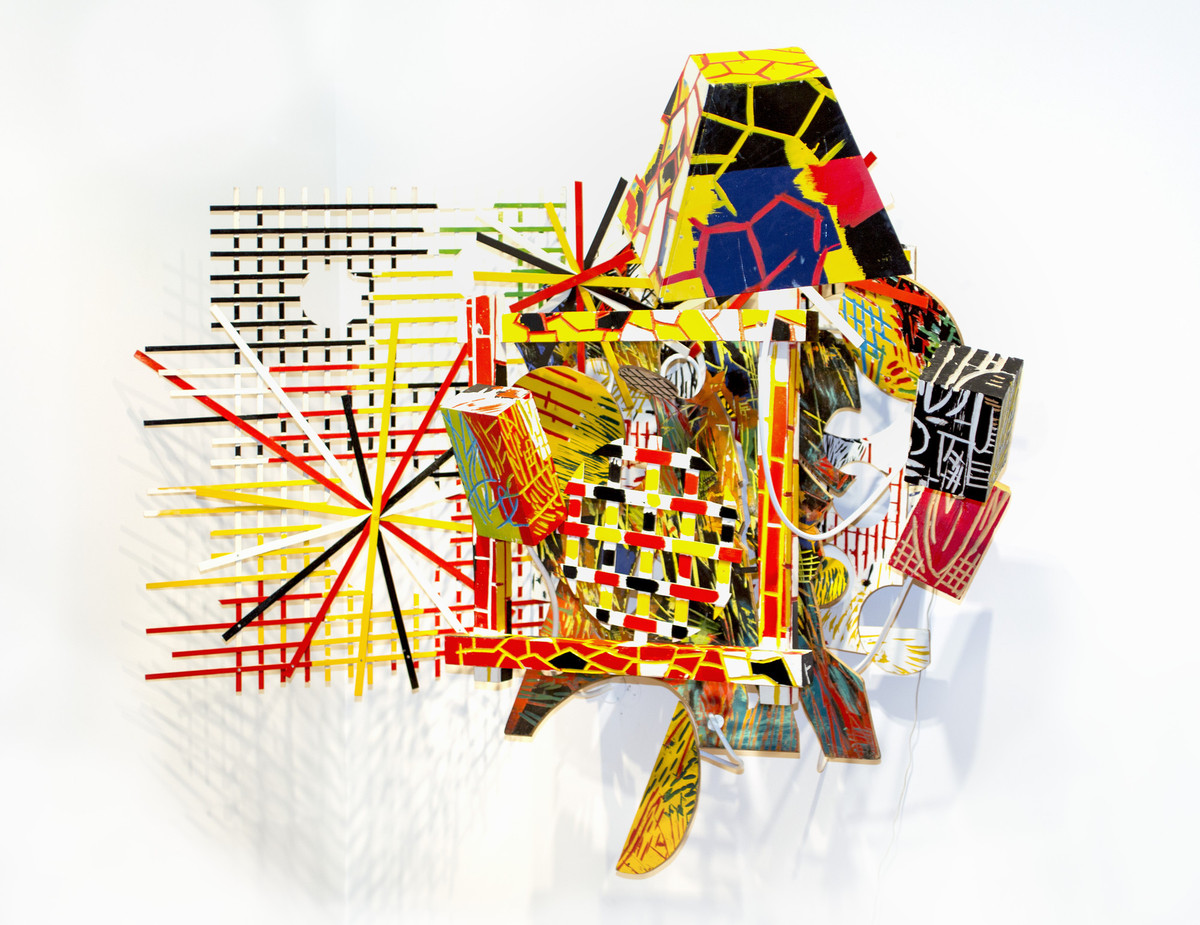
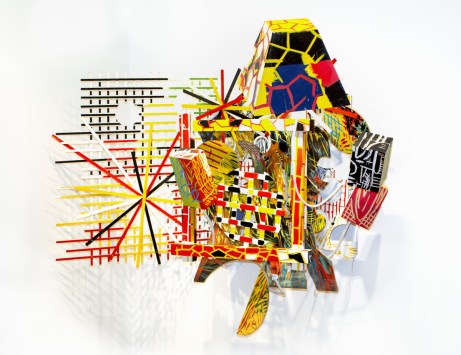
Red, yellow and black. Wheels. Suspended chairs and tables. Order. Chaos. That’s just a glimpse of what “Betwixt” has to offer.  The free-floating objects are actually suspended- yet they create a sense of lightness, contrasting with their implied weight.

Come take a look at her 1885-1992 exhibit at Mount Holyoke.

At a first glance, the scale of Pfaff’s work takes precedence; the magnitude of each piece is mesmerizing.

At a second glance, the installations look random.

At a third glance, there is a visual complexity to the work.
JP1-Betwixt MHC

Judy Pfaff, London born American installation artist, presented at Mount Holyoke College’s annual Louise R Weiser Lecture in Creativity, Innovation, and Leadership throughout Art. The Fall Opening Reception was held in Gamble Auditorium on Thursday, September 24, 2015.

Pfaff elaborated on her journey and style over the past five decades, allowing the student body, staff and local residents to receive a first-hand account of her artistic evolution and accomplishments.

Pfaff received her MFA in painting from Yale in 1973, “I knew nothing about sculpture,” she said.  She was also the only woman in her class, and said: “this must sound very strange to all the students at Mount Holyoke.” Between 1985 and 1992, the artist took her work to another dimension, quite literally by experimenting with new mediums; “I embedded oily material and painterly language,” she said, determined to work against conceptual art which was picking up momentum.

She claims to have always done the contrary to what is expected. “I wanted color, light and transparency in my work- the opposite of density and mass common in sculpture pieces,” she said.  “I wanted some kind of vitality.”

“I love imagery- patterns, I like to fit things and imagine opposites,” Pfaff said. “If I was a kid, I would be diagnosed with many problems, like ADD and whatnot.” Pfaff’s love for a sense of complexity and order in visual information is evident in her prints and 3D installations.

Another aspect of Pfaff’s work that echoes her voice and style is her ability to transform 2D to 3D and vice versa.  “When I was a painter I was always aware of translating space,” Pfaff said. Her emphasis on the spacial realm is also evident in her prints, where the “geometric and bold colors build upon and break the three-dimensional expectations,” she said.

While it is difficult to confine Pfaff’s work into a single category, her work is distinguishable through the combination of architecture and vivid colors used to represent landscapes. Her final work is an extension of the space she occupies, giving rise to an eclectic theme of visual installations. In a slideshow, Pfaff showed visual documentations of selective exhibits. The amount of work she has done is astonishing.
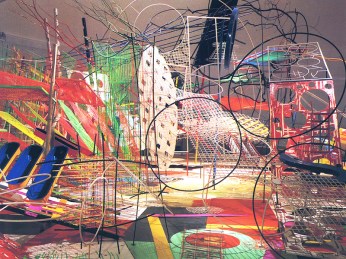
gu chika paGu,Choki, Pa, (Rock, Scissors, Paper)

http://www.art21.org/files/imagecache/full_image/images/pfaff-003.jpg  … Steel, wood, plastic, organic materials, bamboo, lattice, signs, veneer paneling, Formica, steel grating, and paint, 20 x 40 (diameter) feet.

In this Installation in Vernacular Abstraction, curated by Roberta Smith, at the Spiral Wacoal Art Center, Tokyo, Japan 1985, Pfaff used many local inspirations in her work.

There are many Japanese elements hidden or evident, like Mount Fuji, rivers, and the language Kanji, allowing a fusion of multi-dimensional and flat surfaces.  Pfaff’s fascination with the stories of the Kawanishi people and her involved lifestyle in Tokyo allowed her to embed the city life and absorbed culture into the nuances of her work. The natural quality of the work contrasted heavily with the modern hectic lifestyle representations in her structural collage.

Pfaff also elaborated on her process. “Every material is special… In Japan, different materials mean different things.” Pfaff was very much aware of the sense of lightness and fragility of some of her materials and the dominating impact of what they mean and how they are used and viewed. A major question she had to consider was “How will this be received?”

The energetic quality woven with improvisation creates a complicated relationship between painting, sculpture, and architecture. Pfaff uses a wide range of materials from steel, wood, resin, plastic, fiberglass, plaster and most recently the incorporation of photographs and images. Pfaff loves experimenting and shared, “I’ve never taken a sculpture class. Sometimes I was never wearing glasses.”

In an Amherst exhibit, Pfaff went in under the impression that she was visiting an area similar to Vermont. “But there were only professors at Amherst… no woodcutters,” but she continued with her original inspiration of woodwork. Her final tree-like products were displayed in a “congested manner inside another body,” in a different environment than she expected. “I am always learning from doing work and simply being there,” she said.

“My work will change depending on if I’m in Brooklyn, or if I’m in Upstate New York with ten cats and dogs, dead things, leaves roots- where I’m home…My work follows where I am.”

“In Upstate New York, things are calmer, there is zen,” she said. So when she was making art that contrasts with hectic city life, such as flowers and leaves and nature, in New York a gallerist advised her “life is more interesting than art- don’t open the window.”

Pfaff balances planning with intuitive decisions. This intensity coupled with spontaneity brings about a sensational quality in her work that can be enjoyed because of the organic feel encapsulated within the technical skills she applies.

The artist explained why her work is geometric at times and more organic at other times. While space may be one factor that influences the outcome of her final products, inspiration and mood are other key factors. “I incorporate memories- not nostalgia- Oh and television!”

She elaborated on how motivation is like a “fire-it goes out,” she said.  “It must be rekindled again.” For instance, she has to prepare herself, “winter is coming, I hate winter, but I use it as a source.” In one of her works, she was inspired to create art after recovering from a catatonic phase, when she was deeply affected by the state of dying relative and friend.

Pfaff’s goal is to always “get information and evolve,” she said. The artist continues to move around. Her constant journey was reflected in the images of her different studios in Brooklyn, Soho, Tribeca and many other places- I lost count; “If you were a realtor you should have followed me around,” she said.

***

I loved how Pfaff was very honest about everything; her work, her attitude, her interests. When I approached her at the end of the session to ask her a few questions, she talked about how attached she is more attached to her 3D work compared to her 2D work.  She really is the quintessential artist who is super energetic and can jump from one topic to the next. In her talk, she had mentioned how she didn’t know “a sh*t about color, Indian goddesses, and gods,” but wanted to incorporate that culture in her work after a trip to India. She started talking about that again after she got distracted by the henna on my hand. The next thing I knew I was being interviewed;

“Did you do this yourself?” “What materials do you like to use?” “How do you say your name again- Spell that for me please.” Oooh, your background makes for an impressive resume itself.”

Thank you Judy Pfaff!

Pfaff is extremely blunt and her care-free personality and love for energy and movement could not be stressed enough, “I cannot stand static things … at Chelsie people look at things so long that don’t do anything.”

“I’m not such a good reader… I’m no theoretician but I’ve got smart hands.” Sure enough, she went over to one of her pieces and started pulling at the strings and weight balls, showing us how her installation can move!

Just a side note- DO NOT COPY HER. She has artistic licensure; she can do whatever she wants.

Her honesty also came across when she discussed the art world, and how she thought making art used to be a lot easier. Nowadays there is a lot of power in the hands of the curator. “Art is supposed to be fun,” she said.

***

Though I prefer making 2D work as a budding artist, and her work may be too abstract for my personal preference– I still formed a very positive impression of her. Because despite the enigmatic quality to her work, she is not unpretentious at all.

Moreover, I am amazed at her body of work. Her CV will blow your mind. I don’t know how she managed to do all that work. Granted she may have had assistants helping her, but to get inspired, buy materials, travel, install, uninstall, reinstall requires a lot of time and effort. Being an artist is clearly her full-time job.  I’m not sure how she makes money since she probably just spends it all on materials and transportation, but the quality and quantity of her portfolio is unbelievable.

As for the talk, I think she is a great speaker, humorous too. She speaks to the point- maybe a little too much to the point. I wish she had taken the time to show the audience the nuances of the work and break down the photographs in her presentations. Sometimes I didn’t know what she was talking about- no matter how entertaining her stories and comments. Sometimes she would just mention that she has used certain imagery, or say “there’s a mountain in there somewhere” but there was no way to visualize because either the picture didn’t allow it, or the audience was only given ten seconds to really study the image on the screen.  45 minutes just felt rushed; there just wasn’t enough time to go through her work “from the beginning.” One does not simply discuss their entire career through hundreds of images in such a short amount of time. I was definitely overwhelmed with the visual content.

She should (but probably can’t) do a series of talks! But I do appreciate that she spoke in layman dialect.jp23
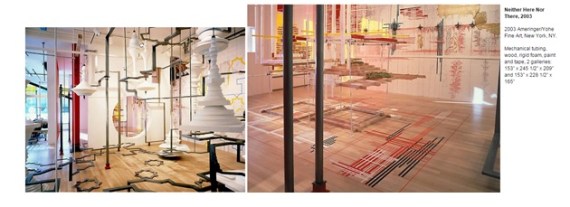
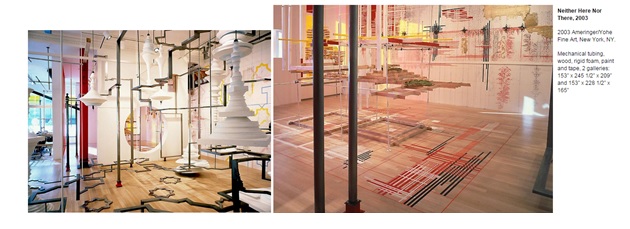
A New York Times critic, Roberta Smith, wrote of Pfaff’s work, “she has been creating elaborately impure, implicitly narrative environments for more than 25 years. She is at the top of her form in the airy, exhilarating Neither Here Nor There.

This work was constructed right after 9/11, Pfaff lived 4 blocks from the World Trade Center. She created a sense of reconstruction, inspired by prints to represent a fusion of different architectural qualities like Islamic and Buddhist art. I first saw chess pieces but there are very distinct symbols and shapes used adhering to different cultures. Was this a response to the negative stereotypes circulating about different ethnicities after 9/11? Was she trying to find a way to create harmony and peace?   I think Pfaff uses different sculptor-specific vocabulary in her work by embedding photos on the floor surface and background. I don’t even know what I should call this approach or technique.

I guess what I loved most was her use of markers that allowed her to distinguish each of her own pieces because they were extensions of personal narratives and other significant events.

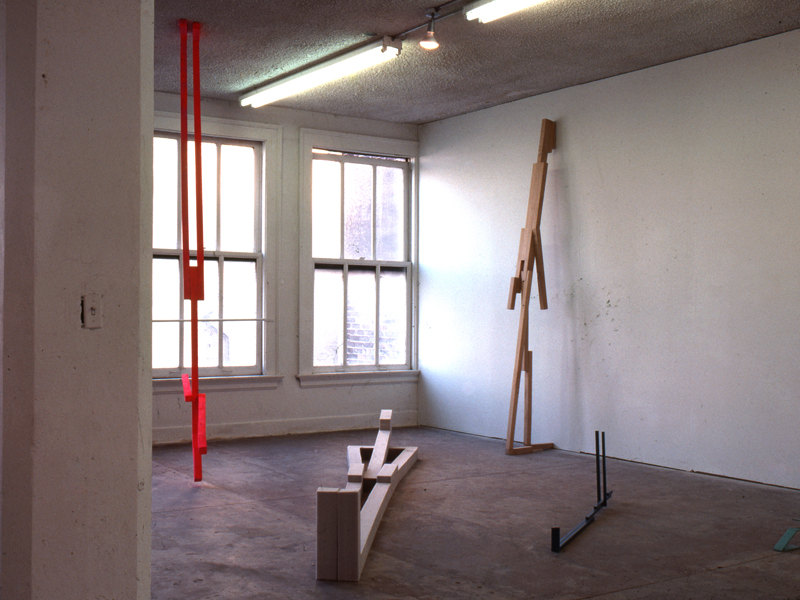
In “Prototypes,” 1978, Pfaff created 3D portraits, except they tried to capture distinct personality traits rather than focusing on resemblance. The sculpture on the right portrays a friend of Pfaff’s walking into a wall. Pfaff narrated, “He thinks it was actually a portrait of me dealing with him.”
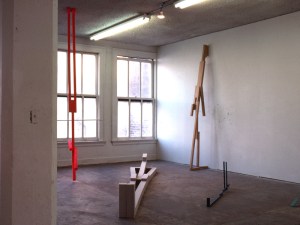
JP4

http://www.judypfaffstudio.com/installations/?album=2&gallery=43&pid=1130

In an exhibit at the Columbus Museum in 1995 Pfaff got the idea when a tree fell down in front of her, and “I thought: idea!”  She took out the roof and lowered the temperature of the space down by twenty degrees. This was in the winter, “We were frozen,” she said.
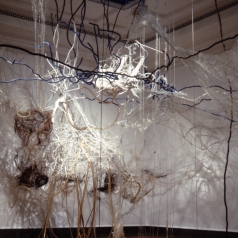
JP5-“Cielo Requerdo”

Installation in Landscape as Metaphor, Columbus Museum http://www.judypfaffstudio.com/wp-content/gallery/cielo-requerdo/thumbs/thumbs_cielo-requerdo-1994-4.jpg

In the image below, a similar version or another version of this installation piece is at display at Mount Holyoke College Art Museum. She uses the dominance of the male aura, a vibe she felt during her tenure in Brooklyn, and combines it with the fragility of growing feminism. Why she chose metal, I’m not exactly sure, but I’m sure as a sculptor she has her reasons for what material properties signify.  But there is something about a battle going on here, the impurity of sculptor making, an inherent vice, and a sense of finite and infinite as parts of the sculpture come together and other parts unravel.
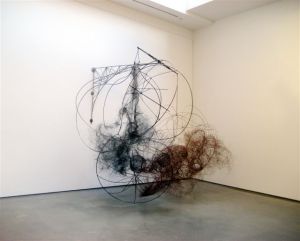
jp6—“Los Voces” (1992)                                                       http://phsarthistory-bjork.wikispaces.com/file/view/Es%20Possible.jpg/342523430/Es%20Possible.jpg
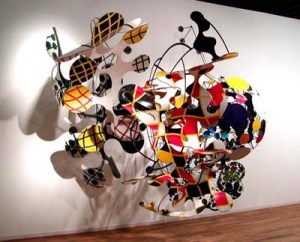
Artwork by Judy Pfaff

-Es Possible (1989)

According to Pfaff, the work above was made in response to watching a soccer game in the ’80s. It is all “geometry, guts, and glory—very masculine in its use of primary colors and hard-edged angularity.”
JP92. jp10

1.https://s-media-cache-ak0.pinimg.com/236x/9a/21/84/9a2184c08403ccc0731dc1d26b7eaa1f.jpg

2.http://www.sculpture.org/documents/scmag13/mar_13/images/features/Judy-Pfaff.gif

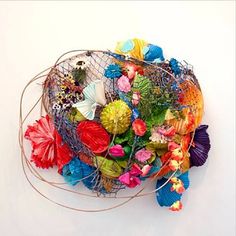
“Untitled” (2010)

These reminded me of candy wrappers, or distinctly shaped sweets, I love this eclectic selection of candies called “Quality Street” but the installation turned out to be “Chinese lanterns, floral prints, and other paper-based collage materials” leaning towards the floor supported by an anchor that isn’t visible unless you look for it in person!

As a budding artist, I can tell that there is a lot of thought put into her installations; Pfaff has clearly looked into composition, foreground, mid-ground and background; there is a sense of balance that is achieved that may be difficult in abstract work. The final result can be interpreted in any way we like.

Even after listening to her talk, asking her questions and reading what other critics have to say, I’m not sure how she manages to pull off a lot of improvisation. I think I am more in awe of Judy Pfaff’s approach to her work than the work itself; her confidence, her beliefs, her boldness. I’m more in awe of the impact of her work and the feeling it evokes than the materials and shapes. But then I guess they all contribute to the way she manages to create chaos and order, all within a single body of art, representing the power that shapes and materials can have over a viewer. Is this combination of order and disorder a contemporary quality?  I’m just left wondering:

How does she create a paradoxical relationship within her work? What goes on inside her head?

.

.

. Sun, Oct 18, 2015, 6:42 PM

Khadija,

I have read your review of Jude Pfaff’s lecture, and it is truly stellar! You do a fantastic job of providing a clear, compelling, and thorough account of her talk, and this would have been enough. However, then you push much further. You engage with a range of examples of her work in sophisticated and deeply perceptive ways, and you also give me a vivid sense of her as a person and an artist, which is unusual in this kind of review. The story of your exchange with her was striking! You assess her talk and provide your opinion in ways that are honest but careful. I’m now fascinated by her work too, which is the best sign of an excellent review.
Grade: A

Best, AM


Amy E. Martin

Chair of the English Department
Associate Professor of English and Faculty Member in Critical Social Thought
Faculty Director of the Speaking, Arguing, and Writing Program
Mount Holyoke College
413-538-2062
Posted by: diamo22a | December 16, 2014

Trick Mirrors and Secret Surveillance, oh my!

So there’s this post over on Fans in a Flashbulb. It’s pretty great, and I’m not going to steal — I mean borrow — their images, so you should go take a look.

So the basic conceit of the post is that a Broadway theater in 1946 New York decided it would be super cool to have a mirror in their lobby! Except it wasn’t a mirror. The mirror was a LIE. Behind the mirror was a photographer, who would take pictures of people who were…adjusting their coats, refreshing their lipstick, maybe trying to get an eyelash out of their damn eye, whatever. The pictures are actually kind of cute. Humans doing human things! Isn’t it adorable? I’m kind of charmed, to be honest. But then I think about the fact that these people thought they were looking into a mirror, and the mirror was a goddamn lie, and maybe we got some cute expressions out of it but we also got what feels to me like a massive invasion of privacy.

I’m going to get personal for a second. In high school, ye olde realm of awful, I took math. I mean, everyone does; it’s one of those core requirements.

I was really bad at math. I was also frequently — who else remembers this about high school — incredibly under-rested. You can probably guess what happened.

Anyways, in junior year, a kid who sat next to me — let’s call him Bob (his name wasn’t Bob) — snapped a picture of me with his phone while I was dozing obliviously in math. I think he thought it was funny, and he and I were kinda-sorta friendly, in the way you are in high school, so he didn’t mean it maliciously. But he was showing it to his friends, and when I woke up he showed it to me. I think he expected me to laugh it off embarrassedly. He definitely did not expect me to get angry.

My anger at the time sprung more from my horror that I’d fallen asleep and there was photographic evidence, oh my god my academic reputation is RUINED than it did a sense of invasion of privacy, I think. I’m honestly not sure. Probably the privacy thing was squirming uncomfortably as my academic indignation roared, but this was before I’d become more or less acquainted with feminism and body autonomy, and I had no idea how to articulate that feeling of betrayal. So I followed Bob out of the classroom when the bell rang, and I didn’t leave him alone until he deleted the photo.

We were not quite as friendly after that.

Back to the trick mirror in a Broadway theater, fifty-some years before any of this happened. These pictures, charming as I’m sure they’re meant to be, strike me uncomfortably as invasive, even if the theater is a somewhat public space, even if its owner has the right to modify the lobby however they want. That doesn’t mean they have the right to document unguarded moments in such a permanent way — so that, fifty-some years later, we are still talking about them. (And, okay — so maybe I’m part of the problem here.) It reminds me uncomfortably of stuff like fake mirrors installed in women’s bathrooms, like my own mostly harmless experience. I wonder if the theater-goers ever found out about the pictures; how they felt about them. I don’t think they would have been pleased.

[Please note: This post contains discussion of pedophilia relating to the Alice books and Lewis Carroll, as well as a visual of drug use via smoking.]

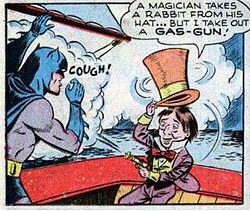
So says Batwoman to the new villain who goes by “Alice” and speaks in lines from Carroll’s books (Rucka et al. n.p.). She’s referring to the Mad Hatter, a.k.a. Jervis Tetch, who’s been rhyming creepily around Gotham City since 1949 (Brooker 152). Take a look:

Jervis-Tetch

Read More…

Posted by: diamo22a | December 16, 2014

Review: The Secret History of Wonder Woman (11/19/2014)

I’m pretty sure that the most obvious thing about me is my love for superheroes. Five minutes into any given conversation, no matter how unrelated the subject, and I probably either will have already brought up superheroes or will be grimly considering the best way to do so. It’s kind of a problem.

(To everyone who’s had to put up with this, I sincerely apologize. It’ll probably still happen the next time we talk, though.)

Part of why I’m constantly talking about superheroes is my thesis, which I’m writing about Batman (or, as I like to call him, the Absolute Worst). My thesis is probably the thing I’m most excited about in my life; I’m more or less constantly excited, constantly connecting everything I read or see back to, say, Arkham Asylum or Batman: Year One or trying to figure out the best way to spend time talking about Oracle and Batwoman and Red Hood and any number of the much cooler characters in the Bat-mythos.

I’m also constantly trying to find sources. There has not been a lot written on superhero comics. Arkham Asylum, lauded as the best-selling graphic novel of all time, turns up a scant four academic articles in the MLA database (all of which have to be requested through InterLibrary Loan).

So, when I heard about Jill Lepore’s new book, The Secret History of Wonder Woman, you can probably understand my excitement. A Pulitzer-nominated Harvard historian writing about probably the greatest superhero of them all? This is literally what my dreams are made of.

(I’m not joking. One time I dreamed I got to talk to Will Brooker, author of Batman Unmasked and known in comics studies as “Dr. Batman,” for about four hours about the Absolute Worst. I am that nerd.)

Anyways: Jill Lepore, Wonder Woman — and she would be speaking at Mount Holyoke. Of course I bought the book, read as much as I could before November 19th, and attended the lecture.

Lepore’s central thesis about Wonder Woman is that she represents a missing link between the early feminist movements of the 1910s and 1920s, and the more modern movements (think Gloria Steinem, the stunning first cover of Ms.), and in my opinion she makes a compelling visual argument grounded in the cartoonist connections between H.G. Peter (the original artist of Wonder Woman and All-Star Comics) and suffragist cartoonist Lou Rogers.

For example, here’s a cartoon Rogers drew:

Lou Rogers' 1912 cartoon: the "Spirit of 1,000,000 Women Voters" is chained by patriarchal rhetoric: "Politics is no place for women!"

Lou Rogers’ 1912 cartoon: the “Spirit of 1,000,000 Women Voters” is chained by patriarchal rhetoric: “Politics is no place for women!”


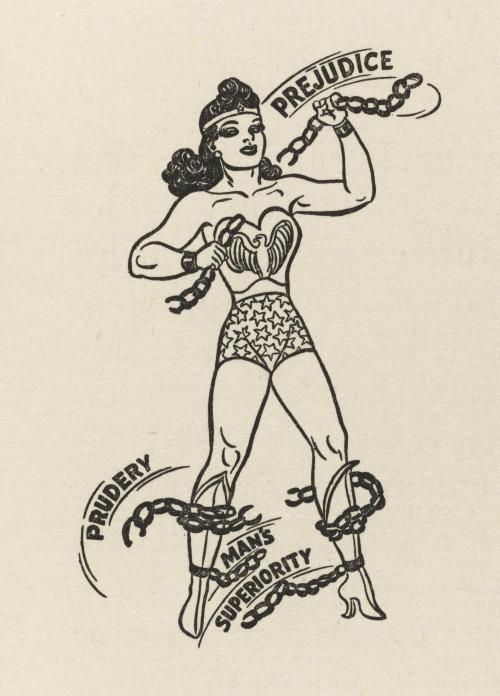
And here is one of the early H.G. Peter Wonder Woman sketches:

Wonder Woman breaking triumphantly free of the chains of "Prejudice," "Prudery," and "Man's Superiority" (1943-44)

Wonder Woman breaking triumphantly free of the chains of “Prejudice,” “Prudery,” and “Man’s Superiority” (1943-44)

One would think it a coincidence, if an odd one, but Lepore reveals that Peter actually worked alongside Rogers in the 1910s, and was occasionally responsible for filling in for her if she was overbooked. He had to have been familiar with her work, and, one thinks, even decades later he’d have that in mind when designing what Wonder Woman’s creator, William Moulton Marston (who, oddly enough, also invested early forms of lie detectors), described as “psychological propaganda for the type of woman who, I believe, should rule the world.”

Lepore tailored her presentation to Mount Holyoke, since Marston’s wife, Sadie Elizabeth Holloway, was a Mount Holyoke alum and worked closely with him throughout his psychological pursuits. (In fact, Holloway was much more successful than Marston, earning three degrees and supporting their family financially more often than not.) But the main takeaway from Lepore’s talk (and her book, though I still have to finish it & look forward to doing so over break) is Wonder Woman serving as an artistic and, as Marston would say, psychological link between early suffragist movements and modern feminism. To that end, she references the 1972 Ms. cover:

Ms. Magazine, 1972: the first issue

Ms. Magazine, 1972: the first issue

However, I’m far from an expert on Wonder Woman, having unwisely spent most of my DC adventures in Gotham, so here are a few links:

An article by Jill Lepore for the Smithsonian magazine

An interview with Jill Lepore

The Comics Journal‘s review of The Secret History of Wonder Woman

Another review by Wonder Woman scholar Noah Berlatsky

« Newer Posts - Older Posts »

Categories