Posted by: burge22s | December 16, 2014

I never expected to write about cats…

So, I originally was just going to comment on the fantastic post about dog portraits, but then I ended up going down this rabbit hole about Victorians and their cats and this blog post happened.

Reading through this post and the two other comments, I instantly thought about the counterpart to this post. What about the cats? I can’t think of any portraits that include say, a lady and her cat. However, there was the one picture of the small child and her cat that Professor Martin showed us in class a while back (I can never remember it’s title or the photographer…). Anyways. I know culturally cats can be interpreted in many different ways, however in western culture cats were traditionally viewed as evil, demonic, and witches familiars.

They were essentially hunted down all through the middle ages and into the 19th century. Think America and Salem witch trials, but with cats. Also, there’s a fun theory that if cats hadn’t been eradicated like they were, the plague that wiped out a lot of Europe might not have been quite so bad because rodents wouldn’t have been able to transmit the disease. Again, only a theory.

Anyways, as a fan of cats, I found this kind of awful. However! Good news, cats made a comeback in the Victorian era, thanks to Queen Victoria herself. There was some really cool archeological stuff happening in Egypt at the time, that had a lot to do about cats. Egyptians really loved cats. Anyways, Queen Vic, was super interested in cats and actually adopted two Blue Persian. The cats lived the high life and were actually treated as members of the court. Newspapers got a hold of this information and suddenly people started getting interested in cats too. These trendy house pets got a ton of popularity in the America’s too, as they were featured in Godey’s Ladies Book. Godey’s stated that cats were not solely for older women or monarchs and that anyone should feel comfortable in embracing the “love and virtue” of the cat.

Some more fun facts about Victorian cats (unintentional rhyme).

Charles Dickens was basically a crazy cat lady and played favorites with his cats. Apparently his favorite was named “The Masters Cat” (real original, Dickens) and this cat was allowed to blow out the candles every night. I’m confused on how a cat blows out candles, but it makes for an interesting story.

The first cat show was held in the Crystal Palace in London in 1871. This sparked a whole snowball of cat shows and nonsense throughout Europe.

Lewis Carroll created probably the most iconic cat in literature, with the Cheshire Cat.

So, in short, the Victorian era basically reclaimed cats as house pets and I can thank Queen Victoria for my three cats who are presently helping me write one last blog post.

-Sarah, Pumpkin, Jaspar, and Baxter

http://www.ancient.eu/article/466/

Posted by: Sam Stone | December 16, 2014

Review: Mount Holyoke Art Museum Visit (10/29/2014)

On a very rainy night in October, our Victorian Literature and Visual Culture class found themselves gathered at the Mount Holyoke art museum instead of their usual meeting place in Shattuck seated around a long table. The change of venue was welcome and everyone seemed to be in good spirits. After putting away our various belongings, including wet umbrellas and backpacks, we gathered in a semi-circle in the art building lobby around the two women who would be our guides for the evening. Ellen Alvord and Kendra Weisbin were lovely from the start and their excitement at the opportunity to share the museum pieces with us was contagious. After a quick review of the rules (no food or drink and no pointing with pencil tips), we all proceeded through the glass doors into the museum.

I had walked past the museum countless times on my way to various classes being held in Gamble Auditorium just down the hall. I usually peeked through the glass to try to catch a glimpse of the art inside, but could barely see anything of interest. Before that night, I had only been to the museum once before in an introductory Biology class, so visiting with the sole intent to view the art as art and not simply a tool to learn observation skills was exciting for me. Walking into the place where I really only had small glimpses of what was inside, I was tempted to stop and look at all of the art in the first few rooms, but we were led through to one of the middle rooms.

In this room, a few exhibits were set up especially for us, the most noticeable a very large image that we would end up looking at first. We all gathered around, some opting to sit in the little chairs providing, some sitting on the floor and others standing, and were met with a large print. It was a map of New York City with lines criss-crossing the image and small pictures of scenes in the city placed where some of the lines intersected. A very large image of a woman dressed in a suit of armor, which appeared to be drawn, and her face a photograph took up a good portion of the right hand side of the print. Ships appear behind her in the background and a large compass is on the other side of the map in the bottom left corner.

After taking all of this in, Ellen and Kendra guided us in a very deep and thoughtful discussion of the image. Each interpretation was incredibly interesting and listening to the conversation and thoughts of my classmates was very enjoyable. After many different analyses, our guides inform us that the artist’s name is Jane Hammond, an artist from New York City, which makes the map of New York City in the photocollage more understandable. The photograph of the woman’s face on the body of the woman with the suit of armor turns out to be a photograph of the artist. This gives the photocollage are more personal interpretation, perhaps that it is a map of her favorite places in her home city.

With the discussion concluded, Ellen and Kendra invite us to walk around and observe the various exhibits set up both in the room we had been in and also in a smaller classroom towards the back of the museum. I started in the first room at a long table set up with three or four pieces. One was another photocollage by the same artist that had done the larger photocollage we had just discussed. Another image was a photograph of a bedroom with a scene from outside the room projected upside down on the wall. It was confusing at first and I couldn’t stop staring at it, remembering learning about the technique back in a high school photography class. Another image on the same table was a photograph of a girl on what appeared to be a lily pad. In the smaller classroom, there were about four or five stations set up. Before I had a chance to look at them all, we were called back together and divided into groups.

I was assigned to the station with rather eerie photographs of children on lily pads. However, the image that immediately caught my eye was a Daguerreotype photograph of a person that, if you looked at it straight on, you could see the reflection of your face over the image of the person. You had to look at it from the exact right angle to see the person correctly. After analyzing the pieces ourselves, Ellen and Kendra handed out sheets of information about each piece to further guide our discussions. The photographs of children on lily pads were by the artist Binh Danh who developed a method called “chlorophyll prints” to achieve such an effect where he uses the sun to print images onto leaves. The children were victims of a massacre, which made the prints even more eerie and unsettling.

After a break where delicious cookies were provided, we returned to share our different discussions with the class. It was very interesting going around to each station and hearing the background information on the pieces and my classmates interpretations of them. After the last group presented their findings, Ellen and Kendra wrapped up our visit with some closing remarks and an invitation to return to look at the pieces more closely. We were led back out of the museum, gathered our belongings, and headed out into the night. The visit was not only incredibly interesting, but also thought provoking.

Posted by: diamo22a | December 15, 2014

Dude Watchin’ with the Brontës, and other comics

Kate Beaton’s fame as the author of Hark, A Vagrant! surely knows no bounds, but I thought I’d take this opportunity to talk about parodies of Victoriana (and the Victorian cultural heritage pervading our media) and lighten the mood. Two birds with one stone, amiright?

Read More…

Posted by: Hyeonjin | December 15, 2014

Review: Emily Dickinson Museum (12 December 2014)

On a not-so-cold December morning, several members of the class and I gathered at ten in the morning to visit the Emily Dickinson Museum in Amherst. Some have already been to the museum, but it was the first time for me. I admit I was a little embarrassed that I never once visited, despite the fact that I was aware that Dickinson was not only a beloved alumna (putting aside the fact that she essentially dropped out) but that it was so close to where I was.

Needless to say, my knowledge of Dickinson was limited before this extensive tour. I was aware, however, of her reserved personality. Perhaps that is why my grade school self was so fond of her poems, particularly this one:

I’m Nobody! Who are you?
Are you – Nobody – too?
Then there’s a pair of us!
Don’t tell! they’d advertise – you know!

How dreary – to be – Somebody!
How public – like a Frog –
To tell one’s name – the livelong June –
To an admiring Bog!

I heard the first lines of the two stanzas echo in my head throughout the tour, as I learned more about how fond she was of her privacy. Yet she seemed like such a personable individual based on the descriptions that Lucy, our tour guide and a Mount Holyoke alumna, gave.

Their parlour was rather disappointing, but with the understandings that it was renovated to become more modern… it was understandable. But still disappointing. I found that I was particularly attracted to the Aeolian harp that sat on a table before we went into the library. Maybe it was the musician in me, but it was eerily beautiful to think about the haunting sounds that it would have created that Emily greatly enjoyed.

A library says quite a lot about the individual, and I found that this was the case for the family. I was particularly amused when told that Mr Dickinson had a desire to keep Emily from reading contemporaries such as the Brontës or Charles Dickens, for fear that they would disrupt the mind. It’s always good to know that an attempt to ban books was still a thing even back in the nineteenth century. It’s also good to know that Emily disregarded that desire and went off to read them anyway.

However, I did not get the “aura” of Emily Dickinson (so to speak) until we reached her bedroom, which was still in process of being restored. Yet I found an odd delight standing in the empty room, hearing Lucy talk about the days Emily spent there. The room was open, with the many windows which allowed for her to see what was happening in the outside world without having to go outdoors.

After a tour of the Dickinson house, we trudged through the mud to the Evergreens, the house that Mr Dickinson gave to Austin, Emily’s older brother, as a means to keep the family together. It really was odd to me that he was so adamant about that, let alone the fact that his children were okay with it. Needless to say, the house had a completely different air to it. It was darker inside, but at the same time, more colorful and exciting to look around. There were all sorts of paintings and objects to look at. Again, the musician in me got a little too excited when I saw the Steinway piano. It also delighted me to know that they actually kept it in tune and that it was still playable. This made the house seem all the more alive despite its antiquity.

We got to see the dining hall, where Austin’s wife, Susan, entertained the guests (and she apparently did quite a good job at it). From there, we huddled together inside the kitchen, seeing the odd combinations of the nineteenth and twentieth centuries. I found it intriguing that there was a (more or less) modern bathroom downstairs, yet when we walked upstairs to pass by the nursery, there was another bathroom but one that would have been more common in their time. It truly reflected on how long the family has stayed in that house, as well as the particular maintenance in keeping it in its original condition for as long as possible. I admit that seeing those two bathrooms made me curious to know what the bathrooms in the Dickinson home would have looked like… since we never actually got to see any.

(Curious where the mind goes, whether it is against your will or not—)

We ended on a rather tragic note as we all shuffled into what was the master bedroom, but also considered the “death room” given how many people passed away there. Lucy, however, finished an altogether wonderful and descriptive tour of Emily’s life and house that made me want to revisit some of her poems, particularly the aforementioned.

It was ironic that she dreaded the idea of becoming a “Somebody” and yet there we were… standing in her house (let alone her room) and discussing extensively about her life. I can’t imagine that she would have been all too pleased about it, but at the same time, I also feel that a part of her is pleased that people did take a delight and charm in her writings, since she did want to publish them.

She may have wanted to be “Nobody” but I’m glad that her writings were able to escape freely and inspire many poets, as well as give us a glimpse of a unique life.

Posted by: ferge22j | December 15, 2014

Review of Death Becomes Her: A Century of Mourning Attire

A few days before Halloween this year, I joined a group I co-founded, Lolitas and the Arts, for a pleasant outing at the Metropolitan Museum of Art and tea afterwards. The group consists of two dozen or so odd young women who are interested in both the arts – theatre, music, museums – and the clothing of a set of six Japanese designers who dominate the fashion subculture known as “lolita.” We meet at the Met at least every other month, but this time was especially exciting because of the new exhibit “Death Becomes Her” at the museum’s Anna Wintour Costume Center, a display of nineteenth-century mourning attire. Rarely do we find an event that so closely fits our aesthetic.

Lolita fashion wears its Victorian influence on its sleeve, especially the more mature, muted variation called “classic” that most of our members (including myself) prefer. Classic lolita designers such as Mary Magdalene and Victorian Maiden attempt to apply the nineteenth-century silhouette and aesthetic, especially its preoccupation with detail and quality, to modern fashion. The exhibit’s focus on mourning made it even more relevant to our interests because lolita was dominated for decades by the “gothic lolita” aesthetic espoused by the designer Moi-meme Moitie, which adhered much more closely to the Victorian Gothic than to Western goth. Furthermore, all our members are fervent Victorianists (including some real academics), and we were just generally very excited for the visit.

Before meeting, we agreed to incorporate elements of gothic lolita and of Victorian mourning into the outfits we would wear to the museum. I don’t own any black lolita dresses because I don’t think the color flatters me, so I decided to opt for half-mourning in violet-colored Angelica by Mary Magdalene with black lace accessories: shawl, parasol, fan, and a little veil attached to a black velvet hat. Most of the other members wore more extensive black but likewise displayed their knowledge of the traditions of half-mourning by only accessorizing with white and lavender. Veils happen to be in style among the lolita designers this year, so many made use of those in varying materials and sizes. We all looked as meticulous and conspicuous as usual.

We met in the museum atrium on a busy Saturday afternoon and quickly attracted many curious stares – to wear lolita fashion in Manhattan, one must not be afraid of standing out. However, as soon as we descended the stairs into the Anna Wintour Costume Center, we began to fit in more than we almost ever do in the city. The darkened room contained thirty or so pure-white mannequins in mourning wear spanning in era from the Regency to the Edwardian. The display platforms were lit from multiple angles so as to cast hazy, shifting shadows on the white floor and the white curtains draped from the walls. There were no glass walls to separate the life-size mannequins from the audience, only platforms to raise them above us, which heightened their uncanny ghostliness. It felt as though we had entered a space outside of time – one of the “liminal spaces” we mention so often in English literary scholarship – where the dead and the living, the present and a dozen different pasts exist at once for our viewing pleasure. The two dozen of us lolitas milling around the similarly-dressed mannequins surely heightened that effect for the other visitors.

The thirty-odd outfits were presented chronologically from 1815 to 1915. There were two men’s outfits and one for a little girl, but the vast majority belonged to wealthy women. The femininity of the exhibit reflected the statement on the informational placards that mourning was a distinctly feminine role in the nineteenth century. While I believe this is a correct statement, I would have preferred to see a broader picture of what mourning could look like in the nineteenth century. The placards describe the ways the traditions of mourning changed according to the class, sex, and age of the wearer, but the exhibited items themselves insufficiently illustrated this information. It is understandable that less working-class clothing than upper-class clothing remains in good enough preservation for exhibition, especially considering the tendency of cheap black dye to fade to brown or blue, but a few good reproductions would have been useful. I would have been particularly interested to see more children’s mourning. The placards mention that mourning clothes for children were often white with black trim rather than the more somber allover black, but the one child’s outfit on display is as pure black as the rest.

Despite the narrowness of the exhibit, we all gushed over the beauty of the clothing on display at least as much as we complimented each other’s outfits over afternoon tea at the beautiful Lillie’s Victorian Establishment (which happens to be named after Lillie Langtry, the character with which I began this series of blog posts). As usual, we bemoaned (with varying amounts of irony) being born into such an unaesthetic era and wished we could visit the real Victorian era for at least a little while. However, as soon as we got out of our taxis (subway crowds are hell on tulle petticoats) and into our respective homes, most of us changed right back into the shapeless styleless garments of the twenty-first century to which we rightfully belong. We would never have to experience the societal pressure that would force women to dress in stiff black crepe for decades; we never had to force our bodies into corsets and crinolines unless we really wanted to. And as much as all of us enjoy visiting the world of Victoriana for an afternoon, I doubt there are many among us who truly wish to live there.

langtry

Greetings from Lillie’s Victorian Establishment

Posted by: Iris Robinson | December 14, 2014

The Isabella Stewart Gardener Museum

All the way back during Fall break I visited Boston for the first time with my mother, who was visiting from England. By chance we ended up at the Isabella Stewart Gardner museum because we though we didn’t have time for the Museum of Fine Arts.

I was immediately enamoured with the idea of the museum. Gardner, who was considered an outrageous women during her life, designed and built the building as a museum to display her vast art collection. Gardner’s will stipulated that the collection stay on display in the same way as she designed it after her death. Because of this decision the museum to me offered a unique insight into the life and mind of Gardner, who to me seems to be an incredibly interesting figure.

Isabella Stewart Gardner was a remarkable woman, she refused to be constrained by the social expectations of her situation, at the end of the Victorian era in Boston. She travelled the world and collected many rare art works and artefacts as well as befriending and supporting the artists and writers of her day including John Singer Sargent, James McNeill Whistler, Anders Zorn and Henry James. There are several portraits of Gardner, some of which were extremely controversial at the time of their production. One pictures her in a black dress, a portrait Gardner commissioned herself. The painting is by John Singer Sargent, Gardner’s close friend. Upon the portrait’s first public display it received many negative comments. This was mostly because her posture was deemed too bold for a woman, her gaze meets the eye of the observer and seems to be appraising. The neckline and silhouette of her dress was judged to be too plunging and daring for the 47 year old it pictured. These comments upset Gardner’s husband so the portrait was not displayed in public while he lived. It now takes pride of place in the Gothic room on the third floor of the museum and I found it immediately striking. It shows Gardner as strong and authoritative, which was very refreshing, she was not a “woman looking sideways”, but someone intelligent and daring for her time, refusing to adhere to society’s expectations.

The museum today has a large glass fronted extension but originally walking into Gardner’s creation the first thing you come to is the courtyard. The space has a classical feel with its arches and columns and various reproduction and original statues. Immediately I noticed the sort of patchwork quality of the layout, with pieces seemingly scattered about the grass. But at the same time there was obviously real skill with how the garden was put together. The whole museum was built surrounding this open air centre and as I continued to explore the three floors of the museum I discovered that the garden was visible from each, and it was stunning from every angle. The piece which stood out the most for me within the courtyard area was a large terracotta fallen vase, in a classical Greek shape. It rested on its side at an angle on a small bank in front of a fountain.  While it was arguably the most plain piece in the whole garden there was something which struck me at the way it seemed to have just landed in its place, very casually and seemingly without care. At the same time however it seems impossible to me to imagine the garden without it. This feeling I had just from looking at this urn made me realise the skill with which Gardener assembled her museum, at once appearing effortless and calculated.

I feel that the Isabella Stewart Gardner museum is a unique place. It was purpose built and designed around the pieces it houses. The rooms themselves therefore become works of art in their own right, painstaking decorated to accompany the art works in a particular way. While I explored the place I was reminded of the Walter Benjamin essay “The Work of Art in the Age of Mechanical Reproduction”. The Garner Museum acts as an enhancer for the aura of original works of art. At a time when the industrial revolution had really taken hold, instead of revelling in the accessibility of reproduced works of art, Gardner cultivated and revelled in the uniqueness of the work of art. Rather than hanging pieces on a blank emotionless classical gallery wall she surrounds the viewer with colour, complimentary artefacts (and even live music while she was still alive and living in the museum). The effect is a full sensory immersion which brings art to life. I would challenge anyone who considers art to be boring or outdated to visit the Isabella Stewart Garner Museum and maintain that opinion.

Posted by: jordanelassonde | December 13, 2014

A Tour of Two Histories: The Emily Dickinson Museum

I can clearly remember the first time I experienced an Emily Dickinson poem. I can’t say if, at that moment, I knew that it was an Emily Dickinson poem, but now, somewhere near a decade later, I know that the words, “I’m Nobody! Who are you?” belong to no other than a small statured red-haired woman. I certainly know that I adore her poetry. However, before our trip to the Emily Dickinson museum, I can’t say that I knew much about her other than the myth that surrounds her image, that she was a recluse dressed all in white.

I didn’t stop to take in the sight as we walked up to the Dickinson house. Without the identifying sign along the driveway, the house would have blended in with all the other old homes and I can honestly say that I don’t think I really had put it together that this was Emily Dickinson’s home until I was reminded by the museum gift shop full of Emily Dickinson souvenirs. Still I was left with some disconnect until we left the gift shop and the exhibit room and entered the Dickinson home.

I was more fascinated by the history of the home than the actual visual around me. The parlor was light, open and more modern than I expected. This aligned with the history of the house as for years its history was forgotten. There had been no intention to preserve the home as Emily Dickinson would have known it. At first this seemed odd to me but I suppose that stems from the fangirl culture we know today. I consider Emily Dickinson such an important figure that it is difficult for me to remember that she was just as human as I am. I think in our culture today we find it too easy to place people, celebrities or artists, on pedestals. While there is nothing inherently damaging about that practice, I think it warps how we look at the world and more importantly how we look at ourselves. For me, it was refreshing to stand in the home of a woman I so admire.

The Dickinson home was a strange juxtaposition of modern and imitation. Thus the disconnect I originally experienced never really dissipated. Even in Emily Dickinson’s bedroom, in the midst of renovations, I felt slightly apart from the reality of her time. Though, it was eery and rather unsettling to stand in the bedroom of Emily Dickinson. Even with such distance of time, I still felt as though I was intruding on her world, her private space. We crossed the hall and entered a space that made no attempts to recreate the feeling of Emily Dickinson’s time. It was a welcome break. We discussed Emily Dickinson’s poetry and breathed a sigh of pent up emotion. Emotions that stemmed from the imaginations of Emily Dickinson writing poetry in her bedroom and watching people walk by her windows (for such a private person, she lived in a room with many windows). I had nearly organized my thoughts and settled my feelings when we walked the short distance to the Evergreens.

Unlike the Dickinson homestead, the home of Emily Dickinson’s brother Austin was a step back in time. This home looked as I would expect a home of that era to look. Kept in the family for years, the home, though worn by age, was everything that the homestead was not. The Evergreens was dark and cluttered with art while the homestead was bright and barren. It was here in the Evergreens that I encountered the connection that I had not realized I was looking for at the homestead. Our tour guide pointed out the piano which Martha, Emily Dickinson’s niece, had played. She told us that recently the museum had had the piano tuned and a pianist played Martha’s compositions for some event. While she did say that even that event did not bring the ghosts out, I can’t help but imagine how surreal that moment must have been. I certainly would have been looking for ghosts.

I found myself raving to friends and family about my trip to the Emily Dickinson museum. I’m not quite sure what captivated me so much that I spent several hours just recovering from the experience. Certainly I had quite a bit of knew learned knowledge to process. However, if I had to make a guess, I’d say what really struck me was the juxtaposition of the two houses and their two histories. I can’t seem to reconcile myself with the fact that the Dickinson home, after being sold out of the family, as at one point used as faculty housing for Amherst College. I keep asking myself how no one could have known the history of such a house. But I suppose that is just a facet of history, the books aren’t written while the wars are still being fought. How could anyone have known that the Dickinson homestead would be such a cherished piece of our history. Certainly Emily Dickinson didn’t turn out to be the nobody that she once called herself.

Posted by: mackenzielibbey | December 13, 2014

Review: Emily Dickinson Museum Visit (12/12/2014)

Amherst, MA — “Just a turn, Maddie, and it’s freedom,” Emily Dickinson used to say to her small niece as they entered her bedroom and she pretended to turn a non-existent lock on the door. For fans of the  incredibly private, world-renowned poet — a different kind of turn, up a small driveway off of Main Street in Amherst, Massachusetts — grants them a different kind of freedom: a chance to explore the home Dickinson lived in from when she was twenty-five until her death at the age of fifty-five.

The excitement that comes with that voyeuristic freedom is palpable as our class full of Dickinson-lovers enters the Emily Dickinson Museum on a sunny December morning. The tour has been arranged specially for our class, an English seminar called Victorian Literature and Visual Culture, courtesy of an alumna who works at the Museum. The alumna, Lucy, greets us with a warm smile tinged with her four years at Mount Holyoke: a recognition of our simultaneous excitement about the visit and the exhaustion she knows we must feel in the middle of finals week. We drop our bags and jackets underneath the staircase in the imposing, colonial-style home. Having spent the last seven years of my life reading Dickinson’s poems and passing by the massive yellow home, situated not far from the center of Amherst, for the past four years, being inside feels somewhat surreal. Lucy summons us into the parlor: “Let’s get started.”

The parlor of the Dickinson home is, disappointingly, quite average and modern. In describing the history of the home, which was built by Emily Dickinson’s grandfather, Lucy reviews its various stages of ownership and renovation, including a brief stint as Amherst College faculty housing. The Museum has done its best to restore original aspects of the home, she tells us, but many of those projects are still works-in-progress. Lucy gestures to the portraits on the walls and gives a brief explanation of each member of the Dickinson family: her father, Edward, her mother, Emily, and her brother and sister: Austin and Lavinia. Winter sunlight streams in through one of the large windows and Lucy notes that during Dickinson’s lifetime, the home would have been far less “light and airy.” She leads us into the adjacent parlor room and continues regaling us with the Dickinson family history. After having invested a large amount of money into the fledgling Amherst College, Emily’s father, Edward, was forced to sell the family home and Emily and her siblings spent the majority of her childhood in a different home before returning to the hilltop colonial. Losing the home was a huge blow to Mr. Dickinson’s ego, Lucy tells us, and I nod along politely, having heard enough about wealthy white men’s bruised egos for a lifetime, tell us more about Emily, I silently implore her. As we move into the library, my secular prayer is answered.

The Dickinson’s library reflects most accurately how the house was decorated during Emily’s lifetime: the walls are covered in dark, forest green wallpaper and the wooden molding is dark. Lucy lifts up a copy of a Charles Dickens novel as she explains that Emily enjoyed reading the popular fiction of her time, including Dickens and the Brontë sisters. Quoting one of Dickinson’s letters, Lucy tells us that Mr. Dickinson often bought his daughter books but “begged her not to read them – because he fears they joggle the Mind.” It is also in this room that Lucy recounts the details of Dickinson’s correspondence with Thomas Higginson at The Atlantic Monthly, who had written an article directed to young artists who might be interested in having their work published. When Higginson suggested that Dickinson’s poems might need some work before she tries to have them published, Dickinson scoffed: “I smile when you suggest that I delay ‘to publish,’” she wrote, “that being foreign to my thought as firmament to fin.” Hearing how Dickinson used her sharp wit outside of her poetry piques my interest and I make eye contact with one of my friends in the group; we must read those letters.

The pièce de résistance of the tour is, of course, Emily Dickinson’s bedroom. When we reach the top of the staircase, Lucy stops us to explain that the room is currently being restored and gestures to the replicated furniture being stored in the hallway. She passes around copies of notes and poems Dickinson had written on envelopes and chocolate wrappers and we move into the room itself. The original floorboards have been exposed and the original ceiling re-installed but the room is still clearly far from being finished. Still, for an avid Dickinson-reader, the barren room retains an almost magical quality. “What surprises you all about this room?” Lucy asks. “There are a lot of windows,” I answer immediately. Though, as Lucy points out, the “Myth of Amherst,” as Emily Dickinson came to be known, was a myth largely created by her later publishers to establish an air of mystery rather than to transmit an entirely accurate history, Dickinson was an intensely private person. Though contained by the three fish-bowl-like windows, she was also able to look out and see who was coming to the front door, allowing her to refuse certain visitors as she was known to do. More than a place to watch family guests walk up the street from the train station though, this room was a space in which Dickinson could write. It was around the age of twenty-five, when the family moved back to their original home, that she began producing her most prolific works of poetry.

Unfortunately, the tour ends on a somewhat low note, at the Evergreens, the house built for Dickinson’s brother, Austin, and his family adjacent to the main home. Part of a bribe put forth by Edward Dickinson to get his son to stay in Amherst rather than move to Chicago, the towering home was apparently modeled after an Italian villa. As we enter into the cramped front hallway, Lucy instructs as to let our eyes adjust to the dark space and gestures to the variety of artwork that populates the walls. From snowy, romantic landscapes to “Oriental-style” artwork chosen by Austin’s wife, Susan, the paintings in the elaborate foyer are meant to show that the family was well-traveled and well-educated. Soon after Austin took over his father’s post as the treasurer of Amherst College, their home became the center of Amherst social life, Lucy explains, and Susan rejoiced in entertaining the College’s distinguished guests. Despite the tales of lively dinner parties, the house in its current condition calls to mind death. More so than the Dickinson home, which changed hands and was renovated many times throughout the years, the Evergreens has been kept as near to its original state as possible and it shows: knobs meant to hold up plaster are hammered into the walls at random intervals and there are cracks in the ceiling; the hallway has a cave-like quality. We end our tour in a room deemed “the death room,” where many of the deaths that made Emily Dickinson’s final years so oppressively sad took place. Lucy hands us all book marks and thanks us for our visit. We reply by thanking her for a lovely tour and I make quickly for the door.

Lucy’s tour was lovely and the Emily Dickinson Museum has made an admirable effort to bring to life the long-dead poet. However, the second half of the tour which focuses on the Evergreens Estate does perhaps too good a job at evoking the intensity and sadness that marked Dickinson’s life, especially her later years. As we open the front door I am thankful for the fresh air. “Just a turn,” I think, “and it’s freedom.”

Bibliography

Higginson, Thomas. “Emily Dickinson’s Letters.” Early Women Masters. EARLY WOMEN MASTERS EAST & WEST, n.d. Web. 12 Dec. 2014.

South Hadley—Upon entering the dimly lit Gamble Auditorium at Mount Holyoke College, I was greeted by the pale, red glow of the exit sign. A large, empty white screen hung at the front of the auditorium and leaned slightly forward towards the half-filled rows of seats. The film we had arrived to see, Ricerche: Three, was shot and produced one and a half year’s ago on the school’s campus at the top of Prospect Hill; a group of thirty-five students make up its cast. Among the audience were a handful of the film’s stars, several of them my friends and classmates. Below us, the director of the film, Sharon Hayes, stood at the podium. While currently an associate professor of art at Cooper Union, Hayes is first and foremost a multimedia artist who “appropriates, rearranges, and remixes in order to revitalize spirits of dissent.” She received a Guggenheim Fellowship in 2014 and has featured work at the Museum of Modern Art (MoMA), the Whitney Museum of American Art, the Guggenheim Museum, and premiered Ricerche: Three at the 55th Venice Biennale in 2013.

In true Pasolinian spirit, the topic of Ricerche: Three is sex, sexuality, and identity. The tone and format is modeled after Pasolini’s 1964 documentary Comizi d’amore, titled in English, Love Meetings. Post WWII, Pasolini traveled through his home country of Italy and interviewed Italians of all ages, classes, and genders about their sexual mores. While the specific problem being addressed in Comizi d’amore differs slightly from that of Hayes’ query, the intention is the same—to confront “the sexual problem” of the day, in this case, 2013.

The film shows Hayes’ interviewing the group of thirty-five students, microphone in hand. Clustered together, the subjects had arranged themselves according to level of acquaintance with one another. At random, she asks a series of questions regarding sexuality and allows whomever to chime in whenever they feel inclined. There appears to be no agenda or sequence to these questions. “Is sex important to you?” asks Hayes as whispers and giggles escape from the cast. “Are you sexually different from other people?” It is remarkable to see how the climate shifts during this discussion over the course of the thirty-eight minute film. The range of topics is vast and oscillates from religion to sexual promiscuity to education. The initial awkwardness among the students falls away after a few short minutes. For the most part, they are eager to answer Hayes’ questions. Tension builds among two of the more outspoken students, and at one point, the group approaches the threshold of a shouting match. Hayes’ doesn’t intervene. It is diffused by the cast themselves, and any discomfort is eventually broken through laughter.

Being a Mount Holyoke student gave me a strange insight into this film that I would imagine viewers from outside our MHC “bubble” wouldn’t quite grasp. After being abroad for a year, many of these faces that I remembered seeing around had graduated, changed hair, or in some cases, gender, since the film was shot. I knew these people, and even if I didn’t know them well, I had been privy to some part of their histories merely by being present within the tight Mount Holyoke community. However, I admittedly wrestled (and still wrestle) with all the different categories of gender labels and sexualities that exist, and, at the time of the film’s production, was less concerned with what it was these students, acquaintances at best, were experiencing.

Behind the discourse of gender and sexuality, moves a strong undercurrent of misrepresentation. One participant, an international student from a conservative background, said, “once I go outside MHC, people come in with one muddled meaning of who I am. They question my legitimacy.” Another participant, a trans-man, said, “my parents don’t know, so only here am I “he.” In the real world, I’m still “she.” In these two examples, the participants had to deal not only with the ignorance of what their identities meant but also had to hide them in order to avoid backlash from family and friends. Sara Amjad from Pakistan, another conservative culture, later used religion to continue the discussion. She spoke of straddling the identities that we construct for ourselves, why we construct them, and how these identities often clash with one another. In my notes, I had scribbled “Maxine” in the margins as it reminded me of a book I had to read in my first college English class, Woman Warrior by Maxine Hong Kingston. Kingston writes, “I learned to make my mind large, as the universe is large, so that there is room for paradoxes.” To push this one step further, it seems that we must find a way to recognize and accommodate the paradoxes within ourselves.

In my opinion, it was these constant and repeated revelations of multi-gender and multi-identity expressions that characterized the film. While I knew many of the cast, the film, for me, was not about the people and their opinions but rather, how they carved and shaped their identity— how they reconciled their multiplicity and fell into the “human tendency to impose logic” upon themselves— before our very eyes. As humans, especially twenty-somethings, we often talk about “soul-searching,” or the search for who we are. After this film, I couldn’t help but wonder if that question demands multiple answers.

Bibliography:

Estefan, Kareem. “SHARON HAYES: There’s So Much I Want to Say to You.” The Brooklyn Rail. 6 Nov. 2012. Web. 12 Dec. 2014. <http://brooklynrail.org/2012/11/artseen/sharon-hayes-theres-so-much-i-want-to-say-to-you&gt;.

Heffernan, Kay. Review: Sharon Hayes, ‘Ricerche: three’. Victorian Visual Culture blog. 13 December 2014. Web.

Kingston, Maxine Hong. The Woman Warrior: Memoirs of a Girlhood among Ghosts. New York: Knopf, 1976. Print.

Nearly two years after filming on Prospect Hill behind the Mandelle dormitories, Sharon Hayes introduced her film, Ricerche: three (2013), to a full auditorium at Mount Holyoke College. “[You are] the most singular audience this piece will ever have,” she said. “This is not a work about Mount Holyoke, but it is an incredibly singular place.” As Hayes suggested, the makeshift installation space of Gamble Auditorium localized the video, drawing in many art enthusiasts from around the Valley and impacting its chronological narrative in unprecedented ways.

In conversation with Italian filmmaker Pier Paolo Paolini’s film, Comizi d’amore (1963), Ricerche: three approaches topics of gender, sexuality, race, and education in a documentary-style film. This film shows Hayes, the filmmaker, asking a series of questions to a group of thirty-five young adults, identified by the title screen as students, past and present, at Mount Holyoke. Hayes’ interview technique, like Paolini’s, questions members of the group in a randomized fashion, allowing whomever chooses to chime in. These students, eager to answer most of Hayes’ questions, illustrated a global and growing interest in the discussion topics, a testament to the contemporary relevancy of this decades-old project. Ricerche: three has been shown around the world, including the 55th Venice Biennale, a biannual mass art exhibition in Italy, during the summer of 2013.

A still from Richerche: three

A video still from Ricerche: three

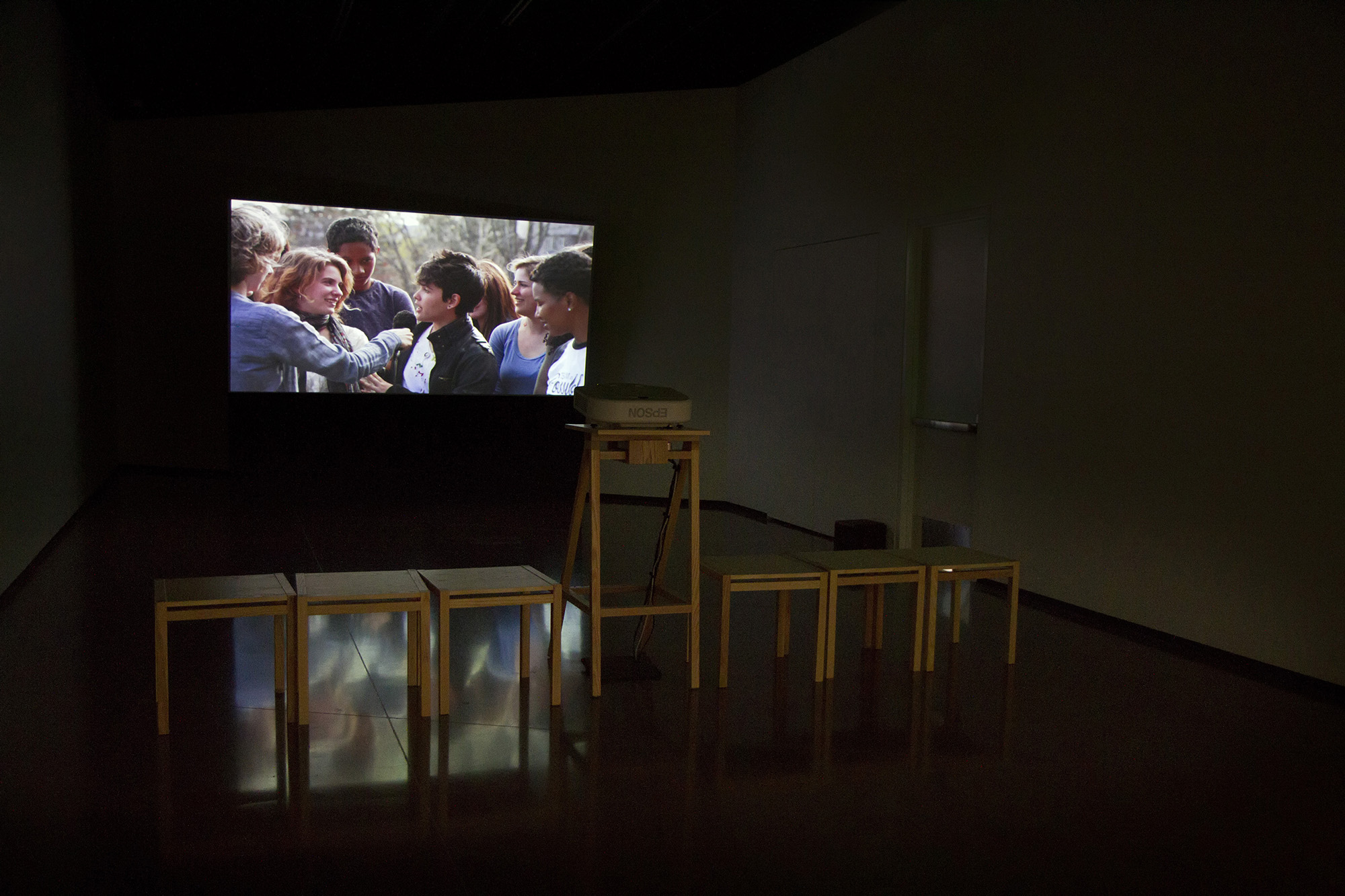
Though it has changed its location and its exhibition space numerous times, none of these spaces created as unique a screening as the one at Mount Holyoke: the viewing in Gamble was never to be repeated again. The film, she explained, had been removed from the context of the installation. As shown below, in the museum space, viewers enter a darkened room and may take one of six seats while the film plays on a loop. It is likely that upon entering the exhibition space, the viewer would not know the names of the interviewees or the question being  answered. Consequently, the screening at Mount Holyoke differed from any other viewing because its spatial context, as well as the popular discourses that occur in that space, was inseparable from its display.

Hayes_1

Ricerche: three, installation view at the Eli and Edythe Broad Art Museum at MSU, 2013, photo courtesy Eat Pomegranate Photography.

As a student at the time the film was shot, I recognized a third of the faces on the screen. Those whom I could not name were identified by my friends and other viewers in the audience, who pointed and whispered, “That’s ––, remember?” The film re-presented a number of faces I had not seen in years, whether the individual had changed their hair, glasses, gender presentation, or otherwise. Regardless of these changes, I was able to name, with the help of my friends who attended the screening, every face, and to even reconstruct some of the life-narratives these individuals carried. Although the names of these participants were never explicitly linked to those onscreen, I was able to recollect their names and what I knew of their histories at Mount Holyoke. My desperation to remember, to find the reason why these people looked so familiar, transformed the main concern of the film from contemporary discourse surrounding gender and sexuality, to the components we use to construct the narratives of people we know and, most importantly, people we don’t.

Context – that of public discourse, history, and space – localized Ricerche: three to a small women’s college in the Pioneer Valley, yet the impact any context – or lack thereof – has on visual art is undeniable; it determines our understanding of the work in front of us, perhaps strengthening or obliterating our original understandings. The intended installation space for Hayes’ film, however, attempts to evade the narrativization imposed by contextual elements including geography, biographical information, and historical frameworks. This evasion is particularly powerful in conversations about gender and sexuality, for the answers given by the students may not make sense when taken out of context or  when one enters the viewing space in the midst of a question or its response. For these topics, paired by the students with discussions of political sanctions and/or discipline of sexualities and gender presentation, a mis-contextualized, misunderstood response carries a greater potency; as the students claim various identities, they face the challenge of being characterized in a way they did not intend. They face the danger of (mis)representation.

Hayes consciously kept her arm and microphone in every frame of the film, holding herself accountable for directing, quite literally, the events that unfolded in the course of the twenty-minute screening. This ingenious decision to include her microphone in the shot recognized the hand she had in shaping the events that unfold over the film’s progression. In Gamble Auditorium, viewers had a rare opportunity to watch the film in the chronological progression Hayes created. As a result, viewers watched as a fight emerged between two outspoken students on either side of the group. This argument antagonized one student in particular – the camera persistently focused on their outbursts – and made me wonder, What is the ‘proper’ way to understand the narratives constructed by the participants in the film? Is there any way to make sense of visual art without context of any kind? Though there is nothing wrong with context and narrativization, Hayes’ film spoke to their limitations and revealed a human tendency to impose logic and order onto the unknowns we encounter.

In a talkback after the screening, Hayes explained that the students had been taken to a hill behind a pair of dormitories on campus and asked to stand on wooden panels. These wooden markers spanned a considerable length of the field, yet the entire space was never seen in a single shot during the course of the film. I took this to be the most striking disruption of spatial context: at the beginning of the film, I didn’t recognize the hill I had climbed many times to watch the sunset, the hill on which I had picnicked. And when I did, I could think more clearly about the impact of Mount Holyoke – a “special place,” said Naomi Rodri ’15, one of the participants in the film – on statements about gender and sexuality made in the film. I finally realized where the participants were coming from; I finally realized where I was.

« Newer Posts - Older Posts »

Categories