Posted by: emilyobedilio | December 12, 2014

Dorian Gray: ***Flawless

Last Tuesday, I arrived at my dorm, slumped on the nearest couch, pulled out my copy of Oscar Wilde’s The Picture of Dorian Gray, and went to pause Beyoncé’s “***Flawless” on my phone before taking out my earbuds – but I stopped with my finger halfway to the button and thought, This album would be a great soundtrack for Dorian Gray.

This is obviously problematic for many reasons. These are only a few:
1. Anachronism. Queen Bey dropped her self-titled album over a century after Wilde dropped Dorian Gray.
2. Radically different experiences. Queen Bey is a feminist woman of color and must cope with discrimination because of these identities. Dorian, definitely, does not have to cope with any discrimination because of his identities. And he’s not exactly a feminist. Like, at all.
3. Different themes. Queen Bey’s lyrics reflect her beliefs and identities, none of which Dorian really aligns with, obviously.

I recognize all of this, but I don’t think we should dismiss any connection (however distant) between Beyoncé’s latest album and Wilde’s only novel.

So do hear me out.

Like Dorian Gray, the song “***Flawless” deals with ideas of perfection, physical beauty, and superiority. Listen here if you wish:

Here’s a snippet of the lyrics:

I know when you were little girls
You dreamt of being in my world
Don’t forget it, don’t forget it
Respect that, bow down bitches (Crown!)

You wake up, flawless
Post up, flawless
Ridin’ round in it, flawless
Flossin’ on that, flawless
This diamond, flawless
My diamond, flawless
This rock, flawless
My rock, flawless
I woke up like this
I woke up like this
We flawless, ladies tell ’em (…)
Say I look so good tonight
God damn, God damn, God damn

As you may have noticed, Bey glorifies her beauty, her wealth, and her superiority over most of the human population. As she should. She does this in many songs throughout her 2012 album. All hail the queen.
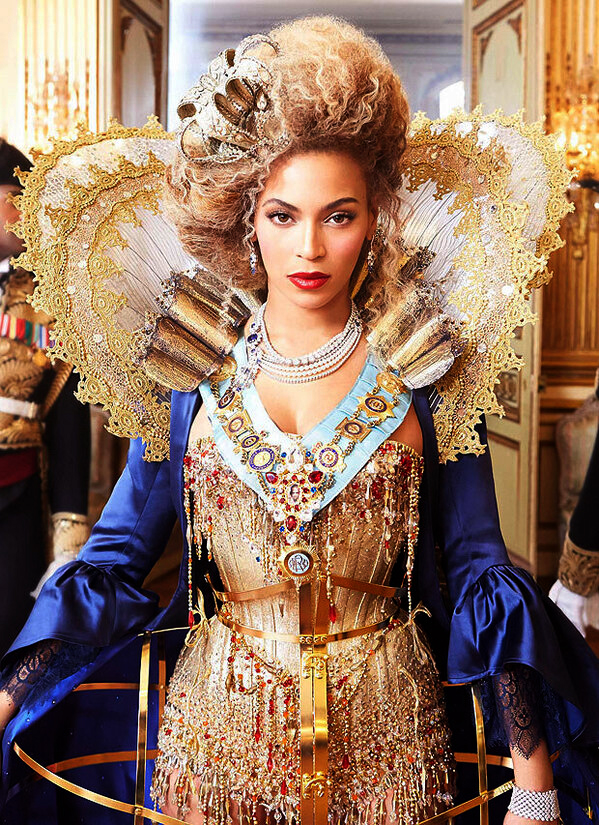
QueenBey-danieb

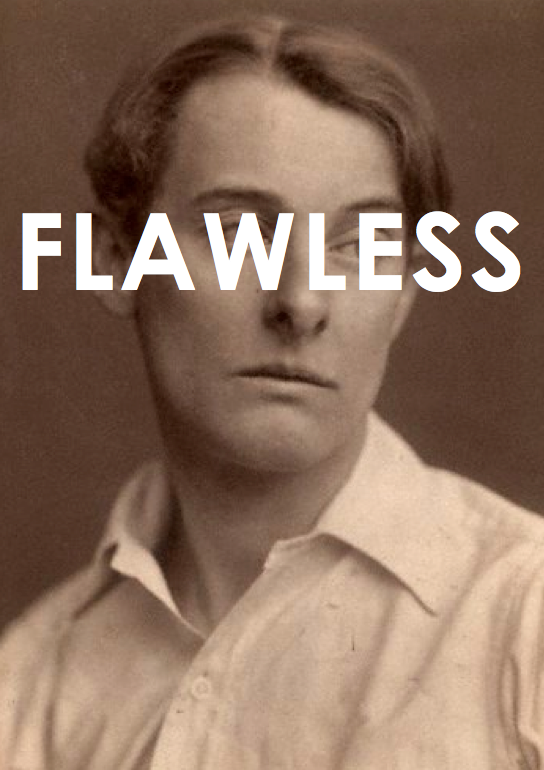
Does this aesthetic sound familiar? It should. A century earlier, enter Dorian Grey (here represented by Wilde’s evil boyfriend Lord Alfred Douglas – a similarly beautiful and unsavory character).

NPG x28098,Lord Alfred Bruce Douglas,by George Charles Beresford

Like Queen Bey, Dorian knows his societally determined assets and uses them to his own advantage. The entirety of The Picture of Dorian Gray investigates his self-love, his wealth, and his misguided belief that he, like Bey, is a deity sent to earth. In a lot of ways, Dorian is in dialogue with our current celebrity culture, and everything we assume that culture stands for.

The celebration of beauty is nothing new to the world of art. Neither is the celebration of wealth or hedonistic practices. But I’d like to posit that Bey and Gray are part of a larger trend of the celebration (occasionally poisonous) self-centeredness and pleasure-seeking. It’s possible that Wilde and the aesthetic he portrayed in Dorian Gray paved the way for Beyoncé and similar artists a century before her birth.

Just some tasty food for thought.

I am not the first to notice the connection between pop and “high” art. Fly Art Productions is a Tumblr devoted to superimposing hip-hop lyrics on top of famous paintings (check it out – it’s wicked: flyartproductions.tumblr.com). I like to think we can do the same for great works of literature.

To me, at least, Dorian Gray feels more fly and relevant to the culture I live in when I’m listening to Beyoncé. In spite of their many differences, they are, in a way, echoes of each other, and each other’s aesthetics.
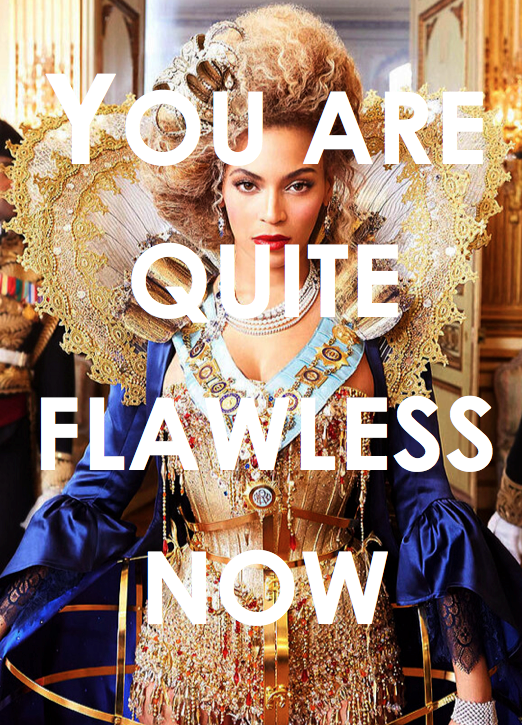
 

Screen shot 2014-12-12 at 10.21.03 PM


Screen shot 2014-12-12 at 10.45.30 PM

Lyrics courtesy of azlyrics.com.
Posted by: smartyy638 | December 12, 2014

Pet Portraiture

After our many discussions about human portraiture, I stumbled upon an article about the revival of pet portraiture in luxury fashion. Here is the link from Gale Cengage database, you may need to use your MoHo login to see it—

Sales happily go to the dogs a century after its Victorian heyday

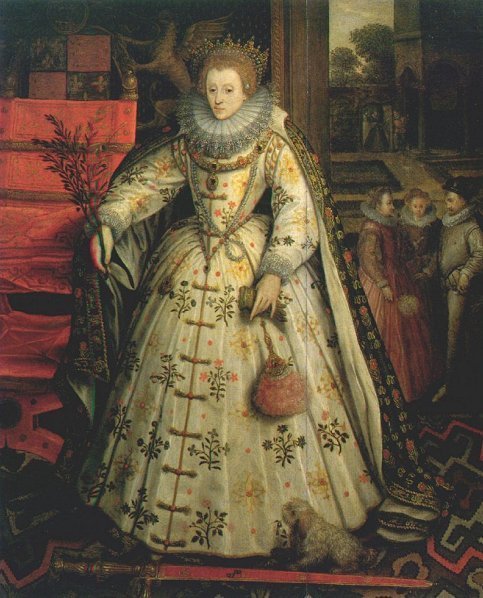
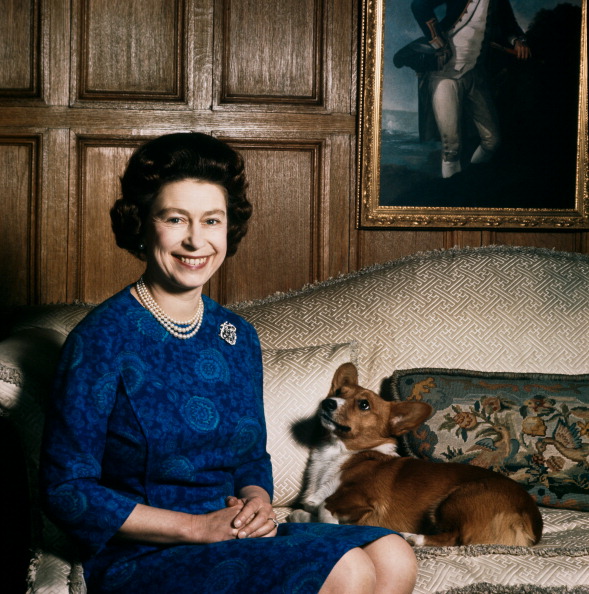
Apparently, pet portraiture originates from the Victorian Era with Queen Elizabeth I at its helm. She enjoyed commissioning portraits of her dogs; the aristocracy followed shortly after. Interestingly enough, it seems that Queen Elizabeth featured her pets in her own portrait in times of peace, shown by the following portrait done by Marcus Gheeraerts the Elder between 1580-1585. It remains Gheeraerts the Elder’s only surviving oil painting. We can see her tiny dog at the right bottom corner, at her feet with his gaze directed at her.  He is cuddled close; she grasps an olive branch.

elizabethpeace

http://www.marileecody.com/eliz1-images.html

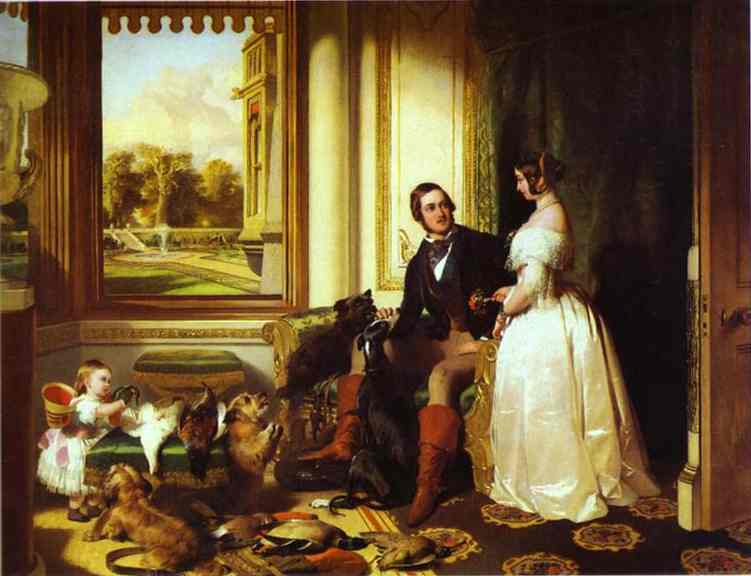
The trend continued with Victorian painters such as Sir Edwin Landseer in his painting of Windsor Castle—

Landseer_WindsorCastleInModernTimes

http://www.artexpertswebsite.com/pages/artists/artists_l-z/landseer/Landseer_WindsorCastleInModernTimes.jp g

And French painter, Gustave Courbet, of the same era in a self-portrait with his dog—

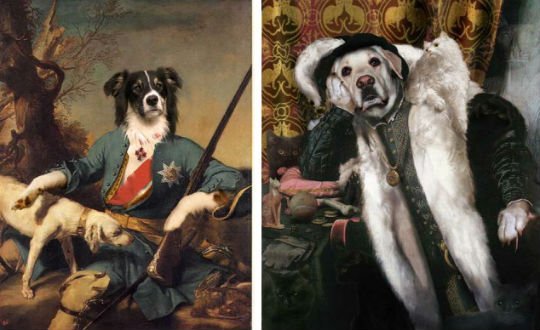
So why dogs? How did they function in portraits with others? As props? Supporting characters? I suppose this strange little branch of portraiture made me wonder about the way we use particular props in portraits in order to portray specific character traits or moods. This was especially true in our discussion of Lady Betty Delme (i.e. setting, displays of wealth, etc.) Furthermore, the presence of dogs in Victorian literature and art is remarkable and surprisingly evident—the presence of stray dogs in Oliver Twist, the expression of “dying like a dog,” in Dickens’ Great Expectations, Holmes’ Hounds of Baskerville, and then, of course, dogs in aristocratic portraiture. What do you guys think? Maybe some of you art history/art lovers can help me out with this one.  There exists also a dichotomy between dog as man’s best friend and of bestiality (i.e “die like a dog”) which fascinates me. Also, I don’t know if you have ever seen these before, but I recall these prints being particularly popular in the early 90’s:

506aff6adbd0cb3081001650._w.540_h.330_s.fit_

There was also a TV show I watched as a kid called Wishbone in which a Jack Russell Terrier  plays lead characters from classic literature. The show’s episodes riff on Oliver Twist, Hounds of Baskerville, Scandal in Bohemia, Great Expectations, Pride & Prejudice, and Tom Sawyer. Such fun.

Anyways, I just wanted to post these for fun — (yes, people STILL do this)

Queen Elizabeth II

Queen Elizabeth II

random person and her pet portrait with Santa (you’d be shocked how many of these there are…)

santa

Happy Holidays!!

Mason, Brook. “Sales happily go to the dogs A century after its Victorian heyday, pet portraiture is enjoying a lucrative renaissance. Brook Mason reports.” Financial Times 7 Apr. 2007: 9. Academic OneFile. Web. 12 Dec. 2014.

Today, some of our classmates (myself included) went on a tour of the Emily Dickinson museum in Amherst. Spoiler: it was fantastic. This was my second tour, and I was still awed at Emily’s genius and strangeness. I call her Emily now, as if we’re the best of friends. That was how the tour made me feel – like we got to see sides of her that most people aren’t aware of.

I won’t say anything too specific about these sides, except that there are many, and that you ought to take a trip to the museum to find them out for yourself. Instead, I’d like to talk about Emily’s relationship to MHC.

But first, an anecdote.

Three years ago, I purchased my beloved purple glasses at a high-end optical store, during which time, this conversation happened.

Impeccably Dressed Salesman: What’s the occasion?
Me: I’m going off to college and I want to change things up a little bit. And my current glasses are like disgusting. They have like all this green stuff in them like slimy stuff…? [I’m an oversharer.]
Impeccably Dressed Salesman: [smiles indulgently, ignores oversharing] Where are you going?
Me: It’s this tiny private college in Massachusetts called Mount Holyoke.
Impeccably Dressed Salesman: I haven’t heard of it. What’s its claim to fame?
Me: Well, it’s a women’s college. And Emily Dickinson went there. I guess she’s a pretty big deal.
Impeccably Dressed Salesman: [is impressed] Really? That’s fascinating.
Me: But she dropped out. She’s like their most famous dropout.
Impeccably dressed employee: [laughs indulgently] [wonders if this wee lout in a too-small T-shirt can afford the expensive frames he has to offer]
Me: [affords frames] [but is broke forever]

Now, after three years at Mount Holyoke, I wonder how much we can actually lay a claim to our most famous dropout. We advertise Mount Holyoke as the college that bred one of the most famous minds in the history of literature. We put up posters of her in our library. We claim her as part of our legacy, and ourselves as part of her legacy.

But, as I (re)learned at the museum today, she hated Mount Holyoke. Its rigorous schedule felt confining. Mary Lyon was, apparently, a tyrant who neglected students with “no hope” of religious salvation. It was far away from Emily’s home, where she enjoyed herself most – and after a semester and a half, she left Mary Lyon and her (un)saved brethren behind to return to her quiet, solitary life, without the nagging of Ms. Lyon and the paradoxical chaos of the strictly ordered life.

She spent only months of her fifty-odd years at Mount Holyoke. Her experience here was a blip in her otherwise somewhat homogeneously private life; Mount Holyoke was a footnote in a half-century of other (presumably more positive) experiences. After a couple of years, I’m sure she rarely thought of the college at all.

Still, when the Impeccably Dressed Salesman called two weeks later, he remembered Mount Holyoke, and he remembered her.

Impeccably Dressed Salesman: Is this Ms. Dickinson?
Me: [eternally clueless] Um, no, I think you have the wrong number.
Impeccably Dressed Salesman: Are you sure?
Me: Um, yes?
Impeccably Dressed Salesman: Actually, this is [Impeccably Dressed Salesman] from Cascade Optical.
Me: Really, I think you have the…oh wait. Are you calling for Emily Oxford?
Impeccably Dressed Salesman: Yes.
Me: Then why did you…oh, I see, Emily Dickinson, right. Ha ha, ha ha, ha…ha…how amusing of you. [is decidedly unsettled]

The Impeccably Dressed Salesman remembered Emily Dickinson’s name better than my own. And, when I went back to get my glasses cleaned a year and a half later, Impeccably Dressed Salesman said, “Yes, I remember you! You go to Emily Dickinson’s Alma Mater.”

Me: She dropped out.

Emily Dickinson is what many remember about Mount Holyoke—an otherwise obscure institution in an obscure corner of the world—but she left here as soon as she could. The place made her skin crawl. We claim her as ours, when really, she wanted to be no one’s. Especially not Mary Lyon’s. Especially not Mount Holyoke’s.

And probably not mine. But I still call her “Emily” instead of “Ms. Dickinson.”

Posted by: Alli C. | December 12, 2014

Henri Matisse and the Portrait

The exhibit at the MHC Art Museum, Matisse Drawings, Curated by Ellsworth Kelly from The Pierre and Tana Matisse Foundation, is a striking display of seeming simplicity. Forty-five sparse pencil, ink, and charcoal drawings set in white mats and blond frames don’t stand out from a white wall when you first walk in, but as you move past them the striking movement contained in them becomes apparent. You expect women formed from a few bold lines to flutter the suggestion of their eyelashes; acrobats caught mid-movement appear poised to lift off again at any moment, while you struggle to assign order – leg, arm, head, breast – to their half-realized forms; a boat – a rectangle with a few lines of ‘oars’ – paddles off to sea as you question your view of it (Through a window? Oh yes, and that’s a palm tree). The sheer simplicity of Matisse’s lines allows for a huge range of potential motion purely because the line-work is so sparse. It is difficult to perceive restriction of movement in an arm formed from the same line as the torso and neck it flows from.

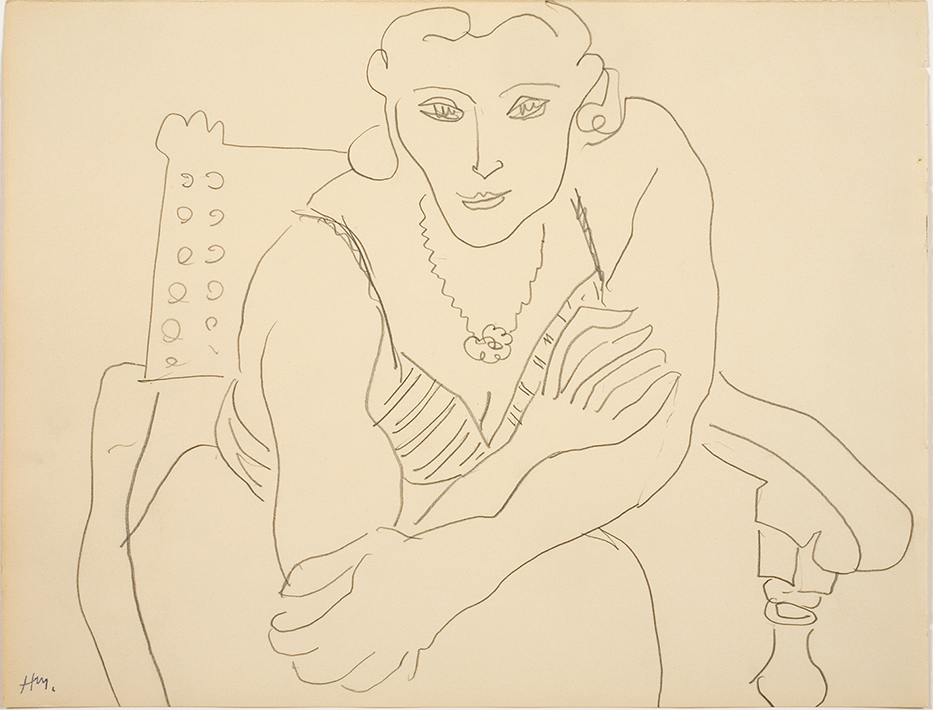
There were two elements of Matisse’s work I thought were particularly interesting given the topics we’ve covered in class. First was the gaze of his portraits. Take for example his femme en fauteuil:

AID_346_cc_4

She’s undeniably looking directly at the viewer (in contrast to our noticeable trend of ‘women looking sideways’), drawing you to engage first and foremost with her eyes before moving down to the casual slant of her shoulders, the curve of her back, the pattern on her clothing. And yet, when you do look in her eyes, you find yourself thwarted; where typically there would be a concrete meeting point for the gaze, la femme has only a few spiraling squiggles. Are they eyelashes? Pupils? If they are pupils, where exactly does one look to interact with the subject? In the world of portraiture, the aim of the artist – and the expectation of the viewer – is that the portrait is, in a way, a person in and of itself; a capture of the ‘person-ness’ of the sitter and something that can be interacted with and understood. Matisse’s femme – and indeed, many of his other portraits – do not allow this. They are clearly interacting with the viewer, and yet the viewer can’t interact back; the cycle of looking and being looked upon that is so common in portraits is being unconventionally broken, leaving the viewer the bereft party.

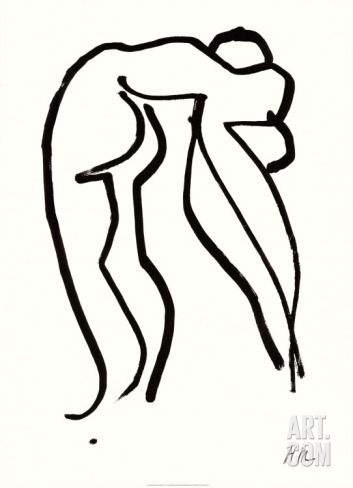
The second element of Matisse’s work I wanted to comment on were his drawings of dancers and acrobats. Unfortunately I wasn’t able to find any of the pieces in the exhibit online, but here’s a similar piece entitled Grand Acrobate:

henri-matisse-grand-acrobate-c-1952_i-G-10-1012-25XW000Z

Several of his dance studies focused on a specific dancer – Christiane. It made me wonder – if the subject is identified in the name of the piece, rather than simply being a dance study, what does that do to the piece? Is it still simply a study, or is it now a portrait? Is it neither? Could it be both? After looking at his dance studies, studies of acrobats, and even several studies of couples, I think perhaps it is a portrait, but not of any specific person. Maybe it’s now a portrait of dance, of acrobatics, of a couple. If a portrait of a person is supposed to convey a sense of the subjects ‘personhood’, then isn’t a drawing which conveys a sense of the movement and feel of acrobatics a portrait of acrobatics? And similarly with dance, or romantic entanglement? We’ve focused so much this semester on portraits of people and what they can convey and it was striking to be examining something labeled as a study and think, ‘but couldn’t that be a portrait?’

The exhibit of Matisse’s work is certainly an arresting one, and one I enjoyed. It’s power comes not only from the depth of feeling and movement that arises from such initially simple pieces, but also for the way those pieces interact with you as a viewer and challenge the traditions of art which we’ve been studying.

Posted by: Rachel | December 12, 2014

On Ricerche: three (Belatedly)

Approximately two months ago, I attended a screening of Sharon Hayes’ Ricerche: three in Gamble Auditorium. It was a slightly surreal experience: Hayes and her partner, Brooke O’Harra, had shot it a year and a half before, and it was startling to see some of the friends who had accompanied me to the event on the screen. I knew many more of the film’s subjects, too, either personally or by sight. Most of them had changed drastically in physical appearance in just the span of time between the film’s creation and the moment we watched it: short hair had grown out, long hair had been cut — even gender identities had shifted. This tangible fluidity embodied the spirit of the film, which aimed to capture a moment in time. In her address to the viewers, Hayes focused on the temporality of the event: it was significant, and a crucial part of the project, that the views expressed in the film were specifically attached to the moment in which they were captured.

The event itself was an extended conversation, framed in a series of questions and answers delivered by Hayes and a group of 35 Mount Holyoke students, respectively. Hayes borrowed the format and tone of her project from Pier Paolo Pasolini’s 1963 film Comizi d’Amore. In the earlier film, Pasolini asked a series of blunt and provocative questions to citizens on the streets of Italy. Hayes called this film a “contemporary inquiry into the ‘sexual problem,'” and the clip she showed did indeed feature such topics as sex, sexuality, love, homosexuality, perversion, and inversion.

Hayes also focused her dialogue on questions around gender and sexuality. In her lecture, she noted that her choice of population was not merely an accident of proximity. Hayes was interested in the women’s college atmosphere for the fascinating combination of its strong foundation in tradition, including traditional notions of femininity, and its more contemporary progressive and liberal attitude toward sexual identity and gender politics. Furthermore, she felt that Mount Holyoke presented a unique opportunity to explore this attitude in a more global context, given the extent of its international population.

On the April day on which the film was shot, Hayes gathered the group of students, a sample she and O’Harra felt was representative of the overall Mount Holyoke population, on the Delles Hill. Both the students and the questions felt distinct and rigid at the start of the film. Hayes directed questions to individual students at random, involving sex, virginity, the decision to attend Mount Holyoke, gender identification, religious and cultural values, and so on. These students attempted to give “correct” answers to the questions, while the surrounding crowd looked on somewhat awkwardly. As the questions progressed, however, the discussion became more cohesive. Students responded to previous responses without being directly addressed and began to deliver answers more confidently. At first, the atmosphere was generally tense, as students struggled to understand Hayes’ purpose in asking these particular questions; however, it became apparent that the questions were meant to inspire a dialogue, rather than well-formed individual answers.

It worked. Tension lifted; genuine laughter replaced awkward giggles. By the end, the focal point had shifted entirely from Hayes to the collective mass of students on the hill. A heated debate broke out, almost to the point of conflict. Hayes had hoped for such a conclusion, she revealed to our audience, though not necessarily in the form of a fight. She had hoped to capture some heightened form of human interaction based in these questions. She emphasized her desire to situate the personal within the collective in order to develop broader insights into the human experience. To that end, she didn’t assign physical spaces or any sort of instructions about how to behave to the individuals in the film. Instead, she allowed students to stand in “affinity groups,” which had the dual advantage of indicating relational structures and elevating comfort. These groups, she said, became “operative” in constructing the dialogue. “We are always ourselves inside of collective affiliations.”

Some of the students who had been interviewed on the hill that day were in attendance, and they were all invited to participate in a talkback. This, too, made the temporal aspect of the project evident. Students reflected on their views then and now, and when they were invited to answer questions, some of them had difficulty recalling the exact parameters of their earlier mindsets. Poorna Swami, a friend of mine as well as a participant in the project, spoke on the importance of recognizing that all the statements made at the time of the film’s shooting were attached to a “singular time in a singular place.” She also noted the limitations and biases of the film: “At the end of the day, this is an elite liberal arts institution.” However diverse the population may have been, the points and arguments made during that conversation were reflective of a certain standard of education. That idea was strangely appealing to me: of course this group wasn’t perfectly representative of the larger human experience on all levels. A precise encapsulated version humanity remains elusive, which is human in itself — the idea that such an endeavor must necessarily be flawed. Overall, Sharon Hayes did a beautiful job examining tones and modes of dialogue in the context of the personal and the collective in a particular moment in time.

Posted by: bellabook1 | December 11, 2014

Carrie Mae Weems: Art and Humanity, a Review

On September 18th, 2014, a wide array of people, ranging from the toddling daughters of Frances Perkins scholars, to traditional college students, to the Weissmans who fund the Weissman center, to members of the wider community, all braved the unairconditioned Gamble Auditorium in the late September heat in order to hear the renowned artist, Carrie Mae Weems, give a lecture on Arts and Humanity.  It was standing room only and students willingly gave up their seats to members of the community, opting instead to watch her presentation, with a slideshow component, from the back.  By way of introduction, John Stromberg, the Mount Holyoke College Museum of Art Director,  discussed his friendship with Weem’s and highlighted how her various perspectives and transformative pieces have redirected the flow of contemporary art, winning Weems not only a 2012 exhibit at the Frist Center and a retrospective at the Guggenheim (she is the first black woman to be awarded this honor), but also the Prix de Roma and the MacArthur Genius Grant.

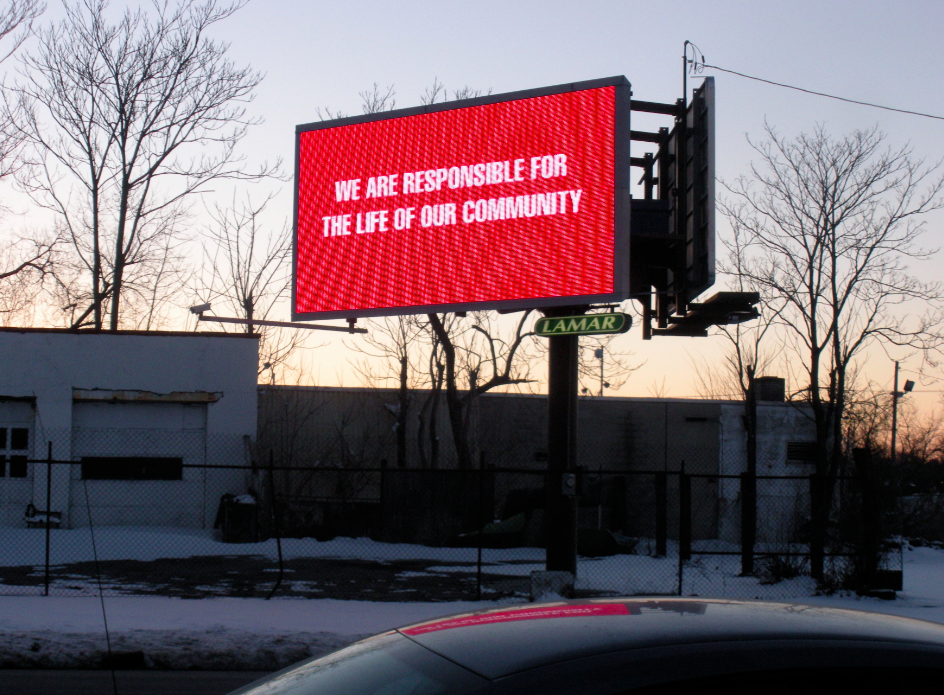
The artist took the stage to loud applause.  She was poised and smiling and the audience immediately fell silent as she began to speak.  Over 300 hundred members in this diverse audience, and you could all but hear the click of Weem’s mouse.  She immediately proved her right to a Genius Grant by seamlessly navigating the opening and operating of her powerpoint show without any technical glitches or apologies, a feat previously unheard of on Mount Holyoke’s campus.  Moving through her photographs, the selection of her pieces is not chronological.  That could be exhausting after a thirty-year long successful career as an artist.  Rather, she began her presentation by discussing how photography is an art that informs you, providing you with the opportunity to look back and reflect on “what you are up to”.  This selection of images is reflective and thematic, sliding from some of her best known pieces, such as “The Kitchen Table”(below) to images of recent signs she created and then posted around her neighborhood  in response to the gang-related killing of a young boy who lived only a few streets away from her.

kitchen-table14 Screen-shot-2011-03-02-at-7.28.25-PM

The juxtaposition between family, art, and civil dialogue was reflected on throughout Weem’s presentation.  This movement between her pieces examined the circuits that run between relationships, contexts, and engagement.  These links are central to Weem’s formation as an artist and to her body of work.  She said that one of the question she seeks to asks both herself and others through her art is: “How do you activate?”.  Weems’ work does a wonderful job of engaging people in a wide discourse on civic identity and engagement.  She communicates differences and similarities simultaneously by her works’ emphasis on resistance and the placement of not only images and text but her own body within specific contexts.  Her work represents her multi-faceted identity as a black female visual artist living in a country where racism, while always prevalent, moves between the honeyed smile of elitist micro-aggression and obvert state-sanctioned brutality.

Her coming to Mount Holyoke College in the wake of last year’s Mohonest campaign and the Ferguson protests made her discussion of race, presence, and context especially poignant and timely.

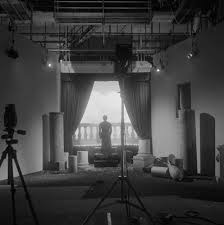
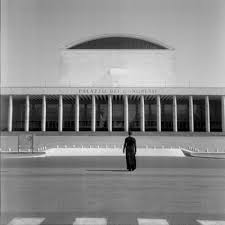
One of the most powerful moments in her presentation was her showcasing the images from her Louisiana Project and her Roaming series (images from both are pictured below).  In these images, Weems inserts herself and other black women into historical, and historicized images of both Louisiana and Rome, contextualizing wealth and culture in a narrative that has been visually white-washed and historically sanitized it their representations of race. During the question and answer portion of her talk, a member of the audience asked Weems why she used her self in her images.  “Because it is convenient,” she replied to laughs from the audience.

The Louisiana Project, 2003

images (5)

download (5)

Roaming, 2006

images (7) images (6) download (6)

Her inclusion of her self, with her multi-faceted identities, however, becomes more than convenient.  It becomes a political and social statement on what spaces are deemed appropriate and accessible for different races.  A question she received while traveling and working in Rome was “What are you doing here?”.   This was a question asked by friends she had already met and worked with in the United States.  They were surprised to see her moving through the setting of Rome, as the recognized space of cultural privilege that it is.  The implication of this question, as Weems noted, was that she didn’t belong there.  It was a space for wealthy white tourists and intellectuals. This led to the most powerful part of Weems’ Art and Humanity lecture, as she stated, “Nigeria isn’t the only place I need to visit.” The audience applauded loudly at this, as Weems talked about the prejudices and assumptions of the art world that limit people of color and people of lower socioeconomic classes in terms of their exposure to culturally significant ideas, places, and museums.  She encouraged the audience to question who they shared certain ideas with and not to assume that seemingly ‘hallowed’ cultural ideas and spaces belonged to specific groups of people.   These images, showcasing the black female body, allow the viewer to enter into the images from the inclusive viewpoint that Weems has curated.  Her pieces, and her discussion, exposed the lack of inclusion and awareness that the absence of not just her body, but all bodies and identities, and the history  and assumptions that are attached to their images, engender.

    A taste of Weems’ dedication to bearing witness can still be had, though the event happened in September, at the Mount Holyoke College Art Museum, with its recent acquisition of Weems’ piece, “I Looked and Looked to See What so Terrified You.”   In this self-portrait, Weems is wearing a beautiful patchwork dress, her face is lit by light and she looks beautiful as she gazes into a handheld mirror, a pastiche of the classical image of a woman arrested by her own reflected image, to see her reflection as a black woman that ostensibly is so threatening.

Posted by: amartinmhc | December 10, 2014

Kiese Laymon and the college ID

Following Kay’s post and Bella’s followup on language, narrative, and racist violence, I remembered that I wanted to share with the class this essay by the brilliant writer Kiese Laymon. There are several reasons that I share it. First, it is perhaps the most devastating analysis of racism in (and out) of the academy that I have read. Second, at the start of the semester, we talked about early identification documents as apparatuses of surveillance and biopower, as ways of archiving bodies seen as deviant, particularly those of the working class. This piece nuances that in very important ways, exploring how for people of color, ID can provide certain kinds of protection while at the same time exacting enormous costs. I urge all of you to read it.

My Vassar College Faculty ID Makes Everything OK

Posted by: bellabook1 | December 10, 2014

Dangerous Narratives, Damaging Language Cont’d

This piece is 100% a continuation (an homage more than anything else) to Kay’s wonderful piece: http://victorianvisualculture.com/2014/12/04/dangerous-language-damaging-narratives-the-case-of-ferguson/

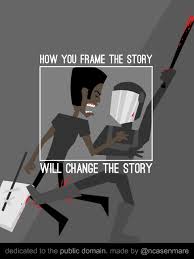
Kay’s piece, which connects the reframing of the images stemming from the media’s portrayal of Ferguson to Oscar Wilde’s discussion of imagery and the danger of representation, uses this powerful image.

download (4)

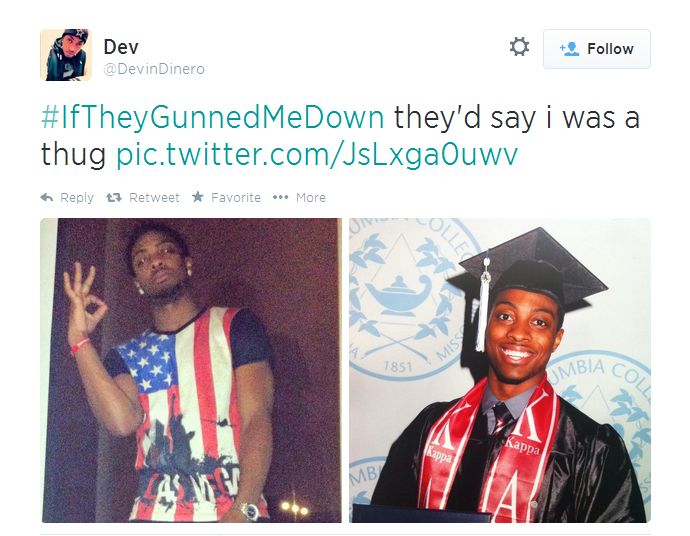
It reminded me of a twitter campaign that happened in August right after Ferguson, entitled #iftheygunnedmedown.   In this campaign, young black people used the ostensibly more democratic form of social media to protest the way that the media was reframing and re-editorializing narratives of violence via their selection of images.

Some of my favorites from the campaign include:

If-They-Gunned-Me-Down-August-2014-BellaNaija.com-03  02-IfTheyGunnedMeDown Screen-Shot-2014-08-13-at-10.52.22-am (1) tumblr_na49o1yrkI1qgwi7to3_500

This refusal to be subsumed into a narrative reminds of the piece we read earlier in the semester “Fenians in the Frame” where certain prisoners smiled during their photographs, thus using their positions as subjects to reimagine the narrative surrounding their images.  The images that first come to mind are these:

IMG_2816

IMG_2815

While being taken centuries apart, both of these sets of images create a dialogue about people reclaiming the images of their bodies that have been othered and presented in different, biased ways.   While the understanding of images, the vehicle for their disbursement, and the power that subjects have in asserting how their images are used were vastly different for both groups of people, the agency of the subject is central to both. While photography, archival or otherwise, was new when the suspected Fenians were taked,  the subjects of #iftheygunnedmedown, are consciously reacting to the rewriting of their images, and by extension, their idenities, within their own social networks and drawing attention to the power that reframing has in presenting a narrative.

Posted by: Hyeonjin | December 9, 2014

Victorian Slang, Anyone?

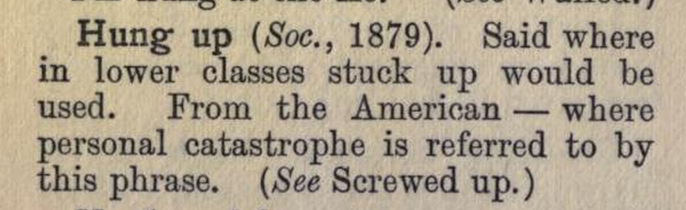
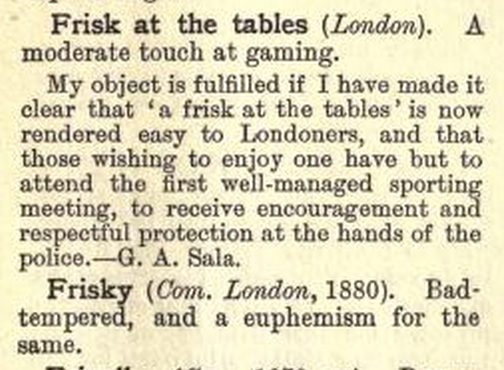
The online world is a horribly dangerous (yet wonderful) place for procrastination and entertainment. I came across this book that can be publicly accessed entitled Passing English of the Victorian Era by a James Redding Ware (who, interestingly enough, created one of the first female detectives in fiction, yay!). It is a collection of slang and phrases heard at this time period, and interestingly enough, some of them seem to have survived today!

I decided to take screenshots of some entertaining ones to share (though I decided to start with something a little more familiar), but definitely check it out. I think you’d be in for a treat. That being said, who would have even thought to say some of these things? Then again, I suppose no one would have ever thought words such as “ratchet” or “yolo” would be a thing. Or calling people peasants on forums (or in real life, but you know… that might not fly all that well).

Screen Shot 2014-12-09 at 23.21.22

Screen Shot 2014-12-09 at 23.24.05

Screen Shot 2014-12-09 at 23.26.03

Screen Shot 2014-12-09 at 23.30.41

Screen Shot 2014-12-09 at 23.31.04

Screen Shot 2014-12-09 at 23.31.30

And my favorite…

Screen Shot 2014-12-09 at 23.29.40

Personally, I’m in favor of bringing back “gigglemug”.

EDIT:

I also felt that this was pretty relevant after I mentioned the strange words that we use today that I’m sure, a hundred or two years later from now, people will also ponder over. These are some of the words that have been added to the Oxford English Dictionary. It’s incredible to see how the English language constantly evolves and grows!

Posted by: morganerosenberg | December 9, 2014

TSwift in Wonderland

As I (poorly) explained last class, I’m going to be looking at Alice in Wonderland and exploring the themes within Alice that are more applicable to adults than children. Themes I found within Alice that are beyond the years of a child include self-doubt (when Alice believes that she has turned into her friend because she no longer remembers anything), insensitivity towards others (when Alice keeps bringing up cats and dogs to the mouse knowing that they are his predators), and also making repetitious mistakes because you forget the implications (when Alice keeps making herself grow and shrink despite telling herself she shouldn’t anymore. Picking out these themes has made me think that this is even more appropriately a book for adults than for children. I think there’s a lot of lessons in there that a child would not pick up on.

At this point, I’ve listened to Taylor Swift’s new album dozens of times (it was pretty much on repeat on a drive all the way down to North Carolina and back #sorrynotsorry). For those who aren’t true Swifties, getting the deluxe album at Target buys you three extra exclusive songs. One of these songs is called “Wonderland.” Besides the fact that this song is awesome, it also got me to think about Wonderland in a new way. The song applies themes from Alice in the context of love and likens falling into Wonderland as the spinning feeling you get when falling in love. (It seems like the audio for the song has been removed from all YouTube videos, so I’ll try to upload the song directly from my iTunes).

I love how Wonderland becomes a place of delirium in her song. The lyrics go, “Flashing lights and we/took a wrong turn and we/Fell down the rabbit hole/You held on tight to me/Cause nothing’s as it seems/Spinning out of control/Didn’t they tell us don’t rush into things/Didn’t you flash your green eyes at me/Haven’t you heard what becomes of curious minds/Didn’t it all seem new and exciting/I felt your arms twisting around me/I should’ve slept with one eye opened at night.” From the lyrics, it seems like emphasis is placed less on the uncertainty of what will become of the relationship, and more on the fact that the end is already doomed because of the rocky start. The lovers in Taylor’s song are distracted by the “flashing lights” and can’t clearly see the mismatch of the relationship. Likewise for Alice, she got so distracted by the rabbit and the garden behind the little door that she didn’t realize the mess she had gotten herself into or the trouble she caused many of the characters along the way.

The last verse of the song is really great because it starts with “We found wonderland/You and I got lost in it/And we pretended it could last forever.” If Wonderland was supposed to act as the bridge between childhood and adulthood (or innocence and maturity) for Alice, we obviously know that this twilight zone cannot last forever. It seems like Taylor is also saying that destructive, naive love has a definitive expiration.

« Newer Posts - Older Posts »

Categories