Posted by: morganerosenberg | December 9, 2014

Goya: Order and Disorder Exhibit at MFA

A few weeks ago, I went to the Museum of Fine Arts in Boston, which is my favorite museum because the building itself is gorgeous and their permanent collection is incredible. They have a fantastic American wing with Eakins, Homer, and Sargent, to name a few. Currently on display is a Goya exhibit. For those of you unfamiliar, Francisco Goya is a Spanish painter who was born March 30, 1746 and died April 16, 1828. He was famously the court painter to Charles III and Charles IV. He also was commissioned to paint for much of Spain’s nobility, which is a testament to his popularity and well-regard. When Goya became ill and deaf, his work took a darker turn. It was at this time when he made his famous print series, Los Caprichos. These prints portray nightmarish and fantastical scenes that reflect the introspective of Goya. The turn of the 19th century brought the Peninsular War, which started when French forces invaded Spain in 1808. Goya became active by representing the war in his work.

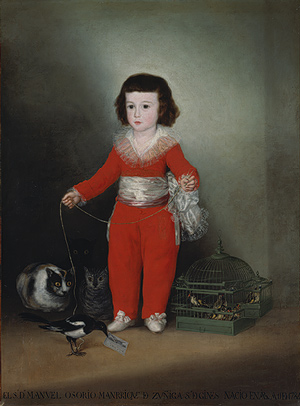
The exhibit is titled Order and Disorder to represent the extreme variation of Goya’s work and how it moves from commissioned portraits to genre drawings to representations of the war. Instead of breaking up his works chronologically, the exhibit was organized by themes, which included nurturing and abuse of children; hunting as sport and metaphor; religious devotion and superstition; equilibrium and loss of balance; justice gone awry; and the symbolism of the giant. This was incredibly interesting because it allowed me to think critically about the subject as opposed to a timeline. A sub-category of many of these themes was age and time. Many of the portraits of youths were sick children who were in the process of dying, his most famous being of Manuel Osorio Manrique de Zuñiga, a wealthy young boy who died at the age of 12. The birds represent the fleeting soul, which may mean that Goya painted this portrait after the boy’s death (Goya never dated his work, so it’s impossible to know when it was actually executed). The child is also quite small for a boy of 12, which is proof of his sickly nature.
h2_49.7.41

Another painting that especially intrigued me was titled Las Viejas or Time of the Old Women, as it is often called in English. The old women are incredibly sallow and decrepit looking. They are elaborately dressed, likely in an effort to ignore their sickness and age and hold onto their youth. This fact cannot be ignored, however, because father time hovers above them. The contrast between Father Time and the women is interesting to note, as all three subjects are old, but Father Time possesses a strength that the women do not. This inspires us to consider beauty and age in different forms. Most art historians believe that Goya painted this after his own illness that left him deaf; therefore, this can act as a reflection of Goya’s own grappling of age and the inevitability of his own death.

703goya

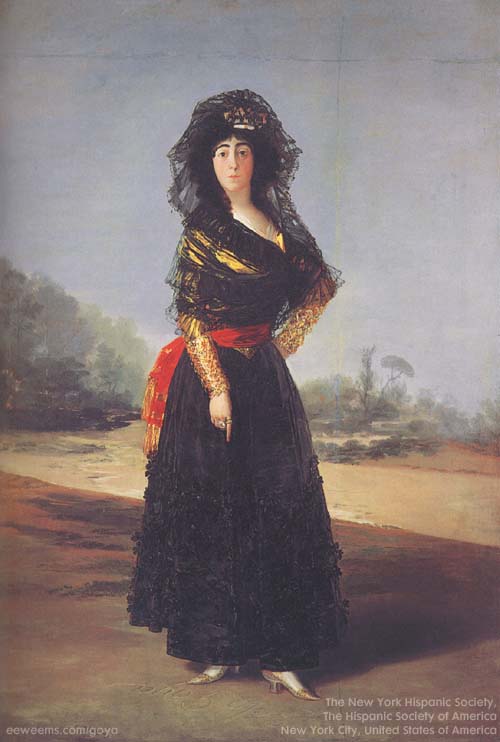
Having spent so much time in class discussing portraiture, this exhibit was very relevant. We’ve focused only on English and Irish portraits, so I enjoyed exploring Spanish portraiture. Spanish portraiture seems to possess more movement and emotion than English portraiture, which I found could be very rigid and formal. Goya often infuses his portraits with satire, which added a lighter element to his pieces. One of my favorite of Goya’s is his painting of The Duchess of Alba. The Duchess is pictured in mourning clothes, as her husband died the year prior; yet, she does not appear to have the sentiment of mourning. She points to the ground, where the words “Solo Goya” are drawn in the dirt. This provides some evidence of an intimate relationship between the Duchess and Goya, which could explain her lack of sorrow. The inscription was covered up and was not discovered until later when the piece was being cleaned; but, it still shows the naughty nature of Goya’s work.
duchess_black_500

This exhibit will remain open through January 19th, so you should all try and make it into Boston during the break to see it! Here’s the link if you want to see videos of the curators explaining their process: http://www.mfa.org/exhibitions/goya.

Posted by: ferge22j | December 8, 2014

Pictures of Dorian Gray: Webcomics and Oscar Wilde

Oscar Wilde was a writer, but he must have had a bit of the soul of another kind of artist. His prose is richly visual, layering simile and metaphor with painterly effect. In the past century, every kind of artist from film directors to ballet choreographers have discovered how well the visual quality of Wilde’s prose translates into other forms. In my own opinion, the very best medium for reinterpreting Wilde is comics, which incorporate visual art and prose better than any other form I can think of.

Quite a number of comic artists have offered their own Dorian Grays, including French artist Stanislas Gros, who did a Beardsley-inspired side project called “Le Petit Dandy” about a Dorian who invents a “mouth organ” that distills music into liquor, among other decadent novelties.

A few more well-known artists have done Wilde comics, including (P. Craig Russel, the first openly gay mainstream comic book artist), but my very favorite Wilde comics are those of the Perfect Stars webcomic series. The author of Perfect Stars (who goes by the penname Romantic) parodies more than retells Wilde’s life and stories, but maintains a few elements of his style: stylization and an interest in the aesthetic. Her undulating lines and sharp colors evoke Wilde’s sometimes-dizzying sensory metaphors at least as well as those of Aubrey Beardsley.

One of her very first post, way back in the resurgence of alt webcomics in 2006, was “Oscar Wilde Comics (!!)”, a vignette on the life and love of Wilde and his asshole boyfriend lover “Bosie”.

Over the years her style evolved, but her Wilde preoccupation remained constant.

She’s also drawn a few scenes from an alternate version of Dorian Gray.

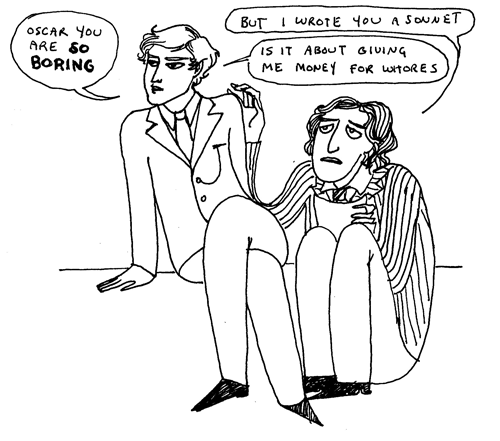
Every literature-based webcomic artist worth her salt has offered her own reinterpretations of the Oscar-Bosie story, including Kate Beaton of Hark a Vagrant fame (possibly inspired by Romantic’s version):

But Romantic’s been my spirit animal since middle school and I’ll always have a particular fondness for her Dorian. I mean, look at this crazy kid:

(Of course I glued this on my eighth-grade English binder.)

Perfect Stars’ Oscar Wilde Comics

Perfect Stars’ Dorian Gray Comics

Hark, a Vagrant

Le Petit Dandy

Posted by: SJ | December 8, 2014

Alice Doubles in Photography and Fashion

My final paper is about doubles in the Alice books, and I thought I’d share some of my side research on the blog! These are some photos from two separate shoots by two contemporary photographers, Lorenzo Agius (x) and Annie Leibovitz.

Photographer: Lorenzio Agius. Model: Liz Jagger

This piece by Agius intrigues me! I believe it is a reference to Tweedledum and Tweedledee (I cannot find a caption for it online). If so, this is a really fascinating tribute to the Looking-Glass text:

They were standing under a tree, each with an arm round the other’s neck, and Alice knew which was which in a moment, because one of them had ‘DUM’ embroidered on his collar, and the other ‘DEE.’ ‘I suppose they’ve each got “TWEEDLE” round at the back of the collar,’ she said to herself.
They stood so still that she quite forgot they were alive, and she was just looking round to see if the word “TWEEDLE” was written at the back of each collar, when she was startled by a voice coming from the one marked ‘DUM.’

In “Photographic Wonderland” Franz Meier argues that the Tweedle brothers act as a stand-in for the medium of photography: you cannot see their backs, they are uncanny doubles, and they are so life-like you lose track of whether they are or are not actually alive. Agius’s photograph flips this idea on its head: we see both the back and front of the person depicted.

Screen Shot 2014-12-08 at 4.28.09 PM
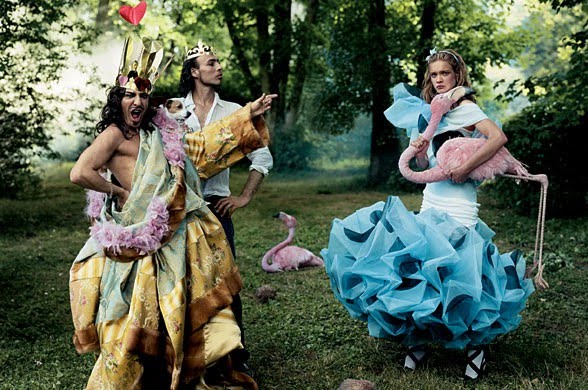
Annie Leibovitz shot an extensive series of photographs for Vogue, featuring prominent fashion designers posing as Alice characters alongside Natalia Vodianova, who was dressed in the designer’s particular dress design.

Photographer: Annie Leibovitz. Models: John Galliano, Natalia Vodianova

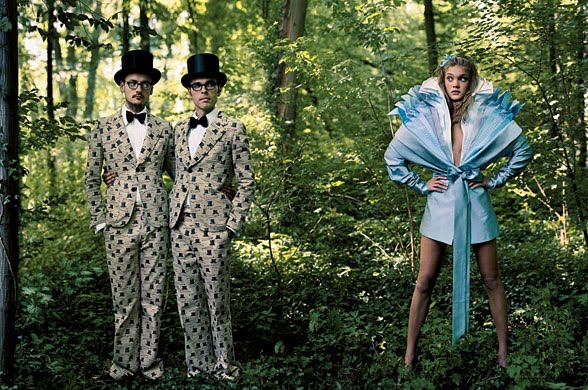
Photographer: Annie Leibovitz. Models: Viktor Horsting, Rolf Snoeren, Natalia Vodianova

What fascinates me about these photographs is the role of the designers — their creations (Alice’s dresses) allow them into the photograph, where in a way they create duplicates of themselves. The photo of Alice with the Tweedle brothers is another interesting take on that aspect of the book: here Alice poses similarly to the brothers, receding into two-dimensional photographic reality. Without Alice to investigate the Tweedle brothers, what happens to them? Do they remain motionless, frozen? This photo raised an interesting possibility for me: if the Tweedle brothers are representative of anxiety about mirrors, photographs, and other objects which capture likeness, perhaps the anxiety specifically concerns what happens to our likenesses when we aren’t around to observe them. Do they vanish? Do they live on as fragments of our faces and selves? Do they become gross distortions of our features and personalities?

I would absolutely love it if you would all contribute your readings of these images! There is so much to say about each of them, that I think it would be fun if I leave off here and let you chime in! 🙂

References and more photographs from these series:
http://www.wicked-halo.com/2010/02/alice-in-wonderland-take-ii.html
http://www.vogue.com/868365/exclusive-emin-vogue-the-editors-eyeem-clip-alice-in-wonderland-comes-to-life/
http://www.bowofmoon.com/2012/10/alice-in-wonderland.html

“This project serves to raise awareness in Sri Lanka that there is a shared deity between Hindus and Buddhists. As the Tamil government has such a violent history, this epic of the Goddess calling for justice is a way to talk through our grief, our suffering, and our loss.”

So began Malathi de Alwis’ November 11th lecture on devotion to the Goddess Pattini-Kannaki. de Alwis, Mount Holyoke College Class of 1985, is currently employed by the University of Colombo in Sri Lanka teaching in the Master’s program for Women’s Studies. She also is highly involved with the work of the International Centre for Ethnic Studies. Her lecture, given to a group of about 40 students, professors and community members, explored the impact of over 120 photographs of representations of the Goddess taken around India and Sri Lanka. de Alwis was sure to note that as the worship of Pattini-Kannaki is primarily practiced by members of the lower castes, these photographs also highlight the religious diversities of emerging complex societies.

I nodded along with this introduction but after about two minutes it became very apparent that I was out of place. Wait, which goddess? Is she talking about more than one? Did I misunderstand story? These thoughts and more raced through my mind as I tried to actively listen and take notes. I entered the space with little background knowledge about the religious culture of Sri Lanka and India (my only understanding came from the advertising blurb), and as this lecture seemed to operate on an assumed cultural knowledge, it was difficult for me to follow. As I sat in the front row, I subtly turned to scan the crowd behind me. All 40 sets of eyes stared ahead with rapt attention, seemingly fascinated by the presentation. So it was just me. I listened harder.

After her introduction, de Alwis read directly from what seemed to be an academic paper. While she was able to deliver great information this way (she explained the intersections of the exhibition with the structuralization of Buddhism and Buddhist identities) it did seem to limit her interaction with the audience. As there are images of this Goddess that are both Hindu and Buddhist, de Alwis noted that viewers often wanted to know which is which because the visual clues were not enough to cement an alliance with or distaste for the representation in a certain work. Laughing, de Alwis reminded the crowd “there are actually very few differences between the two.” This small statement made the biggest impact in reminding the Mount Holyoke audience of this photo-project’s goals: unity, and healing from the violence of perceived differences – a task on the forefront of the American consciousness (re: Ferguson). It was here that I began to connect with this lecture, because even though the context confused me, the overarching idea of truth as portrayed through objective visual culture was very clear: pictures function as unbiased documentation of suffering, and thus can help people heal.

de Alwis showed the audience many painted images of the Goddess is rapid fire, and when she asked if we could identify the special items in Pattini-Kannaki’s hands, she barred faculty from answering to make the game more fair.

“I want to hear from the students,” she said.

“Anklets?” one suggested. I snorted, as did many others around me. Yes, she is holding anklets. In her hands. Anklets.

“Snakes?” asked another.

While the anklet is crucial for recognizing the Goddess (just in a different location), de Alwis explained that the Goddess was holding a mango – -a very powerful symbol in the Buddhist canon, also associated with dewdrops and fire. Both of which, I thought, are symbols of change and rebirth.

As de Alwis continued to weave the 5th century epic of the Goddess with the strife of the 20th and 21st centuries, all my confusion fell away. She noted, “because Pattini-Kannacki was a human who became divine through works, she is a great solace to modern women.” Many women pray to the Goddess about the disappearances of their husbands, sons, and brothers. They hope that because she received justice, that they will, too. These prayers are very politicized, as mothers of the disappeared have cursed two presidents, prompting these men to complete large-scale rituals to ward off the bad energy.

Although the political leaders only attempt to engage with the Goddess in a defensive way, de Alwis noted that there are also men who proactively seek out contact with her, hence the title of the lecture. She said that “spaces connected with the worship of Pattini-Kannacki can be particularly safe for men struggling with their gender identities, for as a priest of the Goddess, you continually inhabit female spaces and can thus explore different times of masculinity and expression.”While audience members (myself included) were curious if the space was equally as open to women exploring alternate identities, we learned that the priests of the Goddess were nearly exclusively men taking on female roles. These men would often go into trances and make prediction about those attending the rituals, and many of the photographs in the exhibit document this occurrence It is thought that even if one if uncomfortable, or if they do not want to hear what the priest has to say, that they must – for it is not him speaking, but the goddess.

As I was leaving, I overheard the lingering conversation of passionate audience members. “The Goddess is agile” one said. “ She is a global. A shape shifter. She can adapt to new communities.” I had to agree with him; especially in regards to the connection I felt this project had with the events in Ferguson, Missouri. “This goddess serves lots of needs and purposes,” he said, “so people keep coming back to her.”

Posted by: Rachel | December 5, 2014

On Ferguson & The Colbert Report

In reference to our conversation in class Wednesday regarding Ferguson and related recent events, I wanted to share this video of an episode of the Colbert Report from earlier in the week.

Colbert does a really nice job of outlining the absurd expectations around performativity that have been used throughout this conversation to defend racist behaviors. He notes that the St. Louis police force has condemned the number of football players for the St. Louis Rams who raised their arms (in a “hands up, don’t shoot” pose) in protest of the events surrounding the Mike Brown/Darren Wilson incident, calling the action “tasteless, offensive, and inflammatory.” He then recalls an incident in which a police officer stopped a black man for having his hands in his pockets (“You’re making people nervous”). Finally, Colbert moves onto a couple of sillier hand gestures: a turkey-style gesture and jazz hands.

The emphasis on evaluating intent through visual cues associated with body language has become central to debates of the last few weeks. It becomes especially crucial when fatal action occurs within the space of seconds or minutes, which means that the bulk of the retrospective analysis must have its basis in visual performance — gestures, facial expressions, and so on. As such, the “hands up, don’t shoot” pose has become a symbol of protests around the country. But what are the implications of a debate so heavily focused on surface-level imagery? How far can such a debate carry us? To some extent, this mode of discourse is useful, as its exaggerated focus on superficiality highlights the flawed way in which our society perceives surface-level racial characteristics. But it may also become dangerous for conversations to continue in this manner.

Thoughts? I’d be interested in carrying on this conversation outside the blog, if anyone else is…

Posted by: ferge22j | December 4, 2014

21st-Century Freak Show

In class on Wednesday, we got into a discussion of Victorian “freakery” after looking at a Lady Clementina Hawarden of one of the Hawarden daughters leaning against a mirror in a circus-like costume. The image evoked contemporary images of conjoined twins who were exhibited as side show attractions, such as Millie-Christine, “The Two-Headed Nightingale,” and the Blazek or “Bohemian” twins.

the Blazek twins

The Two-Headed Nightingale

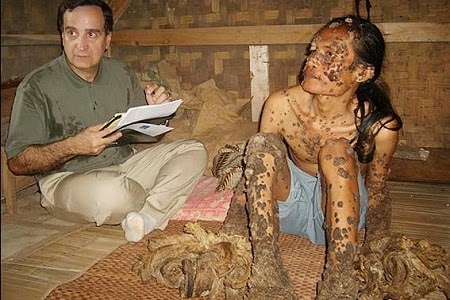
We usually associate freak shows with a less-enlightened era, before the development of modern ethics – possibly ending around the time of Tod Browning’s Freaks, by which time the concept of freak shows had become unpleasant enough for horror movie fodder. However, freak shows ended not so much because people’s interest in freaks waned but because the popularity of film eclipsed that of circuses and vaudeville (which is why many of Browning’s “freaks” saw his film as their big break into the new medium). Twenty-first-century audiences are as fascinated with deformity as were the Victorians, which current television shows such as Extraordinary People, BodyShock, Mystery Diagnosis, and Medical Mysteries demonstrate.

The “tree man” on Medical Mysteries

The most obvious mirroring of the nineteenth-century fascination with conjoined twins (especially young female pairs) is the media frenzy surrounding Abby and Brittany Hensel, a pair of conjoined twins who might have done well in vaudeville if they had been born a century or so earlier. Instead, they gained fame through the morning news and talk show circuit and starred in a 2013 BBC reality miniseries about their post-college adventures.

Abby and Brittany Hensel with some of the friends that co-starred in their reality series

One could argue that the perennial fascination with oddity inspires not only quasi-scientific shows on Discovery Health but the majority of reality television. It’s been said that the reason freak shows were so popular is that it feels good to feel better than someone else. Who could say that isn’t part of the attraction of blockbuster reality series like Here Comes Honey Boo Boo and The Jersey Shore?

Here Comes Honey Boo Boo

Posted by: Kay Heffernan | December 4, 2014

Dangerous Language, Damaging Narratives: the Case of Ferguson

Here is a link to the tweet and illustration by Nicky Case (@ncasenmare) mentioned in class last night. I find this particularly relevant to the discussion we had about Wilde: the mixing, the compounding, and the reification of verbal and visual descriptors – in short, the dangers of representation.

As the Mount Holyoke community continues to respond to the Ferguson case and related ones – Eric Garner, Trayvon Martin, Mike Brown, Renisha McBride, and too many others – I find myself thinking about stories, legitimacy, and truth. I think about language, imagination, fear, and power. How can dialogues about these recent events introduce, validate, and disperse alternative/non-mainstream perspectives? How can we move towards justice by shifting the normative “frame”?

Posted by: jordanelassonde | December 3, 2014

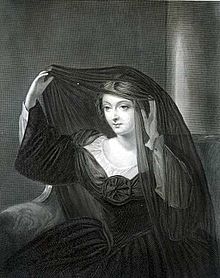
Veils and Gazes

Viola (Cesario): Good madam, let me see your face.

Olivia: Have you any commission from your lord to negotiate with my face? You are now out of your text. But we will draw the curtain and show you the picture.

(She unveils)

Look you, sir, such a one I was this present. Is’t not well done?

Viola: Excellently done, if God did all.

I read Twelfth Night for the first time this semester in my Shakespeare class. The above exchange between Olivia and Viola, at the moment dressed as a man, reminded me of our first class when we read Robert Browning’s “My Last Duchess.” We had an interesting discussion about the control of gaze in the unveiling of the Duchess’s portrait. Though it was quite some time ago, I think our discussion centered around the idea of ownership and possession, that the Duke was exerting his power over his dead Duchess by controlling who could see her portrait.

I found the same theme in this scene of Twelfth Night. Olivia, mourning her brother’s death, veiled her face, controlling who could look upon her. As opposed to “My Last Duchess,” here the woman has control of the gaze, control of the veil. Olivia also compares herself with a portrait, asking if the painting was well done. Viola replies that it is, if it was natural. I wonder what it means that Olivia compares herself to a portrait. Is she suggesting that portraits and their subjects are interchangeable? Or is she making some statement, assuming that there is some degree of difference between portraits and their subjects, that she, as a portrait, is somewhat less than her actual self or in some way constructed.

I also find it interesting that though Olivia believes that she unveiling herself to a man, she is in fact unveiling herself to another women. Throughout the semester we have continually returned to the concept of the power of the gaze. I wonder just what it means that Olivia does not reveal herself to her intended audience.

I am curious too, if anyone has any ideas about the meaning of a veil. Here are a few images of the unveiling in Twelfth Night.

olivia1PAD Twelfth Night S14220px-Charles_Robert_Leslie,_Olivia

Posted by: Rachel | December 2, 2014

On The Toast (Part Two)

I’d like to follow up on Mackenzie’s earlier post regarding Texts From Jane Eyre and its creator, Mallory Ortberg of The Toast. Here’s another in the series of absurdly mundane interpretations of classical artwork: “Women Rejecting Marriage Proposals in Western Art History.”

mmm idk i kind of already have all the cows i need so i don’t really see what i would get out of this

Ortberg pairs grandiose images of long historical significance with twenty-first century style commentary, typically in a bored tone. The unlikely juxtaposition of these two scripts (i.e., contemporary conversational dialect and the more formal scripts traditionally associated with respected art) is in itself humorous — in fact, this formula often serves as the basis for humor. However, Ortberg’s project extends into an even greater dimension: it casts a feminist lens on a historically male-dominated world. Not only does Ortberg inject women’s thoughts into spaces where they were previously absent, but these thoughts also contain a humanity absent in the two-dimensionality of the paintings. Ortberg’s women are bored, disdainful — a radical concept. These women claim their long-awaited voices within these scenes not tentatively or grandly, as might be expected, but in a jarringly human manner.

As viewers and readers, we can interpret Ortberg’s humorous annotations in one of two (contrasting) ways:

a) They’re reductive: they strip the paintings of their historical and artistic dignity, in favor of a crude and lazy twenty-first century sensibility.

b) They provide a supplementary means of achieving the original artistic aims of the paintings. Where the painter aimed to capture a moment in time in order to represent a larger aspect of human nature, relationships, and so on, Ortberg’s language now carries the scene one step further. This has the added bonus of both accessibility and appeal to contemporary readers and viewers, which bridges a temporal gap between the paintings’ historical periods and the present.

I can see both sides, and I think they’re intended to be gently provocative. What do you guys think?

Posted by: mclea22h | December 2, 2014

Salome in Film

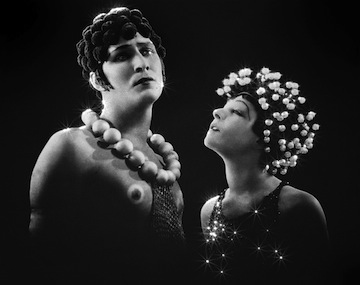
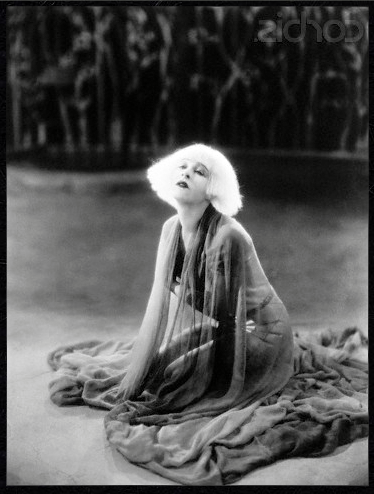
I was captivated by Aubrey Beardsley’s illustrations that accompany Wilde’s Salome—how fanciful and strange they are! When I went to look up the illustrator, I discovered a 1923 film adaptation of Wilde’s play completely set to the aesthetic of Beardsley’s drawings. Directed by Charles Bryant, the silent and black and white film is considered America’s first feature-length art film; its dramatic costumes and exaggerated acting make for a wild and imaginative 74 minutes.

04_alla_nazimova-theredlist

Salome, played by the famous silent film and Broadway actress Alla Nazimova, has all kinds of idiosyncrasies that contribute to the film’s rather outré nature—just check out her eyebrows! (43:14 at https://www.youtube.com/watch?v=BkMq_Cs3OUs should give you a good look.) The biblical seductress’ look shifts from medusa-esque (she shows off a head full of bobbing lights for most of the film) to Lady-Gaga-like when she emerges for her sultry dance of the seven veils in a glowing white bob.

Figure 2

alla nazimova salome-1923-02-g

Nazimova productions of Salome. 29

I looked into other film versions of the biblical story, too. There have been a lot of adaptations, but a 1953 version with Rita Hayworth and 1988 version directed by Ken Russell version caught my interest. Both films work in narratives that diverge from Wilde’s narrative—in the ’53 version, Hayworth plays more of a damsel in distress than a femme fatale under the evil guise of her mother. It’s Herodias that wants the prophet killed in this adaptation, a more common version of the story; when Hayworth sees John the Baptist’s head on the platter, she screams in horror! The movie is apparently pretty bad (Hayworth herself didn’t even like it) but the dance of the seven veils in this version is to die for. Watch here: https://www.youtube.com/watch?v=VJi8xd38zwE

salome-1953-02-g

Russell’s 1988 film wasn’t very well received either, but the visuals are worth attention. It also brings Wilde into the film as a character. The adaptation is fairly erotic, so beware if you watch a little: https://www.youtube.com/watch?v=ZMO4Qi4AFhc

Here’s the plot from IMBD:

Late on Guy Fawkes Day, 1892, Oscar Wilde arrives at a high-class brothel where a surprise awaits: a staging of his play “Salome,” with parts played by prostitutes, Wilde’s host, his lover Bosey, and Lady Alice. The movie moves between the play and Wilde’s night. In the play, Herod begs his pubescent step-daughter Salome to dance for him, promising her anything she desires. Her mother, Herodias, objects. Salome is stung by John the Baptist’s rejection of her affections. The prophet’s scolding celibacy puts him between the expressed desire of age and youth. Wilde dallies with a young man as he watches the show, provoking Bosey’s jealousy. Two surprises await us.

6esiG1KXqLskI8P0V9BvjD5KLVe

The adaptations keep coming—In 2011, Al Pacino even made a version with Jessica Chastain, which includes a filming of the play and a documentary about Wilde.

wilde_salome_ver2_xlg

« Newer Posts - Older Posts »

Categories