Posted by: Hyeonjin | October 15, 2014

Voluntourism à la Victorian Age

As our class viewed and discussed some of the engravings from the Irish Famine, one that really stood out to me was the one of the young girl passing clothes out to the people.

I think it goes without saying that clothes were probably the last thing on these people’s minds.

And I couldn’t help but wonder what even went through this girl’s head as she was passing these clothes out. Did she just completely ignore the fact that these people clearly need food? Her facial expression is hard to read since there doesn’t really seem to be a sense of enjoyment of passing these out, but there isn’t absolute hatred either. Is she doing this because it’s just a “good thing to do”? What even made her leave the comforts of her own abode to travel out to Ireland and pass out clothes of all things?

It’s not only ridiculous but somewhat uncomfortable to think about. And it reminds me of all the celebrities today who go out to help those less fortunate, taking pictures of them smiling widely as though to say, “Look at me! I’m being a good person!”

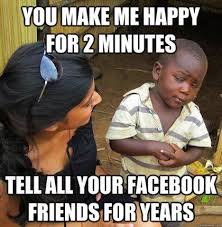
But celebrities aren’t the only ones who do this. You see a huge number of people our age who also go out to volunteer in different parts of the world. Do they actually make an impact? Each case is different, so it’s hard to say. But there is always a handful of people who aren’t really there to volunteer but actually there to travel and tour around the place (“voluntourism” as it is so often called). After all, you may see their Facebook album filled with these beautiful sceneries, them enjoying the culture, and other miscellanea but not really… helping? And if they are, it always seems to be so out of place like Miss Kennedy in the engraving.

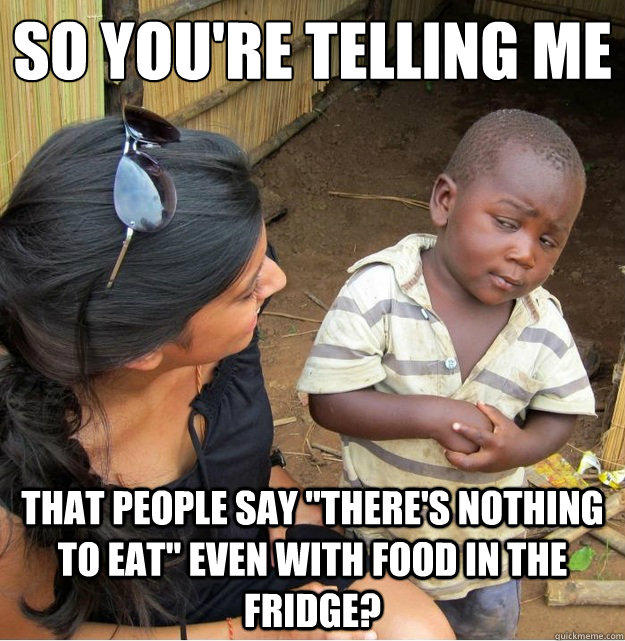
Skeptical Third World Kid meme pretty much encompasses this:

We have no way of knowing what went through any of the minds of these people depicted in the engraving. We don’t even know what’s going through the mind of the artist behind this since the caption does not provide much other than what is happening. As far as I’m aware though, Miss Kennedy is another volunteer for tourism who is clueless to the needs of the people. Even if she is not traveling around the world and perhaps is only going out into the countryside… it still makes you wonder.

Sources:
“Miss Kennedy Distributing Clothing at Kilrush” from London Illustrated News.

Skeptical Third World Kid meme examples from http://www.quickmeme.com/Skeptical-Third-World-Kid/ and Google Images.

Posted by: emkamm93 | October 14, 2014

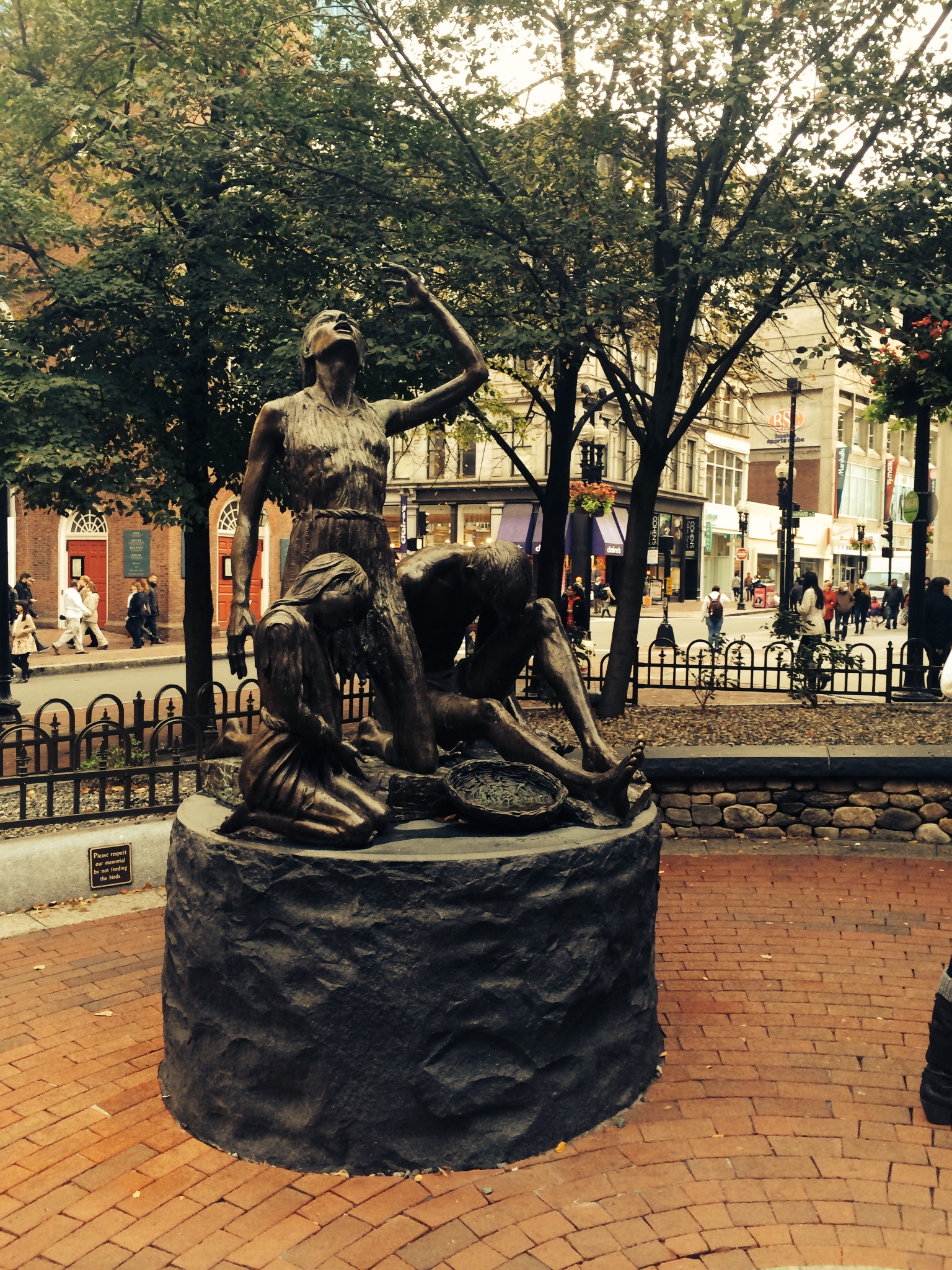
Boston Famine Memorial

IMG_3873         IMG_0684

I spent some time exploring Boston over Fall Break and came across this set of memorial sculptures while walking the Freedom Trail. I felt especially awful viewing them, as in some sort of gross irony they sit directly across from a Chipotle (and a cupcake shop!!!) so I was so full I could hardly stand when I saw them for the first time. Before last Wednesday’s class, I never really knew much about the Irish Potato Famine, so I when I saw the memorial out of the corner of my eye, I thought it was perfect timing for me to discover it.

 We looked at the photo below in class. The little girl, clearly unaffected by starvation, is passing out clothing when what the recipients clearly need is food. This sentiment was echoed in the placards accompanying the figures in Boston. They said, in essence, that the people of Boston would’ve gladly sent supplies to the starving people of Ireland, but they didn’t want the starving people of Ireland coming to Boston. It was upsetting because the Irish who did flee to Boston used the very last of their resources only to be met with prejudice and more starvation. According to the placards, children from the Irish districts of Boston were “literally born to die.”

po

This sentiment of “I’d love to help them, but only if they don’t come here” is still something that we see. I remember when Hurricane Katrina hit New Orleans in August 2004, and so many people from my native Houston were quick to send aid. But as soon as FEMA started busing survivors to Texas, people freaked out and vocally protested it. They would rather send aid to an invisible problem, something happening miles away and out of sight, rather than help people in front of them.

I don’t have too many scholarly points about the famine, or these figures, other then I feel privileged to be learning about the tragedy in an area so closely linked to the events. I also feel like the prominent placement of the memorial on the Freedom Trail, and admission of nineteenth century Boston’s part in the death of even more Irishmen, serves as a very public apology.

I was ecstatic last week when Walter Benjamin’s essay A Work of Art in the Age of Mechanical Reproduction came up in my contemporary art class. Alluding to ideas about the changed value of a copied image and capitalist production in the context of art, my professor referenced the theoretical work to introduce Pop artist Andy Warhol’s “Electric Chair” series. (How appropriate for a time when we’re looking at prison photography in class?)

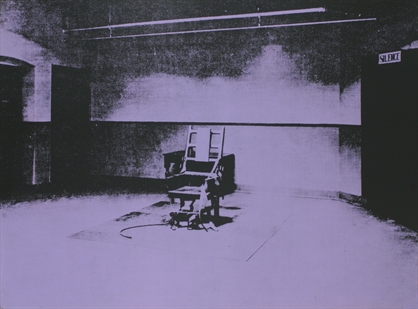
A photograph of an empty electric chair, isolated in a dismal room with a sign that reads “silence,” makes up the base image of the collection. Rendered in different washes of color, the print is silkscreened—a printing technique used for, in Warhol’s case, mass-producing images.

Warhol was obsessed with this idea of large-scale reproduction and manufacturing, with market culture in America—and with serious (though controversial) intention he brought these interests into the realm of fine art. Artists like Jasper Johns and Robert Rauschenberg had set up the Pop movement with work that moved away from the “gestural” (think of the active, painterly marks of a Jackson Pollock drip painting) qualities popular in art of the abstract expressionist movement. But it was Warhol who pushed the envelope with his silkscreened rows of Campbell’s tomato soup cans and Brillo boxes—a real celebration of and focus on consumer capitalism. As curator Jennifer Blessing at the Guggenheim notes, “[Warhol’s] embrace of subjects traditionally considered debased—from celebrity worship to food labels—has been interpreted as both an exuberant affirmation of American culture and a thoughtless espousal of the ‘low’” (Blessing). The artist’s scope and interests, however, eventually grew to include darker, more serious subject matter. His Electric Chair series, which he began in 1963 and would build on for two decades, was a prime example of this.

My contemporary art class was shown the image of the chair, mentioned above and, in this case, stained in purple, then was asked to compare it with “Silver Disaster,” another Warhol piece made up of the same image, but copied several times over. Other than the color, what about the image changed?

Repetition of the photograph, my professor raised, seemingly underscores what the (unfilled) chair at first represents—the poignancy of death and violence, which makes up its “aura.” “When you see a gruesome picture over and over again,” Warhol commented in a 1963 interview with Art News, “it doesn’t really have any effect” (Swenson). In another version in the series, for example, Orange Disaster #5, the image repeats fifteen times over, almost wallpaper-like in effect. What’s left of the chair’s meaning here when it has been reduced to a pattern?

Benjamin alludes to this “what’s left” part of a reproduced image in his essay. Perhaps the loss of an aura actually calls up some other social meaning: “…as man withdraws from the photographic image, the exhibition value for the first time shows it superiority to the ritual value… photographs become standard evidence for historical occurrences, and acquire a hidden political significance,” he says in his essay (Benjamin 226). The repetition of the image has been guessed to reference the endless visibility of disaster in the media at the time, for example (Blessing).

The copying maybe even sources the future tragedy of the people who will fall victim to the chair in history. Notes from a Christies sale of one of the prints, a blue version called “Little Electric Chair,” mentions “the empty chair [as] a motif often used in art history” (Andy Warhol (1928-1987) | Little Electric Chair). English artist Samuel Filde, for example, made a famous drawing of Charles Dickens’ unfilled library desk chair, sketched the day after the writer’s death and published in The Graphic magazine in 1870 (The Victorian Web). Here Filde captured an end, however, while Warhol only began to explore what’s still a present-day and heavily contested symbol of the death penalty in the U.S.

The mass production of the photograph, therefore, is maybe a good thing in the way it creates distance from the image’s aura and in effect makes a new kind of political commentary about it. What do you think?

0_418_309

double-silver-disaster

74.2118_ph_web

p101b

Filde’s drawing of Charles Dickens’ chair 

Sources:

“Andy Warhol (1928-1987) | Little Electric Chair.” Christies. Web. 14 Oct. 2014. <http://www.christies.com/lotfinder/paintings/andy-warhol-little-electric-chair-5792591-details.aspx&gt;.

Benjamin, W. (1968). The Work of Art in the Age of Mechanical Reproduction. In H. Zohn (Trans.), Illuminations: Essays and reflections. New York: Schocken.

Blessing, Jennifer. “Andy Warhol.” The Guggenheim. Web. 14 Oct. 2014. <http://www.guggenheim.org/new-york/collections/collection-online/artwork/4177&gt;.

Swenson, Gene R. “What Is Pop Art? Answers from Eight Painters, Part I,”. Vol. 7. 1963. 26. Print.

The Victorian Web. Web. 14 Oct. 2014. <http://www.victorianweb.org/painting/fildes/drawings/7.html&gt;.

Images:

Electric Chair. 1980. By Andy Warhol.

Orange Disaster #5. 1963. By Andy Warhol.

Silver Disaster. 1963. By Andy Warhol.

The Empty Chair. 1870. By Luke Fildes.

Posted by: mackenzielibbey | October 9, 2014

Charcot and la Iconographie Photographique de la Salpêtrière

Hey, guys, remember when we discussed Robert Browning’s “My Last Duchess” in class? Remember when we unanimously agreed that the Duke’s instinct to immortalize the behavior he found so offensive in his “last duchess” as a demonstration of ownership and a warning to his future duchesses made him a terrible (probably murderous) creep?

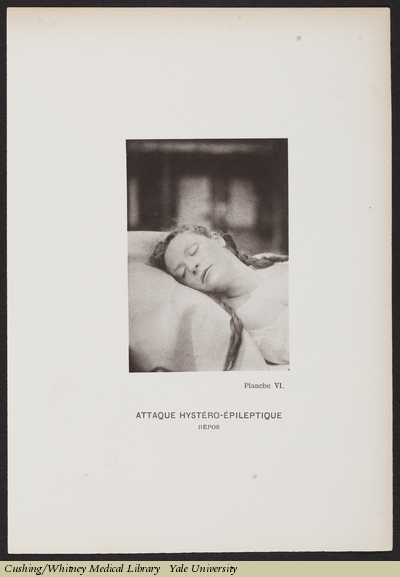
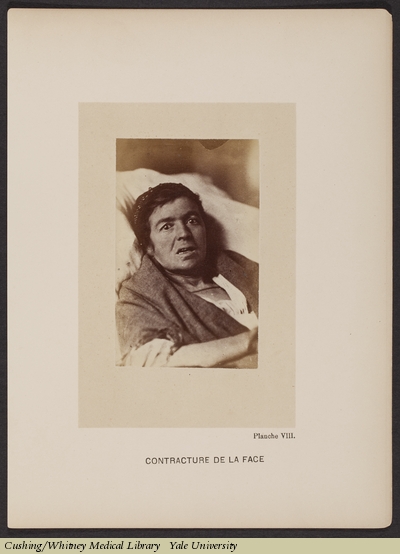
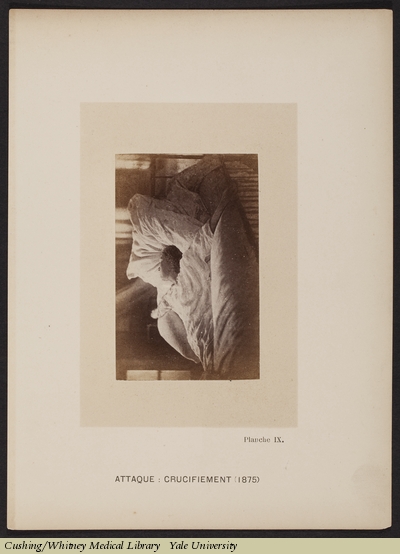
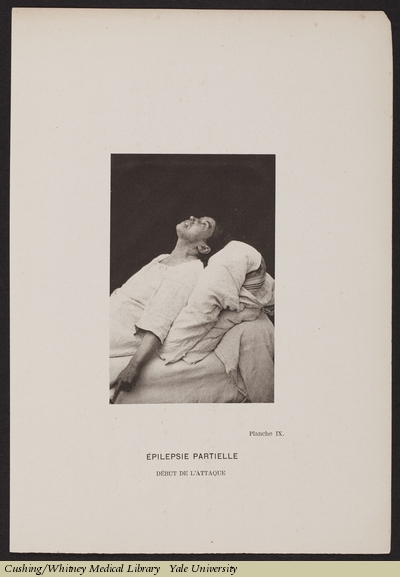
Well, I recently learned about someone who might give Browning’s Duke a run for his money in the terrible creep department. In my anthropology of psychiatry class, we recently began a unit that deals with issues of gender and madness. As I read through Elaine Showalter’s The Female Malady: Women, Madness, and English Culture 1830-1980 (1987), I came across the photographs of Jean-Martin Charcot. Charcot treated primarily female “hysterics” at La Salpêtrière asylum in Paris in the mid 1800s and is credited as being one of the first physicians to acknowledge that hysterical symptoms were beyond women’s conscious control. He is also credited with developing a hypnosis treatment for hysteria. Oh, and he staged photos of patients experiencing hysterical “attacks” and published the photos in three volumes called la Iconographie Photographique de la Salpêtrière.

During his lifetime, even, Charcot was accused of staging the photos to make them visually pleasing and having patients act out symptoms at public lectures so that he could demonstrate the efficacy of his treatment. My question is, though, was this display of feminine mental illness about asserting Charcot’s psychiatric prowess or something else? I’m inclined to think that his motives were somewhat similar to those of the Duke. As Showalter notes in her book, manifestations of anorexia, neurasthenia, and hysteria in Victorian women could be understood as “mental pathology [as] suppressed rebellion” (147). Noting the possible danger of such behavior, the patriarchal (read: misogynstic) psychiatric community shuffled to regain control of the female image. Charcot’s photographs literally capture the disconcerting behavior of hysterical women and yet still manage to make that behavior aesthetically appealing. For me, the subtext the photographs is similar to that of Frà Pandolf’s painting and the Duke’s description: assertion of ownership that subsumes the women’s threatening, transgressive behavior and a warning to other women to avoid the same fate.

I found some of the photographs and I’d love to know what you guys think of them:

Salpetriere_3_39 Salpetriere_3_06 Salpetriere_1_08 Salpetriere_3_34 Salpetriere_1_09 Salpetriere_2_09

I accessed these photos here and there’s a whole, eerie gallery if you’re interested: http://cushing.med.yale.edu/gsdl/collect/salpetre/index.html

All info about Charcot’s practices came from The Female Malady.

The first time I heard about, and subsequently saw a Victorian post-mortem photograph I felt, as I’m sure many others did, creeped out by the whole thing. For my 21st century mind it seemed there was a real oddity to the concept of this tradition and the thought of surrounding oneself with death in this way seemed terrifying.

So why did the Victorians do it? Well the more I thought about this the less strange it seemed. So a loved one dies, perhaps before their time, one of the worst parts of the grief is that you know when they are buried you will never see them again. In an age when photography was newly accessible to the public photography made it possible to have a lasting memento and if a loved one died before their time, and had never had their photo taken there would be something their family could have as a reminder.

While contemplating the post-mortem photographs I found my mind wondering to a phenomenon which has emerged in the last few years – the funeral selfie. I cannot wholly defend the idea of this, but my contemplation of the post-mortem photography did make me re-think my opinion of some of the examples. While some show a lack of respect, others could demonstrate a way for these people to express grief in a way that they are comfortable with. Jenny Wortham of the New York Times recently wrote that the selfie could be viewed as “a kind of visual diary, a way to mark our short existence and hold it up to others as proof that we were here.” If we agree with Wortham we could argue a selfie at a funeral is poigniant – it shows a defiance against the finality and inevitability of death.

So why do you guys think the post mortem photos were taken? Can the funeral selfie be compared? Are the people who take them vain and disrespectful or is there something else going on? I’d love to hear some other opinions on these topics.

Below I have added several interesting photographs, some Victorian post-mortem an some selfies:

Casket post mortem

The protective hands over the coffin were what struck me about this image.

open casket selfie

Compared to the image above, can we draw some parallels?

group post mortem

The framing of this one almost makes it look like a selfie.

funeral selfie

The caption of this one struck me – it insinuates that there is care for the deceased grandmother and what she would think if she were there.

mother and child post mortem

I was drawn to this one as there seems to be a half smile on the mother’s face.

ashes selfie

The girl in this photo emphasises the feeling of the presence of her deceased loved one in her caption.

Sources:

Jenny Wortham article: http://www.nytimes.com/2013/10/20/sunday-review/my-selfie-myself.html?pagewanted=all&_r=0

Photos found through Google search

Posted by: ferge22j | September 26, 2014

Lily Langtry (the real Irene Adler?): capitalizing scandal

There’s a subset among literary critics whose main purpose is to assign famous historical identities to fictional characters. According to some of this group, the would-be blackmailer Irene Adler from the Sherlock Holmes story “A Scandal in Bohemia” represents Lillie Langtry, sometime mistress of the notoriously debauched Prince of Wales (Wolff 286). Langtry was a Jersey merchant’s wife who gained fame from being painted by a series of Pre-Raphaelites in 1874, after which she became an actress and socialite (Mahon). Like Irene, Langtry was a stage performer with royal lovers, and both ladies come from places involving the word “Jersey”, but the surface similarities end there. Unlike Irene, who “lives quietly” and “seldom goes out”, Langtry was a media sensation and reveled in her infamy (Doyle 8). Furthermore, she never had a chance to try blackmail, because neither she nor her lovers made any attempt to keep their liaisons secret – Princess Alexandra knew about her, and the two managed to strike up an awkward kind of friendship (Mahon). Several of Bertie’s many mistresses turned to blackmail when their stints were up, but Langtry never did, despite her mounting debts after losing the prince’s patronage (Holland). Instead she banked on the public’s failproof fascination with sexual intrigue in another way: going into advertising.

Read More…

Posted by: emkamm93 | September 24, 2014

Knowing When You Look

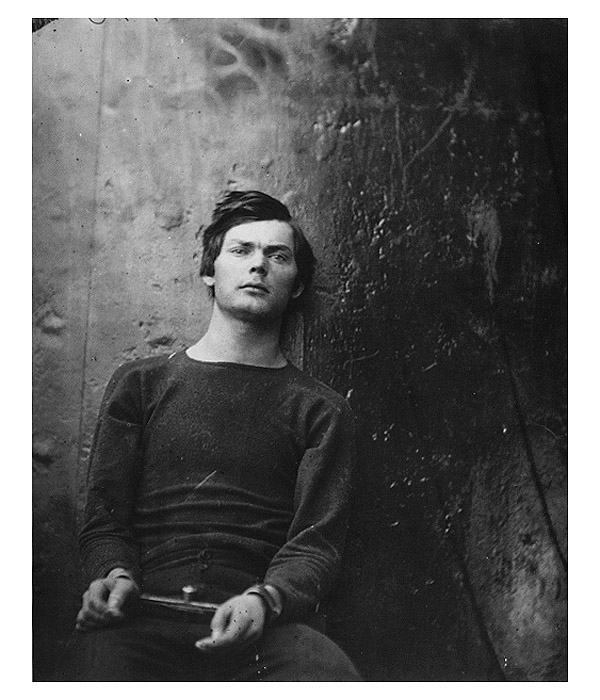
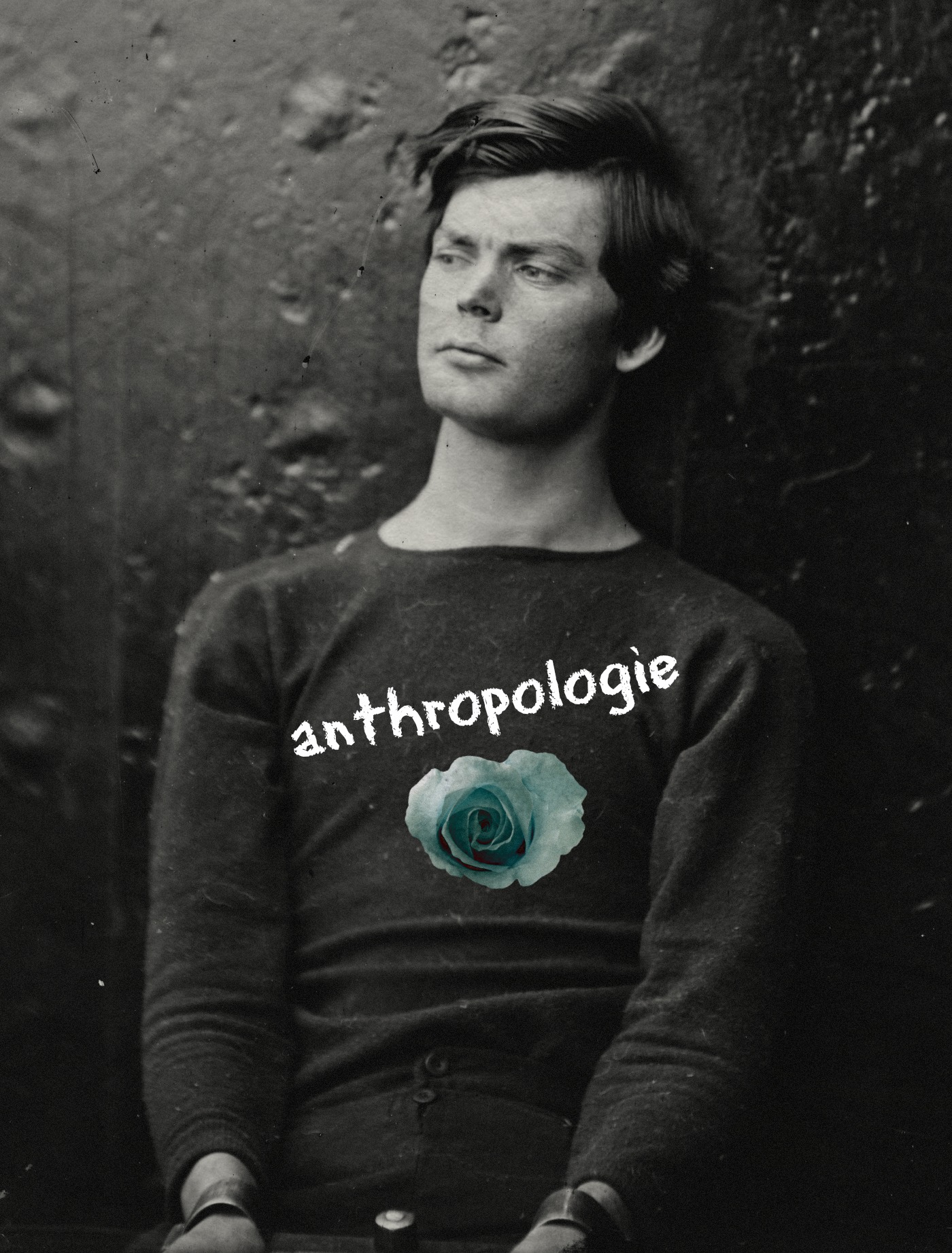
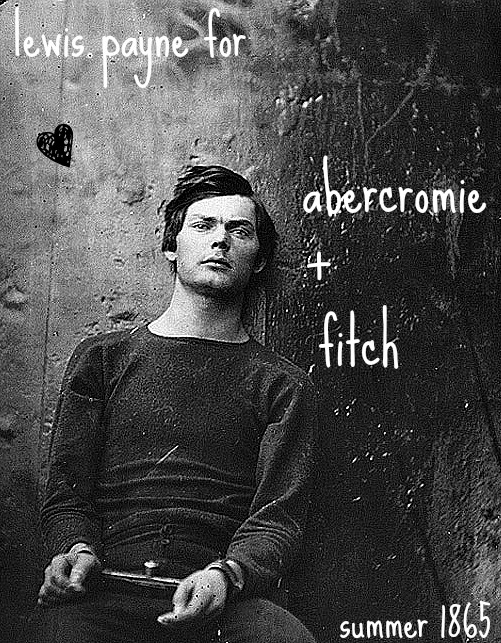
LewisWe spent a long time dissecting this photo of Lewis Payne, taken shortly before his execution for the attempted assassination of the Secretary of State, in class a few weeks back.

Our discussion ranged from “omg he’s such a lil’ cutie” to “look at how the light separates his face, could that speak to the division between life and death in the moment of this photograph?”

I had never seen it before, and processing the photo organically with my classmates was an enriching experience. When we were asked if our view of the photo changed at all when we discovered why it was taken, I really had to say “no.” This man had attempted to commit a crime, and although he was handsome, he would be dead by now anyway….and I really needed to get a hold on myself. Nonetheless, this captured moment, one of his last, was still rather chilling.

Yet although the photo was kind of creepy, we still felt comfortable cracking jokes about his model-looks, hence my creation of the following photos:

Lewis Payne

The day after class, I found this image of young Istvan Reiner as I scrolled through Tumblr (I’m linking to the photo, as opposed to posting it, as I am unsure about the copyrights).

“Aw, what a cute little kid,” I thought, scrolling further down to read the tags, but there weren’t any.

I searched Google for the image, and pulled up multiple Twitter and Pinterest accounts which all had the same shocking assertion: that the photo was taken in the days before the little boy’s untimely death. I knew this couldn’t be true, but when I looked closer, what I assumed were pajamas could actually be prison clothes.

Yet I still didn’t want to take social media posts as a real source, so I kept looking, still hoping that this little boy wasn’t actually murdered in a concentration camp. But when I found the image in the photo archives of the United States Holocaust Memorial Museum, that hope was gone, as they said it was “taken shortly before he was killed in Auschwitz” (source).

Knowing the origin of this photo inspired so many more feelings than James’. Although both boys are “cute” it’s in really different ways. When we were told that Lewis was being sent to his death, there was a momentary dip in my feelings, but it didn’t really change the way I looked at him, but for Istvan, it was different.

This child committed no crime. He was innocent. Innocent of both guilt and the knowledge that his death was approaching. It’s the glee in his eyes that makes his photo even more haunting. He doesn’t know.

It’s knowledge, I think, that really separates these two photos:the subject’s own knowledge of their impending death, the viewer knowing the reasons for their subsequent executions.

Both lives were taken too soon, but I think that Istvan’s photo, because of his age and innocence, demands more reverence.

What do you think?

Posted by: mclea22h | September 24, 2014

Outside The Cannon: Carrie Mae Weems Lecture & Lunch Review

Here’s my review of the Carrie Mae Weems’ lecture from last Thursday night and her “Student Leadership and Careers Luncheon” from the following Friday. She was wonderful to listen to and talk with!

Carrie Mae Weems strolls up to the podium at Gamble auditorium, filled to the brim with students, professors, art yuppies and locals of South Hadley waiting in anticipation of her lecture Thursday night. Soft in a rose tunic, she radiates a warm, smart energy, ready to roll into her lecture. It’s easy for her, standing before a crowd, flipping lightning-fast through first slides of her work. She wastes no time. The artist has over thirty years of material to cover, after all.

I think, very simply, I’m tenacious,” Ms. Weems later tells me, smiling, seated at the head of a little table rounded with students at a “lunch” conversation, part of her fall weekend residency at Holyoke. “I am very hardworking, and I work diligently.” There’s weight in that grin; a MacArthur genius award, National Medal of Arts, and celebrated exhibitions at the Guggenheim, the Museum of Modern Art, and The Whitney, among other institutions, mark the repute of the artist. She is serious, but gracious, efficient, but at ease, takes time with words, and pauses mid-sentence to think when needed—her silence is someone else’s “um.” For an hour, she thoughtfully answers our questions about her career and our own aspirations as students. She is thirty minutes late to the lunch, but we’re the ones racing to keep up with her through it.

Weems started creating art (primarily photography but also installation, video, and works with text, fabric and audio) and first picked up a camera in her early twenties, having once “traded a car [in] college for a polaroid” (a laugh hums around the auditorium audience). Her repertoire has been fundamentally political from the start; using herself in much of her photography and video helps define her volume of work that communicates ideas about race, gender, and class. The subject matter reaches beyond these themes, though, too, in exploration of the complexities of “just being human.” When she hears the word “political” in the context of describing her art, Ms. Weems insists that “the term of course needs to be defined…[it] may be better for me to say that the work is inherently dealing with a multitude of questions that have brought social ramifications.” As Holland Cotter of The New York Times describes in a review of Ms. Weems’ January Guggenheim retrospective, “This is political art, but primarily in the personal-is-political sense. Issues of race and class are certainly there, but subsumed into the universal realities of life lived, daily, messy, crowded, at home.”

The idea of home, of tradition, of convention, roots deep in the heart of Ms. Weems’ work. With a degree in folklore from Berkeley, the artist explores customs and ideas about community, assumptions made about groups in history, and the power of personal accounts to relay these ideas. In “The Kitchen Table Series,” a 1990 collection of black-and-white photographs of Weems and other models at her own table and home, questions of relationship, dynamics of power, and meditations on solitude surface in starkly-lit images. In one of them, Weems leans over a plate of lobster to caress her lover. The creature on her plate is intact; his is ripped apart. Her glass of wine is full; his empty. In another, a daughter figure stares with spite at Ms. Weems, who glares back with comparable ‘tude (“This little girl I saw terrorizing a boy on a bike in the street and thought: there’s my girl,” jokes Weems, as she talks about models in the series (more laughter volleys around the auditorium)). In another image, Weems, alone, stares right at the viewer, leaning over with hands spread on the table, corporate meeting style. Personal accounts and narratives accompany the images, which the audience at her lecture don’t get to see on her slideshow, I assume for the sake of time: “There’s a difference between men and women. I can’t tell ya what to do. But I can tell you that I sided with men so long I forgot women had a side. Truth slapped me so hard up-side my head, I cried for days, got so I couldn’t wash my own behind. Shonuff blue. Biggest fool in the world.”

In another series from 1995, “From Here I Saw What Happened and I Cried,” Weems appropriates thirty-three images and superimposes them with text of a similarly narrative, and sometimes more poetic, tone. At a point in her lecture, Weems slows down her time-transcendent presentation to read the panels of the piece like verse, her melodic voice careful and poignant:

“BORN WITH A VEIL

YOU BECAME ROOT WORKER

JUJU MAMA

VOODOO QUEEN

HOODOO DOCTOR”

The series, like others of hers, devise a telling dialogue about race relations. However, it’s all “…not just about whether the work is black political art. It’s more about how the work is situated to the defined cannon—the cannon which is modernism,” explains Weems, “which we value most today.” For people of color and their work that studies black communities, Weems argues, the work often takes a place outside understandings of modernism. “It’s a place outside and is considered “other,” because there’s an “idea that it will be consumed by a smaller portion of the population or is only consumable by a smaller portion of the population, thereby limiting its value.”

As the first and so far only African American ever given a retrospective at the Guggenheim, Weems reflects on her role in an often unjust world: “I spend as much time thinking about myself as an artist as I think about the system of art that I’m involved in and what that system really means….Jeff Koons will sell, you know, a glass pitcher, and he might receive ten million dollars for it. And probably if you look at everything that I’ve got sitting in my closet it won’t sell for that. Later in the lecture, she admits that “the art world will not slow down to think about equity, gender equality, and for that matter, questions around ethnicity as well,” shrugs Weems.”

Ms. Weems never has even a second to bite into her turkey sandwich during our discussion, and pushes for more questions at the end of her lecture. Admirers, friends, insistent art-goers and students surge at her all weekend. I can barely get five minutes with this woman during her residency to ask her questions for my magazine writing class; she’s the type of person people butt in front of each other to get closer to. Eventually, rising in front of us, she whispers, “I think it’s time for me to go home now. My husband will barely recognize me.” And with that, she circles round us and shakes and holds our hands. And with that, she glides out the door.

During our discussion of Dickens’s short story, On Duty with Inspector Field, yesterday, Professor Martin repeatedly suggested that Field’s detective work was somewhat reminiscent of tourism. To be sure, Field entering the squalid boarding houses and temporarily shining his “flaming eye” onto the heaps of poverty-stricken Irish families evokes memories of haunted house tours and historical reenactments I saw as a child; “look at this horror, but just for a minute,” the flaming eye swings on to the next room (12). More disturbing, however, is that Field’s desire to expose the squalor in which these people live (even for his own professional purposes) and the attendant questions regarding accountability, are not limited to fake haunted houses and reenactments. The story raises a number of concerns for the modern reader, including but not limited to: the media’s saturation with disturbing images that reveal the plight of peoples all over the world, service work that functions more as “poverty tourism” than real service, and the physical boundaries erected between those who are suffering and those who would prefer not to be inconvenienced by witnessing it.

A book of essays I read recently comes to mind. In The Empathy Exams, Leslie Jamison explores what it means to care, the role of affect and saccharine prose in a culture hell-bent on rationality, and whether empathy can truly be felt and measured (among many other themes). In one of her essays, “Indigenous to the Hood,” Jamison describes her experience participating in an LA Gang Tour. The tour, founded by a former member of the Florencia 13 gang, promises to allow tourists to “experience areas that were forbidden until now.” Jamison, a Santa Monica native, is in awe of the treacherous landscape that she always knew intellectually was right at her doorstep but never saw until that day (see: Mr. Snagsby scouring the area surrounding Tom-All-Alone’s for Joe). She is particularly preoccupied by a story one of the tour leaders tells about a shoot-out between 7th graders at a local school. “How many . . . would believe that they breathe THIS air?” writes Dickens (7). Jamison rides through the Los Angeles neighborhood, long disputed territory that has resulted in years of brutal violence, wondering the same. The guide points out significant sites and tells his own story, relating to the group how he finally managed to escape the nearly-inescapable world of gang control and violence.

Critiques of the existence of such a tour (of which there are many) aside, I think the most important part of Jamison’s essay comes in the final paragraph. She writes: “What good is this tour except that it offers an afterward? You’re just a tourist inside someone else’s suffering until you can’t get it out of your head; until you take it home with you–across a freeway, or a country, or an ocean. No bail to post: everything lingers. Puppet [a tour guide] lingers. Those clapping seventh graders linger. Your own embarrassment lingers. Maybe moral outrage is just the culmination of an insoluble lingering. So prepare yourself to live in it for a while. Hydrate for the ride. The great shame of your privilege is a hot blush the whole time. The truth of this place is infinite and irreducible, and self-reflexive anguish might feel like the only thing you can offer in return. It might be hard to hear anything above the clattering machinery of your guilt. Try to listen anyway.” *

Similarly, the narrator of On Duty with Inspector Field begins the story by acknowledging the importance of this “self-reflexive anguish,” asking, “How much Red Tape my be there . . . and say, ‘I have thought of this. I have not dismissed this thing. I have neither blustered it away, nor frozen it away, nor tied it up and put it away, nor smoothly said pooh, pooh! to it when it has been shown to me?” (7).

Comparing these two texts even briefly has left me with many more questions than answers. The narrator of On Duty with Inspector Field is ultimately empathetic, noting that “The wicked cease from troubling sometimes, even in this life,” but is Inspector Field, with his flaming eye, an empathetic character (25)? To what extent can the acts of showing and seeing suffering be understood as empathy (or even significant social action)? Is practicing and writing about this kind of empathy a cop-out from taking real “action” or is it the most appropriate form of “action” for a person as far-removed from the suffering as Field is from the boarding houses and Jamison is from the streets of L.A.? If you’ve somehow made it all the way through this post, I’d be interested to hear your opinions!

*I don’t have a page number for this quote because I don’t have the book with me here but will add it ASAP.

Posted by: Kay Heffernan | September 18, 2014

“It’s Too Real!”: Thomas Eakins and Portraiture

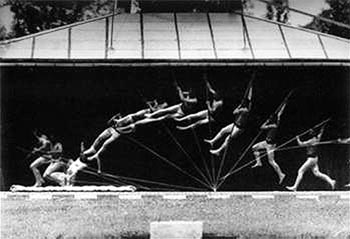
After our discussions of portraiture and the representational “reality” posited in these works, I thought to introduce all of you to Thomas Eakins (1844-1916), one of my favorite artists. An American artist who worked during and after the Victorian period, Eakins was, to say the least, a realist: he labored over his paintings, aiming for exactitude and accuracy in his subjects, natural and otherwise. Topics in his paintings included athleticism and new conceptions of masculinity – think of it as the shift from Mr. Skimpole and Mr. Turveydrop’s old aestheticism and “Deportment,” to Mr. George’s strapping presence in Bleak House – as well as studies of the body in medical scenes and portraiture.

Thomas Eakins, "Motion Study (Thomas Eakins Pole Vaulting)," 1884.

Thomas Eakins, “Motion Study (Thomas Eakins Pole Vaulting),” 1884, Marey Institute.

Perhaps most notably, Eakins worked alongside his friend Eadward Muybridge, a pioneer in the field of photography, to document and track human and animal subjects in motion. Eakins even served as a model for some of these locomotion studies. He strove to represent “the real” in his art. Photography, then, was a tool for Eakins to slow down the speed of observation, to make every detail perfect and correct. Eakins employed other, more controversial modes of study, including cadaver dissections, live nude modeling (the scandal!), and observations during operational theater (medical procedures during which a master surgeon would lecture, while performing surgery…).

Read More…

« Newer Posts - Older Posts »

Categories