Citing a recent Daily Mail article that looks at a Victorian Era census for evidence of May-December romances. Research, it is what you make of it!
Posted by: thedawsonrewatch | December 12, 2012
Victorian Cougars
Posted in Uncategorized
Posted by: Lara | December 12, 2012
Dream Children
At the beginning of the semester I sat down with my buddy the LoC to find some images for the class. Of the many intriguing and beautiful images I found this one:

The image is entitled “A-listnin’ to the witch-tales ‘at Annie tells about” and was taken by Elizabeth B. Brownell, ca. 1900.
(I also want to point out that this is a platinum print, platinum! I can only imagine what the physical copy of it looks like.)
We discussed Cameron’s and Carroll’s work with children and photography and I wanted to learn more about Brownell. Turns out there’s not much out there. A number of her images can be found in the LoC and the text of one of her books is available online, but besides that she’s rather difficult to find.
From my investigation I found she wrote/illustrated/photographed three books-
Dream Children, 1901, a collection of poems, stories, and prose about children with Brownell’s illustrations and photographs, including the image above that went along with “Little Orphant [sic] Annie” by James Whitcomb Riley.
Vision Children Posters, 1903, (full title: Elizabeth Brownell’s posters of the vision children of childhood : a small bunch of the most fragrant blossoms gathered from the ever-blooming gardens of childhood’s dreamland.)
and Really Babies, 1908, her final book with untitled verses that list no author, but written presumably by Brownell. *
Dream Children is available in the public domain via google books/archives, but only contains the text, not the images. Talk about frustrating. However, from her introduction we learn that Brownell is heavily influenced by religion and that “the aim of this little book has been to picture, with the newest aid to pictorial effect, the camera, a few Dream Children of literature.”
The table of contents is just wonderful in itself, containing the work of Hans Christian Anderson, Henry Longfellow, Lewis Carroll, Elizabeth Berrett Browning, Charles Dickens, Robert Browning, George Eliot… and two of my favorite additions Edgar Allen Poe (“Annabel Lee” of course, since that’s totally for children) and our pal Thomas Carlyle (Remember him?).
I’m desperate to see the other photographs and illustrations in the books, so I requested both Dream Children and Vision Children through the interlibrary loan system and I hope I get them (many seem to be for display only).
I have to say that I am continually drawn to the “Orphan Annie” photograph. The girl’s eyes pull my own gaze and I feel like I cannot look away, yet at the same time, neither can she. (This also reminds me of Cameron’s “Echo” in a way). The title of the photograph causes me to apply the idea that the girl is listening to a story (told by Annie and thus must be rather exciting and a little scary). For me, the photograph captures the perfect moment of anxiety and anticipation. The moment of wanting, no needing, to know what will happen, while also being terrified for the tale to continue. In all honesty I feel that I can barely explain how the girl’s expression makes me feel. Those stunning wide eyes, so open and telling… it makes me think of our conversation in the last class about the soul in photographs.
Anyway, I wanted to leave off with this image:

Young boy holding a smaller child, Brownell, ca. 1900.
For me it recalls Cameron’s “Double Star.” I’m still contemplating the connection; how does Brownell’s image of two young boys differ from Cameron’s girls? Brownell’s pose is different, yet there still seems to be an intimacy / connection between the figures, how different is it?
Is anyone else as fascinated as I am with the “Annie” photograph?
—
*Most of the information I found came from one article by Gillian Greenhill Hannum, which can be found in pdf form here.
Posted in Uncategorized | Tags: children, Children Photography, Elizabeth B. Brownell, Julia Margaret Cameron, photography
Posted by: emilywmurphy | December 11, 2012
Velocipeding
I accidentally posted this somewhere else that was not here. But here it is again.
I was talking to someone about bicycling, and I referenced this picture, which I think is absolutely hilarious:

There are a lot of things that I like about this picture: his hat is attached to him by a string; the guy smiling in the corner; the woman’s expression, headdress, and cigarette combo. There seem to be a lot of pictures like this one, trying to discourage women from riding bicycles.
It seems there was a widespread concern about protecting female modesty when she participated in physical activities. The woman in the image also presents an interesting contrast with the “angel of the house” that Loeb talks about. I found this thing on how ladies should ride bicycles for maximum modesty:
“The idea has been conceived from seeing experts ride side-saddle fashion, and drive the machine with one foot, that ladies might begin by learning the art in that way. This would be well nigh impossible, though it is easy enough after one is proficient. But with a proper teacher of their own sex, and with suitable dresses for preliminary practice, ladies can soon obtain such a command over the vehicle…”
“A lady must begin with great moderation, and train her muscles to the work of propulsion, or they will cry out vehemently at first. Above all, she must avoid getting cold, rheumatism, and neuralgia, after being heated by the exercise.”
This last quote raises the ever-present concept of female frailty, of course, but would have also encouraged women’s anxiety about their own health. Loeb also talks about this anxiety in terms of women in advertising – preying on women’s fears seems to have been a good way to get them to do things (even today, if you look at advertisements aimed at women).
Posted in Uncategorized
Posted by: emmajem | December 11, 2012
A Portrait of the Artist: Mis-Recitations in Wonderland
Today I just want to discuss an idea that wandered through my head when I was reading the Alice stories for last week. It might simply be because I have been reading Joyce, but I interpreted Alice’s garbled recitations in a very specific way.
One of the running jokes in Alice’s Adventures in Wonderland is Alice’s inability to correctly recite the poems she learned in the real world. She tries to give a poem to just about everyone she meets in Wonderland, and each instance is the opportunity for a wonderful display of Carroll’s parodic pen. Thinking of it in the context of the story, each garbled poem reminds me very much of the opening of A Portrait of the Artist as a Young Man. I will quote the very beginning for you simply because it is so lovely:
“Once upon a time and a very good time it was there was a moocow coming down along the road and this moocow that was coming down along the road met a nicens little boy named baby tuckoo. . . . .
“His father told him that story: his father looked at him through a glass: he had a hairy face.
“He was baby tuckoo. The moocow came down the road where Betty Byrne lived: she sold lemon platt.
O, the wild rose blossoms
On the little green place.
“He sang that song. That was his song.
O, the geen wothe botheth.”
Joyce is presenting a much earlier time of childhood (this is supposed to be the earliest memory of the novel’s hero, Stephen Dedalus), and his style is vastly different from Carroll’s. But they both have their child-hero do the same thing. For here Stephen, like Alice, is garbling a recitation. “O, the geen wothe botheth” is “O, the wild rose blossoms” mimicked with a child’s lisp. But the difference comes not only from the child’s inability to quite speak yet–how “geen” logically comes from “wild” is a mystery. Thus this “recitation” of Stephen’s becomes his own very early interpretation of a poem–perhaps it could be called the first poem of this artist as a (very) young man. Thus Joyce presents mis-recitation as the first stage to creation (a thought curiously in line with Harold Bloom’s proposal that every piece of literature is an intentional mis-reading of the masterpieces that came before).
With this in mind, I cannot help but read Alice’s mis-recitations as her own artistic creations, and to see her thus presented as on the first step toward becoming a writer. The plot thickens when we reach Through the Looking Glass, however, for as the mirror through which Alice steps reverses everything in her in-book reality, it also reverses most of the narrative structure that came before in Wonderland. Whereas Alice was wandering around reciting parodic poetry to everyone she met in the first book, in the second she is wandering around and is forced to listen to poetry recited by just about every character she meets. In addition, most of these poems seem to be pure creations from Carroll rather than parodies of other poems. This switch divests Alice of her creative power and transforms her from a (mis)writer to a reader. I find the move curiously indicative of Carroll’s own attitude toward writing. While Alice is still (mostly) a child, she is presented as creative enough to produce something artistic, even if it is parody. When she is on her journey to growing into a queen–the symbol for her coming of age–she loses that creative spark, and becomes a reader. Carroll is suggesting that a true writer is always a child, and thus gives us the only portrait of the artist Alice we shall ever see– as a (very) young woman.
Posted in Uncategorized | Tags: a portrait of the artist as a young man, Alice in Wonderland, james joyce, Lewis Carroll, nonsense, poetry, writer
Posted by: keenan | December 11, 2012
Modern Composition
After reading Allan Sekula’s piece, I remembered that I had seen modern composite images frequently. With websites like Morph Thing anyone can find out What Will My Baby Look Like? as well as morph celebrities into one another. MyHeritage boasts it’s ability to match any face to a number of different celebrities. I’ve tried MyHeritage, and there’s an odd flattery in being compared physically to a celebrity you like. Even if you really look nothing like them, it’s not difficult to find the comparison pleasing. And if it’s someone you don’t like, it’s easily dismissible.
But beyond these casual “morphs,” I remembered seeing an image of a woman who was supposedly the average vision of every woman in the world. I wasn’t able to find that particular image, but I was able to find this:
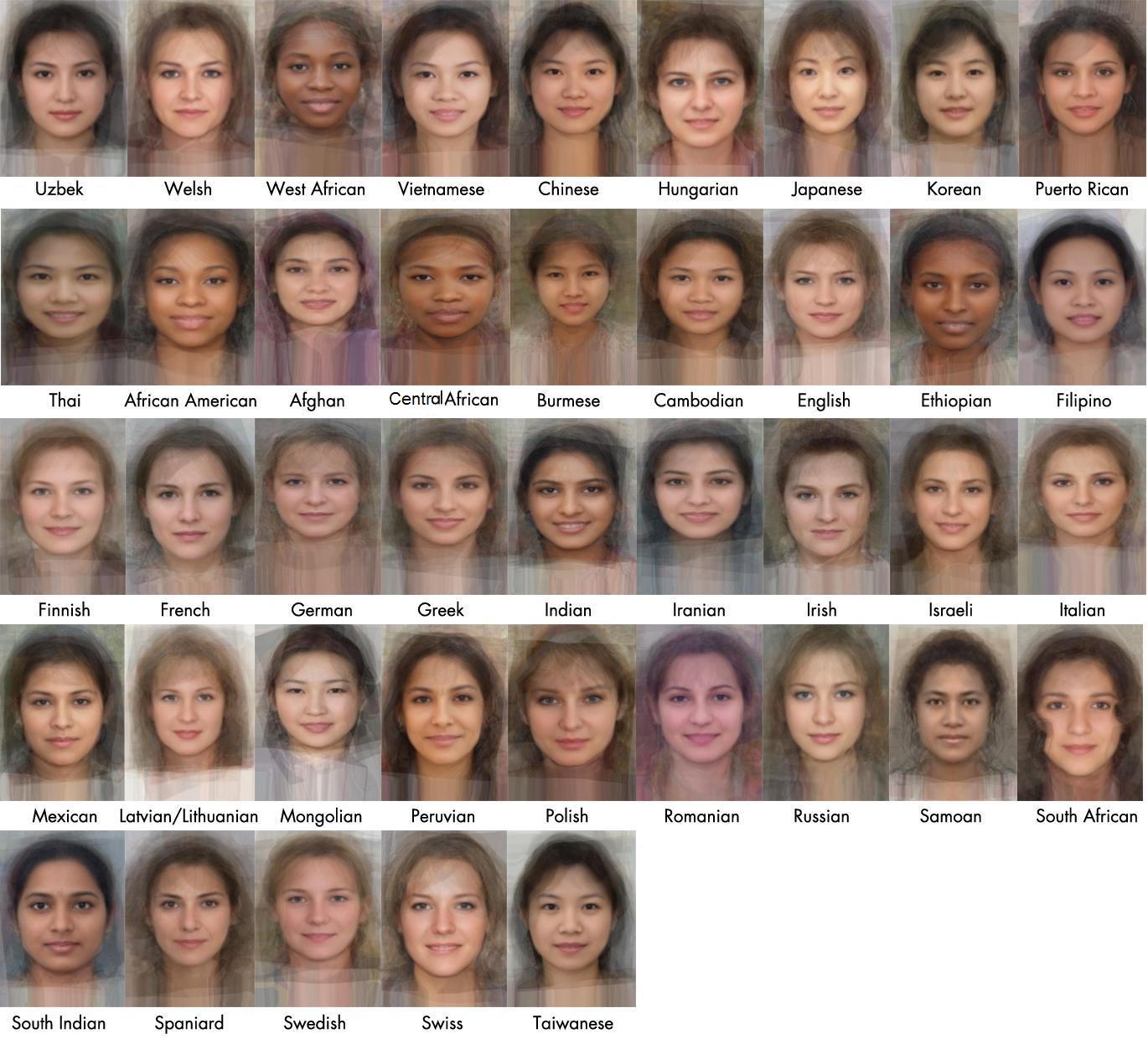
These images are the work of Istanbul based photographer Mike Mike. His artist’s statement actually mentions Galton:
Mike’s journey of discovery began a few years ago, on a trip to London. “Sitting on the underground train, I was intrigued by the sheer diversity of the place – Somalis, Indians, Americans, Zimbabweans, Scandinavians and a hundred other nationalities vying for their place in the metropolis. I thought “what is this place, what is a Londoner?” A few weeks later I was in Istanbul and looking at the relative uniformity of the population I realized I was looking at the future of London. A thousand years ago Istanbul was the capital of the remnants of the Roman Empire – home to an astonishing variety of peoples from Greece, Rome, central Asia, Arabia and the Russia. Yet now this diversity had coalesced around a mean – almost everyone dark haired, brown-eyed and olive-skinned. And I thought if one could merge all the people in a place like London one would be looking at the future of that place – one would have some notion of what a Londoner is or will become.”
Taking as his reference point the early work of Francis Galton and more recent works by Gerhard Lang and Nancy Burson, which explore issues of identity through a layering, or in the case of Burson a morphing, technique, Mike has established a systematic almost census-like approach to this theme. Asking the question “What does a New Yorker, a Londoner, a Parisian look like?” he attempts to find an answer by photographing one hundred people he stops at random on the street and then combining those faces to create a new individual – someone that doesn’t exist right now but someone it seems quite real – almost familiar.
The recent fascination with morphing and overlay makes sense to me– as much as Western society values individualism, it is fascinating to compare ourselves to something grander. However, I find the mention of Galton’s work suspect because it is so closely tied to eugenics and persecutional stances on physical appearance. I also worry that because Mike’s alleged inspiration comes from the sheer diversity of Londoners, it follows that it may be impossible to maintain these regional categories with a so-called random sample as small as 100. I wonder about the racial implications of his work. It is interesting nonetheless.
Sources:
http://celebrity.myheritage.com/face-recognition

Posted in Uncategorized | Tags: composite photographs, francis galton, Galton, mike mike, the face of tomorrow
Posted by: keenan | December 11, 2012
The Uncanny and Postmortem Photography
In the blog entries on postmortem photography so far, there have been a lot of comments about the eerie quality of the photographs. The photographs might be particularly unsettling because they seem so distant from present sentiment– they seem surprising, almost unfathomable and possibly blasphemous. There’s an uncertain quality about them that shocks the viewer, and a concern about the casual quality of this portrayal of death. At least, that’s been the case for me. However, beyond that, I would argue that postmortem photographs are inherently uncanny from a Freudian perspective.

We’ve discussed the photographs asmomentos. The Thantos Archive was introduced to me in another class and although the origin of the photographs are not always noted online (and are very possibly American), this selection seems equally relevant to the discussion of Victorian post-mortem photography. These photographs are full of sentiment and care. So then why do they seem in such poor taste?
Freud’s psychoanalytic standpoint explains the concept of the uncanny as something that is both home-like and un-home-like. Freud mentions that “To many people the acme of the uncanny is represented by anything to do with death” and, in connection with Lara’s entry below, Freud argues that “in hardly any other sphere has our thinking and feeling changed so little since primitive times or the old been so well preserved [ . . .] our unconscious is still as unreceptive as ever to the idea of our own mortality” (Freud 148). Rather than settle into the obvious ghastly qualities of someone dead, however, postmortem photography can be approached from the idea of the uncanny double. In this vein, a dead body is unsettling because it suggests a person but isn’t one. By “promising us everyday reality and then going beyond it” (Freud 157), the uncanny arises.

This idea can be understood through considering the concept of the automaton, or a very life-like robot. Dead but seemingly alive and vice versa. This concept seems perfectly designed for post-mortem photography.

Having defined the photographs as uncanny, however, one must wonder why the owners of the photographs wouldn’t have found them to be so. If we are to believe or even entertain Freud’s Uncanny, it would make sense to consider this reading definitive for all of humankind, in any generation. This is even logical in considering Victorian literature– it is very clear that this uncanny is used to inspire fright or sensation (Miss Havisham anyone?). Why wouldn’t these photographs be considered equally eerie during the Victorian era?
Sources:
Freud, Sigmund. The Uncanny. New York: Penguin Books, 2003. 123-161.
Posted in Uncategorized | Tags: freud, postmortem photography, psychoanalysis, the uncanny
Posted by: Lara | December 9, 2012
Spiritualism and Ghost Photography
The “afterlife” is.. well, a rather controversial topic. Death is part of the human condition, it is a universal experience we cannot escape (so cheery, I know), and of course, we have absolutely no idea what happens after we die. Answers to the “what happens” question can be found virtually anywhere but the reality remains that we have no concrete facts/evidence and (likely?) never will. The nineteenth century brought all kinds of new technologies and theories. One such belief that arose was Spiritualism.
Spiritualism is defined by the OED as:
The belief that the spirits of the dead can hold communication with the living, or make their presence known to them in some way, esp. through a ‘medium’; the system of doctrines or practices founded on this belief. [first cited in 1853]
The Spiritualist movement gained considerable popularity in the 1850. The movement attracted many believers, such as Sir Arthur Conan Doyle, as well as a slew of skeptics, such as Harry Houdini. (Doyle and Houdini disagreed so vehemently on the subject that it cost their friendship).

Out of this movement came Ghost or Spirit photography. At the forefront was an American photography, William H. Mumler. Experimenting with the still rather new form of photography, in 1862 while taking a picture of a colleague Mumler found that a double exposure could produce a “ghostly” image. Mumler’s “discovery” drew numerous people to his Boston studio who wished to be photographed ‘with deceased’ loved ones. (Mary Todd Lincoln was one of his famous sitters). Capitalizing on the opportunity, Mumler charged an exorbitant fee of 10 dollars a picture. People believed the photographs to be proof that spirits existed, however in 1869 Mumler was brought to court on the charge of fraud: he claimed the photographs captured the image of spirits, but was really using other live sitters or photographs. The case was eventually dropped, but Mumler’s reputation and business declined significantly.
But Mumler was not alone. Across the pond in England, Frederick Hudson and William Hope worked in the late nineteenth century into the twentieth. In France, Edouard Isidore Buguet (E.Buget) tied the ideas of channeling by photographing mediums while they were in trances.
While many images are obviously fakes, there are numerous reports that some images may actually have some grain of authenticity. Much to my surprise, Alfred Russell Wallace even speculated that some photographs could contain truths – From Spirit Photography: It’s Strange and Controversial History:
In 1891, the practice of spirit photography gained more credibility when Alfred Russell Wallace, the co-developer of the theory of evolution, spoke out with the belief that spirit photography should be studied scientifically. He later wrote about his own investigations into it and included a statement that he believed the possibility of it was real. He did not feel that just because some of the photos that had been documented were obviously fraudulent, that all of them could be dismissed as hoaxes.
-

- Top left image of Mary Todd Lincoln with her deceased husband, Abraham Lincoln.
-
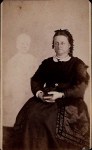
- Albumen print carte de visite, circa 1868, by William H. Mumler.
-

- Frederick Hudson, 1872, by Mr. Reeves.
-

- Stereograph card, c1889.
-
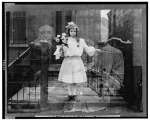
- c1905
Spiritualism remained popular throughout the early 20th century and still attracts people today.
Further reading and sources:
Do you Believe? ; The Mumler Mystery
Beyond the Grave: a Brief History of Spirit Photography
Met Museum: The Perfect Medium: Photography and the Occult
Spirit Photography: It’s Strange and Controversial History
I said I would share my ghost stories, but I figured I’d leave it up to you if you’d like to read them, it is relate as I believe – to some extent – in Spiritualism. So here you go:
Ghost Stories, Part 1: The Incidents
Ghost Stories, Part 2: Some Thoughts
****************
Edit (12/11/12):
Read More…
Posted by: The Snooty Tea Person | December 7, 2012
Madness in Wonderland–Is it really that mad after all?
It seems that in Wonderland, what Lewis Carroll calls “madness” in fact has a certain logic to it. For example, when the Cheshire Cat explains to Alice why he’s mad, he says, “you see a dog growls when it’s angry, and wags its tail when it’s pleased. Now I growl when I’m pleased, and wag my tail when I’m angry. Therefore I’m mad” (66). Essentially, the Cat is claiming that a dog’s actions are not mad, therefore to do the opposite is by default to be mad. It is evocative of simple logic statements found in math and philosophy: if a statement is true, then its inverse must also be true.
Now, logic is defined by the World English Dictionary on Dictionary.com as “reasoned thought or argument, as distinguished from irrationality.” Irrationality is linked to madness, which is defined as, “senseless folly.” Now, if logic is the reverse of irrationality, then it is the reverse of madness. Therefore here’s the snag in the puzzle: if the madness in Wonderland has a logic to it, doesn’t the nature of logic itself negate the madness?
I believe that the Wonderland system is built on its own logic, yet since its laws are the inverse of our own, it qualifies as madness in our world and thus they call it “madness” because that is how it is perceived by Alice. Yet within Wonderland itself, that “madness” is merely the norm. When studied in this way, it would seem that Carroll is also making a subtle prod at imperialism–what the English called “madness” upon being exposed to indigenous cultures, was only mad by English standards.
Sources: http://en.wikipedia.org/wiki/Deductive_reasoning
dictionary.reference.com
Carroll, Lewis. Alice in Wonderland.
Posted in Uncategorized | Tags: Alice in Wonderland, Lewis Carroll
Posted by: mahoganycloud | December 6, 2012
The Murder Scene

The Post-mortem photography never ceases to amaze those who happen to gaze upon them. The sensations that they elicit is not only sadness, but also trepidation. Though eery to many of the modern age who studies them, they were accepted as a normal and quite popular practice. The picture here attracts one’s attention to not only the dead family, but also to the injuries that the family seems to have. They are propped on the bed as if they are simply sleeping together, but what we seem to be looking is probably a murder scene, or probably a murder-suicide. Is this a premature form of capturing the murder scene in pictures, which will be quite common today?
Also, I am quite curious about when this practice of photographing the dead in this way ceased? Do we still have a practice in Western modern society that is similar?
Posted in Uncategorized
Posted by: thedawsonrewatch | December 6, 2012
Louis Wain- Painter of Cats
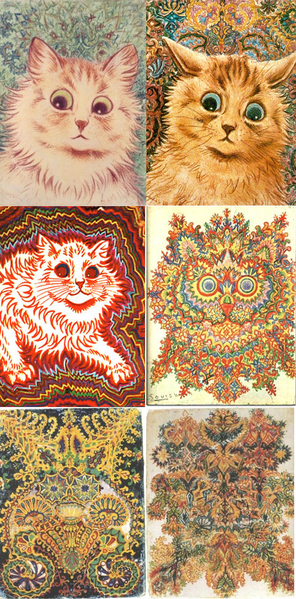
First let me say, I fallen victim to the “Dracula Effect” and now wish that I was writing my final paper about Wain, is it too late?
Louis Wain was born in Clerkenwell, London in 1860. The oldest of six children. At the age of 20 he became a freelance artist to support his mother and sisters following the death of his father. His specialties were illustrations of animals and country scenes. Wain found work with several London Journals including “The Illustrated London News.”
At 23, Wain married his sister’s governess, Emily, who also happened to be ten years his senior. (ESCANDALO!) Tragically, Emily was ill with what would turn out to be breast cancer and within three years of their union, she would be dead. During her illness, Wain began to draw pictures of their adopted stray kitten to cheer her up. It was around this time that Wain would begin to experiment with anthropomorphised cats.
. 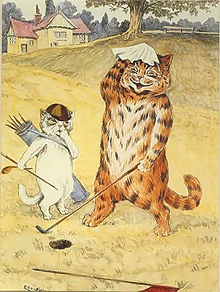
Over the next several years Wain would produce hundreds of images in a variety of forms including hundreds of children’s books, post cards, cartoons, and paintings. Wain was also heavily involved in Animal Charity Societies.
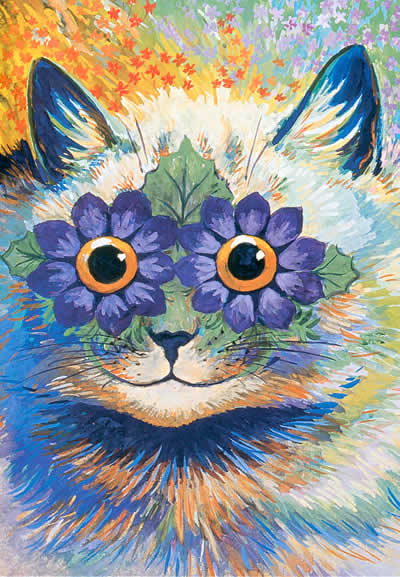
In the early 1900s, following a trip to America to do some work for Hearst publishing, Wain began to exhibit symptoms of a mental disorder. He suffered from delusions, became hostile, slept little, and spent long periods locked in his room. Eventually diagnosed with Schizophrenia, his sisters could no longer care for him and he was committed to the Springfield mental hospital.
Wain’s paintings done during this time are now frequently referenced by psychologists as examples of psychological deterioration. Wain’s focus shifted from making the cats look human to the cats themselves and then to shapes, lines and colors that obscure almost any recognizable vision of a cat
.


 Victorian Visual Culture
