Posted by: emmajem | December 5, 2012

Reel Victorians

“We never called ourselves teenagers, but we were certainly Victorians.”

This quote ends a clip of a show that I would love to get my hands on someday, called Reel Victorians.  It is a series of three episodes which are comprised of thematic interviews about daily Victorian life.  And yes, the interviewees are actually (very old and very vivacious) Victorians.  While studying any time period it is easy to forget that it was once a very real present through which people lived, and I found these reflections on the period (remembered (mis)representations though they might be) quite refreshing.

The first segment is from the episode called “Nineties Girls,” and alternates between interviews with two women.  Both were young adults in the 1890s, living in London, but while one was working class the other was at least upper middle.  Of life in London, Berta talks about the “hansom cabs slurring through the mud; where there wasn’t mud there was fog and in between was us enjoying ourselves.”  Of course they enjoyed themselves in very different ways.  Berta (of the upper class) talks about art and how “the thing to be was decadent” (which meant enjoying Oscar Wilde).  It was Effie (the working woman) who most interested me, however, perhaps especially because of our recent discussion of Munby’s working women.  While, as one of the first secretaries, Effie was not Munby’s kind of dirty working  woman, her comments on the work of women bring a sense of the personal to a topic we have spoken much about in class.  She recalls being seated in a window typing at her typewriter, surrounded by “crowds” looking in through the glass to see what she might be doing.  Being in a window seems a very odd place to do work, but this (as well as the crowds) indicates how much women’s work really was a spectacle, and not just in the Munby way.  It reminds me of manikins in shop windows used to advertise clothing–but what is this woman in a window advertising?  The service of typing, foremost, but might she also be advertising herself?  Or women’s labor in general?  I would be curious to know just how much of women’s labor was so flagrantly flaunted.

Effie also sheds light on the condition of the Victorian woman when she discusses that radical method of transport, the bicycle.    She remembers riding along in typical Victorian bicycle dress (near-scandalous dishabille in those days) when a man shouted down to her, “Don’t you want any children?”  I am not quite sure what to say about that, but I wanted you all to at least read it (if you don’t watch the clip, which you really should do) and enjoy with me the fact that a woman riding bike in her bicycle clothes is treated as just as scandalous as a woman not riding but “walking the street” in her similarly “scandalous” occupational dress.

Another interesting thing about these clips is the mixing of genres.  All presented to the viewer in a cinematic format, the video itself–as historical videos so usually are–is an amalgam of clips from more modern interviews, clips from the Victorian period, pictures of the younger versions of the women speaking, pictures of other Victorians, and drawings from the time period.  They are all used to construct the same narrative–an episodic wander through the streets of Victorian London–and experience a kind of fluidity of essence as though they all are different they are meant to represent the same thing/time.  Since it is a first-person narration, the images shown, whether they are of the person speaking or not, are meant to represent that person, and then all contemporary persons in a more general sense.  I know it is a common technique, but I have always found the use of images to simultaneously represent the individual and the general interesting.

You should definitely take a look at these videos–they are lively, engaging, and fascinating windows on what we have been studying framed by a very personal viewpoint.  The first is from “Nineties’ Girls”:


This second one I add just because it is rather wonderful to see a 93 year old Princess Alice (granddaughter of Queen Victoria) reminisce about her grandmother.  Highlights include footage of the queen’s funeral, as well as endearing little anecdotes of the queen.  I can’t get the host site to allow me to put another video in, but here is the link:

http://www.youtube.com/watch?v=qS4hAbHLszw

The Naughty Nineties: A Saucy Victorian Pop-Up Book for Adults Only | Brain Pickings.

ref=as_li_ss_tilAs I’m doing perusing the internet for possible resources and ideas for my final I came upon this most scandalous post about Victorian Pop-Up Book for Adults Only, by Edward Gorey and published in 1982 (Gorey was an American writer /artist and known for his macabre illustrated books) .  The images are quite entertaining, but they also bring to light the issue of repressed sexuality and the representation of women as objects. From a couple of the images seen in the post, the gaze appears to always be that of a man. The woman  is depicted either as a seductress (can-can dancer, maid etc) or sultry wife (actually, who knows if these images are representations of married Victorian couples!). The sauciness lies in the fact that a scene first appears quite innocent until you move the tab and the real intentions of the figures in the image are revealed. However, I’m disappointed in the fact that many of these women appear as fetishes for these Victorian men. I wonder if Gorey actually offers images of women acting as instigators of titillating acts? The fact that the book supposedly amuses a modern audience and yet continues to adhere to the dominant discourse of men as the possessor of the gaze leaves it found wanting for a more inclusive discourse.

Posted by: cotem3sons | December 2, 2012

Gavin Millar’s “Dreamchild” (1985)

After reading “Dream Rushes” about Lewis Carroll’s obsession with little girls (especially Alice Liddell) and photography, in Mavor’s “Pleasure’s Taken”, I was curious. So, I looked it up on ‘Youtube’ and wanted to share the clip of the video mentioned in our reading. This represents Carroll as such a creepy man as he gazes at Alice Liddell!

Posted by: thedawsonrewatch | December 1, 2012

Neat Portraiture Blog

Neat Portraiture Blog

Hey all,

I just wanted to share this really great blog with you. Described as “Where early photography meets extreme hotness” My Daguerreotype Boyfriend has a huge variety of images. Although it is, on the surface just a fun website, a lot of what we have been discussing in our course about race, class, and portraiture is evident in the  images. These images also represent a huge span of time so it is possible to see some of the changing techniques in portraiture as well.

Check out this jaunty fellow:

jaunty

Posted by: emmajem | November 29, 2012

Ghost Mothers and Other Ghosts

I have question to pose to all of you, and it stems from this image:

 http://margaretgunnng.blogspot.co.uk/2012/01/i-see-dead-people-victorian-post-mortem.html

Tomorrow we are going to be talking about ghost mothers in Victorian photography, a strange phenomenon for which the above photograph seems to be a perfect example.  The darling baby is staged in angelic white, and some creeping specter looms in black behind it.  It is a creepy image, similar to the “ghost of death” image mahoganycloud brought to our attention.  But its real creepiness, to me, stems from the context in which I was first introduced to it, for the context was not that of the ghost mother, but the ghost subject.

I was doing some research for a blog post I was thinking about doing on post-mortem photography, and it was on one of the websites or blog posts dedicated to this practice that I found this image.  Post-mortem photography was very common in the Victorian period, especially with recently deceased children, because often there was no picture of the deceased, and an after-death photo was the only chance the family would get to create a physical likeness to memorialize their loved one.  In many of these images children (and adults) are often posed as if they were alive, sometimes merely “sleeping” but sometimes with their eyes propped open or with pupils painted on closed eyelids.  In such images the child is often bedecked with flowers.  Although some of the pictured corpses seem peaceful and truly vital, in many there is a certain stiffness or something that just is not quite right, and it is this that betrays the true state of the pictured body.  The image above I find fascinating because it presents us with conflicting codes.  Here we have a baby with a ghost mother lingering behind him/her, ostensibly to keep the child still in order to have its picture taken.  However, the child is not being held by the mother, as is the case in many of the ghost mother images we have looked at, nor can I see the mother’s hands wrapped around the child to keep him/her still.  The baby is then still (for there is no blurring indicative of movement) of its own accord.  There are other oddities about the baby’s pose.  It seems amazing to me that such a young child could keep its legs crossed and fingers clasped (in an angelic position common in post-mortem photographs) for the length it took to take the picture.  Then there is the wreath of flowers around the baby’s head, which, in the context of the flower-strewn children in post-mortem photographs, layers on a graver significance.  The part of the image that startles me the most, though, is the baby’s eyes.  They are not open, but they are not exactly closed.  They look unnatural in a face already somber, and remind me of the other instances of the unnaturalness around the eyes in post-mortem photographs I have seen.  These eyes would have me think the baby is dead.

The baby’s self-contained stillness further problematizes this image, for it then calls into question the reason for the presence of the mother (we assume it is a mother) behind it.  Why would the mother, whose job in such a photo is typically to keep the baby from moving, be in the photo if she is not touching or otherwise calming the child?  But if this is in fact a memento mori image, why is she trying to hide herself when many such post-mortem photographs feature children cradled by their living relatives?  Is this child alive or dead?  I am not sure if the image itself can conclusively tell us.

But that is precisely why I find the image so intriguing, and why I decided to write a blog post about it.  The photo fits uncomfortably well in either context (of the ghost mother or the post-mortem), which suggests that the Victorian conception of mortality is more complicated than it seems to us.  In our culture, when you die you’re dead, and taking photographs of the dead is typically unsettling.  Death is the most final state of all–its boundary cannot be recrossed once it has been passed.  Victorian photographs, however, often blur the boundary between the living and the dead, making the deceased subject look “as if she were alive” (I do not think it was an accident that Robert Browning wrote this line during this particular period).  Traditional portraits could memorialize the dead, but photography has an immediacy to it, and painting a likeness of the deceased reconstructed from memories of loved ones is a different practice entirely from actually photographing the corpse.  Photographers would often pose the figure as if s/he were still alive, whether as merely sleeping, as here [WARNING–ABOUT TO GET GRAPHIC]:

c.1870 carte de visite of a young girl, posed as if sleeping. http://thanatosarchive.com/

and here:

http://www.mdolla.com/2012/05/stiff-pose-victorian-postmortem.html

or posed as if in a normal photograph, as here:

 http://www.mdolla.com/2012/05/stiff-pose-victorian-postmortem.html

and (behind the scenes) here:

http://margaretgunnng.blogspot.co.uk/2012/01/i-see-dead-people-victorian-post-mortem.html

and here:

 http://www.mdolla.com/2012/05/stiff-pose-victorian-postmortem.html

I’ll admit that when looking at a lot of these photographs in slideshows or in archives it was sometimes (though not always, and those were the especially disturbing pictures) difficult for me to decipher who was dead and who was not, because photography blurs the line between the living and the dead in a way that other mediums cannot.  While painting and poetry memorialize the dead, photography does so by using their own corpse as part of the medium.  The body is staged, costumed and positioned, in order to give the appearance of life.  Sometimes the body serves further as a canvas when color is later added to the cheek to indicate a life all black and white photographs lack, or when pupils are painted onto closed eyelids.  The photographer must manipulate the body in order to make it represent something it no longer is, the living person who is now gone, and so the body becomes a medium through which the artist’s “vision” (or the departed life) must be expressed.  Then again, this is not all that different from what a photographer usually does.  The figures in photographs are all staged, costumed and positioned appropriately, in order to convey some sort of essence of identifiable self through the photograph.  Making the dead seem as if they are alive is not all that different from making the living seem as if they are alive in a certain way (by which I mean the presentation of a self–that this woman is a lady, or that woman is a housemaid, the accuracy in the depiction of which we have already seen called into question by Hannah Cullwick).

There are a lot of interesting questions here, but, unfortunately, one blog post cannot ask them all.  So, Victorian conceptions of mortality aside, what do you think of the first image?  Is it a picture of a ghost mother or a ghost child?  And, I can’t help but wonder, how many people in Victorian images taken out of context might be merely passing as alive?

Posted by: victorianophelia | November 26, 2012

Ophelia Powders, Photos, and Advertising

In reading Carol Mavor’s “Pleasures Taken” I came across the sentence, “When [Hannah] was a lady, she painted herself white: whitening her dark, reddened hands with smart white gloves and, most certainly, dusting her face not with soot, but with the “Ophelia powders” so popular then” (p 95). As you can probably tell, I’m a little obsessed with the Victorian interpretations of Shakespeare’s Ophelia, so I followed the footnote to p 150. Mavor says that “One of the most well known [of the aforementioned “Ophelia Powders”] was “Lily Powder…”

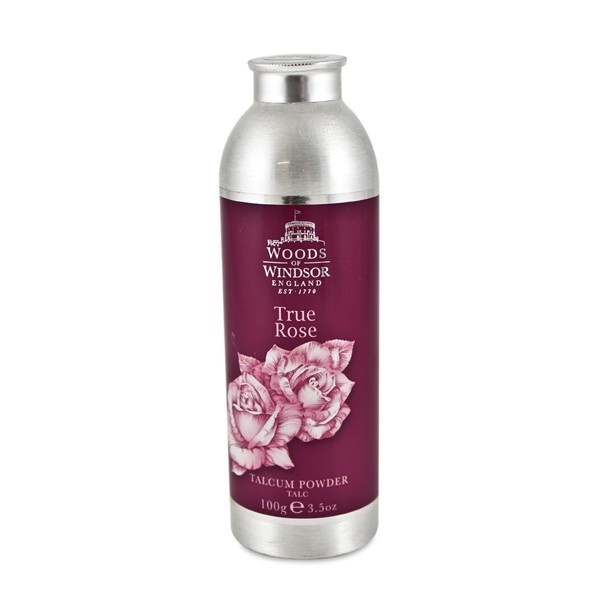
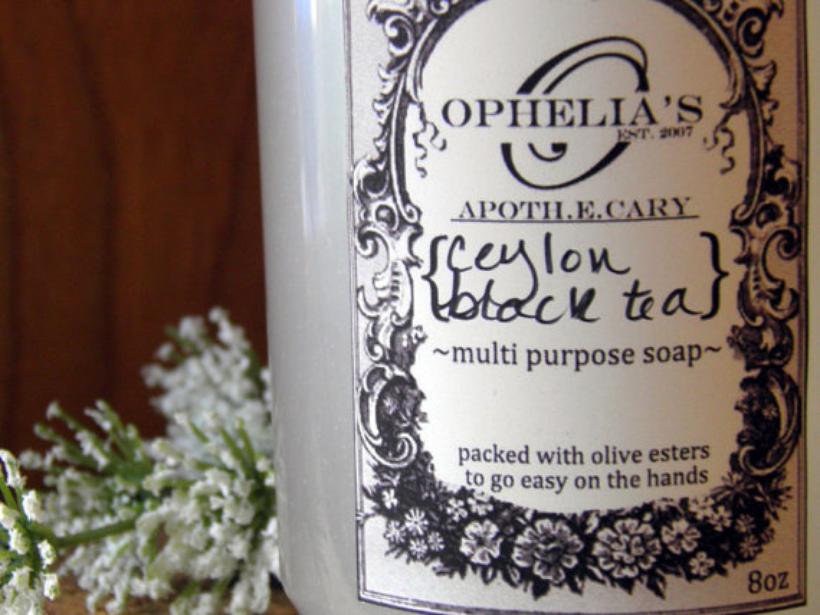
I tried to do some further research into this but, due to the fact that people are just as infatuated with Ophelia today as in the Victorian era, most of what came up were teen angst blogs and edgy makeup lines (Ophelia’s Apothecary & Perfumery at http://opheliasoddities.goodsie.com/ advertises “Good~for~you bath and body products free of sulfates and parabens”).  Many of the makeup and soap lines (e.g. Crabtree & Evelyn and Woods of Windsor) did actually advertise “Lily of the Valley” scented talcum powder, and even used the Victorian health and beauty advertisement frames that we’ve seen so much of on their products:

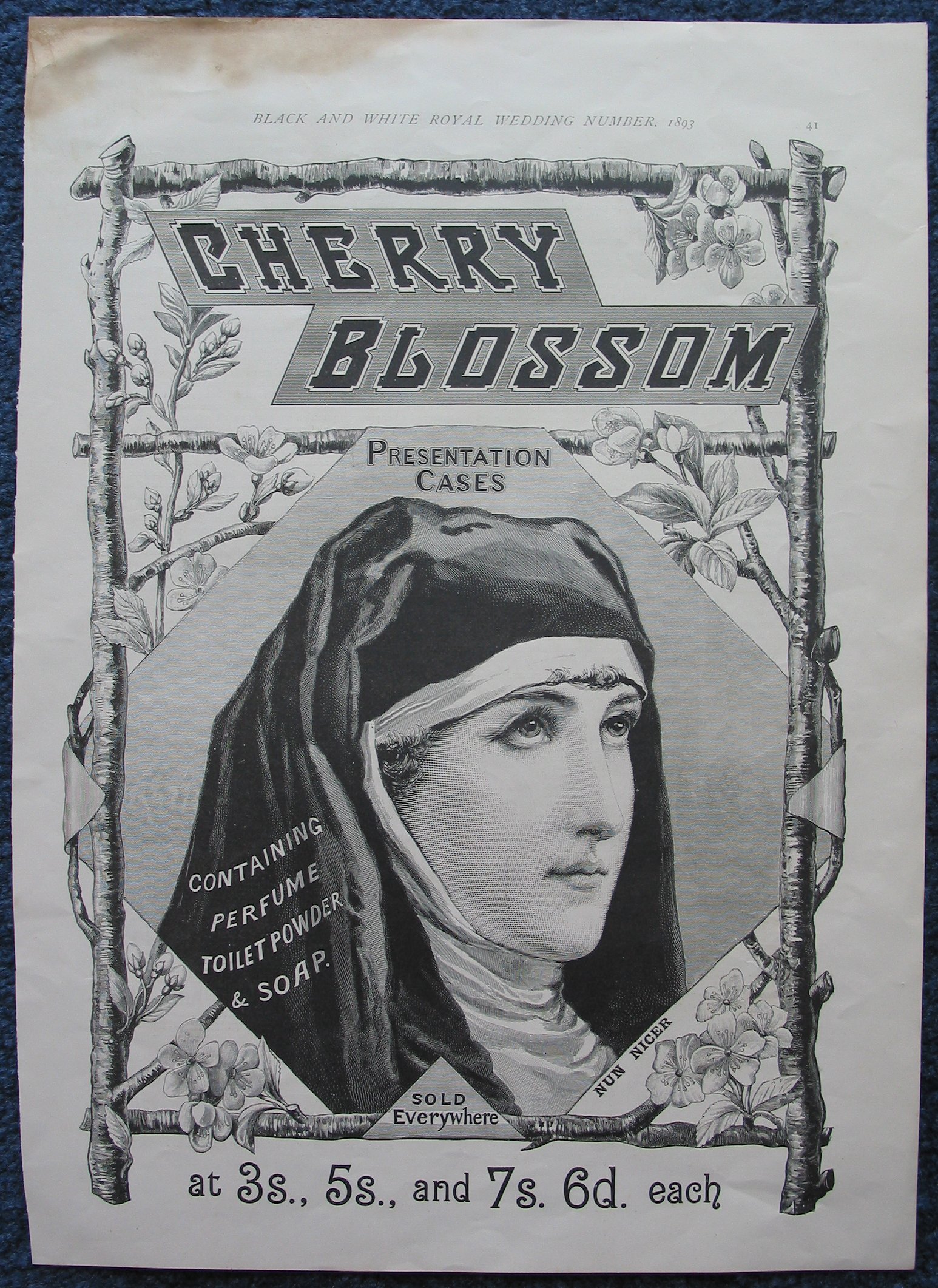
I did manage to find one seemingly popular advertisement from the 1890s for John Gosnell & Co.’s Toilet and Nursery Powder (talcum powder) at http://www.sensationpress.com/victoriantalcumpowder.htm and subsequently http://www.gosnell.org.uk/JohnGosnell/index.html (a rather long list of images of many of John Gosnell & Co.’s product history):

Isn’t the image of the nun interesting, considering women’s makeup was loaded with poisons such as lead and mercury (amongst other bizarre ingredients such as chalk, found in “Pearl Powders”), as @Cialci mentioned in her post about  arsenic for skin whitening (Nov 10th)? And yet John Gosnell & Co. claimed their powder was “celebrated for its purity.” Sounds very much like the “Good~for~you” product from Ophelia’s Apothecary etc. (above)… I think it is really interesting how even today we are drawing on the original visual appeal of health and beauty advertisements from the Victorian era, and the words are often of less importance: on the Ophelia’s Apothecary etc. website the only words are the name of the company, and the above quote at the very bottom of the page; on the Crabtree & Evelyn talcum powder bottle most of the space is taken up by the “English Floral” image and the fancy Lily of the Valley font; and on the Woods of Windsor talcum powder bottle most of the space is taken up by the two very large roses, with the name of the product almost concealed by them at the bottom. In John Gosnell’s Cherry Blossom Powder ads the nun takes up most of the image and the actual product is squeezed in at the left side of the page.  As a culture we depend very much on the aesthetic value of products, which is ridiculous because, as we said about the Scrubbing Bubbles ads, images can be entirely deceiving.

What I really find intriguing though was the use of Ophelia as an emblem of beauty and simultaneously of Hysteria (the “medical condition”).  One of Hugh Welch Diamond’s most famous photos is in stark contrast to the flowery, pure, scented powder advertisements that call on Ophelia, Lilies and Pearls.

This Ophelia’s flowers seem sharp and thorny, more akin to Jesus’ crown of thorns than the wildflowers and waterlilies that Ophelia is more frequently associated with in Shakespeare’s play and in paintings since. Also in this photo her eyes are so piercing and downcast, and so unlike the nun in the Cherry Blossom powder ad, which look softly up to the heavens (and to the name of the product). This contrast is very much like, in my opinion, the cult of Ophelia that has come about since Shakespeare’s play, which features the popular understanding of a character (as  the epitome of beauty and femininity with her simple floral bouquets, and the image of her drifting sleepily [yet truly dead] down a flowery stream) that is more often than not entirely unlike her original portrayal (a tragic and sorrowful human descent into heartbreak, madness and eventual death by drowning – recall Laertes pain in particular at her madness/death). The advertisements celebrate the popular, gentle, martyred (and visually pleasing/superficial) Ophelia, whereas the photos of institutionalized Ophelias display the stark reality of depression and insanity unencumbered by the need for aesthetic pleasure.

I just wanted to know what the rest of the class thought about the use of Ophelia in these contexts (both between the advertisements/products and the photos/reality, and between today’s culture and Victorian culture)?

Following Emily’s lead, I find that I too must return to the Sekula article after stumbling upon a project that irresistibly reminded me of Galton and his composite images.  Galton sought to trace the hereditary links of certain groups of people, and both his objective and his composite images have been taken up by a contemporary photographer experimenting with Photoshop in Canada.

Ulric Collette “accident[ally]” created what became a series of images when he was trying to teach himself photography and was trying to age his son in Photoshop.  The result was a composite image, but of a different kind than Galton’s pictures with multiple facial sources, and of a more focused vision than Galton’s attempts to pictorially define race, criminality, infirmity, insanity, and nearly every other condition of mankind he decided he could categorize.  Collette splices just two faces together belonging to the most intimately connected of human categories, the family.  Instead of overlaying images and letting common facial characteristics loom out while dissimilar ones fade into hazy incongruity, Collette matches two faces together in an effort to reveal common features between family members.  The results can be utterly striking.

This is combination of two cousins of the same age, the male being the artist.  Their gender difference and starkly contrasting hairstyles (white vs. dark, smooth vs. scruffy) clash to cobble together a very strange-looking entity.  This mash-up seems to emphasize difference more than similarity, but it also reveals a common lower face shape and a similar eye color.  What I like most about this image is the potential to explore the different portrayals of gender as represented by these two individuals.  The combination begs the comparison, and we might observe that while the man’s side looks rather natural in his raggedy scruff, the woman’s side is the quintessence of carefully pruned presentation.  The earring gives the sense of self-conscious adornment as does the slight eye make-up.  The dark roots to her shock of white hair belie its artificiality–her roots even look to be the same shade as her cousin’s–and her carefully plucked tiny eyebrow in juxtaposition to the male side’s large and supposedly natural state displays an attention to appearance much more artificial than the man’s.  One might even like to read into the greater number of wrinkles on her side of the face, and say that despite the fact that they are the same age, her life and her particular attention to appearance (which is all we have to go on in this photograph out of context) tax her body to a greater extent than it does her male counterpart.  This photograph of differences thus points to a scenario that might be more similar (what would she look like if her hair were not dyed and her eyebrows not plucked?) if the differentiating factor of gender might be removed.

Other images, in contrast, underscore a family resemblance that is almost uncanny in the sudden presentation of what looks to be an un-tampered, if slightly askew, whole person.

These two sisters combine to create a remarkably unified human being, their commingling serving to highlight lifestyle choices such as eyebrow plucking and hairstyling.  This image of twins

similarly explores the difference that lifestyle choices can create in a person (hair, make-up, and sun exposure as revealed by uneven freckles) and seems to undermine the fact that twins are perfectly identical, for this combination seems to display a person more unsymmetrical than some of the others.  These two brothers, for example,

seem to be a most extraordinarily perfectly matched pair.  Comparing father and son as in the following image:

both reveals the unfortunate family trait of baldness while attempting to map the effects of age.  Indeed, by pairing two generations together like this, Collette’s images (there are more such inter-generational combinations) seem to suggest a pattern for the younger half to follow.  Since the father/son or mother/daughter images often look so similar, the images often seem to claim that the image is not just of son and father or mother and daughter, but of a self and its future.

The most curious image which appears to represent a self and its future is the combined faces of the photographer and his son, who he claims “looked very much like [him] when [he] was a kid.”

But this image does more than just suggest possible lines along which youth grows into adulthood, for it is the picture in the sample which feels most unnatural and most obviously undermines the (admittedly stretched) truth claim of the photo.  While many of the other pictures appear almost natural or if shocking at least match up along similar lines, the photograph of the artist and his son unsettles the viewer in a different way because the son’s and the father’s faces very strikingly do not match up.  The son is younger and smaller, and therefore his face, though enlarged to match more with his father’s, is on a different scale.  This obvious disparity of scale undermines the apparent naturalness of many of the photos by pointing to their artificiality through this evidence of the artist’s hand (or mouse in Photoshop) that cannot be erased.  Collette had to manipulate these photographs to create these images which seek to define the reality of commonality between them.  Collette says that “there’s always something, a particular physical trait or characteristic that helps merge siblings together.  Sometime it’s the eyes, nose or mouth and sometime it’s only the facial structure.”  While this statement appears to merely emphasize the shared characteristics between family members, it also hints subtly at the photographer’s method of creation.  He picks a “particular trait” to “help” him “merge siblings together,” suggesting that the artist’s hand was heavier in the creation of these images than just placing two figures together.  He had to touch them up and align these faces along their similar traits, and–Photoshop being notorious as it is–one wonders if and how much the faces of the two different people were changed to enable their combination.

This idea brings us back to a question central to our study of photography.  Though these images seem to present to us “new people that are sometimes quite normal looking and other times far from it,” none of these people actually exist.  Even the images of the siblings, which seem to represent an almost unsplintered human being, show people who have never breathed.  Thus while the images do reveal hereditary traits in striking and undeniable ways, they also undermine their claims to truth through the undeniable presence of the artist’s altering hand.

Finally, I would like to add that while Galton’s composite images made me distinctly uncomfortable in their profiling racial or otherwise, Collette’s images strike me as something much more interesting, or at least much more comfortably based on more prominent and traceable similarities.  His portfolio is quite worth a look, and can be found here:

http://www.ulriccollette.com/?nav=facade

In addition to these genealogical portraits, it includes a series that reminds me slightly of Picasso, in which he attempts to capture the multiple sides to a person by merging two expressions onto the same body.  It is a little disconcerting, but often amusing.

The interview I drew on can be found here:

http://www.mymodernmet.com/profiles/blogs/split-family-faces

All images belong to Ulric Collette, and the quotes which are not identified as Collette’s belong to “alice” from her blog entry which includes the interview from which I occasionally quote.

I hope you found the images as intriguing as I did.

Gerritsen Collection: Historic and Primary Sources in Women’s History

From the LITS blog:

Our new subscription to The Gerritsen Collection gives full text access to thousands of publications as far back as 1543 about women’s history including suffrage, women’s movements, feminism and women’s rights

In case you don’t check the LITS blog often, or ever; there is a new resource that may prove helpful for our class / some people’s final papers.

Posted by: emilywmurphy | November 17, 2012

Severed Heads, the Victorian Way

I know it’s been a few weeks since we talked about the Sekula article and the creepy severed heads, but I came across this blog post in my internet travels, and thought it relevant.
http://thechirurgeonsapprentice.com/2012/08/13/losing-ones-head-a-frustrating-search-for-the-truth-about-decapitation/
    The post follows variations of the myth about the head retaining consciousness after decapitation, beginning with its inception (contemporary to the invention of the guillotine and the French Terror). The question being pursued is one that has been around for a while, first asked of Dr. Guillotin, the creator of the guillotine: “Do you know that it is not at all certain when a head is severed from the body by the guillotine that the feelings, personality and ego are instantaneously abolished…?” This question was asked because already the humaneness of decapitation as a method of execution was being questioned. If it was true that some part of the human self remained alive after the head was cut off, then surely it was not as clean and quick a death as had been originally advertised.
    The fact that the myth persisted throughout the 19th century is interesting, since it indicates the prevalence of the question of consciousness and death in the culture. As consciousness is inextricably linked to identity, the question can also be considered in relation to ideas of the face and personhood. In addition to this, there is the reason that the severed heads are creepy in the first place – they trigger some deep empathy inside us, because as humans, we understand the features, especially the eyes, as a tool of communication. This is why in the blog post, the man who is about to be executed says “call me with your voice and my eyes will reply to you.” In absence of the voice, it is the eyes and face that are used as tools of communication and signifiers of identity.
    The post also talks about a number of experiments done on severed heads, in which a scientist “bore[d] holes in the skull and insert[ed] needles into the brain” and then ran an electrical current through the brain in an attempt to trigger a response. This plays into the idea that we were talking about in class: the head becomes a specimen once it is detached from the body. In tension with this, however, is the human tendency towards individuation – people prefer to believe that their identity (and soul) survives the demise of their body. It is perhaps for this reason that people still cling to the myth of life remaining in the head, the seat of our intellect and selves, even after it is detached from the body.

Posted by: Chelsea | November 17, 2012

Women, Work and Luxury

Reading selected chapters from Loeb’s Consuming Women sent my mind reeling. It seemed to me that Loeb wanted to use the growing trend towards luxury-oriented advertising to show that women benefited from a culture of conspicuous consumption that encouraged them to fulfill their desires. But I had trouble following her logic–why should we assume that women benefit from an advertising culture that defines the feminine ideal in terms of a hedonistic household goddesses surrounded by material abundance? Aren’t these images also serving an oppressive function, by implying that a woman have no valued as such unless they succeed in acquiring and arranging every last accoutrement of leisured life?

As far as I can tell, Loeb’s argument centers around the assumption that, in an increasingly market-oriented society, it was empowering for women to be able to manage household consumption.  But social (and commercial) expectations determined what the household should look like. So, even when orchestrating household consumption, the woman was not truly enacting agency, but only serving to project the image that her family desired. This may have been especially oppressive endeavor for middle-class women, who were wedded to these dominant ideals of gender and class, but who did not have the economic resources and “extensive retinue of servants” available to the classes that they sought to emulate (29). The burden placed on women to demonstrate their family’s affluence though appropriate consumption probably made conspicuous display of luxury into a chore.

Remembering of a scene from the The Buckaneers (the adaption of Wharton’s novel) made me think that, while middle-class women finally had access to elaborate “confections…silver…greenhouses…and exotic flowers,” they also inherited from their aristocratic idols a unique burden.

In this scene, a young American bride arrives at her husband’s household, where her mother-in-law instructs her in the work of luxury.

« Newer Posts - Older Posts »

Categories