After previously touching on the gloomy “Hidden Mother” picture, I wanted to find a something a bit amusing and a little less dark–as most Victorian pictures are. So, I found a video that has a reference to Holmes, and his possible rival.
Posted by: mahoganycloud | October 18, 2012
Holmes Meets His Rival
Posted in Uncategorized
Posted by: mahoganycloud | October 18, 2012
The Ghost of the Mother
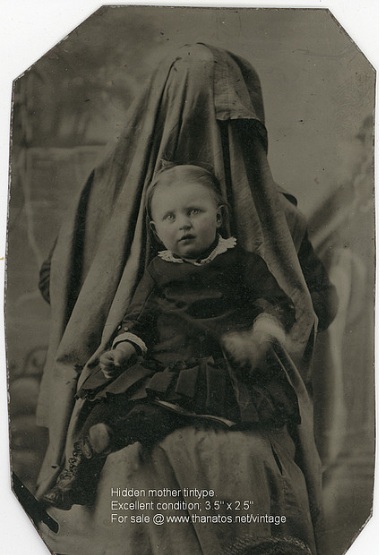
Here is a tintype photograph of an infant and the “ghost of death” shadowing it. I mean–you can interpret this picture in that way due to the fact that infant/child mortality was high due to birth defects, or exposure to an environment (water and food) that was contaminated from poor sanitary conditions. But another interpretation of the “hidden mother” is simply there is a mother in the picture, hidden under some sheet, trying to avoid appearing conspicuous in a picture with the child as the main focus. But because the photographic technology during that time was not as advance, and the mother was there to hold the child in place for the time it took to get the picture done. Take a look at the blurred right hand of the child due to movement; we can tell that this child could not sit still. The mother hold’s the child down so that a photo can be taken, which will memorialize the likeness of the child that may not live past childhood.
Posted in Uncategorized
Posted by: annegab | October 12, 2012
Ways of Seeing: From Oil Paintings to Profile Pics
Ways of Seeing: John Berger’s Classic 1972 BBC Critique of Consumer Culture | Brain Pickings.
I stumbled upon this article last week and lo and behold it pertained exactly to our discussion of Bleak House. The article, by Maria Popova discusses John Berger’s 1972 TV-mini series on “Critique of Consumer Culture”. Berger began by talking about oil painting and “its formative role in the creation of consumer culture”. As we discussed in class, Bleak House illustrates (with Lady Dedlock’s image) the transition towards painted portraits as a celebration of private property to an object of public property no longer controlled by the individual. This evolution from private paintings to public portrait photography created our perception of portraiture and poses. Tagg mentions this in his example of the middle-classes imitating aristocratic poses in the beginnings of portrait photography. The idea of poses and posturing in photography made me think of our modern-day poses (often sexualized) that we put on in front of the camera for facebook or other social networking sites. A day doesn’t go by where I don’t see someone taking a picture with their iphone or asking a friend to record a moment. The question of who controls images is still relevant today and in particular with Berger’s “discussion on how media culture shapes gender politics and woman as an object.” Berger’s quote talks about how being born a woman, was to be born into a confined space controlled by men. Under this limited space women were constantly surveying or watching themselves being looked at and since that surveying was male, Berger argues that the surveyor of woman in herself is male. Who is the surveyor today and why do we continue to constantly watch ourselves or manipulate images to represent an idealized reality?
Posted in Uncategorized | Tags: Bleak House, consumer culture, photography, portraiture
Posted by: Chelsea | October 3, 2012
Holmes & Watson
Before this week, I had never actually read Sherlock Holmes. I only knew Holmes through parodies, adaptations, and other cultural references. I had gleaned that he boxed, played violin, and smoked cocaine. I was also become familiar with several popular interpretation of his character: suggestions that he was a sexist, a racist, that he’d had an affair with Irene Adler, or that he was gay.
I always assumed that these interpretations were based more on readers’ individual ideologies than on Conan Doyle’s own words. But as soon as I finished the first few stories, it seemed blatantly obvious that Conan Doyle was hinting heavily at a romantic relationship between Holmes and Watson: the two of them strolling about with arms in the manner of “intimately acquainted men,” Watson abandoning his wife to spend the night with Holmes, Holmes’ fantasy of holding Watson’s hand as they fly above the rooftops of London.
If the Victorians were committed to strictly defined gender roles, Conan Doyle must have known that any breach of gender norms would be interpreted as homosexuality. But then I had to ask: were the interactions between Holmes and Watson unusual in the context of their time? Or was the behavior simply an example of “normal” interactions between male friend?
I remember reading an article by David Deitcher that addressed some of these questions by analyzing photographic representations of Victorian men. Based on Deitcher’s discussion, I would say that Holmes and Watson’s relationship might best be characterized as an example of “Romantic Friendship.” According to Deitcher, the strict stratification of Victorian society encouraged and normalized intimate relations between members of those groups, and particularly among men of a certain class. Romantic Friendship was seen as a relationship that transcended the vulgar material world (which the Victorians created but also hated), and a manifestation of non-sexual passion (compared to sexual passion which was also deemed vulgar).
Deitcher’s article is really interesting for many reasons, including the gender and class elements…but you can’t read it online! I did find a photo exhibit that he curated, though, which includes the picture that he analyzes in The Passionate Camera.

Posted in Uncategorized | Tags: gay, Photographs, sherlock holmes, watson
Posted by: hipstercorgi | October 2, 2012
An Iconic Image with a Musical Twist [샤이니_Sherlock•셜록 (Clue + Note)]
I was just as surprised as anyone else when I stumbled upon the famous South Korean boy band, SHINee performing a musical video using elements and imagery from the famous Arthur Conan Doyle series, Sherlock Holmes. Flashy dancing and pop music aside, the camera pans into a room with the members wearing clothing reminiscent of the Victorian era and imitating some of Sherlock Holmes’ iconic habits such as playing the violin, or thinking with the tips of his fingers of each hand touching. Other elements such as the letter seal and old fashioned camera reemphasize the vintage tone of the scene.
The story depicts the band members as detectives tasked with finding missing jewelry The image of the ghost aiding the gang with clues, (Jessica from a girl K-pop band, Girls Generation) evokes the famous ghost stories of the Victorian era. In 2:40 one of the members uses a camera to capture her image before she vanishes, reminding me of our class discussion of how the camera can immortalizes a person. Photography could transform the idea of memory, death, and representation.
The lyrics show a sense of urgency, the singer wants to interrogate the person who has all the answers and won’t let the person leave until the crime is solved. “You walk out from the picture at the moment..You don’t exist in front of me right now I know that for sure but I’m going to interrogate you.” All in all, it was quite enjoyable to watch this video and see how the visuals and representation of the Victorian culture were given a modern and Asian twist.
Source: YouTube and http://www.kpoplyrics.net/shinee-sherlock-lyrics-english-romanized.html
-Annie Lattner
Posted in Uncategorized | Tags: holmes, korean, sherlock, shinee, sm entertainment
Posted by: Laura Gross Smith | September 30, 2012
Arthur and George by Julian Barnes
 If you enjoy Sherlock Holmes, you just might be interested in this wonderful novel by Julian Barnes. It is the story of Sherlock’s creator, Arthur Conan-Doyle, and George Edalji, a solicitor who is charged with a crime he didn’t commit. Part of the novel follows the character of Arthur, part follows George and finally their lives intersect as Conan-Doyle becomes fascinated with the trial of this man, the son of an Indian vicar, and tries to clear his name. The novel explores Conan-Doyle’s relationship with his first wife, Louisa Hawkins, and his friendship with Jean Leckie, as well as his fascination with spiritualism. It is a great book for historical fiction buffs as well as Sherlock Holmes fans.
Posted in Uncategorized | Tags: A, Arthur and George, Arthur Conan Doyle, Julian Barnes, sherlock holmes
Posted by: amartinmhc | September 29, 2012
New Daguerreotype of Emily Dickinson
Since Michelle posted about Dickinson House, I want to make sure that all of you know about the new daguerreotype of Emily Dickinson that has been discovered. Amherst College Archives now have a copy, and here is an interesting article about the image.
https://www.amherst.edu/aboutamherst/news/news_releases/2012/09/node/431291
Thanks to Lucy Abbott, former student in English 325 and now a guide and museum assistant at the Emily Dickinson Museum, for letting me know about this, in particular the you tube video, which is rather incredible.
Posted in Uncategorized | Tags: daguerreotypes, Emily Dickinson, photography
Posted by: cotem3sons | September 28, 2012
Speaking of Victorian Daguerreotypes
Since we have been focusing on Victorian portraiture and daguerreotypes, I thought I would take this opportunity to remind everyone that right next door to MHC is the Emily Dickinson Museum. Inside, there are some family portraits in the living room that are fascinating to see in person. Also, right outside of Emily Dickinson’s bedroom is a sample of a dress that Emily Dickinson would have worn. These are just some of the many interesting features at the museum. I studied “Emily Dickinson in Her Times” with Professor Martha Ackmann during my first semester at MHC in 2010, so I know a bit about the museum and the Evergreens next door which are both a must-see! Although this does not directly relate to what we are currently reading, I thought it would relate to Chapter 1 of “The Burden of Representation”. Emily Dickinson is also relevant, since she existed during the same time as Charles Dickins and A. Conan Doyle. I think the Dickinson Homestead would be a great field trip (hint..hint)
Posted in Uncategorized
Posted by: cotem3sons | September 28, 2012
“Bleak House” part 23 Youtube video
In the middle of this video, Lady Dedlock and Esther meet and have a heartfelt conversation. After our class discussion on Tuesday about whether or not the two characters were cast with similar facial features, I thought it would be helpful to post this video. In my opinion, they don’t look very similar. This Lady Deadlock has a very thin/narrow face and Esther has a rounder face. Other than their hair color, I don’t see any similarities. What do you think?
Posted in Uncategorized


 Victorian Visual Culture