Posted by: anniemharper | September 25, 2012

Everyone, meet my great-great-great-grandfather

Thomas Harper, middle row, far left, with the admirable white beard.

In last week’s class we discussed the popular 1865 photograph of condemned prisoner Lewis Payne (oddly someone made a greeting card version), which was featured in Roland Barthes’ Camera Lucida. Photography is fascinating because of its ability to transcend time and space. That a photograph can capture a single moment in time gives the observer the illusion of immediacy and intimacy with the subject. This sense is especially strong in prison photography, when the subject is captive and therefore at his or her most vulnerable.

Speaking of Victorian-era prison photography, allow me to introduce you to my great-great-great-grandfather, Thomas Harper. He’s the one on the left with the beer belly and the death-glare in the picture above. Actually, I shouldn’t joke about the beer belly, because Bishop Thomas Harper definitely never consumed a drop of alcohol in his life. In fact, Bishop Thomas Harper was a devout Mormon pioneer who left Wales in 1851 and traveled by ship and covered wagon to Salt Lake City, Utah. He founded a township, which he creatively named Harper, and, according to his religion, took three wives, fathered eleven children, and became a successful farmer. How does a nice hard-working guy like that end up in prison, you ask?

Meanwhile, Utah began its bid for statehood in the 1860s. The politicians in Washington thought polygamy was weird, and wouldn’t allow Utah to become a state until it complied with the Edmunds Act, which outlawed polygamy. In the mid-1880s, American marshals and deputies began to round up prominent polygamists to make examples of them. Bishop Thomas Harper was one of those unlucky few, and spent several months in the Sugar House Penitentiary in 1888. In this picture he is posing with VIP Bishop Cannon (the guy in the middle with the flowers) and several other prisoners. Eventually, in 1890, the Mormon Prophet had a very convenient revelation from God and decided that polygamy was wrong. Utah became a state shortly after, in 1896, and polygamy is still outlawed in the Church of Jesus Christ of Latter Day Saints to this day.

Before you ask: no, I’m not a Mormon. And yes, I am descendant from Thomas’s first wife (as you can imagine, this is a huge honor). I’m not sure in exactly what context this picture was taken, except that Cannon wrote later that he had to stand outside for several hours and that he caught cold as a result. It may have originally been intended to serve as identification of the prisoners. Interestingly, that identification function has taken on a new form in the modern era, as the descendants of these men love to create intricate family genealogies (a Mormon specialty), and even celebrate the fact that their ancestors were imprisoned in Sugar House (which is now a park). Also interestingly, my grandfather once glared at me in the exact same way once when I left my toys all over the living room floor. A wonderful example of photography’s ability to transcend time.
Source: http://www.stayfamily.org/showmedia.php?mediaID=247

Posted by: The Snooty Tea Person | September 17, 2012

Female-to-male crossdressing

Glenn Close’s recent film, “Albert Nobbs,” introduces the concept that women in the Victorian Era would dress as men for greater work opportunities, as well as the social benefits that came with being perceived as male, thus assimilating themselves into the unspoken ruling class. This also served as insurance against rape and the degradation that commonly befell women of this period.

This theme is also present in “Tipping the Velvet, ” a book by Sarah Waters, later adapted for the small screen on BBC. The LGBT cult classic presents sapphic Victorian Culture as a sphere characterized by exaggerated gender presentation. This happens in a self-conscious manner–on stage before the public eye, where it is welcomed as a novelty–or in earnest, during homosexual affairs behind closed doors.

My question is how much of this based on fact? Close and Waters paint female-to-male crossdressing as a well-populated underworld of Victorian culture, in response to the era’s signature, hyper-stylized gender roles. Was this practice truly as rampant as these works would have us believe? Or did was it no more notorious than other instances of crossdressing throughout history, such as the onnagata (male-to-female kabuki actors) of Japan?

Albert Nobbs trailer (http://www.youtube.com/watch?v=ini59bYhaUY):

Tipping the Velvet ending clip (http://youtu.be/RlJrccFvt6w):

Posted by: Lara | September 15, 2012

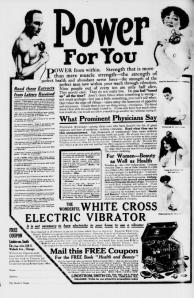
Power For You

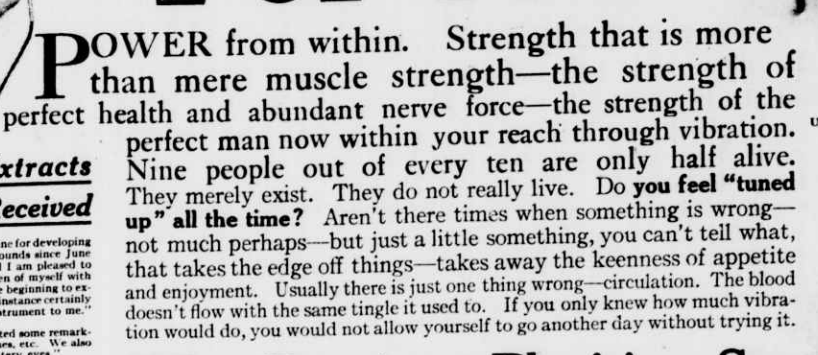
New York Tribune 1913 ad for an early electric vibrator.

To the left is an early ad for the electric vibrator featured in the Sunday edition of The New York Tribune on January 5, 1913. It appears at the end of Part III (“The Sunday Magazine”) and right before Part IV (Financial, Real Estate, Music).

According to the testimonials in this ad the vibrator could do everything from helping gain weigh, curing anxiety, helping digestion, to curing dandruff! Yet, at the time the main use of the vibrator was to cure women of “hysteria.” I will not be giving you a history lesson on female hysteria (see further reading at the end). However, it is important to know that hysteria was to many considered a disease,  to some considered another way for men to control women, and it ‘affected’ mainly middle and upper class women. Symptoms included “anxiety, sleeplessness, irritability, nervousness, erotic fantasy, sensations of heaviness in the abdomen, lower pelvic edema, and vaginal lubrication.”*

Female hysteria has been a topic of numerous articles and as well as a film in 2011. But what I find interesting about this ad is its public nature and the public nature of female sexuality. The ad featured here stresses the health and beauty value of the invention, the vague, suggestive writing alludes to the other uses:

Can you imagine an ad like this in a newspaper today? I can’t. Not even because of what is being sold but how it is being sold. The vibrator here is being advertised as “Power For You.” In many forms of current media, sexuality is used to exploit, not empower. Even though the ad encourages women to use the vibrator for beauty and health, it seems to also empower women to use the vibrator to ‘cure her own hysteria. ‘ Sounds like sexual empowerment to me!

What do you find interesting about the ad? (I also like the “mail in” offer).
What about the lack of change in the views on female masturbation? Was it taboo then, why is is taboo now?

For some further reading:
History of the Vibrator
Vintage Vibrator Museum
The American Journal of Clinical Medicine  Vol. 15, issue 1 1908

Posted by: Laura Gross Smith | September 15, 2012

Having it All

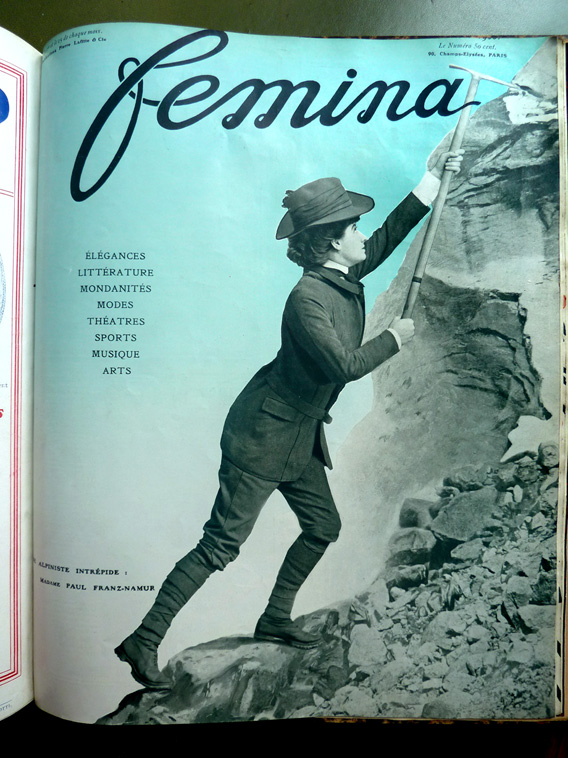
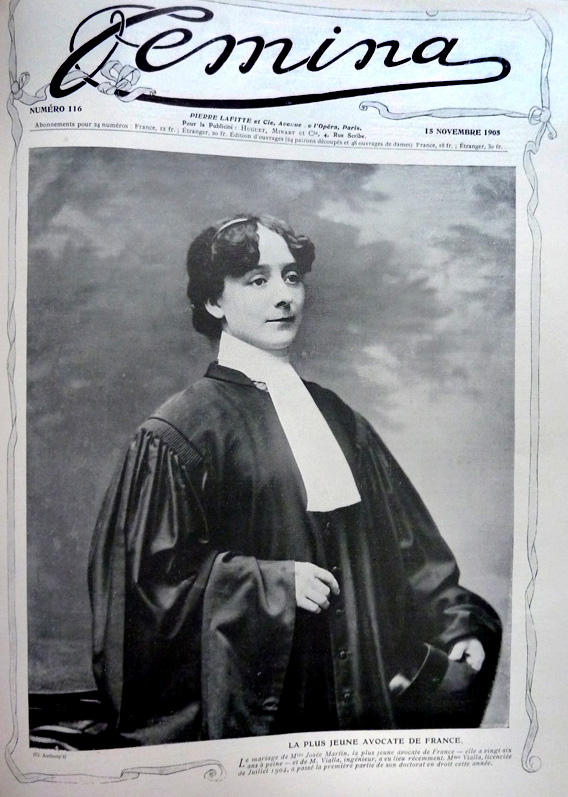
ImageI recently came across an article, Having it All. In France. 100 Years Ago. in the online journal, Slate.com. Seems that we women of the 21st century aren’t the only ones who wish to have it all. In the early 20th century two rival French magazines introduced the concept of the femme moderne. The author Rachel Mesch states, “All of a sudden, women’s progress was not about making demands but about performance and possibility, evidenced by an array of photographs that repeatedly demonstrated the elegant and graceful ways that women were embracing modern roles. This offered women a pleasing, affirming, and celebratory new way to see themselves— both a great feminist strategy and a fabulous way to sell more magazines.” Covers featured female athletes, professionals and mothers, smiling while they work.  Today women’s magazines inform us that we can drop two dress sizes, decorate for fall, raise healthy toddlers and have glowing skin, while we start our own companies and create the perfect outfit for only $19.99, all without breaking a sweat (much like the women of the 20th century magazines.) Can we have it all? I would like to think so, but it is a bit more of a sweaty proposition than the covers of these magazines portray. Image

Posted by: cotem3sons | September 12, 2012

Bleak House’s locations

Bleak House’s locations – in pictures

As I read Dickin’s “Bleak House”, I found myself having a difficult time imagining what it would look like. Envisioning a dreary-gothic style of architecture due to the name “Bleak”, I was pleasantly surprised upon discovering this article that the actual pictures of the model of the house were more pleasant to their appearance than I imagined. These pictures gave me a more accurate sense of the setting, and were also helpful since I am more of a visual learner.

According to article, “The locations in Bleak House act almost as characters in their own right. They convey emotion, mood, atmosophere – and tell us a great deal about the personalities of those that inhabit them. Dickens let reality feed his imagination and it’s still possible to see many of the places that inspired him”

Dickens places: Jewellery shops on Hatton Garden
Hatton Garden
“Now the home of jewellery shops and media types, in Bleak House Hatton Wall was an undesirable neighbourhood – the place the Jellybys retreat to after their bankruptcy”:
“As soon as her papa had tranquillized his mind by becoming this shorn lamb, and they had removed to a furnished lodging in Hatton Garden (where I found the children, when I afterwards went there, cutting the horse hair out of the seats of the chairs and choking themselves with it), Caddy had brought about a meeting between him and old Mr Turveydrop; and poor Mr Jellyby, being very humble and meek, had deferred to Mr Turveydrop’s deportment so submissively that they had become excellent friends.”Photograph: Linda Nylind for The Guardian
  • Dickens places: Jewellery shops on Hatton Garden
  • Dickens places: Tom all alone's
  • Dickens places: An Old Entrance to Lincoln's Inn Fields
  • Dickens places: Charles Dickens, Bleak House, Broadstairs, Kent.
  • Dickens places: Commuters leaving Chancery Lane underground station
  • Dickens places: Rockingham Castle, Leicestershire, Britain - Oct 2006


Posted by: caitlinmonahan | December 21, 2011

Portmanteaus

The more I learn about Lewis Carroll, the more I am amazed by his wonderful creativity and coupled with his extremely logical, math-oriented mind. One does not often see these two opposite characteristics in one person. For example, I knew that Carroll liked to make up his own words and definitions as part of his quest to add logic to the world, but I just recently learned that he coined “chortle” and “galumphing” which are now standard English words. Even more fascinating, is that Lewis Carroll coined the term “portmanteau”, as in portmanteau words, meaning words that are made from two or more other words. Carroll wrote the words “slithy” meaning lithe and slimy, as well as “mimsy” meaning flimsy and miserable, seen in the poem Jabberwocky. These words were so-called because of how Humpty Dumpty described them as being like the piece of furniture the portmanteau, which is two pieces in one. Although he didn’t coin them himself, Lewis Carroll is responsible for words like smog, spork, and sexting!

Posted by: caitlinmonahan | December 21, 2011

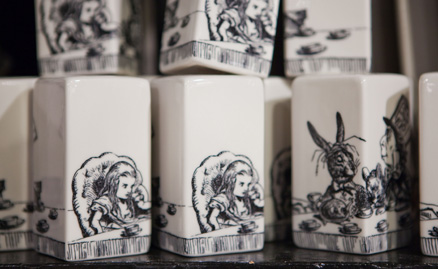
John Tenniel’s Illustrations on Dinnerware!

Image

This website has some amazing ceramics with John Tenniel’s illustrations from the original Alice’s Adventures in Wonderland printed on them. I loved the illustrations that Tenniel created for the story, and I think that they look absolutely beautiful on these dishes too! I was surprised to find these, as I feel like the original illustrations, along with the original story, have really become lost to the modern world with so many recreations and adaptations. It is lovely to see the beautiful artwork available in this timeless fashion.

Posted by: caitlinmonahan | December 21, 2011

American McGee’s “Alice”

When I was in middle school I had a friend with an older sister who would often play a computer game called “American McGee’s Alice”, and I remember thinking it was the scariest and coolest thing I had ever seen. This game from the early 2000’s is based on Alice in Wonderland, but it is really a completely backwards version of the already backwards Wonderland of Lewis Carroll’s imagination. In this corrupt version of Alice, she has grown up and has spent several years in an insane asylum following the death of her parents in a house fire, and has subsequently become twisted and deranged. After leaving the asylum she finds herself back in Wonderland, which is now just as dark and demented as she is being that it is her own dream manifestation. The player of the game has to navigate many obstacles involving killing Wonderland creatures in the macabre version of Alice in Wonderland. As a preteen I thought that this game was extremely cool, and I somehow thought that it must be more like the original story than the Disney version, not having read the original story. Now I just think that this game is a very strange perversion of a wonderful story that doesn’t need to be manipulated to be made more interesting or provocative. Also, I read that this game was the predominant inspiration for Tim Burton’s “Alice in Wonderland” from 2010 rather than the original story. Here is a trailer for the “backwards Wonderland”:

Posted by: caitlinmonahan | December 21, 2011

Jefferson Airplane “White Rabbit”


This popular song from the 1960’s has an interesting take on Lewis Carroll’s classic story. Because of the popularity of drug culture in the sixties and the video’s definite psychedelic feel, Jefferson Airplane appeared to be using imagery from Alice in Wonderland to create a song and video that simulated an acid trip. I like this song very much, but now that I know the “real” Alice I know that the lyrics of this song are a manipulation of the original story from the 1800’s, long before the invention of such psychedelic drugs as acid. These are the lyrics:

One pill makes you larger
And one pill makes you small
And the ones that mother gives you
Don’t do anything at all
Go ask Alice
When she’s ten feet tall

And if you go chasing rabbits
And you know you’re going to fall
Tell ’em a hookah smoking caterpillar
Has given you the call
Call Alice
When she was just small

When men on the chessboard
Get up and tell you where to go
And you’ve just had some kind of mushroom
And your mind is moving slow
Go ask Alice
I think she’ll know

When logic and proportion
Have fallen sloppy dead
And the White Knight is talking backwards
And the Red Queen’s “off with her head!”
Remember what the dormouse said;
“Keep your head”

It is very interesting to see the use of the events in Alice’s Adventures in Wonderland as a vignette of drug use. Jefferson Airplane talks about taking pills, which Alice does not do, and they allude to taking “some kind of mushroom”, both of which are drug references that were not in the original Alice. Basically, the lyrics of this song are saying, if you’ve taken drugs and are experiencing a trip in which you chase rabbits and encounter hookah-smoking caterpillars, then go talk to Alice, because she’s done those drugs before and knows all about that trip.

Posted by: kamibrodie | December 19, 2011

Stabbing Paintings

One of the things that stood out to me as I worked on my final paper was the way Wilde comes full circle in regards to the painting of Dorian.  When Basil first finishes the painting, Dorian grows despondent after realizing that, while the Dorian in the painting will remain young and beautiful forever, he will not.  Basil, upon seeing his friend’s sadness, decides that the painting, though his finest work, is not worth as much as his friendship, and takes up a knife, planning to destroy the painting.  Dorian stops him, crying, “‘It would be murder!'” (Wilde 30).  Basil stops, and eventually, the painting ends up in Dorian’s hands.

By the end of the novel, Dorian is again despondent, because he realizes what a terrible person he’s been.  He goes to the room with the painting, and using the knife he used to murder Basil, stabs the painting.  In doing so, the painting is restored to its original beauty, and Dorian is transformed into the person that was depicted in the painting.  As it was the image of the aged Dorian that was stabbed, the living Dorian is now dead, by his own hand.  It is ironic, because, had Dorian let Basil destroy the painting, it would not have been actual murder, and both of them would have probably lived.

« Newer Posts - Older Posts »

Categories