Posted by: millyc13 | December 15, 2011

Alice and Others in Central Park

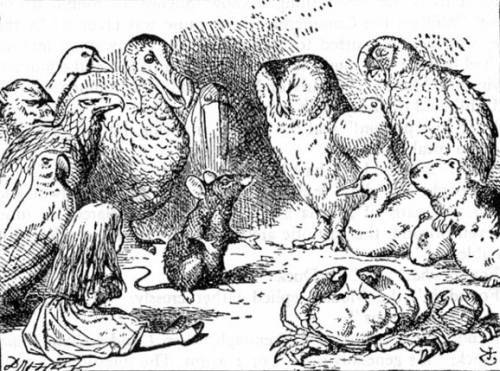
Across from the boating pond and a stones throw away from the statue of famous children’s book author Han Christian Andersen feeding the ducklings, a different scene is taking place. Often obscured by a mob of children, this Central Park favorite is a bronze piece of Alice and others. The artist, José de Creeft, cited the original illustrations of John Tenniel as his main inspiration for this 1959 piece. Do you notice any similarities to the illustrations? Differences?

Alice in Wonderland in Central Park

Next time the college has a New York bus, this sculpture might become one of your new destinations!!

More information can be found here: http://www.centralpark.com/guide/attractions/alice-in-wonderland.html


Posted by: millyc13 | December 15, 2011

Kiki Smith’s Take on Lewis Carroll

Illustration of "Alice's Adventures in Wonderland" by John Tenniel

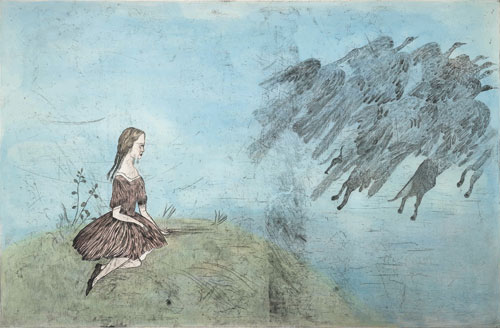
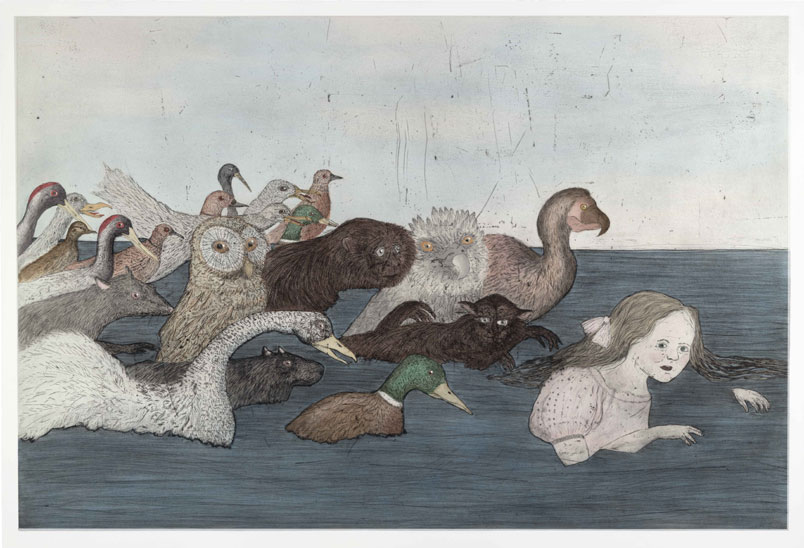
John Tenniel’s famous illustrations of Alice have set the standard for how we view this famous girl, but many have developed their own interpretations. Kiki Smith, contemporary printmaker and a previous visiting artist at Mount Holyoke, has created a number of images inspired by the work of Lewis Carroll. Smith is especially known for her pieces that deal with the feminine, and “in her recent work Smith has often turned to fairy tales in search of dramatic female personae and alter egos. The poignant vulnerability of childhood is an underlying theme in many of her images.” (MoMA)

Come Away From Her after Lewis Carroll (2004) by Kiki Smith

Pool of Tears 2 after Lewis Carroll (2000) by Kiki Smith

These two images are featured in a current exhibition at the Tate, from now until the end of January, titled “Alice in Wonderland”: http://www.tate.org.uk/liverpool/exhibitions/aliceinwonderland/default.shtm

More images by Kiki Smith can be found here: http://www.moma.org/interactives/exhibitions/2003/kikismith/

Posted by: malenfantable | December 15, 2011

Just a thought

Novelist Laurence Sterne wrote in a time in which the typical novel followed a linear, bildungsroman-esque, storyline. Time almost always moved forward and emotions were explained through the chronological understanding of time and events. Sterne’s, Tristram Shandy, was atypical for the time period, it provides the reader with no context of stories, and incorporates a plot line that is sporadic and disconnected. Examples of calendrical time in Tristram Shandy, are few and far between. In Tristram Shandy, we receive our understanding of time and events through Tristram Shandy’s personal conscience and his varying emotions instead of a built up database of circumstances in which we can refer back to for understanding. By doing this Sterne was borrowing concepts from John Locke’s theory of time, Sterne was suggesting that although many instances can take up the same literal space in time their resulting effects and feelings can take up differing amounts of emotional time. Sterne displays how ideas pass through a character’s mind, and how specific ideas and memories can slow down time or draw it out.

 John Locke was not himself a novelist, Laurence Sterne adapted Locke’s beliefs on time to criticize other authors portrayal of human understanding during the 1700’s. I am not sure if I can explain this perfectly, but I started to think about this same type of human understanding in terms of Victorian visuality, specifically the portrait. This may be a very vague connection but, within The Picture of Dorian Gray, the portrait conveys what time and place and linear understanding cannot. Art works as a vehicle to explain, similarly to Tristram Shandy’s rants, human emotion, fear, and personal conscience. Out of this sort of blind leap I made between Tristram Shandy and Dorian Gray, characters both questioning who they are and their worth, I am wondering if the dispersion of different visual mediums helped to expand human understanding of emotion in the Victorian era. Perhaps portraits were so powerful in the Victorian area because they put into question, more then ever before, what text was missing or ignoring. Pictures, images, advertisement, etc. present us with dialogue, with subliminal messages, and questions without the excuse or the explanation of the past or a specific linear understanding. Images shove problems and questions in our face and the lack of explanation leaves the viewer left to interpret and understand. It is often said images work to bring up feelings and emotions words cannot. Dorian Gray’s portrait forces him to view himself and to question himself, he cannot look to the past explanations, or past text for answers. In a way images enforce John Locke’s belief that specific emotions can be understood more clearly without chronological context and explanation, images can dredge up and convey issues that words and history blur.   

Posted by: oliviajane16 | December 15, 2011

Don’t Fix What Isn’t Broken

A couple of weeks ago we talked about Mavor’s chapter on Lewis Carroll and the way children were photographed with the intent to portray sexuality in certain images. We talked a lot about how children can be sexual but they most likely don’t know what sexuality means until it is explained to them, as well as at what point in development can it be assumed the child knows that dressing or acting in a certain way will express a sexuality that isn’t socially acceptable for their young age.  I think part of the reason why some of the pictures such as Cherry Ripe were so disturbing to us (or at least to me) was because it seemed like such an impossibility in our world today.

Today if someone tried to put together an exhibit of sexualized children serious questions about pedophilia would be brought up. However, this idea of children expressing sexuality inappropriate for their age pops up in surprising ways in pop culture. If any of you are TLC addicts like me, you’ve probably stumbled across the gem of a show “Toddlers & Tiaras” once or twice. If you haven’t (consider yourself lucky), it’s about the world of child beauty pageants and the crazy things parents will do to “help” their child win. Here are a few clips of some of the worst offenders.


Posted by: nathalieoates | December 14, 2011

Dorian Gray and a Commentary on Self-Representation

During our last class we talked about Oscar Wilde’s The Picture of Dorian Gray and specifically the function of representation in the novel. While the portrait is a reflection of the artist and not necessarily the sitter, it is also a distinct way of representing the subject. The artist’s lense captures what they see in the subject, but is that how the subject wants to be seen? In Dorian’s case, no. He is filled with rage when he finally sees the gruesome portrait Basil has painted.

What can we take away from Oscar Wilde’s novel? In a more modern context, we understand ourselves in relation to representation and how we choose to represent ourselves. The more control we have over this, the more accurate it may be. However, we use mirrors and artists to establish an integrity of self.

Do you think your Facebook picture is an accurate portrayal of yourself? How does self-awareness factor into how you see your personal beauty? While contemplating these questions, I remembered Wendy’s post on photoshop. I came across a true photoshop fail: Faith Hill’s cover picture on this month’s Redbook magazine. I just wonder which one Faith sees herself as…before or after?

Posted by: kamibrodie | December 13, 2011

Alice Grows Up

I always found it really interesting that Alice goes to other worlds in two different ways.  In the first book, Alice’s Adventures in Wonderland, she follows a white rabbit down a rabbit hole.  In Through the Looking Glass, she steps through a mirror into the world mirroring her own.  The way I see it, her methods follow her growth.

In Alice’s Adventures in Wonderland, Alice, tired of watching her sister read a book with no pictures, follows a strange rabbit down a rabbit hole, and discovers Wonderland.  In Wonderland, she is constantly changing size, and can never seem to figure out how she is supposed to be.  This is similar to the feelings we attribute to puberty.  First, there is a fascination with the world around you, as you are now old enough to explore it a bit on your own.  This is why Alice follows the rabbit; she is curious about the world around her.  Her size changes while she is in Wonderland mimic the changes one goes through during puberty, when one barely recognizes oneself anymore, because they are changing so fast.

In Through the Looking Glass, Alice goes through a mirror, because she is curious about the world on the other side.  The mirror is important, because in it, Alice would see a reflection of herself.  Now that she is older, she is curious about herself.  We also see signs of her being older when she chastises the black kitten for being unruly.  Likewise, Dinah has grown up and become a mother.  Alice’s quest to become a queen also shows us that she has grown up, but her lack of confidence in ruling also shows us that she is not all the way grown up yet.

My only problem with this analysis is that, in Through the Looking Glass, Alice is only 7 (and 6 months).  Is it just that the Victorians have a drastically different conception of when one became an adult, or is there something else going on here?

Posted by: kamibrodie | December 13, 2011

Keeping Portraiture for the Wealthy

In almost all of the photographs we’ve looked at this semester, class plays a major role.  It determines who is in the photo, and how the photo is used, among other things.  It seems that even though photography was democratized, readily available for all, there was still a clear distinction between the way photographs of the wealthy and the poor were used.

One of the first forms of photography we considered was police photography, and the use of mug shots.  The collection of mug shots led some photographers to try composite photography, in which they layered mug shots of different criminals on top of each other to get the “average” of the group.  Thus, they could isolate features common to criminals.  While these composite photographs were never actually used by legal authorities, they carried the threat of a justification for eugenics, because if you can isolate the features that are common in criminals, why not just stop people with those characteristics from reproducing?

Similarly, many travelers and explorers photographically documented the native people they encountered while abroad.  They tried to find exemplars of the native groups’ physical features, to serve as the standard for those ethnic groups.  In this way, people who stayed in Britain were able to see what people from distant lands looked like.

Again, in Thomson’s book, Victorian London Street Life, we saw examples of different types of people that you might encounter on the street.  While there were sometimes personal stories to go along with the photographs, many were impersonal.  The photographs were also staged, suggesting that there was a certain look that Thomson wanted the people to have.  Rather than looking like individuals, they seem to be reduced to types.

I don’t believe that we have seen this with the middle and upper classes.  There hasn’t been a photo that shows us what a typical doctor looks like, or what we should expect a member of the House of Lords to look like.  Their photographs seem much more individualized.  This becomes very clear when looking at the photocollages in Elizabeth Siegel’s Playing with Pictures, where we’re shown pictures of people mixed with drawing or painting meant to exaggerate an individual’s personality or other features.

It seems that the middle and upper classes tried to keep portraiture as a sign of wealth, even as photography became more common and accessible than painting.  By reducing photographs of the lower class to types, and retaining individuality in their own photographs, they were able to maintain a separation between the classes.

Posted by: caitlinmonahan | December 12, 2011

Mathematics in Alice

Before actually reading Lewis Carroll’s Alice’s Adventures in Wonderland I had heard several theories about the inspiration for the story. I had heard that it was actually about drug use, specifically LSD. But as malenfantable pointed out LSD was not invented until several decades after Alice was written and in fact, the association with drug use was only “a manipulation of the text to fit the drug culture”. I had also heard that Carroll was a mathematician, and so the story was all about math and hidden beneath the text were mathematical equations much too complicated for anyone but a mathematician, much less a child, to understand.

After reading the original story, I have learned that it was really not the sinister adult-themed-story-veiled-as-a-children’s-book that I thought it was, but in reality a story that was intended for children and about a real girl named Alice Liddell. However, the rumor that Lewis Carroll (Charles Dodgson) was a mathematician is absolutely true, and the theory that the Alice is an allegory for mathematics is not all that far off. Sprinkled throughout the text are references to math that are quite interesting (and not all that complex with the help of the annotations).

The first mention of math that I found interesting was in chapter 2 when Alice tries to remember her times tables, but says them all wrong and finally states, “I shall never get to twenty at that rate!” The  notes explain that the way she is reciting the times tables, which generally end at twelve, she would end with 4 times 12 is 19, and not make it to 20, which I found quite interesting because I wouldn’t have understood her concern without the mathematical explanation.

This article and radio clip from NPR help to explain Alice and Dodgson’s connection with math. He believed that math was very concrete and about numbers, and was frustrated with the new ideas springing up in the nineteenth century about algebra, and his story reflected his frustration. Maybe his argument was that if we can make up silly ideas about math, then why can’t cats talk and hares worry about time, and other nonsensical things that occur in Wonderland.

The most interesting scene in regards to math is when Alice has tea with the Mad Hatter and the March Hare. The Hare’s broken watch leads them to a discussion about time and, as the article explains, this discussion is about the new math being explored by mathematician William Hamilton in which time was a key factor. He explains that without time in the equation, the numbers will go around and around in a circle, just like the characters in the story going around the table.

I’m sure there are many more allusions to math hidden in Alice’s Adventures in Wonderland and I hope to learn more about them. 

Posted by: oliviajane16 | December 11, 2011

Alice and her favorite blue dress

I really enjoyed our discussion about Alice in Wonderland the other day, particularly the part when we discussed how Alice’s level of responsibility and maturity would change depending on how big or small she decided to be. Her age feels manipulated throughout the entire story. One minute she’s too little and can’t accomplish anything on her own and the next she’s taller than everyone and decides to march off by herself with no supervision. I think the Tim Burton adaptation of Alice does a really great job of mimicking this trend and incorporating it into what Alice wears as the story progresses. Every time Alice either grows or shrinks her blue dress completely changes shape and style. Often when she gets smaller it takes on a sweet little girl style that’s more modest. Then when she grows bigger it becomes much more of a high fashion adult dress. There’s at least 6 changes total. Here’s a link to an article and a video with the actress playing Alice and Colleen Atwood (the costume designer) talking about working with the different dresses.

‘Alice in Wonderland’ Costume Designer Colleen Atwood Talks Dresses

Posted by: malenfantable | December 9, 2011

Lewis Carroll, Alice and LSD

Alice’s Adventures in Wonderland, has as Lwinfree mentioned, become a major source of marketing in our modern world. Alice as a character has become a sort of cultural marker, an important figure, her character fitting many different niches in today’s society. She has functioned as a trite and seemingly overly happy Disneyworld character, she has been drawn into Disney film adaptations, made into toys, as well as manipulated in darker ways like in Tim Burton’s film, Alice and Wonderland.

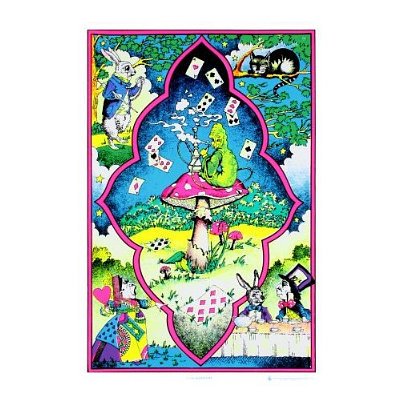
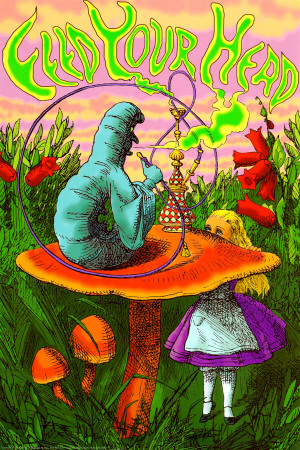
With these more socially accepted adaptations there has also been a cult following of Lewis Carroll and the story of, Alice  In Wonderland, within in the drug culture. This topic has been largely ignored because the idea often seems laughable, but I think the manipulation of the text to fit the drug culture and implications of that manipulation proves interesting to the power of visuality combined with text or in addition to the text. (Below are images of backlight posters and a smoking caterpillar tattoo. Blacklight posters are often associated with drugs because of their ability to light up when triggered by a black light)


The most commonly associated drug with Alice’s Adventures in Wonderland, is LSD. This concept is easily squashed by the fact that LSD was not invented and in use until the 1940’s. In 1938 Swiss chemist Albert Hoffman invented the drug, 40 years after Carroll died. (http://www.chm.bris.ac.uk/motm/lsd/lsd1_text.htm)

What is interesting about this relation to drug culture is that those who are looking for drug references are rarely looking at the actual text for answers. When doing a simple google search I found many websites who aimed to prove Carroll’s drug use by utilizing images from various movie adaptations. The Disney movie for example, was produced in the 1950’s, how does this imagery then have anything to do with Lewis Carroll? It simply doesn’t.

This misunderstanding between text and visuality is a simple and silly one but, it still plays an important roll in understanding the effects of visuality both in the Victorian era and today. Without the caterpillar image in the original Alice’s Adventures in Wonderland, I believe it would be harder to make the jump from childhood dream to acid trip. There is a power within image to explain what words cannot, to further words. An image places the reader in a specific position, it can tell the reader how to read and how to see. Images and movies produced long after Lewis Carroll’s death seem to be able to manipulate his text no matter how nonsensical.

« Newer Posts - Older Posts »

Categories