Posted by: malenfantable | December 17, 2011

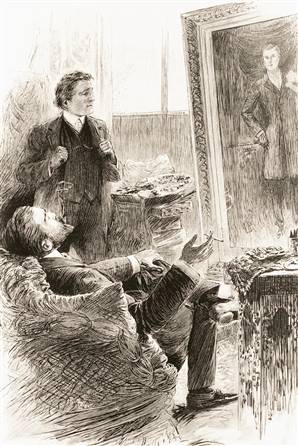
Image and deception

When researching, pondering, and looking for interesting topics for my final paper I could not really come to any satisfying concept until I looked into the incredibly academic world of Yahoo Answers . I think a great deal of information about how we as humans perceive and are simultaneously deceived can be seen through the uneducated, or un-reasearched answers we can find on sites like Yahoo or Wiki answers. These answers, especially when ungrounded, can give us a window into how many different visual and textual mediums can come together to create an altogether false or unfounded common knowledge. 

For example when I type into the Google search bar, “Was Lewis Carroll a…” google gives me the most commonly asked question, “Was Lewis Carroll a pervert?” If I accept this wording and click search, my first internet hit is a link to yahooanswers.com( http://answers.yahoo.com/question/index?qid=20100513155537AALX8Hy) The best answer chosen by the asker is: 

“Without ANY DOUBT Lewis Carroll was a dirty old man, but because he was a great mathematician and an even better writer of fascinating childrens books like many other famous people his “transgressions” are forgotten and forgiven, and how about his photos of little girls almost naked? yes the guy was a pedophile but a very ingenious and genial one. 

Voila.”

Or alternatively, if I search, “Drug references in Alice’s Adventures in Wonderland,” in my first three hits I get linked to an article that uses images from the 1951 Disney movie to describe possible references to drugs in the 1865 children’s novel.(http://unrealitymag.com/index.php/2011/02/22/alice-in-wonderland-demonstrates-various-drug-use/)

So voila. That’s that. No but seriously now, how do we come up with this information? Where is the source? I don’t think there is one specific source, there is instead, a culminating effect of ideas and guesses based off  sometimes unrelated imagery that yields fallacious knowledge. Maybe this is not interesting to others, maybe I am reading too far into the depths of silly online forums, but I really do think there is something in this false understanding. I believe it may show that unrelated images from different time periods can shape people’s conceptions of history in a very real way, whether it be Alice’s Adventures in Wonderland or something completely different. 
Posted by: chloecivin | December 17, 2011

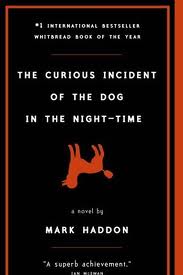
The Curious Incident of the Dog in the Night-Time

The Curious Incident of the Dog in the Night-Time, by Mark Haddon, is very much inspired by The Adventures of Sherlock Holmes.  The protagonist of the story, Christopher, sets out to unveil a mystery concerning the murder of his neighbor’s dog.  Like Sherlock, Christopher relies on his deductive reasoning skills to solve the undeserved crime.

Detective fiction certainly wouldn’t have been the same without Doyle’s new approach regarding the solving of crimes.  Doyle explains his disappointment with “chance” playing such a huge role in books written by his precedents.  Doyle wanted to make mystery novels more compelling, which he very much did.

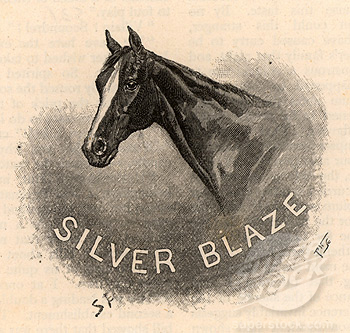
 While I was reading Silver Blaze, I stumbled upon this conversation between Holmes and Inspector Gregory:
“” You consider that to be important?” he asked.
“Exceedingly so.”
“Is there any other point to which you would wish to draw my attention?”
‘To the curious incident of the dog in the night-time.”
“The dog did nothing in the night time.”
“That was the curious incident,”
remarked Sherlock Holmes.”” (197).
This was a very exciting discovery for me, and seems to tie well in our discussion of Doyle’s influence.  Clearly Haddon’s protagonist, and Haddon himself were inspired by Doyle, at least enough to name his novel in homage to Sherlock’s quote.
Sometimes we need to pay attention to what’s absent, as well what’s present.  That is the similarity between two stories.
Posted by: chloecivin | December 16, 2011

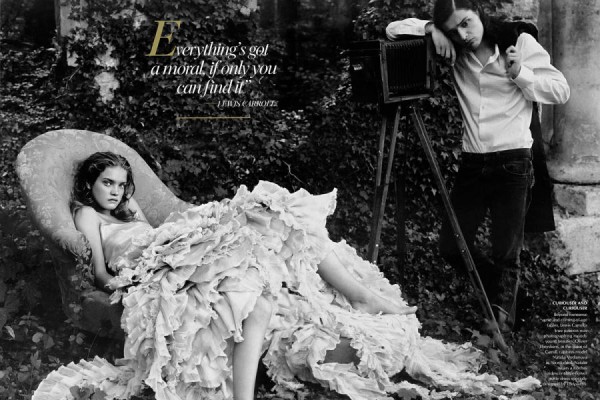
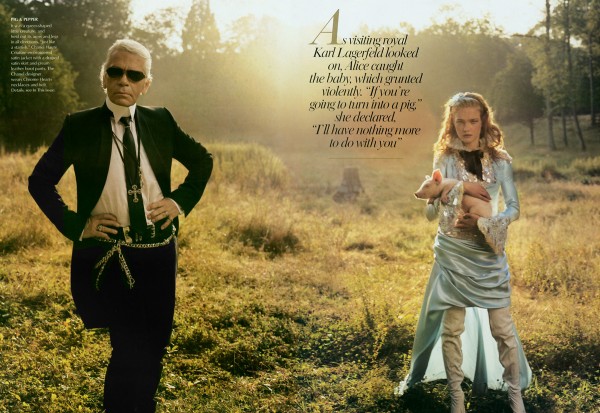
Alice and High Fashion

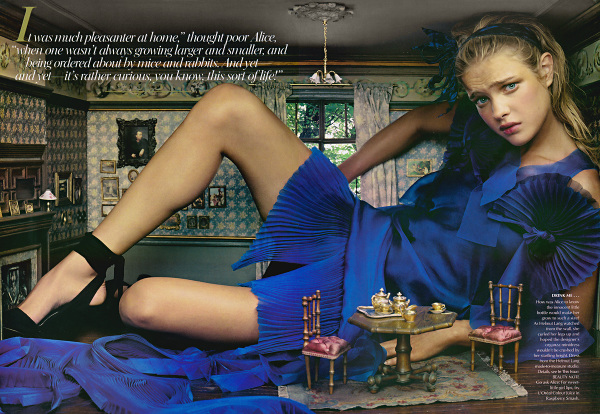
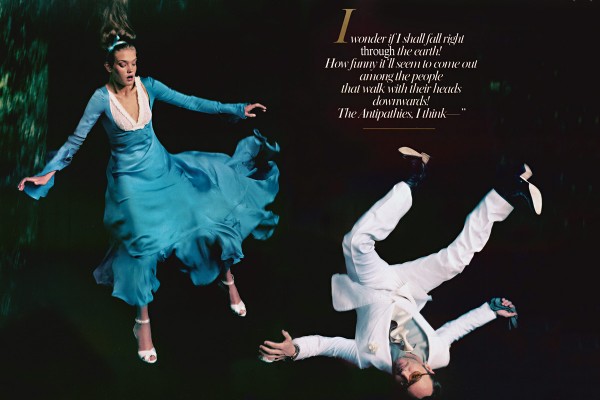
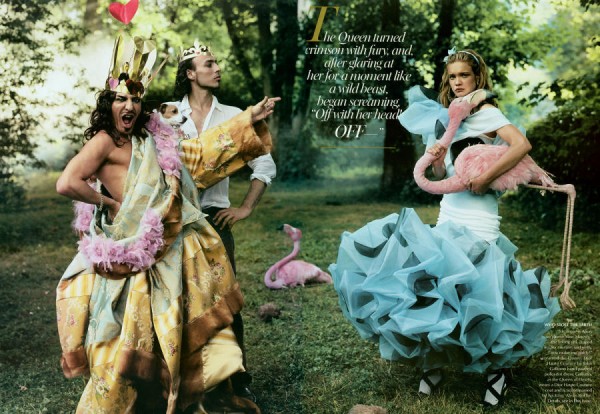
Annie Leibovitz’s portrayal of Alice in Wonderland with high fashion is breathtaking. Here are the some of the images captured during the shoot. Enjoy!

Posted by: chloecivin | December 16, 2011

On Consuming Angels…

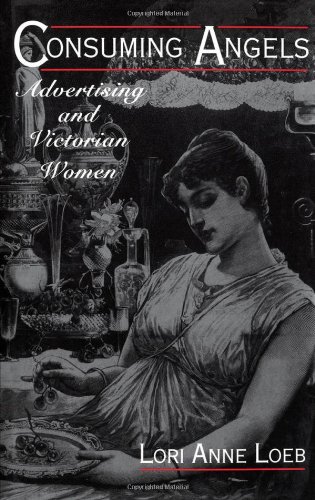
Caring for your home and children were fundamental concerns for Victorian women. Companies idealized this perception of women through their advertisements, in the hopes that women alike would feel compelled to buy their products.  In a way the advertisements  suggested that if women didn’t buy their products, they were either bad caretakers of their home, and therefore bad wives, or inadequate caretakers of their children, and thus, bad mothers.  This rationale inspired Loeb’s Consuming Angels: Advertising and Victorian Women.  The perception of women as “angels” of their household is misleading, especially with the advertisements depiction of them as being rather masculine and self-sufficient.  This text also puts a spotlight on the middle-class and the growing impact consumerism attained.

My favorite advertisement within this reading continues to be the Grecian woman for Matchless Metal Polish because of its feminist qualities.  Portraying women as Greek goddesses served as a motif for advertisements alike.  This Matchless woman is depicted as especially strong, and is not subjected to any levels of subordination.  She appears to have slain other people, or products, in a public area.  The shield she grasps is the top to the polish which is both a) indulgent and b) highly unrealistic.

Regardless, this ad is genius.  It makes consumers feel like they cannot live without this product, while recognizing women in a public sphere. It is important to note that women were very much targets in the eyes of the companies.  In addition, the middle-class as a whole became targets as well:

” The buyers of the world are the great MIDDLE CLASS PEOPLE- the man and woman in good or fairly well-to-do circumstances.  These people are the backbone of every city and every country.  These are the men who have built the houses and the shops, the women and men who fill the churches and make life worth living and upon whose children rest the future of every nation under the sun” (Consuming Angels).

After reading this segment of the book, I realized how nothing really has changed regarding the ways in which companies sought out to sell their products.  Consumers become entranced with the products, i.e. informercials, and feel compelled to buy the products.

Consumerism seems to want mothers to compete over their levels of maternity to their children.  Without certain products, it seems, companies suggest her incompetency in being a mother.  Here is an example of an ad made in 1993:


Posted by: chloecivin | December 16, 2011

From Carroll to Mann: What’s all the fuss about?

Both Lewis Carroll and Sally Mann experiment with visions concerning childhood.  Just as Carroll is the patriarch for the Liddell sisters, Mann serves as the matriarch for her three children, whom she so famously photographed.  Another similarity both photographers share is the controversy they were subjected to with the release of their photographs.  In 2006, Smithsonian Magazine interviewed one of Mann’s daughters regarding her thoughts on being photographed as a young child. Smithsonian Magazine states:

Sally Mann Photography

“The experience of collaborating with her mother taught her about the power of art, she says.  And she admires the way the photographs provoke questions about the difference (or lack of it) between reality and fantasy, even as they touch on something deeper.  “There is magic in things, life is magical and wonderful””.

The article also referenced opposing views on Mann’s children being the subject of her focus, stating that they were immoral and should not be seen.  A New York Times article, entitled The Disturbing Photography of Sally Mann discusses some of these controversies including problems the NYT had in depicting the images:

“The nudity of the children caused problems for many publications, including this one.  When The Wall Street Journal ran a photograph of then-4-year-old Virginia, it censored her eyes, breasts and genitals with black bars.  Artforum, traditionally the most radical magazine in the New York art world, refused to publish a picture of nude Jessie swinging on a hay hook.  And Mann’s images of childhood injuries–Emmett with a nosebleed, Jessie with a swollen eye — have led some critics to challenge her right to record such scenes of distress…”

This article was very distressing to read, as it took away from the innocence Mann, and Carroll, were intending on exposing.  Is it possible that by calling these images examples of child pornography, we are taking away the photographs real intentions? I think yes. Viewers saying that Sally Mann is selling her children to pedophiles around the world seems rather insulting.  Pedophiles I don’t think begin their quest for material via Sally Mann Photography.

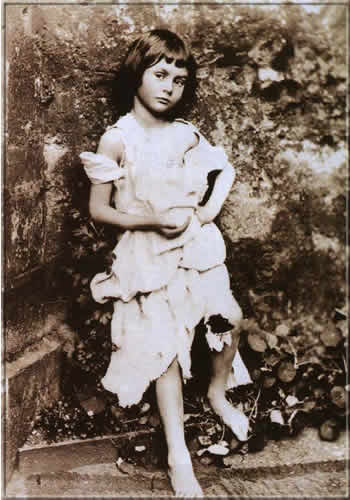
Lewis Carroll PhotographyLewis Carroll’s photography of young girls, and his infatuation with Alice especially, have stirred a lot of controversy as well.  Mavor pays tribute to Gernsheim’s acknowledgement of these photographs that so many have glanced over.  An “innocent love” is generally tagged in describing Carroll’s affection for young women, which I now recognize.

Children have been subjects of the lens for hundreds of years.  Instead of vulgar or provocative, I find the photographs quite romantic and curious.  Children’s inquisitiveness is shown in how they interact with the camera.  The sense of trust Carroll and Mann must attain to capture these images should be more recognized.

Posted by: allisongran | December 16, 2011

Modern Adaptations of Dorian Gray

After rereading Dorian Gray I was struck by how incredibly gothic it was, which I’m sure I realized the last time, but for some reason it stood out to me much more now. Perhaps it was in stark contrast with other works we’ve read (other than Alice) which seem do deal so much more with the world as it is. It made me wonder at the shifts society takes in the reading of the same story. This can be easily seen in the adaptations of the novel to film. For example the 1945 movie adaptation appears to focus mainly on the moralistic aspects of the plot, speaking more to the horrors of his crimes and vices, the magic behind the painting merely being an addition.

However, if we look at how the latest modern film adaptation presents the story, it appears to be much more gothic and mystical in its plotline, choosing instead to play to the idea that the immorality came from the cursed magic and corrupt figures around him.

Between these two adaptations, the later appears to be not only much darker, but much more transfixed on the nature of the occult behind it all where the 1945 film seems to just accept that it is and focus more on the actions taken by the character himself. Both are interesting interpretations and I wonder as to whether or not this speaks at all to the desires of society at the time or only the director himself. I do not know enough about it to make a guess, I can only observe that modern society does seem to have a desire, particularly in our entertainment, for the supernatural.

Posted by: chloecivin | December 15, 2011

Preface/Portraits

I really liked the preface to The Picture of Dorian Gray.  People talk about the preface to Dorian Gray in terms of the purpose of art, the role of the artist, and the role of the critic.  The purpose of art is to create beauty, the artist reveals art-not himself.  The artist can express everything without the ego.  The role of the critic is one of a translator who can speak of the beautiful things that he sees.

When I was younger, my mother asked her artist friend to paint a portrait of me.  Before she began applying paint to her canvas, she asked for several photographs of me.  These photographs were intended to supply her with sufficient images of me before her interpretation of me was created.  After several months of anxiously waiting, the portrait was completed.

The portrait currently hangs in my living room, and is more eerie than enjoyable.  Her portrait of me, which was intended to represent me of the age I was, was in fact an interpretation of what she imagined I’d look like as woman.  I look nothing like the portrait, in fact I see more of the artist in it than me.  This portrait violated Wilde’s perception of artist’s ego not appearing within their work.

But the most important focus of Dorian Gray, is the effect of the portrait on the viewer.  “The nineteenth century dislike of realism is the rage of Caliban seeing his own face in a glass.  The nineteenth century dislike of romanticism is the rage of Caliban not seeing his own face in a glass.”

In the novel, Dorian is Caliban.  When he sees his own face, his infatuation with himself begins.  This infatuation is to the same degree of Narcissus, but instead causes his destruction.  Dorian cannot cope with the painting’s  immortality and his mortality.  He mistakes the beauty of the painting for his himself.  He cannot bear to allow the art to stand for itself.  Instead, like Caliban, he rages against the art.

His deal with the devil is to have the art age, and not him.  His desire to become the art is unwavering and almost burdensome.  His psychosis is his inability to sever his imaginary ties between the painting and him.

Posted by: chloecivin | December 15, 2011

Tate Liverpool: Alice

As discussed in class, Carroll’s novels have impacted the visual arts in many ways.  Mavor discusses within the introduction  of Pleasure Taken- Performances of Sexuality and Loss in Victorian Photographs, that the novels were her source of inspiration for an art installation:

“featured walls filled with colored-pencils pictures-floors littered with large, painted cut-outs of anthropomorphic animals- and even a miniature house that the viewer could walk into (with some difficulty).  The pinkened walls of the house were lined with Carroll’s photographs of girl-children (framed in gold), which I, like Carroll, had fetishized” (1).

Currently at the Tate Liverpool, there is an exhibition entitled Alice in Wonderland. The exhibition includes Carroll’s own interpretation of the text and other various artists’ works. Some of the other things on display include art that are not “suitable for the eyes of children”.  Would Carroll agree with this? It seems to be that he probably would not advocate for this division as he sees girls more as young women.

In the video,Tateshots: Alice in Wonderland at Tate Liverpool, the main designers of the exhibition explain their attempt in having both an abstract and literal reference to the text.  I especially liked their intention of weaving photography with painting in homage to the text.  Their views concerning mirrors were also quite similar to our discussion.

After watching the film, I was interested in finding some reviews on this seemingly luscious exhibition. Is it as intoxicating as it appears? Adrian Searle of the Guardian offers an interesting take of the exhibition in Mad about the girl: Tate Liverpool’s Alice in Wonderland show.  I especially liked his suggestion of Alice being seen as a religion.

Still, I wanted a youth’s opinion on this exhibit. I found a magical review of the exhibition on youtube, surprisingly enough. Here, a student named Amelia addresses what she may have changed if she headed the exhibit.  Carroll, I presume, would rather hear his youthful fans opinions as opposed to his fellow comrades. Amelia recognizes that placing the objects like any exhibition, takes away from the physicality of the book.  I believe Amelia is right in questioning whether Carroll’s zany books belong in a museum- like setting.  Perhaps this representation conforms the zaniness of the book.  Why couldn’t the artwork be placed beneath obstacles to accentuate the viewer’s experience? Alice herself underwent so much movement, so why couldn’t we?

Mavor and artists alike are all included within the exhibition. Some photographs of the exhibit are seen towards the end of this article: Alice in Wonderland At Tate Liverpool: A Peep Through the Looking-Glass

Posted by: millyc13 | December 15, 2011

Dorian Gray and Plastic Surgery

Although wonderful in real situations where physical alterations can help improve quality of life, plastic surgery is often used for purely cosmetic reasons. Plastic surgery is the closest, it seems, that one can get the the Fountain of Youth. The danger, however, is that it is obviously not natural but created beauty that results from these procedures. In “Picture of Dorian Gray”, Dorian becomes eternally youthful in appearance, while the portrait of himself reveals the truth of his inner beauty: that there is none. Out in the world are many Dorians who can keep up the illusion of youth through the modern means of plastic surgery, but at a cost. People who use this surgery obsessively out of fear of aging are sometimes diagnosed with Dorian Gray Syndrome, and many are suicidal.

Do you think this is a fair comparison? Would Dorian opt for a facelift if he were present among us?

More information on Dorian Gray Syndrome can be found here.

Posted by: oliviajane16 | December 15, 2011

Temporality Meets YouTube

Perhaps my favorite thing that we’ve discussed this semester is the issue of temporality. I love the idea of photography and portraits being used to preserve a moment that would otherwise die instantaneously. What I loved about Dorian Grey was the challenge it posed to this temporality and immortality of the moment. In order for time to move on the moment must die, but what happens when the moment is simultaneously immortalized through portraiture or photographs? There’s definitely something to be said for how we chose (or maybe don’t chose) to immortalize ourselves through this medium and I think it’s interesting to see how temporality is being manipulated in mixed mediums today. Someone mentioned (I think it was Wendy) the portraits in the Harry Potter movies and the fact that they can move and interact with living subjects but they can never age. Here’s a short clip of one moving portrait:


Also, there’s a cool trend developing on YouTube of people taking a picture every day for an extended period of time and then compiling them together in a video to show long term development and growth. If you do a search along the lines of “photo every day” or really anything to do with time lapse photography you’ll find some really cool submissions. I think this one is especially interesting as it covers a child’s life from birth to 10 years old:

« Newer Posts - Older Posts »

Categories