Posted by: oliviajane16 | November 9, 2011

The Lost Text Of Doré’s “London: A Pilgrimage”

So Professor Martin briefly mentioned a couple weeks ago that Doré’s London: A
Pilgrimage
was originally published with text to accompany the
illustrations. I found a link to the Tufts’ online library which has the
complete version of the text as well as the images and where they would have
been inserted on each page. It’s a really interesting read if you have some
time to spare.

http://dl.tufts.edu/view_text.jsp?pid=tufts:UA069.005.DO.00070

So much of our reading of Thompson’s Victorian Street Life
focused on the way he would tell the stories of his subjects and then use the
photography to highlight certain aspects of their lives from the information he
was able to write about. For example, we keep bringing up in class the way that
the crawler was lit with this angelic halo as she looked after another woman’s
baby. This greatly influences the viewer’s level of sympathy towards her and whether
or not we see her as someone who made bad decisions or someone who just had a
string of bad luck beyond her control. However, with Doré’s illustrations we
only had one side of the story, if you will. In the Tufts text it’s really
interesting to look at the way that the text changes how the reader feels about
the images and how it informs any interpretations that can be made. Take a look
and see how your views are either changed or solidified!

Posted by: lizzyspain915 | October 24, 2011

Some thoughts on Portraiture

While I have so far enjoyed all aspects of this class, the part of it that I am less familiar with in my studies is what I’ve actually enjoyed the most…the visual culture part! A few of our three hour seminars have been almost solely devoted to the study of portraits and photographs, and what the subjects of the photos/portraits and the time periods during which they were done or taken represent.

I was recently looking through some of the New York Times archives online and came across something called “Portraits of Grief”. These “portraits” depict victims of the September 11 attacks, and include a thumbnail photograph of a victim, and a few blurbs about the victim’s background, life leading up to 9/11, and sometimes, at the end, a short narrative on what the victim did for a living and perhaps even what the victim was doing on the morning of the attacks. In navigating the website, it was hard to figure out when these “portraits” were first documented, but in reading them it seems as though they were written in the immediate months following 9/11. I thought that considering what we have been studying in class, these portraits were fascinating on many levels but mainly because they add even more meaning to the word “portrait”. In this circumstance, the word does not just mean a photograph or a drawing of a person, but is a small picture alongside a description of their life…these together are what make these pieces “portraits”. In learning about the history of portraiture, and then applying what we know to what we read on websites or in newspapers, or any other type of medium, we learn that the definition of a portrait does not just mean what a person physically looks like, but everything that they are.

I’ve included the website so that you guys can see what I’m talking about!

Posted by: wmellin | October 15, 2011

Facebook: A Contemporary “Jarndyce and Jarndyce?”

From Dickens to Conan Doyle to Benjamin, we have discussed many kinds of value: economic, domestic, emotional, maternal, aesthetic, reproductive, and evidentiary (the latter three being related in ways in which I will not go into here). In Bleak House, certain aspects of value that appear in the present tense narrative are absent from that of Esther. These aspects come together in a dynamic way to piece together the world inhabited by the novel. Our lives are similarly constructed by these concepts of value in flux with one another, and this question of value has recently been on my mind each time I log into Facebook. What kind of value does Facebook have? What is the value of my time spent on Facebook?

I doubt that I will offend many readers if my response to both questions is, “little to none.” Many Facebook users claim to hate the social networking site and violently complain when it is upgraded, yet still tune into their respective News Feeds. They keep up with what I like to call “Facebook errands:” sending birthday wishes, RSVPing to events, checking updates from their friends and pages to which they now “subscribe.” It is ironic that we routinely invest time for something in which we find so little value.

Facebook is like a 21st Century Jarndyce and Jarndyce, an aporia into which we are drawn but at the center find emptiness. Aporia, a word we discussed in class to describe both the case and the novel, is defined by The Oxford American Dictionary as “an irresolvable internal contradiction.” The word captures both Dickens’ characters’ involvement in the suit and our attitudes towards Facebook, not to mention the suit and the site themselves.

The greatest “internal contradiction” I see in this contemporary parallel is the disconnect between reality and hope for reality: a continual waiting for something to come out the nothing that attracts followers. Richard spends a large portion of the novel continually working to improve both his understanding and the organization of the Chancery suit. During this time he misses out on engaging in meaningful, fleshed out relationships with Ada, Esther and others. He develops connections with single-minded people like Mr. Vholes while cutting his ties with Mr. Jarndyce. It is fittingly ironic that Richard is so intimately connected with the name Jarndyce and the legal characteristics which it represents, but increasingly estranged from the actual person.

The end of the 2010 film “The Social Network” finds the character Mark Zuckerberg in a similar position. Sitting alone in a conference room, he repeatedly clicks the refresh button as he waits for a girl he used to date to accept his friend request. His focus on and investment in developing a superficial network of impersonal interaction – redefining the notion of a “friend” – has eclipsed opportunities for him to make personal connections, valuable friends. Richard is, of course, is more a victim than a pioneer of that which consumes him, but each character remains semi-isolated and unfulfilled at the story’s end. Ada still loves and marries Richard, but their relationship is more one-way and less dynamic than it was in its early days.

Richard initially gets involved in the suit because he feels that he is being treated unfairly; he wants his fair share. Facebook users are familiar with the egocentricity of the site: we post statuses (stati?) and comments about our lives, often carefully phrased so as to get the greatest reaction from friends. Jarndyce and Jarndyce similarly has regular followers, such as Miss Flite, who are interested in the outcome of the suit – but how much does it really matter to them? Could they not do something of greater use than attend to a suit that has cyclically gone nowhere for years? Lawyers involved in the case continue to belabor details when they might be more productive in taking up an entirely new case.

At the close of the novel, the suit dwindles into nothing: the entire inheritance is used up to pay the bill. Miss Flite frees her many birds – a symbolic release of the wards and all others held back by the court – but the lives of Ada, Esther and Mr. Jarndyce continue as they always have. For those both deeply connected and nearly ignorant of the suit, life goes on, unchanged. Facebook similarly has very little effect on the “real” life outside of it. As it occupies no real physical space, it easily dissolves and disappears into a blank computer screen: on a Saturday night, we close our computers and resume spending time with our friends in person.

In regard to making the most of, or getting the most value out of the present, both Jarndyce and Jarndyce and Facebook are extremely wasteful uses of time and, in the former case, money. This is the aporia: since the center is empty and of no value, then all the means spent getting to that end are empty as well.

So if emptiness is the center of the main subject of both, why do we continue to read Bleak House, a novel about the repercussions of Jarndyce and Jarndyce, or update Facebook?
Posted by: chloecivin | October 11, 2011

Ms. Honoria

Gillian Anderson stars as Lady Dedlock in BBC’s adaptation of Dickens’ Bleak House. Her description of Lady Dedlock’s character was “ded” on. What she said was uncannily similar to our discussions in class. She spoke about the Dicken’s strong visual imagery, which provided a template for her understanding of the character.

Gillian Anderson, Paying a Visit to Bleak House

Posted by: kdpotter | October 11, 2011

Victorian jokes

Just a quick post to share something I found a few days ago:

http://www.historytoday.com/blog/2011/10/victorian-jokes-best-19th-century-humour

If you’re curious, I found it on the Two Nerdy History Girls’ blog, which is a fantastic one to follow if you’re interested in history/material culture/historical fashion/etc. (twonerdyhistorygirls.blogspot.com)

Posted by: Rachel Czwartacky | October 4, 2011

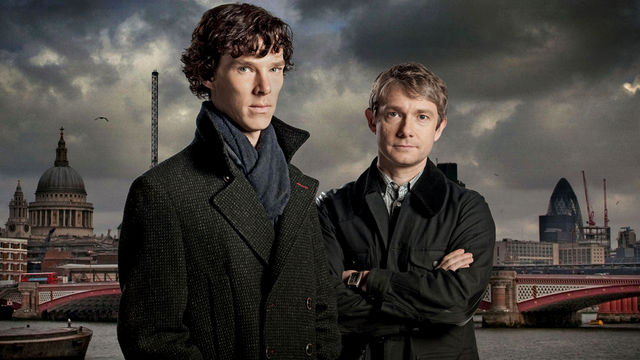
Sherlock: At Ho[l]me on TV

I don’t know if anyone reading this has seen the BBC miniseries Sherlock that came out last summer, and last October in the US. Firstly, if you haven’t it’s phenomenal television (the second episode lags a bit but who’s counting?) and you should check it out. But it’s also an interesting new representation of Sherlock Holmes in a modern setting.

BBC's Sherlock

Check out London in the background.

And the setting is a major part of it – we can easily discuss the Arthur Conan Doyle stories in terms of surveillance in a new urban setting, coupled with an evolving police force. In the stories, and in this miniseries, the need for Holmes, the innovative, imaginative (and, in this interpretation, “high functioning sociopath”), and only consulting detective in London, could be said to stem from the fact that the police force cannot keep up with the new wave of crime in the growing urban landscape. Not necessarily the scale of crime, but its changing nature in a modernizing world.

In any case, the BBC’s Sherlock gives the stories a remarkable relationship with the setting of London. They traverse the city in cabs with sweeping aerial shots of a fast-paced, glamorous city contradicting the wet, dingy alleys they seem to find themselves running through, and the starkly ordinary people who get mixed up in their cases – the first episode hinges around a cab driver, another involves a grandmother held hostage in a housing development as a way to deliver clues to Holmes. He uses fifty pound notes and a network of homeless, invisible persons to do reconnaissance work for him. Often as Watson and Holmes travel across the city, a split screen shows Holmes’s rationally reasoning face against a backdrop of London sweeping past.

Technology is interesting as well. Even though this is modern London, and the modern police force, there is remarkably little use made of the actual surveillance in Britain – CCTV is rarely of any use in these cases, which is usually why Holmes has been called in in the first place. The detectives are not incompetent, but they are unable to imagine past what might be found in easily capture-able or photographable evidence. Holmes’s ‘camera’ mind, more interpretive and reasoning than both the police and their technology, is represented on screen in some cases in ‘Sherlock-vision’ scenes, where we get to experience flashes of indexed information passing through Holmes’s mind as he investigates his surroundings. Frequently these involve text messages and smart phones, and us viewing what it is he’s typing onto his iPhone on screen next to his face.

And in terms of observation, Watson’s role is re-imagined from a mere chronicler of adventures to a blogger. He rewrites their cases as similarly titled blog posts (“A Study in Pink” as opposed to “Scarlet,” for the murder of a woman in a pink coat) for the general public to read. In an interesting comparative twist, Holmes too is a blogger, but his blog is one less of narrative than of objective and informative reporting – a twist on the way in which Holmes both observes and sees, while Watson is said to merely see in “A Scandal in Bohemia.” Instead, Watson twists their real life doings into amusing and plotted-out narratives, while Holmes uses his blog in the pursuit of scientific inquiry, communicating with nemeses, and seeking out interesting cases.

In many other ways that I haven’t even begun to explain, Sherlock is smart and visually stunning. Through the medium of television, it is interesting to see portrayed the relationship of the detective story to an urban setting, and to have a visual representation of the way Sherlock Holmes collects information and knowledge, as opposed to how ordinary humans do. For a class on visual culture, I very much recommend this adaptation.

Posted by: oliviajane16 | October 4, 2011

Is Oprah Winfrey Esther Summerson 2.0?

We talked about Esther’s role as mother to all except her own primarily 2 weeks ago in class but before we move on to Doyle I thought I’d just post a little something that’s been floating around in my head. The more we talked about Esther’s interesting life choices I couldn’t help but see a few similarities to another well-known mother figure without kids of her own.

First of all we discussed how Esther (with the exception of the last 6 pages) makes no mention of wanting kids of her own despite how easily she claims the role of caretaker to all those around her. Ms. Winfrey has also made the decision to not have children even though she started her talk show 25 years ago so that she could help as many people around her as possible.

Neither had stellar childhoods. While Esther grew up with the feeling that her godmother wished she hadn’t been born, Oprah was raised in rural poverty and was sent to live with several different family members because her mother either couldn’t or didn’t want to take care of her.

Marriage has never seemed a priority for either Esther or Oprah. Esther does harbor romantic feelings towards Woodcourt and intends to marry Jarndyce for a period of time, but romance is by no means the focus of her life. Ms. O and her long-term significant other, Stedman Graham, have technically been engaged since 1992 but have never gotten around to actually tying the knot despite societal expectations.

Just thought I’d share, especially given the rise in celebrity during the period in which Dickens wrote the novel and Ms. Winfrey’s current title of most influential celebrity in America.


Posted by: stephblakeman | October 4, 2011

Sherlock Holmes: The Man, The State Photographer

As the photograph became more and more an instrument of the state in the late 19th century, it is no wonder that Sherlock Holmes, the best, albeit eccentric, private detective in “three continents,” becomes almost an embodiment of the camera- a keen, astute and perceptive “observer.” His primary mode of evidence gathering is through basic powers of observation. The descriptions of his clients come to us through Sherlock’s vision as a series of focused snapshots—a fresh ink stain, squared-toe boots, or an indent on a thick fur. It is as though his clients come to him as portraits of their circumstances, and Holmes has the incredible ability to discern these details quickly.
Perhaps what Sherlock, an admirable and lovable character, may mask is an anxiety of the public as they become increasingly aware of the evidence-gathering tactics of the police force, and the ‘all-seeing Eye of the Law’ today. Holmes may be a rogue agent, who outsmarts and out-detectives the official investigators, but he is a forbearer of the caliber of visibility to which the public will soon be exposed.
Holmes not only gleans truth from the details that make themselves visible to him, but though actual photographs. Both in “The Adventure of the Cardboard Box” and “A Scandal in Bohemia,” photographs and portraits reveal to Holmes an index of truths and serve as testimonials of truth, though no confession is spoken. Used to blackmail the King of Bohemia, a picture of a King with someone he isn’t supposed to be with threatens to start political upheaval, indicating the value and faith the public held to photographs, the visual, over the spoken or pronounced. Holmes operates not only as an agent of the state, but as well as an allegory for the technologies and power of the industrialized and modernized state, including their new expectations for evidence.

Posted by: Rachel Czwartacky | September 26, 2011

Esther Summerson: traded in for a newer model?

Something we’ve touched on briefly in the last couple of classes has been just what people were doing with these newfangled photograph things that became fairly ubiquitous, fairly quickly. And one thing people were doing was collecting them and giving them away – now that you could have multiple copies of a portrait, it was easier to distribute, which played into the whole cult of celebrity and carte de visite phenomenon, where ordinary citizens could pass around photographs of famous people or give photographs of themselves or their family away.

Or give the people themselves away? At the end of Bleak House, doesn’t Mr. Jarndyce essentially do just this with Esther? As though she were a trading card, or a popular photograph, he trades her away to Mr. Woodcourt and his second-best Bleak House, retaining, instead, the elder Mrs. Woodcourt and the companionship of Ada. And, fairly enough, it seems like Mr. Woodcourt is a much better match for Esther (even she might admit that) and no parties involved come out at the end having been wronged, but this entire exchange in the last few chapters feels like just that – an exchange, but of women, not just their images.

Copies of portraits and photographs had an impact on culture in that it became much easier to mass produce these images. But throughout Bleak House, Esther is treated as one in a million, an irreplaceable “little woman.” So why now, at the end, is she treated like a precious, but tradable, icon?

Posted by: kdpotter | September 21, 2011

Bleak House and clothing

Over the summer I started reading a few history blogs, and one of them mentioned Bleak House:

http://twonerdyhistorygirls.blogspot.com/2011/09/those-rebellious-victorians.html

If you’re not inclined to click the link, the relevant quotation is near the bottom of the post; “In this he [William Bruges, a cabinetmaker] was not unlike most of his Victorian contemporaries, who held their predecessors and predecessors’ tastes in low regard.  In Bleak House, for instance, Dickens creates a devastating caricature of a Regency beau in old Mr. Turveydrop.”

Springing off of that, one thing that has really popped out of Bleak House for me is the emphasis on clothes, and the way they give some hints as to the wearer’s character. I mentioned Charley Coavinses in class, and how Dickens’ emphasis on her “womanly” bonnet and apron underscore how fast she has grown up, before she needed to. Mr Tulkinghorn is probably one of the best examples of this. When we first meet him, Dickens tells us that Tulkinghorn is of “the old school…and wears knee breeches tied with ribbons, or gaiters and stockings. One peculiarity of his black clothes, and of his black stockings, be they silk or worsted, is that they never shine. Mute, close, irresponsive to any glancing light, his dress is like himself.”

As the endnote points out, knee breeches were hopelessly out of fashion by 1852, except possibly in extremely formal situations (ie the British court). That Mr Tulkinghorn is clinging to them for every-day wear fifty years after everyone else has stopped wearing them says a great deal about his personality.


« Newer Posts - Older Posts »

Categories