Posted by: emmadamato | December 1, 2010

QUEEN 4 A DAYYYY

I was really struck by the comment from last class that one of the most common female delusions in institutions was a woman believing she was a queen. It made me think of contemporary queens like drag queen, queen bitch or welfare queen. I wonder if women wanted to be Queen Victoria, or a different queen. Maybe they were attracted to the fact that Queen Victoria was a widow, but what’s more appealing, or romantic about that- that she is still powerful, or that she is as sad as they are? It also reminded me of the show Queen for a day. On the show the host would interview a panel of women who would explain their current hardships and then they would tell him and the audience what they needed and then win or lose a big prize based on the amount of applause that they received. The contest was really Who’s The Saddest!? The women would often break down sobbing telling stories of their chronically ill child, or their imminent bankruptcy. It was like pain pornography for the audience. It was also incredibly popular, men and women ate it up. Was it’s popularity an extension of the Victorian tendency towards queen fantasies?

here’s a taste of what the show is like

Posted by: Laurel | December 1, 2010

Why is a raven like a writing desk?

I’m going to double post, because it is the end of the semester and there are no deadlines coming up, nothing is due, and I have nothing but free time to post to the blog. But in all seriousness (sort of), I’ve spent some time digging around for answers to this question. Here is a link to a fairly lengthy discussion concerning the riddle:

http://www.straightdope.com/columns/read/1173/why-is-a-raven-like-a-writing-desk

Reading through the answer given by Cecil Adams who is apparently “the smartest man alive,” I began to feel like a nincompoop. First, because I wanted to know the answer. Second, because even knowing there was no answer, I still wanted to know the answer. Alice knows there are better things to do than waste time discussing riddles with no answer, and here I am scouring websites for every quick quip on the subject.

Carroll definitely got me. The riddle was meant to have no answer, his characters say the riddle has no answer, and I’m still looking for the answer. He probably knew where this was going all along. And still we (read I) get caught up in it. This is shameful. I’m becoming exactly the kind of adult that Alice would despise. If she were here, I’m sure she would tsk-tsk me.

Posted by: Laurel | November 30, 2010

Miniature Worlds

I’m with Alice. I, too, am frustrated by her inability to remain a consistent height. When she’s talking with the Caterpillar, she says that she can’t seem to explain herself, that “being so many different sizes in a day is confusing.” Agreed. So I wondered why, on page 56, she would opt to take a bite out of the mushroom in her right hand after she had only just returned to a more proper height. Even to enter into a cute little house (trespassing, anyone?) I wondered why she would allow herself to stretch wildly in one direction or another, then remembered Carroll’s “Lilliputian Stationary” from the Mavor reading. From the reading:

Constructing miniature worlds, writes Susan Stewart, is a way of making ‘an other time, a type of transcendent time which negates change and the flux of lived reality.’ Carroll ensured such an other time by cementing a tiny photograph of Alice Liddell inside the end of his telescope; one gaze and the world would stop still, every star would be Alicious.

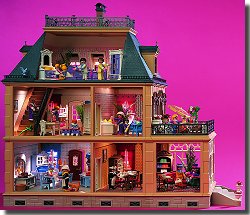
Okay, the first bit of this, I understand completely. I had an American Girl book that taught readers how to make objects in miniature. Playmobil is very popular. It’s the second part that makes my skin crawl. Anyhow, trying to get to the crux of the matter. If the above quotation is what Carroll thought of life in miniature, I wonder why he would make the change in size such a constant event for Alice. It seems, firstly, that he would prefer to keep her small, not stretching to ten feet tall with her neck bobbing all over the place. And second, didn’t Wonderland have enough wonders to begin with?

Old school Playmobil Victorian Dollhouse, image found at drtoy.com/2003_c/classic_03_20.html

Posted by: siobhananderson | November 30, 2010

Whimsical and Emblematic/Figured Writing

While reading Carroll’s Alice in Wonderland I was particularly struck by the passage in which the Mouse recounts his “tail”.  The use of emblematic or figured poetry fits in perfectly with the whimsical and fantastical nature of the story of Alice in Wonderland. On the other hand it brings out the more mathematical nature of many of the stories and games found within the book. Carroll as a not just a writer, but as a logician seems to have left puzzles throughout the story and I was interested to read in the side notes by Gardner about the two high school students in New Jersey that made the discovery that in one of the original texts, this Mouse’s tale actually looked as if each stanza was in the shape of a mouse. Though personally I prefer the one that is used in our version for its obvious play with the words “tale” and “tail”, yet I searched for other examples of emblematic writing and found that George Herbert also was a fan of this kind of structure:

(Poem #567Easter Wings

Lord, Who createdst man in wealth and store,
      Though foolishly he lost the same,
                  Decaying more and more,
                       Till he became
                         Most poore:

                         With Thee
                       O let me rise,
                  As larks, harmoniously,
      And sing this day Thy victories:
Then shall the fall further the flight in me.

My tender age in sorrow did beginne;
      And still with sicknesses and shame
                  Thou didst so punish sinne,
                       That I became
                         Most thinne.

                         With Thee
                       Let me combine,
                  And feel this day Thy victorie;
      For, if I imp my wing on Thine,
Affliction shall advance the flight in me.

— George Herbert

One can see that the subject of the poem aligns perfectly with the form, as the stanzas mirror the shape of Angel’s Wings. Another form of emblematic writing that was taking place at the time was what is now being called in fact, a kind of “old school” version of modern text lingo. The following link is from Aol news and it follows an exhibit that took place in the British Library last November called  “Evolving English: One Language, Many Voices.”

http://www.aolnews.com/surge-desk/article/old-school-victorian-text-messages-arrive-at-the-british-library/19604455


It includes a very funny essay written by an unknown poet, that uses a lot of the lingo we use more commonly today.


Posted by: marycib | November 30, 2010

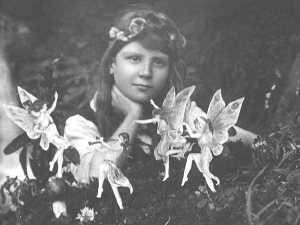
The Cottingley Fairies

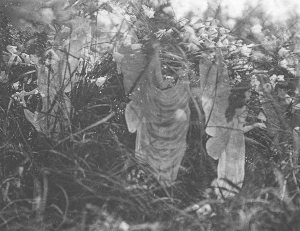
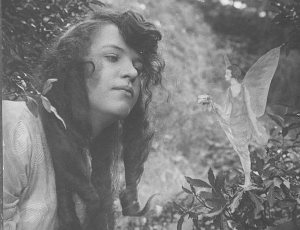
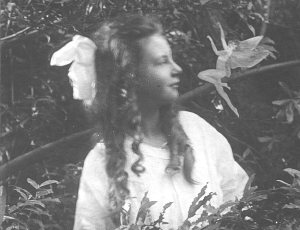
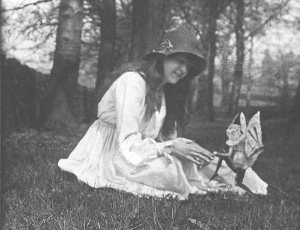
While the story of the Cottingley Fairies occurred in the 1920s after the close of the Victorian era, I think it is interesting and relevant to the role of photography in the portrayal of real versus imaginary. In 1917, two young cousins in England, Elise Wright and Frances Griffith, borrowed Elise’s father’s camera and told him that they were going to take pictures of the fairies in their garden. Once these photographs had been developed, Elise’s mother Polly Wright, who was a spiritualist, believed the girls’ story that the fairies were indeed real and took them to a lecture she attended on spiritualism. After showing them to the speaker, a professional photographer, Harold Snelling, declared that the fairies in the photographs were real. Even more interestingly, Arthur Conan Doyle used these photographs to show the public that fairies existed. Even after many individuals pointed out that the fairies in the photographs looked like pieces of paper, a large number of people still believed the photographs were real. Only in 1981 did Elise Wright confess that the fairies in the photographs were in fact paper cutouts based on the fairies from a children’s book called Princess Mary’s Gift Book. Elise said that she had sketched the fairies from the book, made paper cutouts, and held them up in the photographs with hairpins. Because individuals like Arthur Conan Doyle wanted to believe in fairies, they used these photographs to explain their existence. It is interesting that even though it was known that photographic techniques had advanced to the stage where photographs did not always portray reality, people were still misled by these photographs.


Here are the five photographs that Elise and Frances took:


Posted by: lbrooksd | November 30, 2010

The Annotated Alice

I’m in love with the annotations – officially.  I’ve read Alice in the Wonderland and parts of Through the Looking Glass before, but these little insights into how to story fits into the context of the era, or the inside jokes that no one other than the people involved would know about, are making it seem like a whole new book.  I’m especially intrigued by the juxtaposition of Carroll/Dodgson’s skewed versions of popular songs and poems with the real ones.  There is so much in these notes to think about and color my interpretation of the text that I just didn’t know before, it’s making what I thought would be repetitive reading into something a lot more engaging than I had anticipated.

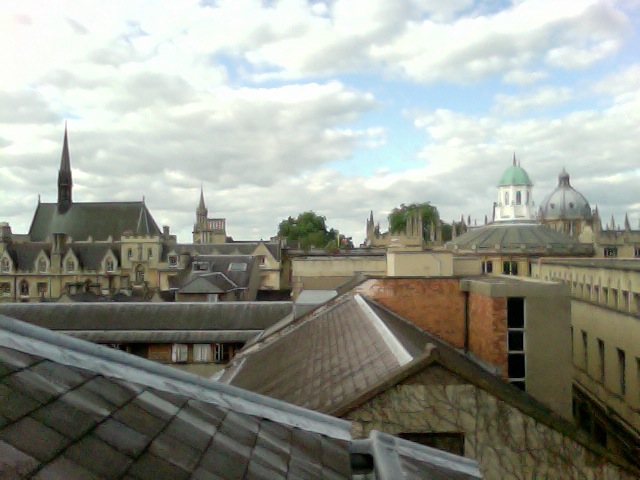
This week’s reading also holds a particular fascination for me because I spent the summer in Oxford, so all the references to the city and the University itself are all the more fun to read about.  The Dodo, for instance, that is in the pool of Alice’s tears along with the rest of the menagerie, gets a note of its own which talks about the Dodo remains in the Oxford University Museum that Carroll and the Liddell girls used to visit often.  These days there’s not much left, but I’ve seen what’s there, and it’s just too much fun finding those references that I can tie to physical places I’ve been.  I was there for Alice Day, sometime in mid July, and there were tea parties and people dressed as characters all over town, so I’ve been getting a big kick out of imagining the Alice enthusiasts I saw sending Martin Gardner all those funny little facts he credits to specific people.

Just for kicks, this is the view from the roof of Trinity College in Oxford.  Christ Church, where Alice Liddell’s father was Dean, is a short walk from here, off to the right – Trinity and Christ Church are sister colleges.  Christ Church is the biggest, or at least one of the biggest colleges at Oxford, and it’s one of the hardest to get into.

Posted by: anniebutts | November 30, 2010

Games in Wonderland

Reading Alice’s Adventures in Wonderland was a simultaneously frustrating and amusing endeavor for me. In a few instances, I think that I may have felt as frustrated as Alice herself. There are a lot of things that I could say about the nonsense that defines this story, but I’d like to make a general comment that I was thinking about while reading it. The concept of a “game” in the Wonderland was a little puzzling to me. When I think about a game, I think of something fun and enjoyable, and also facilitated by a set of rules. The curious nature of the Queen’s game is that it is neither enjoyable nor does it seem to be regulated by any rules at all.

“The players all played at once, without waiting for turns, quarreling all the while, and fighting for the hedgehogs; and in the very short time the Queen was in a furious passion, and went stamping about, and shouting ‘Off with his head!’ or ‘Off with her head!’ about once in a minute.”

Between the chaos of the game itself and the Queen shouting for decapitation, the “croquet match” is actually the opposite of what one might expect. In my mind, a lawn game facilitated by royalty definitely does not include hedgehogs and flamingos. The irony is inescapable. It seems curious that the Queen would not only allow for, but almost indulge in, chaos between the people she is supposed to be governing. Furthermore, she will eventually have no one to rule over at all if she orders for decapitations “about once in a minute.” I’m not quite sure where Carroll was going with this, but it seems as though the game might be a comment on the Wonderland as a whole. It is laden with frustrations and nonsense, and the lack of laws makes everything chaotic. An inverted game in an inverted world, I suppose.

As predictable as the ending was, I did find it strangely comforting to finish with some sense of order and reality.


Posted by: siobhananderson | November 30, 2010

Humbert Humbert and Lewis Carroll

After reading Martin Gardner’s introduction and then revised introduction to Lewis Carroll’s Alice’s Adventures in Wonderland I was struck by how so many aspects of Carroll’s life and demeanor reminded me of someone I just couldn’t put a finger on. It hit me finally several pages in that Carroll did not in fact remind me of a real person, but rather a literary one, that of Humbert Humbert, the famed girl-child obsessed protagonist of Nabokov’s Lolita. As Gardner says, “…Carroll’s principle hobby–the hobby that aroused his greatest joys–was entertaining little girls.” And later, “He thought the naked bodies of little girls (unlike the bodies of boys) extremely beautiful.” These few lines in addition to several quotes and letters included in the text as made by Carroll himself reminded me so much of Humbert that I brought out my copy of Lolita and found their language to be strikingly similar. For example, this passage from Lolita seems to me representative of the relationship between Carroll and Alice Liddell:

Lolita, light of my life, fire of my loins. My sin, my soul. Lo-lee-ta: the tip of the tongue taking a trip of three steps down the palate to tap, at three, on the teeth. Lo. Lee. Ta. She was Lo, plain Lo, in the morning, standing four feet ten in one sock. She was Lola in slacks. She was Dolly at school. She was Dolores on the dotted line. But in my arms she was always Lolita. Did she have a precursor? She did, indeed she did. In point of fact, there might have been no Lolita at all had I not loved, one summer, an initial girl-child. In a princedom by the sea. Oh when? About as many years before Lolita was born as my age was that summer. You can always count on a murderer for fancy prose style. Ladies and gentlemen of the jury, exhibit number one is what the seraphs, the misinformed, simple, noble-winged seraphs, envied. Look at this tangle of thorns.

The fanciful language concerning his obvious affection and passion for this young girl simulates what I also imagine to have been consuming Carroll. However, further on in the introduction, Gardner refutes this possibility saying that “their goals [Humbert Humbert and Lewis Carroll] were completely different.” Gardner goes on to suggest that while Humbert Humbert’s fascination and attraction to little girls was purely sexual, Carroll’s interest was “of complete sexual innocence with a passion that can only be described as thoroughly heterosexual.” In my opinion Gardner dismisses this comparison far too easily. The character of Humbert Humbert did not only have a sexual attraction to little girls, but he was selective in choosing which ones merited his attention. Carroll seems to have done something very similar with his pursuit of Alice Liddell or Irene Barnes. In addition, like the writer Humbert Humbert in Lolita,certain little girls became life-long muses, their girlhood forever captured between the pages of books, the greatest example in Carroll’s case being of course Alice in Wonderland. And, just as with Humbert Humbert, Carroll’s fascination with little girls was precisely that: once they became older, young women, the relationship faded, or served an entirely different purpose than before. Though there is speculation that Carroll had wanted to marry Alice Liddell, her mother was stern about this never coming to be. And just as with other little girls he had doted on or brought to the seaside, his relationship with her changed and soon disappeared after she encountered adulthood.

It is certainly more difficult to prove that Carroll desired and perhaps had sexual relationships with his, if I may, “nymphets”, but after all of the nude photographs, romantic letters and whimsical story telling and weekends at  the beach, it is foolish to dismiss the possibility of the sexual undertones and perhaps frustration of Lewis Carroll, not unlike Nabokov’s Humbert Humbert.

I’ve included some photographs of Humbert Humbert and of Lewis Carroll below:
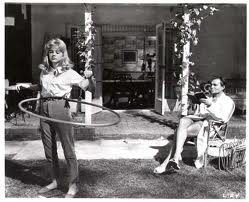
A scene from Stanley Kubrik's Lolita, 1962
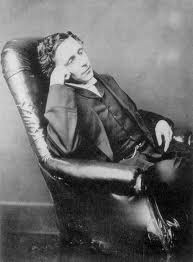
Lewis Carroll

Lewis Carroll seated in much the same way as Humbert is often depicted
Posted by: amartinmhc | November 30, 2010

two exhibits

In case anyone is going to be in DC at any point soon, there are two exhibits at the National Gallery that are relevant to our class:

http://www.nga.gov/exhibitions/preraphaeliteinfo.shtm

“The Pre-Raphaelite Lens” in particular intersects with much of what we have been looking at recently.

Image: Julia Margaret Cameron, The Sunflower, 1866-1870, albumen print, National Gallery of Art, Washington, Paul Mellon Fund

Posted by: melissayang | November 28, 2010

alice through the moving picture

It is clear that Alice continues to be a popular figure in our culture today, and one of the many telling factors is her presence in film. Wikipedia’s entry on Alice in Wonderland offers an extensive though apparently incomplete list of Alice’s appearances in cinema and television, from the 1903 Hepworth and Stow production Meghan just posted, to a 1999 television movie. Going back to the disambiguation page for Alice in Wonderland, there are three more adaptations listed: a  (2005) Malayalam-language film, a  (2009 miniseries), which is “a modern interpretation TV miniseries broadcast on Syfy,” and of course, Tim Burton’s oft-bashed (2010) Disney film.

In Thirteen Ways of Looking At Alice in Wonderland in Film, Jan Susina (The Place of Lewis Carroll in Children’s Literature) writes “One of the great strengths of the Alice books is how various directors have been able to create distinctive and original films based on the same text,” before discussing her selections and directing readers to David Schaefer’s “Alice on the Screen” in the Annotated Alice text we are using.

As I am guessing all of us have seen at least one Alice adaptation in our life thus far, I was interested in what everyone finds so fascinating about Alice, and what exactly you think makes Lewis Carroll’s story so ageless and continuously interesting to audiences and inspirational to artists up to this day? Since two of the blog posts on Alice have already been on film adaptations, I was particularly interested in that particular medium’s interpretations of her story. What are your favorite film (or otherwise!) versions of the story?

I just watched Jan Svankmajer’s 1988 “Alice” this weekend, and was hugely impressed with it.

Here’s a short clip,  just for fun –

« Newer Posts - Older Posts »

Categories