Posted by: meghanhealy | November 28, 2010

Alice Adapted (and a tangent about the Beatles)

I couldn’t resist sharing this link to the first film adaptation of Alice’s Adventures in Wonderland:

The youtube caption reads:

The first-ever film version of Lewis Carroll’s tale has recently been restored by the BFI National Archive from severely damaged materials. Made just 37 years after Lewis Carroll wrote his novel and eight years after the birth of cinema, the adaptation was directed by Cecil Hepworth and Percy Stow, and was based on Sir John Tenniel’s original illustrations. In an act that was to echo more than 100 years later, Hepworth cast his wife as the Red Queen, and he himself appears as the Frog Footman. Even the Cheshire cat is played by a family pet. With a running time of just 12 minutes (8 of which survive), Alice in Wonderland was the longest film produced in England at that time. Film archivists have been able to restore the film’s original colours for the first time in over 100 years.

On a tangent from the film clip, but still related to Alice: John Lennon credits The Beatles’ “Lucy in the Sky with Diamonds” and “I am the Walrus” as being inspired by Lewis Carroll. In several interviews in the 1960s, Lennon argued that he did not know the the initials spelled LSD, although he certainly never denies his experimentation with drugs; he wrote the song based on a picture his son, Julian, had made of a schoolmate (Lucy) which he told his father was “Lucy in the sky with diamonds.” The images in the song were inspired by the “Wool and Water” chapter in Through the Looking Glass, and “I am the Walrus” came from “The Walrus and the Carpenter”; Lennon later announced he should have named it “I am the Carpenter” after realizing that the carpenter was actually the good guy. [Also, on the cover to the “Ballad of John and Yoko” single, the Wonderland land gnomes belonged to Paul McCartney, and Ringo starred in one of the Alice film adaptations, so John wasn’t the only Carroll-inspired Beatle.]
Posted by: akhtikian | November 23, 2010

Alice By Cameron

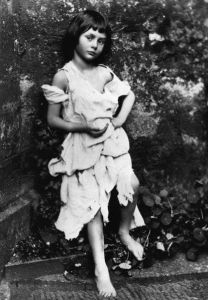
Lewis Carroll, "Alice Liddell as a Beggar-Child," 1858

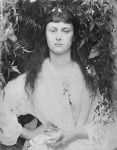
Julia Margaret Cameron interestingly photographed Lewis Carroll’s favorite sitter, Alice Liddell as a young woman (versus child? the female without adolescence). Cameron mirrors Carroll’s comments about the conflicting ideals of Victorian women, “with its emphasis on the bourgeois family, the sacredness of motherhood, and the desired purity of women,” (Mavor, 51) by replicating and also reversing elements of their subject. Cameron captures Alice in mirror image to herself as she was fourteen years earlier, in Carroll’s portrait, reflecting the “time, aging, and developing,” (Mavor, 34) Carroll attempted to control through photography. Cameron’s portrait works against Carroll’s essentialist agenda however, together the portraits of Alice unfix her from any time.  Cameron takes Alice’s picture in a garden, the vegetation that wraps around her, embracing Alice as part of the natural world while simultaneously creating a fantastical world as it reaches out to the surface of the image, is imaginably the same plants that Carroll’s Alice trample. Alice has blossomed, emphasized by the flowers in her hair and echoed in the vines, into a woman however her sexuality is still conflicted, “neutre.” Alice’s hair has grown out, a sign of womanhood, yet she has kept her childish bangs but her hair also falls in front of her body, slightly untamed, which (re)enhances her sexuality in her animality. In both portraits she wears white, the color of innocence and purity. In Carroll’s photograph Alice’s shirt is torn, it falls  from her body revealing bare shoulders and nearly half her chest creating tension

Julia Margaret Cameron, Alice Liddell, 1872

between virginal child and sex. Cameron mimics this anxiety in her portrait of Alice; a female with fully developed reproductive organs and sex whose sex is repressed by the claims made by her more conservative, properly fitting, intact white dress. In both photographs Alice demands to be looked at, to be seen. She wears a penetrating gaze that is somehow accusative and demurely seductive. Both photographers allow their female subject the agency through her eyes which stare out of the photographs, alerting viewers to her consciousness of herself as a visual subject and trapping onlookers in the uncomfortable role of voyeur. Cameron has Alice perform the same pose as she did in her childhood portrait; Alice has one hand firmly on her hip, a defensive stand-offish pose, the other is conversely cupped and held out before her, as if offering her hand to another, inviting the viewers hand to slip into hers. Even Alice’s hands contradict themselves. One accentuates her hip, a universally admired part of a female’s physical body in an unapproachable and reserved way while the other highlights her sensuality, encouraging the viewers her eyes are aware of to imagine her touch, to experience her with multiple senses.


How must Julia Margaret Cameron have experienced Alice Liddell to understand the power of the way Lewis Carroll experienced Alice strongly enough to not only mirror the sexual gender and age contradictions but also to feel those contradictions would be best re-presented only by the Alice herself?


Posted by: labbott12 | November 17, 2010

I couldn’t resist…

So, this was such a striking image to me and I didn’t realize it until it was on the big screen today. On the left is the portrait of Henry Taylor that we looked at today. Below is my father’sfacebook profile picture. He’s a writer as well. So funny, I just couldn’t resist.


Henry Taylor


Tony Abbott

Posted by: phane20c | November 17, 2010

Altered Madonnas

In the chapter on Julia Margaret Cameron, Mavor refers to Cameron’s Madonnas as “altered” and “altared.” This struck me as a little confusing, because ‘altared’ is not a word. I tried to understand as best I could given Mark Taylor’s definition of the word ‘altarity,’ which Mavor mentions in the chapter. ‘Altarity,’ according to Taylor, is the semiotic play that the concept of alterity invokes within a space of Derridian undecidability. If I try to put this in more understandable terms, it comes out like: altarity is the symbolic play that altering something invokes withing a space of undecidability. This definition is still pretty confusing, but I think I can grasp it as meaning something to do with undecidability. This makes sense since the Madonnas are blurred and offer an array of semiotic contradictions: pure vs erotic, living versus dead, holy Mary versus earthly Mary Hillier, etc.
In addition to being ‘altared,’ Cameron’s Madonnas are altered. This concept is easier to grasp because the Madonnas are in fact different from traditional Virgin portraits. Cameron is using a real woman who hints at nonpurity and at a number of contradictions listed above.
Cameron’s work is beautiful, and I had not come across it before this class.

Posted by: jmacd32 | November 17, 2010

Images of the Virgin Mary

I know this does not directly connect to our readings or Julia Margaret Cameron, but when I was reading Mavor’s chapter on  Cameron and the Madonna images she created I was reminded of another kind of Madonna image, one of which had appeared in my hometown in 2003.

The image is said to be caused by leaking chemicals

A US hospital has asked the Catholic Church for help after being swamped by thousands of people seeking to view what they believe is an image of the Virgin Mary in a third-floor window. (http://news.bbc.co.uk/2/hi/americas/2999172.stm)


A girl holds up a statue of the Virgin Mary to compare it to an image in a Milton Hospital window that many believe resembles the Virgin Mary.

http://www.visionsofjesuschrist.com/weeping162.htm

This phenomena that appeared on one of Milton Hospital’s (Milton, MA) windows garnered global as well as national attention as it was covered by outlets from the Boston Globe to the LA Times and even the BBC (see first image and accompanying text). To connect it back to our class as well as the Mavor chapter though, its global attention suggests the power and truth we invest in images, a topic we have been discussing all semester. In June of 2003 when the image appeared thousands of people visited the hospital simply to view it. Although, as the news outlets pointed out, the Madonna image could simply have been a product of “leaking chemicals” in a window with a broken seal, the possibility of it being a “true” religious image outweighed such speculation for the thousands that visited it after its appearance. My father brought my sisters and I to see the image with our nana who suffered from chronic pain. She was raised Catholic but seldom went to church in her adult life, and at the time hadn’t been in years. However, she went with us to Milton Hospital to see the image and to hope it held some type of power. The speculation surrounding the image between science and religion reminded me of photography and its place between science and art. Mavor notes the “split in photography between science and art” in her chapter on Cameron and it was her quote about “angelic” Victorian women  as those who “maintained sacredness within an age of modernist doubt” that led me to this post (Mavor, 63, 52). The Milton Hospital Madonna definitely holds a “sacred” position in the face of “modernist doubt.”


Posted by: ellenlarson | November 17, 2010

Landscapes That Don’t Lie

At the same time Julia Margaret Cameron was arranging her household into portraits and Munby was dressing up Cullwick, there was a movement in the United States towards viewing the unspoiled American West as idyllic and artists using it to construct a sense of nationalism. Many artists did much the same that Munby and Cameron did in carefully constructing their images to project an intended message or meaning. In the mid-19th Century, tension between expansion and industry, the city and the country, nationalism and land in the United States caused a boom in landscape portraiture that depicted the West as a lush, beautiful wilderness.

A particular photographer by the name of Carleton E. Watkins took a different vantage point on capturing images of the American West. He was a commercial photographer responisble for publicizing the Yosemite region to the rest of the country. What Watkins did differently is that he showed the place as it was. Unlike the Munbys and Camerons, he selected his best images but did not fabricate them. Painters and photographers with the same focus as Watkins (to capture the West in art) strove to make their works the most beautiful, glorious, and inspiring. Watkins showed a real place as what it really was.

His photograph “Yosemite Valley from ‘Best General View'” shows his vision of showing what is really there. Where many artists would remove the ugly bare tree from the breathtaking view, Watkins embraces it as the focus for the picture. He does not falsify his image and shows that while the land is undeniably beautiful, sometimes it is ugly too, and that’s just the way it is.

For more photographs check out http://www.yosemite.ca.us/library/watkins/list.html

Posted by: anniebutts | November 17, 2010

“I longed to arrest all beauty that came before me…”

I hadn’t heard of Julia Margaret Cameron before taking this class, but after looking through some of her pictures, I decided to do a little research. I found that the following quote and description of her work were helpful in understanding her photos…

“I longed to arrest all beauty that came before me, and at length the longing has been satisfied.” -Julia Margaret Cameron

“For Julia Margaret Cameron, photography was an art form for her to master, to twist and change as she would. Because she did not need to make a living from her photos, she was not constrained to following conventional techniques put forth by those before her. This being so, Cameron sought to produce photos in which the emotional state of the model was of highest importance. Technical aspects were set aside so that this could be done.”

“Cameron focused on two main things in her photography: women and allegorical lessons. Although some of her most well known photos are of famous men, most of her work centred around the women in her life. She tried to reveal her sitter’s natural beauty, having them pose with their hair down and flowing free to reveal a position not usually seen. Cameron’s photos are romantic. They use subdued lighting and dark backgrounds to create a dreamy setting. Cameron often left the lens of her camera purposely out of focus so as to add to this dreaminess.”

http://www.victoriaspast.com/JuiliaMCameron/juliacameron.htm

Posted by: labbott12 | November 17, 2010

Sociological thought about Cullwick and Munby

So, here comes another interdisciplinary revelation I had in our last class session that I find relevant in adding to our discussion of Cullwick and Munby. In sociology, I’m writing a grueling paper on the presentation of self–specifically, gender performance. In an article titled “Presentation of Self in Everyday Life” by Erving Goffman, the theorist presents the following idea:

When an individual plays a part he implicitly requests his observers to take seriously the impression that is fostered before them. They are asked to believe that the character they see actually possesses the attributes he appears to possess, that the task he performs will have the consequences that are implicitly claimed for it, and that, in general, matters are what they appear to be. In line with this, there is the popular view that the individual offers his performance and puts on a show ‘for the benefit of other people.'(Goffman 109)

In thinking about Cullwick and Munby, this excerpt came to mind when we were discussing what representation was and how we have come to understand their relationship based on these images and writing. We may consider Cullwick as having performed for Munby through these images that are highly staged and pre-meditated and the diary that she wrote specifically for Munby’s viewing. In this aspect, Cullwick very much offers her performance ‘for the benefit of’ Munby. Perhaps this may add to our discussion of agency within the relationship. Was Hannah Cullwick performing chiefly for Munby? Can we really know? How does Goffman’s idea about interaction in performance of self add to our discussion?

Posted by: emmadamato | November 17, 2010

Cameron and Lange

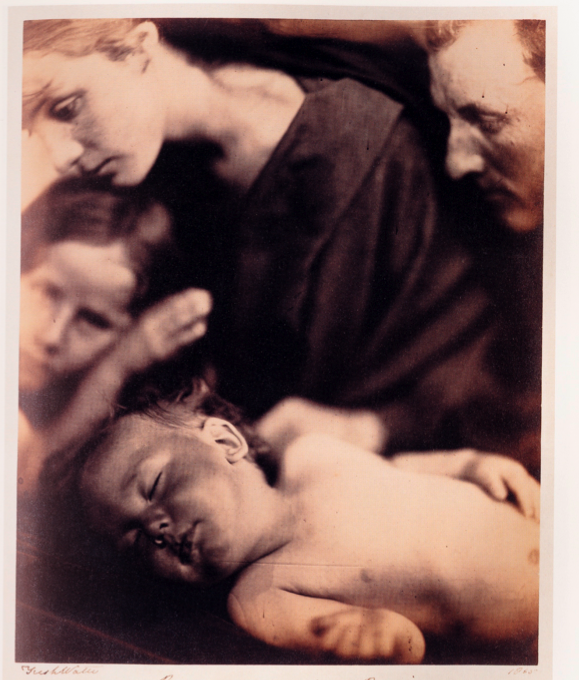
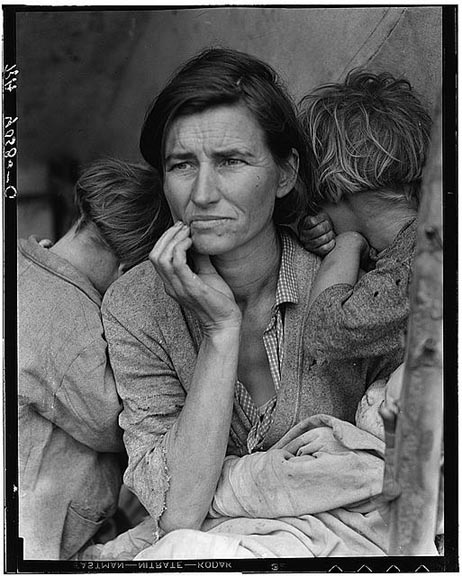
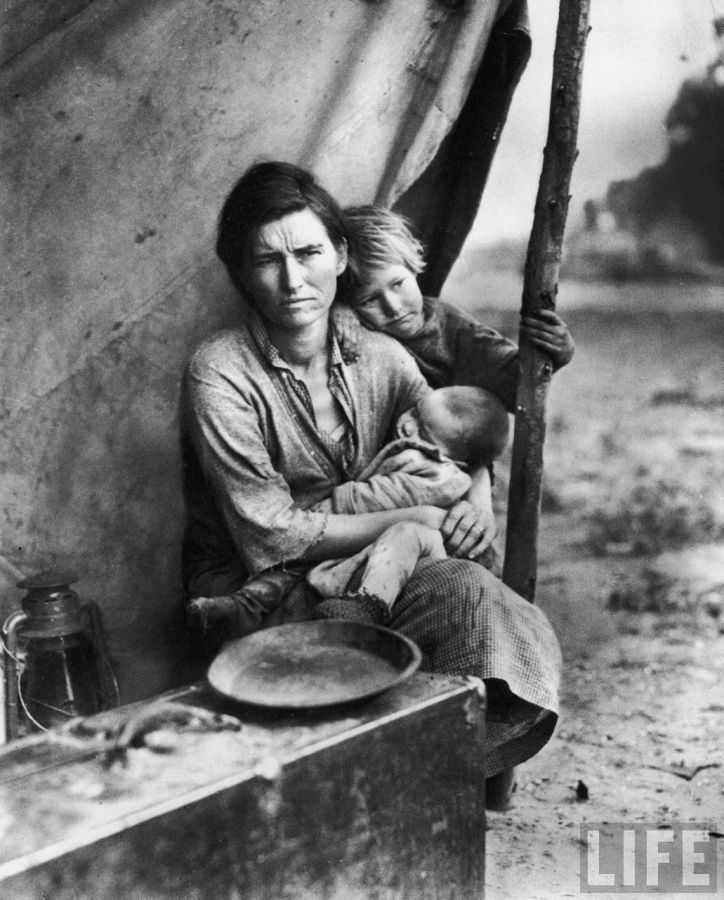
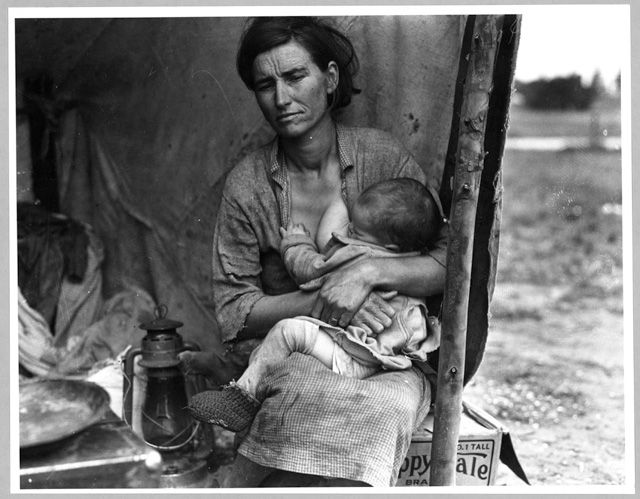
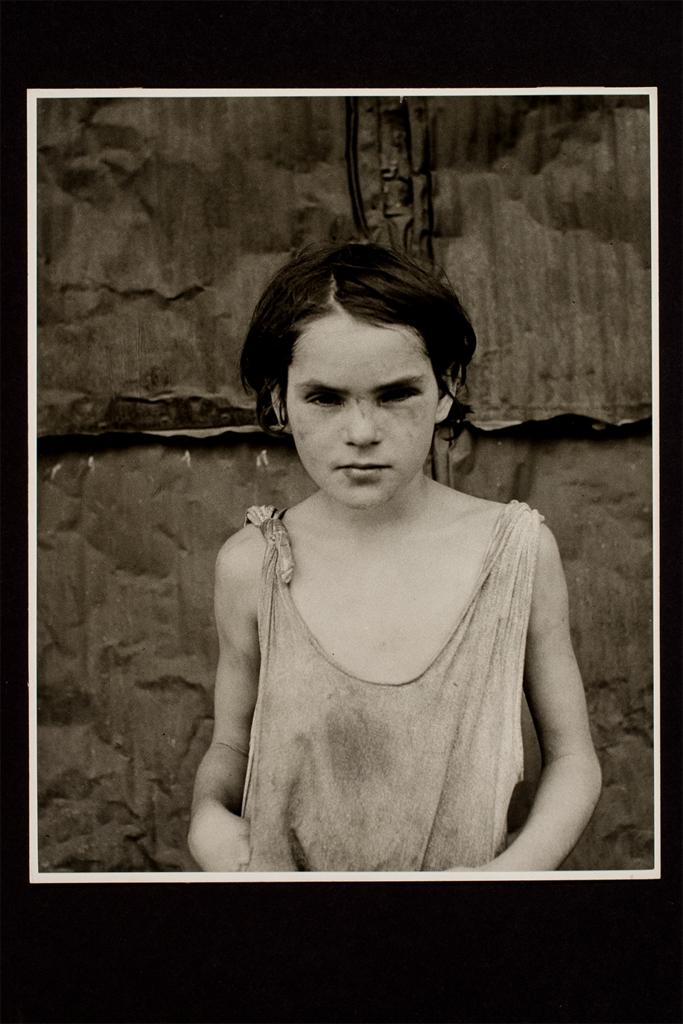
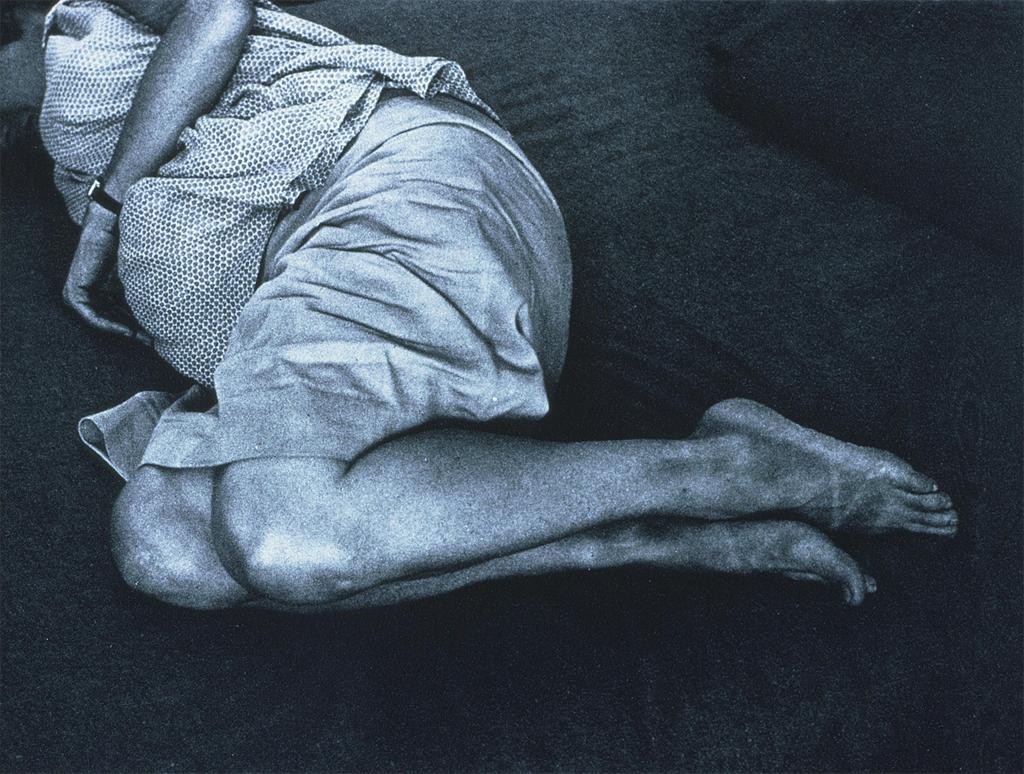
While looking at Cameron’s work I could not help but think of another female photographer Dorothea Lange. Lange was a FSA photographer and is most famous for her photos of families in the dust bowl. It was interesting to me how similar their final protects were when their projects were so different. How can the agenda of a photographers be so different and the results so similar. Am I projecting to much of my agenda as a viewer? Does the fact that they are both women have anything to do with it? Does anyone else even see the similarities? I spent so much time finding images I lost all I had to say in the search

Posted by: marycib | November 17, 2010

Motherhood and Death

Viewing Cameron’s photographs of “dead” children was somewhat disturbing, especially considering that posing a deceased child was a custom during the Victorian era. Since Cameron was not actually photographing dead children, it was interesting to think about the meaning of the photographs. Plates 4, 5, and 6, seem to emphasize the relationship between mother and child, especially when viewing the woman and child as Madonna and Child. The connection between sleep and death generates the idea that death is not actually final. Instead, “The literature and the postmortem photography of the period often linked sleep with death: it was a way of denying death” (Mavor 55). Plates 4 and 5 are especially suggestive of the Pietà image of Madonna holding Jesus after he was crucified. In Plate 4, the woman is looking up, as if toward heaven, indicating that she is praying about the death of her child. While the child appears similar in both photographs, the woman’s facial expression is much different. In Plate 5, the woman appears sad and almost puzzled as if she cannot fully grasp the meaning of her child’s death. The placement of mother and child in Plate 6 accentuates the connection between a mother and her child by having their bodies appear to be a continuation of each other. The mother is also looking away from her child as if to suggest that she has lost faith now that her child has died. In these photographs, Cameron connects death with the bond between mother and child.


« Newer Posts - Older Posts »

Categories