Posted by: anniebutts | October 31, 2010

Just an Advertisement?

As I was reading Loeb’s “Consuming Angels”, I couldn’t help but to think of I movie that I recently re-watched. It’s a Julia Roberts film called “Mona Lisa Smile” about a woman who accepts an art history teaching job at Wellesley College in the 1950’s. Roberts’ character, Katherine Watson, tries to break down some of the limitations and gender roles that these women face as they are going through school. I remembered one particular scene vividly while reading this piece. During one of her art history lectures, Watson creates a slideshow of advertisements that portray the woman’s role in the household….

The first thing a student says when Watson puts up the first slide is “that’s just an advertisement.” JUST an advertisement? Watson knows, and so do we, that these newspaper advertisements are “a portrait of women.” Whether or not they are accurate does not matter. They may be highly stereotyped, but they do provide a glimpse into this idealized domestic culture. They make use of the woman’s figure and reputation, just as they did in Victorian culture, to appeal to an audience focused on the commercial aspects of domesticity.

Anyway, thought this was an interesting comparison with the Loeb piece..

Happy Halloween everyone!!

Posted by: labbott12 | October 28, 2010

The Power of the Purchase

In class yesterday, we discussed women feeling empowered by being able to make the purchases for the household. The quote we looked at reads,

Although she did not earn money, the woman of the house could significantly control the way that it was spent. Advertisers would attempt to manipulate, husbands could limit the funds available, but the ultimate decision(to buy or not to buy) was usually women were empowered. They gained a new form and degree of economic control and they became arbiters of new social values including gender. Advertisements trace the shifting contours of the feminine ideal.

I started to think about purchasing and what it means in a contemporary context. What does it make us as women feel to be consumers? Does it make us feel powerful as Loeb suggests? Though times have changed and (I’m generalizing) the power dynamic between partners in a household has shifted, it seems that the link between purchasing and empowerment still holds truth. Consider the concept of retail therapy. My boyfriend broke up with me, and I went shopping…it helped. Being able to choose the clothes off the rack and bring them home feels good, it is a release of a need to control a situation. Victorian women were given this outlet of control and perhaps they embraced it as I embrace my ability to choose what I wear or what I buy. Money and purchasing come with a feeling of independence and I believe that that independence inspires empowerment. The natural extension of empowerment around purchasing would be to make one’s own means with which to purchase..leading to financial independence as well. It is my understand that for their time and circumstance(generalization acknowledged), the women targeted in advertising campaigns for their ability to chose the household brands were as empowered as they financially and appropriately could be.

Also, I found a cool 3D recreation of the Crystal Palace here: http://www.youtube.com/watch?v=8W_MRYJDueU&feature=related

Enjoy!

Posted by: sabinabw | October 27, 2010

“Making Sense of Ads”

So while I was online trying to find some more advertisements, I came across this website about “Making Sense of Ads”.  The different sections are definitely interesting to read, giving insight into the reasons for ads, and there are little quizzes at the end of most sections that are great to try…take a peek!


http://historymatters.gmu.edu/mse/ads/intro.html


Posted by: fulto20e | October 27, 2010

Vintage Advertisements

13 Vintage Ads That Would Be Banned Today

I actually found these Ads through a Mad Men fansite, but I thought they were relevant to our readings in Imperial Leather. Most of the examples are incredibly misogynistic and promote the idea of a wife submitting to her husband. Interestingly, the same advertisement for Chlorinol is included on the website as is shown in Imperial Leather (fig. 5.7).

Edit:

Just found this and couldn’t resist adding it!

Posted by: siobhananderson | October 27, 2010

Neoclassicism and Pears’ Soap for the Complexion

While reading Loeb’s first chapters from Consuming Angels, I was particularly struck by what Loeb articulates as “the middle class desire to be thought different from the common herd.” This along with the notion that luxury goods were in some way a representation of a democratized society made me really take a longer look at the advertisement for Pears Soap advertisement on pg. 11. (I tried to find the advertisment online to include with this post, but no such luck)

The use of neoclassicism in paitings, drawings, plays, architecture and decor has always been an evocation of regaining something that has died away in an effort to render it newly fashionable or unarguably elegant. From the columns in the background to the robes worn by the two figures, the advertisement represents itself as not only an excellent choice for soap, but an ancient even just selection for all of your facial washing needs.

In this advertisement the evocation of neoclassicism implies the sort of divine simplicity in living shared by the Gods in ancient Greek and Roman legends. The idea of purity is also present throughout the advertisement, as the figures’ skin is as ivory white and firm as the columns standing straight behind them, the child, naked, is giggling and flowers fall around the base of a Classic looking vase. The word “pure” is in fact written at the bottom of the illustration.

The neoclassicism present in this advertisement seemed to me a perfect reflection of this Victorian middle-class desire for material luxury. Though the advertisement evokes a sort of strength in simplicity there is the undeniable undertone of elegance, even wealth. Soap here does not only represent cleaniness, but even a sort of elevation of the body to that of the Gods. I looked online for more advertisements touched by neoclassicism but did not see any…. was anyone else able to find anything?

Posted by: emmadamato | October 27, 2010

In response to Meghan’s post- than a tangent

I wanted to include images but didn’t know how to in a comment

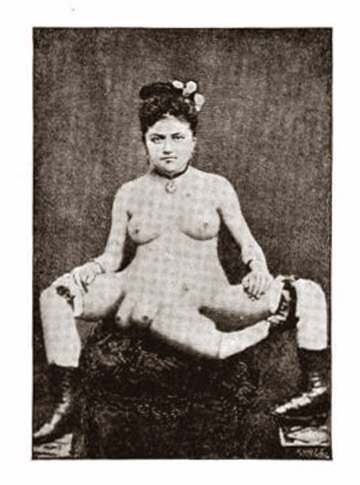
One image that sticks out in my mind (because it is almost impossible that it wouldn’t) is of Blanche Dumas the famous three legged prostitute. She is remembered as a departure from the “normal human type” rather than an acceptable sexual icon. Her image still exists as a archiving of her freakishness and her oddity status. She was born in 1860 with one torso, three legs, two sets of breasts and two fully developed vaginas, and a notably “high libido”. Her freakishness was attributed to her biracial mother. It seems like her story could have been inserted into McClintock’s first chapter. As a model for degeneration Dumas not existed outside the normal human type in terms of labor and class and race but as a physical extreme. Two vaginas, with the sole purpose of sexual pleasure rather than reproduction! what could be more threatening?

Blache Dumas was an incredibly successful prostitute. I think that men are incredibly interested in sexually conquering women they fear.  I think this is possibly the root of the oedipus complex. The language of imperial conquest and sex are so similar because I think the experience for men is similar. The balancing act that McClintock writes about between “imperial megalomania, with its fantasy of unstoppable rapine- and a contradictory fear of engulfment, with its fantasy of dismemberment and emasculation” seems just as present in the bedroom.In the play Venus by Suzan-Lori Parks, based on the Venus Hottentot, men gather around the cage the are keeping Saartjie Baartman and with uncontrollable lust and anger touch themselves and violate her body. Her hypersexualised body is compared to a man’s and the depictions of her genitals are very masculine.

Victorian Erotica was full of rape stories, including The Man and the Maid- a hugely popular book at the time that tells story after story of violent sexual conquest,

This is amazons description: “Man With A Maid tells the story of Jack, a Victorian gentleman, who plots sweet revenge on the fiancee who jilts him, not to mention her maid, a close friend, and his rival’s mother-in-law. Setting up residence in the ‘Snuggery,’ once the soundproof “”mad room”” of an insane asylum, he subjects Alice and the rest of his female company to bondage and orgiastic sexuality, dealing out both pleasure and pain in exacting revenge.”

The national model of sexually orders of power had to exist within the home to be so successful for the empire. Popularizing sexual fetishes within museums, literature, and other media was a way for it to exist within the private familiar space. The family is the nation and therefore sexual violent conquest would be successful as a mode for international relations.

blah blah blah, I feel like i have a lot of more points before this makes sense, but its making me feel like a pervert

Posted by: marycib | October 27, 2010

Male Preoccupation with Power

The connection between colonization and the male need for power offers an explanation for the practice of men naming things in order to lay claim and authority over those objects. The examples McClintock gives should also be noted because they are associated with women being degraded in the process of men assuming dominance. McClintock explains how the “discovery” of various empires were not actually breakthrough discoveries because there were communities already established in these locations. While the naming of the discovered land gave men control over that land, “…the imperial act of discovery is a surrogate birthing ritual: the lands are already peopled, as the child is already born. Discovery, for this reason, is a retrospective act” (29). The concept of naming things to assert control over them becomes connected with the naming of a child because during that time period there was not an absolute certainty that it was the father’s child, while it was a certainty for women because they carried the child in their womb. After the child is born, “…men diminish women’s contribution…by reducing them to vessels and machines-mere bearers-without creative agency or the power to name” (29). The male preoccupation with naming and claiming things reveals their insecurity and tenuous hold of power because it is not definitive. This idea is interesting because it is not even the father’s desire for the child to have his name because he is proud of his child, but rather because he does not wish for his manliness to be reduced. This again connects with imperial discovery because by “…naming ‘new’ lands, male imperials mark them as their own, guaranteeing thereby…a privileged relation to origins-in the embarrassing absence of other guarantees. Hence the imperial fixation on naming, on acts of ‘discovery,’ baptismal scenes and male birthing rituals” (29). This is an important concept because during the early stages of colonization, native cultures and societies were overlooked and their claim to their land was disregarded. Men treated the indigenous people with the same regard that they treated women because they wished to assume control over both.


Posted by: meghanhealy | October 25, 2010

Women of Ill Repute

(First off, I must admit that I stole the title of this entry from the title of a course I took at Amherst two years ago on nineteenth-century prostitution in France.)

Although it was just a brief passage in Imperial Leather, this one caught my attention:

“Domestic workers, female miners and working-class prostitutes (women who worked publicly and visibly for money) were stationed on the threshold between the white and black races, figured as having fallen farthest from the perfect type of the white male and sharing many atavistic features with ‘advanced’ black men…Prostitutes–as the metropolitan analogue of African promiscuity–were marked as especially atavistic and regressive. Inhabiting, as they did, the threshold of marriage and market, private and public, prostitutes flagrantly demanded money for services middle-class men expected for free. Prostitutes visibly transgressed the middle-class boundary between private and public, paid work and unpaid word, and in consequence were figures as ‘white Negroes’ inhabiting anachronistic space, their ‘racial atavism anatomically marked by regressive signs: ‘Darwin’s ear,’ exaggerated posteriors, unruly hair and other sundry ‘primitive’ stigmata.” (56)

With this renewed interest of the figure of the prostitute in mind, I was also struck by this passage:

“Under imperialism, I argue, certain groups are expelled and obliged to inhabit the impossible edges of modernity: the slum, the ghetto, the garret, the brothel, the convent, the colonial bantustan, and so on. Abject peoples are those wom industrial imperialism rejects but cannot do without: slaves, prostitutes, the colonized, domestic workers, the insane, the unemployed, and so on. Certain threshold zones become abject zones and are policed with vigor: the Arab Casbah, the Jewish ghetto, the Irish slum, the Victorian garrett and kitchen, the squatter camp, the mental asylum, the red light district, and the beddroom. Inhabiting the cusp of domesticity and market, industry and empire, the abject returns to haunt modernity as its constitutive, inner repudiation: the rejected from which one does not part.” (72)

This idea of the threshold—public/private, marriage/market, paid/unpaid work, white/black—stuck out, for in a society obsessed with neat classification, how should liminal figures be classified? I was also interested in the fact that, just as the slums of London were treated similar to colonies—dark spaces that must be penetrated, documented, made comprehensible—prostitutes are viewed as similar to blacks, not just in terms of morals/character traits but also in terms of genetics. All these forms of the “Other” become linked together—the insane, slaves, prostitutes, the unemployed—and both the justification for their “Otherness” (genetic differences) and the solution (“polic[ing] with vigor”) are the same. (As an aside, I wasn’t sure what the reference to Darwin’s ear meant, but as I was intrigued by the fascination of the Victorians with criminal ears, I decided to google Darwin’s ear. I found Darwin’s earpoint and Darwin’s tubercle: http://kenpitts.net/bio/genetics/face_lab/26_darwins_earpoint.htm and http://en.wikipedia.org/wiki/Darwin%27s_tubercle show that it is a recessive trait similar to that of monkeys.)

I am curious if anyone more familiar with photography at this time knows of the existence of photographs (documentary, artistic, official, or otherwise) of prostitutes. I am familiar with the French obsession with the figure of the prostitute (specifically the courtesan) and the wide-spread obsession of artists with prostitutes. Degas paints prostitutes in France, Delacroix penetrates harems in Algeria in order to paint the “Oriental” prostitutes. Within the category of French prostitutes, there are paintings that use them as models but do not label them as such and there are others that specifically try to represent the prostitute. Nineteenth-century French novelists, sociologists, anthropologists, painters—all seem obsessed with the figure of the “woman of ill repute.” With poems centering around the figure of the prostitute, such as Dante Gabriel Rossetti’s “Jenny” and Webster’s “A Castaway” (both occurring contemporaneously with the Contagious Diseases Acts), it seems that there was a British interest in the figure of the prostitute (though perhaps to a lesser extent). Yet I am unfamiliar with photographs of French prostitutes, and I am particularly unfamiliar with British visual culture and if there is a tradition of prostitutes in paintings or photos. I would be curious to see how they are depicted, in what circumstances the photos were taken, how the figures are framed, etc. In other words, is there a correlation between the ways in which colonized female subjects are captured and those of domestic female “Others” such as prostitutes?

Posted by: lbrooksd | October 24, 2010

Soap Making and Advertising

Imperialist Leather is a book I’ve heard lots of things about and always wants to get into – so far so good.  I’m especially intrigued by Chapter 5 which talks a lot about imperialist advertisements, specifically soap.  I’m kind of into soap – maybe that’s a weird thing to be into, but I like to make my own.  It’s really kind of a cool process:

There are a few different ways to do it, but I generally make cold process soap.  Basically you combine your lye with your melted oils or fats, usually it’s a few different kinds, like olive oil, palm oil and coconut oil, but traditionally this is where the lard comes in.  Then you stir until the mixture traces, which when you’re doing it by hand, can take hours.  Into the molds the soap goes, thick but still pretty soupy at this point, to be popped out after a half day or so, when it will hold it’s shape but still be a little soft, then under the bed for at least a month before it’s usable.  During that time the soap “saponifies” which basically means that the fat/oil is being turned to soap by the acid from the lye.  Before the soap is fully saponified, the lye is still active, so it’s obviously not great for your skin.  The resting time also firms up the soap, but how solid your bars turn out depends a lot on what kind of oils you use also.

It’s interesting to see how fetishized soap was in Victorian times, and that got me to thinking about how we fetishize soap incurrent culture.  Hygiene products in general are a huge market, I don’t even want to know how much money is spent on these commodities every year, and there are certainly trends in the ways that these products are sold.  It’s funny, so many of the body washes and shower gels aren’t even technically soap anymore – without lye they can’t really be considered soap.

I wonder whether you think there are any remnants of the qualities we see in the Imperialist advertisements in the soap/hygiene products of today?  I haven’t seen any monkeys or white aprons in these ads lately, but certainly mirrors are still an image we see again and again – how do you think the symbology behind them has changed, if it has?  Or is there a new quartet of advertising symbology to match the times?

Here’s an easy cold process soap recipe if you’re interested in giving it a whirl.

Posted by: melissayang | October 22, 2010

the German stuffed frogs of the Great Exhibition

As it turns out, my previous tidbit on Victorian taxidermy was not totally irrelevant! Thomas Richards mentions taxidermy frogs on display at several points in “The Commodity Culture of Victorian London,” but they achieve their brief side note of fame in parentheses near the end of the essay, here:

“At the Great Exhibition commodities were always sliding from autonomy into solipsism, and each and every commodity had its cult of viewers (the German stuffed frogs were the most prominent of these commodity cults)” (59-60)

There was no further note on them, but I believe the “German stuffed frogs” mentioned here are the frogs of Hermann Ploucquet, who worked as a taxidermist for the Royal Museum in Stuttgart, Wurttemberg, Germany. (Side note: Walter Potter was a teenager at the peak of Ploucquet’s popularity — some sources believe Potter was influenced by his work.)

For a fun look at Ploucquet’s Great Exhibition taxidermy, I highly recommend glancing through http://www.gutenberg.org/files/28508/28508-h/28508-h.htm. “The Comical Creatures from Wurtemberg” is more or less a picture book, illustrating and telling stories to bring Ploucquet’s anthropomorphic taxidermy tableaux to life.

I’ll let one of the reviews speak for itself:

From the Morning Chronicle, August 12th.

“The book is a clever and a pleasant memento of the Great Exhibition. The drawings are careful and clever, and convey a very correct representation of the original creatures, with all, or nearly all, their subtlety of expression and aspect. The capital fatuity of the Rabbits and Hares, the delightful scoundrelism of the Fox, the cunning shrewdness of the Marten and Weasels, the hoyden visages of the Kittens, and the cool, slippery demeanour of the Frogs, are all capitally given. The book may lie on the drawing-room table, or be thumbed in the nursery; and in the latter case we have little doubt that many an urchin still in petticoats will in future years associate his most vivid recollection of the Great Exhibition of 1851 with Mr. Bogue’s perpetuation of the Comical Creatures from Wurtemberg.”

And here is an image and excerpt from”The Frogs Who Would A-Wooing Go” —

“Two frogs, who were cousins, were hopping about together one warm summer’s evening by the side of a rivulet, when they began talking—just as the men will talk—about a young lady-frog who lived in a neighbouring marsh. One extolled the brightness of her eyes, the other praised the beauty of her complexion, and somehow the two frogs found out that they had both fallen in love with the same young lady-froggy. When they had made this discovery they parted rather abruptly, and muttered something, the meaning of which was not very clear.”

For images of actual taxidermized frogs, and other things from the Victorian era, try http://www.taxidermy4cash.com/histo.html. For more on taxidermists at the Great Exhibition of 1851, another link on the same site has a good amount of info: http://www.taxidermy4cash.com/exhibition.html

For the record, collecting pictures of posed dead frogs at 3am on Friday morning to put on a course blog is a bit weird even for me, but there you have it! Enjoy (or something like it) and have a lovely weekend!

« Newer Posts - Older Posts »

Categories