Posted by: kellyannem | October 14, 2010

The Irish and the Railroad

I started this as a comment to the previous post about the Irish immigrants in Pennsylvania, which I found very interesting. However, there were too many fun things to share that I wasn’t able to do in the comment box, so hence the real post…

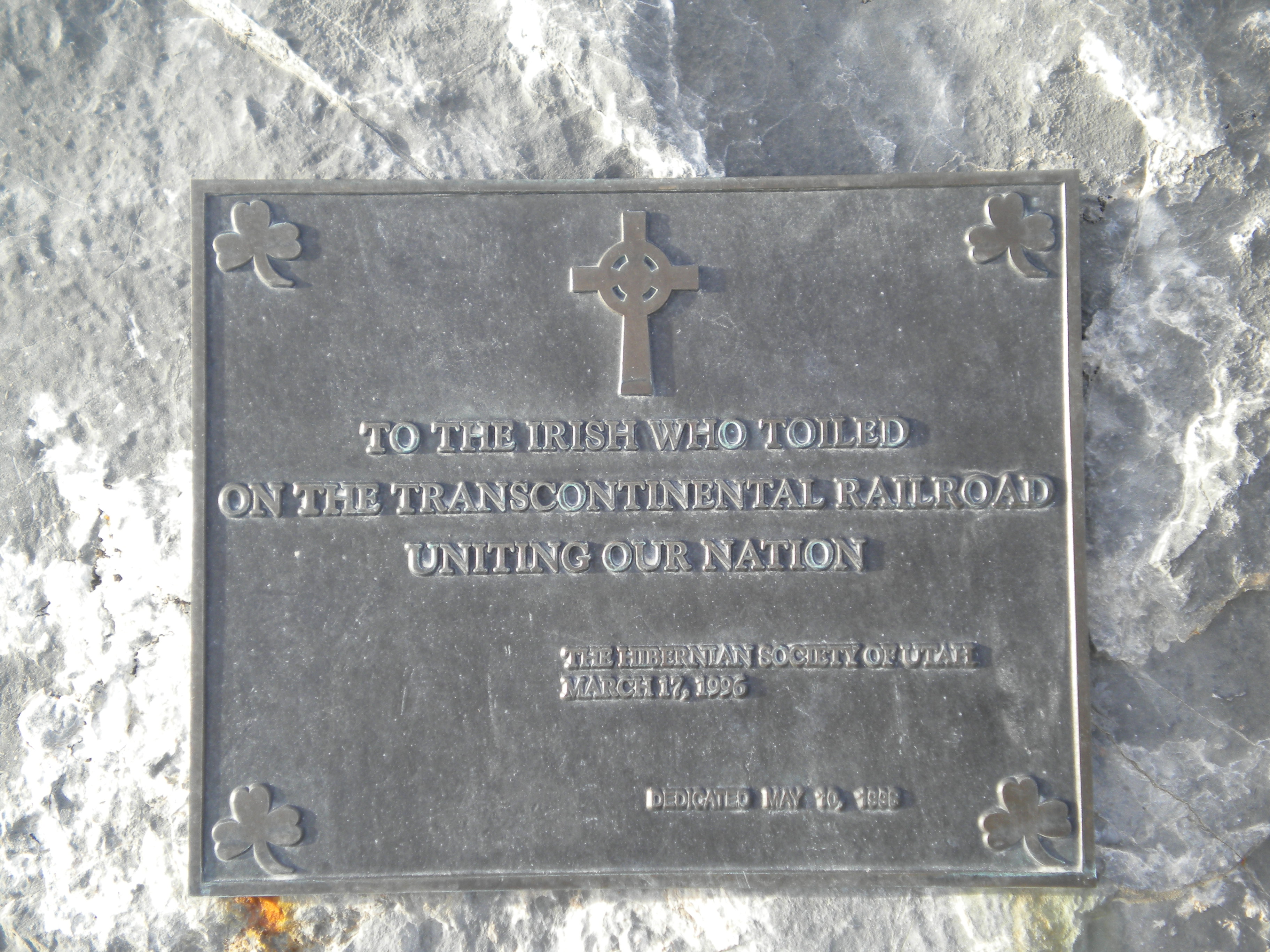
This summer I visited the Golden Spike National Historic Site at Promontory Summit in Utah. This is where the Union and Central Pacific Railroads were joined on May 10, 1869, completing the first Transcontinental Railroad. I was extremely surprised to come across the following plaque:

If you can’t read it, it says “To the Irish who toiled on the Transcontinental Railroad uniting our nation.  ~The Hibernian Society of Utah, March 17, 1996, Dedicated on May 13, 1998”

I was surprised and pleased to discover this considering how much the Irish worked on the railroad, and as the previous post pointed how, how many lost their lives.  I’ve included a link to the Hibernian Society of Utah because I had never heard of them (apparently many states have Hibernian Societies), and because it seems like a pretty cool thing for those interested in Irish culture.

http://www.irishinutah.org/index.php

Posted by: fulto20e | October 13, 2010

Irish Immigrants in PA

Please bear with me while I explain the train of thought that led to this post:

The (frankly) racist cartoon images of the Irish that we have been looking at made me angry, mostly because the idea that the British were superior only escalated to more and more violence in the UK. Over the years I’ve developed an interest in the oppression of the Irish, both in their own country and as immigrants to the US. So, in thinking of my favorite films in relation to the cartoon images, Scorsese’s Gangs of New York immediately came to mind.

American’s do not have the best record of welcoming the Irish with open arms, as demonstrated in the film. With a quick google search for information on Irish immigrants (originally looking for images) I came across a news article that caught my attention: 19th Century Irish Railroad Workers in Pennsylvania Grave May Have Been Murdered. Well, I’m a Pennsylvania girl, so of course I had to read it. As it turns out, these Irish workers constructed Mile 59 “one of the toughest stretches” of the PA railroad to construct (as it happens, Mile 59 is located in Chester County, my home town!)

“Within six weeks of the arrival, all 57 men were dead. They were buried in a mass grave near Malvern, Pa., and their deaths were kept a secret by the railroad company. Duffy ordered that the shanties were they lived be burned down for sanitary reasons.”

It wasn’t until May 2010 when two brothers, one a history professor at Immaculata University, having discovered the mass grave concluded that:

“local vigilantes, perhaps with the blessing of the contractor Phillip Duffy, simply came into the forest and killed all the workers, believing it was the only way to keep the cholera from spreading… And right after the men were buried, Duffy had the site torched to hide the evidence.”

What does all this have to do with the hideous cartoon images of the Irish? The sad fact is that Irish workers in America were forced to take the most dangerous jobs that no one else was willing to do. The article on the murdered Irish workers in PA concludes with this unfortunate statement:

“Railroad construction was so dangerous that it was said, ‘[there was] an Irishman buried under every tie.’”

Clearly, the lives of immigrant workers, especially Irish workers, were not valued by those who employed them. They were executed and buried in a mass grave without a second thought, because they may have infected “real” Americans. Although the Irish fled to the US in search of a better life, they were faced with even more prejudice and intolerance.

To read more on the killed Irish workers in PA – The Duffy’s Cut Project (this website also has images of the bones found.)

There is also a book: The Ghosts of Duffy’s Cut: The Irish Who Died Building America’s Most Dangerous Stretch of Railroad

(source)
Posted by: ellenlarson | October 13, 2010

Hibernia as the “Other” Ireland

A few of the cartoons and caricatures for this week feature Hibernia as a personification of Ireland as a nation. She is a pretty young woman and far more appealing to behold than the Fenian monsters around her. These ‘pests’ make her visibly frightened and in need of a strong outside force to keep her safe from them. Britannia fills this need and is depicted alongside her as strong, unafraid and armored. Hibernia leans on Britannia or hangs on her arm, expressing her dependency on the other woman. Beyond the personification, Ireland is illustrated as requiring Britain’s strength in defending itself against the bestial Fenians. This version of Ireland is more attractive to be sure, but is weak, vulnerable and helpless. Hibernia is a preferable image to the British viewer as a sort of little sister to their own Britannia. Lovely but pitiable, she is not any more a positive model for the Irish than the Fenian Frankenstein.

Posted by: phane20c | October 12, 2010

Phantasmagoric Aesthetic and the Perpetration of Racism

I thought the Phantasmagoric Aesthetic article from last week was very interesting. The author offers a profound look at a history of photography and its significance in the colonial world and beyond. I bring this article up now because some of the discussions I’ve been having in my Psychology of Racism course tie in with the racism aspects covered in the article- namely in the photographs Group of Five Young Andamanese Women and Juang Girls. In my class, we have been discussing how racist qualities like barbarianism and primitivism had been imposed on African slaves in America. The Phantasmagoric Aesthetic article makes a point of saying that the subjects in the aforementioned photos have had “foreignness imposed upon them.” The women in these photos are not wearing what they normally wear. They are posed to look more “authentic” and “primitive” than they are. We see the women in leaves and beads instead of the not-so-primitive white dress or saris the photographer admits he usually sees them wearing. Also noteworthy is in Andamanese Women, we see an upside-down barrel “with the primitive foot resting on it, as if to suggest a momentary refusal of labor.” This might seem like a small detail but it is actually very important in the perpetration of racist thinking. It labels the subject as rebellious and untamed. It suggests the need to be kept under control. Indeed, with the case of slaves in America, only the disobedient ones were pointed out so that negative stereotypes ensued. Colonists had the audacity to strip natives of their land and culture, and make them work hard with little or no pay then point out the natives’ understandable bitterness and suggest “they” need a lesson in civility and manners. By differentiating between “us” and “them,” colonizers, like slave owners, could justify violence toward foreigners without guilt. Photography in the 1800s aided the perpetration of racism by showing foreigners as primitive, thus leading to false truths and stereotyping. The phantasmagoric aesthetic can actually be responsible for justifications of violence and “us” and “them” thinking. When seen by the colonizer, the people in these photographs were just exotic items on display, thus detaching the observer from his/her senses.

Posted by: lbrooksd | October 9, 2010

Truth and Photography

I have been thinking about truth and photography, and the evolution of their relationship to one another.  In the Victorian age it seemed that the two were inextricable; that this new way of creating images from life was more exact and more reliable than anything else available in the time period.  Arthur Conan Doyle is a prime example here, when thinking about the blind faith bestowed upon photographic images and their representation of reality.

And yet – in our own time period, photography has become highly controversial.  Photoshop happened.  The reality of a photograph is just as subject to doubt as the reality of painting.  Just think of the Photo Booth computer program, where you can distort your own image to your heart’s content.  No longer is photography associated with truth in the same way.  A photograph proves nothing now, whereas then it proved everything.

Now that we have video and audio technology, the truth of a photograph pales in comparison.  We have upgraded our technology, and the reality of a still image seems single faceted when set against a moving, speaking video clip.  It makes me wonder what the next frontier of truth will be – what could possibly move us closer to a representation of reality than video technology?

In the end, all of these things are representations.  The truth of an image, of a sound, of a video, is subjective, no matter how refined the technology is.  Then again, every experience we have is filtered through our own perception – is there a difference?  Is the reality we experience just as removed from truth as an image?

Posted by: melissayang | October 9, 2010

living memento mori (edited)

When discussing Victorian visual culture casually, the topic of photographed death tends to be a favorite. There are some familiar landmark images that come to mind, including death that is faked for the camera, such as Hippolyte Bayard’s “Self Portrait as a Drowned Man” (1840) – with death being used as a convenient narrative device to incorporate human subjects, given the  slow exposure time it took to capture a single image.

There are actual postmortem photographs, which I’m sure most of us are familiar with (if not, Google Search will bring up thousands upon thousands of results, and I think there’s a line on our syllabus for this topic, so I won’t go too in-depth here just yet…)  – typically including men and women sitting in chairs, children posed with their families, looking deeply asleep, sometimes among their favorite toys…

but as I was perusing the web, I found one tradition in postmortem photography I was not previously aware of, wherein the dead are actually posed as living.

Supposedly the girl in the center here is actually dead. The author of  http://www.mentalfloss.com/blogs/archives/32946 (where you can also see an enlargement of the image here) talks about how you can tell:

The girl’s rigid hands and painted-on pupils — not to mention the edge of a stand behind her left leg — give it away. The owner of the photograph adds:

If you look closely you can see a base behind the girls feet and a post would go up from that with clamps at the waist and neck and the clothing would be open at the back. The arms would have stiff wires running at the back to hold them in place. Also notice the strange placement of the hands. The pupils are painted on the closed eyelids.

I was unaware of  the lengths people went to to make their family members look alive — including having a dead body propped/held up with clamps, and painting eyes over closed eyelids. While the reasons seem to make sense (depicting the child as if still alive and among the family), I was surprised by how shocking I found this image, so I wanted to share.

OH! EDIT! I meant to discuss the contemporary ties to the portrayal of dead bodies in photographs today. I’ll try to come back to this later, but most contemporary images of death I can think of are not a) mementos nor b) posed earnestly. There are war photographs used for journalism and crime photographs used for investigations. More subversively, there are artists who use dead bodies in their work (one of my favorite photographers is Joel Peter-Witkin, who created complex images out of dismembered  parts of corpses to photograph – for example, http://www.edelmangallery.com/witkin10.htm), but I wonder if anything we can find today is comparable to the postmortem photographs of the Victorian era…

Posted by: ellenlarson | October 9, 2010

Black and WTF

Happy break, everyone! Here are some intriguing, weird and hilarious black and white photos. Not all are Victorian, but still worth a look-through.

http://blackandwtf.tumblr.com/

Posted by: kellyannem | October 7, 2010

Holmes’ Index

In chapter two of The Burden of Representation, John Tagg writes about “a novel form of the state and a new and developing technology of knowledge” (63). The emergence of a collection of information and the need to archive this collection of knowledge is something that many of the articles we are reading discuss. In “The Body and the Archive” Allan Sekula writes “the early promise of photography had faded in the face of a massive and chaotic archive of images,” noting that “the problem of classification was paramount” (26).

While the articles are directly concerned with photography, this growing compulsion of the state to note, classify, and file (Tagg 64) information about people to be recalled at a later point is certainly anticipated in A Scandal in Bohemia. Upon hearing that the case concerns a certain Irene Adler, Holmes turns to Watson and says, “Kindly look her up in my index, Doctor” (Doyle 15). Watson goes on to explain to the reader that “for many years he had adopted a system of docketing all paragraphs concerning men and things, so that it was difficult to name a subject or a person on which he could not at once furnish information. In this case I found her biography sandwiched in between that of a Hebrew Rabbi and that of a staff-commander who had written a monograph upon the deep sea fishes” (15). For Holmes, recording information is crucial to his trade as a way of supplementing his powers of observation. He understands the importance of compiling his own records in much the same way that the state was beginning to. Regarding organization, however, one can only imagination what kind of system he utilized. Initially it is easy to assume that it was alphabetical (Hebrew Rabbi, Irene Adler, etc.), but knowing Holmes, I would like to think that it was somewhat more imaginative.

I only call attention to this to demonstrate yet another way in which Arthur Conan Doyle brings his awareness of contemporary issues into the Sherlock Holmes tales. The Victorian Era was really a period of flux, and Doyle brilliantly captures this.

Posted by: ellenlarson | October 6, 2010

Sander’s “People of the 20th Century”

In reading this week’s articles I was reminded of a photography experiment that I had learned about in an art history course but couldn’t put my finger on until recently. The collection comes a bit later than the Victorian era, but all the same I find it to be a fascinating exercise in the early power of photography.

The series is called People of the 20th Century and was compiled by one German man, August Sander. It was intended to document every individual living in Germany under the Weimar republic. Although unfinished, more than 40,000 images were taken. Sander believed in a hierarchy of occupations and formatted his photographs into appropriate categories as he interpreted them. These categories are The Farmer, Classes and Professions, The Woman, The Artist, The City, and the Last People.

I find this work intriguing because it expanded photography to reach absolutely everyone. Not only was it available to them, but it sought them out. The people were photographed straight-on in their elements in static poses. In this way the individual is not obscured by action. The viewer is able to look at the image and see just this one person, understanding his or her place in the world.

Some photographs provided by Google (not all are actually his, of course. It is Google, after all):

http://images.google.com/images?q=august+sander+photographs&gbv=2&ndsp=20&hl=en&start=0&sa=N&biw=1054&bih=593

Informative write-up for an exhibition at the Getty:

http://www.getty.edu/art/exhibitions/sander/

Posted by: emmadamato | October 6, 2010

p.s. cool thing about mount holyoke..

did you now that since they could to about 1960 Mount Holyoke College took a full body nude of every women entering the school. We still have all of them in sealed records. Other schools such as Yale and Princeton did the same (they have a picture of a young George Bush naked out there). It was to monitor the health of the students- or something

CRAZY

« Newer Posts - Older Posts »

Categories