Posted by: emmadamato | October 6, 2010

clockkks

I really loved Chaudhary’s article. One of the things that stuck out to me was the section Colonial Techno-aesthetics. In my notes on page 94 I wrote the genius side bar comment- “boys would love this” next to the quote: “the worker inhabits the temporality of hell- in Benjamin’s view, ‘the province of those who are not allowed to complete anything they have started’”. I am sure any gender(ed) comment I could make will offended someone, maybe even myself, so please accept a broad statement of apology in advance. Time is a very gendered thing, especially in relation to labor. What time is important, what time is valued all plays into gender roles. The work of the home is not on par with work outside of it- and we all know who’s doing what. Women are traditionally working without the factory clock. The women who are working with the factory clocked are almost classed out of their gender- like a big poor trump card. Is women’s detachment from this time the root of gender based ethical differences? Perhaps it is not hormones but the clock that changes men and women’s perspective on the world. Men’s connection with time contributes to their sense of importance. Women on the other hand are disjointed from this mechanicalism and are forced back into their body insisting that they are more connected with their “synaesthetic system”. Women are not more sensitive, they are less numb- forced to feel more pain. Going back to the original quote, men are the only ones who would really be bothered not to see an object at the send of the labor. Men view progress differently- they plant a seed they want to see it grow. Women are the earth, waiting is their occupation.

love,

(crazytalkin)emma
Posted by: anniebutts | October 6, 2010

The Camera and the Eye

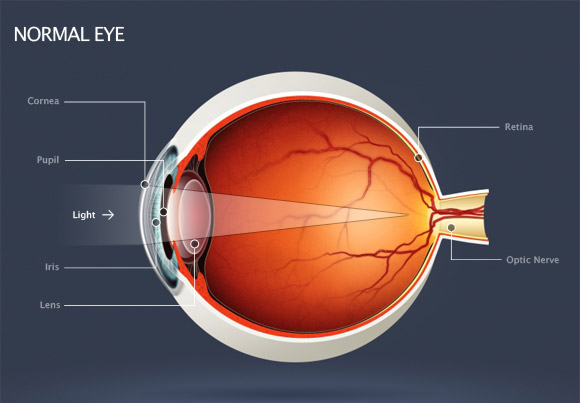
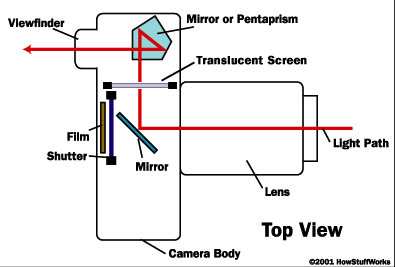
Symbolism is my literary weakness. Ever since the idea of Sherlock Holmes as a “camera” himself came up in class, I’ve been thinking about the connection between the human and the camera. I recently decided to do a little research on how cameras work, and came across a picture that took me back to high school Anatomy class. The diagram of a camera that I found struck an uncanny resemblance to the eye diagrams that I remember studying years ago.

I thought it would be interesting to draw attention to how similar these processes are. Light enters the eye/camera, goes through the lens, in reflected, and is eventually processed. Sherlock Holmes, private eye, is undoubtedly symbolic of a literary camera. He takes in every last detail and projects a clear image for the reader to see. In Holmes’ adventures, Doyle even presents him as something more reliable than a camera. When a picture is taken, it can only capture an image within the frame, but Holmes has more freedom than that. He is able to evaluate every detail without the limitations of a frame.

I was particularly struck by one particular passage in “A Case of Identity” that demonstrates Holmes’ camera-like qualities. After asking Watson to describe a woman that they had just seen, Holmes says, “You did not know where to look, and so you missed all that was important. I can never bring you to realise the importance of sleeves, the suggestiveness of thumbnails, or the great issues that hang from a bootlace” (Doyle 47). Holmes collects all of this data through careful observation, and his attention to detail is like that of a photograph. Very few literary characters have an eye as sharp as Sherlock Holmes’, but I think that the concept of using the senses (particularly sight) to create portraiture in literature is noteworthy.

Posted by: marycib | October 6, 2010

Transformation of Photography

As Breandán Mac Suibhne and Amy Martin point out in their article, “Fenians in the Frame: Photographing Irish Political Prisoners”, the system of photographing prisoners “marked a major transformation in the uses of photographic technology” (115). This new phenomenon of photographing prisoners created a way for the government to keep track of the prisoners after they had been released. The reaction of the prisoners to having their photograph taken varied, with the majority of them not feeling comfortable with having their faces documented. Their objection poises the question of whether or not this practice is legal and if it violates the prisoners’ civil liberties. One prisoner in particular, Jeremiah O’Donovan Rossa, accurately drew the distinction between portraiture and this new form of having prisoners’ photographs taken. Although Rossa’s conversation with the guard is his attempt to avoid having his picture taken, he “plays on the association of portrait photography with intimacy, romantic attachment, and the domestic sphere in order to signal the state’s intrusion into these domains” (114). Rossa’s statements mark the transition and change in function of photographs from having an emotional sentimentality to simply serving as an evidentiary commodity. By illustrating this idea, Rossa portrays the division between the new use of photography to what photographs previously signified. The availability of photographic technology has created many issues that were anticipated by the implementing of criminal photography. The question of who has the right to one’s photograph is still an issue today, especially now that photographs can be put on the Internet, making them accessible to anyone.

Posted by: lbrooksd | October 6, 2010

Physiognomy: Myth or Enigma?

Phew!  Okay, those articles weren’t easy reading, but ‘The Body and the Archive’ especially caught my interest.  This idea of physiognomy – the connection between physical appearance and temperament is fascinating.  It seems logical in a way that what lies within must be reflected somehow on the outside, and yet it is also totally outrageous to my modern sensibilities. However, this base idea is certainly less outlandish than the specific modes of distinction, differentiating between good and bad, healthy and sickly, etc.  The theory that a criminal can be identified by his facial features is ridiculous, yet the idea that our inner selves are somehow reflected in our outer selves has an appealing, justifying symmetry to it.  It is an idea both disturbing and attractive all at once, but more than anything I am intrigued – by the outrageous approaches, the ever changing rules of the game, and the lack of definitive progress to date.  Clearly the human face is a cipher that we have not been able to decode successfully, but is it a myth or an enigma?  Is there information there to be gleaned, or are we chasing an archaic idea?

Posted by: labbott12 | October 5, 2010

Holmes and Watson Dynamic on the page and on screen

With the arrival of Guy Ritchie’s 2009 film adaptation of Sherlock Holmes, much hubub was made about the possibility for homoerotic tension between Watson and Holmes. Again, with the BBC’s modern day mini-series, Sherlock , bloggers and columnists went to work on the new take on hinting at a romantic relationship between Watson and Holmes. Notorious gay celebrity blogger, Perez Hilton posted on Ritchie’s first film speculating on the idea of having a “gay Sherlock Holmes”:

“This ain’t going to be your Grandpa’s version of Sherlock Holmes. In the flick due out on Christmas Day, Guy Ritchie’s Sherlock Holmes will have the famed detective and his side-kick sharing more than just a love of mysteries. They’ll be sharing a bed!”

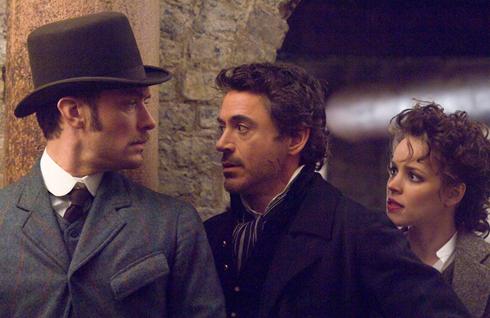
Ritchie’s film hinted at flirting between the mates and conflict of jealousy surrounding Watson’s marriage. Watson seemed to have an understanding of Holmes that only a partner would have of their significant other. In Ritchie’s film, Holmes and Watson to share the same realm of understanding and mutual love as Sam and Frodo in The Lord of the Rings trilogy. Two single men share their time and living space, with no interest in women, until one decides to settle down and marry, leaving the other seemingly depressed and heartbroken…makes sense doesn’t it? However, I do think that this take on the famous sleuths is a purely modern invention. After reading the stories and coming to understand the characters as very different from Robert Downey Jr. and Jude Law, there seems to be no evidence of textual support in this interpretation of the characters. The two don’t share as much intimacy or understanding in the text as they seem to in Ritchie’s or other contemporary adaptations. The temptation toward dubbing Sherlock Holmes as homosexual most likely stems from the sex-symbol-actors who play their modern interpretations and the budding trends of homosexuality in the media. There is also a trend of outing men and women from previous eras as gay and lesbian to promote identification with a younger audience (“…did you know Socrates was gay?”). However, with a basic knowledge of Gender studies, one must note that “being gay” didn’t exist until much much later; people had same sex relationships and had no sense of identity tied to them. Therefore, the idea of trying to figure out whether or not Conan Doyle meant Holmes and Watson to be homosexual is pointless. In addition, the woman in charge of the Conan Doyle literary estate was recently quoted by Perez Hilton in reference to the consideration of a sequel to Guy Ritchie’s adaptation:

“It would be drastic, but I would withdraw permission for more films to be made if they feel that is a theme they wish to bring out in the future. I am not hostile to homosexuals, but I am to anyone who is not true to the spirit of the books,”

Sir Arthur Conan Doyle would most likely cringe at Guy Ritchie’s adaptation of his stories in Sherlock Holmes, yet let’s not deprive ourselves of a few hunky gay detectives for the adherence to accuracy alone!

Sources:

Perez Hilton: http://perezhilton.com/2009-08-05-sherlock-homo

http://perezhilton.com/2010-01-04-sherlock-and-holmes-a-little-too-close-for-comfort-for-some

Posted by: sabinabw | October 4, 2010

Quick Question

I know this is kind of late, but last week while I was reading the Sherlock stories, did anybody else feel like Sherlock had already solved the case very early on, and was just taking us readers through the formality and process of an investigation?

Posted by: jmacd32 | September 29, 2010

Holmes, Doyle, Photographs, and Fairies

In “A Scandal in Bohemia” a photograph is the driving force behind the actions contained in the story. The photograph of Irene Adler and the King of Bohemia presented physical proof of their relationship and threatened the king’s upcoming nuptials. In fact, when hearing of the photograph Holmes stated that it was “an indiscretion” on the king’s part (16). Holmes’ reasoning behind his statement is interesting. He reminds the king that if Adler only had letters signed by the king, even with the official seal, he could just accuse her of dishonesty and forgery. If she had a photograph of the king, Holmes said he could claim she bought it. However, once the king revealed that the photograph depicted the images of the two together, is when he noted the king’s “indiscretion.” Here, technology is proof. While searching Sir Arthur Conan Doyle on google I found several references to a photograph Doyle took to be “proof” of something.

http://www.prairieghosts.com/fairies.html

Teenage cousins Elsie Wright and Frances Griffiths took this picture and several others in the summer of 1917 claiming proof of the existence of fairies. Although an obvious hoax to those who see it today and also to several who saw it in the early twentieth century Sir Arthur Conan Doyle took the picture as proof or evidence towards the existence of fairies. The similar notion of truth in photography that Holmes’ presents in “A Scandal in Bohemia” brings to question the reliability of technology. Although these “fairy” photographs appeared years after Doyle had written this particular Sherlock Holmes story, a belief in technology to provide answers to the unknown still connects the two very different situations. While Holmes would not take part in the beliefs of Spiritualism that Doyle did later in his life, the character and the author both used photography as evidence of that which could otherwise not be recorded.  The Sherlock Holmes stories foreshadow the technological advances of crime solving. In “The Man With the Twisted Lip” the blood that is left spattered on the windowsill is noticed and recorded by Holmes in a scene which immediately made me think of CSI and other crime shows which take Holmes’ actions to the next step by using such evidence to prove identity through DNA. However, Wright and Griffiths’ pictures of fairies remind me of the fallibility of technology as well. That photography could breathe life into paper cut-outs of fairies can parallel the fact that crime labs can mess up DNA testing in cases. Technology is not always reliable. Even though fairies and Sherlock Holmes do not entirely mesh well together, as a group they call into question the advent of technology and what it can really prove.

Sources:

http://www.lhup.edu/~dsimanek/doyle.htm

http://www.ash-tree.bc.ca/acdsfairies.htm

http://www.prairieghosts.com/fairies.html

Posted by: marycib | September 29, 2010

Gender and Race

The roles of gender and race materialize in a few of the Sherlock Holmes stories, specifically “A Scandal in Bohemia” and “The Adventure of the Yellow Face”. In “A Scandal in Bohemia”, Holmes alludes to the fact that there is only one woman, Irene Adler, who possesses any semblance of power allowing for the constraints of her sex in Victorian society. As Watson describes, “she is always the woman…she eclipses and predominates the whole of her sex” (Doyle 11). While it might seem that Adler tenuously holds a false sense of power during the pursuit of the photograph of her and the King of Bohemia, at the end of the story she still possesses the photograph. But her strength is still compared to that of males when the King of Bohemia says, “She has the face of the most beautiful of women, and the mind of the most resolute of men” (Doyle 16). There is still no position in society for a strong woman without a comparison to men. Adler declares in her farewell letter that she keeps the photograph “only to safeguard myself, and to preserve a weapon which will always secure me from any steps which he might take in the future” (Doyle 24). Adler realizes that she is in a position to seize the upper hand and secure her place in society.

With race, however, the somewhat optimistic tone assumed with respect to women is not apparent with race. Effie cannot even confess to her husband that she had married a black man not only due to her fear of society’s reaction, but also because she fears her husband’s reaction. When Effie’s daughter is inside the cottage, she wears a mask and white gloves “so that even those who might see her at the window should not gossip about there being a black child in the neighborhood” (Doyle 224). There is also a condescending tone taken when the portrait of Effie’s late husband is revealed: “There was a portrait within of a man, strikingly handsome and intelligent, but bearing unmistakable signs upon his features of his African descent” (Doyle 223). This description suggests that being of “African descent” somehow detracts from his “handsome” and “intelligent” features. Because Effie fears the stigma of an interracial marriage in Victorian society, she unnecessarily creates a mystery due to the race of her late husband and daughter.

Posted by: annarose12 | September 29, 2010

A Soul of Steel

“A Scandal in Bohemia” has always been my favorite Holmes story.  For once in Conan Doyle’s stories a woman is not simply a character but arguably the lead.  She doesn’t rely on Holmes and Watson to solve her problems, she both creates and fixes them on her own.  In “The Five Orange Pips” Holmes says that he has been beaten thrice by men, and once by a woman.  So who was Irene Adler?

Born in New Jersey in 1858, Irene Adler had a German last name, lived all over Europe, maintained a successful career in a competitive field, conducted scandalous affair with a Bohemian King, and rushed in to marriage with an Englishman.  As a Mezzo Soprano opera singer, the majority of her roles would have been those of young men, known as “trouser roles”, though there are a number glamourous ill-fated temptresses also in her range.  Holmes scholars have cast her as everything from Lola Montez’s daughter to Nero Wolfe’s mother.  She is the worldly opposite to Holmes eccentric Baker Street life.  While she’s presumed dead at the end of the story her life remains so interesting that she has survived on in numerous film adaptations, far more than her 14 pages would have predicted.

Even the title of this story remains ambiguous.  The reader is led to believe two things: that there is A) A scandal and that B) It takes place in Bohemia.  Sadly we’re wrong on both counts.  Though this case isn’t completely resolved and it’s possible this story is instead the prologue to a grander scandal in Bohemia.

And what could this scandalous photo have been of?  In 1889 George Eastman marketed his No. 1 Kodak camera to the public, making it feasible that the photo could have been taken by an amateur.  But it would still require  the subject to pose for a significant amount of time.  “A Scandal in Bohemia” was published in 1891, and set a few years previous.  The technology required to produce a “snap-shot” wouldn’t be perfected until just before 1900.  So, one thing to leave you with: What could it be?

Irene Adler the Illustration:

Irene Adler the Paper Doll:

Irene Adler the Super Hero (I kid you not… this is like the 3rd thing that pops up when you Google Irene Adler):


Sources:

The Cycleback museum’s Photo Phacts page:  http://www.cycleback.com/1800s/earlyphotos.htm
A Scandal in Bohemia and Sherlock Holmes’s Ultimate Mystery Solved:  Pascale Krumm
The Irene Adler Story, Continued: Charles E. Jacquart

Posted by: kellyannem | September 29, 2010

The Value of Imagination

In the selected Arthur Conan Doyle stories we have read, I have noticed a theme in how Sherlock Holmes views himself in relation to the established police force. His “immense faculties and extraordinary powers of observation” enable his abilities in “clearing up those mysteries which had been abandoned as hopeless by the official police,” writes Watson in A Scandal in Bohemia (11). Obviously Holmes is extremely intelligent, and we can count on him to solve the mystery, but for him there is a more important asset to possess besides mere intelligence and honed observation skills. Sherlock Holmes places great value in the powers of imagination. In The Adventure of Silver Blaze he critiques his peer when he says the following: “Inspector Gregory, to whom the case has been commissioned, is an extremely competent office. Were he but gifted with imagination he might rise to great heights in his profession” (189). It is clear that Holmes respects Inspector Gregory’s intelligence, but knows that experience combined with imagination allow for a much more skilled detective.

Holmes’ imagination comes into play in several ways. First of all, he can creatively look at cases through different angles, allowing him to reach solutions that wouldn’t be possible if he only viewed them through one lens. In The Adventure of Silver Blaze he says, “the art of the reasoner should be used rather for the sifting of details than for the acquiring of fresh evidence” (185). His “day-dreaming” allows him the power to thoroughly work through every angle of every case, thus reaching solutions (191).

Secondly, Holmes is extremely theatrical. In A Scandal in Bohemia, Watson notes his “amazing powers in the use of disguises” (17). Not only does he have skills in the art of costumes and makeup, he is also able to manipulate his own physical features, such as he does in the opium den in The Man with the Twisted Lip (82). These transformations allow him to secretly conduct research on his suspects, while causing endless amusement for his friend Watson.

If Holmes were any less creative, theatrical, and imaginative he would not be as successful as he is. It sets him apart from the established police force, and is just one of the many advantages of being an “unofficial” inspector (195).

« Newer Posts - Older Posts »

Categories