While searching for a compelling virtual exhibition to focus on for my review, I came across the Smithsonian’s online exhibitions and visited their portrait focused virtual event. The exhibition focuses on the actions taken by the U.S. in and around 1898, and how it shaped both imperialism domestically and within annexed territories. The event is shaped around each territory or country the U.S. focused their attention on within the time period: Cuba, Hawai’i, Puerto Rico, The Philippines, and Guam. The exhibition itself features a wide variety of portraits and photographs of notable players in each conflict, both American imperialists, and those who rejected annexation. The portraits are interspersed with images such as ship manifests, political cartoons, and even American board games depicting the Spanish-American War. 

I found this exhibition especially fascinating when contrasted with our class discussions surrounding British imperialism and colonialism. Much of the 19th century crises occurring in Britain and its colonies at the time reflect greatly in the determination behind the American government’s need to supersede Spain and its territories in the same time period. Some of the exhibition explains how each war and annexation were framed for the American public as a sort of “Manifest Destiny”: an obligation to free each country from either Spain’s oppression or their own independent governments that placed the residents of these territories as less than those who lived in the U.S. and therefore needed their aide. 

While there are many portraits and photographs used in this exhibition, the first two that caught my eye were of Queen Lili’uokalani of Hawai’i, their first female monarch and last independent ruler, the first being the portrait she commissioned during her reign as a message of power towards the U.S., and the second being a photograph taken years later after her failed Congress hearing to ask for both her lands back and reparations to be paid. Something about both of these pieces felt immensely powerful to me, and struck me as standing out from many of the portraits in the collection depicting various American soldiers and congressmen. The accompanying description of the first portrait explains her dedication to showing strength in the face of American imperialism and I think the use of an ornate portrait that reflects those made of European monarchs is an impressive strategic move indicative of her intelligence in a wider context. According to the blurb, using western art methods for her own benefit was a strategy she used consistently throughout her reign. 

Despite completely different artistic methods and intention, the photograph taken of the Queen fifteen years later seems to bring a similar impression of power to her appearance. The description with this image tells the story of her work after the annexation of Hawai’i, including her various terms of house arrest, and her subsequent trips to Washington D.C. to fight for her country back. The clear cut reality in this photo caught my attention immediately. She stares at the camera with such a calm intensity that reminds me of many other images of world leaders taken in later decades. Even though she had failed in her plea to the U.S. government right before she sat for this photo, her resolve remains strong. I think using both the portrait of the Queen and this photograph add a needed dimension to the exhibition as a whole, especially as Hawai’i is the only one of territories taken by the U.S. at this time that has become a U.S. state. The forced assimilation and overwhelming tourism that has dominated modern Hawaiian culture feels much more despicable when faced with the woman who fought so intensely against it. 

In a completely different vein, the element of the exhibition that surprised me the most was the section titled “Consumer Culture” that presented images of various board games made in the 1890’s to gain national support and selective understanding of the wars being fought over the countries mentioned in the exhibition. Most were made with children in mind, and some(as described in various blurbs) even encourage kids to come up with their own battle strategies to overtake the enemy. Propaganda like this clearly skewed public opinion in favor of imperialism during the period, and while the stakes of board games and images such as these are much higher, the manipulation of patriotism feels quite reminiscent of the advertising we discussed in class for products such as soap and perfume. I wonder how much British advertising was accessible to American advertisers and how each industry benefited from each other in the 19th century.

Overall, I thought this exhibition was quite fascinating as a critique of, and general history lesson about American imperialism. While imperialism in Britain took a different shape in the 1800s, it nonetheless shows a clear influence over the actions of the American government.

Works Cited:

1898: U.S. Imperial Visions and Revisions, 29 Apr. 2023 – Feb. 25 2024, National Portrait Gallery, Washington D.C.

Posted by: jem4300 | December 10, 2023

Skinner Museum Review

While the Joseph Allen Skinner Museum is only about a ten minute walk from campus, I had never been there until last month. The museum has been closed to the public since the pandemic began in 2020, but one of my professors made an appointment for our class to spend an hour there and try to write some poetry. Our visit began with an introductory video by the museum staff and curators explaining the history of the museum. Joseph Allen Skinner was a Massachusetts man who was intensely interested in collecting throughout his entire life. He assembled the collection that is currently the Joseph Allen Skinner Museum over many years, and ultimately left it to Mount Holyoke College in his will when he died in 1946. I will link to the video, which is available on the Skinner Museum’s website, below in case anyone wants to watch it for themselves.

The video attempts to preface some of what the experience of visiting the museum is like, which is wise because the museum and collections themselves are extremely unusual, and even with the added context the experience was very strange. The building itself is an old meetinghouse that was relocated to South Hadley from a different town in Massachusetts, so the ambience is very different from what one would expect from a more traditional museum; the sense was more that we really were just walking around in someone’s old house, looking at objects that often were not behind any kind of glass or barrier and to which we could get very close. 

The collection itself was composed of thousands of individual objects generally clustered together with other similar objects– all the guns were together on one set of shelves, and all the rocks from various places in the world on another set, for example. One thing that marked this museum as so different from any other museum I have explored was the general absence of information and context for the things on display. There were no placards to give any detail about the objects or even identify what they were, but some of the objects had small pink tags around them with brief labels written in what a member of the museum staff believed to be Joseph Skinner’s own handwriting. These were sometimes difficult to read or even to see because of their positioning, but they did often provide some identification for what we were looking at. Even in the instances where we could tell what the objects were, though, there was still a lack of information about where those objects had come from and how they had come into the museum’s possession, which, given the nature of some of the objects, was often concerning. While the museum has apparently returned a lot of the objects that had previously been exhibited in the museum to the indigenous communities they had originated in, there is still a strongly felt presence of objects Joseph Skinner acquired through unclear means during his travels of many parts of the world, and as a viewer who has complicated feelings about museums in general even where there is more transparency about how certain pieces entered the museum, the lack of background available in the Skinner Museum was sometimes uncomfortable. 

I believe that the curators and staff of the museum are doing a good job of contextualizing and dealing with the collection as a whole, given the inherent nature of working with a group of objects that were all collected by one man and therefore are entirely subject to what his personal, and now unknowable, visions and motivations behind the collection were. In recent years, multiple artists have been brought in to work with the museum and create their own work or curatorial projects to frame and respond to it. vanessa german’s show, “The Rarest Black Woman on the Planet Earth”, was constructed in response to the Skinner Museum’s collection, and the staff member we spoke to said the museum was open and hoping to collaborate on similar projects in the future. The visual experience of the museum is somewhat eerie– the viewer enters into a space that is absolutely full of eclectic groupings of largely unlabeled items complete with multiple taxidermied animals, and there is still a wooden statue of a Native American man that stands at the door that leads into the museum. I was trying to write about a small glass case of taxidermied birds and a large animal skull that no one was able to identify, but I was later able to find out from the listing on the museum website that it was a hippopotamus. I am not sure what the future of the Skinner Museum should be, but at the moment the museum is a very strange and unique experience that is interesting as long as you maintain an awareness and concern for what you are looking at, even if there is no direct labeling to tell you to feel uncomfortable with it. The website has some helpful information and background that I wasn’t able to get at the museum itself, and it also has a virtual tour of the museum that you can navigate through if you can’t go to the museum in person!

Posted by: jem4300 | December 7, 2023

Britannia in Political Cartoons

From the political cartoons in Punch magazine depicting Irish resistance to British colonial power, a few things are extremely clear: an inclination to portray the Irish as savage, violent, and pretty much exclusively male, and to show the nations of Britain and Ireland as female entities, separate from the people who inhabit them, create the sense of a sternly powerful Britain protecting the innocent Ireland from the “less evolved” men who need to accept British wisdom and control. There are obviously interesting dynamics at play here with the use of imagery of gender and strength, but what immediately jumped out at me about the depiction of “Britannia” was her strong visual echo of the Greek/Roman goddess Athena/Minerva, which adds a dimension to the rhetoric at play.

Generally, the depiction of Britain as both a woman and a strong, authoritative figure within these images might seem confusing or contradictory to the ways one would expect images of women to read to Victorian audiences. However, there would still have been a preexisting reference point for this kind of image in visual representations of Minerva. Britannia’s clearly Roman helmet, weapon, strong, muscular physique, and militaristic but feminine dress in a classical style give her many of the iconic physical indicators of a depiction of Minerva, and Victorian audiences would have recognized the similarity. This has the benefit of positioning Britannia as a goddess, rather than simply a strong human woman, and places her above the other figures in the images while simultaneously allowing her the space to break slightly from gender norms since she is drawn from a preexisting and well known cultural source. Her status as a goddess legitimates both her protective power over Hibernia and her punitive power over the Irish people; if Britain is godly, then it is natural and unquestionable for it to have imperial control.

Additionally, this ties Britain to the Roman Empire, allowing it to claim a place in a lineage of empire that would have been very desirable. The particular associations of Minerva, the goddess of war, allows for the complex depiction of her that is in every way beneficial to being a symbol of “justified” colonial violence. Minerva is strong, powerful, and skilled at carrying out violence, but she is also a woman, specifically a virgin, and thus can also embody purity and moral clarity to the Victorian eye in a way that a male Britain would not. Hibernia, the personification of the country of Ireland being terrorized by its people, also benefits from the latter feminine associations, but not the former masculine ones that Britannia gains from the Minerva parallel, which sets her up as an innocent victim who Britannia can protect. 

This context helps to potentially explain the choice to depict these countries as women, which might seem strange otherwise given the social circumstances of Victorian England. Drawing on ancient Rome as an exemplary past empire and one of its deities for the perfect mixture of virtue and power lends these images a lot of their weight in attacking any anti-colonial resistance against Britain.

Posted by: fionarogers24 | December 6, 2023

Charles Robinson’s Alice and the Power of the Child

File:Page 017 Alice's Adventures in Wonderland (Carrol, Robinson, 1907).png  - Wikipedia

Charles Robinson, 1907.

While there were many illustrations throughout The Annotated Alice, one that caught my attention in particular was Charles Robinson’s drawing on page 24, depicting Alice and her pool of tears. The image is in stark contrast to Tenniel’s illustration on the next page, mainly due to Robinson’s choice to embrace Alice’s pre-adolescence with a shapeless, high-collared dress while Tenniel stays consistent with his choice of a cinched waist and a crinoline. More than that, what drew me to this image is Alice’s overt unhappiness. Of course, she is unhappy, as she is frustrated and crying in the scene Carroll has written, but most other illustrations depicting Alice in a highly emotional state(that are used in this publication of the story) tend to shy away from showing the overwhelm that Alice feels within the story and lean toward serenity and beauty instead. In Robinson’s image, Alice is a fully understood child whose imperfections allow her to understand her world differently. 

She sits in the pool, staring at her own reflection while attempting to wash away her tears, seemingly lost in her emotion at this moment. The mysterious white rabbit doesn’t exist in this heightened state, and therefore irrelevant, and the shrinking potion isn’t physically needed for us to understand Alice’s state of mind. Her physical being can speak for itself.

I agree with the overarching sentiment we came to in class, that Tenniel’s “adultifying” takes away from the power of Alice. I also agree that his illustrations are a misunderstanding of the Alice that Carroll writes about. That’s why I kept thinking about Robinson’s work: he understands the child as the magical story, rather than Tenniel’s ordinary child in an otherwise magical land. Her naivety and capacity for overwhelming emotions gives power to an otherwise nonsensical world. I understand the Alice in Robinson’s illustrations because she isn’t perfect or “adultified”, she is simply herself, and whatever results from that are allowed to happen without interference from adults. I think that Robinson is able to capture a greater part of Alice in this illustration that Tenniel ever manages to. 

Artist Lenka Clayton was featured in the 2021 Patricia and Edward Falkenberg Lecture, which is featured as a virtual event on the Mount Holyoke College Art Museum website. In her section of the lecture, she explained pieces from her exhibit “Comedy Plus Tragedy” and the inspiration behind the pieces. The exhibit was in celebration of the 75th anniversary of the Joseph Allen Skinner Museum, and featured items from the collection. She spoke alongside a slideshow of pictures of her pieces and items not directly featured in the exhibit from the Skinner Museum that inspired her. In the exhibit, the main focus was the way in which the items were displayed. For example, she had items that were invisible in some way, a meteorite hanging from the ceiling, and a row of vases/vessels arranged in height order. The arrangement of the displays in itself says something about or emphasizes certain aspects of the items. 

I found it particularly interesting how Clayton chose to play with the placement and spacing of her pieces. The placement of art and the way it interacts with the pieces around it can change the meaning and how people look at it. I am currently taking a course in 19th-century art history, in which we have discussed the style of art hanging in the Salon. That style features as many paintings as one could possibly fit on the wall; it is very crowded and busy. This style of presentation changes the way we look at art as opposed to how we view it in a spread-out format, like modern Museums and Clayton’s exhibit. The placement of Clayton’s pieces feels more deliberate as opposed to just cramming everything in that will fit.

One piece that I found really interesting was “Four Invisible Objects.” The objects were a wedding cake eaten by mice with only the box remaining, stolen diamonds with only the identification tag remaining, a flag that is too fragile to unfurl, and a cannonball that exploded with only its stand remaining. The most compelling part of this piece was how the main focus was not even present. The remainders of the objects only serve as placeholders to signify the once extant object that has since been lost to time. In talking about the inspiration behind this piece, Clayton recalled her visit to the Skinner Museum and said, “I found a lot of nothingness.” That sentence and the way she turned nothingness into somethingness really resonated with me. 

Another piece that really stood out to me was “Meteorite at its Highest Height in 50,000 Years.” Clayton hung the meteorite from the ceiling to put it back in the air 50,000 years after it crashed into the Earth. The meteorite is both suspended in air and in time. It is taken back to its fall and frozen there. The way the shadow hits the wall behind it and all the empty space below it also does something interesting. The dynamic between the object and what is not there puts all the more emphasis on the very deliberate placement. I liked that this piece encouraged me to think about space and time (though maybe I went a tad bit too existential with my train of thought). Clayton explained how she sat with and held the meteorite before she did anything with it, which I thought was a fascinating method and showed the extent of the thought she put into this piece. 

One last piece that stood out to me was “Remainder.” It was a row of vessels arranged in height order, and the vessels themselves spanned 4 continents and 400 years. Each vessel also has sand around its base, the excess of sand poured from the larger vessel before it. Clayton chose the vessels from hundreds in the Skinner collection but picked carefully to represent a range of cultures, materials, time periods, and functions. In her talk, Clayton did not go into a ton of depth on the purpose of this piece, but I enjoy it when artists allow the audience to interpret the work in different ways. I took away from this piece that no matter what, a little bit of the past always remains in the present, both in a worldwide sense and a personal sense. Cultures, society, and technology are only built off of what came before them, just as we are built off of our past experiences.

Overall, I think Lenka Clayton’s exhibit was fascinating, and the talk that went along with it provided some interesting insight into her choices. I liked how she played with placement, space, and time to create something unique and thought-evoking. One thing I don’t understand, though, is why it is called “Excerpt from ‘My Grandmother Lived to be One Hundred Years Old.’” It is an excerpt from a larger lecture, but “My Grandmother Lived to be One Hundred Years Old” is never mentioned in it, which I think makes the title a little confusing, and creates a conflict between the audience’s expectations going into it and the actual content.

“Lenka Clayton: Excerpt from ‘My Grandmother Lived to Be One Hundred Years Old.’” Mount Holyoke College Art Museum, 18 Aug. 2022, artmuseum.mtholyoke.edu/virtual-engagement/lenka-clayton-excerpt-my-grandmother-lived-be-one-hundred-years-old?bc=node%2F1972.

Posted by: mayaduganbloom | December 5, 2023

REVIEWS – Events and Exhibits: Long Distance Relationship

In the time since COVID-19 shutdowns and isolation, I feel I’ve forgotten to reflect on lost time and tend to conceptualize that period as a big blank space, void of color and meaning. Mount Holyoke College Art Museum’s exhibit “Long Distance Relationship,” details the defiance of color and artistic connection in isolation. The virtual exhibition was offered by students involved in “Senior Studio,” Class of 2020 and 2021. These students describe how though isolation stifled artistic discourse, which is the backbone of most considerable works in visual culture, “new territories” emerged to maintain artistic connection, such as “Zoom, Google, Discord, Instagram, Facetime, Moodle,” and, “Spotify.” The exhibition’s categories include “Fragmented Bodies, Stitching Past into Present, Constructing Memory, and Chromatic Abstraction.” What drew me to this exhibit was the idea of persevering connection through digital and impressionistic means, like photography (Zoom), writing (Discord), and music (Spotify). The exhibit itself represents visual culture, but what’s most striking is the way visual culture benefits human connection and the endeavor to create, first. I’m reminded of a popular tweet about the value of visual culture–movies, books, photos, art–and that being the life raft that kept humans afloat during COVID-19, but the tweet itself was what I find significant. The desire to communicate about visual culture speaks to the encouraging value of connection through art. Much of the art I intend on discussing remarks on the intended value of art. Whether a piece represents a human, looking at nature as a reflection, making oneself from nature, and the cyclical experience of becoming and unbecoming a self through art. Discussions create this art, and from this art, discussions spark – connection, connection, connection. The humanity embedded in art is significant in all of these pieces, and the artists explore the dimensions of representation as impressionistic or limiting. 

To begin, I’m interested in Anaïs Quiles-Lewis’s pieces.

Anaïs Quiles-Lewis ’21, “i finally know,” 2021.

This artist opens with a question “What extent is [art] in response to the world around us?” This question primarily refers to the construction of identity in art, the degree to which a person can be themself, and how this manifests in self-portraits (self-representation). This paired with their photography implies the question of “truth.” The artist titles their piece, “I finally know,” playing into this idea of coming to know oneself due to objective photography, whilst being unable to break free from the constraints of photography and form. Quiles-Lewis writes, “ As I press my face onto the glass, my form becomes crushed by my physical weight[…]As I move around in an attempt to free myself, I become more distorted and more trapped.” The artist concentrates on the concept of a “copy of oneself,” which reminds me of Oscar Wilde’s portraits, hating the impression of himself. He struggles, as this artist demonstrates, to understand which dimension of himself is the copy, his photograph, or his idea of how he looks. 

This idea is somewhat abstracted in Levi Brooker’s thesis project, Flesh and Mud: Bodily Construction Through Handmade Paper. Brooker radicalizes truth in their art by making casts of their body with handmade paper and exposing it to the world.

Levi Booker ’20, “Devoured,” (2020). Cotton paper and acrylic paint.

The sense of ownership defies Wilde and Quiles-Lewis’s idea of representation as limited by highlighting the act of “hyperawareness” and therefore stripping it of its power. The artist conceives of the creations as “monstrous or mythical hybrids to reflect the experience of being “othered,” which I conceive as a relieving measure of expectation, and allowing the body to be a body, and not a truth. By being able to see all dimensions of the body–a head, an arm, etc–unlike photography, the human form becomes regular and not representative of value. By utilizing nature in papermaking, the artist heals this sense of being “unseen,” by virtually invisibilizing nature in art while specifically crediting nature as the makings of their art. Nature is supposedly “unseen,” and yet allows for creation–nature is (in) everything. 

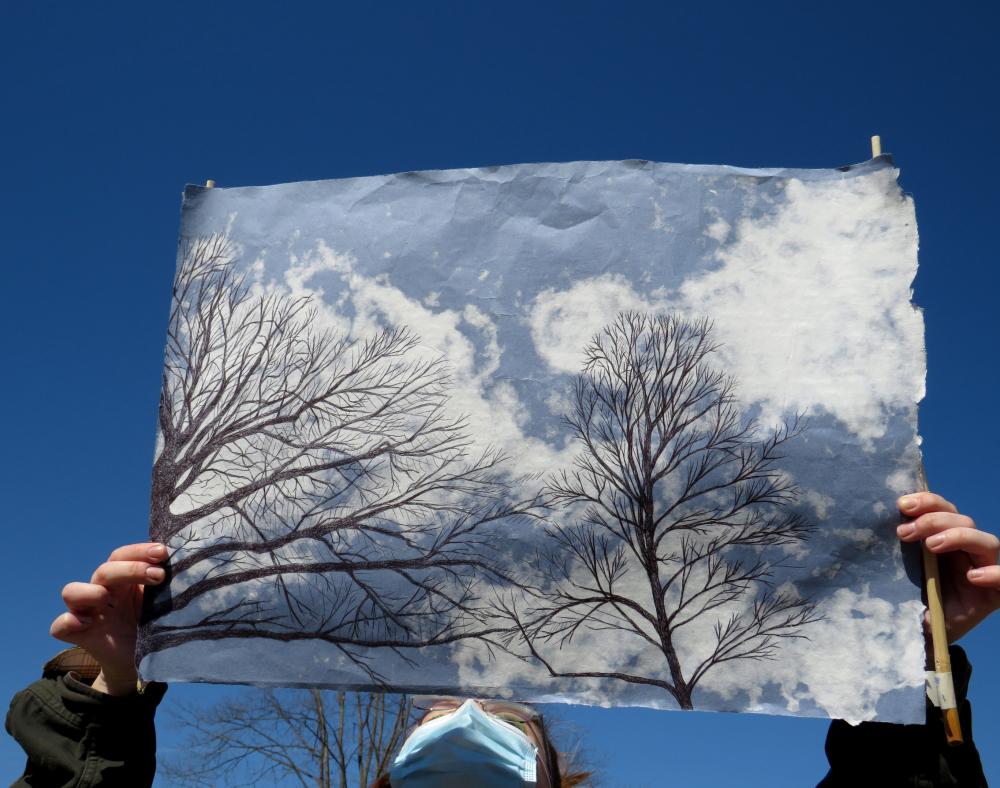
This sentiment is further explored and yet inverted in Micha Haftl’s exhibited art. The pieces “All or Nothing,” and, “Looking Up/I Hope You Feel Awe,” are pastoral examinations of nature and the human impression of it.

Micha Haftl ’21. “Looking Up/I Hope You Feel Awe,” (2021). Pen on handmade cloud paper (bleached cotton on denim).

As with Levi Brooker, Haftl reexamines the human form through nature–as a function of nature. Brooker writes, “Kids all draw trees the same way—tall, skinny trunks and winding branches, much like how they draw people similarly with a head and arms and legs.” Human forms, like trees, are approximated without care for individuality. That said, Haftl “hopes to mimic” the “feelings,” evoked by witnessing “the sun peek through stripes of trees or the laugh of two trees rubbing against each other.” Nature becomes a reflection of the human psyche, seeing oneself everywhere by personifying the sun and trees, and humans in turn become a reflection of nature. This is especially true given that they don’t “intentionally bring the human body and its recognizable features into [their] work.” This is a common artistic experience that reminds me of communal interactions with nature, which was once deified through organized religion and is now deified through artistic expression. No matter how human perceptions of Gods and power change, there is a desire to be surrounded by sentience, and held by nature’s community. 

The exhibit, “Long Distance Relationship,” contributes to visual culture beyond the evident art, identifying the significance of human connection in making art and becoming a part of visual culture. The question of who one is fuels the pieces and continues to inspire newness from established artistic self-expression.

Credited: Mount Holyoke Art Museum’s exhibit “Long Distance Relationship,” (2021). https://artmuseum.mtholyoke.edu/virtual-engagement/long-distance-relationship?bc=node/2207

Posted by: mwbarron | December 5, 2023

Surrealism + Alice in Wonderland

Alice and Wonderland by Lewis Carroll can evoke feelings of nostalgia for many, whether that may be due to the child-like and whimsical tone of the novel, or because it brings up memories of watching or reading an edition in one’s youth, or the nonsensicality that Carroll injected the scenery with. The satirization of other important aspects of Victorian culture, like fairy-tales and maternalism, almost borders on surrealism. 

Surrealism was a literary movement that began half a century after the publication of Alice in Wonderland— beginning in the 1910’s and 1920s (Voorhies). Loosely inspired by Dadaism, a multidisciplinary movement created by those disillusioned with the mass destruction and huge death toll of the first World War, Surrealism touched on music, poetry, art, politics, and psychology; particularly the unconscious mind (Trachtman). It seems that Alice predates these movements with her deconstruction and decontextualization of this new world around her, and the fact that her adventure in Wonderland took place while she was asleep could point to a surrealist reading of this story. 

Was Alice an early adopter of surrealist modes of thought? Or was she just a child forced into a strange new world, just like the world was forced to adapt to industrial advances and international war? Looking at her reaction to the non-logic of Wonderland, it appears she could’ve swung either way: “‘Stuff and nonsense!’ said Alice loudly,” (Carroll, pg 85).  

Bibliography!

Carroll, Lewis, 1832-1898, Martin Gardner and John Tenniel. 2000. The Annotated Alice: Alice’s Adventures in Wonderland & Through the Looking-glass. New York, Norton

Paul Trachtman. “A Brief History of Dada.” Smithsonian Magazine, https://www.smithsonianmag.com/arts-culture/dada-115169154/.Accessed 5 Dec. 2023.

Voorhies, James. “Surrealism | Essay | The Metropolitan Museum of Art | Heilbrunn Timeline of Art History.” The Met’s Heilbrunn Timeline of Art History, https://www.metmuseum.org/toah/hd/surr/hd_surr.htm. Accessed 5 Dec. 2023.

Posted by: kateasnyder | December 4, 2023

Collages in Wonderland: The Royal Ballet’s Adaptation of Alice

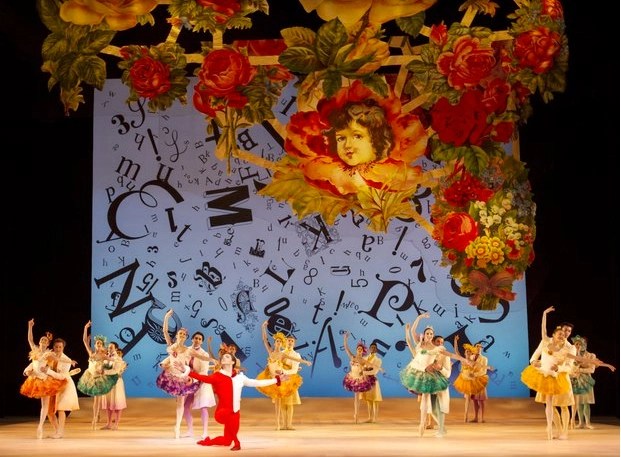
As a ballet dancer, it wasn’t long before I discovered Christopher Wheeldon’s production of Alice’s Adventures in Wonderland for the Royal Ballet. I’ve loved the choreography and the score since I watched it the first time, but it wasn’t until our discussion of Victorian women’s photocollage that I really payed attention to Bob Crowley’s set design.

Much of the backdrop of the ballet is characterized by falling letters – Alice falls into the book as she falls down the rabbit hole. These letters seem random and vary in fonts and orientation. Overlaying the projection of these letters are designs that seem hand drawn, engraved, painted, or cut from photographs. In the Caucus Race, the water is three-dimensional, forming paper cutouts that make lanes though which the dancers swim. Alice travels in a paper boat made from a page of the book itself, and animated projections travel across these material media. Wheeldon and Crowley’s Wonderland is constituted by an assemblage of visual materials.

This Wonderland, then, is constituted in much the same way as a collage. The connection between the two is perhaps most easily visible in Crowley’s set for the scene in which Alice first enters the garden. Painted flowers border the scene, lowered in front of the background of falling letters. Most notable is the face of a child nestled in the central flower, which is painted, though it gives the impression that it was cut and pasted from a different source than the flowers were. This calls to mind a photocollage from Alexandra, Princess of Wales, in which children were cut out of photographs and arranged on painted flowers.

Alexandra, Princess of Wales. From the Princess Alexandria Album, 1866/69
Photo by Richard Nutbourne Scenic Studio. Design by Bob Crowley.

Photographs make a claim to realism. In “Society Cutups,” Elizabeth Siegel describes the Victorian understanding of the medium by saying that “photography in the mid-nineteenth century was generally understood to represent accuracy, fidelity to nature, and representational stability” (32). In the ballet, this can be seen in the first and final scenes. Before falling down the rabbit hole and after waking from her dream, Alice dances before a backdrop representing her house that is painted in a more realistic style, and the interior of the house is represented by a photograph. As Alice occupies a space closer to the real world, her surroundings move closer to the real with her.

But by taking the photograph out of its context and relocating it, collage disrupts and undermines the photograph’s realist logic (Siegel 33). The assemblage of materials used is destabilizing and disorienting. Made up of fragments, the images themselves never feel quite whole. Not only does incorporating collage elements into Alice’s Adventures in Wonderland produce a fitting feeling of whimsy, but it also lends a sense of the uncanny to Alice’s world. Wonderland is recognizable in its realistic aspects, yet unfamiliar as the real is turned on its head, manipulated into something imaginary and otherworldly.

Works Cited:

Siegel, Elizabeth. “Society Cutups.” Playing with Pictures, The Art Institute of Chicago, 2009.

Wheeldon, Christopher. Alice’s Adventures in Wonderland, Royal Opera House, London, 2017.

Posted by: Haley McDowell | December 4, 2023

The Punishment of Photography: The Use of Mugshots by the State

I was inspired by our class discussion on the use of standardized photography of convicts, so I wanted to take a look at the use of mugshots today and those captured in the Victorian Era. The practice could be said to have forever changed the use of criminal records and the interference of the state with their community.

The use of photography as a means of an archive was not new even when normalized for the use of prisons. However, the choice of using prisoners as a means to archive society in a way that was not seen with other communities or events, such as workplaces or births, is a statement to the people. For the argument of preservation, this idea is negated by the simple fact of evidence. In contrast to today where every instance is routinely photographed and memorialized for the masses, the limited instances of state-controlled photography only emphasizes the use of photography of convicts as a means of polarization for the individual and well as a method of control.

Thomas Murphy 1880s. From Greater Manchester Police.

One such photograph is that of Thomas Murphy, a man who was convicted of stealing purses from the 1880s-90s in Yorkshire and Lancashire. The photo captured, an unknown person with their hands on Thomas’s face, appearing to force him into a position.

Allyson Wright 2023. From Austin Mug Shots.

I found a modern example of prison photography on a Facebook page titled “Austin Mug Shots”. There are pages of mugshots available with the only information provided being the person’s name and their arrest date. However, to find any further information, one only needs to look up their name on a database.

From the beginnings of the practice of photography in prisons to the standard of mugshots in the present day, there are little differences besides the advancement of technology for access and the understanding of the standard by society. There is no need for manipulation of faces to guide a prisoner to maintain the standard pose for the majority of prisoners, as there is an understanding of expectations set by the abundance of examples we are shown throughout our lives. By simply living in such a society, one understands that you will be photographed and will have your arrest record made public. By committing a crime, you agree to sacrifice your privacy.

The standard practice of photography in prison is not only the use of mugshots. It is the knowledge from the state that the society they exert control over know of the state’s use of their identity. What can the modern day individual change about a practice that those in the 1880s could not overcome? Is one’s image not sacred in the modern age and was it ever? Does an ease of access mean that it is not worth as much?

Works Cited

“Austin Mug Shots.” Www.facebook.com, 4 Dec. 2023, http://www.facebook.com/photo/?fbid=345325311434708&set=pb.100078717252636.-2207520000. Accessed 4 Dec. 2023.

Lashmar, Paul. “How to Humiliate and Shame: A Reporter’s Guide to the Power of the Mugshot.” Social Semiotics, vol. 24, no. 1, Oct. 2013, pp. 56–87, https://doi.org/10.1080/10350330.2013.827358. Accessed 28 Nov. 2019.

Mac Suibhne, Breandán, and Amy Martin. “Fenians in the Frame: Photographing Irish Political Prisoners, 1865-68.” Field Day Review, vol. 1, 2005, pp. 101–20, jstor.org/stable/30078606. Accessed 4 Dec. 2023.

Over Thanksgiving break, I had the pleasure of spending an afternoon at Boston’s Isabella Stewart Gardner Museum. In spite of my being a Massachusetts resident and an art museum enthusiast, I had somehow never visited the Isabella Stewart Gardner Museum before! I can now firmly attest to the museum’s esteemed reputation; with a breathtakingly elegant garden courtyard and an extensive collection of multinational artifacts, this place feels downright magical to explore.

The cherry on top to my visit was the all-new exhibit that had just made its debut only a month prior in October. This exhibit, titled “Inventing Isabella,” was about the museum’s enigmatic namesake herself. After reading the wall panel outside the Hostetter Gallery’s entrance, I had to stifle a laugh because of just how perfectly applicable—almost to an eerie degree—this exhibit’s content was to the themes of our course.

(TL;DR: “[Isabella]’s legendary aura is not accidental. She deliberately cultivated her public persona, pioneering the type of image control that many of us navigate today in the age of social media… She used paintings, fashion, and photography to shape her own image and negotiate the boundary between private and public… she collaborated with trusted artists to craft her public identity and to create enduring portraits of herself for posterity… [she] shaped her public persona through art.”)

Yeah, I wasn’t exaggerating: this entire gallery was dedicated to the manner in which Isabella defied the social expectations forced upon aristocratic Victorian women to meticulously “invent” her own public identity! There’s something so fascinating to me about an art connoisseur extending their own philosophy towards art collection to literally curate their own self-image; I consider this a resounding testament to Isabella’s intimate understanding of the arts and their cultural evolution.

As the blurb above states, Isabella pioneered the art of self-curation many of us actively participate in today. Even before the age of social media and photo manipulation tools like Photoshop and Facetune, Isabella was hyper-aware of visual media’s power over people’s appearances and reputations. As a celebrity figure, she was constantly scrutinized and commented on by the press. To prevent the distribution and circulation of photographs of which she’d have no control over, Isabella notoriously dodged unauthorized photographers by limiting her daytime outings and concealing her face. In a 1915 letter addressed to her friend Edmund Hill on display, Isabella even wrote, “I am never photographed, unless by some Kodax fiend, who does it on the sly, & without my permission.” Her usage of the word “fiend” here reveals both her disdain for prying eyes and commitment to her own self-preservation.

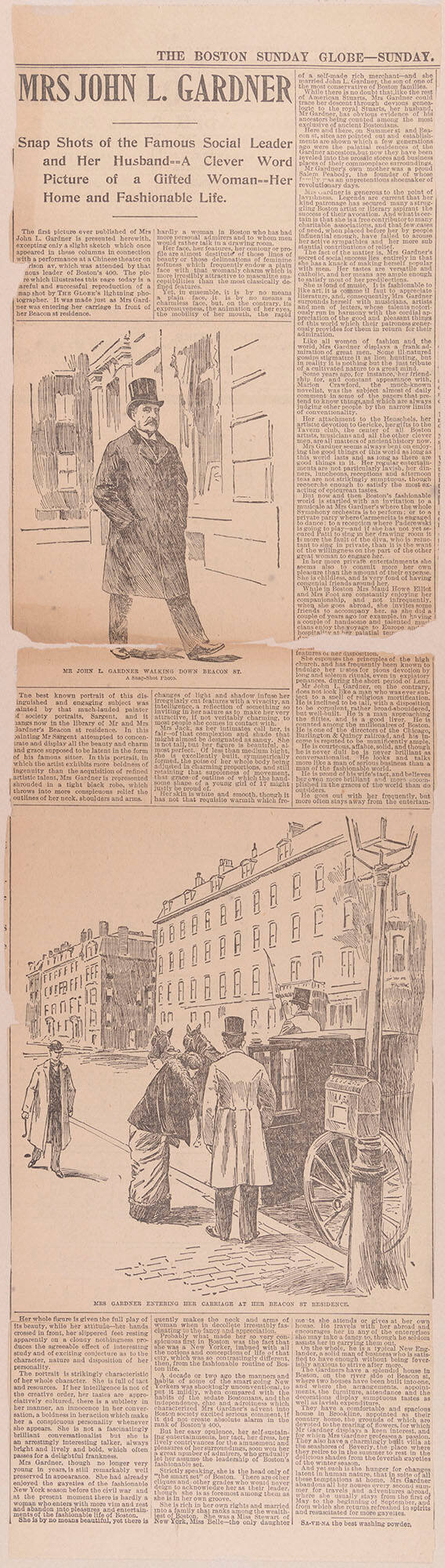
According to the archival records featured in the exhibit, her efforts were so successful that newspapers resorted to publishing photographs of women with Isabella’s likeness under the pretense that they were of Isabella herself. An 1894 article even claimed to include the first ever “photographic likeness” of Isabella, but in actuality it was only a drawing of a faceless woman climbing into a carriage:

“Mrs. John L. Gardner: Snap Shots of the Famous Social Leader and Her Husband,” The Boston Globe, 1 April 1894, printed ink on newspaper.

Another newspaper account from the same year said the following about Isabella (beside an impersonator’s portrait): “She can never be induced to look fairly and squarely into the camera. It is true that she has been taken at various times in groups, but invariably the moment of exposing the camera coincides with some movement of Mrs. Gardner’s so that the face is blurred.” This exemplifies how the elusive Isabella, like many other rebellious women across history, frustrated those who couldn’t bend her to their whims.

“The Real Mrs. Jack Gardner.” Boston Post, 4 December 1904, printed ink on newspaper.

Instead of allowing the press to shape her identity, Isabella commissioned and collaborated with a wide array of trusted artists from across the globe. Within the privacy of their personal studios or her own home, she had complete agency. These were spaces where her own artistic vision could operate in dialogue with the artist’s. Together, the patron and artist could freely experiment with different poses, outfits, backgrounds, and color schemes to perfectly encapsulate the “Isabella” brand. This was done with varying degrees of success, as Isabella was known to destroy or hide works that she was dissatisfied with.

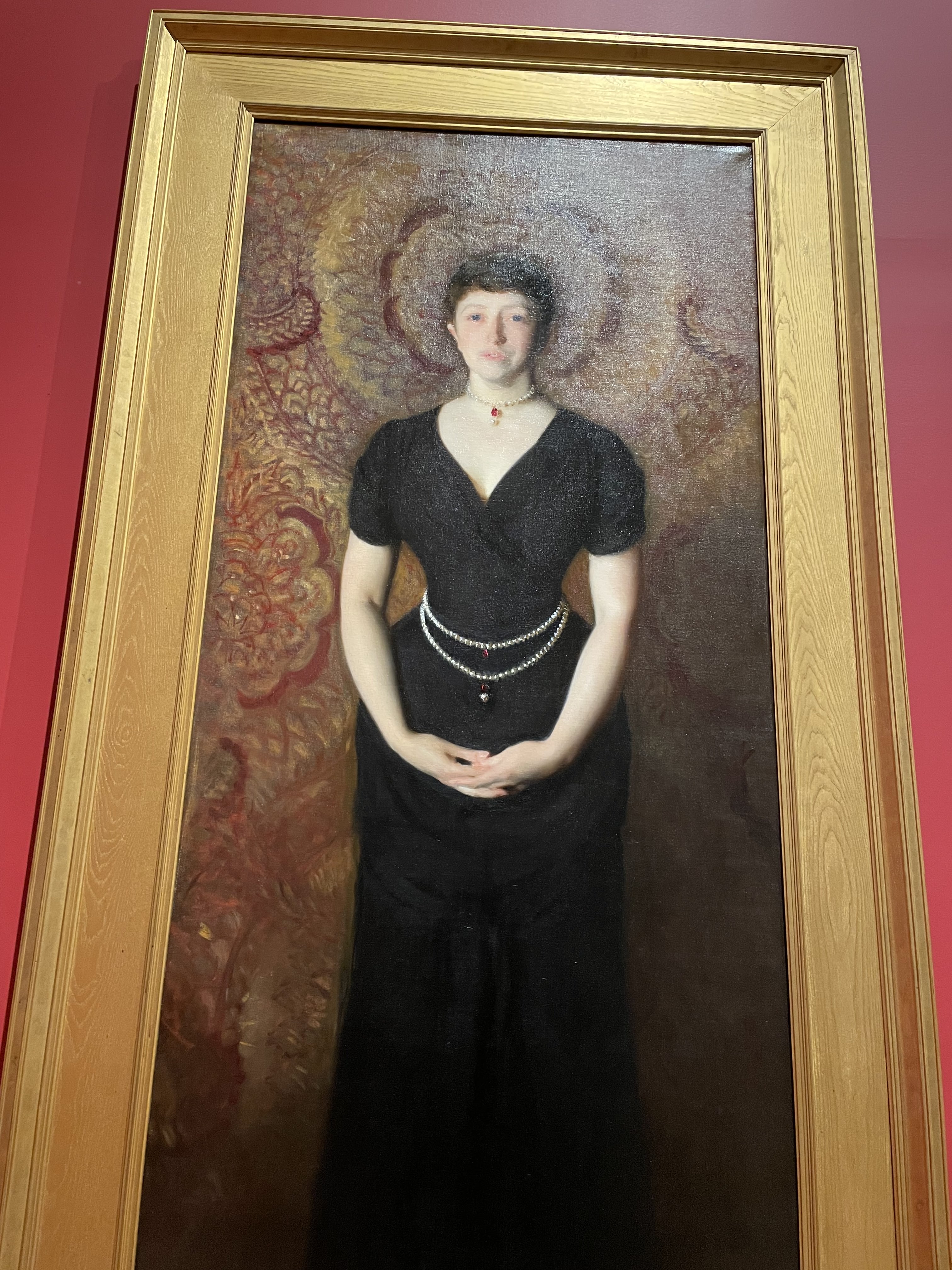
Her most notable intellectual friendships were shared with prolific artists John Singer Sargent and Anders Zorn, whose respective renditions of her garnered both great acclaim and criticism for their provocativeness. Sargent’s 1888 oil painting in particular, considered the Isabella Stewart Gardner portrait, was the centerpiece of the entire “Inventing Isabella” exhibit. The description beside the painting mentioned that Isabella herself “rejected eight renderings of the [portrait’s] face until she was satisfied,” which epitomizes her preoccupation with her own image. In real life the portrait has an almost ethereal quality to it, which can likely be attributed to its halo iconography. With its commanding, direct gaze and straightforward pose, Sargent’s portrait is extremely daring: it perfectly reflects Isabella’s unconventional character.

John Singer Sargent (American, 1856-1925), Isabella Stewart Gardner, 1888. Oil on canvas.

“Inventing Isabella” is an absolute gem of an exhibit that explores the many nuances of Victorian visual culture. What really resonated with me was that after a lifetime of methodical curation (of both artwork and her own image), Isabella’s home-turned-museum is her public identity; it has preserved her legacy as a legendary aesthete, visionary, and philanthropist. Art is simultaneously her life’s work and her identity, even after death. 

Links/Further Reading:

Photos 1, 2 & 5: mine

Photo 3: https://www.gardnermuseum.org/experience/collection/27939000 

Photo 4: https://www.gardnermuseum.org/experience/collection/27940000 

“Inventing Isabella” Homepage: https://www.gardnermuseum.org/calendar/inventing-isabella 

« Newer Posts - Older Posts »

Categories